Slides
Lesson plan
Fix the Shop: Converting Units
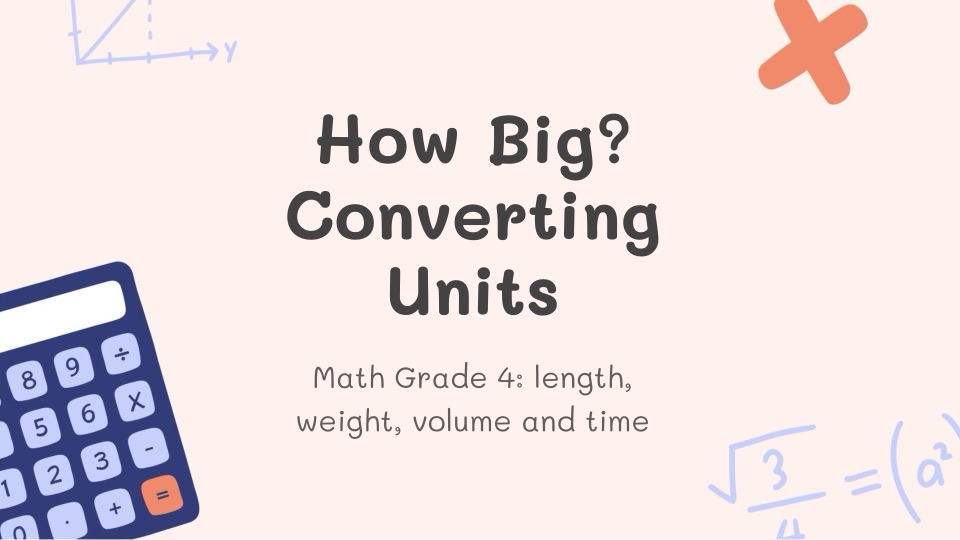
Students learn how metric and customary units compare in size. They fix shop labels by converting and ordering measurements.
Objectives
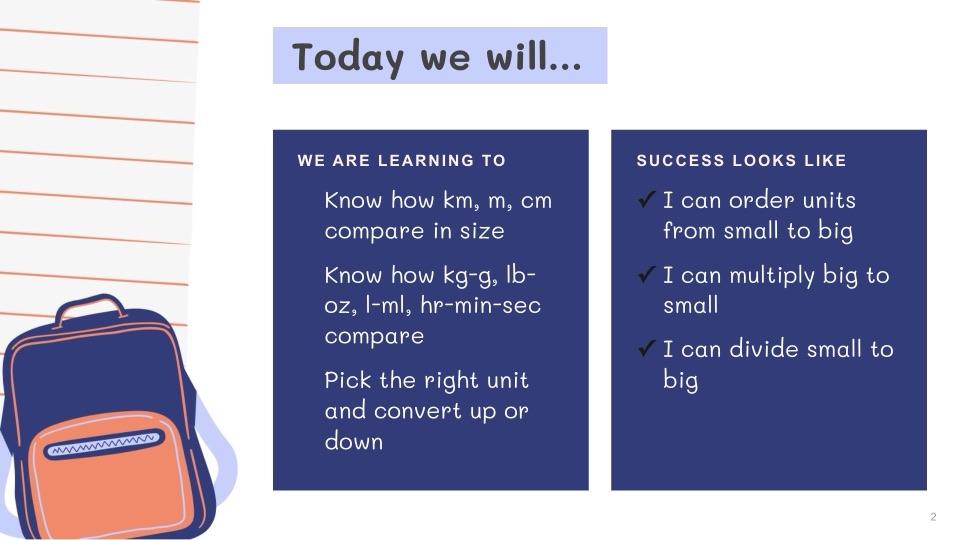
- Students will compare the relative sizes of length, weight, volume and time units.
- Students will convert measurements between larger and smaller units within one system.
- Students will choose sensible units and order measurements by true size.
Success criteria
- I can order units from small to big and say which is larger.
- I can multiply big to small and divide small to big correctly.
- I can pick the best unit and convert to fix word problems.
Key words
| Word | Meaning |
|---|---|
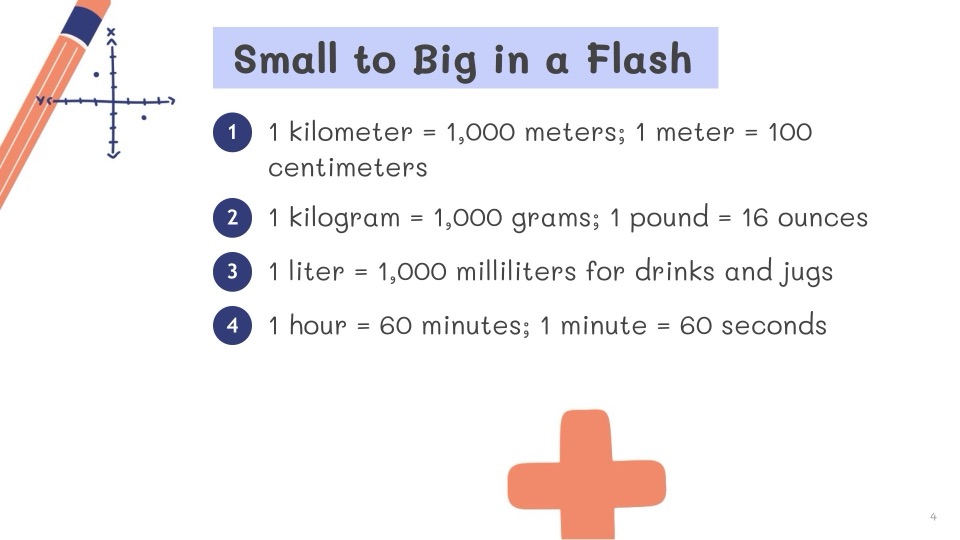
| kilometer | a long distance unit for trips; 1 equals 1,000 meters |
| centimeter | a small length unit for a pencil; 100 make a meter |
| kilogram | a heavy weight unit for a backpack; 1 equals 1,000 grams |
| ounce | a light weight unit for an apple; 16 make a pound |
| milliliter | a tiny volume unit for a spoon; 1,000 make a liter |
| minute | a time unit for recess; 60 make an hour |
Timed plan (60 minutes)
| Time | Stage | What happens |
|---|---|---|
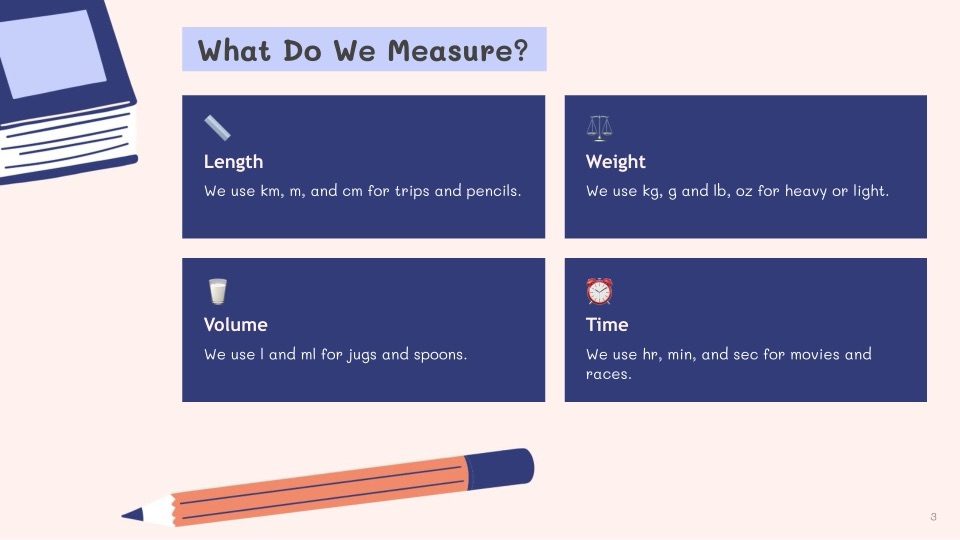
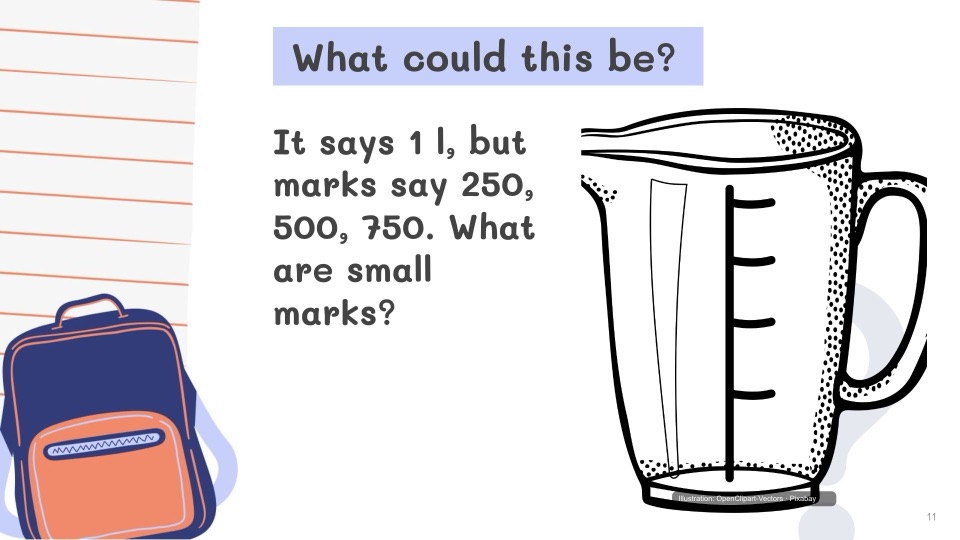
| 8 min | Starter | Hook students with the shop mix-up and recall which units measure length, weight, volume and time. Show Slides 1-2 and read today's goals with the class. Tell the shopkeeper hook and hold up a 200-milliliter cup next to a 2-liter jug. Show Slide 3 and model sizes with hands for centimeter, meter and kilometer. Ask partners to sort km, g, ml and min into length, weight, volume or time. |
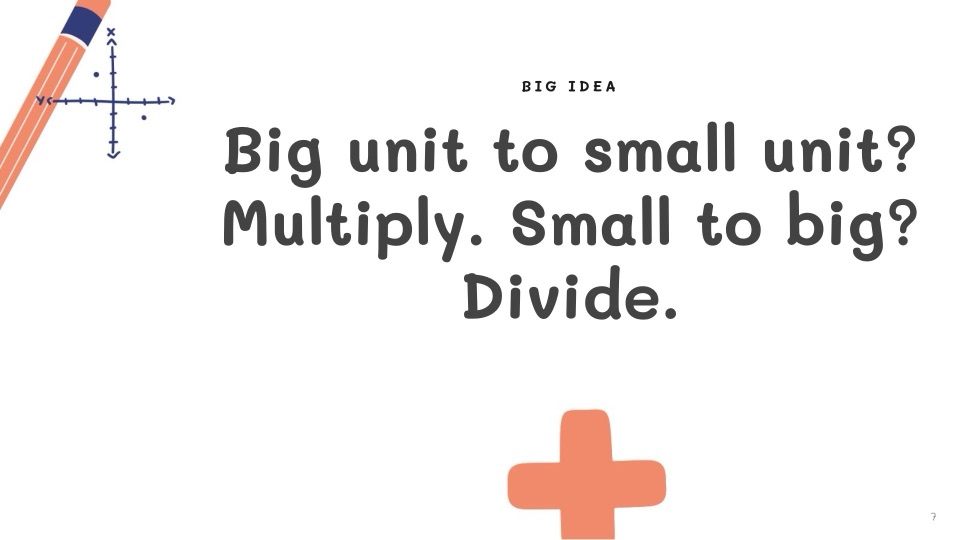
| 12 min | Teaching | Teach relative sizes and the multiply down, divide up rule for all unit groups. Play Video clip 1 (0:00-2:01) and tell students to listen for when to multiply or divide. Show Slide 4 and read the size facts: 1 kilometer = 1,000 meters and 1 meter = 100 centimeters. Model 2 km to meters and 300 cm to meters on the whiteboard step by step. Show Slide 7 and chant the rule that larger to smaller means multiply and smaller to larger means divide. |
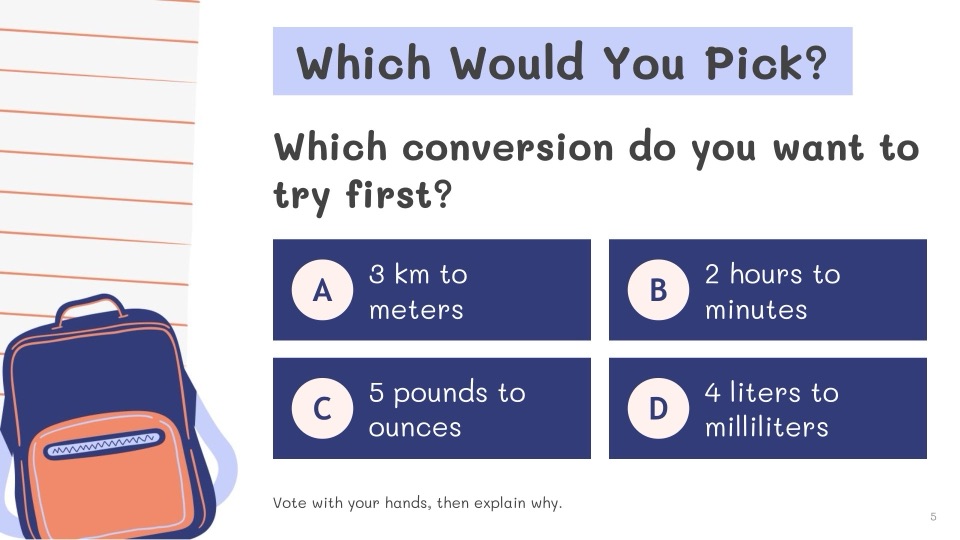
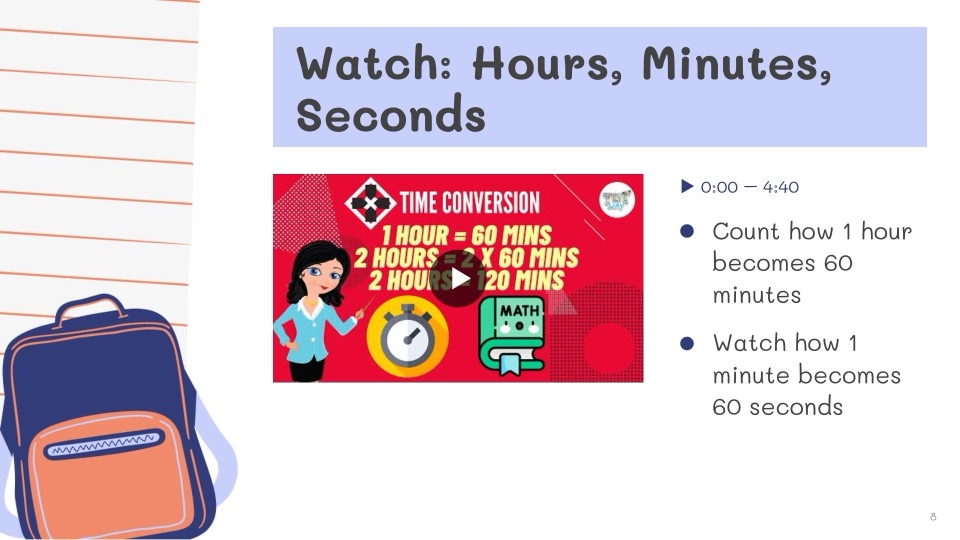
| 12 min | Practice Together | Practice time and weight conversions together using voting and short video. Show Slide 5 vote: 3 km to meters, 2 hours to minutes, 5 pounds to ounces, 4 liters to milliliters. Play Video clip 5 (0:00-4:40) and tell students to count how 1 hour becomes 60 minutes. Model 2 hours = 120 minutes because 1 hour = 60 minutes and 3 minutes = 180 seconds because there are 60 seconds in 1 minute. Call on teams to solve the vote choices and write number sentences on the board. |
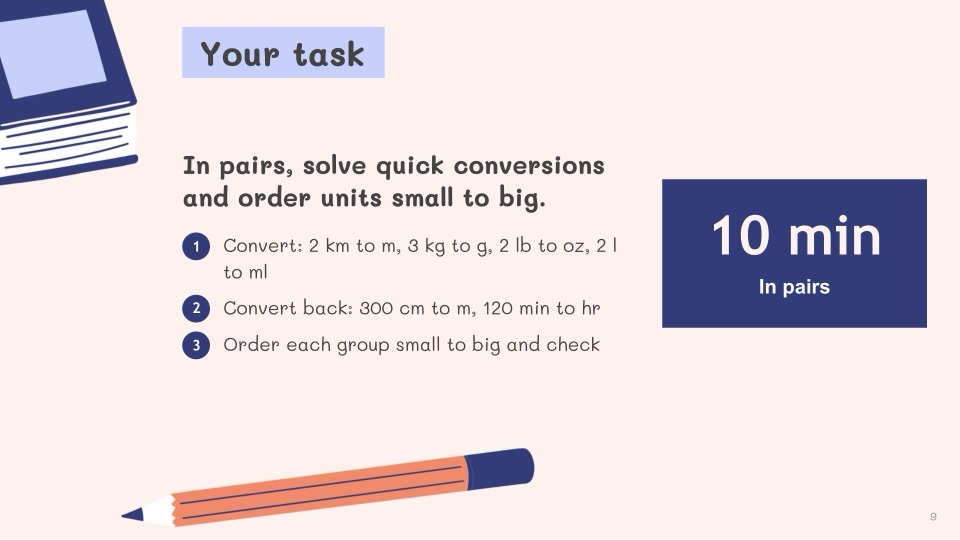
| 18 min | Main Activity | Apply all conversions to fix shop word problems in pairs. Show Slide 9 task and hand out problem cards, paper and play money. Read the five cards aloud: Card 1: The shopkeeper measures a 2-kilometer delivery trip. How many meters is that? Card 2: The shopkeeper has 3 kilograms of apples priced at $4.50. How many grams is that? Card 3: The shopkeeper packs 2 pounds of rice. How many ounces is that? Card 4: The shopkeeper has 2 liters of water for plants. How many milliliters is that? Card 5: The shopkeeper cleans for 2 hours starting at 10:00 a.m. How many minutes is that? Also convert back 300 cm to m and 120 min to hr. Remind pairs to write the conversion, circle the correct label, and check by ordering small to big. Circulate, check tables with scale readings, and stop the class once to share one strong solution. |
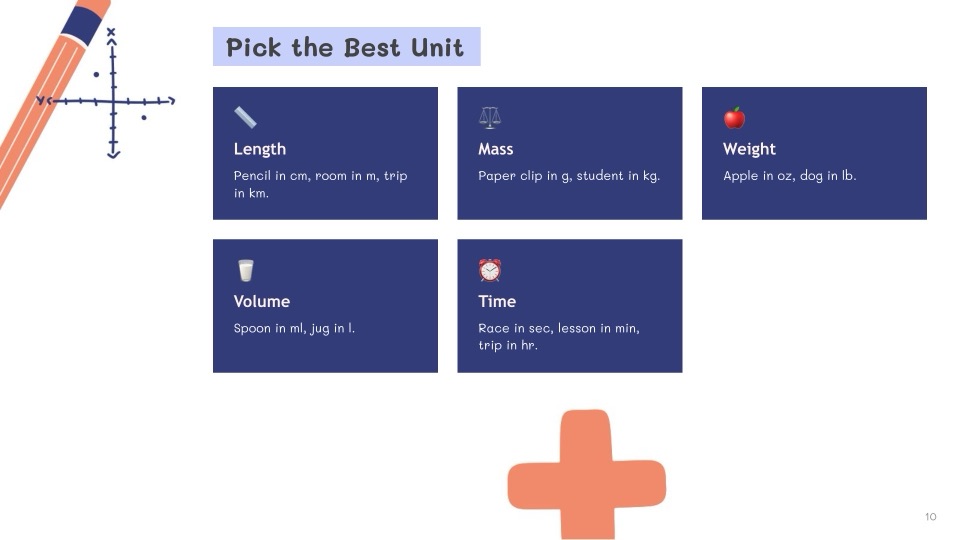
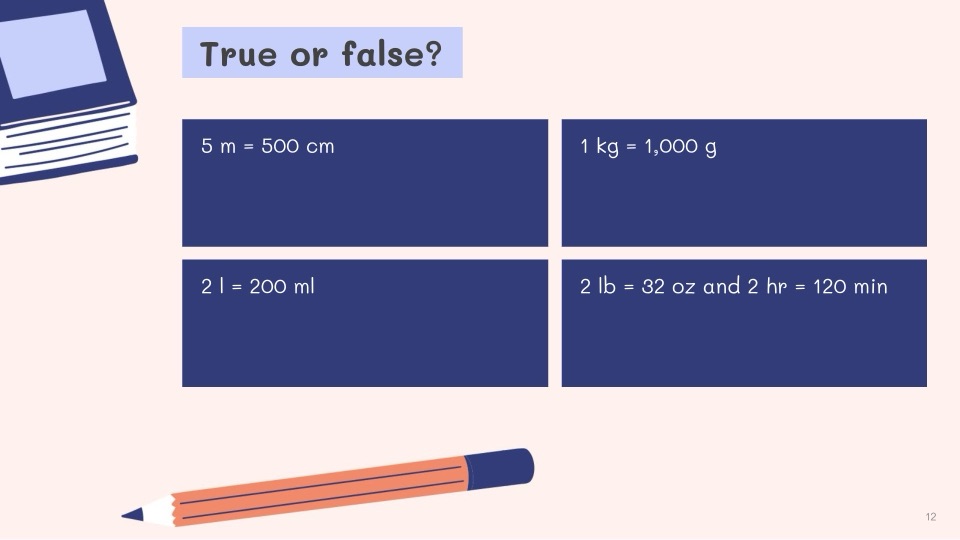
| 10 min | Plenary | Return to goals by checking true-false conversions and ordering by size. Show Slide 10 best-unit cards and ask for quick picks for pencil, trip and spoon. Show Slide 12 true-or-false and have all vote true or false with reasons. Model ordering 200 cm, 2 m and 2 km from small to big using 1 m = 100 cm and 1 km = 1,000 m. Summarize the multiply-divide rule and preview the exit ticket. |
Common mistakes
- Mixing up when to multiply or divide
How to spot it: Bigger unit gets a smaller number, like 2 m written as 20 cm
Point to rule larger to smaller multiply; check that 1 meter = 100 centimeters so 2 m must be 200 cm. - Using 100 or 10 for all conversions
How to spot it: Writes 2 lb as 200 oz or 2 kg as 200 g
Sort facts: 1 kg = 1,000 g and 1,000 milliliters is 1 liter, but 1 pound = 16 ounces. - Thinking time works like metric by 100s
How to spot it: Writes 2 hours as 200 minutes
Chant that 1 hour = 60 minutes and there are 60 seconds in 1 minute, so 2 x 60 = 120.
Support
- Keep a helper table for kg to g and l to ml on desks for quick look-up
- Use picture cards and sentence frames to explain best-unit choices
- Allow partner whisper time before answering time conversions
Stretch
- Students write their own mix-up problem for another pair using pounds and ounces
- Try two-step jumps like kilometers to centimeters or hours to seconds
- Order close pairs like 1,500 ml and 2 l after converting first
Check questions
- 3 km is how many meters?
Answer: 3,000 meters - 2 pounds is how many ounces and 2 hours is how many minutes?
Answer: 32 ounces and 120 minutes - Order small to big: 1,500 ml, 2 l, 200 cm, 3 m
Answer: 200 cm, 3 m is length order and 1,500 ml, 2 l is volume order; 1,500 ml is less than 2 l
Curriculum
Know relative sizes of measurement units within one system of units including km, m, cm; kg, g; lb, oz.; l, ml; hr, min, sec.
Video clips
Clips on YouTube, from the start and end times we chose. Check each one before you show it.
-
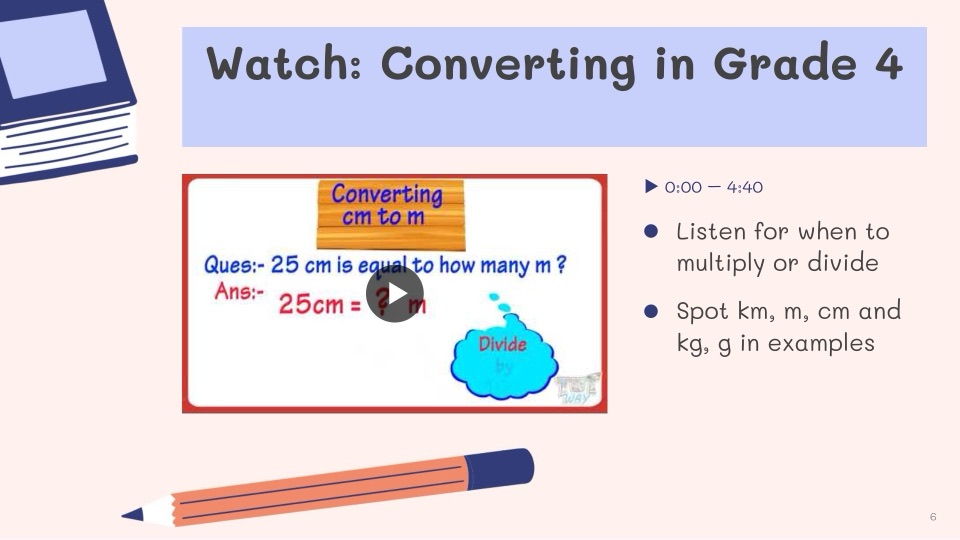
Grade 3 and 4 conversion from 0:00 to 4:40
TutWay: Conversion of Units | Grade 3 & 4 Math | Tutway
Made specifically for grades 3-4 so the examples and pace are perfect for ages 9-10 learning unit conversion.
-
Hours, minutes, seconds from 0:00 to 4:40
TutWay: Time Conversion (Hours | Minutes | Seconds) Math - Tutway
Covers exactly hr, min, and sec conversion with elementary examples that fit ages 9-10.
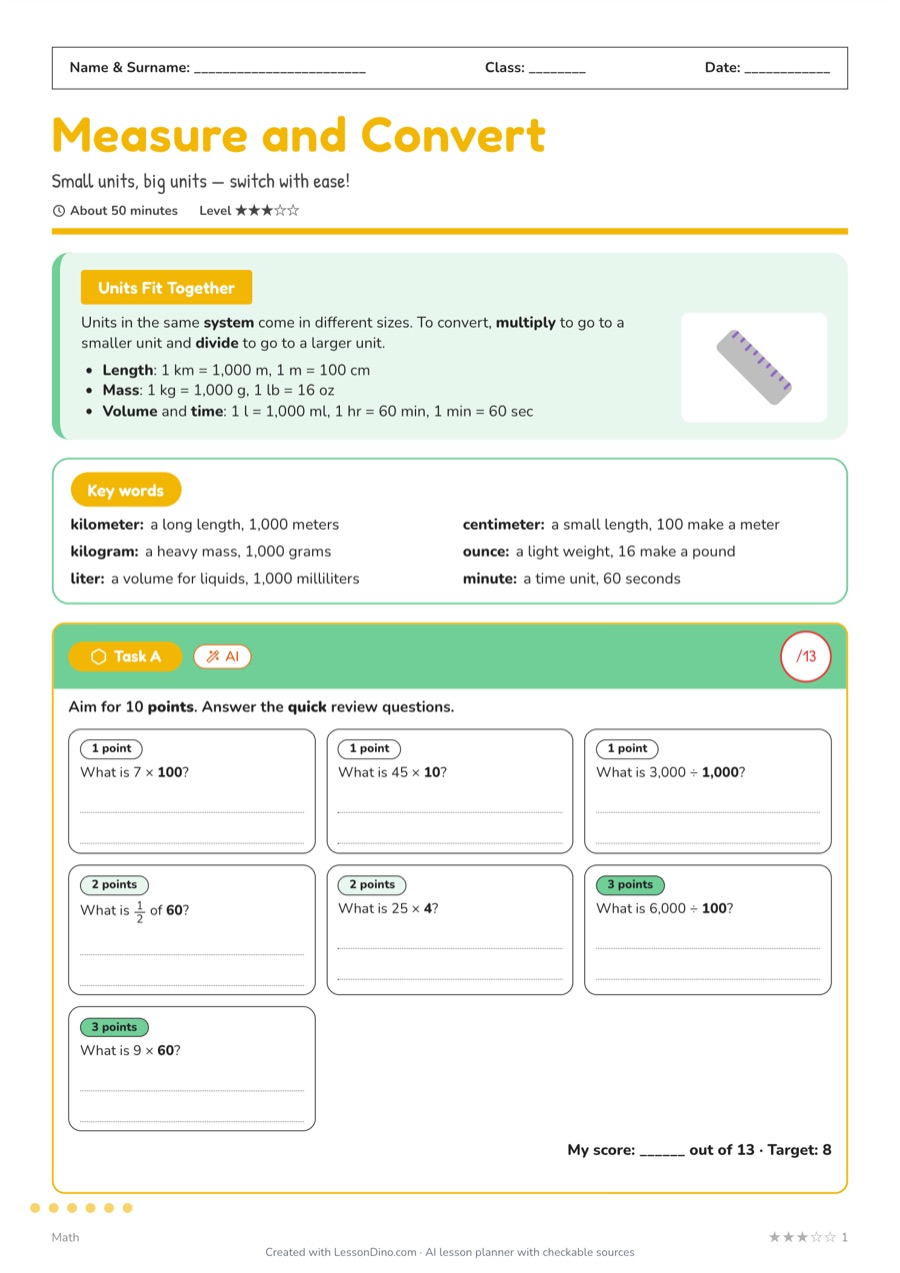
Worksheet
Sources
- Grade 4 Math Curriculum - Fairfax County Public Schools fcps.edu
- Unit Conversion | NIST nist.gov
- Units and Conversion Factors – Chemistry Fundamentals pressbooks.online.ucf.edu
- 1.3 Unit Conversion – University Physics Volume 1 pressbooks.online.ucf.edu
- Conversions within the USC System and between the USC and SI bates.edu
- conversion-table - Purdue University engineering.purdue.edu
- The Math You Need, When You Need It - Unit Conversions serc.carleton.edu
- Conversion of units Facts for Kids kids.kiddle.co
- Flexi answers - How to learn conversion of metric units? | CK-12 Foundation ck12.org
- Choosing appropriate units and converting between units bbc.co.uk
- Units: A Unit Conversion Program and Scientific Calculator gnu.org
- Unit Conversion Videos for Kids - EDU.COM edu.com
- ⚓ T150877 Unit conversion does not create psn:P2043 for Q531 phabricator.wikimedia.org
- Converting units KS2 | Y5 Maths | Lesson Resources thenational.academy
- Teaching Kids About Measurements | Unit Conversion Guide qonvert.org
- 1.2%3A+Unit+Conversion+ +American+System math.libretexts.org
- Conversion Of Measurement Units Educational Resources for Kids splashlearn.com
- How to Do Unit Conversions - DoodleLearning dreambox.com
- Unit conversions | How to convert units of measurement ... doodlelearning.com
- How Does Unit Conversion Work? – Explained for Kids smartonlinegames.com
- Math Unit Conversion Worksheets For Kids - SchoolMyKids schoolmykids.com
- BYJU'S Online learning Programs For K3, K10, K12, NEET, JEE ... byjus.com
- Unit Conversions In Eight Easy Steps | MCAT Tips and Tricks | SDN studentdoctor.net
- Converting metric units - KS2 maths resources for Year 5 - BBC bbc.co.uk
- Temperature in Physics: Definition, Units & Conversion Explained vedantu.com
Picture credits
- Illustration: OpenClipart-Vectors · Pixabay
- Microsoft Fluent Emoji (MIT)
Made with Lesson Dino's AI on 16 October 2026. AI can make mistakes, so check facts against the sources before you teach.