The worksheet
About this worksheet
Students learn to solve two-step problems in order and explain remainders. They practice with strips, letter equations, and rounding checks. This Grade 4 Math worksheet gives students (ages 9–10) six pages of practice on multi-step word problems, part of the operations and algebraic thinking unit. It goes with our free Multi-step word problems lesson, which has the slides and a timed lesson plan.
What it covers
By the end, students should be able to:
- Students will solve two-step problems with whole numbers using all four operations.
- Students will write step equations with a letter for the unknown amount.
- Students will interpret remainders and estimate with rounding to check answers.
How to use it
- Main Activity (18 minutes): Hand out short problem cards, paper strips, and pencils plus Worksheet Task B.
- Remainder and Estimate Check (15 minutes): Hand Worksheet Task C for both steps and remainder meaning.
- Support: Use partly filled bar models and cups with counters to show totals and leftovers.
- Stretch: Add a third step to the same card and write all three equations.
- The answer sheet is the last page, so you can print it on its own or let students check their own work.
Key vocabulary
- equation: a number sentence with = that shows two amounts are the same
- unknown: the number we have not found yet, shown by a letter like n
- remainder: what is left over after sharing into equal groups
- estimate: a close guess found by using round numbers
- multi-step: needing more than one calculation to reach the end
Mistakes to watch for
- Stopping after Step 1 and giving middle total as final answer. Underline final question first and reread to check answer label matches what was asked.
- Ignoring remainder or dropping it when story needs rounding up. Act out with counters and ask where leftover students sit; write sentence that remainder means one more group.
- Picking operation from cue word only without picturing story. Draw bar or cups to picture equal groups, then choose divide or multiply.
What's on the worksheet
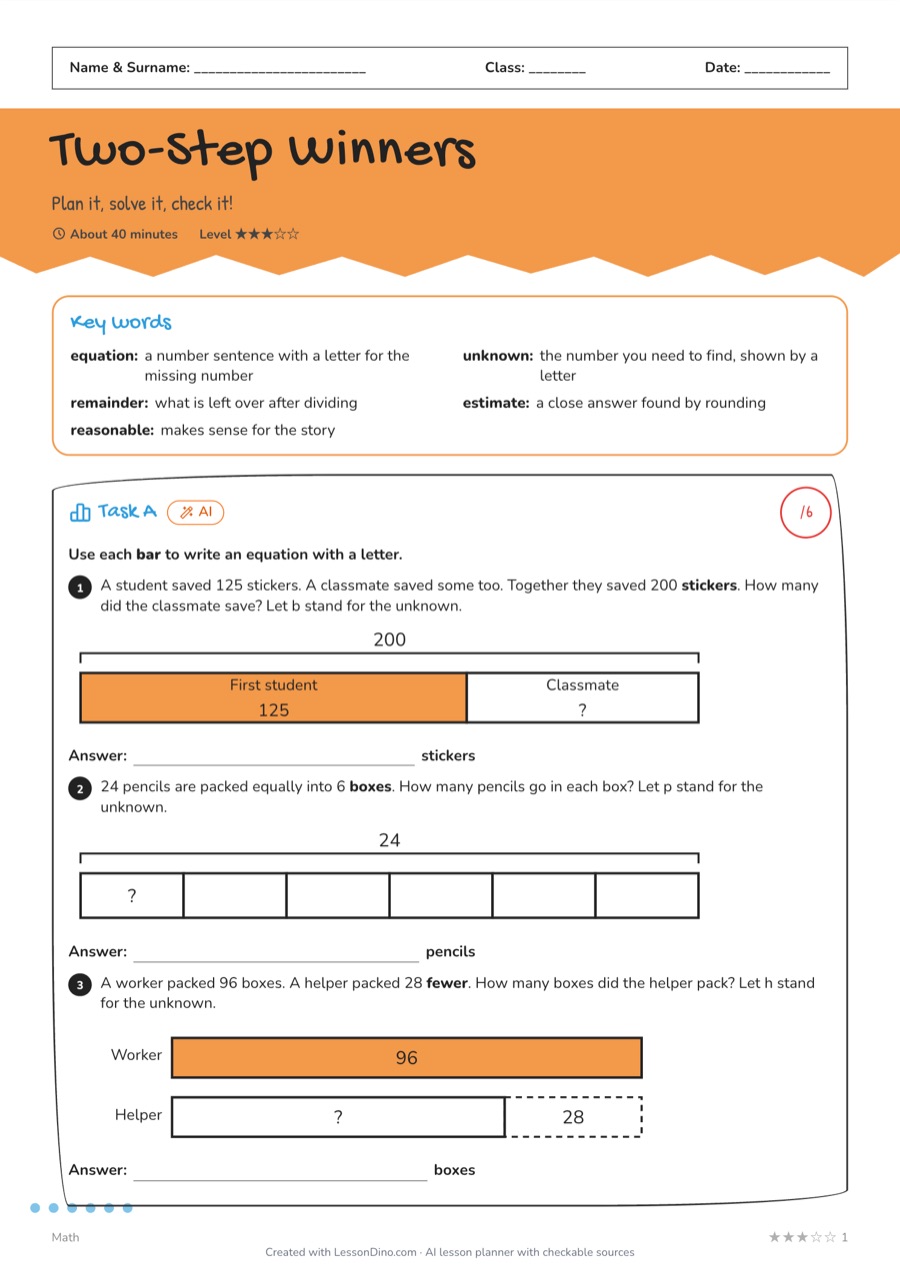
Solve in Steps
Learn the plan, then see it in bar models.
| Word | Meaning |
|---|---|
| equation | a number sentence with a letter for the missing number |
| unknown | the number you need to find, shown by a letter |
| remainder | what is left over after dividing |
| estimate | a close answer found by rounding |
| reasonable | makes sense for the story |
Use each bar to write an equation with a letter.
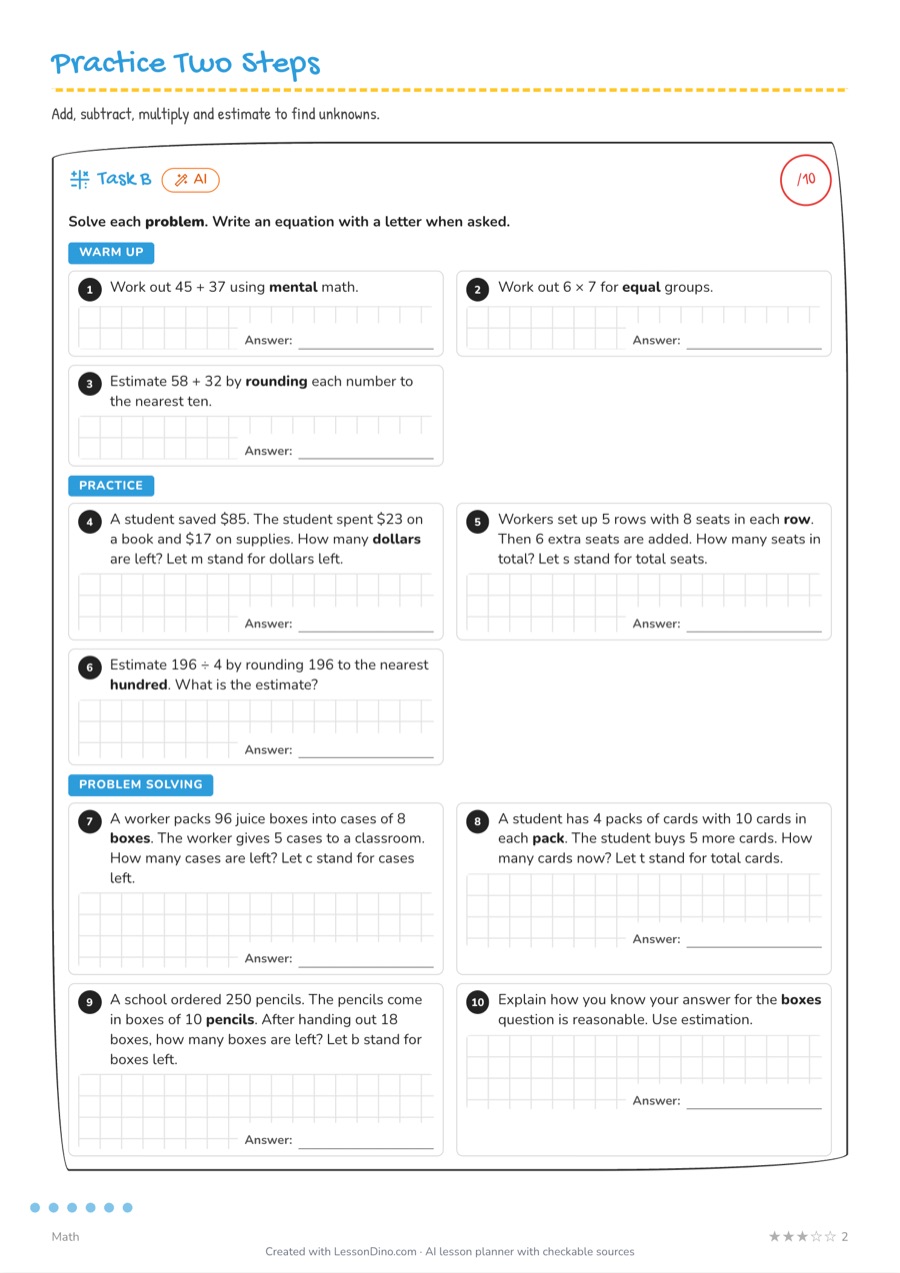
Practice Two Steps
Add, subtract, multiply and estimate to find unknowns.
Solve each problem. Write an equation with a letter when asked.
Warm up
- Work out 45 + 37 using mental math.
- Work out 6 × 7 for equal groups.
- Estimate 58 + 32 by rounding each number to the nearest ten.
Practice
- A student saved $85. The student spent $23 on a book and $17 on supplies. How many dollars are left? Let m stand for dollars left.
- Workers set up 5 rows with 8 seats in each row. Then 6 extra seats are added. How many seats in total? Let s stand for total seats.
- Estimate 196 ÷ 4 by rounding 196 to the nearest hundred. What is the estimate?
Problem solving
- A worker packs 96 juice boxes into cases of 8 boxes. The worker gives 5 cases to a classroom. How many cases are left? Let c stand for cases left.
- A student has 4 packs of cards with 10 cards in each pack. The student buys 5 more cards. How many cards now? Let t stand for total cards.
- A school ordered 250 pencils. The pencils come in boxes of 10 pencils. After handing out 18 boxes, how many boxes are left? Let b stand for boxes left.
- Explain how you know your answer for the boxes question is reasonable. Use estimation.
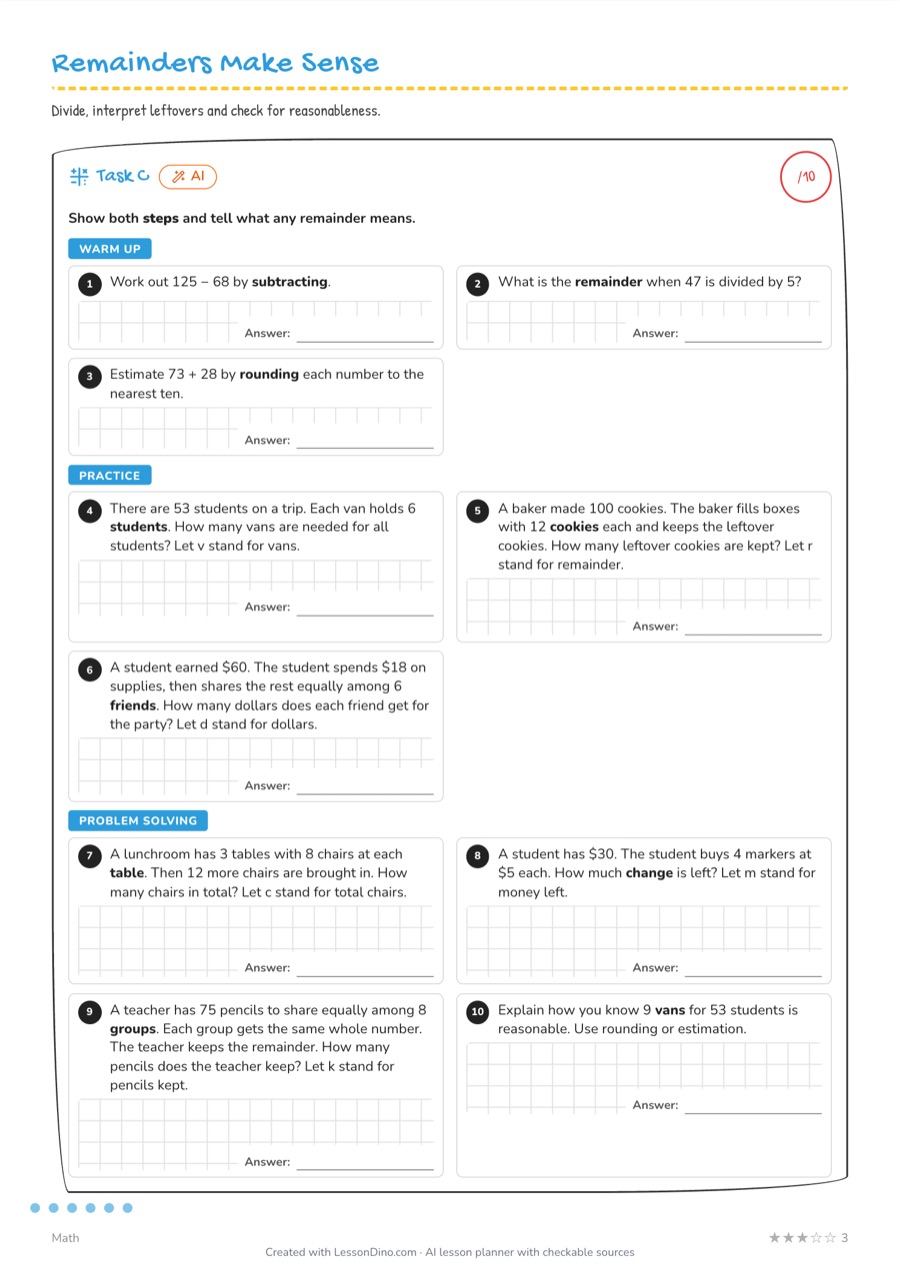
Remainders Make Sense
Divide, interpret leftovers and check for reasonableness.
Show both steps and tell what any remainder means.
Warm up
- Work out 125 − 68 by subtracting.
- What is the remainder when 47 is divided by 5?
- Estimate 73 + 28 by rounding each number to the nearest ten.
Practice
- There are 53 students on a trip. Each van holds 6 students. How many vans are needed for all students? Let v stand for vans.
- A baker made 100 cookies. The baker fills boxes with 12 cookies each and keeps the leftover cookies. How many leftover cookies are kept? Let r stand for remainder.
- A student earned $60. The student spends $18 on supplies, then shares the rest equally among 6 friends. How many dollars does each friend get for the party? Let d stand for dollars.
Problem solving
- A lunchroom has 3 tables with 8 chairs at each table. Then 12 more chairs are brought in. How many chairs in total? Let c stand for total chairs.
- A student has $30. The student buys 4 markers at $5 each. How much change is left? Let m stand for money left.
- A teacher has 75 pencils to share equally among 8 groups. Each group gets the same whole number. The teacher keeps the remainder. How many pencils does the teacher keep? Let k stand for pencils kept.
- Explain how you know 9 vans for 53 students is reasonable. Use rounding or estimation.
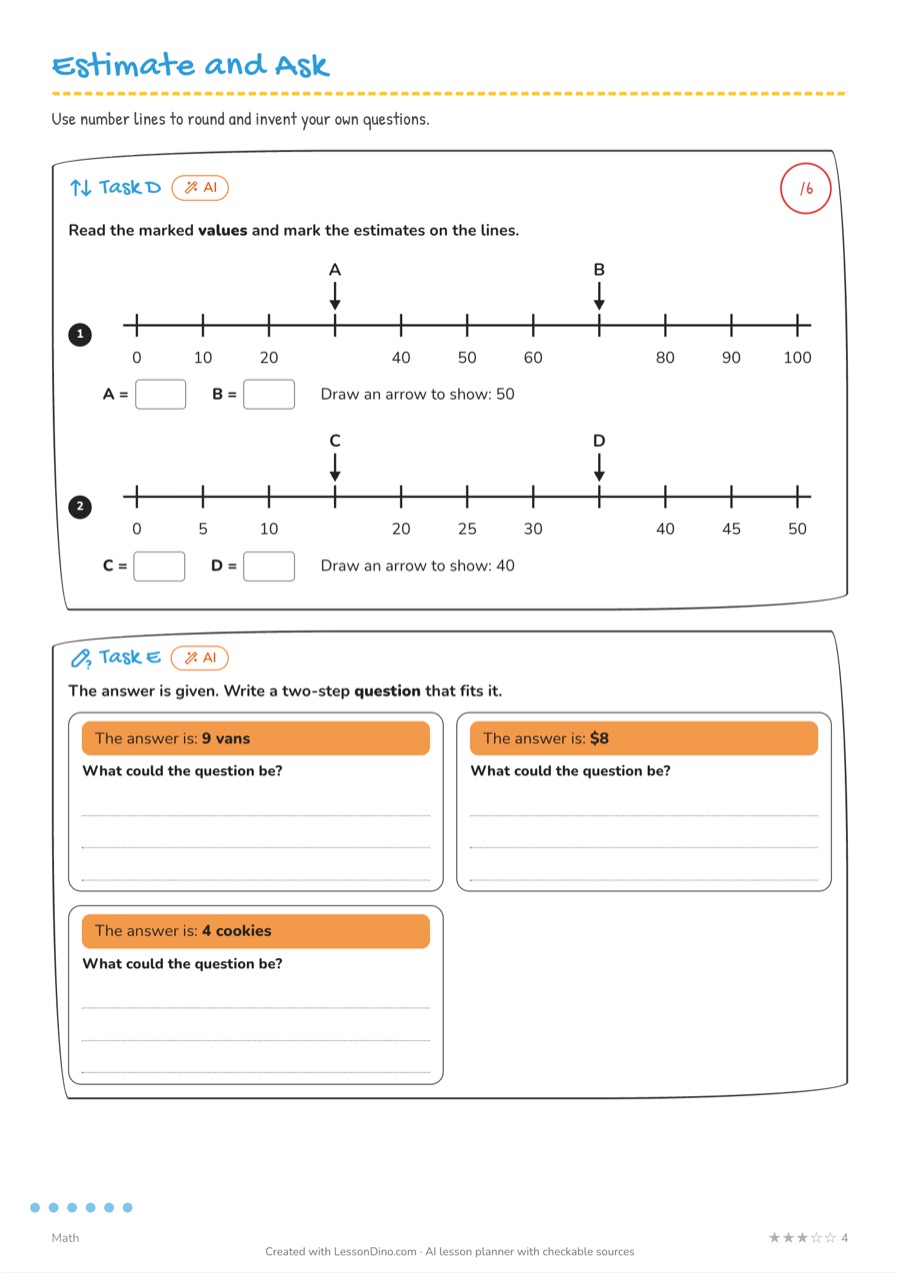
Estimate and Ask
Use number lines to round and invent your own questions.
Read the marked values and mark the estimates on the lines.
The answer is given. Write a two-step question that fits it.
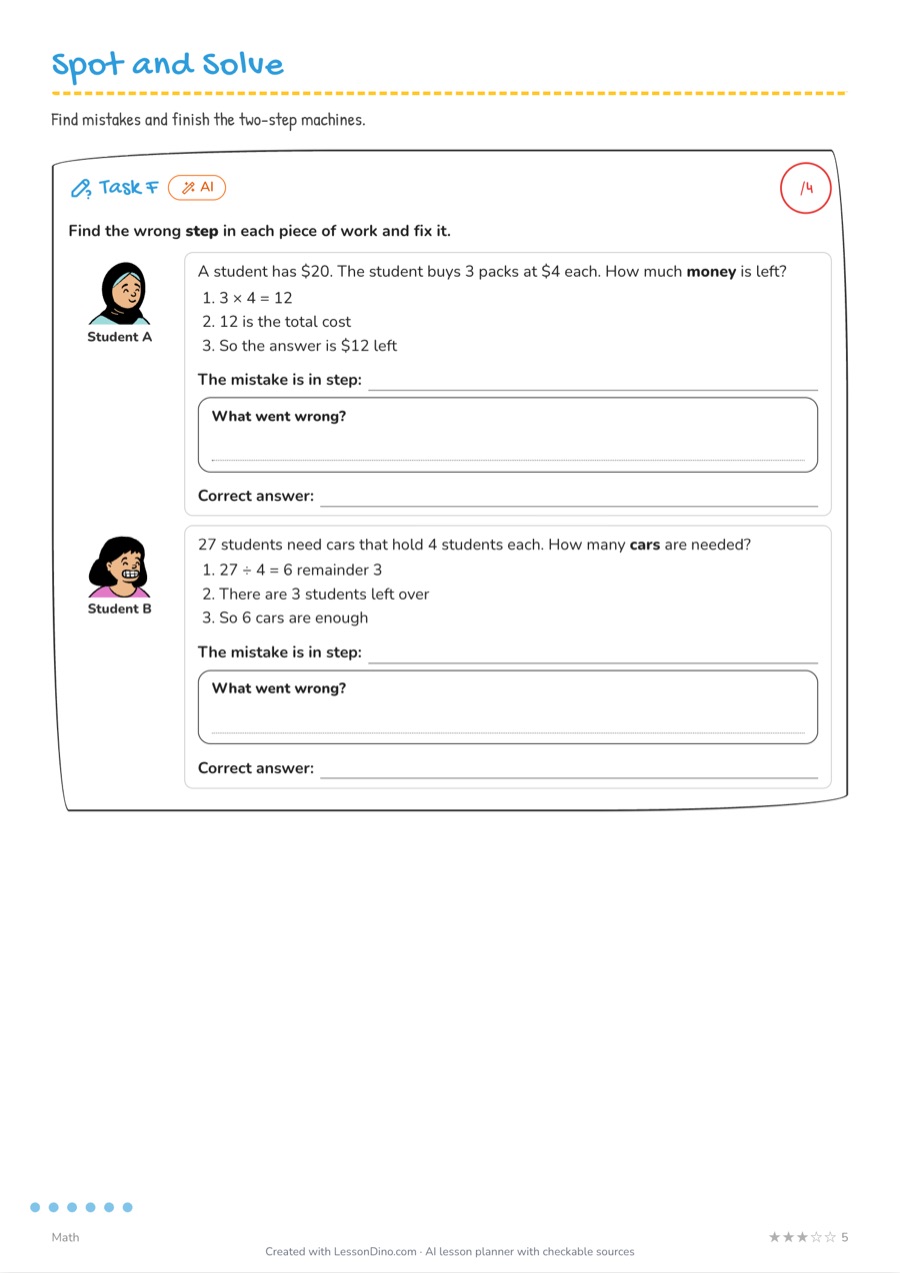
Spot and Solve
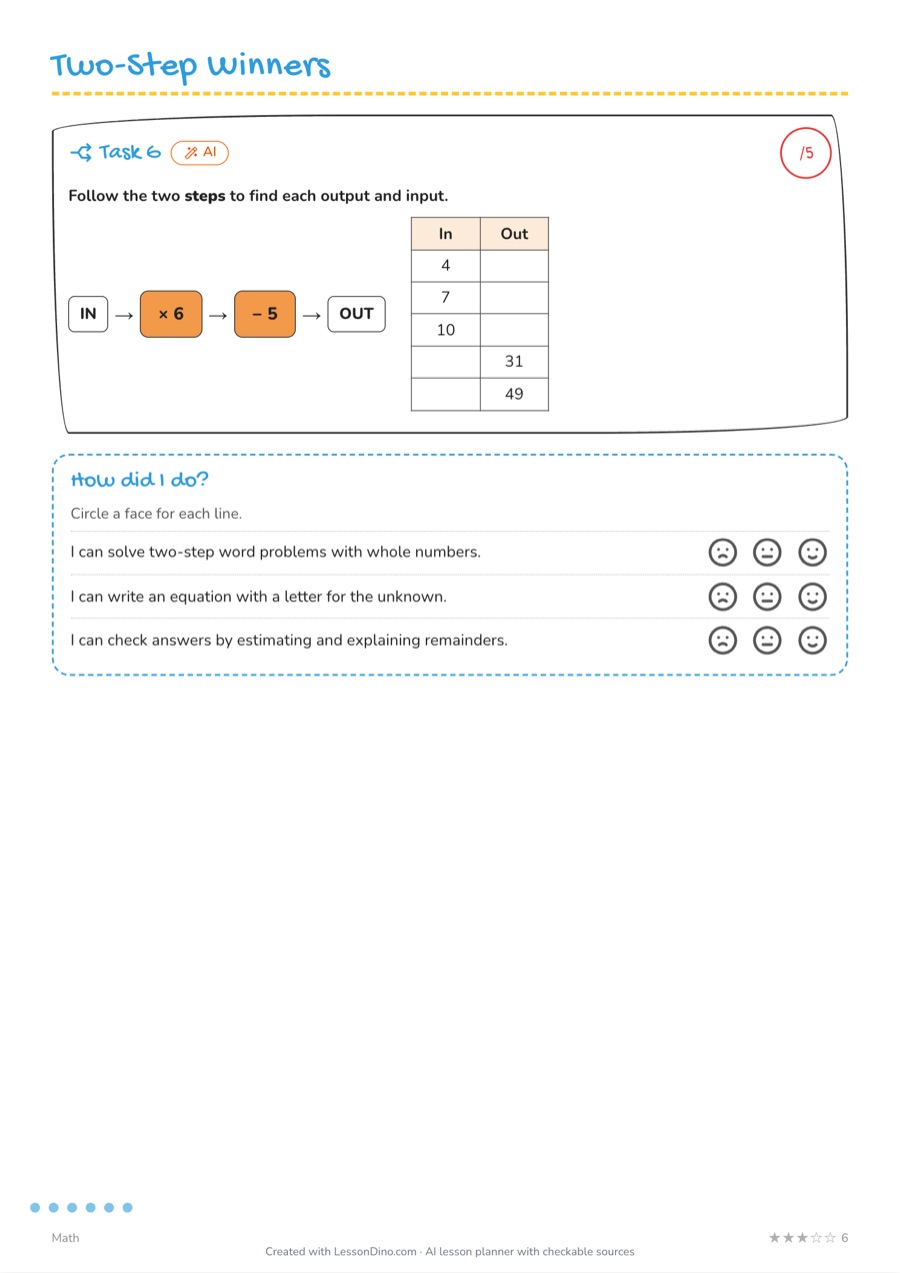
Find mistakes and finish the two-step machines.
Find the wrong step in each piece of work and fix it.
Page 6
Follow the two steps to find each output and input.
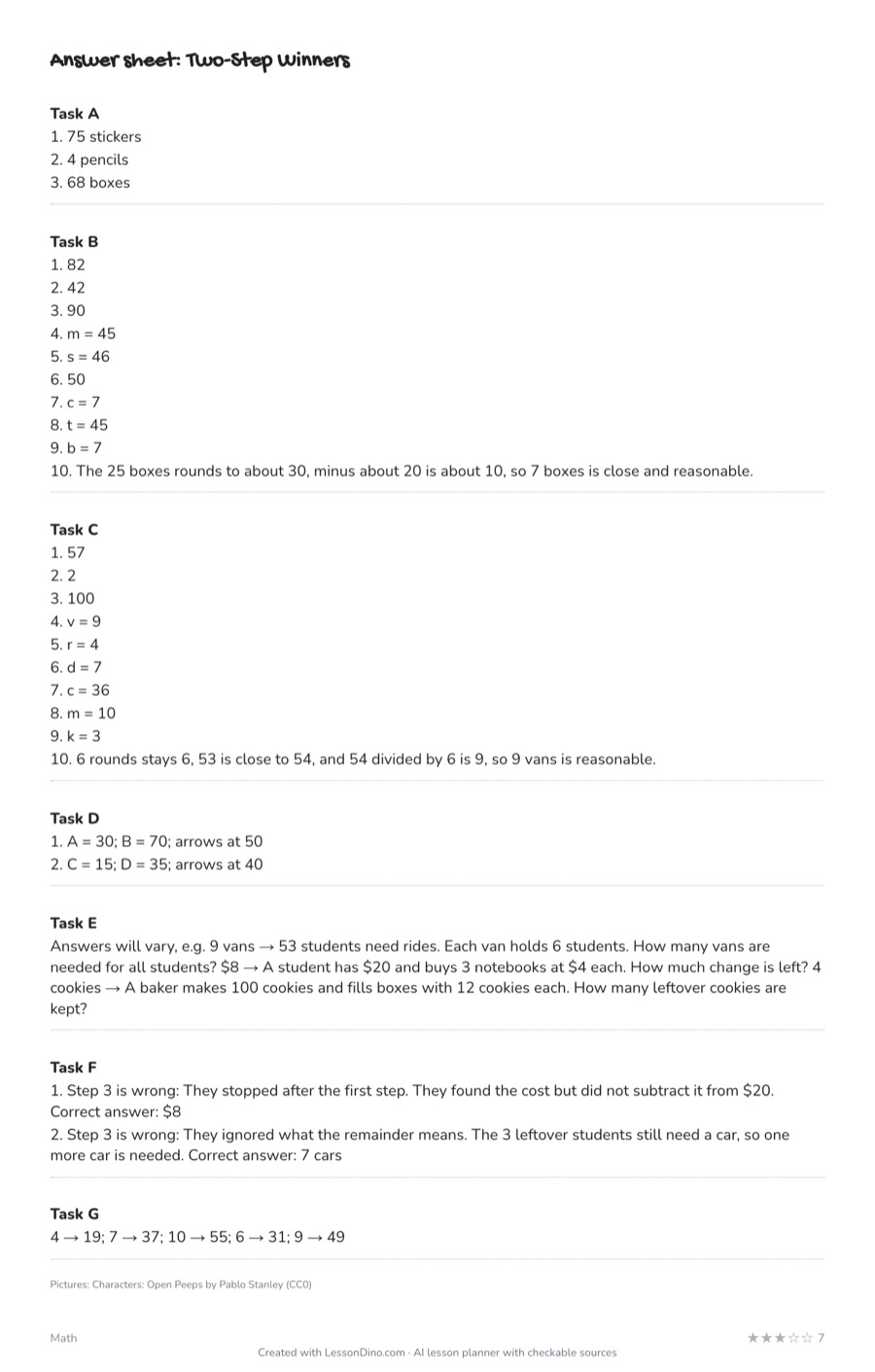
Answers
Show the answers
- Work out 45 + 37 using mental math. 82
- Work out 6 × 7 for equal groups. 42
- Estimate 58 + 32 by rounding each number to the nearest ten. 90
- A student saved $85. The student spent $23 on a book and $17 on supplies. How many dollars are left? Let m stand for dollars left. m = 45
- Workers set up 5 rows with 8 seats in each row. Then 6 extra seats are added. How many seats in total? Let s stand for total seats. s = 46
- Estimate 196 ÷ 4 by rounding 196 to the nearest hundred. What is the estimate? 50
- A worker packs 96 juice boxes into cases of 8 boxes. The worker gives 5 cases to a classroom. How many cases are left? Let c stand for cases left. c = 7
- A student has 4 packs of cards with 10 cards in each pack. The student buys 5 more cards. How many cards now? Let t stand for total cards. t = 45
- A school ordered 250 pencils. The pencils come in boxes of 10 pencils. After handing out 18 boxes, how many boxes are left? Let b stand for boxes left. b = 7
- Explain how you know your answer for the boxes question is reasonable. Use estimation. The 25 boxes rounds to about 30, minus about 20 is about 10, so 7 boxes is close and reasonable.
- Work out 125 − 68 by subtracting. 57
- What is the remainder when 47 is divided by 5? 2
- Estimate 73 + 28 by rounding each number to the nearest ten. 100
- There are 53 students on a trip. Each van holds 6 students. How many vans are needed for all students? Let v stand for vans. v = 9
- A baker made 100 cookies. The baker fills boxes with 12 cookies each and keeps the leftover cookies. How many leftover cookies are kept? Let r stand for remainder. r = 4
- A student earned $60. The student spends $18 on supplies, then shares the rest equally among 6 friends. How many dollars does each friend get for the party? Let d stand for dollars. d = 7
- A lunchroom has 3 tables with 8 chairs at each table. Then 12 more chairs are brought in. How many chairs in total? Let c stand for total chairs. c = 36
- A student has $30. The student buys 4 markers at $5 each. How much change is left? Let m stand for money left. m = 10
- A teacher has 75 pencils to share equally among 8 groups. Each group gets the same whole number. The teacher keeps the remainder. How many pencils does the teacher keep? Let k stand for pencils kept. k = 3
- Explain how you know 9 vans for 53 students is reasonable. Use rounding or estimation. 6 rounds stays 6, 53 is close to 54, and 54 divided by 6 is 9, so 9 vans is reasonable.
The answer sheet is the last picture above.
Curriculum
Solve multistep word problems posed with whole numbers and having whole-number answers using the four operations, including problems in which remainders must be interpreted. Represent these problems using equations with a letter standing for the unknown quantity. Assess the reasonableness of answers using mental computation and estimation strategies including rounding.
Made with Lesson Dino's AI on 16 October 2026. AI can make mistakes, so check the answers and facts against the sources before you teach.