Slides

Lesson plan
Two Steps, Letter Unknown, Check It
Students learn to solve two-step problems in order and explain remainders. They practice with strips, letter equations, and rounding checks.
Objectives
- Students will solve two-step problems with whole numbers using all four operations.
- Students will write step equations with a letter for the unknown amount.
- Students will interpret remainders and estimate with rounding to check answers.
Success criteria
- I can do step 1 then step 2 in order to find the final answer.
- I can write n equations to show the unknown in each step.
- I can explain leftovers and use rounding to check if answers fit.
Key words
| Word | Meaning |
|---|---|
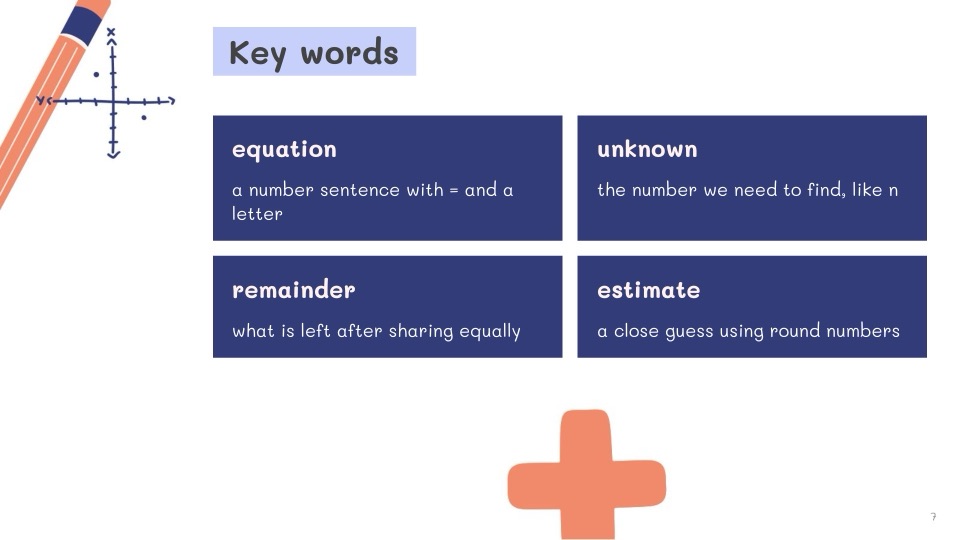
| equation | a number sentence with = that shows two amounts are the same |
| unknown | the number we have not found yet, shown by a letter like n |
| remainder | what is left over after sharing into equal groups |
| estimate | a close guess found by using round numbers |
| multi-step | needing more than one calculation to reach the end |
Timed plan (60 minutes)
| Time | Stage | What happens |
|---|---|---|
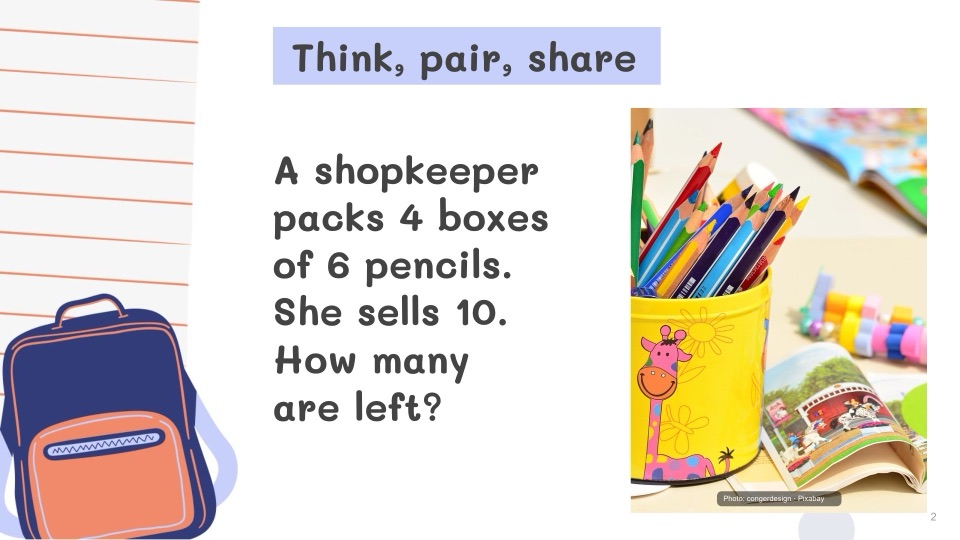
| 5 min | Starter | Hook students and recall one-step facts needed for two-step solving. Say hook: I have a problem that tricks almost everyone — they stop after step one. Can you go all the way to step two? Show Slides 1-2 with question: A shopkeeper packs 4 boxes of 6 pencils. She sells 10. How many are left? Ask students to read twice and tell a partner what the final question asks. Collect quick ideas without solving fully yet. |
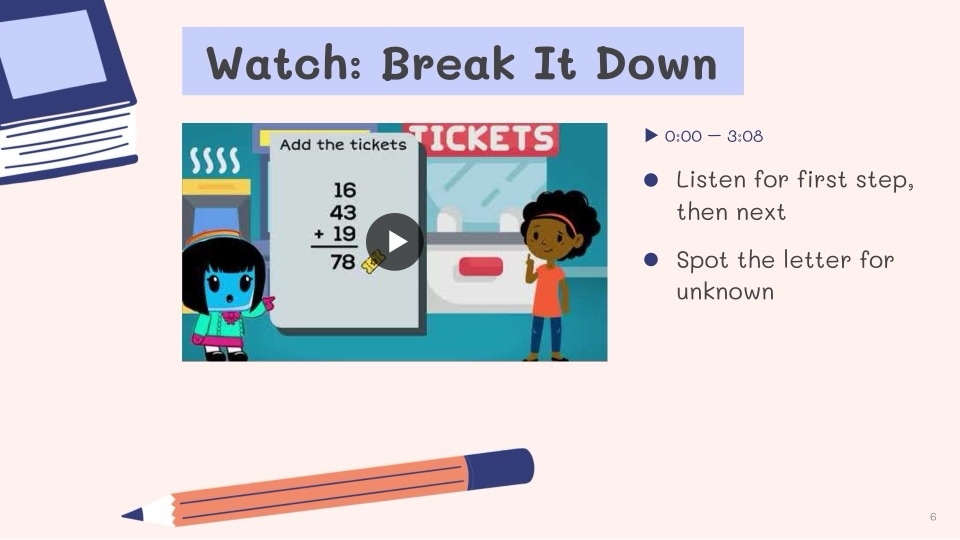
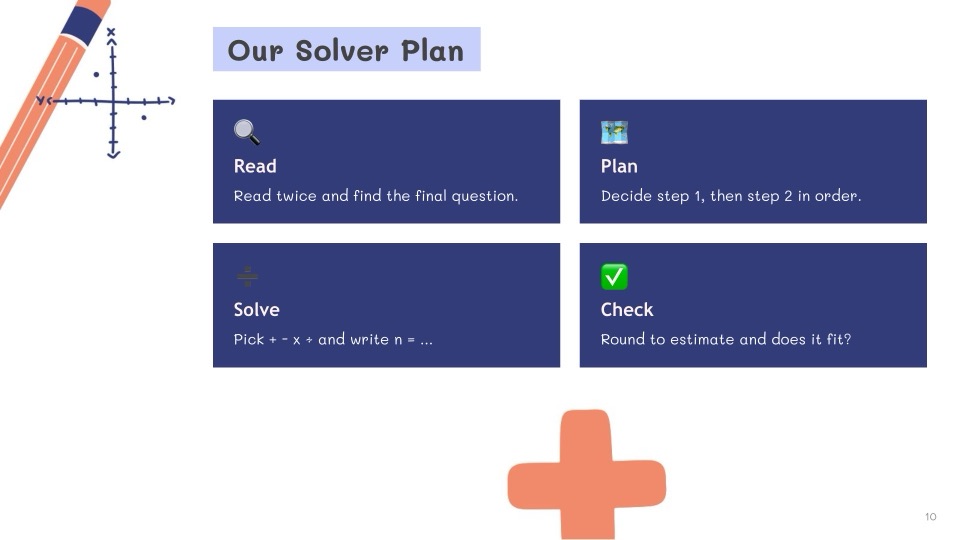
| 12 min | Teaching | Model breaking a story into steps and writing letter equations. Show Slide 10 solver plan: Read, Plan, Solve, Check. Play Video clip 1 (0:00–3:08) on Slide 6 and tell class to listen for first step, then next and spot the letter for unknown. Model example card on board with two strips and equations using letter n for the final unknown amount. Define key words on Slide 7 and model a quick rounding check. |
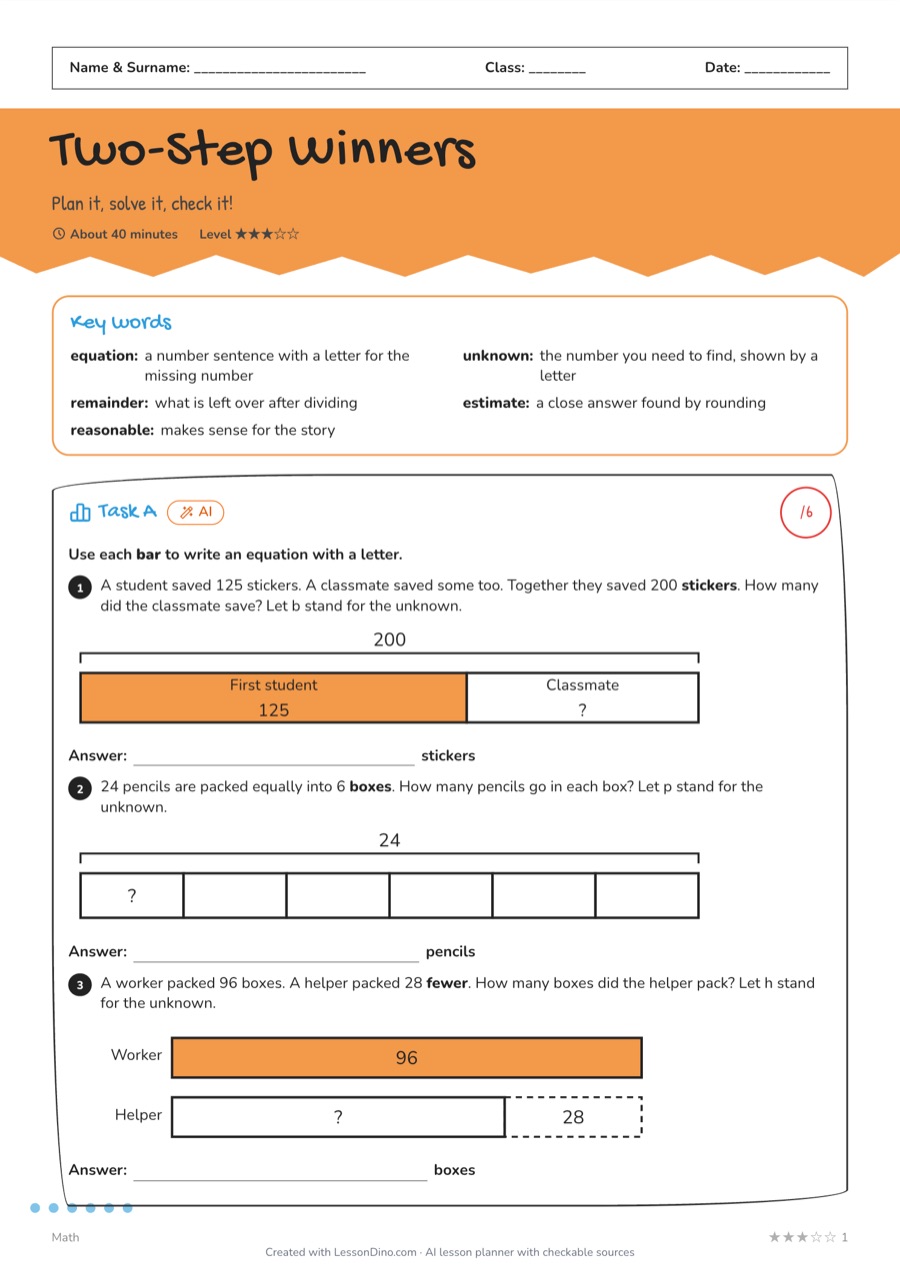
| 18 min | Main Activity | Solve two-step problems in order and show each step with strips. Hand out short problem cards, paper strips, and pencils plus Worksheet Task B. Remind pairs to read each card twice and write the steps before they calculate, because multi-step problems need more than one calculation to solve. Show how to lay the two paper strips in order and write one equation for each step, using the letter n for the final unknown amount. Circulate, prompt pairs to say what step 1 finds and why it is needed before calculating. |
| 15 min | Remainder and Estimate Check | Interpret division leftovers and judge answers with rounding. Show Slide 4: 25 students need seats. Vans hold 6 each. Model 25 ÷ 6 with counters into cups, a one-digit divisor and a two-digit dividend. Circle remainder and model sentence: 25 ÷ 6 = 4 R1, so need 5 vans because you cannot leave anyone behind, interpreting the remainder and its effect on the answer. Model estimate: 298 + 412 - 105 rounds to 300 + 400 - 100 = 600 using rounding to nearest 100. Solve exactly 605 and describe as closer to 600. Hand Worksheet Task C for both steps and remainder meaning. |
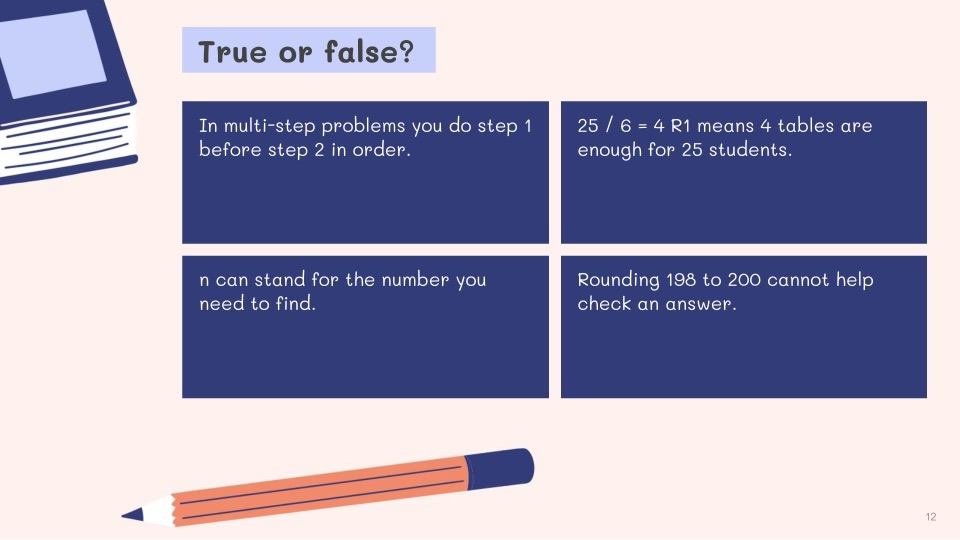
| 10 min | Plenary | Return to objectives and check two-step order and leftovers. Show Slide 12 true or false and read each statement together. Revisit Slide 10 solver plan and ask students to say steps in order. Give 3-question exit ticket on paper and collect. |
Common mistakes
- Stopping after Step 1 and giving middle total as final answer
How to spot it: Answer matches first calculation but label does not match final question
Underline final question first and reread to check answer label matches what was asked - Ignoring remainder or dropping it when story needs rounding up
How to spot it: Writes 25 ÷ 6 = 4 R1 and says 4 tables are enough
Act out with counters and ask where leftover students sit; write sentence that remainder means one more group - Picking operation from cue word only without picturing story
How to spot it: Multiplies when sharing equally is needed
Draw bar or cups to picture equal groups, then choose divide or multiply
Support
- Use partly filled bar models and cups with counters to show totals and leftovers
- Read problem twice aloud and underline final question before calculating
- Provide sentence frames for step equations with a and n
Stretch
- Add a third step to the same card and write all three equations
- Write one combined equation with parentheses, like n = (4 x 6) - 3
- Create a two-step question that fits a given answer and trade to solve
Check questions
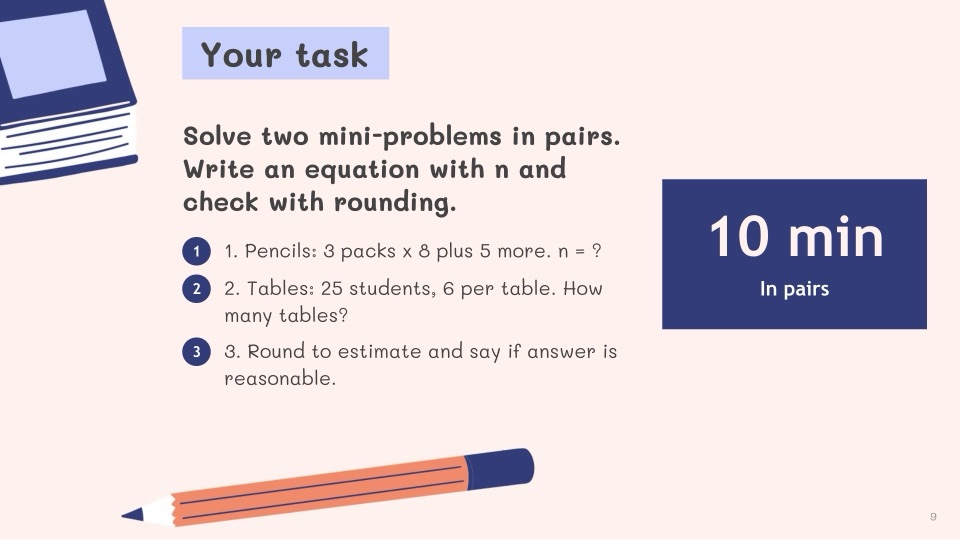
- A class has 3 packs of 8 markers plus 5 more. Write equations with n and solve.
Answer: a = 3 x 8 = 24; n = 24 + 5 = 29 markers - 25 students, 6 per table. How many tables and why?
Answer: 5 tables because 25 ÷ 6 = 4 R1 and 1 student still needs a seat - Estimate 198 + 305 by rounding to nearest 100. Is 503 reasonable?
Answer: 200 + 300 = 500, so 503 is reasonable, closer to 500
Curriculum
Solve multistep word problems posed with whole numbers and having whole-number answers using the four operations, including problems in which remainders must be interpreted. Represent these problems using equations with a letter standing for the unknown quantity. Assess the reasonableness of answers using mental computation and estimation strategies including rounding.
Video clips
Clips on YouTube, from the start and end times we chose. Check each one before you show it.
-
4.OA.3 multistep models from 0:00 to 3:08
Boddle Learning: Multistep word problems - 4th Grade Math 4.OA.A.3
Exactly Grade 4 multistep word problems with equations and remainders and pace suits ages 9-10.
-
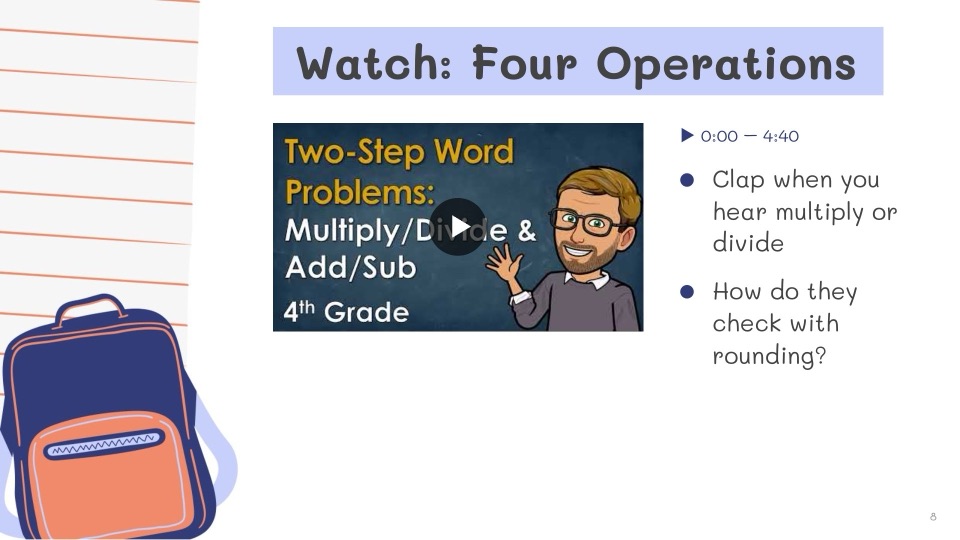
2-step with four operations from 0:00 to 4:40
Mr. Heaton's Math Lab: Mastering 2-Step Word Problems | Addition, Subtraction, Multiplication & Division
Covers addition, subtraction, multiplication, and division in 2 steps with style good for ages 9-10.
Worksheet
Sources
- Grade 4 Math Curriculum - Fairfax County Public Schools fcps.edu
- Grade 4 Math | SFUSD sfusd.edu
- Multistep Word Problems - Online Lesson articulate.strayer.edu
- Pirate Math Equation Quest - Small Group Word Problem ... piratemathequationquest.education.utexas.edu
- Solving Multistep Problems: What Will It Take? files.eric.ed.gov
- Multi-Step Word Problems | Math | EducaWeb educaweb.org
- Multi-step word problems with whole numbers - Khan Academy khanacademy.org
- Learn how to deal with multi-step word problems - BBC Bitesize bbc.co.uk
- Multiple-Step Word Problem Worksheets superteacherworksheets.com
- Multi-Step Word Problems Worksheets | Free Printable Worksheets mathfunworksheets.com
- Multi-Step Word Problems Mastery - Teaching with a Mountain View teachingwithamountainview.com
- Multi-step Word Problems Worksheets for 4th Grade ... freeworksheets.com
- How to Solve Multi-Step Word Problems - Effortless Math effortlessmath.com
- 2.MD.B Modeling Multi-Step Word Problems_Ball Throws | OER Commo… oercommons.org
- Solving maths problems - KS2 Maths - Year 4 - BBC Bitesize bbc.co.uk
- Money Math: Word Problems with Multiplication and Division ducksters.com
- Money Math: Word Problems with Addition and Subtraction ducksters.com
- Multi-Step Word Problems: How to Explain Your Thinking teachjunkie.com
- How do you solve multi-step word problems? math-wordproblems.com
Picture credits
Made with Lesson Dino's AI on 16 October 2026. AI can make mistakes, so check facts against the sources before you teach.