The worksheet
About this worksheet
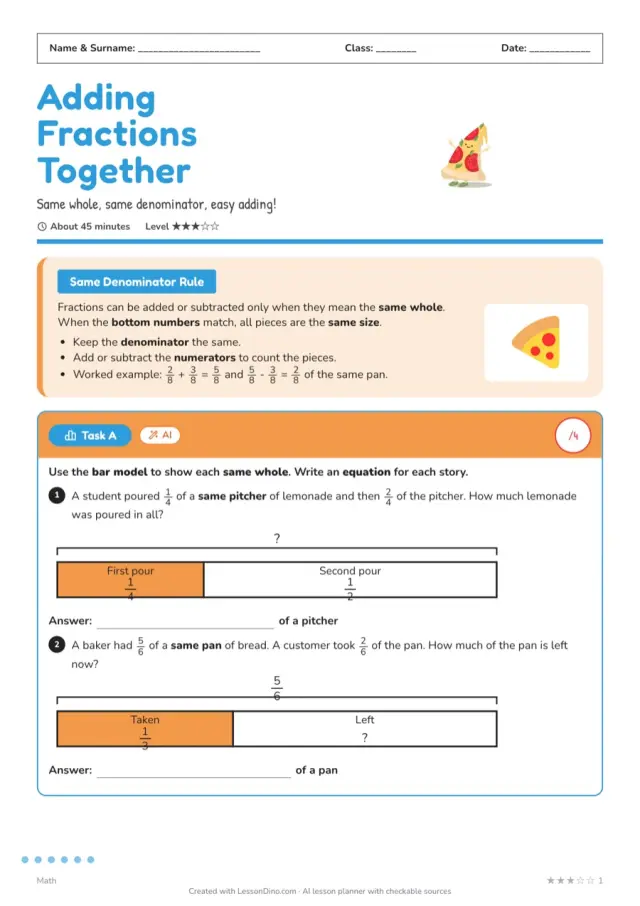
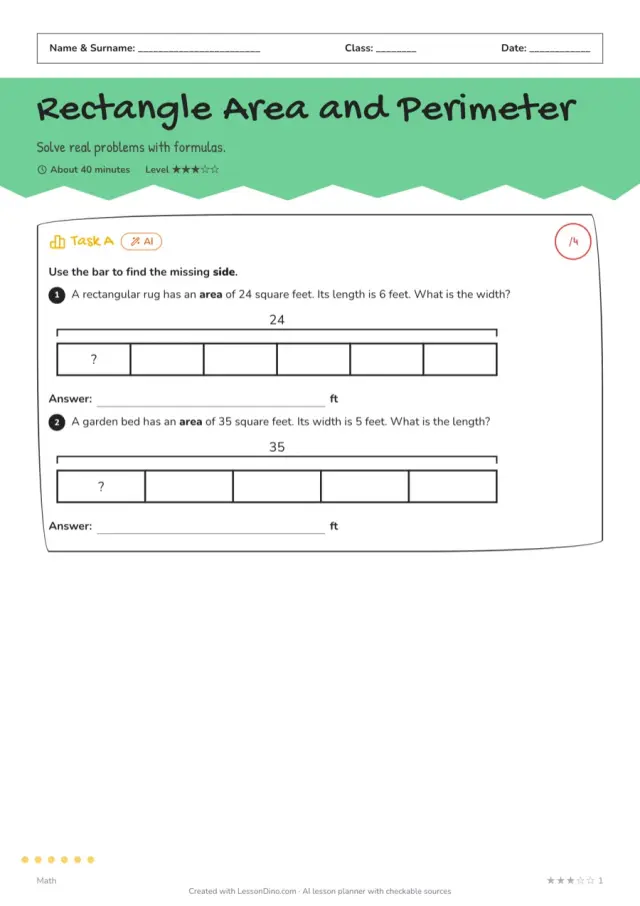
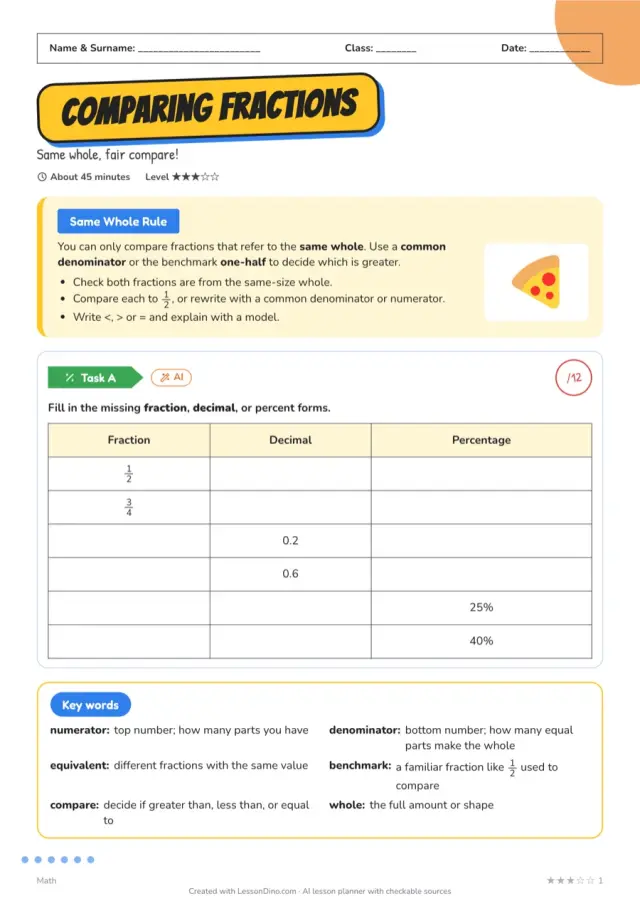
Students learn to break numbers by place value and multiply each part. They draw area models to solve 2-digit by 2-digit and 4-digit by 1-digit problems. This Grade 4 Math worksheet gives students (ages 9–10) six pages of practice on multi-digit multiplication, part of the number and operations in base ten unit. It goes with our free Multi-digit multiplication lesson, which has the slides and a timed lesson plan.
What it covers
By the end, students should be able to:
- Students will multiply up to four digits by one digit using place-value breakup.
- Students will multiply two two-digit numbers using area models and partial products.
- Students will illustrate and explain steps with equations, arrays and area models.
How to use it
- Use it for practice after the teaching part of the lesson, once students have seen the worked examples on the slides.
- Support: Give students the four equations with one number missing to fill in before adding.
- Stretch: Have students design and solve a 24 x 18 space and compare whose area is larger.
- The answer sheet is the last page, so you can print it on its own or let students check their own work.
Key vocabulary
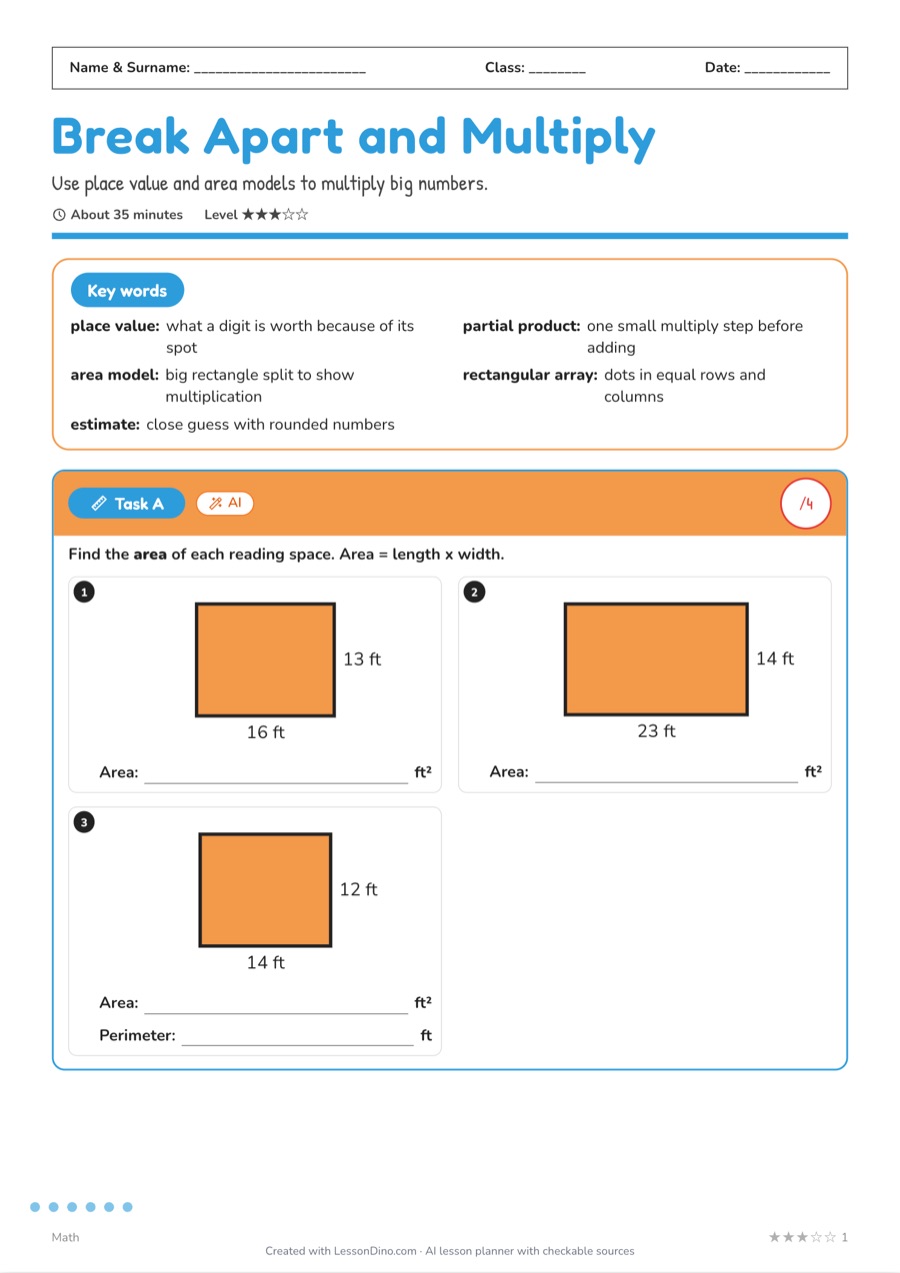
- place value: what a digit is worth depends on where it sits in the number
- rectangular array: rows of dots or blocks lined up to make a box shape
- area model: a rectangle drawing split into smaller parts to show each multiply step
- partial products: answers to the small multiplications that you add to get the total
- estimate: a close guess found by using round numbers to check
Mistakes to watch for
- Missing placeholder zero in the tens row, so second product is too small by ten times. Write a 0 first for the tens row, then multiply by the tens digit, because it means x20 not x2.
- Skipping zero inside the top number, like 508 x 3 written as 154. Multiply every digit including zeros, 3 x 0 = 0 plus any carry, to keep place value.
- Reusing old carries in the next row. Cross out carries between rows and start each row fresh to avoid double-adding.
What's on the worksheet
Break It Apart!
Learn how place value makes big multiplication easy.
| Word | Meaning |
|---|---|
| place value | what a digit is worth because of its spot |
| partial product | one small multiply step before adding |
| area model | big rectangle split to show multiplication |
| rectangular array | dots in equal rows and columns |
| estimate | close guess with rounded numbers |
Find the area of each reading space. Area = length x width.
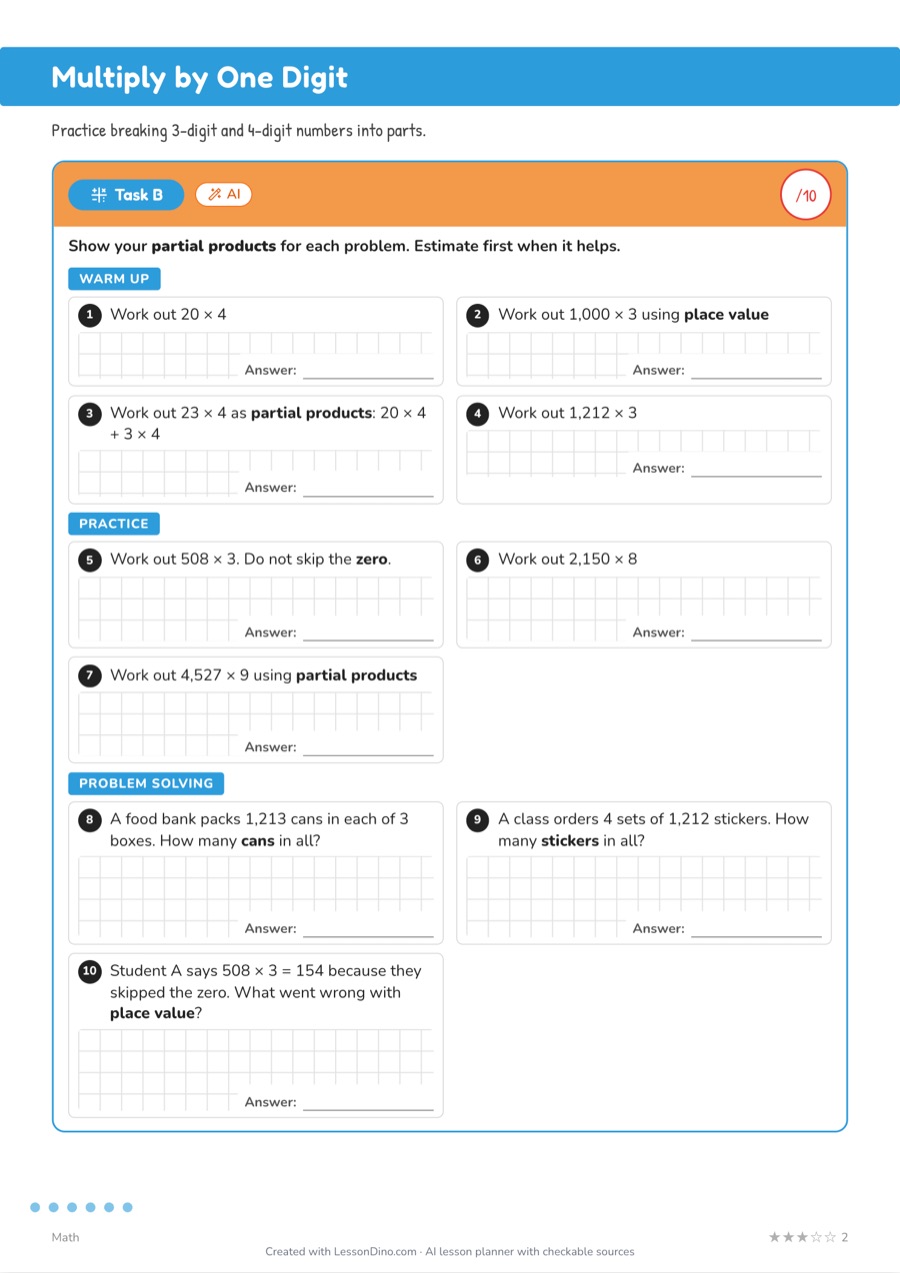
Multiply by One Digit
Practice breaking 3-digit and 4-digit numbers into parts.
Show your partial products for each problem. Estimate first when it helps.
Warm up
- Work out 20 × 4
- Work out 1,000 × 3 using place value
- Work out 23 × 4 as partial products: 20 × 4 + 3 × 4
- Work out 1,212 × 3
Practice
- Work out 508 × 3. Do not skip the zero.
- Work out 2,150 × 8
- Work out 4,527 × 9 using partial products
Problem solving
- A food bank packs 1,213 cans in each of 3 boxes. How many cans in all?
- A class orders 4 sets of 1,212 stickers. How many stickers in all?
- Student A says 508 × 3 = 154 because they skipped the zero. What went wrong with place value?
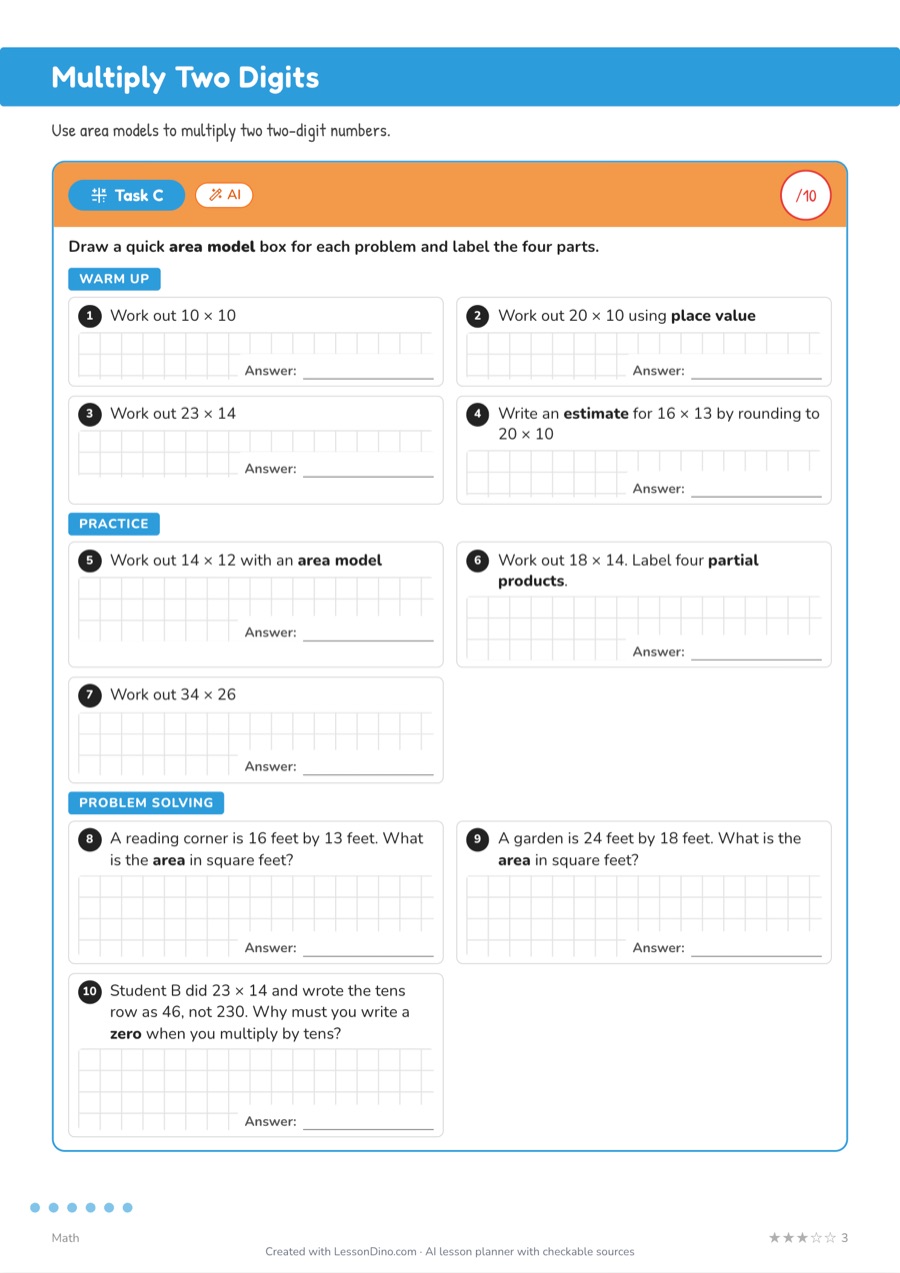
Multiply Two Digits
Use area models to multiply two two-digit numbers.
Draw a quick area model box for each problem and label the four parts.
Warm up
- Work out 10 × 10
- Work out 20 × 10 using place value
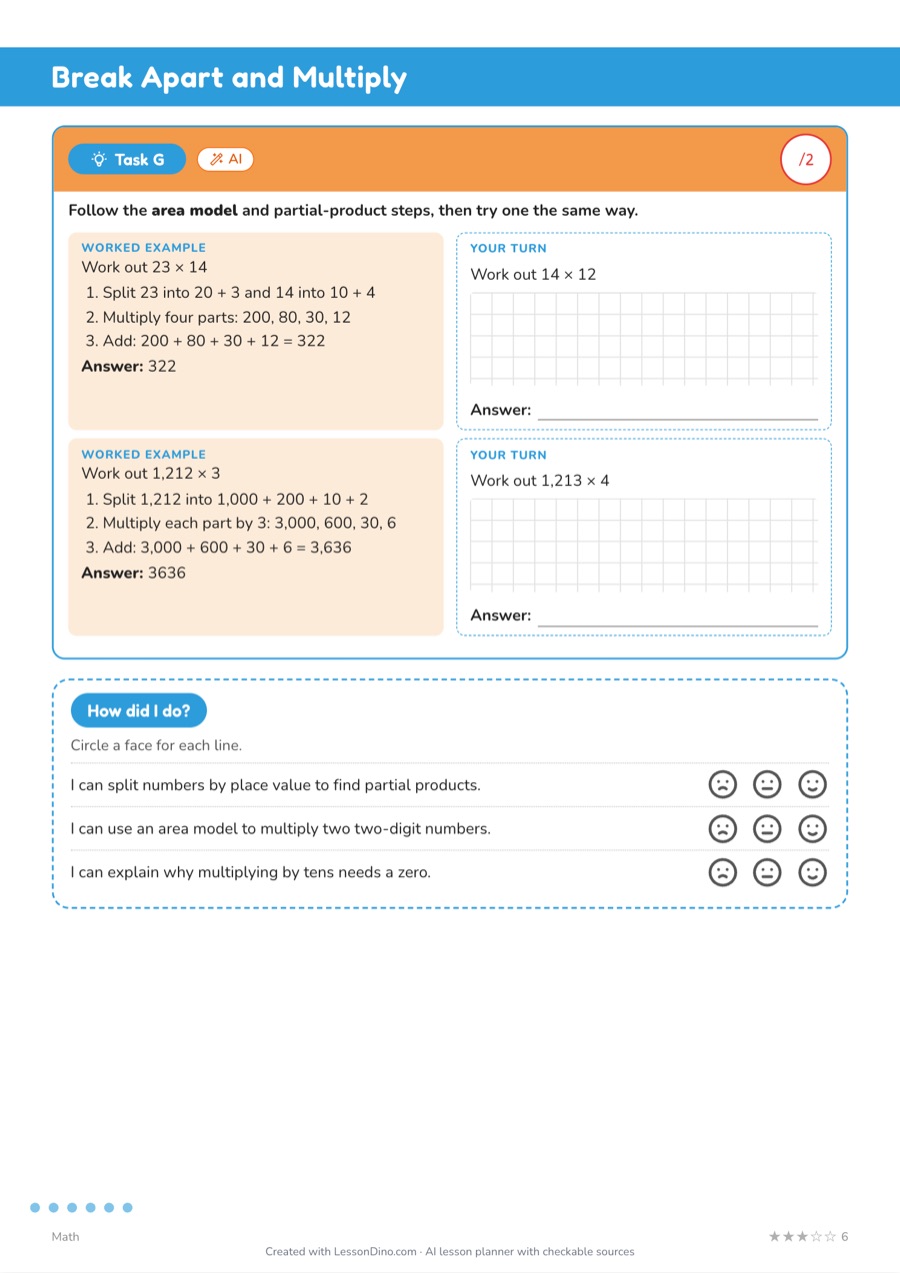
- Work out 23 × 14
- Write an estimate for 16 × 13 by rounding to 20 × 10
Practice
- Work out 14 × 12 with an area model
- Work out 18 × 14. Label four partial products.
- Work out 34 × 26
Problem solving
- A reading corner is 16 feet by 13 feet. What is the area in square feet?
- A garden is 24 feet by 18 feet. What is the area in square feet?
- Student B did 23 × 14 and wrote the tens row as 46, not 230. Why must you write a zero when you multiply by tens?
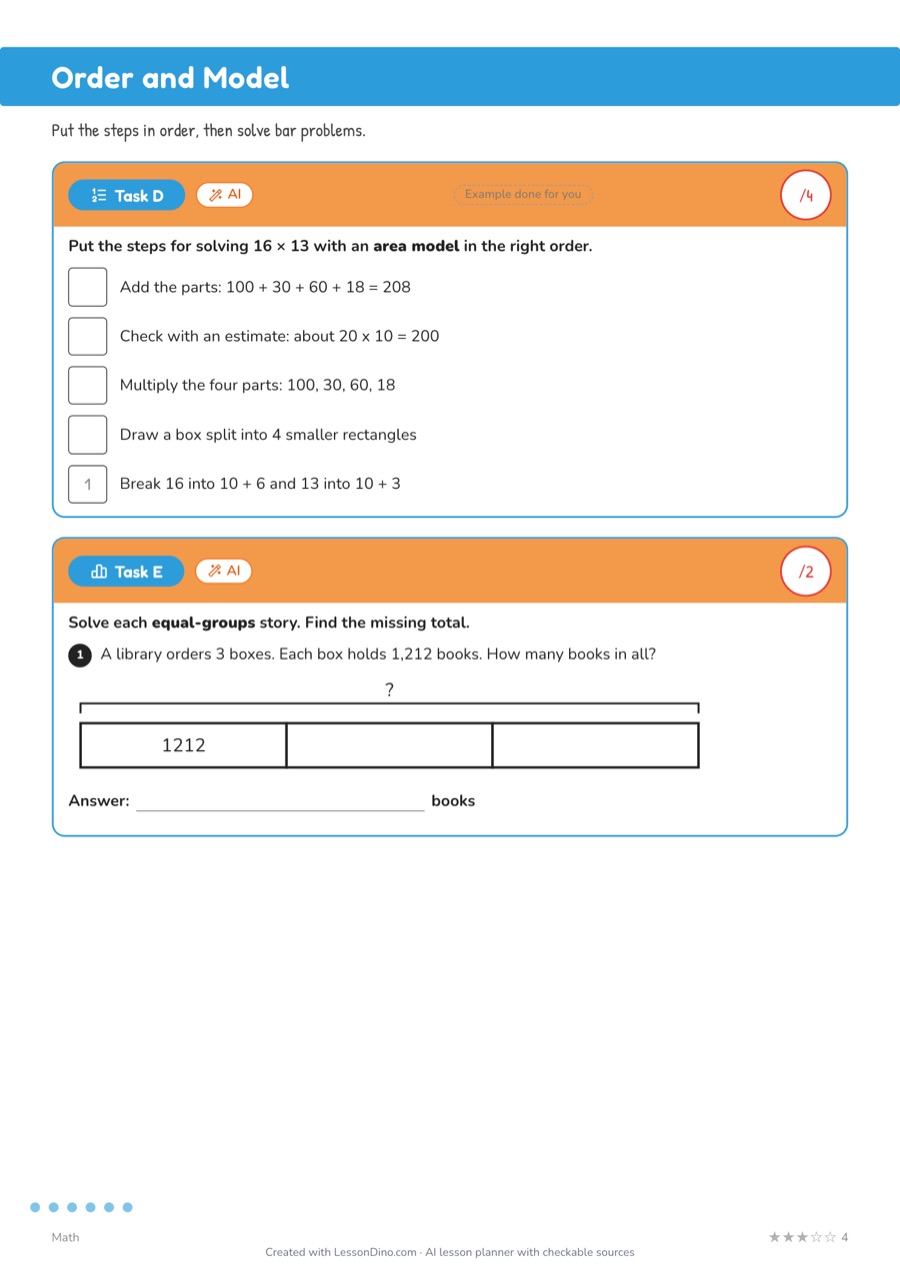
Order and Model
Put the steps in order, then solve bar problems.
Put the steps for solving 16 × 13 with an area model in the right order.
Solve each equal-groups story. Find the missing total.
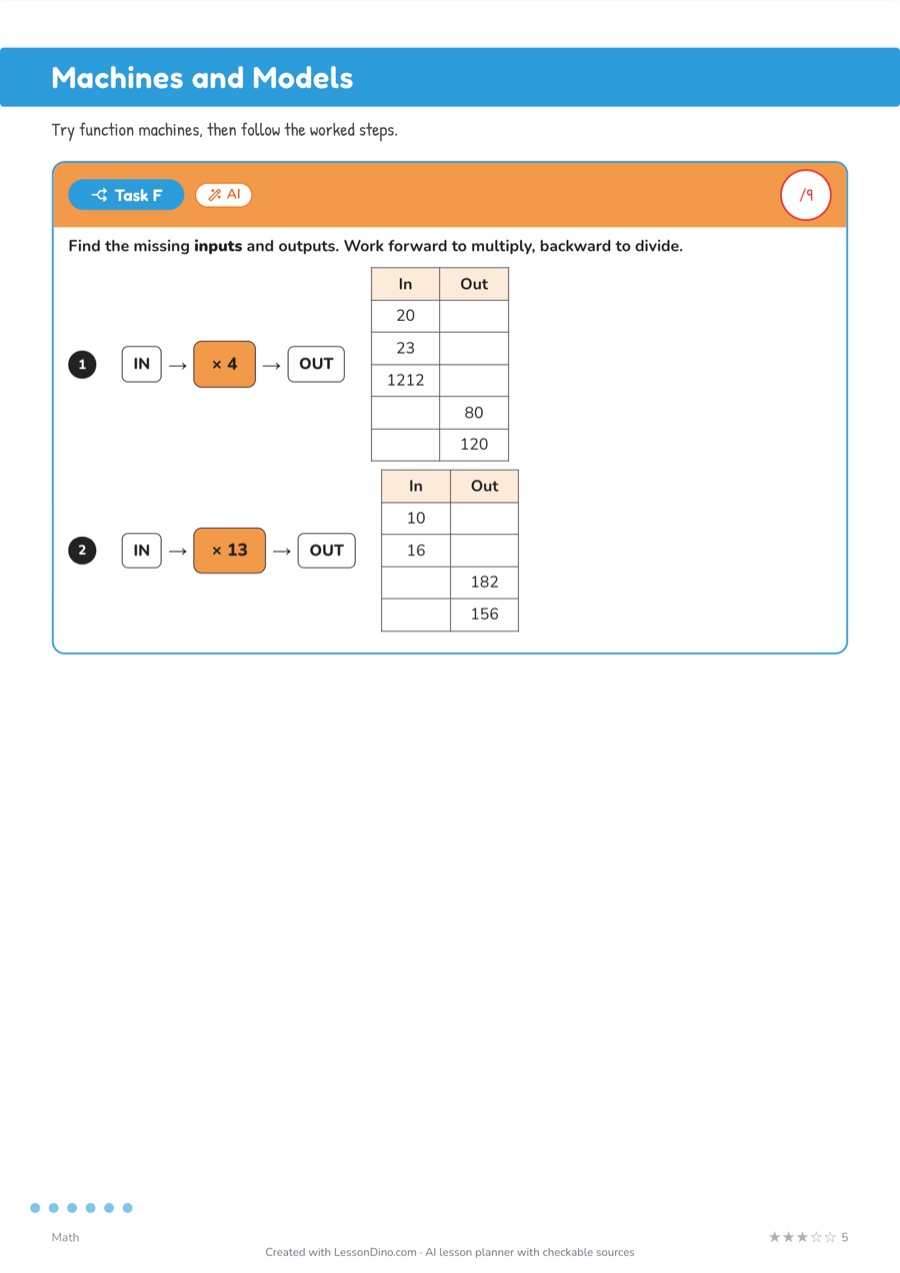
Machines and Models
Try function machines, then follow the worked steps.
Find the missing inputs and outputs. Work forward to multiply, backward to divide.
Page 6
Follow the area model and partial-product steps, then try one the same way.
Answers
Show the answers
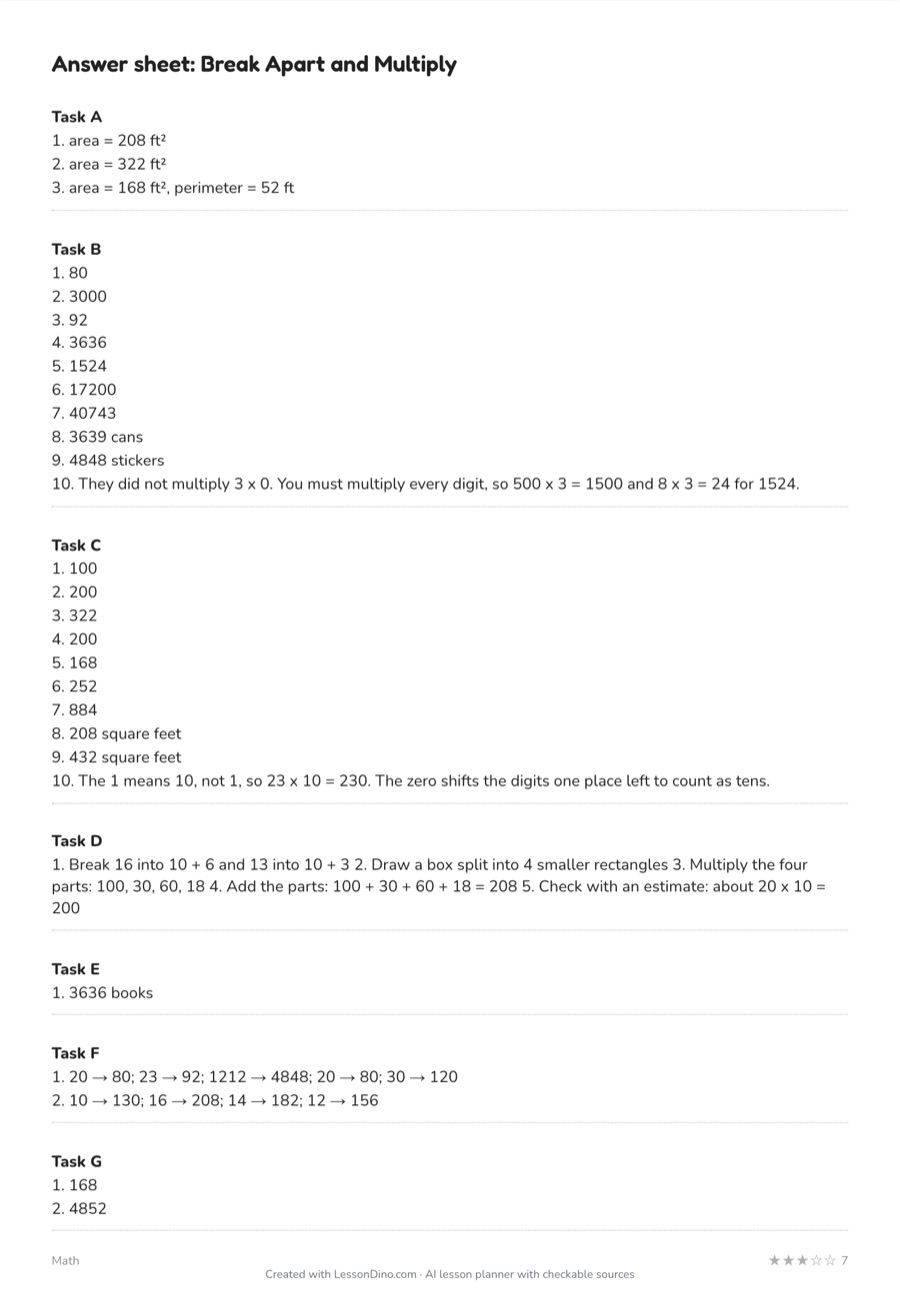
- Work out 20 × 4 80
- Work out 1,000 × 3 using place value 3000
- Work out 23 × 4 as partial products: 20 × 4 + 3 × 4 92
- Work out 1,212 × 3 3636
- Work out 508 × 3. Do not skip the zero. 1524
- Work out 2,150 × 8 17200
- Work out 4,527 × 9 using partial products 40743
- A food bank packs 1,213 cans in each of 3 boxes. How many cans in all? 3639 cans
- A class orders 4 sets of 1,212 stickers. How many stickers in all? 4848 stickers
- Student A says 508 × 3 = 154 because they skipped the zero. What went wrong with place value? They did not multiply 3 x 0. You must multiply every digit, so 500 x 3 = 1500 and 8 x 3 = 24 for 1524.
- Work out 10 × 10 100
- Work out 20 × 10 using place value 200
- Work out 23 × 14 322
- Write an estimate for 16 × 13 by rounding to 20 × 10 200
- Work out 14 × 12 with an area model 168
- Work out 18 × 14. Label four partial products. 252
- Work out 34 × 26 884
- A reading corner is 16 feet by 13 feet. What is the area in square feet? 208 square feet
- A garden is 24 feet by 18 feet. What is the area in square feet? 432 square feet
- Student B did 23 × 14 and wrote the tens row as 46, not 230. Why must you write a zero when you multiply by tens? The 1 means 10, not 1, so 23 x 10 = 230. The zero shifts the digits one place left to count as tens.
The answer sheet is the last picture above.
Curriculum
Multiply a whole number of up to four digits by a one-digit whole number, and multiply two two-digit numbers, using strategies based on place value and the properties of operations. Illustrate and explain the calculation by using equations, rectangular arrays, and/or area models.
Made with Lesson Dino's AI on 16 October 2026. AI can make mistakes, so check the answers and facts against the sources before you teach.