Slides

Lesson plan
Break Apart and Multiply Big Numbers
Students learn to break numbers by place value and multiply each part. They draw area models to solve 2-digit by 2-digit and 4-digit by 1-digit problems.
Objectives
- Students will multiply up to four digits by one digit using place-value breakup.
- Students will multiply two two-digit numbers using area models and partial products.
- Students will illustrate and explain steps with equations, arrays and area models.
Success criteria
- I can break numbers apart and multiply each part correctly.
- I can draw an area model and add the four parts.
- I can explain why multiplying by tens adds a zero.
Key words
| Word | Meaning |
|---|---|
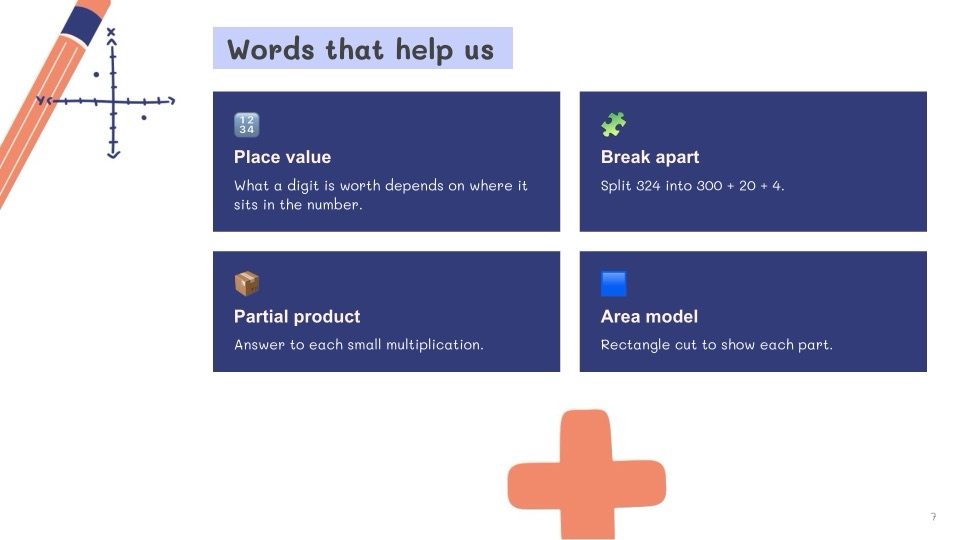
| place value | what a digit is worth depends on where it sits in the number |
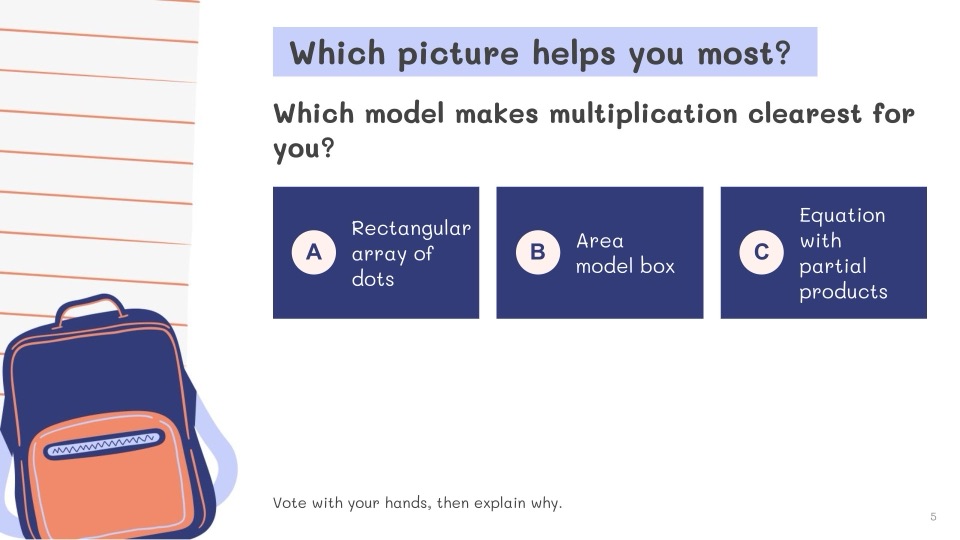
| rectangular array | rows of dots or blocks lined up to make a box shape |
| area model | a rectangle drawing split into smaller parts to show each multiply step |
| partial products | answers to the small multiplications that you add to get the total |
| estimate | a close guess found by using round numbers to check |
Timed plan (60 minutes)
| Time | Stage | What happens |
|---|---|---|
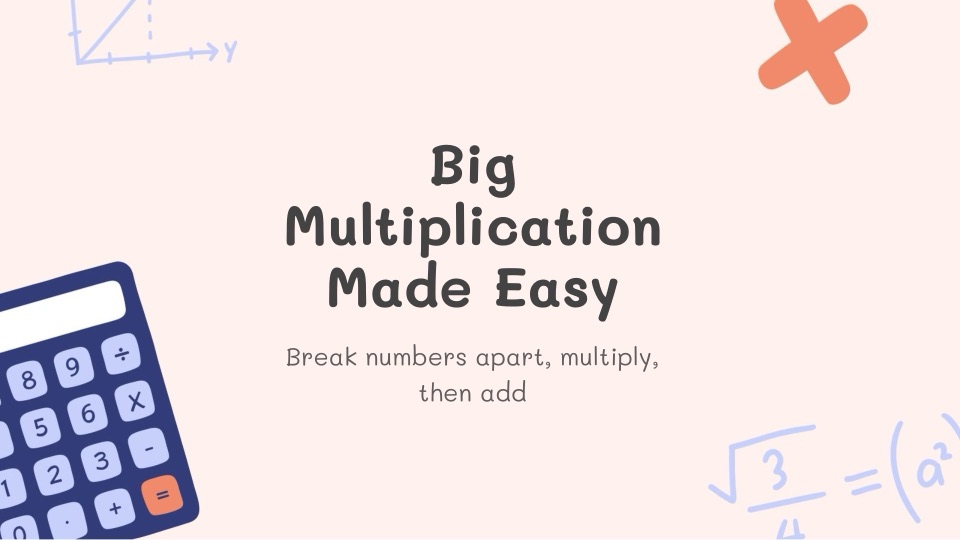
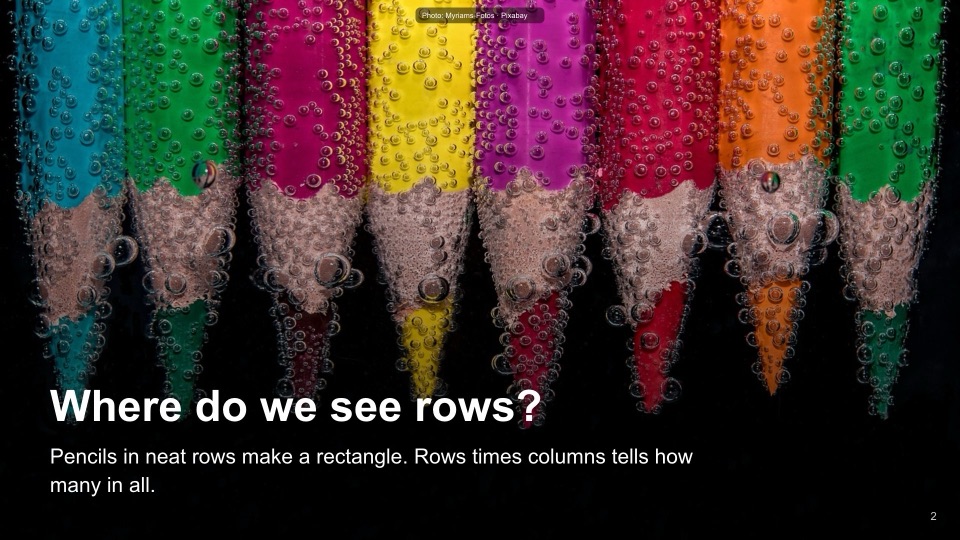
| 8 min | Starter | Hook interest with the reading corner problem and recall rows-times-columns. Show the title that says break numbers apart, multiply, then add. Show the photo of pencils in neat rows that make a rectangle. Read the reading corner hook and ask students to turn and talk about how rows help. Take 2-3 quick ideas and link rows times columns to finding a total. |
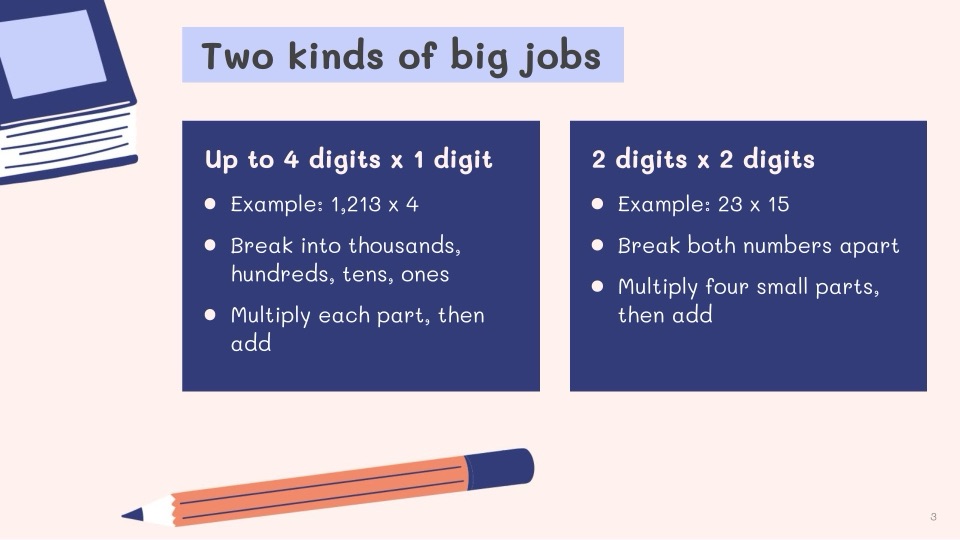
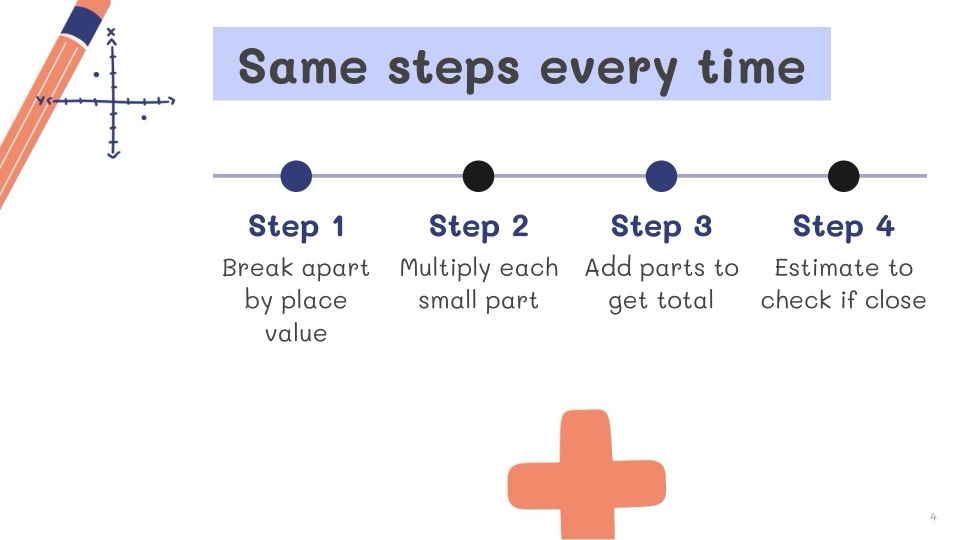
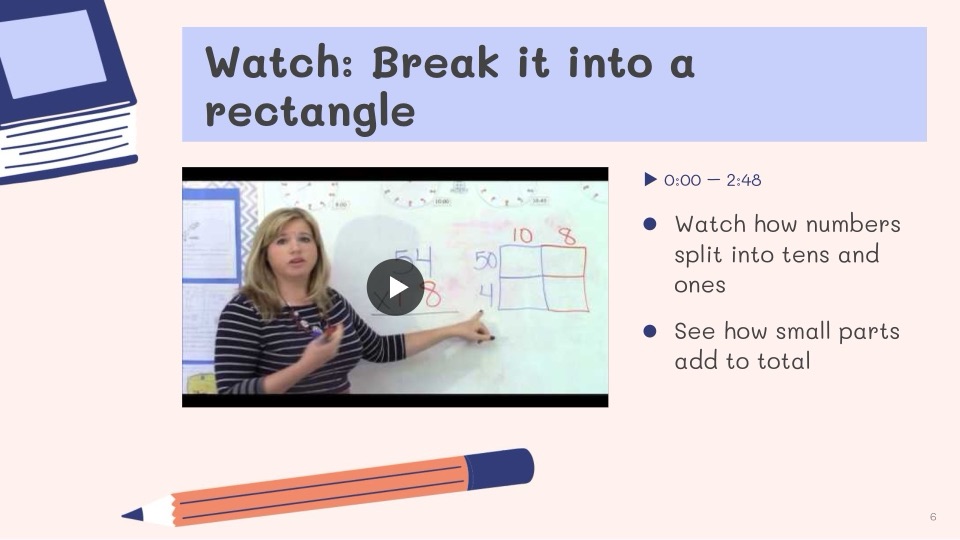
| 12 min | Teaching | Model multiplying up to four digits by one digit with place-value parts. Show the compare of two kinds of big jobs: up to 4 digits x 1 digit and two 2-digit numbers. Play the video that shows how numbers split into tens and ones and small parts add to total. Model 1,212 x 3 on the board by splitting into thousands, hundreds, tens and ones. Add the four partial products in place-value columns and estimate to check if close. |
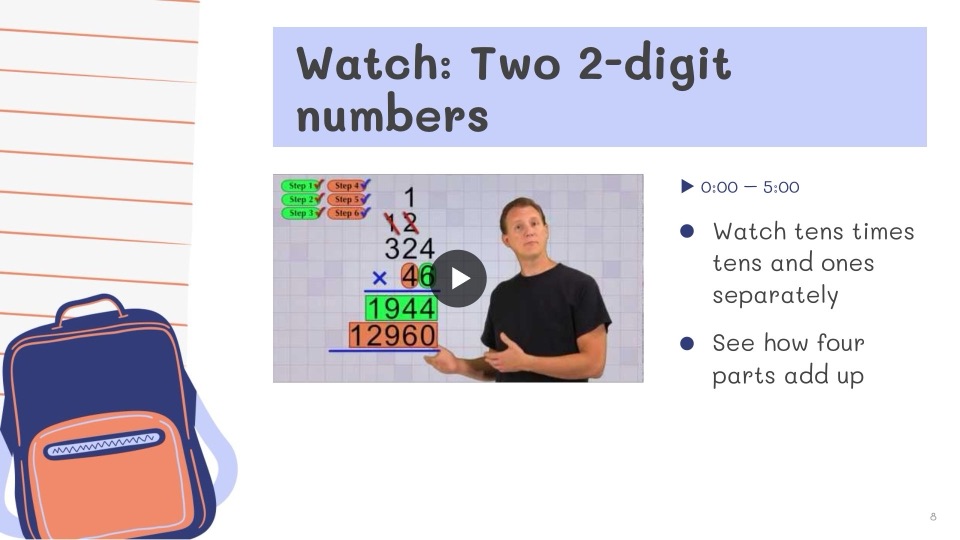
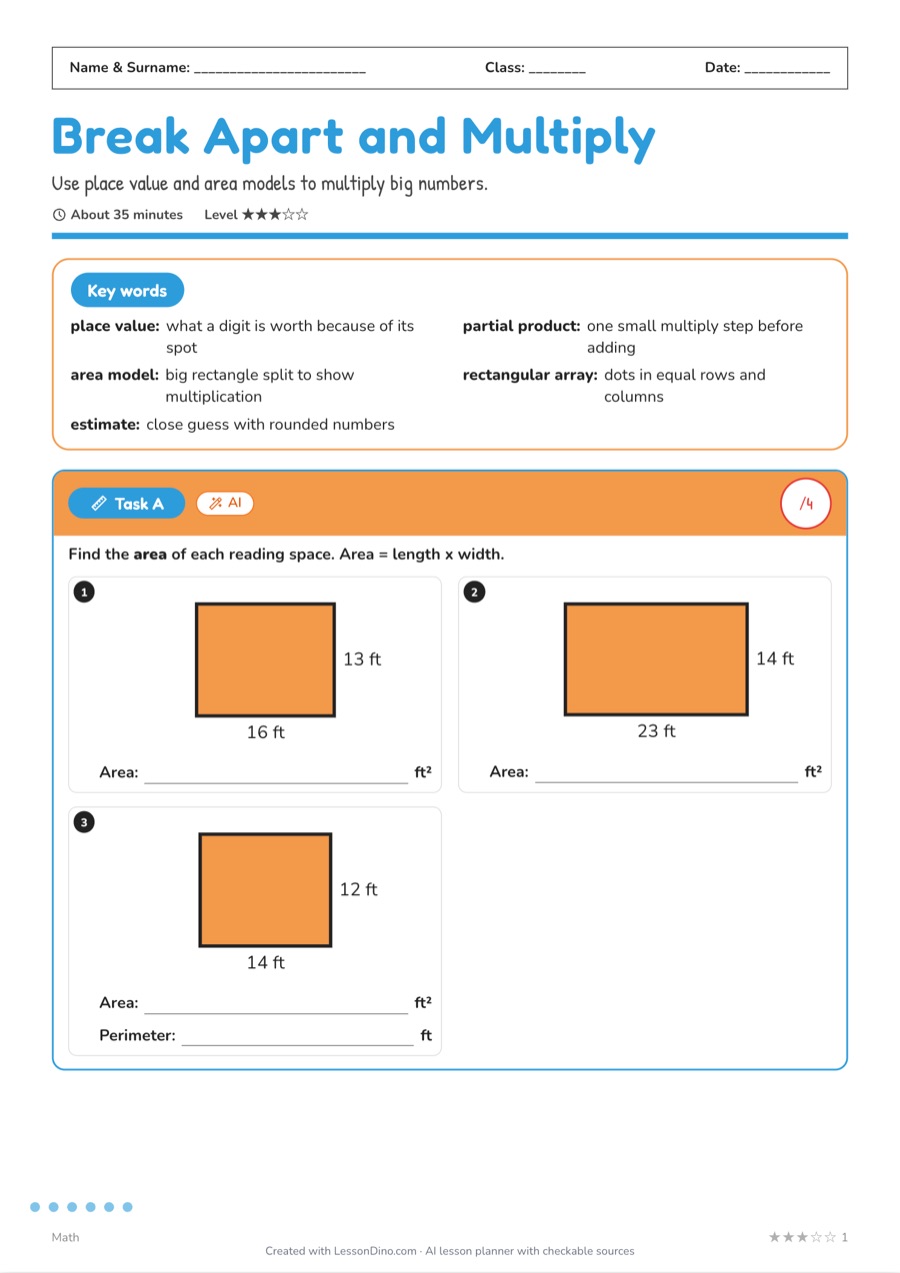
| 12 min | Guided practice | Connect base-ten thinking to the four-part area model for two 2-digit numbers. Show the word cards for place value, break apart and answers to small multiplications. Play the video that shows tens times tens and ones separately and how four parts add up. Draw 16 x 13 split into 10 + 6 and 10 + 3 and label the four smaller boxes. Think aloud while multiplying and adding: 100 + 30 + 60 + 18 = 208 square feet. |
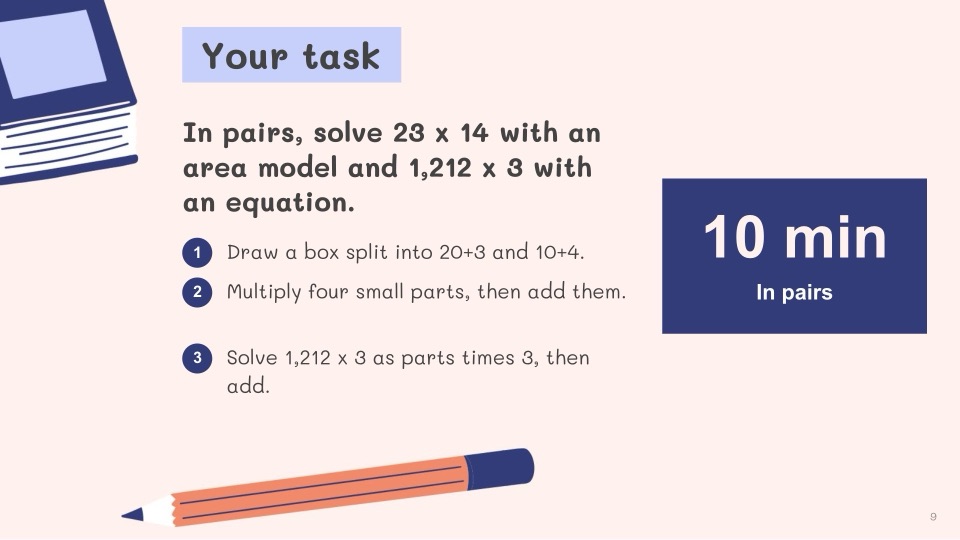
| 18 min | Main activity | Pairs solve 23 x 14 with an area model and 1,212 x 3 with equations. Hand out large graph paper, colored markers, scissors and glue sticks for the reading corner design. Direct pairs to draw a box split into 20+3 and 10+4, find four small areas, then add. Direct pairs to solve 1,212 x 3 with four partial-product equations lined up by place value. Circulate, check place-value alignment, and prompt pairs to color and label each part with its equation. |
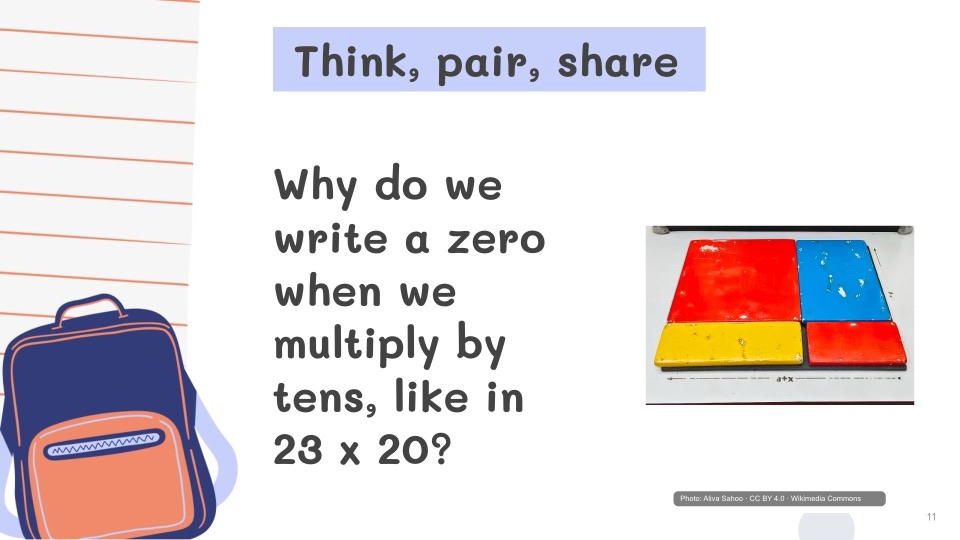
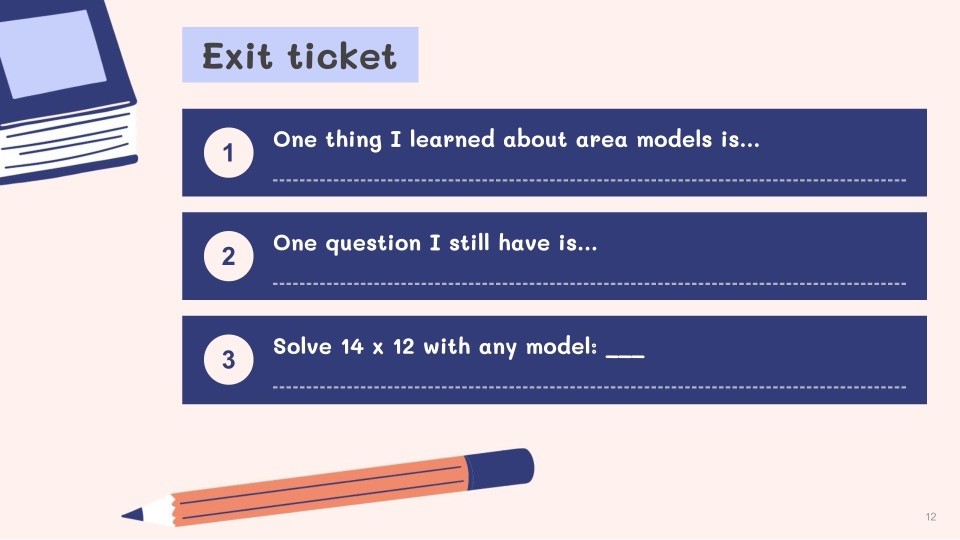
| 10 min | Plenary | Explain the shortcut method and the tens-zero and check understanding. Share that the fast stacking method is just partial products in disguise. Display 34 x 26 as 34 x 6 plus 34 x 20 and ask why the second row counts as 20. Pose why we write a zero when we multiply by tens, like in 23 x 20, for think-pair-share. Hand out exit tickets that ask for learning, a question, and solving 14 x 12 with any model. |
Common mistakes
- Missing placeholder zero in the tens row, so second product is too small by ten times
How to spot it: Second row is written one place too far right and total is far below estimate
Write a 0 first for the tens row, then multiply by the tens digit, because it means x20 not x2 - Skipping zero inside the top number, like 508 x 3 written as 154
How to spot it: Product has too few digits and zero place was never multiplied
Multiply every digit including zeros, 3 x 0 = 0 plus any carry, to keep place value - Reusing old carries in the next row
How to spot it: Second partial product is too large and carries are not crossed out
Cross out carries between rows and start each row fresh to avoid double-adding
Support
- Give students the four equations with one number missing to fill in before adding.
- Start with 12 x 3 and 14 x 2 with a pre-split box and a multiplication chart for facts through 12 x 12.
- Provide a place-value chart with splits already written, like 1,213 = 1,000 + 200 + 10 + 3.
Stretch
- Have students design and solve a 24 x 18 space and compare whose area is larger.
- Challenge students with 4,527 x 9 using the same split-and-add method.
- Add a multistep order, like 15 boxes at $12 each plus 3 packs at $14 each, and find the combined total.
Check questions
- Solve 14 x 12 with any model and show your parts.
Answer: 168. Example: 100 + 20 + 40 + 8 = 168. - Why do we write a zero when we multiply by tens, like in 23 x 20?
Answer: The 2 means 20, so we multiply by 20; the zero shifts the product into tens. - One thing I learned about area models is...
Answer: Example: they split numbers by place value and the small products add to the total.
Curriculum
Multiply a whole number of up to four digits by a one-digit whole number, and multiply two two-digit numbers, using strategies based on place value and the properties of operations. Illustrate and explain the calculation by using equations, rectangular arrays, and/or area models.
Video clips
Clips on YouTube, from the start and end times we chose. Check each one before you show it.
-
Area Array Model for Multi-digit Multiplication from 0:00 to 2:48
The Caffeinated Teacher: 4th Grade Mathematics - Lesson 3: Multi-digit multiplication using the Area Array Model
Made for Grade 4 and models multiplication with arrays and area models at the right pace for ages 9-10.
-
Multi-Digit Multiplication Pt 2 from 0:00 to 5:00
mathantics: Math Antics - Multi-Digit Multiplication Pt 2
Teaches two two-digit number multiplication with partial products, ideal for ages 9-10 in Grade 4.
Worksheet
Sources
- Grade 4 Math Curriculum - Fairfax County Public Schools fcps.edu
- Grade 4 Math | SFUSD sfusd.edu
- 11 Multi Digit Multiplication Worksheets for Practice endolab.ucdavis.edu
- Social Mathematical Practices in Multi-Digit Multiplication files.eric.ed.gov
- Multi Digit Multiplication - Online Lesson reports.bankstreet.edu
- Multi Digit Multiplication Worksheets - Great Research epm.cnc.stanford.edu
- KCM Math Hub kcm.nku.edu
- Multi Digit Multiplication And Division Worksheets - Great ... epm.cnc.stanford.edu
- Multi-Digit Multiplication: Complete Guide timestablestrainer.com
- Multi-digit Multiplication Interactive | Math activities math-center.org
- Multi-Digit Multiplication - Math Minute mathminute.com
- Multi-Digit Multiplication: Standard Algorithm Step by Step mathifykids.com
- Multi Digit Multiplication Steps and Examples - Vedantu vedantu.com
- Multiplication Worksheets (Multi-Digit) | Free & Printable superteacherworksheets.com
- Simple Strategy to Teach Multi-Digit Multiplication mathgeekmama.com
- Multi Digit Multiplication Worksheets - Math Salamanders math-salamanders.com
- How to Teach Multi Digit Multiplication so Your Students ... educatewithease.com
- How To Teach Multi-Digit Multiplication makemathmoments.com
- Long multiplication - KS2 Maths - Learning with BBC Bitesize bbc.co.uk
- Multi digit Multiplication and Division | Math Concepts for Kids kidsworldfun.com
- Teaching Multi-Digit Multiplication Strategies - Mikey D Teach mikeydteach.com
- Multiple Multi-digit Multiplication Strategies – SMathSmarts smathsmarts.com
Picture credits
Made with Lesson Dino's AI on 16 October 2026. AI can make mistakes, so check facts against the sources before you teach.