The worksheet
About this worksheet
Students learn to measure angles in whole-number degrees with a protractor. They sketch ordered angles and check them with a partner. This Grade 4 Math worksheet gives students (ages 9–10) six pages of practice on measuring angles, part of the measurement and data unit. It goes with our free Measuring angles lesson, which has the slides and a timed lesson plan.
What it covers
By the end, students should be able to:
- Students will measure angles in whole-number degrees using a protractor.
- Students will sketch angles of a specified measure using a ruler.
How to use it
- Use it for practice after the teaching part of the lesson, once students have seen the worked examples on the slides.
- Support: Let students choose only from 30°, 60°, 90°, 120°, or 150° first, with the starting ray already drawn.
- Stretch: Request angles that must open left or down so the drawer has to find the correct 0° line.
- The answer sheet is the last page, so you can print it on its own or let students check their own work.
Key vocabulary
- angle: an opening made by two straight rays meeting at a point
- vertex: the corner point where the two rays meet
- protractor: a half-circle tool marked from 0 to 180 for finding openings
- degree: a tiny unit that tells how big an opening is
- right angle: a square corner opening that measures exactly 90 degrees
Mistakes to watch for
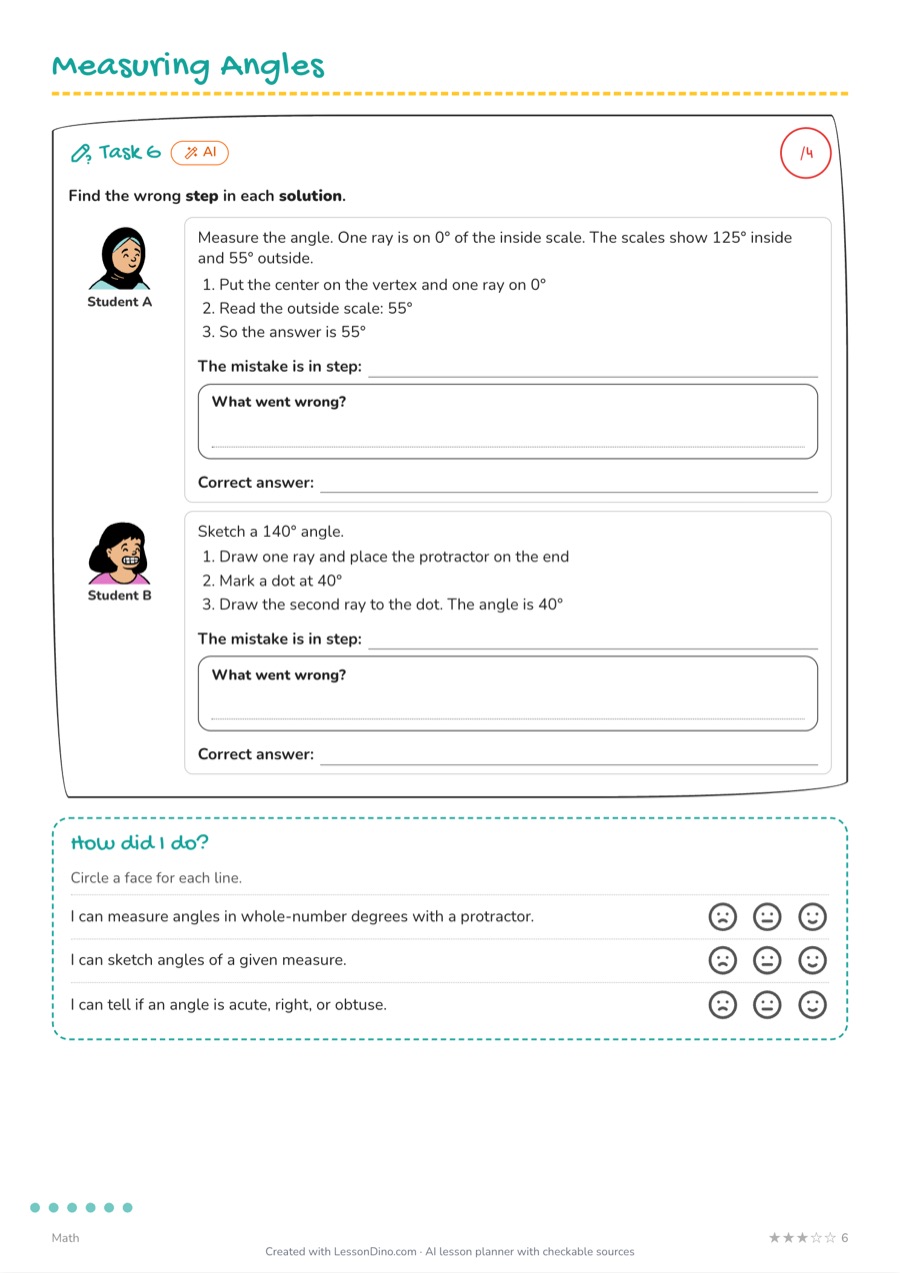
- Reading the wrong scale, such as 115° for a 65° acute angle. Ask if it looks smaller than a right angle; if yes, use the scale that gives under 90°.
- Not placing the protractor midpoint exactly on the vertex. Slide the protractor until the middle mark sits on the vertex and the ray runs through 0°.
- Sketching freehand without a ruler or straightedge so sides are wobbly. Redraw rays with a ruler or straightedge from endpoint through the dot.
What's on the worksheet
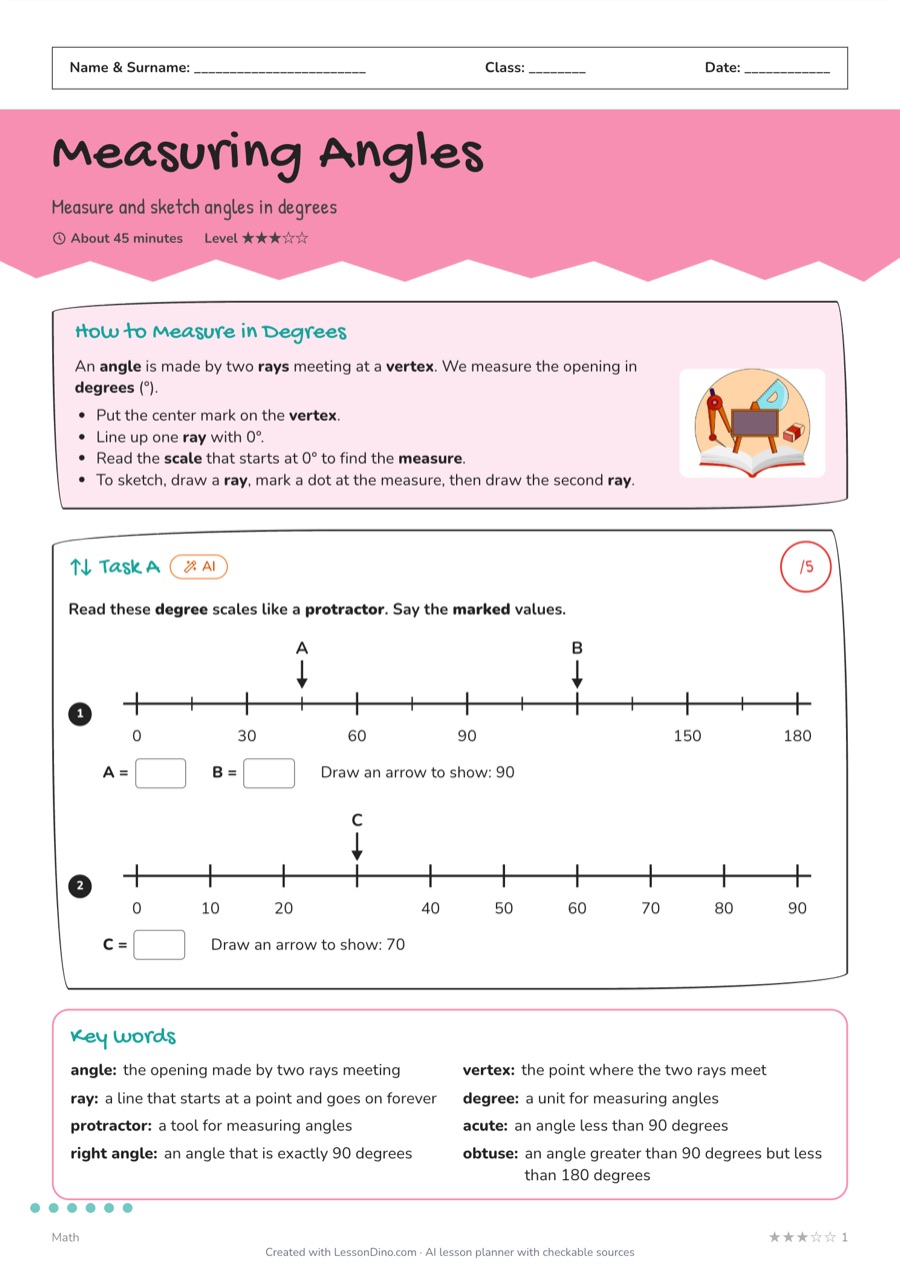
Angles All Around
Learn how a protractor measures angles in degrees.
How to Measure in Degrees
- An angle is made by two rays meeting at a vertex. We measure the opening in degrees (°).
- Put the center mark on the vertex.
- Line up one ray with 0°.
- Read the scale that starts at 0° to find the measure.
- To sketch, draw a ray, mark a dot at the measure, then draw the second ray.
Read these degree scales like a protractor. Say the marked values.
| Word | Meaning |
|---|---|
| angle | the opening made by two rays meeting |
| vertex | the point where the two rays meet |
| ray | a line that starts at a point and goes on forever |
| degree | a unit for measuring angles |
| protractor | a tool for measuring angles |
| acute | an angle less than 90 degrees |
| right angle | an angle that is exactly 90 degrees |
| obtuse | an angle greater than 90 degrees but less than 180 degrees |
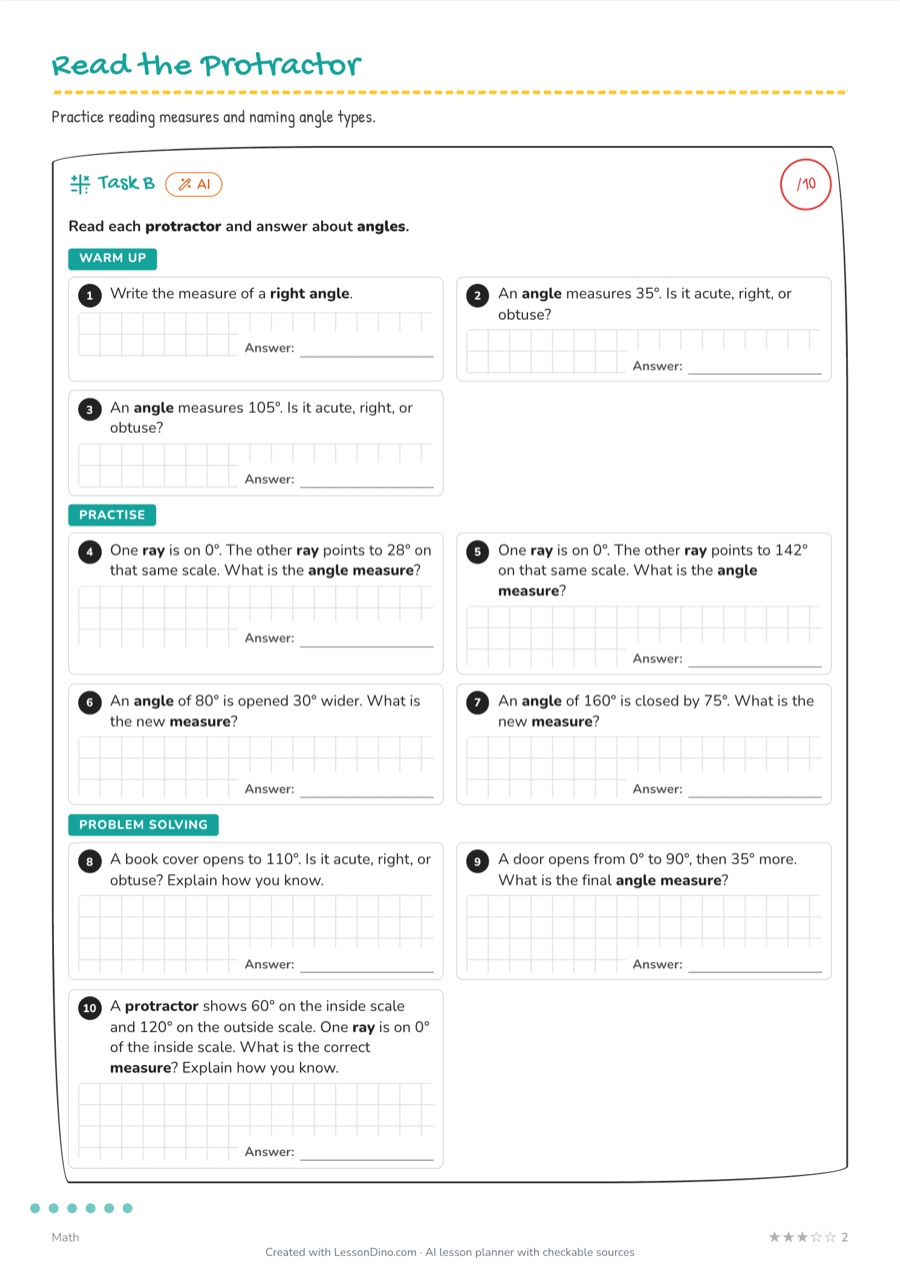
Read the Protractor
Practice reading measures and naming angle types.
Read each protractor and answer about angles.
Warm up
- Write the measure of a right angle.
- An angle measures 35°. Is it acute, right, or obtuse?
- An angle measures 105°. Is it acute, right, or obtuse?
Practise
- One ray is on 0°. The other ray points to 28° on that same scale. What is the angle measure?
- One ray is on 0°. The other ray points to 142° on that same scale. What is the angle measure?
- An angle of 80° is opened 30° wider. What is the new measure?
- An angle of 160° is closed by 75°. What is the new measure?
Problem solving
- A book cover opens to 110°. Is it acute, right, or obtuse? Explain how you know.
- A door opens from 0° to 90°, then 35° more. What is the final angle measure?
- A protractor shows 60° on the inside scale and 120° on the outside scale. One ray is on 0° of the inside scale. What is the correct measure? Explain how you know.
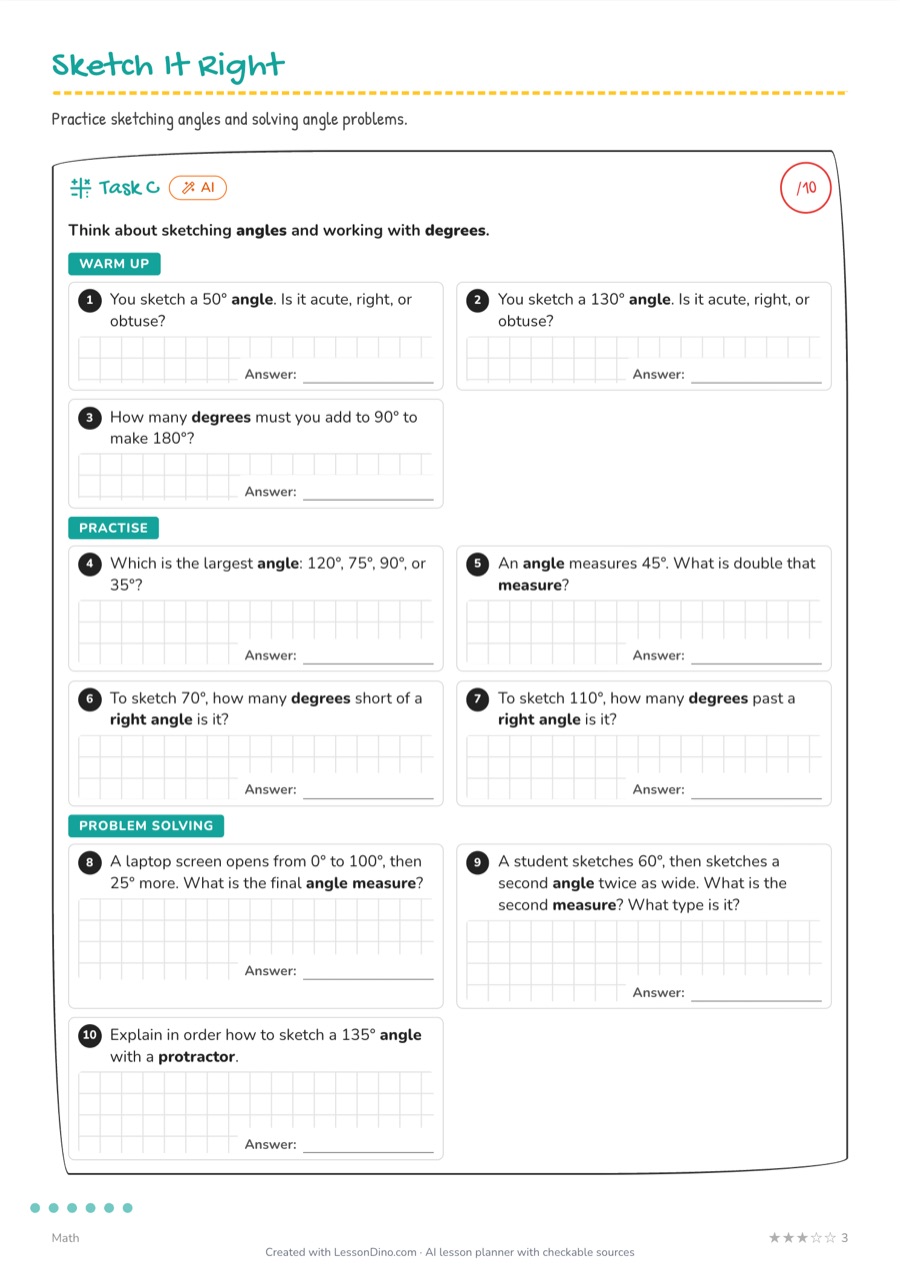
Sketch It Right
Practice sketching angles and solving angle problems.
Think about sketching angles and working with degrees.
Warm up
- You sketch a 50° angle. Is it acute, right, or obtuse?
- You sketch a 130° angle. Is it acute, right, or obtuse?
- How many degrees must you add to 90° to make 180°?
Practise
- Which is the largest angle: 120°, 75°, 90°, or 35°?
- An angle measures 45°. What is double that measure?
- To sketch 70°, how many degrees short of a right angle is it?
- To sketch 110°, how many degrees past a right angle is it?
Problem solving
- A laptop screen opens from 0° to 100°, then 25° more. What is the final angle measure?
- A student sketches 60°, then sketches a second angle twice as wide. What is the second measure? What type is it?
- Explain in order how to sketch a 135° angle with a protractor.
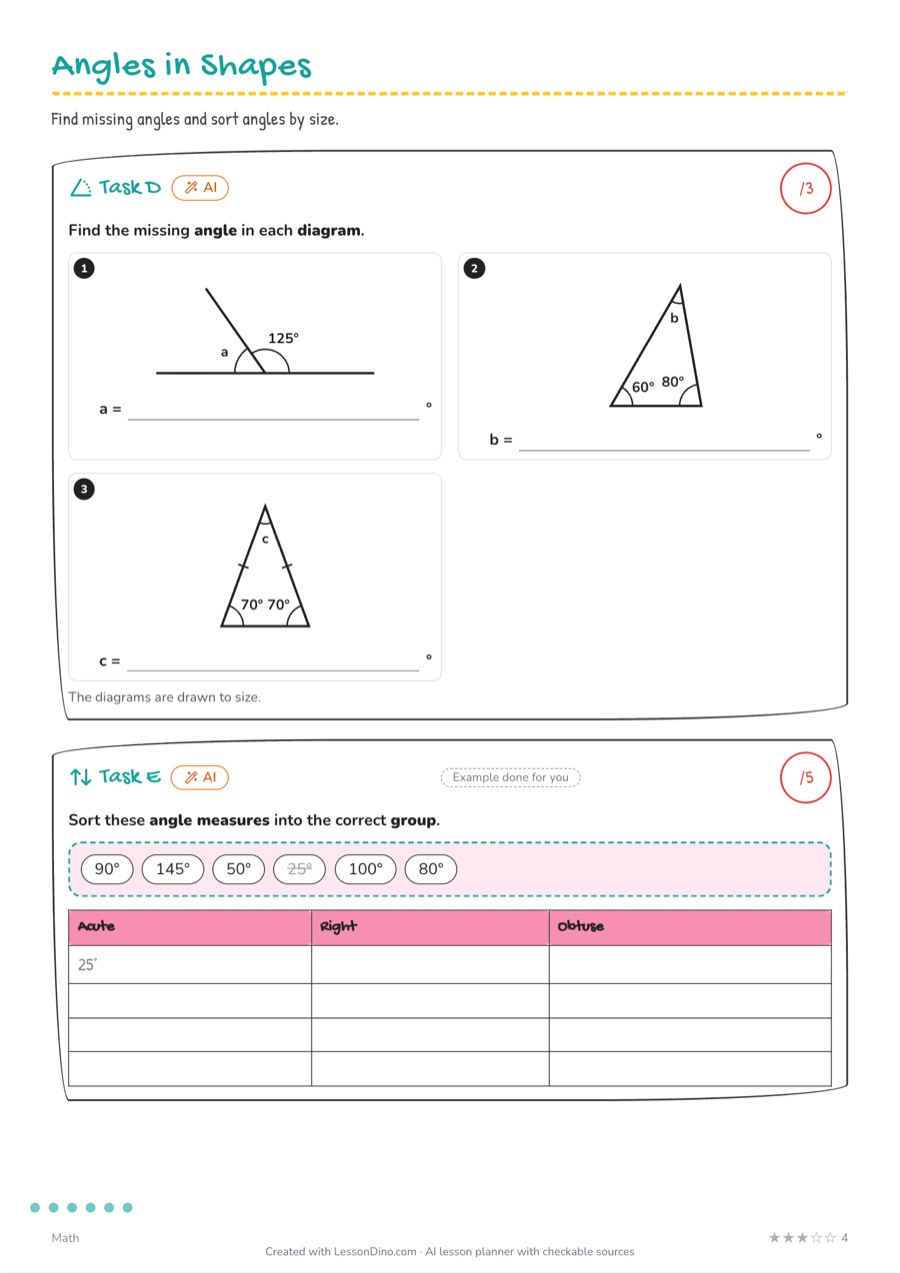
Angles in Shapes
Find missing angles and sort angles by size.
Find the missing angle in each diagram.
Sort these angle measures into the correct group.
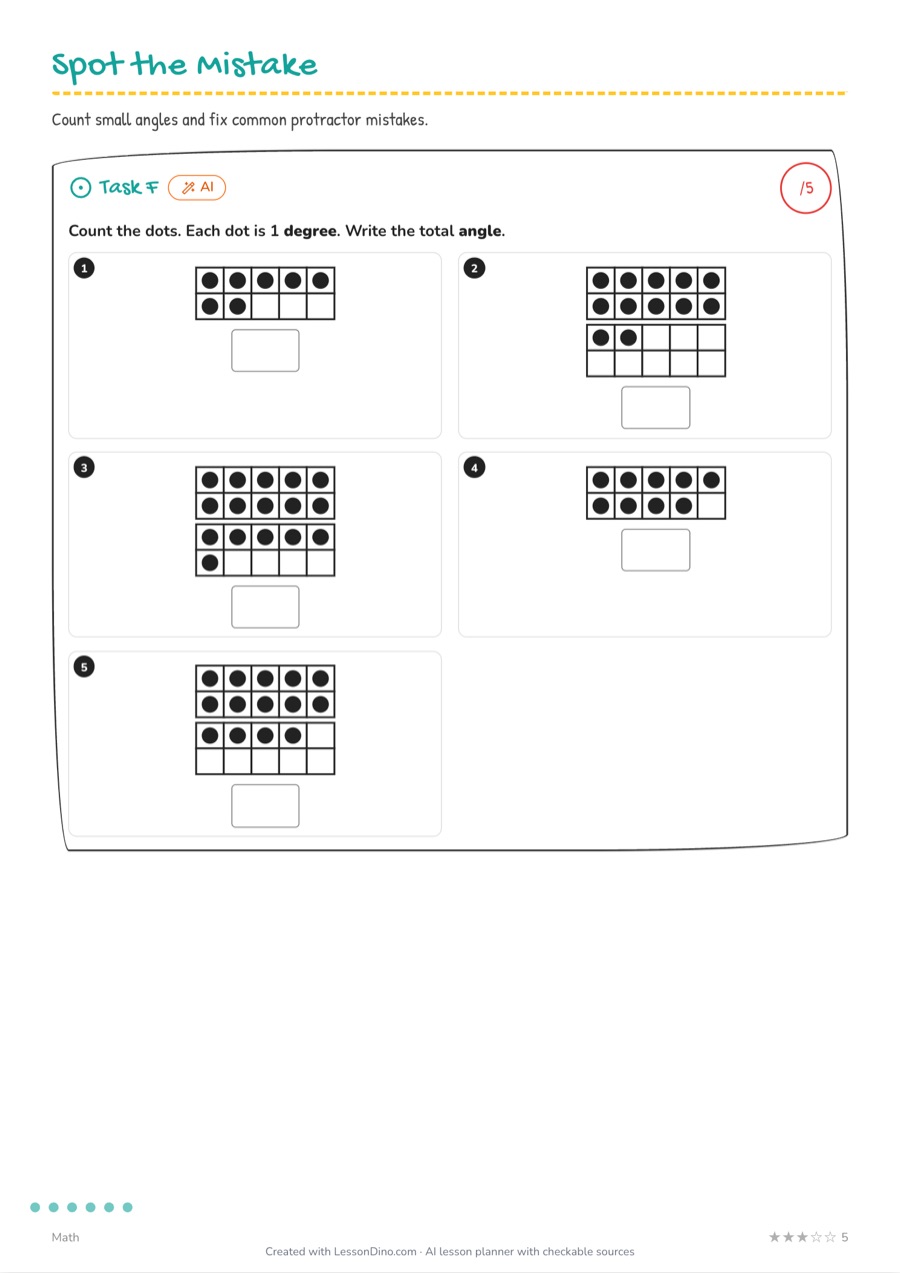
Spot the Mistake
Count small angles and fix common protractor mistakes.
Count the dots. Each dot is 1 degree. Write the total angle.
Page 6
Find the wrong step in each solution.
Answers
Show the answers
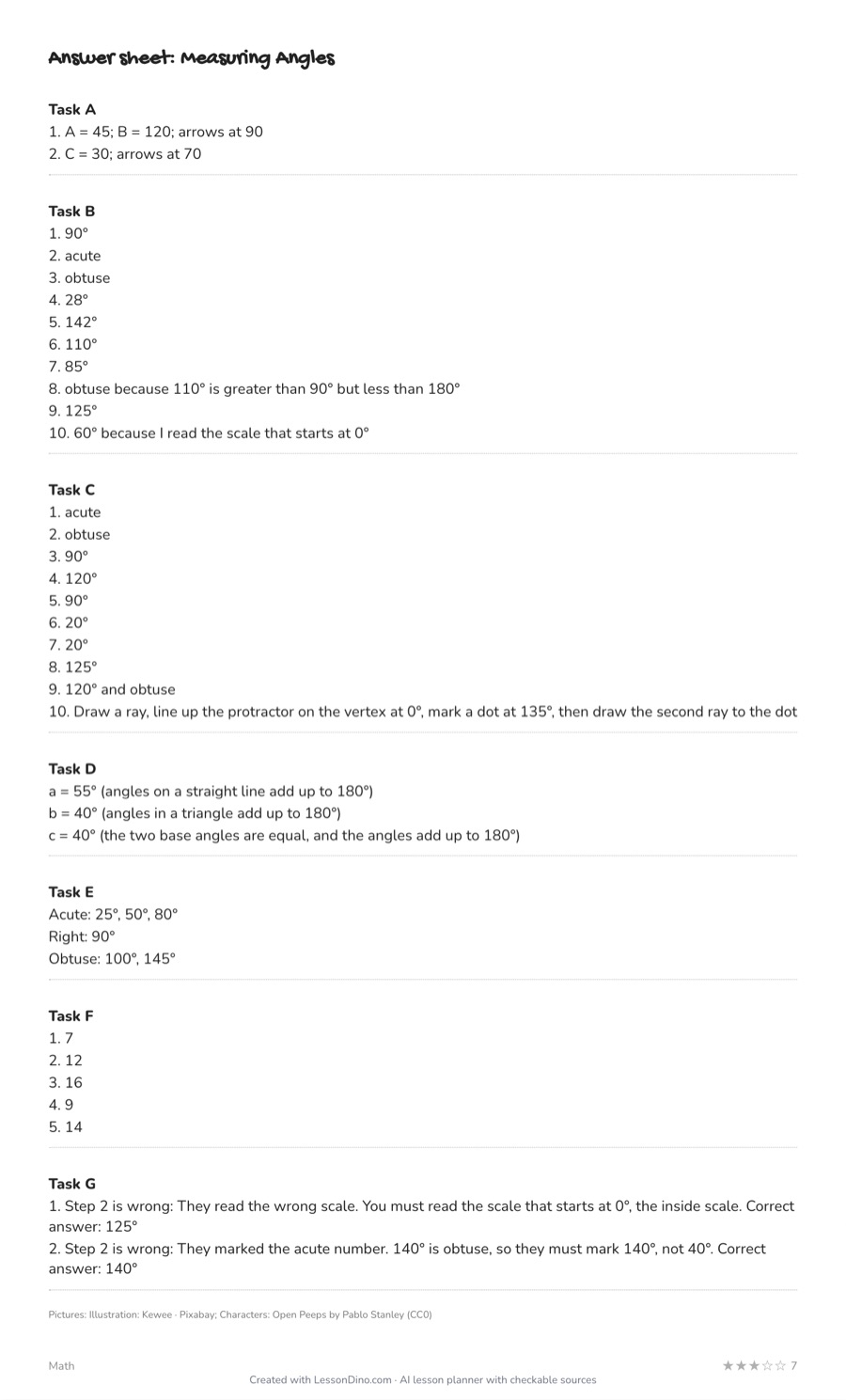
- Write the measure of a right angle. 90°
- An angle measures 35°. Is it acute, right, or obtuse? acute
- An angle measures 105°. Is it acute, right, or obtuse? obtuse
- One ray is on 0°. The other ray points to 28° on that same scale. What is the angle measure? 28°
- One ray is on 0°. The other ray points to 142° on that same scale. What is the angle measure? 142°
- An angle of 80° is opened 30° wider. What is the new measure? 110°
- An angle of 160° is closed by 75°. What is the new measure? 85°
- A book cover opens to 110°. Is it acute, right, or obtuse? Explain how you know. obtuse because 110° is greater than 90° but less than 180°
- A door opens from 0° to 90°, then 35° more. What is the final angle measure? 125°
- A protractor shows 60° on the inside scale and 120° on the outside scale. One ray is on 0° of the inside scale. What is the correct measure? Explain how you know. 60° because I read the scale that starts at 0°
- You sketch a 50° angle. Is it acute, right, or obtuse? acute
- You sketch a 130° angle. Is it acute, right, or obtuse? obtuse
- How many degrees must you add to 90° to make 180°? 90°
- Which is the largest angle: 120°, 75°, 90°, or 35°? 120°
- An angle measures 45°. What is double that measure? 90°
- To sketch 70°, how many degrees short of a right angle is it? 20°
- To sketch 110°, how many degrees past a right angle is it? 20°
- A laptop screen opens from 0° to 100°, then 25° more. What is the final angle measure? 125°
- A student sketches 60°, then sketches a second angle twice as wide. What is the second measure? What type is it? 120° and obtuse
- Explain in order how to sketch a 135° angle with a protractor. Draw a ray, line up the protractor on the vertex at 0°, mark a dot at 135°, then draw the second ray to the dot
The answer sheet is the last picture above.
Curriculum
Measure angles in whole-number degrees using a protractor. Sketch angles of specified measure.
Made with Lesson Dino's AI on 16 October 2026. AI can make mistakes, so check the answers and facts against the sources before you teach.