Slides
Lesson plan
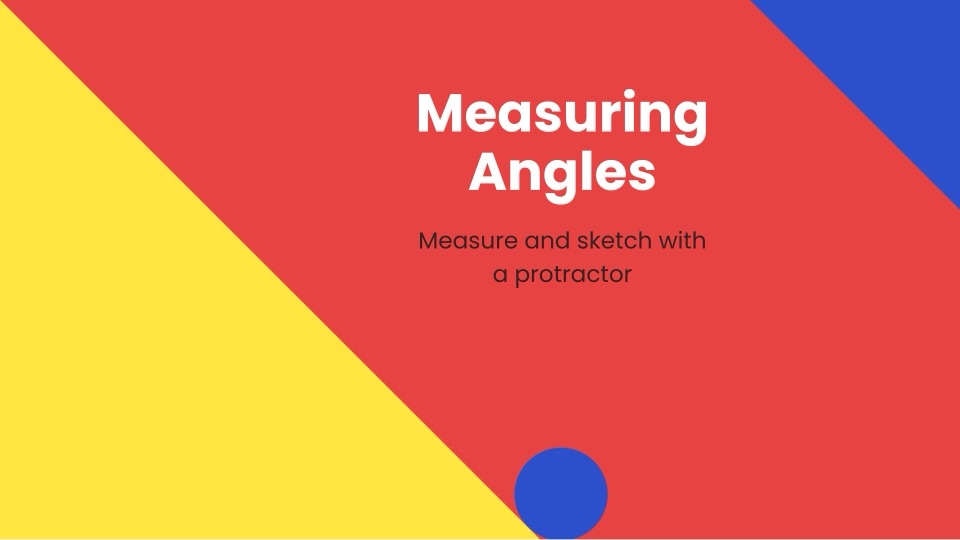
Measure and Sketch Angles with a Protractor
Students learn to measure angles in whole-number degrees with a protractor. They sketch ordered angles and check them with a partner.
Objectives
- Students will measure angles in whole-number degrees using a protractor.
- Students will sketch angles of a specified measure using a ruler.
Success criteria
- I can line up the protractor on the vertex and zero.
- I can read the correct whole-number degrees for an angle.
- I can sketch an angle of a given size and label it.
Key words
| Word | Meaning |
|---|---|
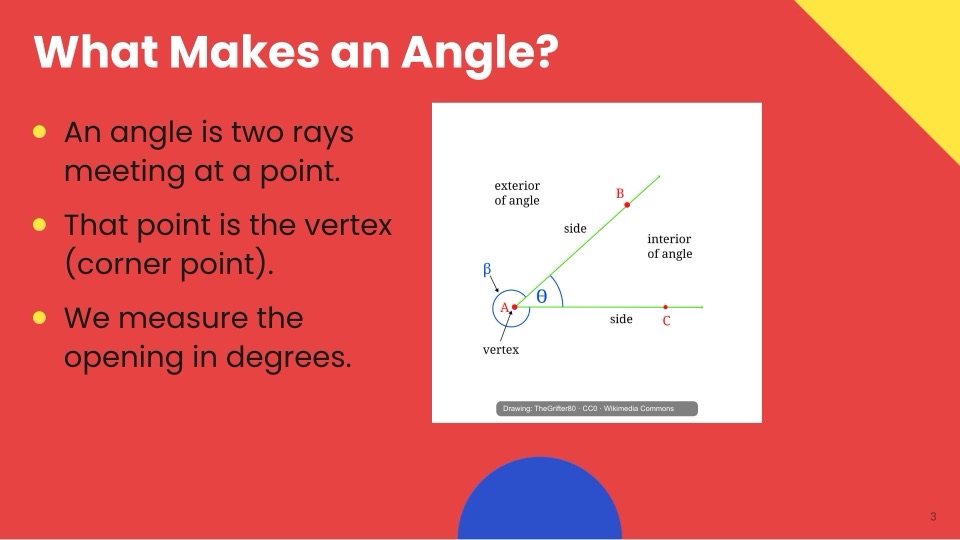
| angle | an opening made by two straight rays meeting at a point |
| vertex | the corner point where the two rays meet |
| protractor | a half-circle tool marked from 0 to 180 for finding openings |
| degree | a tiny unit that tells how big an opening is |
| right angle | a square corner opening that measures exactly 90 degrees |
Timed plan (60 minutes)
| Time | Stage | What happens |
|---|---|---|
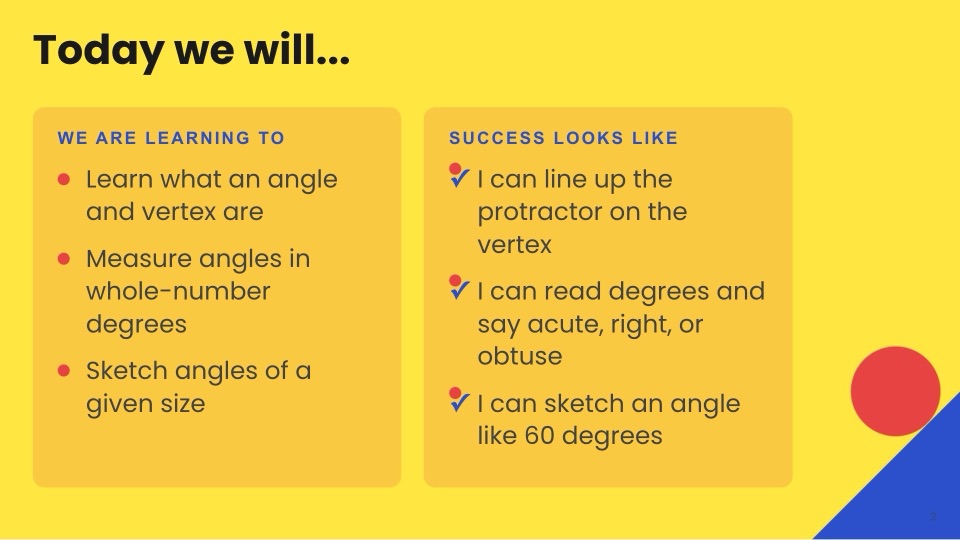
| 5 min | Starter | Recall small and wide openings and hook students for measuring and sketching. Show Slide 2 and read the goals: measure in whole-number degrees and sketch angles of a given size. Say the hook: Student A, pick a number. Student B, you have to draw it exactly. Then you switch and get revenge. Show Slide 5 and ask pairs to name where they see a small opening and a wide opening. Take 3 quick ideas and link small to acute and wide to obtuse. |
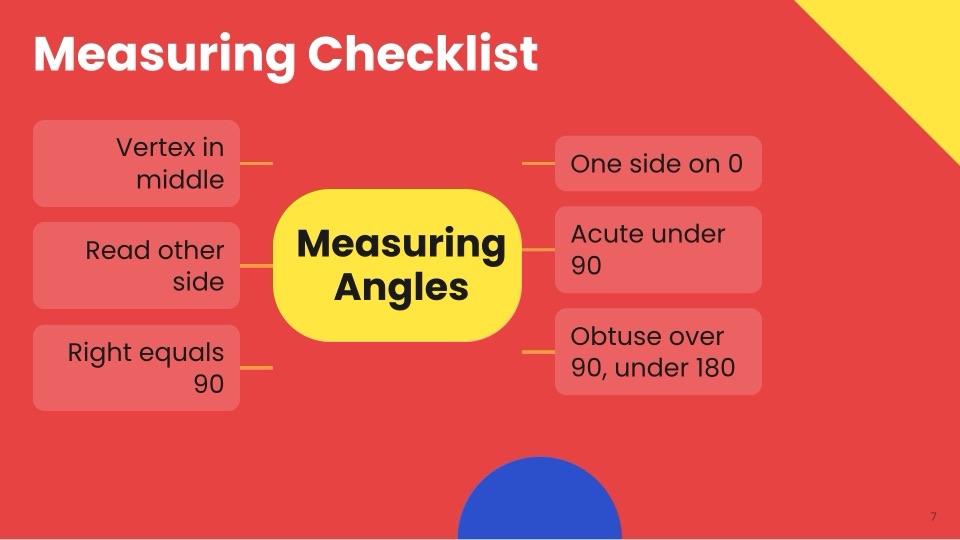
| 12 min | Teaching: measuring | Teach correct protractor placement and reading in whole-number degrees. Show Slide 3 and explain an angle is formed when two rays share a common endpoint called a vertex. Show Slide 4 and explain the protractor is a half-circle that shows degrees from 0° to 180°. Model on a large acute angle: put the midpoint on the vertex, line up one ray with the 0° line, read where the second ray crosses the numbers. Show Slide 7 checklist and classify the angle as acute, right, or obtuse. |
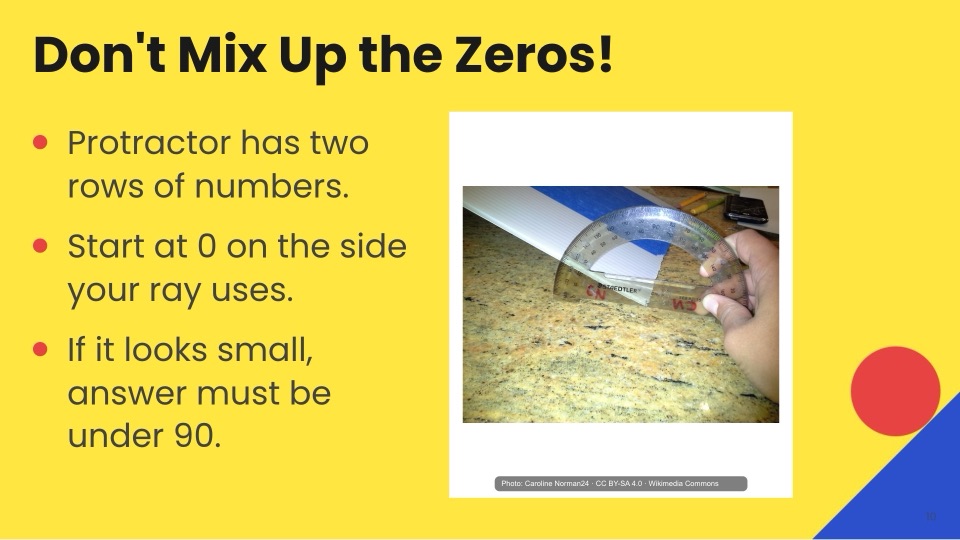
| 13 min | Teaching: zeros and sketching | Teach choosing the correct scale and sketching an ordered angle. Show Slide 10 and explain the protractor has two rows of numbers and you start at 0 on the side your ray uses. Remind the class an acute angle measures less than 90° and an obtuse angle measures greater than 90° but less than 180°. Model sketching 120°: draw a ray with a ruler or straightedge, place midpoint on the endpoint, dot 120°, connect dot to endpoint. Check the sketch by re-measuring and showing it is obtuse, not 60°. |
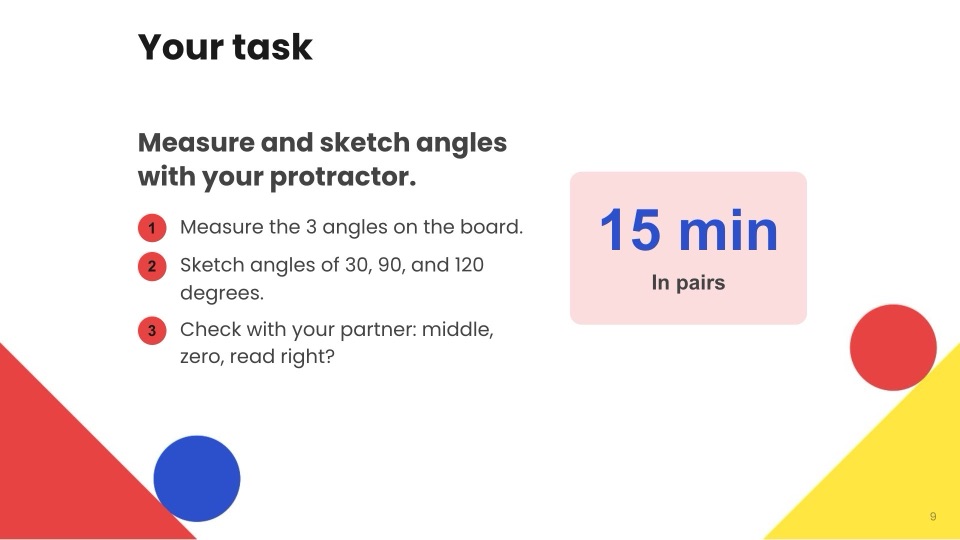
| 20 min | Main activity | Practice sketching requested whole-number angles and verifying by measuring. Show Slide 9 task and explain Partner Mystery Draw roles for Student A and Student B. Model one round: Student A says 45°, Student B draws a ray with a ruler or straightedge, marks 45°, draws second ray, Student A measures to check. Set the rule: say a whole-number measure between 20° and 160°, sketch, measure, initial if within 2°. Circulate, check middle, zero, read, and prompt partners to switch roles every 5 minutes. |
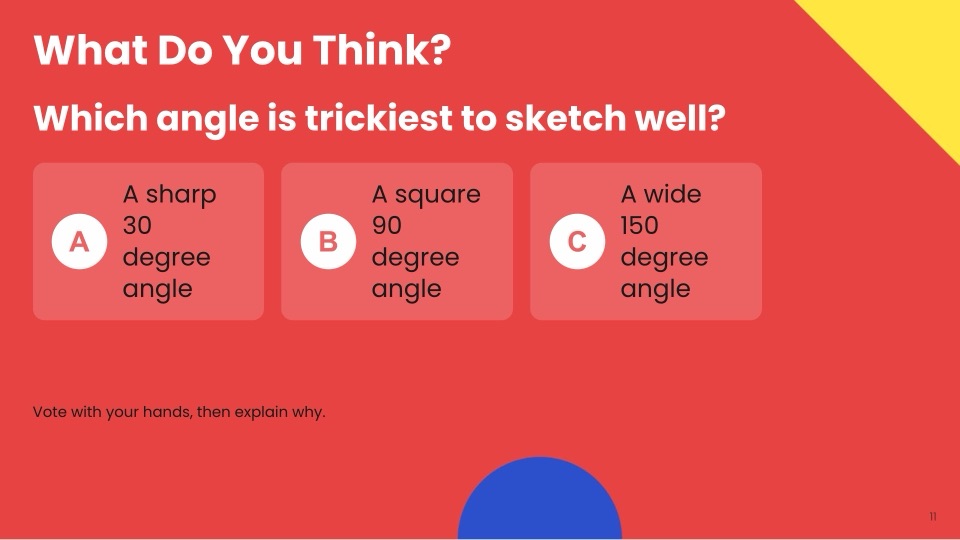
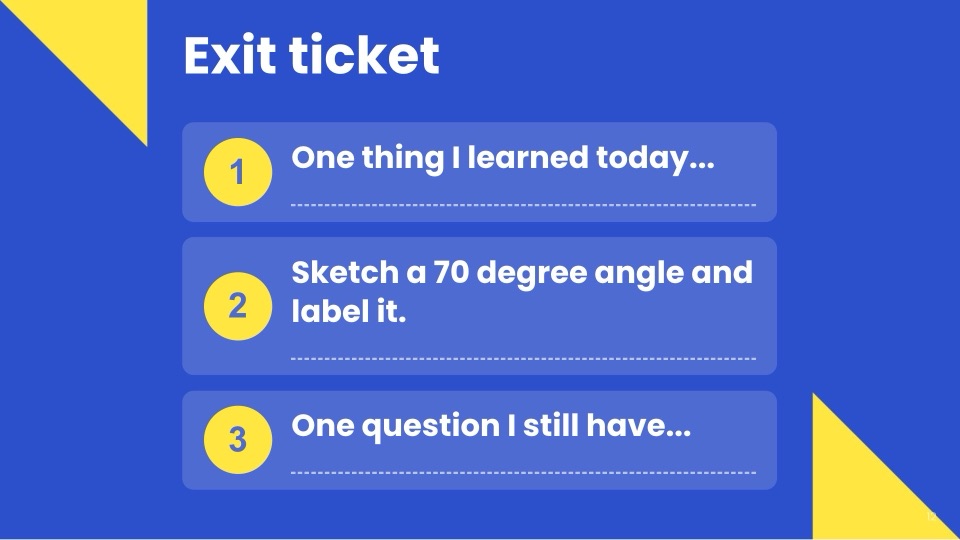
| 10 min | Plenary | Return to the goals and check measuring and sketching. Show Slide 11 and take a vote on which angle is trickiest to sketch: 30°, 90°, or 150°. Ask two students to explain their vote using middle, zero, and read. Show Slide 12 exit ticket: sketch a 70° angle and label it. Review I can statements and collect exit sketches. |
Common mistakes
- Reading the wrong scale, such as 115° for a 65° acute angle
How to spot it: Answer is over 90° but the angle looks small and acute
Ask if it looks smaller than a right angle; if yes, use the scale that gives under 90° - Not placing the protractor midpoint exactly on the vertex
How to spot it: Zero line floats above or below the ray and measures vary by 5-10°
Slide the protractor until the middle mark sits on the vertex and the ray runs through 0° - Sketching freehand without a ruler or straightedge so sides are wobbly
How to spot it: Second side does not go through the dot or start at the endpoint
Redraw rays with a ruler or straightedge from endpoint through the dot
Support
- Let students choose only from 30°, 60°, 90°, 120°, or 150° first, with the starting ray already drawn.
Stretch
- Request angles that must open left or down so the drawer has to find the correct 0° line.
Check questions
- Where do you put the middle mark to measure 40°?
Answer: On the vertex, with one ray on 0° - An angle looks acute but you read 125°. What should it be?
Answer: 55°, because acute measures less than 90° - Sketch a 70° angle and label it. How do you finish?
Answer: Draw ray with ruler, dot 70°, connect dot to endpoint and label 70°
Curriculum
Measure angles in whole-number degrees using a protractor. Sketch angles of specified measure.
Video clips
Clips on YouTube, from the start and end times we chose. Check each one before you show it.
-
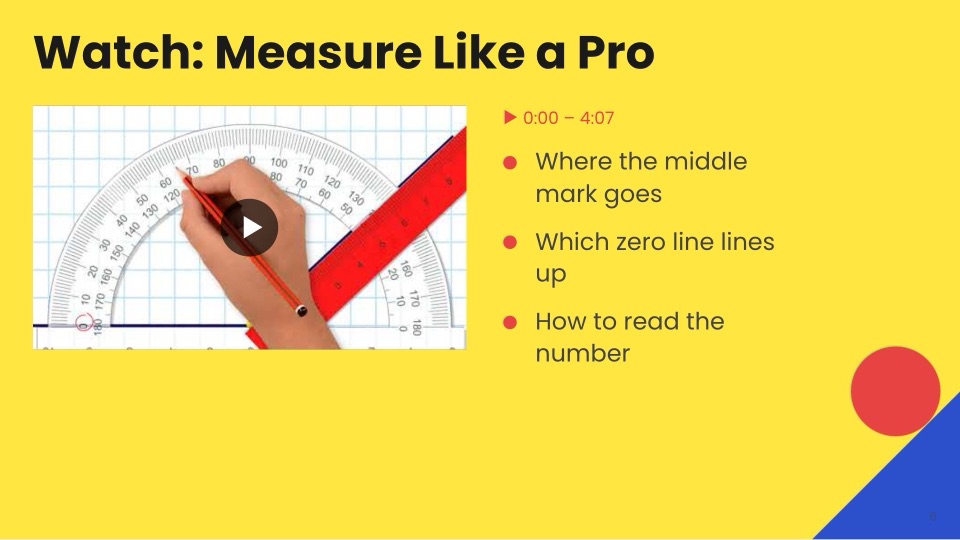
Measure and draw Grade 4 from 0:00 to 4:07
MATH-N-ROLL: Measuring and Drawing Angles with a Protractor. Grade 4
Made for Grade 4 and covers both measuring and drawing angles with a protractor at the right pace for 9-10-year-olds.
-
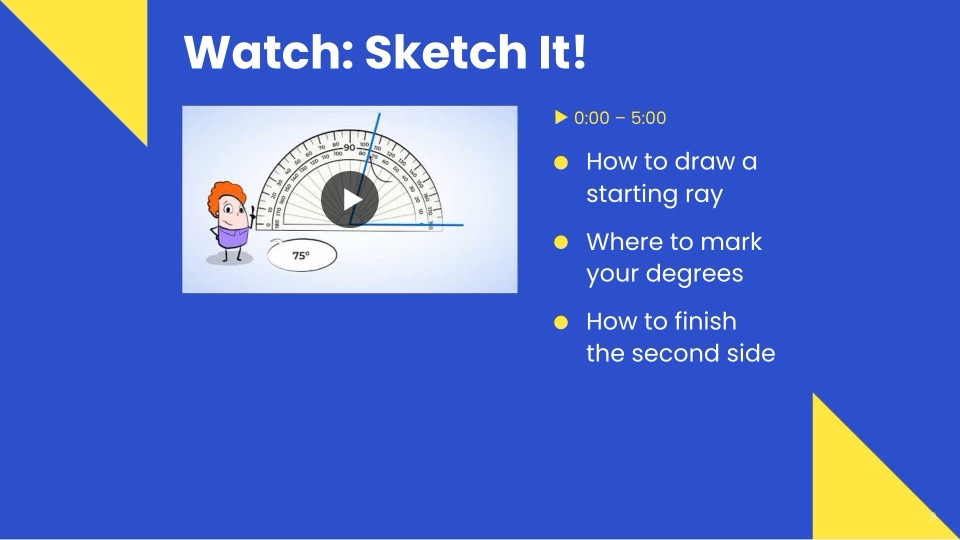
MightyOwl measuring angles from 0:00 to 5:00
MightyOwl: Measuring angles | MightyOwl Math | 4th Grade
Made for 4th grade and explains measuring angles in degrees clearly for 9-10-year-olds.
Worksheet
Sources
- Grade 4 Math Curriculum - Fairfax County Public Schools fcps.edu
- Grade 4 Math | SFUSD sfusd.edu
- 6. Measuring Angles | The Nature of Geographic Information e-education.psu.edu
- Lesson 1 Understanding and Measuring Angles cdnend.americanhighschool.org
- Measuring Angles: Definition, Using Protractor, Examples & FAQs geeksforgeeks.org
Picture credits
Made with Lesson Dino's AI on 16 October 2026. AI can make mistakes, so check facts against the sources before you teach.