The worksheet
About this worksheet
Students learn to draw points, rays, segments, lines and three angle types. They work in pairs to draw from directions and spot them in 2D figures. This Grade 4 Math worksheet gives students (ages 9–10) five pages of practice on lines and angles, part of the geometry unit. It goes with our free Lines and angles lesson, which has the slides and a timed lesson plan.
What it covers
By the end, students should be able to:
- Students will draw points, lines, line segments, rays and angles accurately with a ruler.
- Students will classify angles as right, acute or obtuse by comparing to a square corner.
- Students will identify parallel, perpendicular and intersecting lines in two-dimensional figures.
How to use it
- Practice (13 minutes): Hand out Worksheet Task D and model on a rectangle: trace opposite sides that stay apart as parallel.
- Support: Provide sentence frames and a word bank with small pictures, and remind students that parallel lines in the word have two side-by-side lines like the letter l pair to help remember.
- Stretch: Student A adds a 2D figure clue, like add a triangle side that is perpendicular to the first line, for Student B to complete.
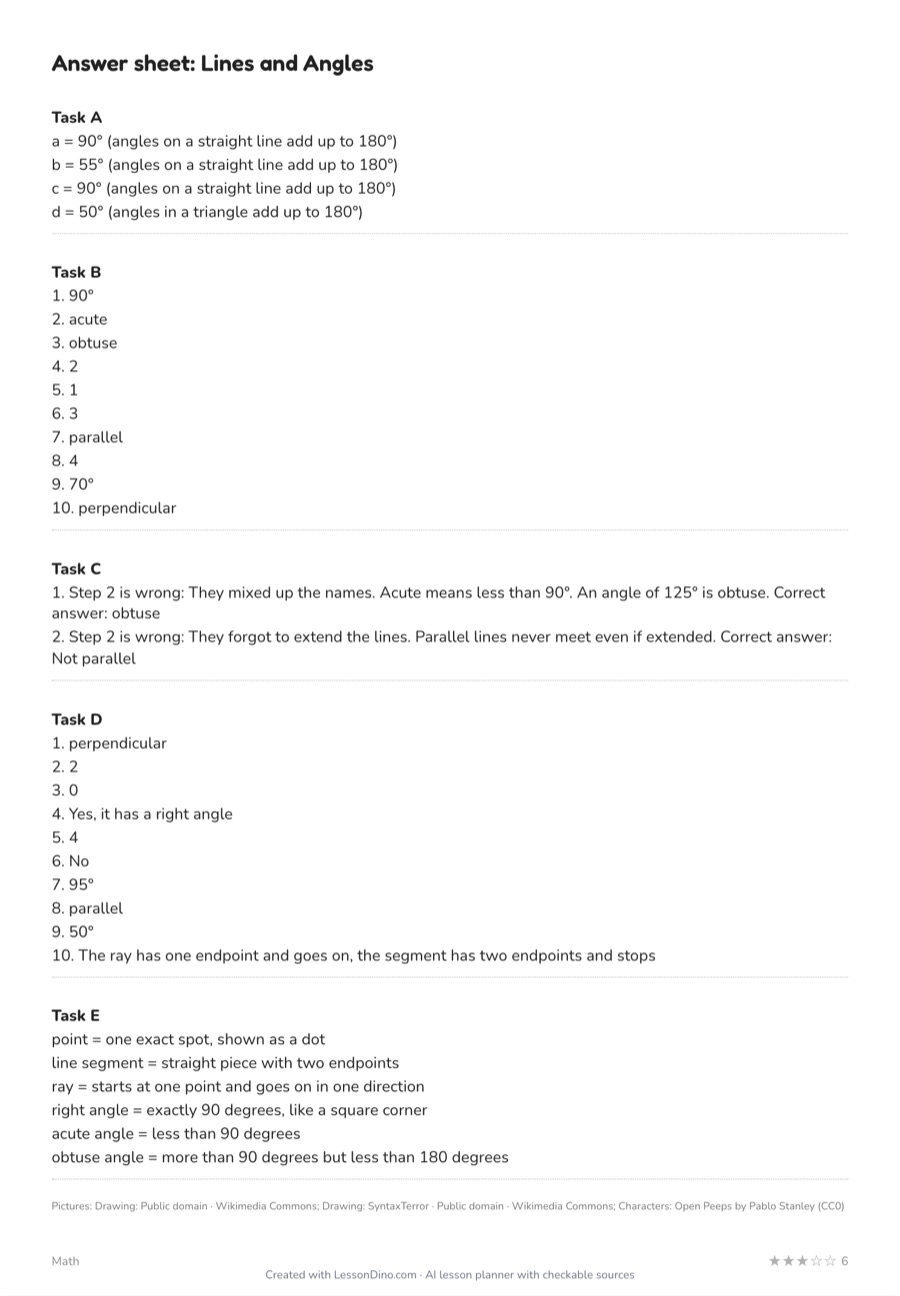
- The answer sheet is the last page, so you can print it on its own or let students check their own work.
Key vocabulary
- ray: a straight path that starts at a dot and keeps going one way only
- acute angle: a sharp opening smaller than a square corner, less than 90 degrees
- right angle: an opening exactly 90 degrees, like a book corner with a tiny square mark
- obtuse angle: a wide opening bigger than a square corner but smaller than a straight line
- parallel lines: two straight paths that stay the same distance apart and never cross
- perpendicular lines: two straight paths that cross to make a square corner
Mistakes to watch for
- Judging acute or obtuse by length of side lines, not opening size. Turn cutout to line up one side with card edge and compare opening only; it is size of opening that matters, not line length.
- Calling any non-crossing lines parallel. Check with ruler that distance stays the same and extend with dotted lines to see if they would meet; parallel never touch even if longer.
- Thinking all intersecting lines are perpendicular. Test with square corner and add tiny square only if exactly 90 degrees; perpendicular is a special intersecting case.
What's on the worksheet
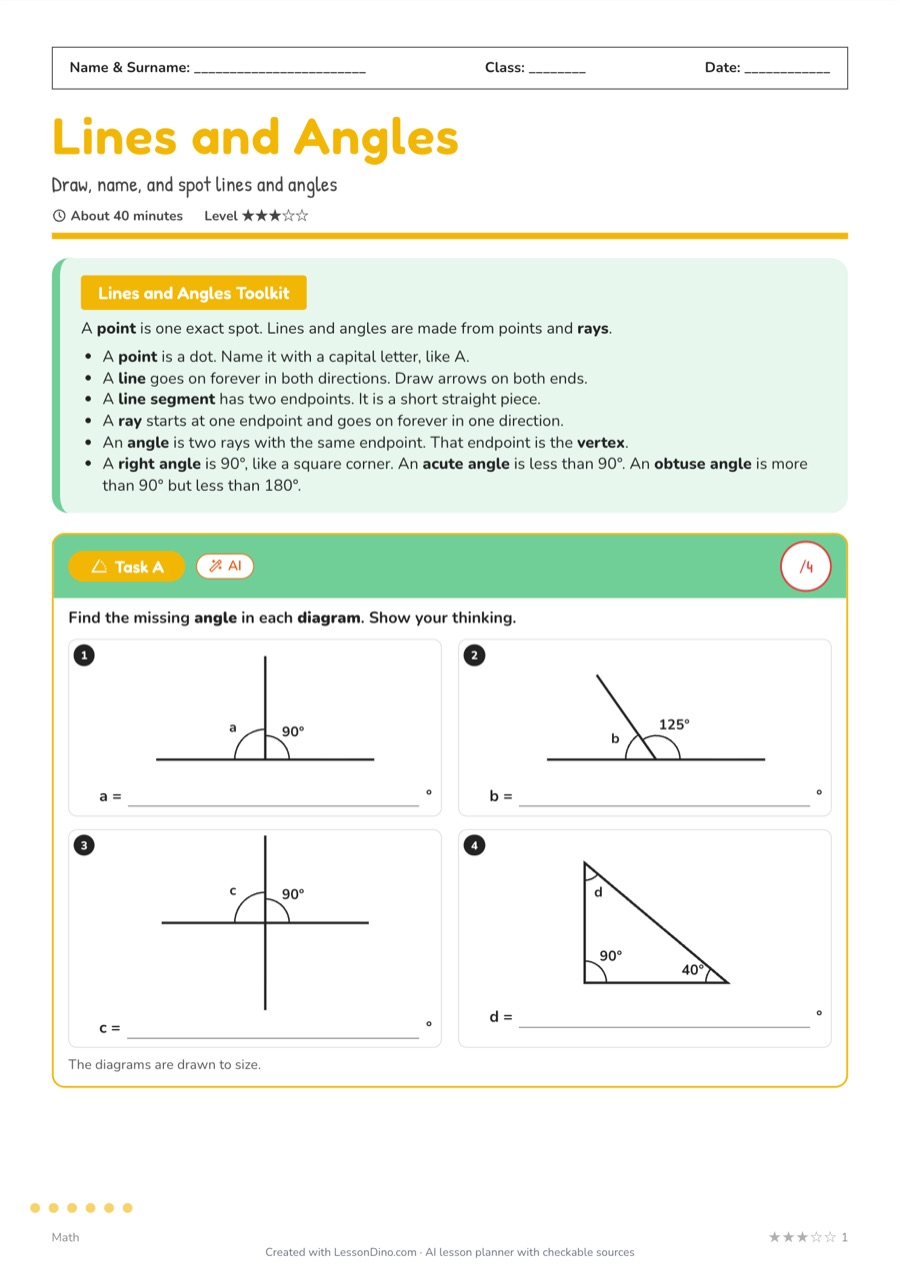
Lines and Angles
Learn the parts, then find missing angles.
Lines and Angles Toolkit
- A point is one exact spot. Lines and angles are made from points and rays.
- A point is a dot. Name it with a capital letter, like A.
- A line goes on forever in both directions. Draw arrows on both ends.
- A line segment has two endpoints. It is a short straight piece.
- A ray starts at one endpoint and goes on forever in one direction.
- An angle is two rays with the same endpoint. That endpoint is the vertex.
- A right angle is 90°, like a square corner. An acute angle is less than 90°. An obtuse angle is more than 90° but less than 180°.
Find the missing angle in each diagram. Show your thinking.
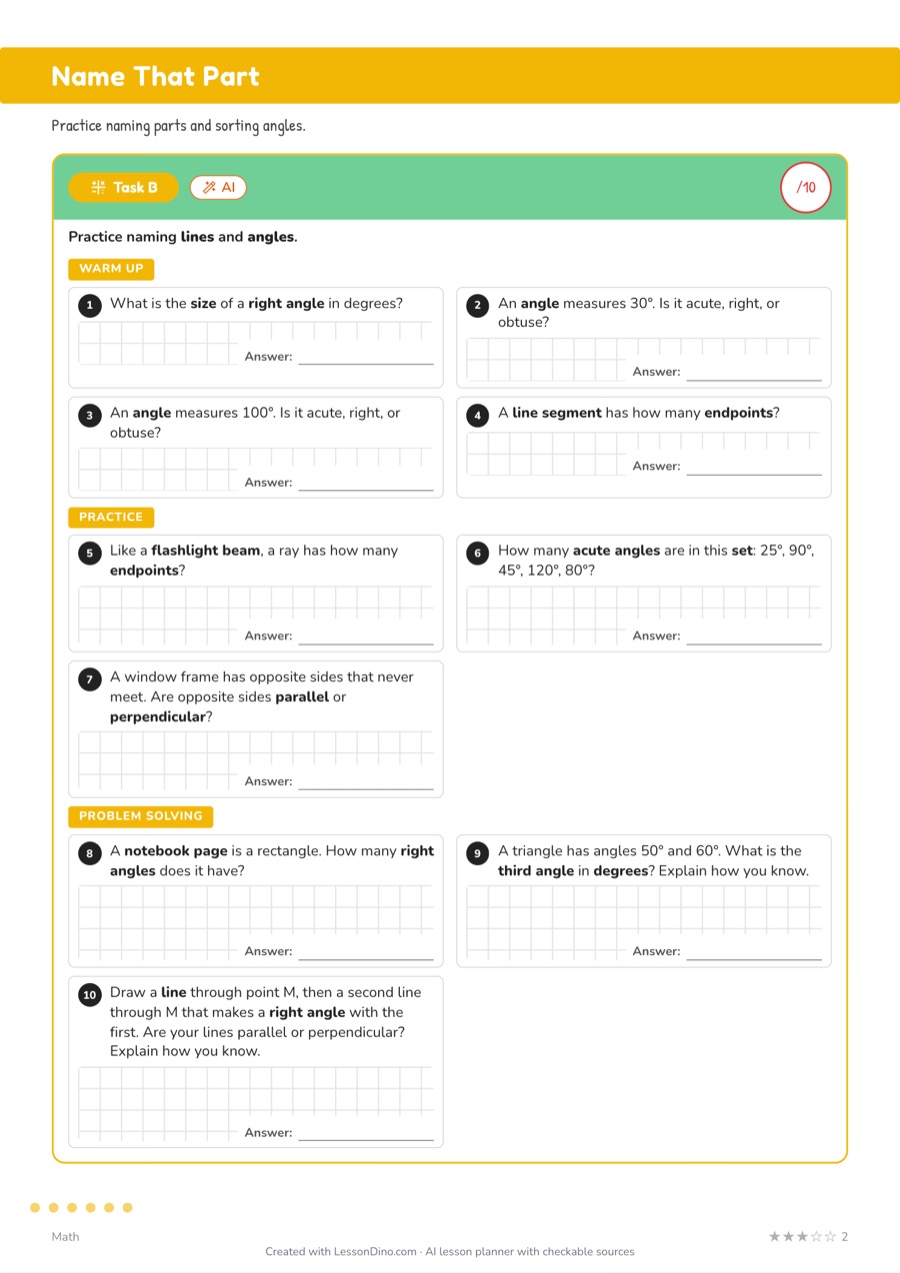
Name That Part
Practice naming parts and sorting angles.
Practice naming lines and angles.
Warm up
- What is the size of a right angle in degrees?
- An angle measures 30°. Is it acute, right, or obtuse?
- An angle measures 100°. Is it acute, right, or obtuse?
- A line segment has how many endpoints?
Practice
- Like a flashlight beam, a ray has how many endpoints?
- How many acute angles are in this set: 25°, 90°, 45°, 120°, 80°?
- A window frame has opposite sides that never meet. Are opposite sides parallel or perpendicular?
Problem solving
- A notebook page is a rectangle. How many right angles does it have?
- A triangle has angles 50° and 60°. What is the third angle in degrees? Explain how you know.
- Draw a line through point M, then a second line through M that makes a right angle with the first. Are your lines parallel or perpendicular? Explain how you know.
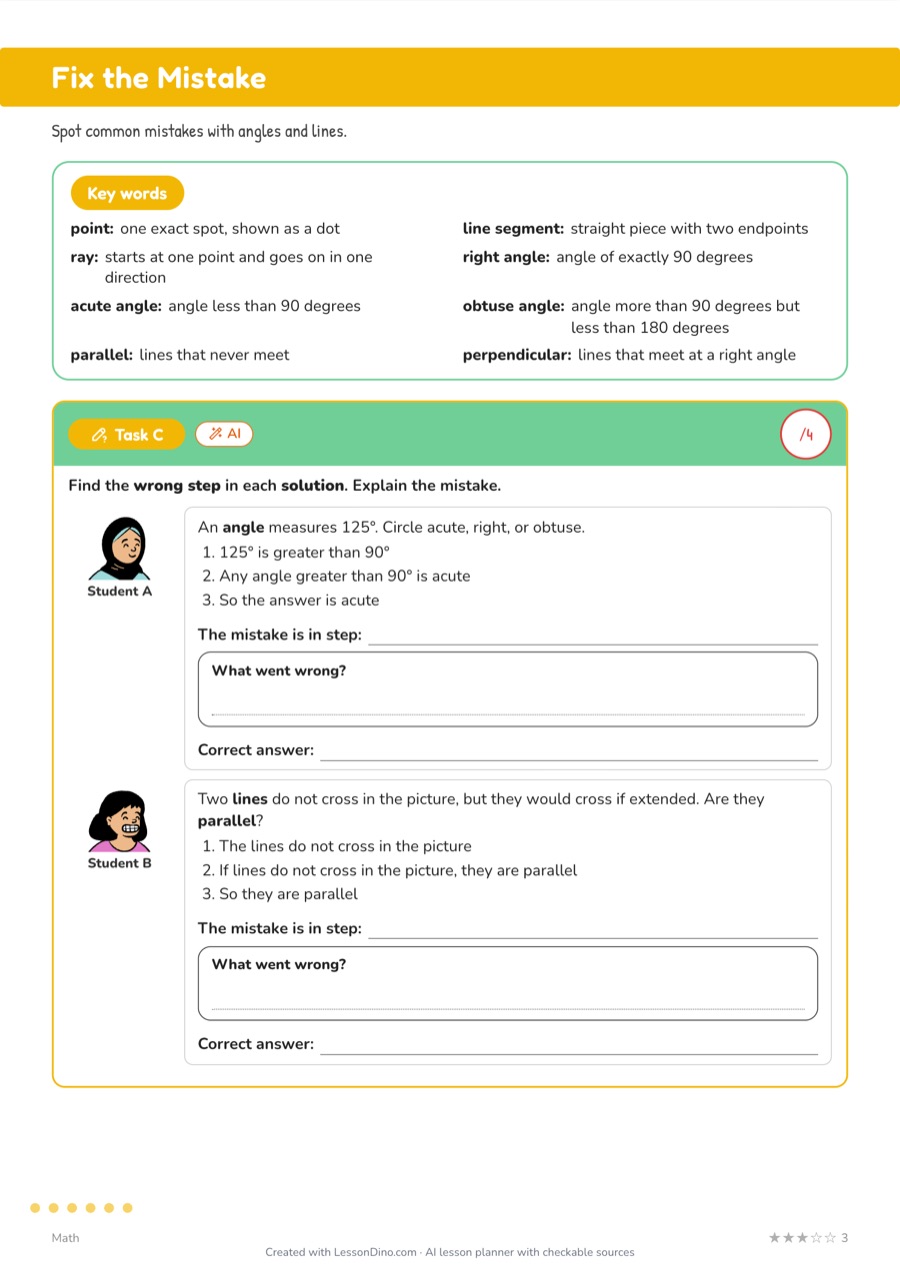
Fix the Mistake
Spot common mistakes with angles and lines.
| Word | Meaning |
|---|---|
| point | one exact spot, shown as a dot |
| line segment | straight piece with two endpoints |
| ray | starts at one point and goes on in one direction |
| right angle | angle of exactly 90 degrees |
| acute angle | angle less than 90 degrees |
| obtuse angle | angle more than 90 degrees but less than 180 degrees |
| parallel | lines that never meet |
| perpendicular | lines that meet at a right angle |
Find the wrong step in each solution. Explain the mistake.
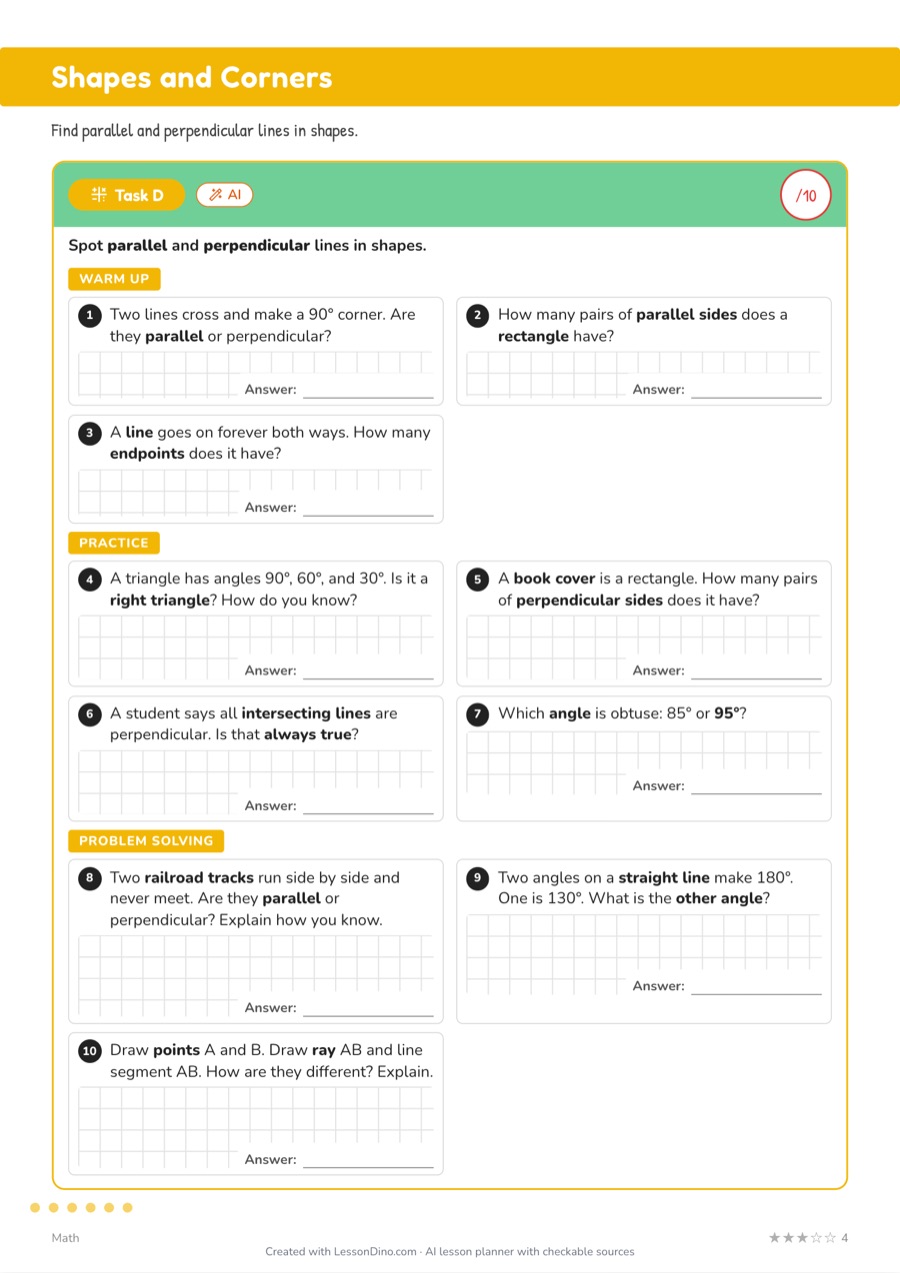
Shapes and Corners
Find parallel and perpendicular lines in shapes.
Spot parallel and perpendicular lines in shapes.
Warm up
- Two lines cross and make a 90° corner. Are they parallel or perpendicular?
- How many pairs of parallel sides does a rectangle have?
- A line goes on forever both ways. How many endpoints does it have?
Practice
- A triangle has angles 90°, 60°, and 30°. Is it a right triangle? How do you know?
- A book cover is a rectangle. How many pairs of perpendicular sides does it have?
- A student says all intersecting lines are perpendicular. Is that always true?
- Which angle is obtuse: 85° or 95°?
Problem solving
- Two railroad tracks run side by side and never meet. Are they parallel or perpendicular? Explain how you know.
- Two angles on a straight line make 180°. One is 130°. What is the other angle?
- Draw points A and B. Draw ray AB and line segment AB. How are they different? Explain.
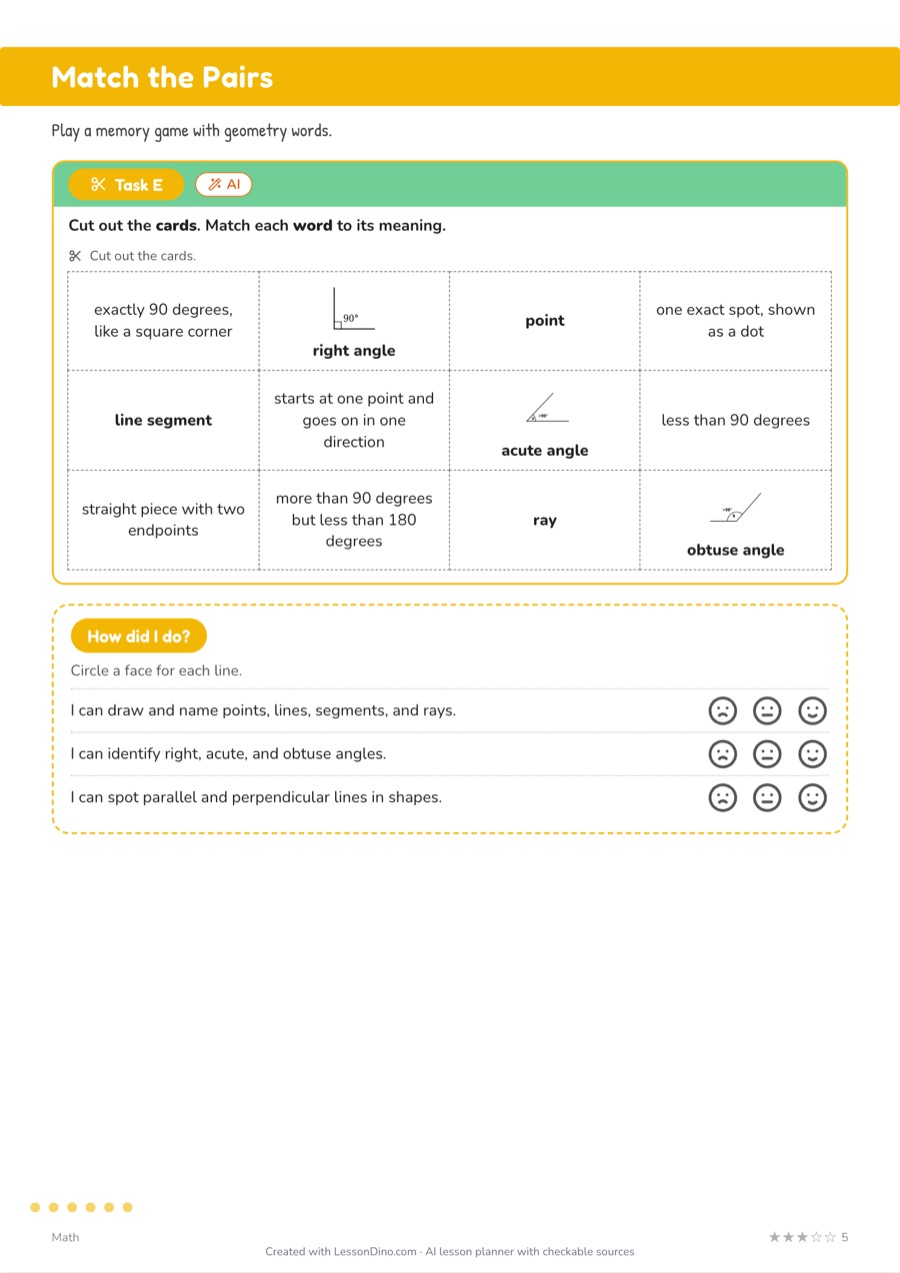
Match the Pairs
Play a memory game with geometry words.
Cut out the cards. Match each word to its meaning.
Answers
Show the answers
- What is the size of a right angle in degrees? 90°
- An angle measures 30°. Is it acute, right, or obtuse? acute
- An angle measures 100°. Is it acute, right, or obtuse? obtuse
- A line segment has how many endpoints? 2
- Like a flashlight beam, a ray has how many endpoints? 1
- How many acute angles are in this set: 25°, 90°, 45°, 120°, 80°? 3
- A window frame has opposite sides that never meet. Are opposite sides parallel or perpendicular? parallel
- A notebook page is a rectangle. How many right angles does it have? 4
- A triangle has angles 50° and 60°. What is the third angle in degrees? Explain how you know. 70°
- Draw a line through point M, then a second line through M that makes a right angle with the first. Are your lines parallel or perpendicular? Explain how you know. perpendicular
- Two lines cross and make a 90° corner. Are they parallel or perpendicular? perpendicular
- How many pairs of parallel sides does a rectangle have? 2
- A line goes on forever both ways. How many endpoints does it have? 0
- A triangle has angles 90°, 60°, and 30°. Is it a right triangle? How do you know? Yes, it has a right angle
- A book cover is a rectangle. How many pairs of perpendicular sides does it have? 4
- A student says all intersecting lines are perpendicular. Is that always true? No
- Which angle is obtuse: 85° or 95°? 95°
- Two railroad tracks run side by side and never meet. Are they parallel or perpendicular? Explain how you know. parallel
- Two angles on a straight line make 180°. One is 130°. What is the other angle? 50°
- Draw points A and B. Draw ray AB and line segment AB. How are they different? Explain. The ray has one endpoint and goes on, the segment has two endpoints and stops
The answer sheet is the last picture above.
Curriculum
Draw points, lines, line segments, rays, angles (right, acute, obtuse), and perpendicular and parallel lines. Identify these in two-dimensional figures.
Made with Lesson Dino's AI on 17 October 2026. AI can make mistakes, so check the answers and facts against the sources before you teach.