Slides

Lesson plan
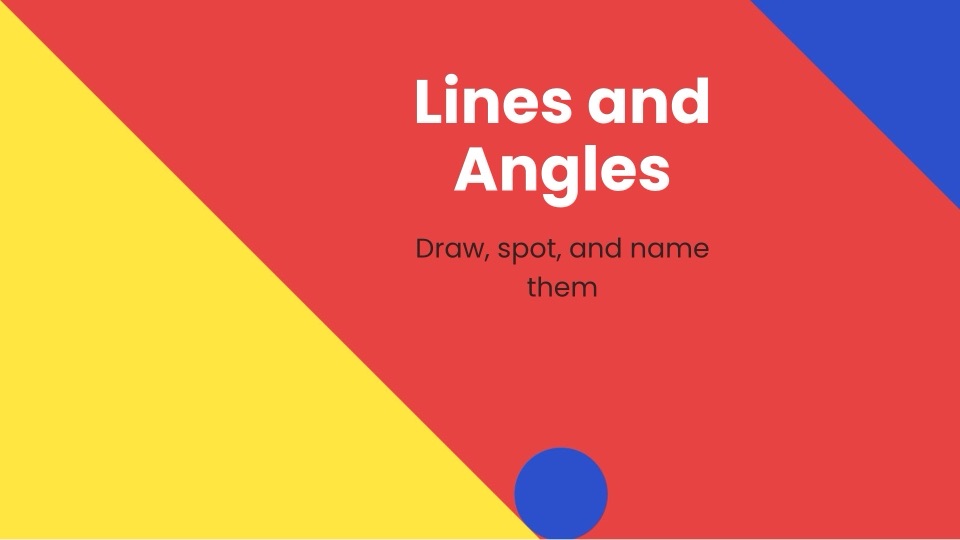
Draw, Name, and Spot Lines and Angles
Students learn to draw points, rays, segments, lines and three angle types. They work in pairs to draw from directions and spot them in 2D figures.
Objectives
- Students will draw points, lines, line segments, rays and angles accurately with a ruler.
- Students will classify angles as right, acute or obtuse by comparing to a square corner.
- Students will identify parallel, perpendicular and intersecting lines in two-dimensional figures.
Success criteria
- I can draw a point, line, segment, ray and each angle type.
- I can sort angles as acute, right or obtuse using a corner tester.
- I can label parallel and perpendicular sides in 2D figures.
Key words
| Word | Meaning |
|---|---|
| ray | a straight path that starts at a dot and keeps going one way only |
| acute angle | a sharp opening smaller than a square corner, less than 90 degrees |
| right angle | an opening exactly 90 degrees, like a book corner with a tiny square mark |
| obtuse angle | a wide opening bigger than a square corner but smaller than a straight line |
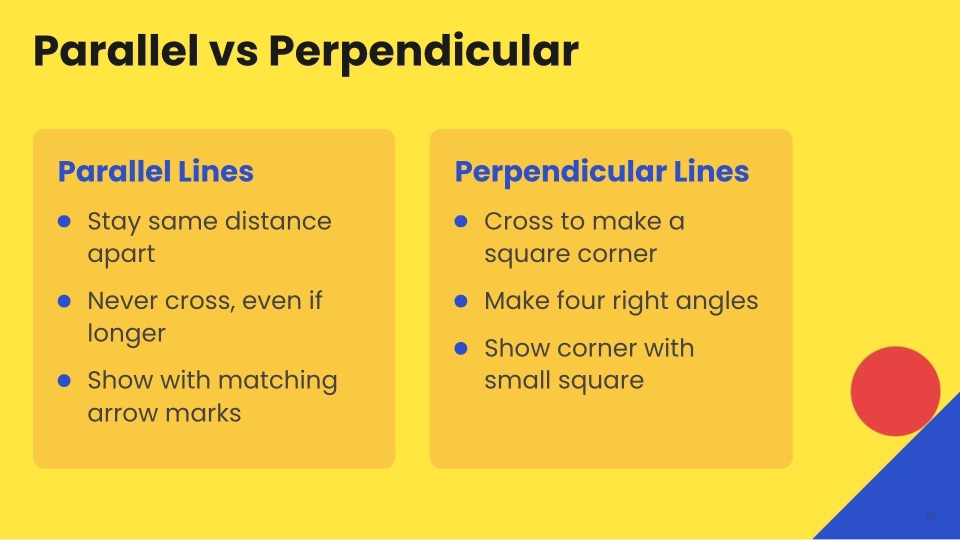
| parallel lines | two straight paths that stay the same distance apart and never cross |
| perpendicular lines | two straight paths that cross to make a square corner |
Timed plan (60 minutes)
| Time | Stage | What happens |
|---|---|---|
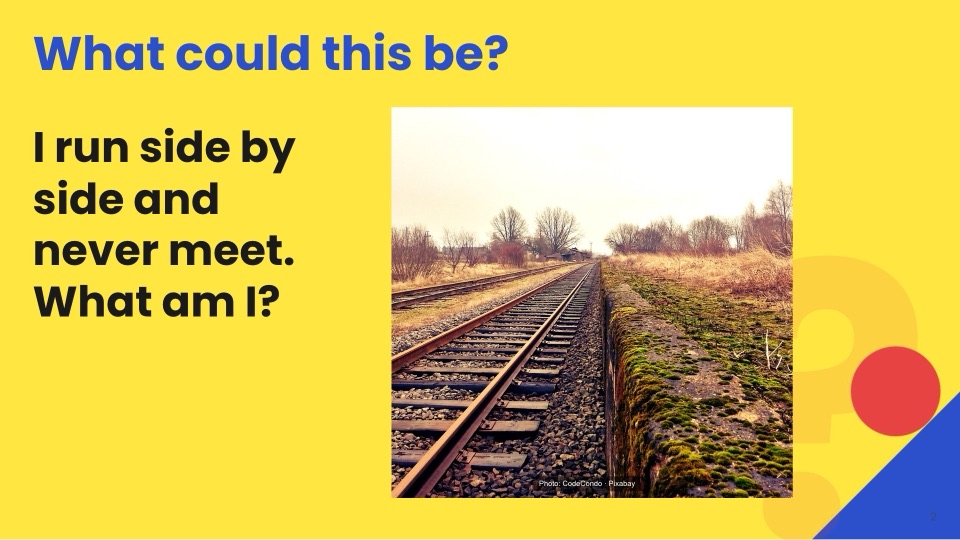
| 5 min | Starter | To hook interest in drawing from words and recall what students know about lines and square corners. Welcome the class and say the hook line, asking students to close eyes and picture the words. Show Slide 2 mystery and read the riddle about running side by side and never meeting. Take answers and confirm parallel lines that stay the same distance apart. Ask who has seen a book corner square mark and what it tells us. |
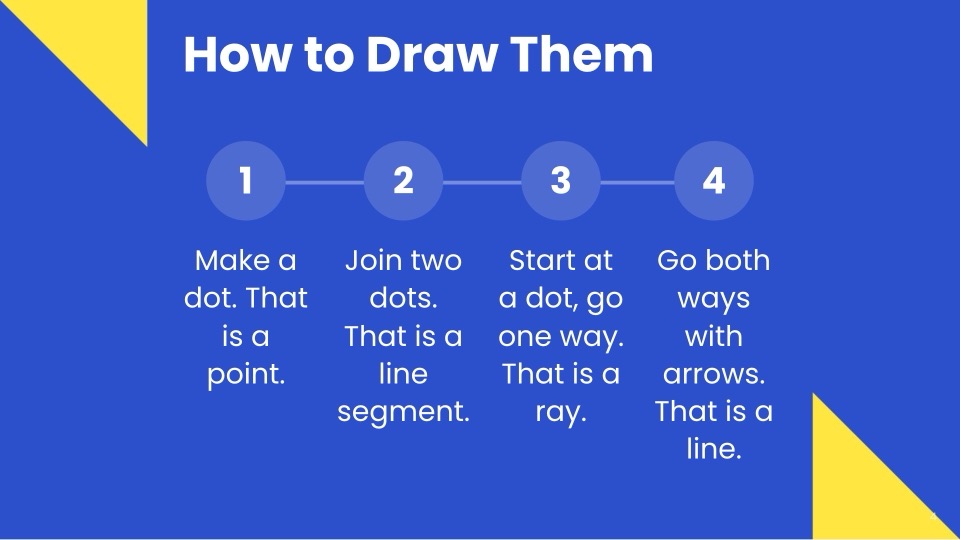
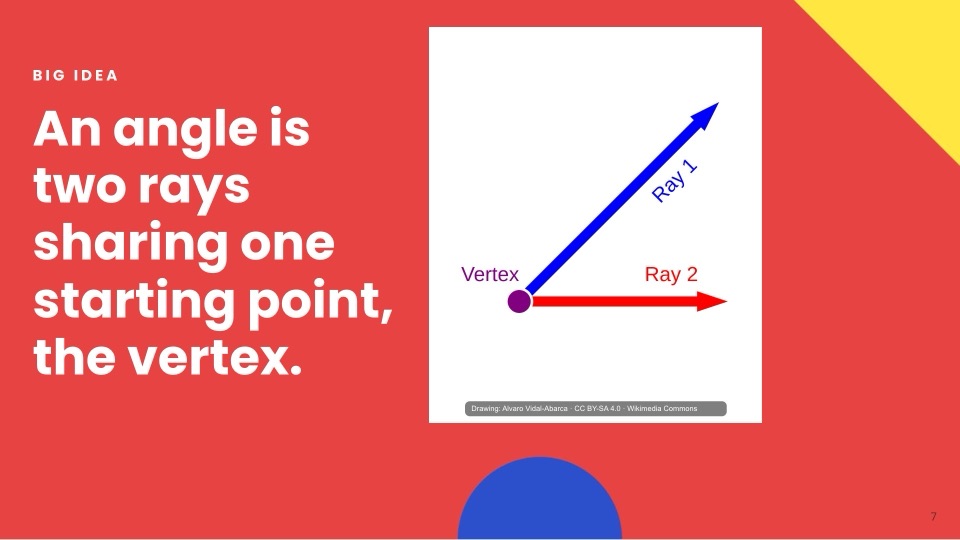
| 12 min | Teaching | To model how to draw points, segments, rays, lines and three angle types. Display Slides 4, 6-7 and model each draw with a ruler on the board. Play Video clip 1 (0:00–2:36) and tell students to listen for point, line, segment, ray and how two rays meet. Explain that an angle is two rays sharing one starting point, the vertex. Model the paper corner tester to test right, smaller and wider openings. |
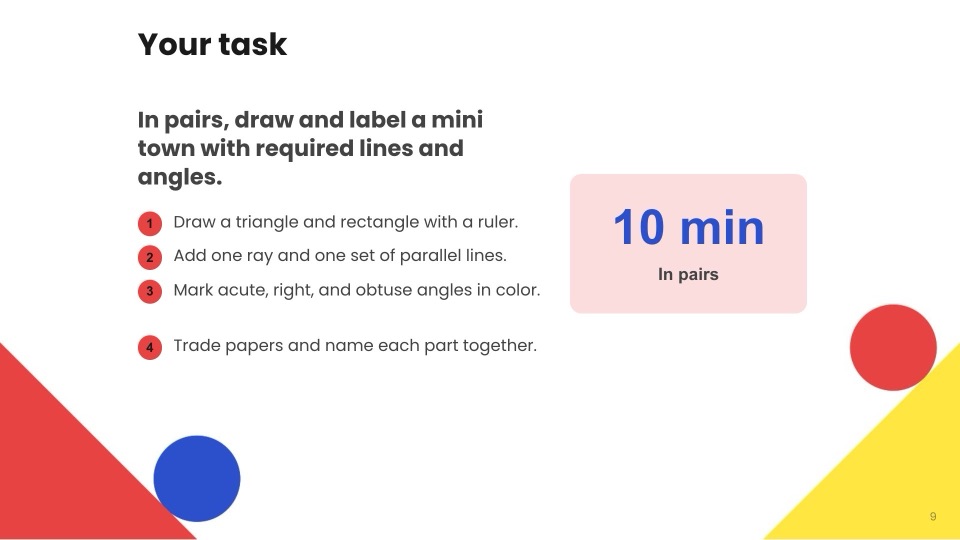
| 20 min | Main activity | To practice drawing and naming figures accurately from spoken directions in pairs. Pair students as Student A reader and Student B drawer and hand out direction cards, paper, pencils and rulers. Model Card 3: read aloud, think aloud, draw two rays from one dot, then label. Start pairs on Cards 1-5: Card 1 Draw a point and label it. Draw a line segment with two endpoints. Card 2 Start at a dot and draw a ray that goes one way only with one arrow. Card 3 Draw two rays with the same endpoint to make an acute angle. Card 4 Draw a pair of parallel lines that never meet. Card 5 Draw a pair of perpendicular lines that cross at a right angle. Add the small square. Stop halfway to swap roles and display Slide 9 to guide finishing, trading and labeling. |
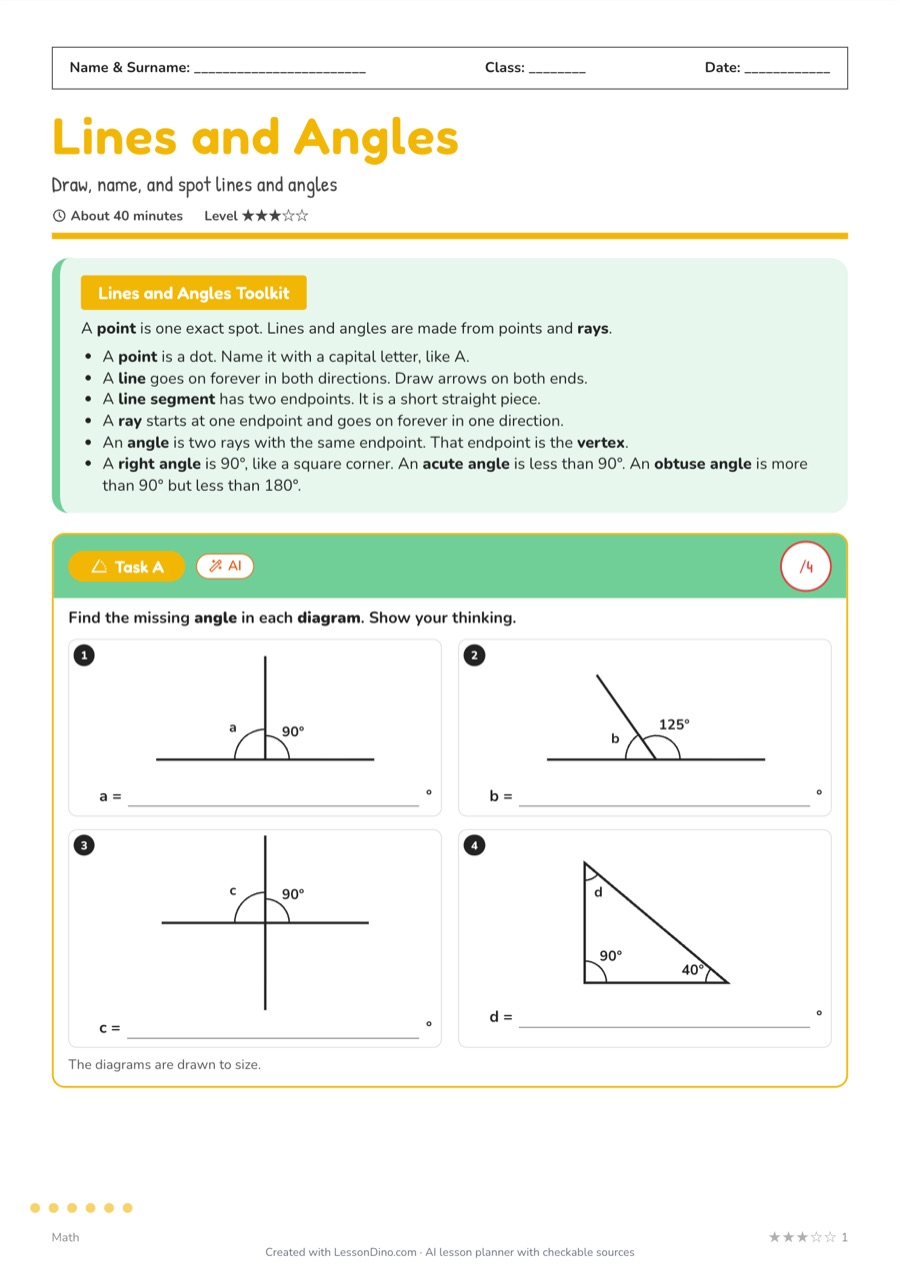
| 13 min | Practice | To identify parallel, perpendicular and angle types in two-dimensional figures. Display Slide 10 and compare parallel that never cross even if longer with perpendicular that cross to make a square corner. Hand out Worksheet Task D and model on a rectangle: trace opposite sides that stay apart as parallel. Release pairs to spot parallel and perpendicular lines in shapes and mark acute, right and obtuse angles in color. Circulate with paper corner testers to confirm square-corner checks. |
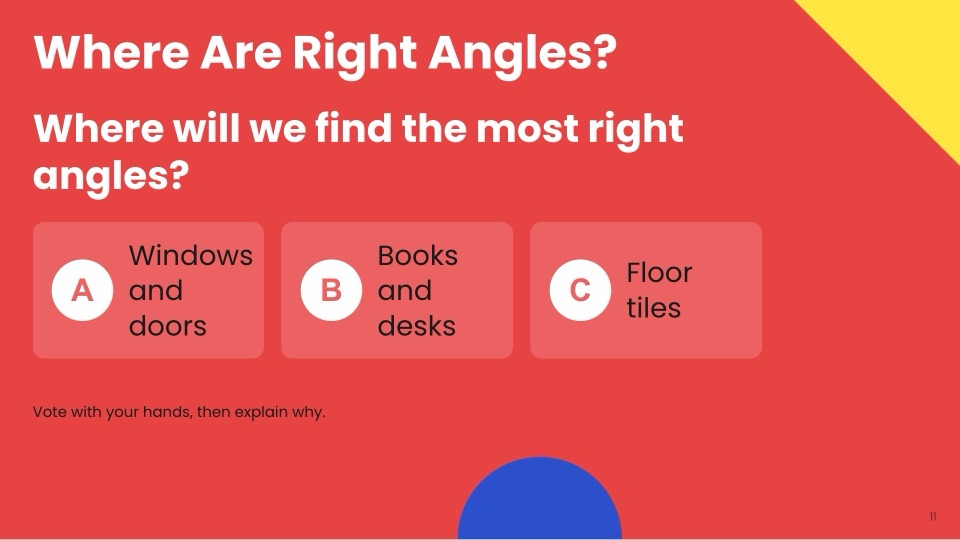
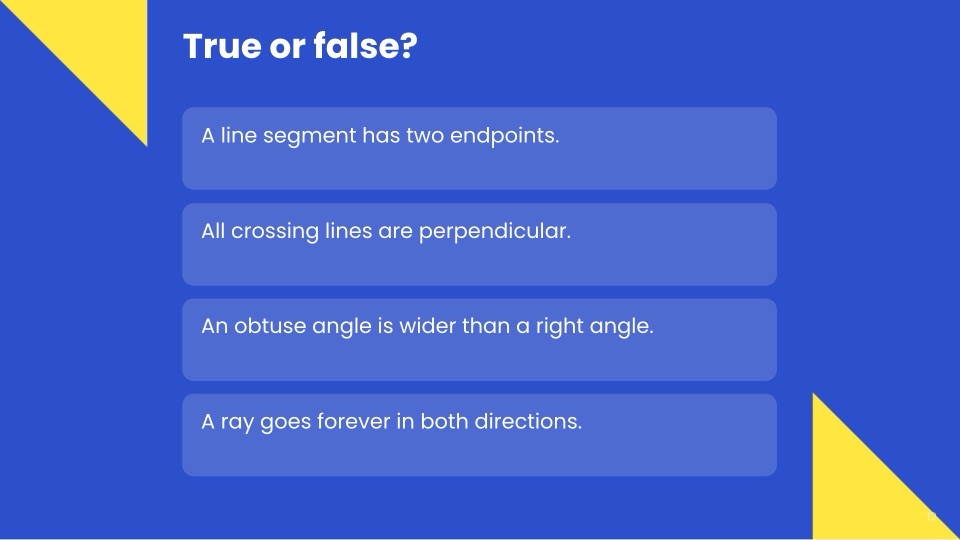
| 10 min | Plenary | To review drawings and check all students can name lines and angles. Run Slide 11 vote on where we find most right angles and tally windows, books and floor tiles. Run Slide 12 true or false, asking students to justify with corner tester or ruler. Give 3-question exit ticket on mini whiteboards and collect answers. Link back to success criteria and set homework. |
Common mistakes
- Judging acute or obtuse by length of side lines, not opening size
How to spot it: Labels long-ray angles as obtuse and short-ray angles as acute
Turn cutout to line up one side with card edge and compare opening only; it is size of opening that matters, not line length - Calling any non-crossing lines parallel
How to spot it: Marks slanted sides that would meet if extended as parallel
Check with ruler that distance stays the same and extend with dotted lines to see if they would meet; parallel never touch even if longer - Thinking all intersecting lines are perpendicular
How to spot it: Marks any X-cross as perpendicular without testing corner
Test with square corner and add tiny square only if exactly 90 degrees; perpendicular is a special intersecting case
Support
- Provide sentence frames and a word bank with small pictures, and remind students that parallel lines in the word have two side-by-side lines like the letter l pair to help remember.
- Give dot stickers for endpoints and paper corner testers to focus on direction and opening size.
- Pre-teach vocabulary with arm and pencil models for ray that goes one way only.
Stretch
- Student A adds a 2D figure clue, like add a triangle side that is perpendicular to the first line, for Student B to complete.
- Challenge students to build a rectangle and triangle and point out parallel sides and right angles.
- Ask students to hunt for both parallel and perpendicular sides in one shape and explain how they know.
Check questions
- Draw a ray. How many endpoints and arrows does it have?
Answer: One endpoint and one arrow going one way only - Is an opening smaller than a square corner acute, right or obtuse?
Answer: Acute, less than 90 degrees - In a rectangle, which sides are parallel and which meet as perpendicular?
Answer: Opposite sides are parallel; adjacent sides meet at right angles, so perpendicular
Curriculum
Draw points, lines, line segments, rays, angles (right, acute, obtuse), and perpendicular and parallel lines. Identify these in two-dimensional figures.
Video clips
Clips on YouTube, from the start and end times we chose. Check each one before you show it.
-
Lines, Rays, and Angles - Grade 4 from 0:00 to 2:36
MATH-N-ROLL: Lines, Rays, and Angles. Grade 4.
Made specifically for Grade 4 and covers lines, rays and angles at the right pace for 9-10-year-olds.
-
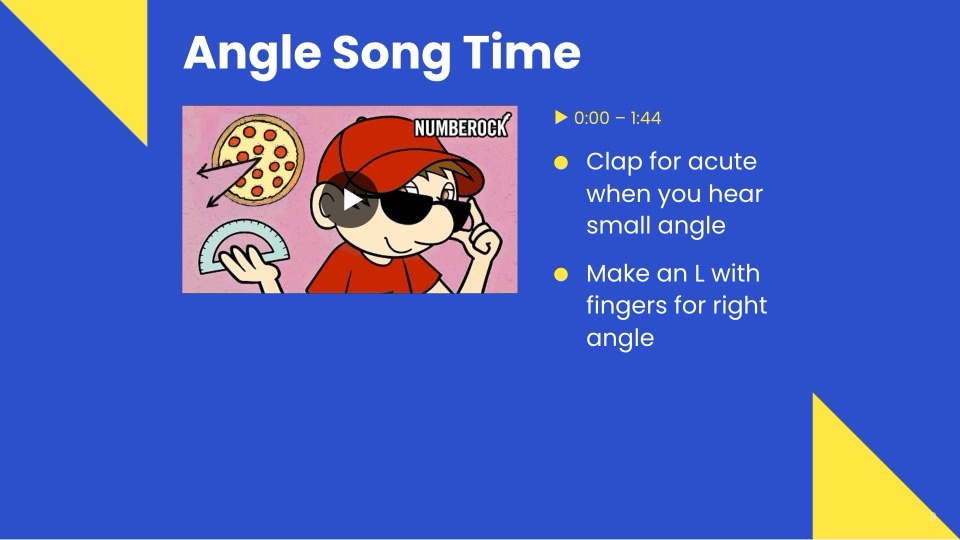
Acute, Obtuse and Right Angles Song from 0:00 to 1:44
Numberock: Angles Song | Acute, Obtuse, & Right Angles | 3rd & 4th Grade
Made for 3rd and 4th grade and directly teaches right, acute, and obtuse angles for 9-10-year-olds.
Worksheet
Sources
- Grade 4 » Geometry | Common Core State Standards Initiative thecorestandards.org
- Grade 4 Math Curriculum - Fairfax County Public Schools fcps.edu
- Points, Lines, and Angles - Ximera ximera.osu.edu
- Angles and Lines - Andrews University andrews.edu
- Lines & Angles - Department of Mathematics at UTSA mathresearch.utsa.edu
- ANGLES OF LINES AND TRIANGLES - Idaho State University isu.edu
- Lines and angles - KS2 Maths - BBC Bitesize bbc.co.uk
- geometry: angles, line, segment, and ray - Britannica Kids kids.britannica.com
- Lines and angles - KS2 Mathematics and Numeracy - BBC Bitesize bbc.co.uk
- Angle Facts for Kids kids.kiddle.co
- Geometry Part 6: Angles and Lines | OK Math and Reading Lady cindyelkins.edublogs.org
- Geometry For Kids | Shapes, Lines, Angles & Symmetry learnwithsitesforkids.com
- Lines and Angles Facts, Worksheets & Introduction For Kids kidskonnect.com
- Lines and Angles Explained with Concept-Based Learning planetspark.in
- Lines and Angles - Definition, Types, Properties, Formula, Examp… byjus.com
- Understanding Angle Relationships on Parallel Lines for Children learningcorner.co
- Lines And Angles - Definition, Types, Properties cuemath.com
- Lines & Angles Hair Salon, IL - Illinois 2026: contacts, address, phone Lines & Angles Hair Salon, responds, vacancies, feedback, finance • Yellow List of companies in the United States 2026 ylistus.com
- Angles and Lines | Math Concepts for Kids kidsworldfun.com
- Lines and Angles: Definition, Types, Properties, and Examples geeksforgeeks.org
- Lines, rays, and angles - a free geometry lesson with exercises homeschoolmath.net
Picture credits
- Photo: ponce_photography · Pixabay
- Photo: CodeCondo · Pixabay
- Photo: coyot · Pixabay
- Drawing: Alvaro Vidal-Abarca · CC BY-SA 4.0 · Wikimedia Commons
- Drawing: Public domain · Wikimedia Commons
- Drawing: SyntaxTerror · Public domain · Wikimedia Commons
- Drawing: SyntaxTerror · Public domain · Wikimedia Commons
Made with Lesson Dino's AI on 17 October 2026. AI can make mistakes, so check facts against the sources before you teach.