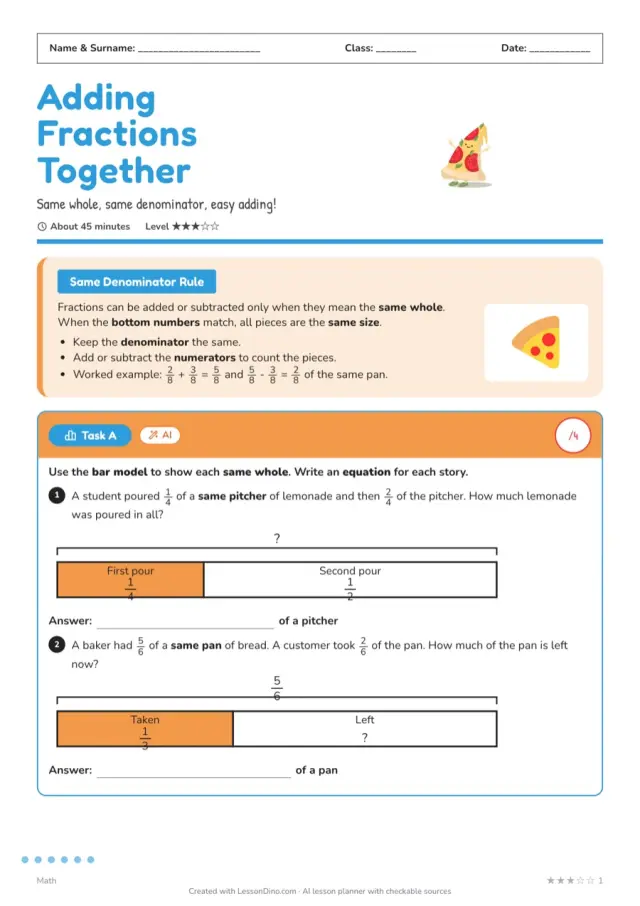
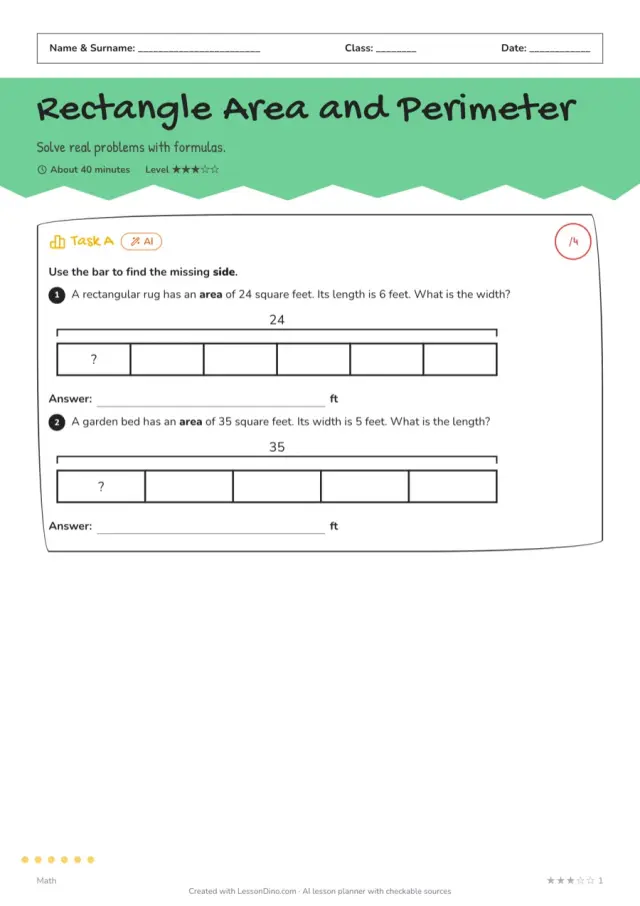
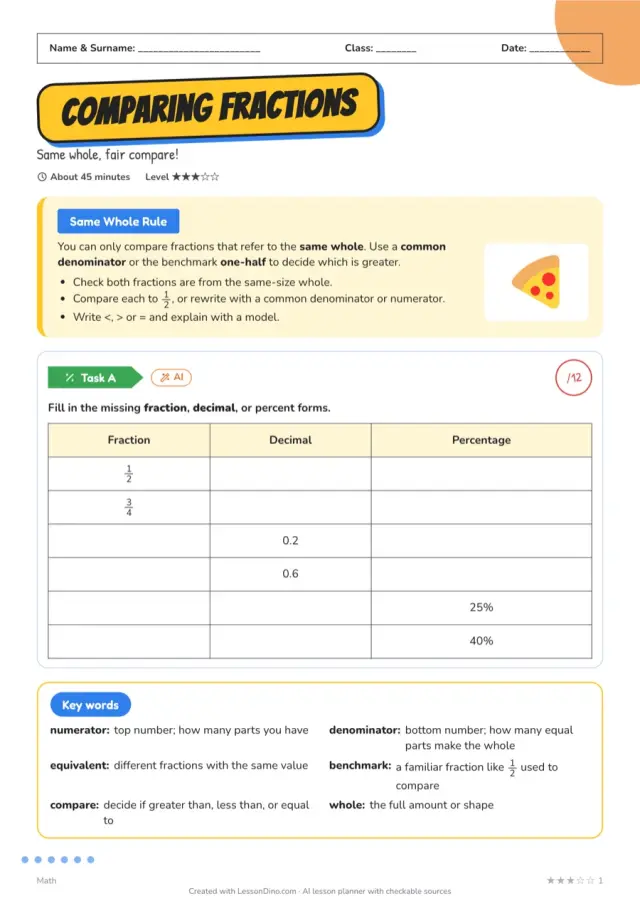
The worksheet
About this worksheet
Students find all factor pairs with rectangles and link them to multiples. They build, list pairs, and sort numbers as prime or composite. This Grade 4 Math worksheet gives students (ages 9–10) five pages of practice on factors and multiples, part of the operations and algebraic thinking unit. It goes with our free Factors and multiples lesson, which has the slides and a timed lesson plan.
What it covers
By the end, students should be able to:
- Students will find all factor pairs for whole numbers to 100 using rectangles.
- Students will connect factors and multiples and test multiples of one-digit numbers.
- Students will decide if numbers to 100 are prime, composite, or neither.
How to use it
- Teaching (12 minutes): Model Worksheet Task B first two rows together: list pairs, then circle multiples.
- Support: Start with 6 tiles and 8 tiles only to find 1 x 6, 2 x 3 and 1 x 8, 2 x 4 using tiles.
- Stretch: Try 36 tiles and check if any rectangle is a square, then explain why it has an odd number of factors.
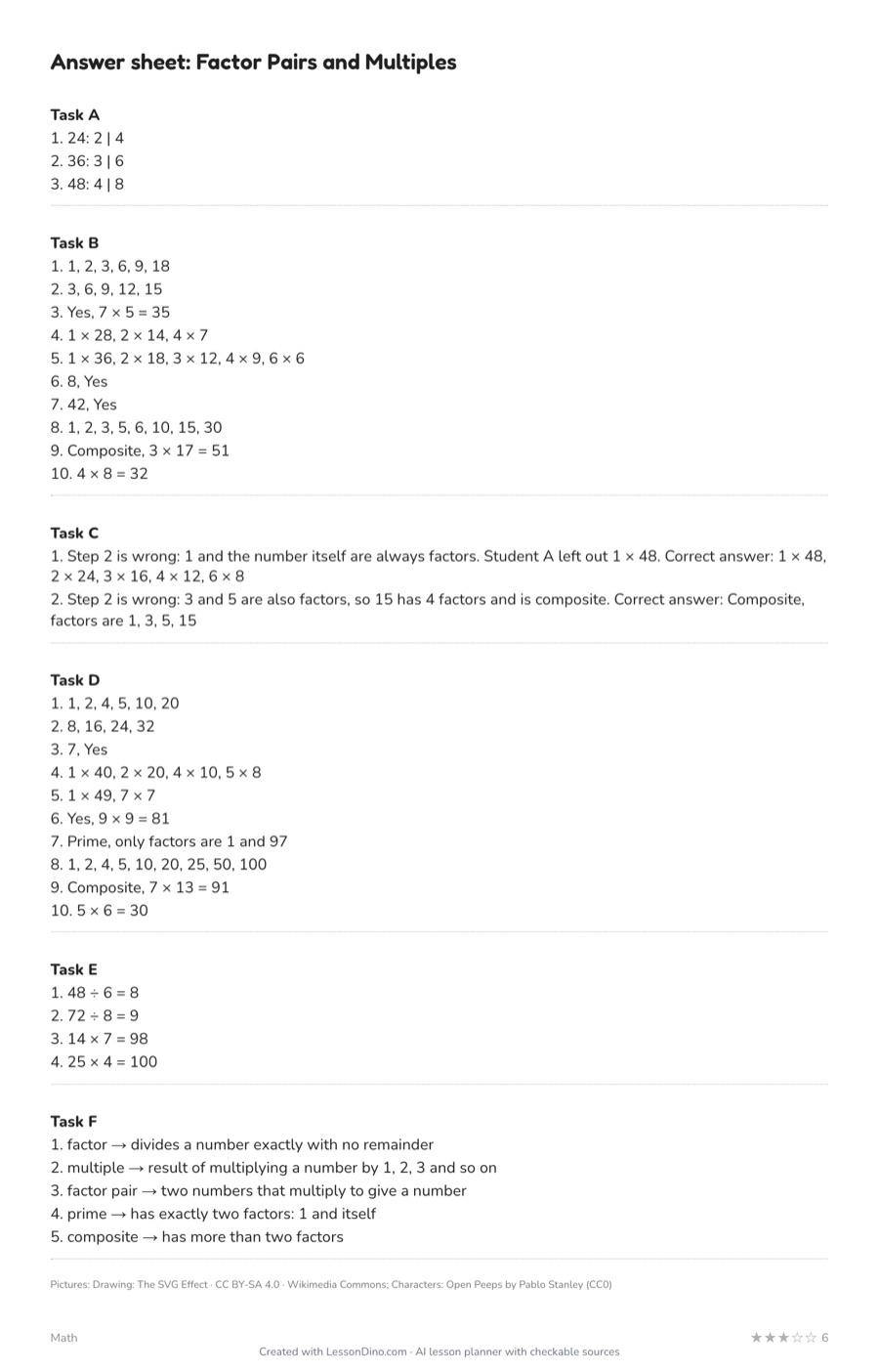
- The answer sheet is the last page, so you can print it on its own or let students check their own work.
Key vocabulary
- factor: a number that goes into another with nothing left over
- multiple: what you get when you times a number by 1, 2, 3 and so on
- factor pair: two whole numbers that times together to make a given number
- prime: has just two dividers: 1 and itself
- composite: has more than two dividers, not just 1 and itself
Mistakes to watch for
- Listing multiples when asked for factors, like 12, 24, 36 for factors of 12. Remind factors fit in and are the target or smaller, multiples grow out; cross out any number over the target.
- Missing 1 and the number itself or missing the square pair like 6 x 6. Always start with 1 times the number and test in order until pairs meet; 6 x 6 counts once.
- Calling 1 prime. List factors of 1: only 1. It is neither prime nor composite because it has only one factor.
What's on the worksheet
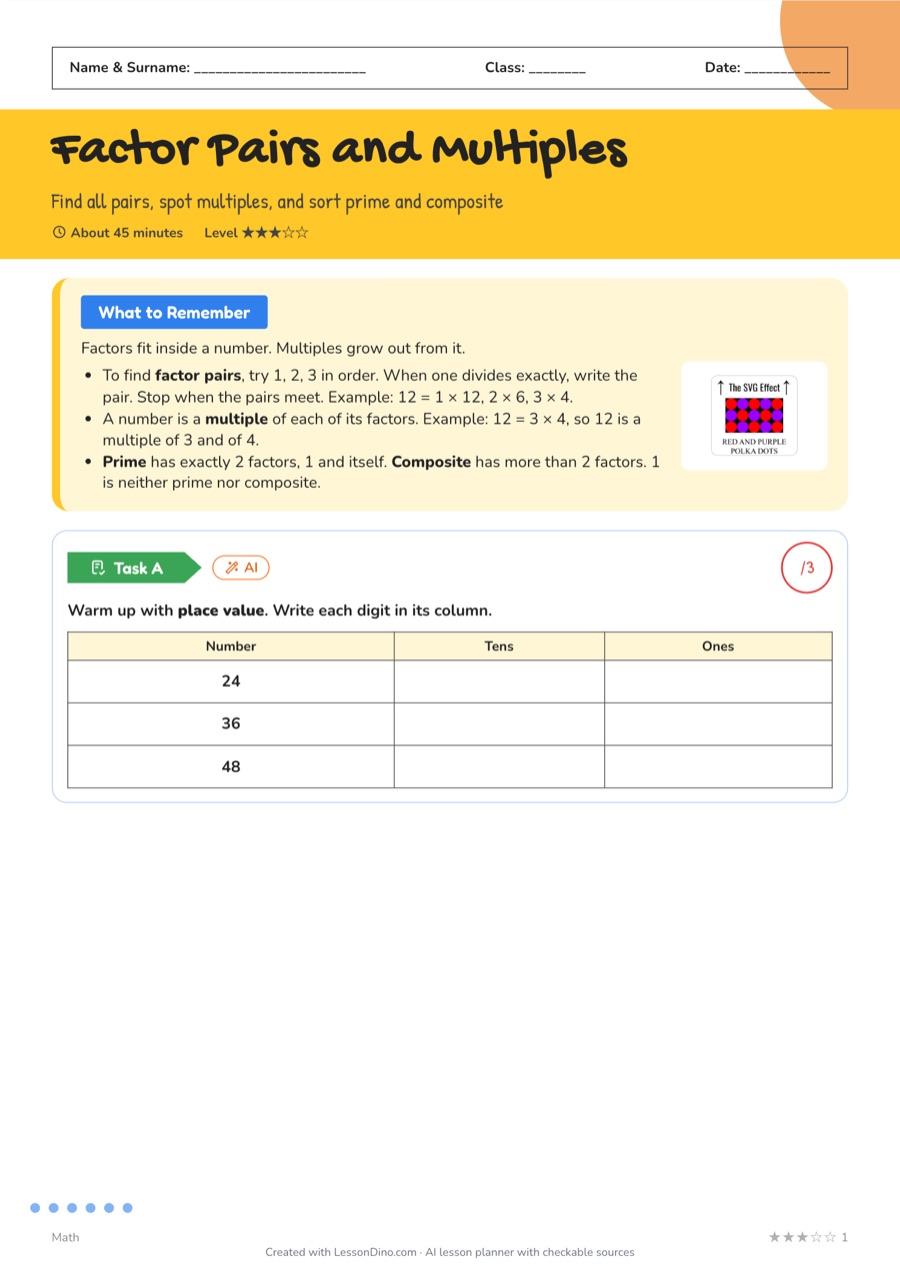
Factor Pairs First!
Learn the method, then warm up with place value.
What to Remember
- Factors fit inside a number. Multiples grow out from it.
- To find factor pairs, try 1, 2, 3 in order. When one divides exactly, write the pair. Stop when the pairs meet. Example: 12 = 1 × 12, 2 × 6, 3 × 4.
- A number is a multiple of each of its factors. Example: 12 = 3 × 4, so 12 is a multiple of 3 and of 4.
- Prime has exactly 2 factors, 1 and itself. Composite has more than 2 factors. 1 is neither prime nor composite.
Warm up with place value. Write each digit in its column.
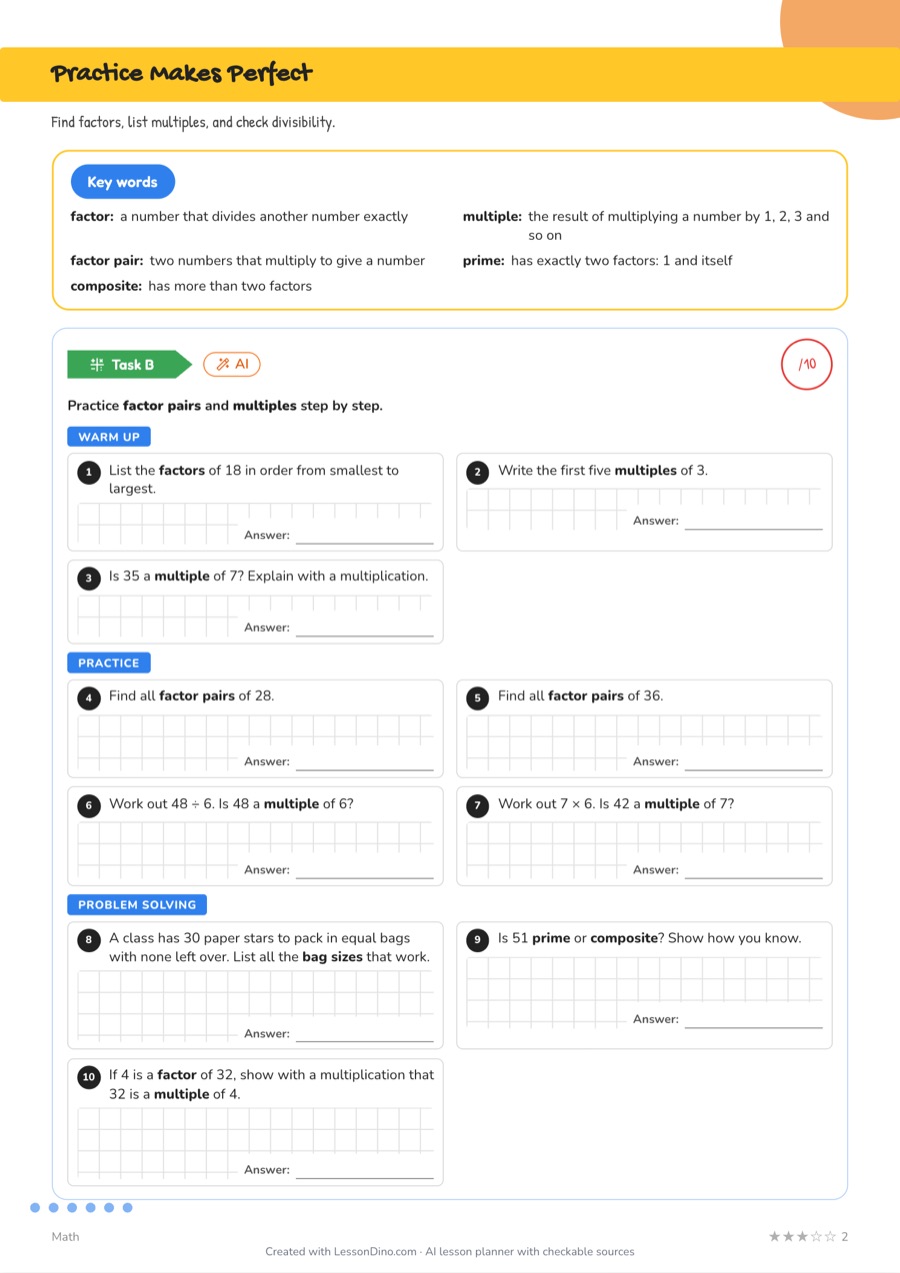
Practice Makes Perfect
Find factors, list multiples, and check divisibility.
| Word | Meaning |
|---|---|
| factor | a number that divides another number exactly |
| multiple | the result of multiplying a number by 1, 2, 3 and so on |
| factor pair | two numbers that multiply to give a number |
| prime | has exactly two factors: 1 and itself |
| composite | has more than two factors |
Practice factor pairs and multiples step by step.
Warm up
- List the factors of 18 in order from smallest to largest.
- Write the first five multiples of 3.
- Is 35 a multiple of 7? Explain with a multiplication.
Practice
- Find all factor pairs of 28.
- Find all factor pairs of 36.
- Work out 48 ÷ 6. Is 48 a multiple of 6?
- Work out 7 × 6. Is 42 a multiple of 7?
Problem solving
- A class has 30 paper stars to pack in equal bags with none left over. List all the bag sizes that work.
- Is 51 prime or composite? Show how you know.
- If 4 is a factor of 32, show with a multiplication that 32 is a multiple of 4.
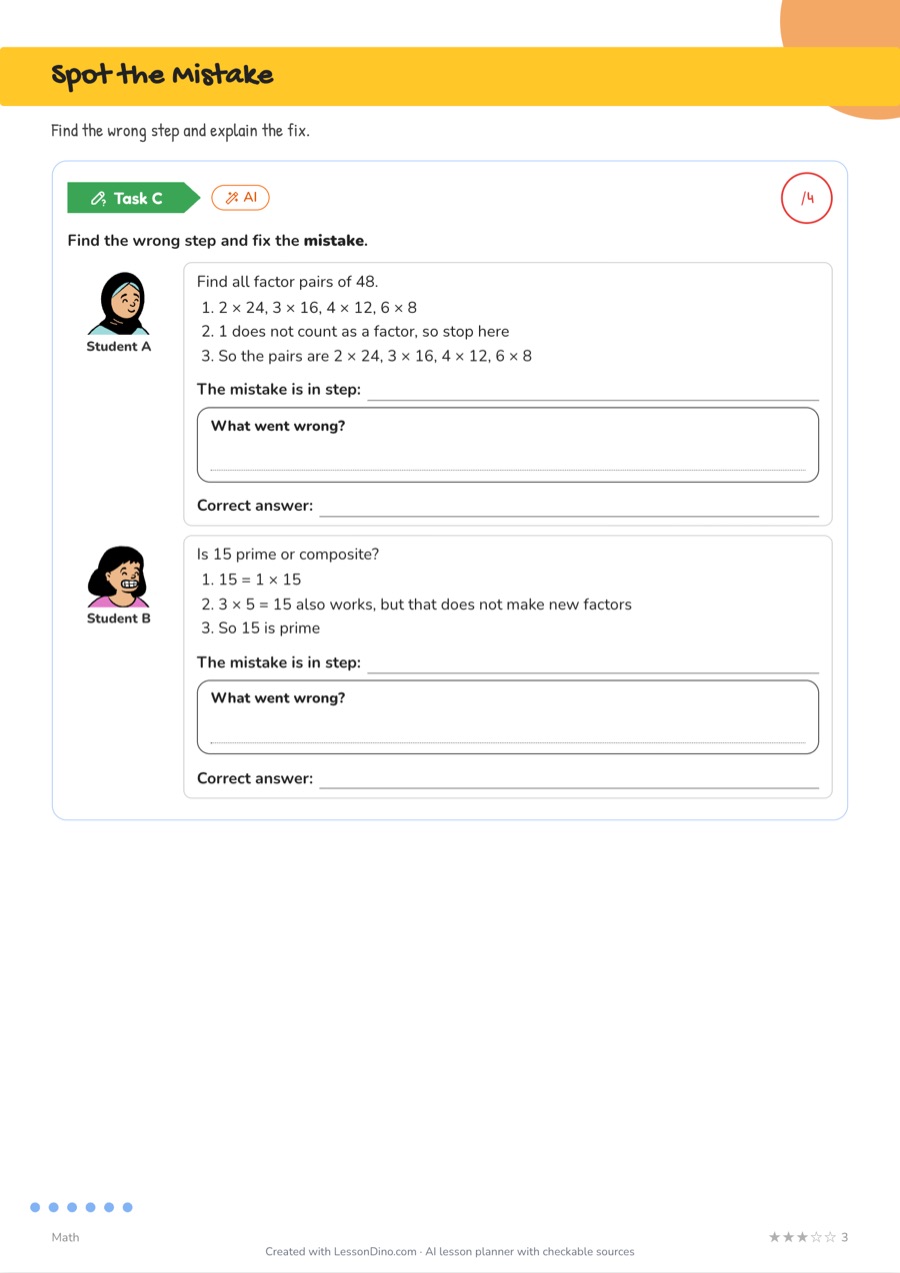
Spot the Mistake
Find the wrong step and explain the fix.
Find the wrong step and fix the mistake.
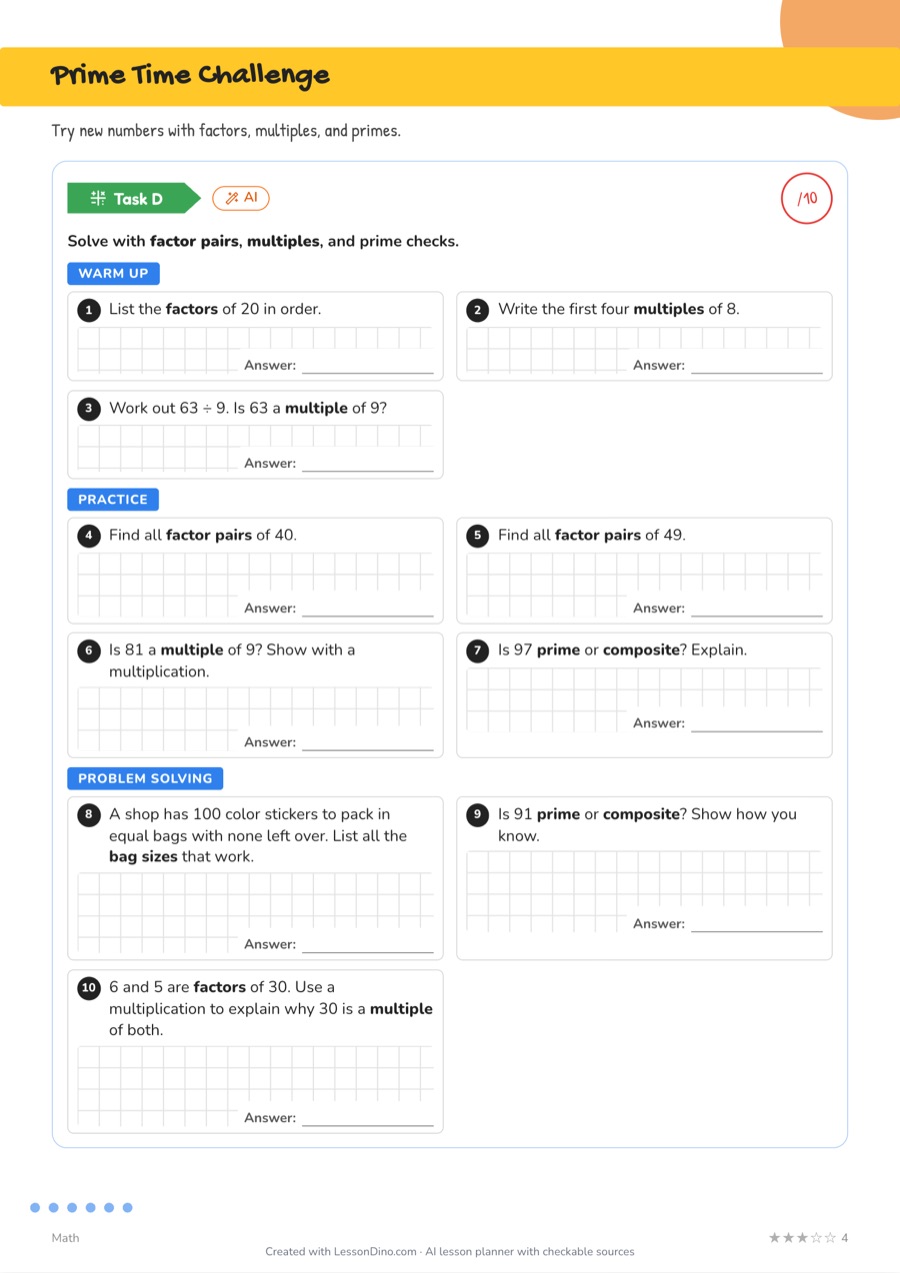
Prime Time Challenge
Try new numbers with factors, multiples, and primes.
Solve with factor pairs, multiples, and prime checks.
Warm up
- List the factors of 20 in order.
- Write the first four multiples of 8.
- Work out 63 ÷ 9. Is 63 a multiple of 9?
Practice
- Find all factor pairs of 40.
- Find all factor pairs of 49.
- Is 81 a multiple of 9? Show with a multiplication.
- Is 97 prime or composite? Explain.
Problem solving
- A shop has 100 color stickers to pack in equal bags with none left over. List all the bag sizes that work.
- Is 91 prime or composite? Show how you know.
- 6 and 5 are factors of 30. Use a multiplication to explain why 30 is a multiple of both.
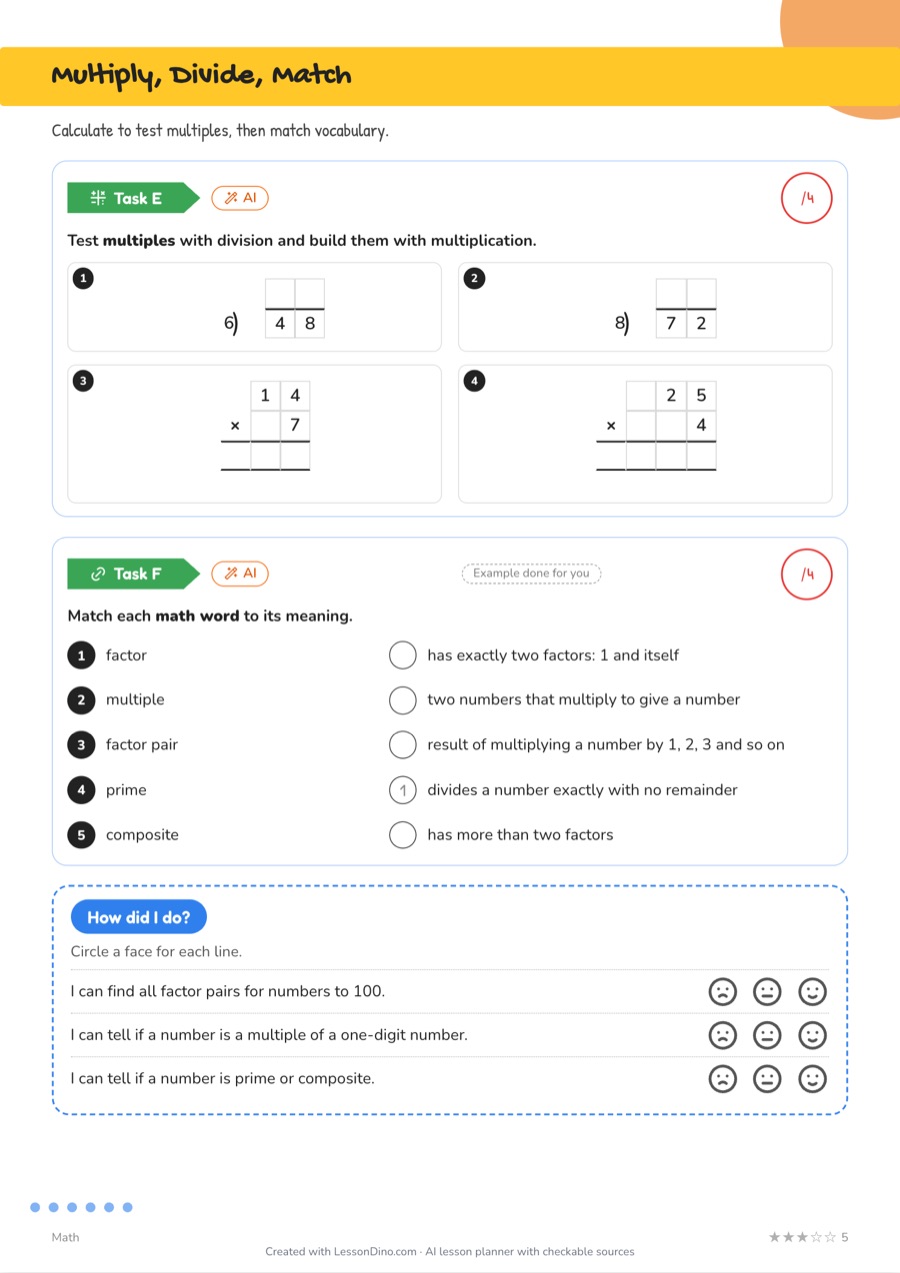
Multiply, Divide, Match
Calculate to test multiples, then match vocabulary.
Test multiples with division and build them with multiplication.
Match each math word to its meaning.
Answers
Show the answers
- List the factors of 18 in order from smallest to largest. 1, 2, 3, 6, 9, 18
- Write the first five multiples of 3. 3, 6, 9, 12, 15
- Is 35 a multiple of 7? Explain with a multiplication. Yes, 7 × 5 = 35
- Find all factor pairs of 28. 1 × 28, 2 × 14, 4 × 7
- Find all factor pairs of 36. 1 × 36, 2 × 18, 3 × 12, 4 × 9, 6 × 6
- Work out 48 ÷ 6. Is 48 a multiple of 6? 8, Yes
- Work out 7 × 6. Is 42 a multiple of 7? 42, Yes
- A class has 30 paper stars to pack in equal bags with none left over. List all the bag sizes that work. 1, 2, 3, 5, 6, 10, 15, 30
- Is 51 prime or composite? Show how you know. Composite, 3 × 17 = 51
- If 4 is a factor of 32, show with a multiplication that 32 is a multiple of 4. 4 × 8 = 32
- List the factors of 20 in order. 1, 2, 4, 5, 10, 20
- Write the first four multiples of 8. 8, 16, 24, 32
- Work out 63 ÷ 9. Is 63 a multiple of 9? 7, Yes
- Find all factor pairs of 40. 1 × 40, 2 × 20, 4 × 10, 5 × 8
- Find all factor pairs of 49. 1 × 49, 7 × 7
- Is 81 a multiple of 9? Show with a multiplication. Yes, 9 × 9 = 81
- Is 97 prime or composite? Explain. Prime, only factors are 1 and 97
- A shop has 100 color stickers to pack in equal bags with none left over. List all the bag sizes that work. 1, 2, 4, 5, 10, 20, 25, 50, 100
- Is 91 prime or composite? Show how you know. Composite, 7 × 13 = 91
- 6 and 5 are factors of 30. Use a multiplication to explain why 30 is a multiple of both. 5 × 6 = 30
The answer sheet is the last picture above.
Curriculum
Find all factor pairs for a whole number in the range 1-100. Recognize that a whole number is a multiple of each of its factors. Determine whether a given whole number in the range 1-100 is a multiple of a given one-digit number. Determine whether a given whole number in the range 1-100 is prime or composite.
Made with Lesson Dino's AI on 17 October 2026. AI can make mistakes, so check the answers and facts against the sources before you teach.