Slides
Lesson plan
Build It, Grow It: Factors and Multiples
Students find all factor pairs with rectangles and link them to multiples. They build, list pairs, and sort numbers as prime or composite.
Objectives
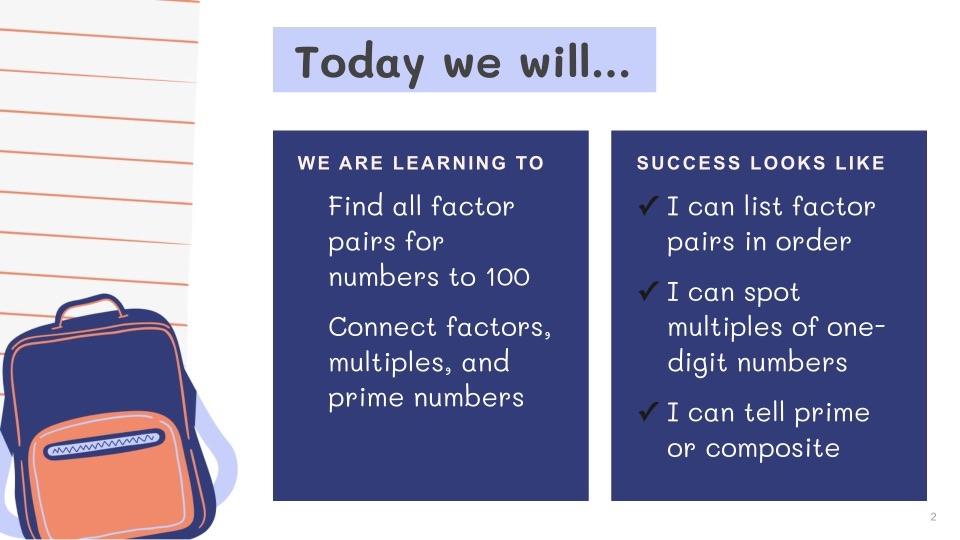
- Students will find all factor pairs for whole numbers to 100 using rectangles.
- Students will connect factors and multiples and test multiples of one-digit numbers.
- Students will decide if numbers to 100 are prime, composite, or neither.
Success criteria
- I can list all factor pairs for numbers to 100 in order.
- I can show a number is a multiple of its factors.
- I can sort numbers as prime, composite, or 1 neither.
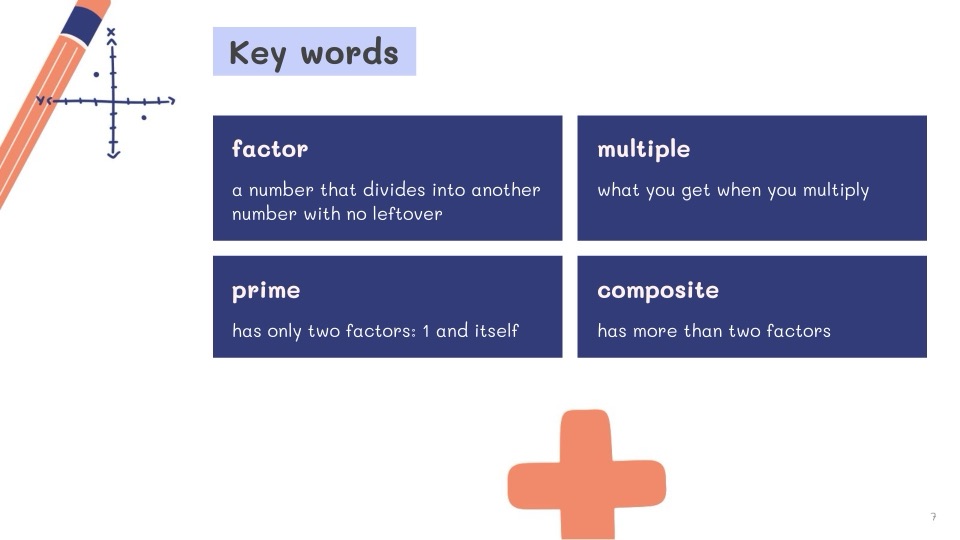
Key words
| Word | Meaning |
|---|---|
| factor | a number that goes into another with nothing left over |
| multiple | what you get when you times a number by 1, 2, 3 and so on |
| factor pair | two whole numbers that times together to make a given number |
| prime | has just two dividers: 1 and itself |
| composite | has more than two dividers, not just 1 and itself |
Timed plan (60 minutes)
| Time | Stage | What happens |
|---|---|---|
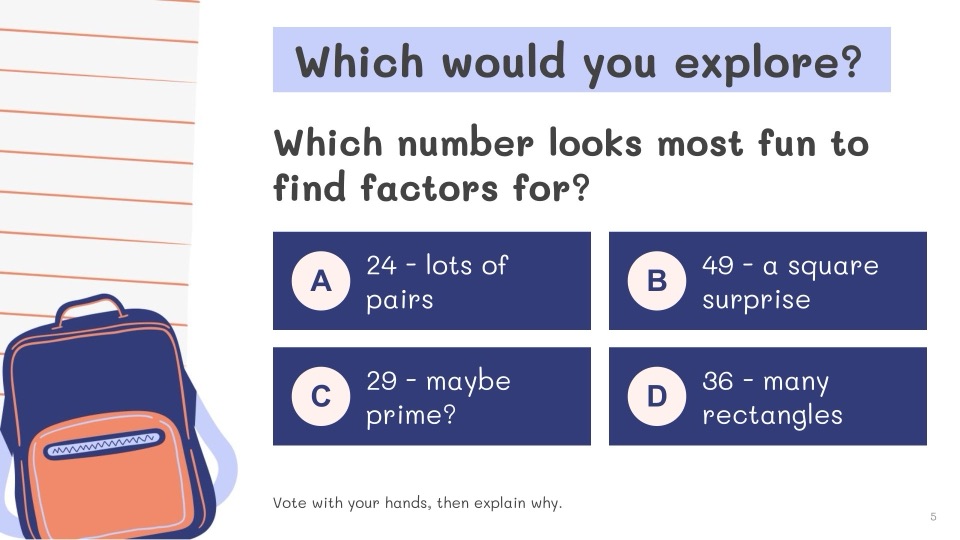
| 8 min | Starter | Hook interest with rectangles and recall multiplication facts needed for factors. Show Slide 1 and hold up 12 tiles. Say the hook and let pairs talk for 1 minute. Show Slide 5 and take a vote: Which number looks most fun to find factors for? Show Slide 2 objectives and link vote to finding factor pairs. Do a 2-minute times-table chant for 2s, 3s, 4s to warm up. |
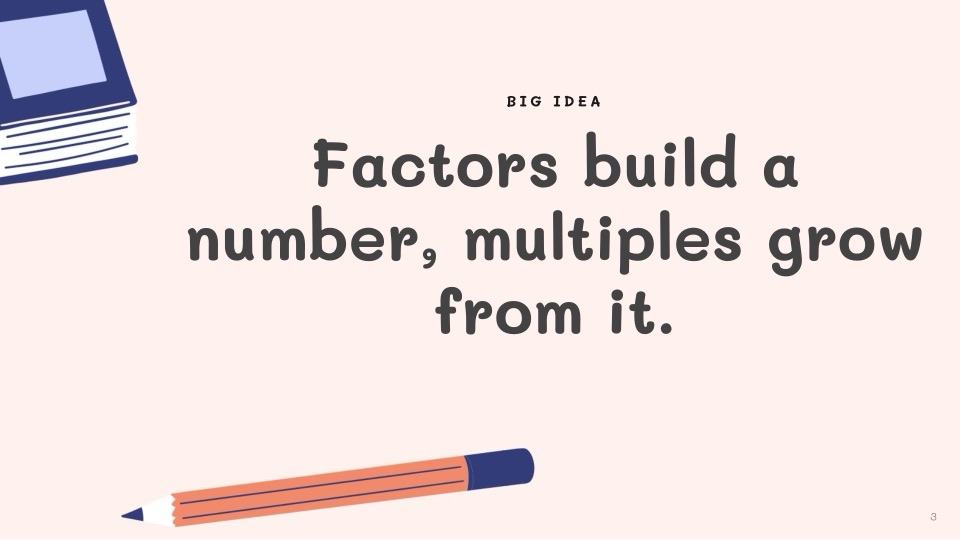
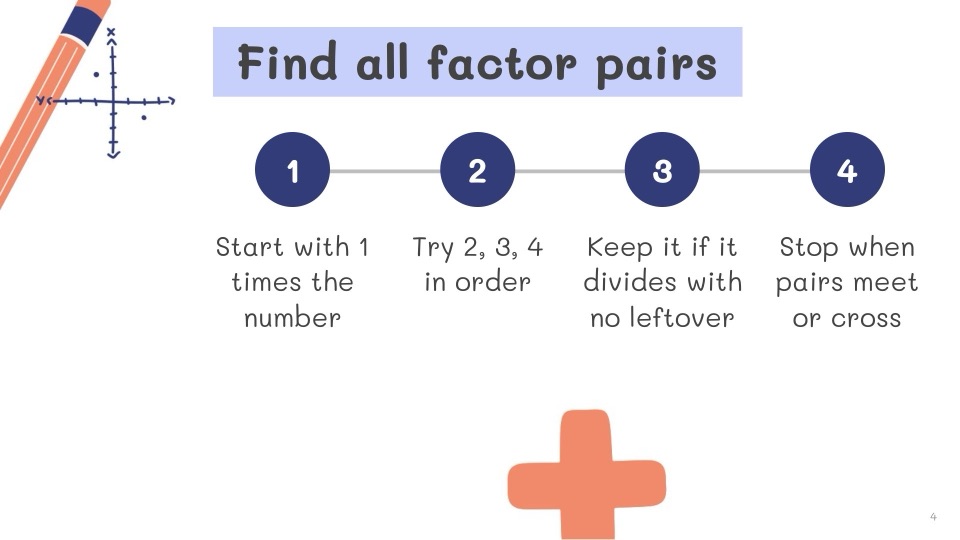
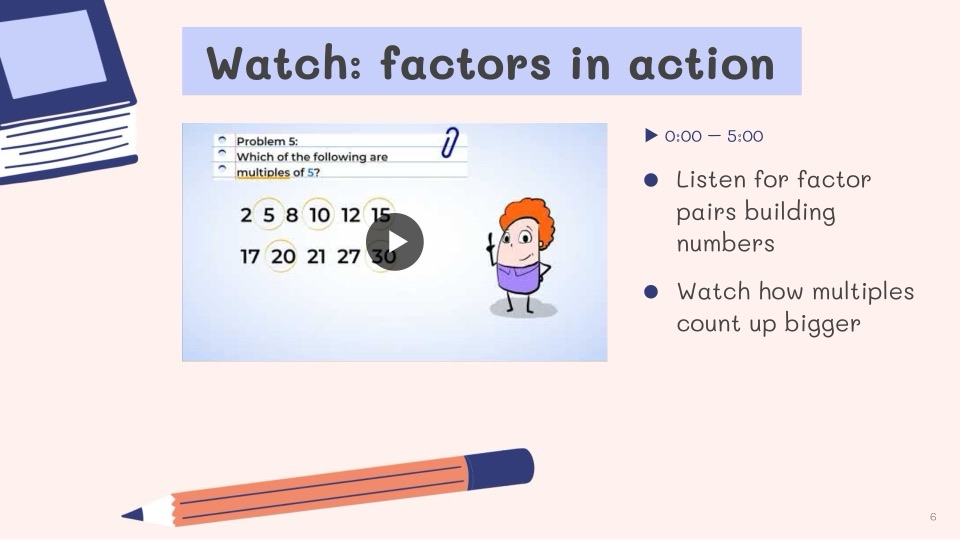
| 12 min | Teaching | Model a systematic way to find every factor pair without missing any. Show Slide 3 big idea and Slide 4 steps: start with 1, try 2, 3, 4 in order, stop when pairs meet. Model with tiles under a camera for 24: 1 x 24, 2 x 12, 3 x 8, 4 x 6. Play Video clip 1 on Slide 6 to show factor pairs building numbers and multiples counting up. Think aloud why you stop after 4 x 6 because factors always appear in pairs. |
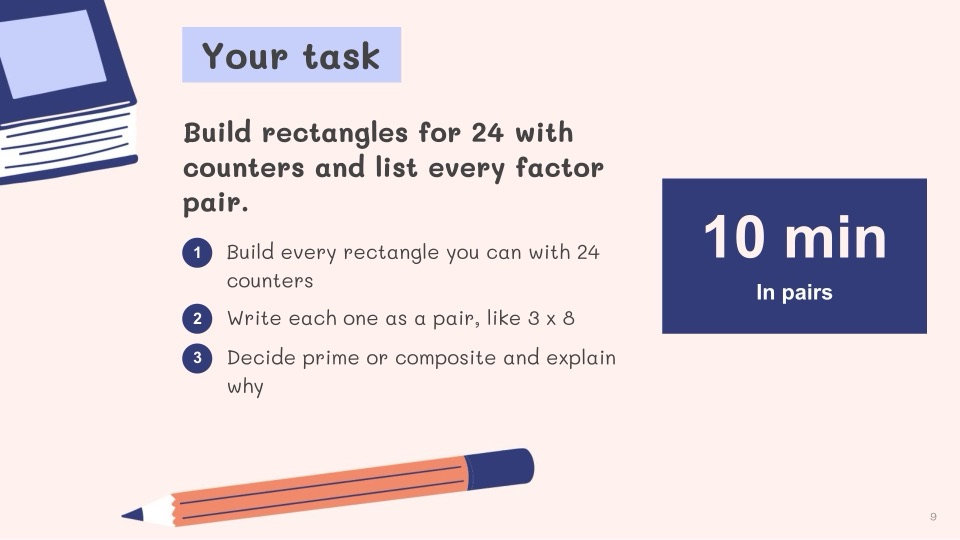
| 20 min | Main activity | Find all factor pairs for numbers to 36 by building every rectangle. Show Slide 9 task: build every rectangle with counters, write each as a pair, decide prime or composite. Hand out tiles, grid paper and pencils. Demo recording for 18: build, draw, write 1 x 18. Circulate, prompt testing in order: Did you try 2? 3? 4? What is the partner number? Stop class at 15 minutes for two pairs to show rainbows for 18 and 24. |
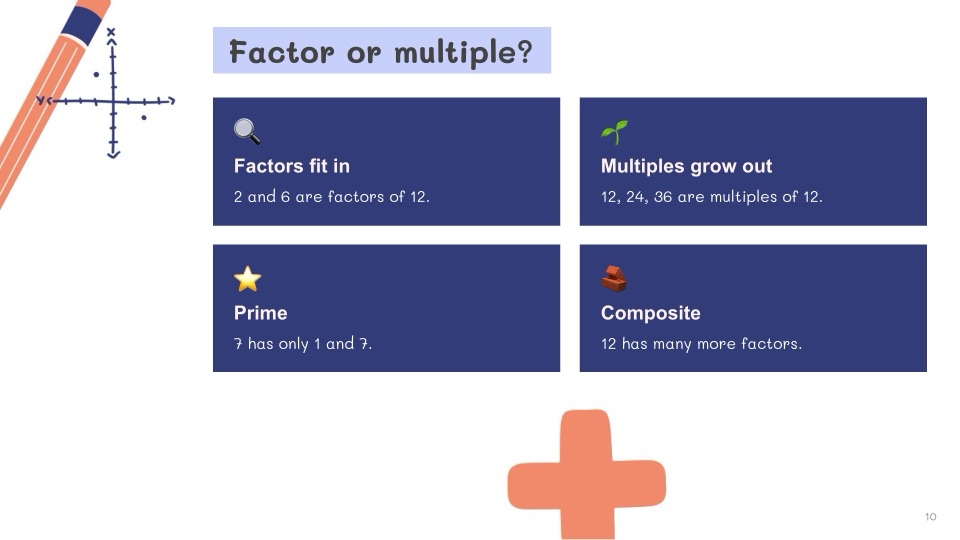
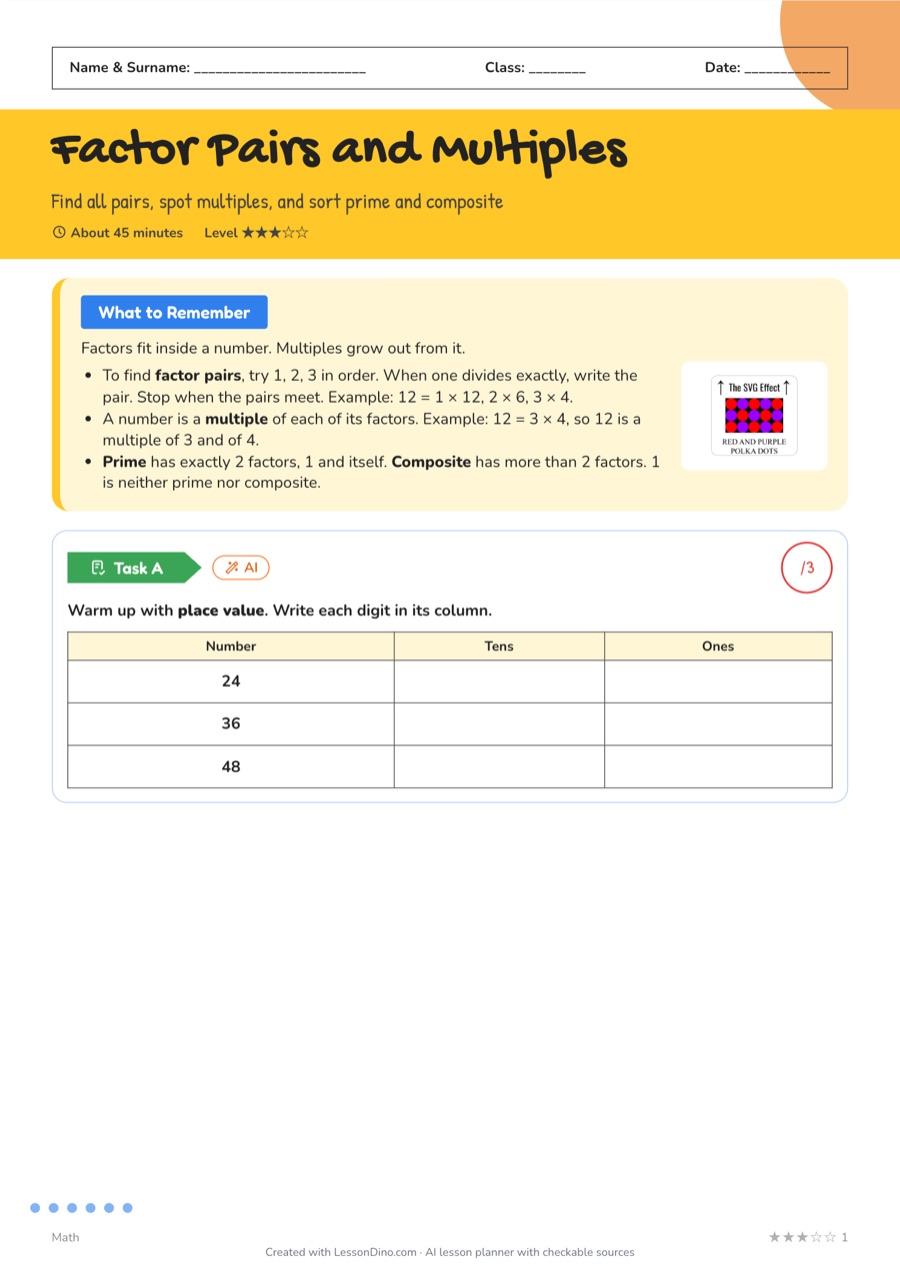
| 12 min | Teaching | Connect factor pairs to multiples and to prime or composite sorting. Show Slide 7 key words and Slide 10 cards: factors fit in, multiples grow out. Model with 7 x 5 = 35: 7 and 5 are factors of 35, 35 is a multiple of 7 and 5. Model Worksheet Task B first two rows together: list pairs, then circle multiples. Model prime check: list factors, stamp prime if only 1 and itself, composite if more. |
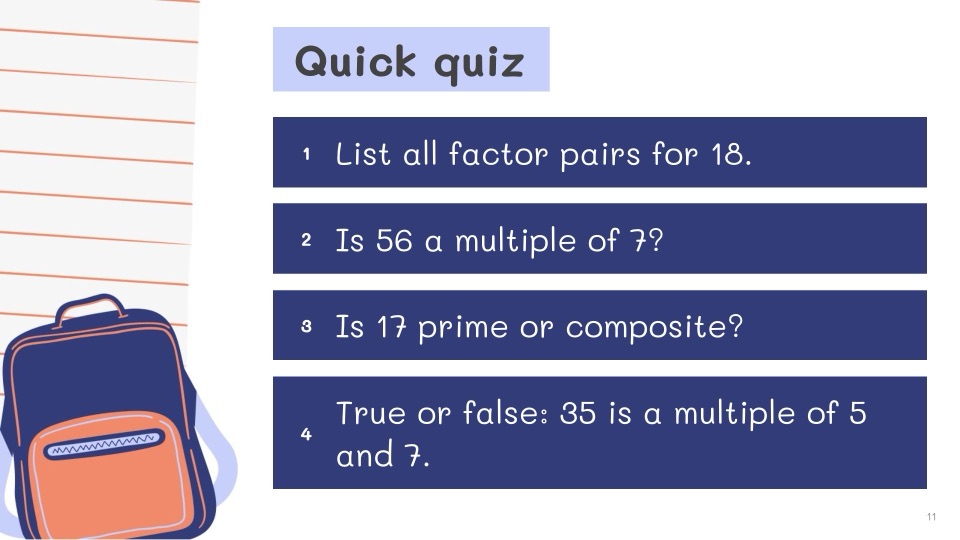
| 8 min | Plenary | Check all three goals: pairs, multiples, and prime or composite. Show Slide 11 quiz and read each prompt aloud. Give 5 minutes silent work: list pairs for 18, test 56, sort 17. Take answers, show correct pairs and facts, link back to I can statements on Slide 2. Collect papers as exit ticket and preview next lesson on common multiples. |
Common mistakes
- Listing multiples when asked for factors, like 12, 24, 36 for factors of 12
How to spot it: Answers are bigger than the target number
Remind factors fit in and are the target or smaller, multiples grow out; cross out any number over the target. - Missing 1 and the number itself or missing the square pair like 6 x 6
How to spot it: List starts at 2 or has even count for a square number
Always start with 1 times the number and test in order until pairs meet; 6 x 6 counts once. - Calling 1 prime
How to spot it: Student says 1 has two factors or stamps 1 as prime
List factors of 1: only 1. It is neither prime nor composite because it has only one factor.
Support
- Start with 6 tiles and 8 tiles only to find 1 x 6, 2 x 3 and 1 x 8, 2 x 4 using tiles.
- Give multiplication chart and factor rainbow arcs to see pairs before writing lists.
- Use sentence frames for factor-multiple links and limit prime hunt to 1-15 with tiles first.
Stretch
- Try 36 tiles and check if any rectangle is a square, then explain why it has an odd number of factors.
- Predict arches for 48 or 60 from 1, 2, 3, 4, 5, 6, 10, 12, 15, 20, 30, 60 and defend if 5 is both a factor and multiple of 5.
- Test if 51 is prime or composite by trying factor pairs and divisibility by 3.
Check questions
- List all factor pairs for 18.
Answer: 1 x 18, 2 x 9, 3 x 6 - Is 56 a multiple of 7? Give the fact.
Answer: Yes, 7 x 8 = 56 - Is 17 prime or composite? Why?
Answer: Prime, only factors are 1 and 17
Curriculum
Find all factor pairs for a whole number in the range 1-100. Recognize that a whole number is a multiple of each of its factors. Determine whether a given whole number in the range 1-100 is a multiple of a given one-digit number. Determine whether a given whole number in the range 1-100 is prime or composite.
Video clips
Clips on YouTube, from the start and end times we chose. Check each one before you show it.
-
4th grade factors and multiples from 0:00 to 5:00
MightyOwl: Factors and multiples | MightyOwl Math | 4th Grade
Made explicitly for 4th grade so vocabulary and pace are perfect for ages 9-10 and covers the lesson objectives.
-
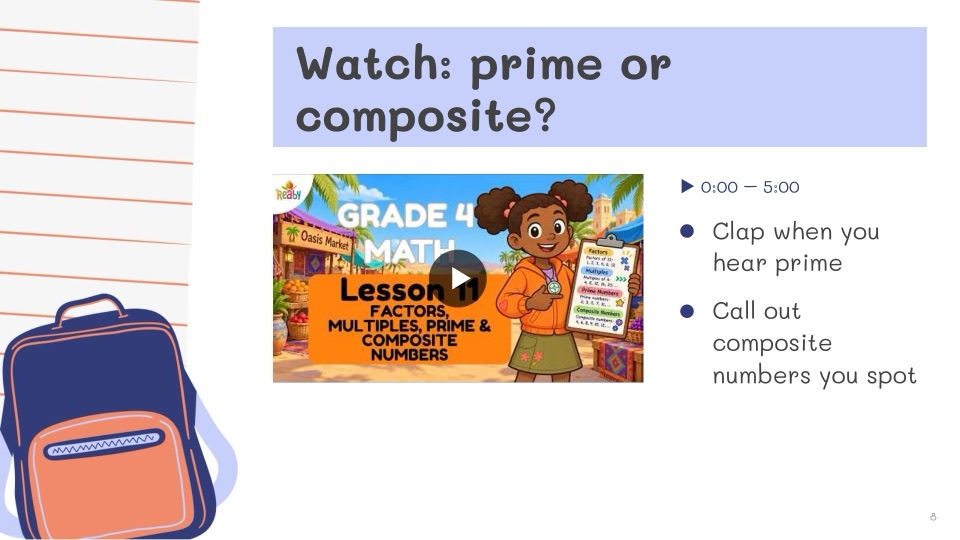
Grade 4 factors, multiples, prime/composite from 0:00 to 5:00
Reaby - The Learning Lab: Factors, Multiples, Prime and Composite Numbers | Grade 4 Math Lesson 11
Labeled Grade 4 lesson and covers factors, multiples, and prime vs composite so it matches this age and all objectives.
Worksheet
Sources
- Grade 4 Math Curriculum - Fairfax County Public Schools fcps.edu
- Grade 4 Math | SFUSD sfusd.edu
- FACTORS AND MULTIPLES: IMPORTANT AND MISUNDERSTOOD - ed files.eric.ed.gov
- Pre-Algebra Lecture 2. Factors - Department of Astrophysical ... astro.princeton.edu
- What Is The Difference Between A Factor And A Multiple shrine-qa-node01.catalyst.harvard.edu
- Least Common Multiple - ResourceCenter resourcecenter.byupathway.edu
- Factors & Multiples ⋆ Math Project mathproject.us
- Factors and Multiples Chain | wild.maths.org wild.maths.org
- Factors, multiples and primes - KS2 Maths - BBC Bitesize bbc.co.uk
- Factors and Multiples | Math Concepts for Kids kidsworldfun.com
- Factors and Multiples - Math is Fun mathsisfun.com
- Factors and Multiples: Difference, Examples and Practice mathifykids.com
- Factors and Multiples: Definition, Facts, Examples, and Quiz ... workybooks.com
- BYJU'S Online learning Programs For K3, K10, K12, NEET, JEE ... byjus.com
- Factors and Multiples Explained Simply for Students planetspark.in
- Factors and Multiples – Divisibility and Primes – Mathigon world.mathigon.org
- Factors and Multiples - Methods & Examples - Cuemath cuemath.com
- Factors and Multiples: Definition, Differences, Examples splashlearn.com
- Factors & Multiples - Math Games and Videos for Kids - NeoK12 neok12.com
- Prime factors and decomposition - BBC bbc.co.uk
- What are Factors and Multiples? Definitions | Twinkl twinkl.com.au
Picture credits
Made with Lesson Dino's AI on 17 October 2026. AI can make mistakes, so check facts against the sources before you teach.