The worksheet
About this worksheet
Students learn to tell time to the minute and find minutes passed. They build clocks, read hands, and time real jobs. This Grade 3 Math worksheet gives students (ages 8–9) six pages of practice on telling time to the minute, part of the measurement and data unit. It goes with our free Telling time to the minute lesson, which has the slides and a timed lesson plan.
What it covers
By the end, students should be able to:
- Students will tell and write time to the nearest minute on analog and digital clocks.
- Students will measure time intervals in minutes using number lines and counting.
How to use it
- Guided practice (13 minutes): Hand out Worksheet Task E and do the first clock together with Student A reading hour and Student B reading minutes.
- Support: Give a clock already labeled with 5, 10, 15 minutes around the edge to support skip-counting.
- Stretch: Set two times 1-2 minutes apart to read, write, and order.
- The answer sheet is the last page, so you can print it on its own or let students check their own work.
Key vocabulary
- minute: a short bit of time; 60 of them make one full turn of the long pointer
- hour hand: short pointer that shows the current 60-minute block that has started
- minute hand: long pointer that shows how far past the block start we are
- time interval: amount that passes from the start to the end of an activity
Mistakes to watch for
- Reads 7:45 as 8:45 because short pointer is near 8. Cover long pointer, name hour only by number at or below short pointer; when pointer is on 8 it is 8 o'clock, before that is minutes past 7.
- Reads 4:10 as 4:02, using face value of 2. Remind each number has two values; label 5 by 1, 10 by 2, 30 by 6 and skip-count by 5s, then 1s.
- Swaps pointers, reading long as hour, like 2:45 as 9:15. Always read shorter pointer first, then longer pointer; have student trace short then long aloud.
What's on the worksheet
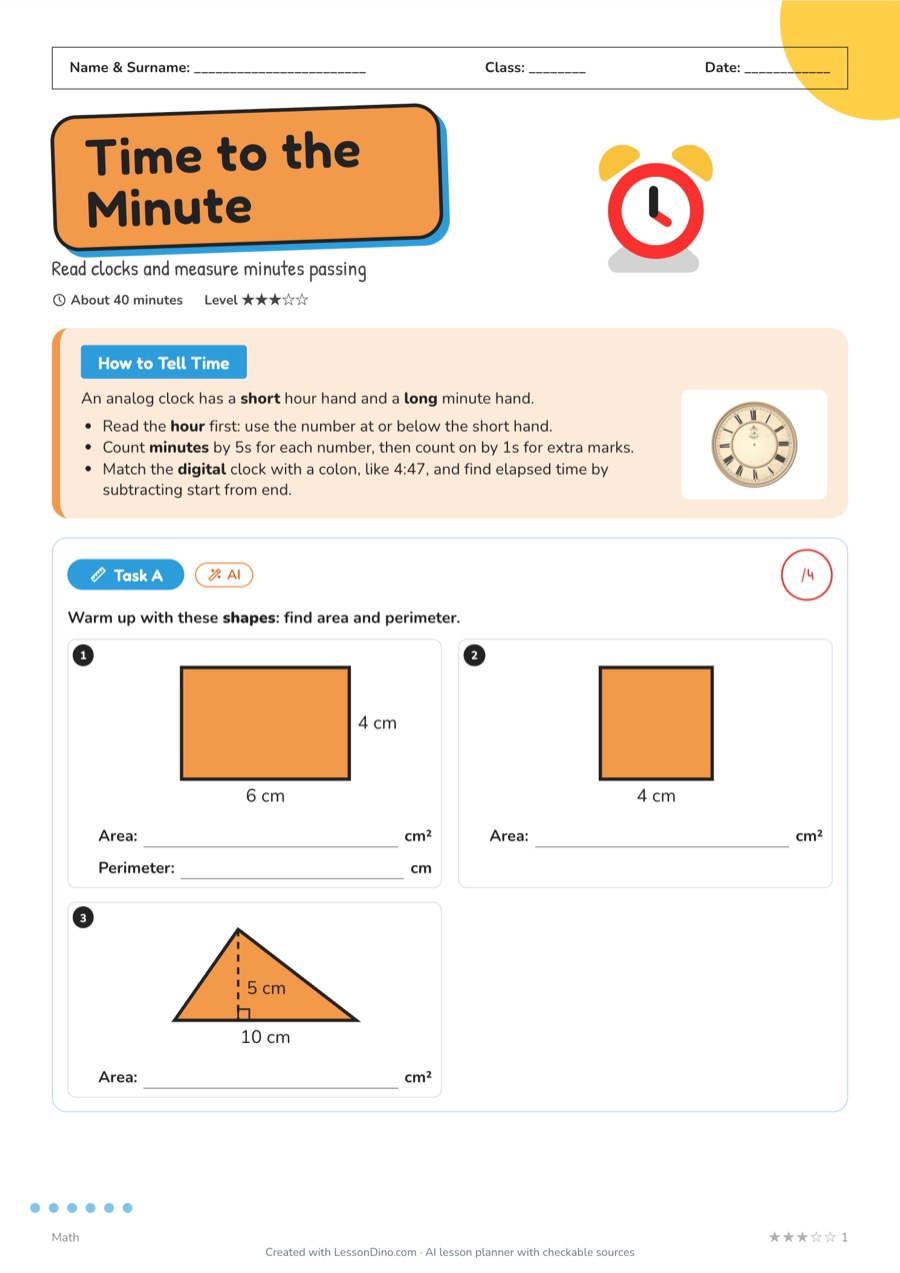
Time to the Minute
Warm up with area and perimeter, then read clocks to the minute.
How to Tell Time
- An analog clock has a short hour hand and a long minute hand.
- Read the hour first: use the number at or below the short hand.
- Count minutes by 5s for each number, then count on by 1s for extra marks.
- Match the digital clock with a colon, like 4:47, and find elapsed time by subtracting start from end.
Warm up with these shapes: find area and perimeter.
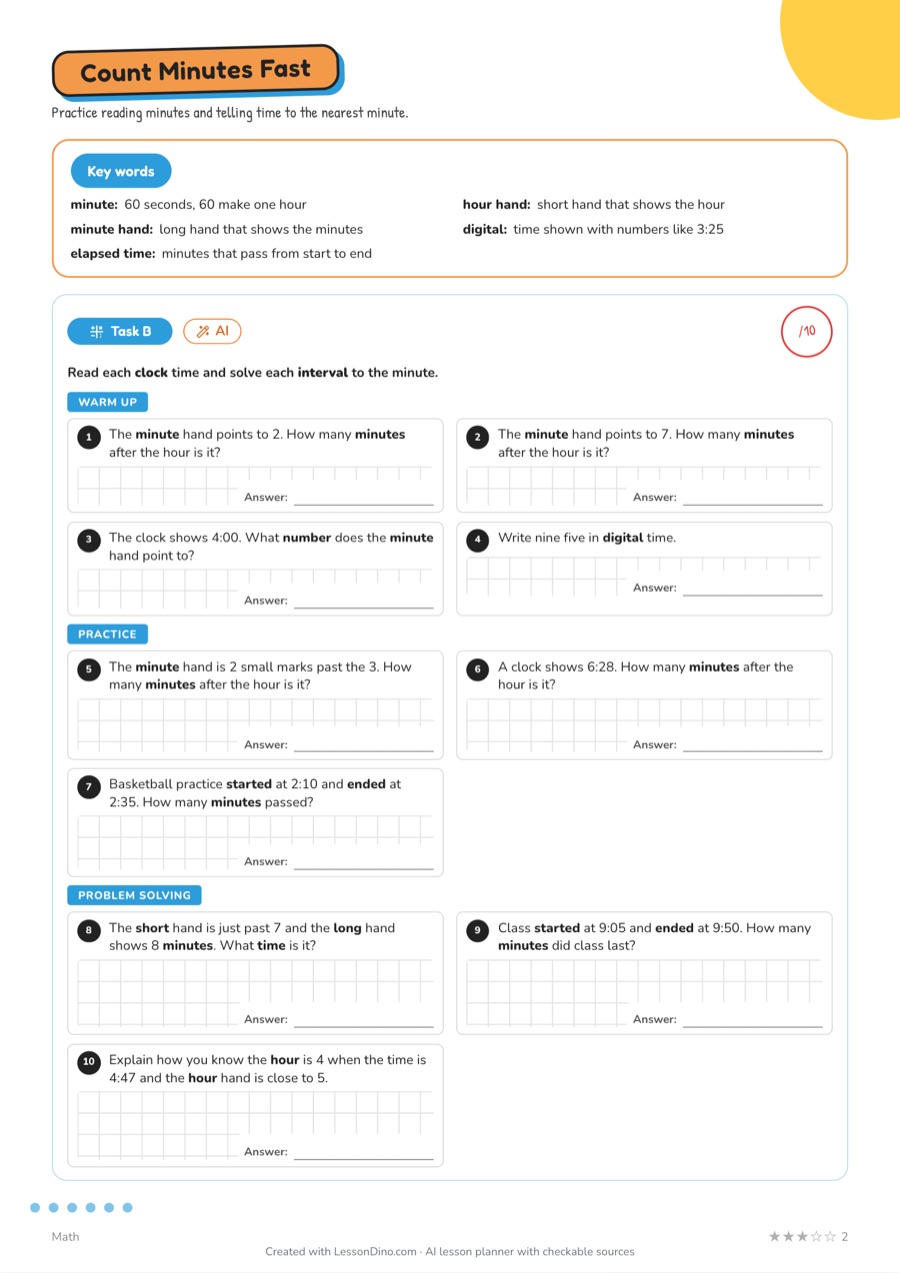
Count Minutes Fast
Practice reading minutes and telling time to the nearest minute.
| Word | Meaning |
|---|---|
| minute | 60 seconds, 60 make one hour |
| hour hand | short hand that shows the hour |
| minute hand | long hand that shows the minutes |
| digital | time shown with numbers like 3:25 |
| elapsed time | minutes that pass from start to end |
Read each clock time and solve each interval to the minute.
Warm up
- The minute hand points to 2. How many minutes after the hour is it?
- The minute hand points to 7. How many minutes after the hour is it?
- The clock shows 4:00. What number does the minute hand point to?
- Write nine five in digital time.
Practice
- The minute hand is 2 small marks past the 3. How many minutes after the hour is it?
- A clock shows 6:28. How many minutes after the hour is it?
- Basketball practice started at 2:10 and ended at 2:35. How many minutes passed?
Problem solving
- The short hand is just past 7 and the long hand shows 8 minutes. What time is it?
- Class started at 9:05 and ended at 9:50. How many minutes did class last?
- Explain how you know the hour is 4 when the time is 4:47 and the hour hand is close to 5.
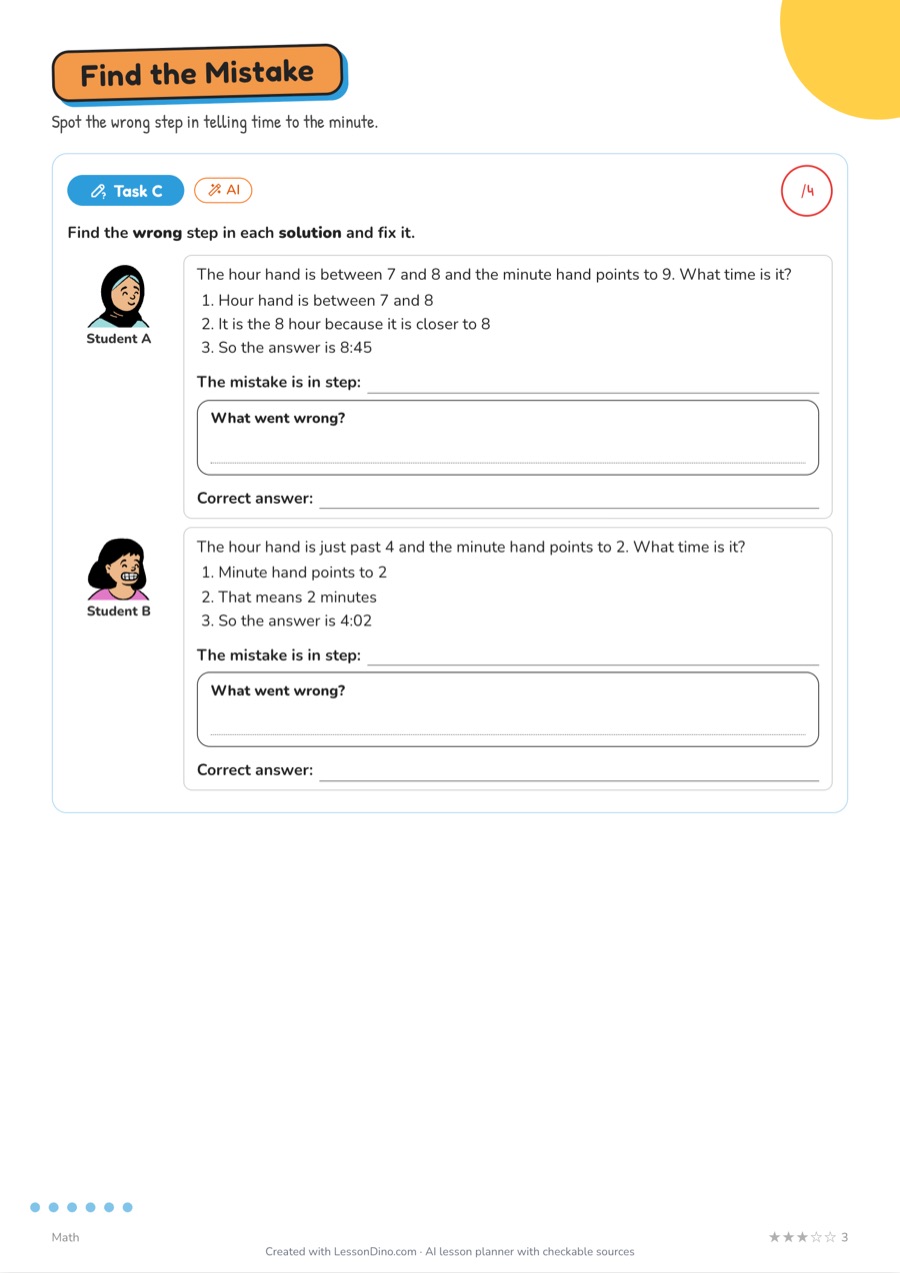
Find the Mistake
Spot the wrong step in telling time to the minute.
Find the wrong step in each solution and fix it.
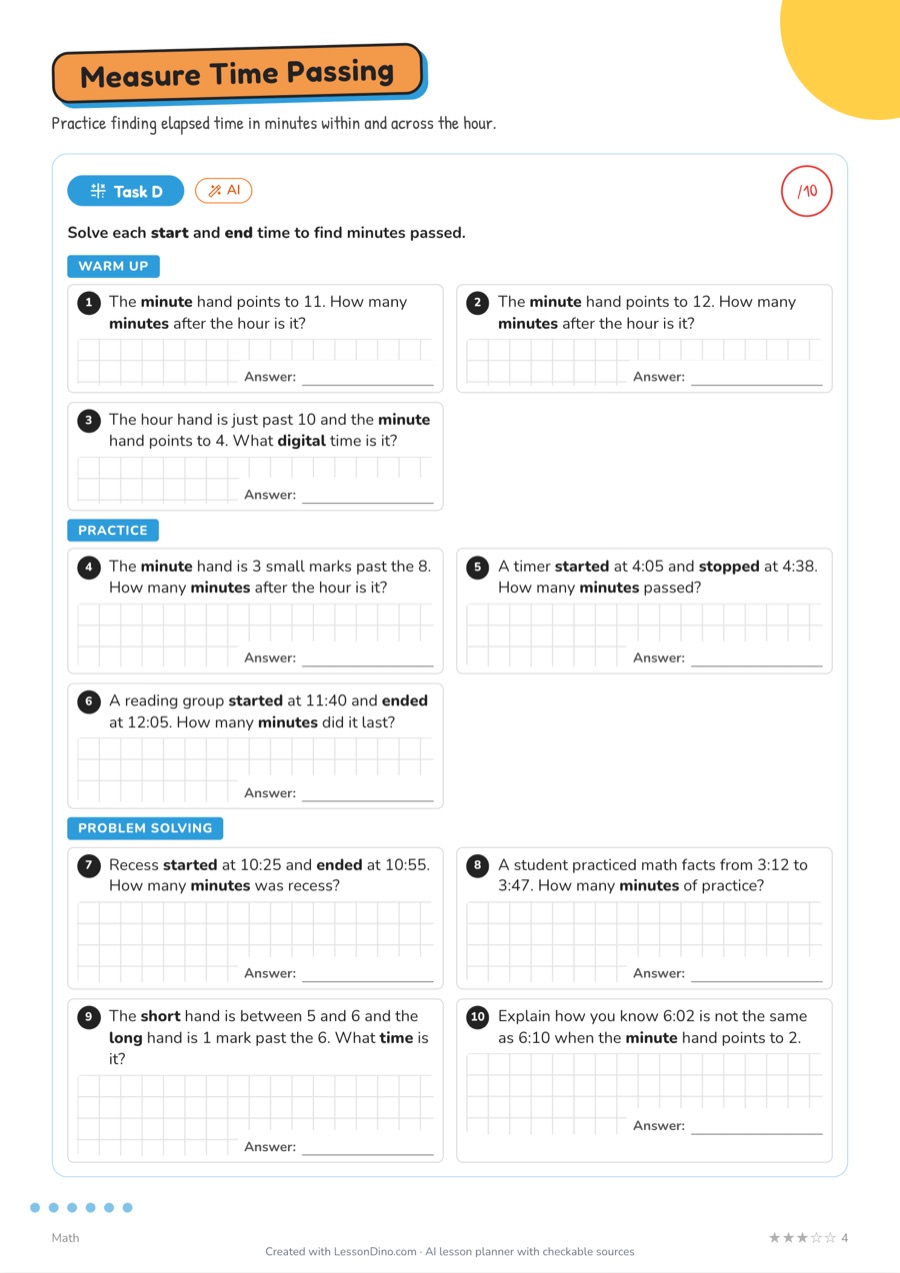
Measure Time Passing
Practice finding elapsed time in minutes within and across the hour.
Solve each start and end time to find minutes passed.
Warm up
- The minute hand points to 11. How many minutes after the hour is it?
- The minute hand points to 12. How many minutes after the hour is it?
- The hour hand is just past 10 and the minute hand points to 4. What digital time is it?
Practice
- The minute hand is 3 small marks past the 8. How many minutes after the hour is it?
- A timer started at 4:05 and stopped at 4:38. How many minutes passed?
- A reading group started at 11:40 and ended at 12:05. How many minutes did it last?
Problem solving
- Recess started at 10:25 and ended at 10:55. How many minutes was recess?
- A student practiced math facts from 3:12 to 3:47. How many minutes of practice?
- The short hand is between 5 and 6 and the long hand is 1 mark past the 6. What time is it?
- Explain how you know 6:02 is not the same as 6:10 when the minute hand points to 2.
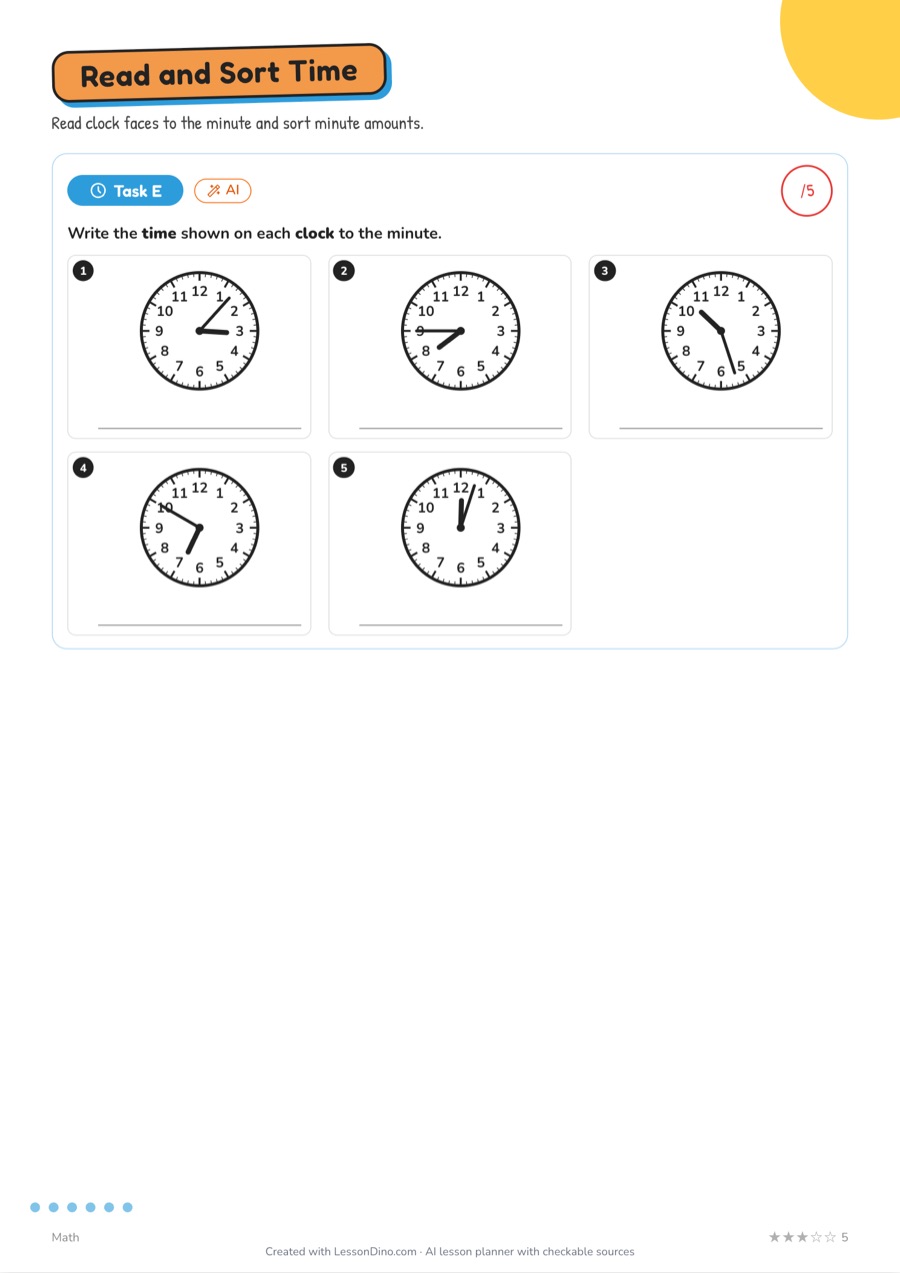
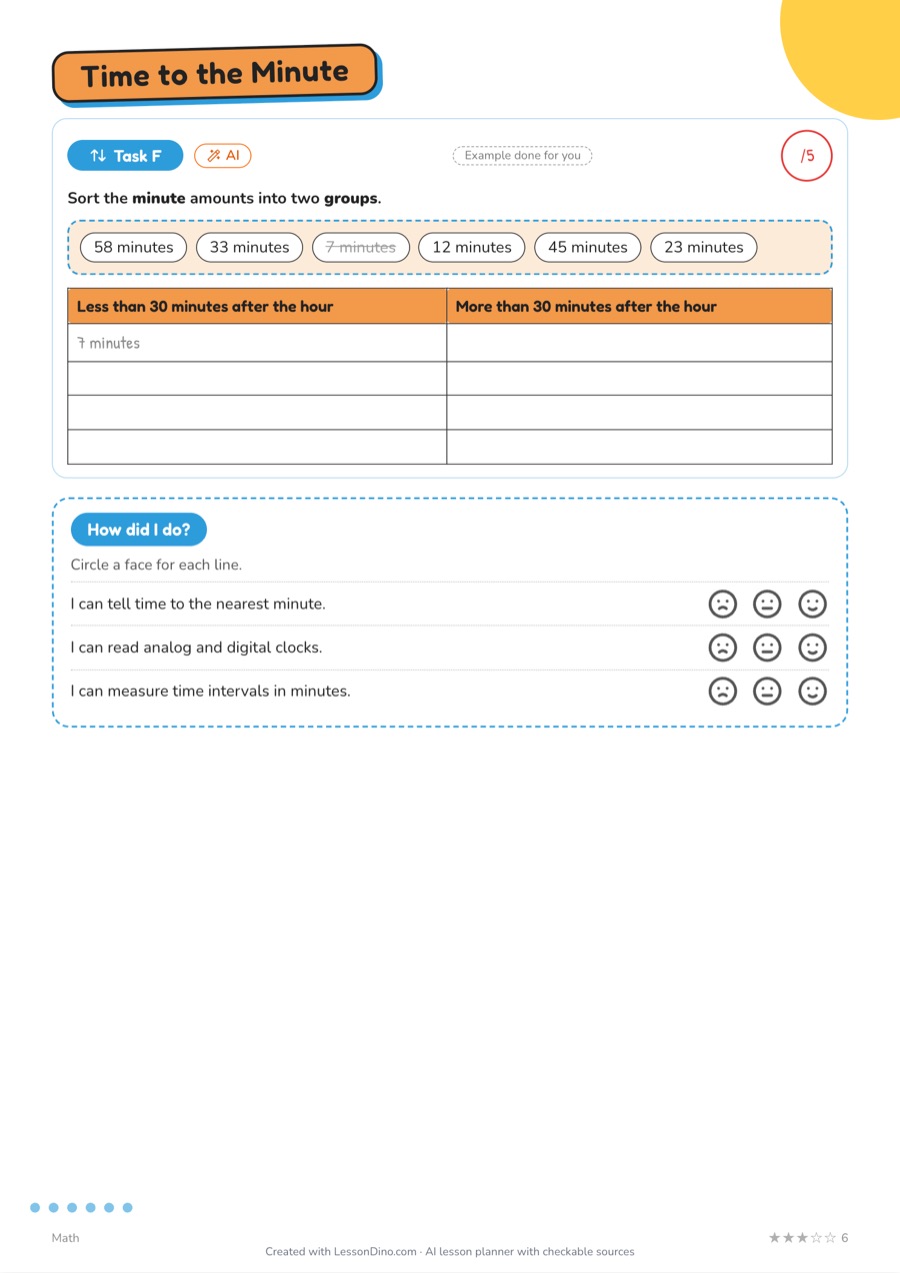
Read and Sort Time
Read clock faces to the minute and sort minute amounts.
Write the time shown on each clock to the minute.
Page 6
Sort the minute amounts into two groups.
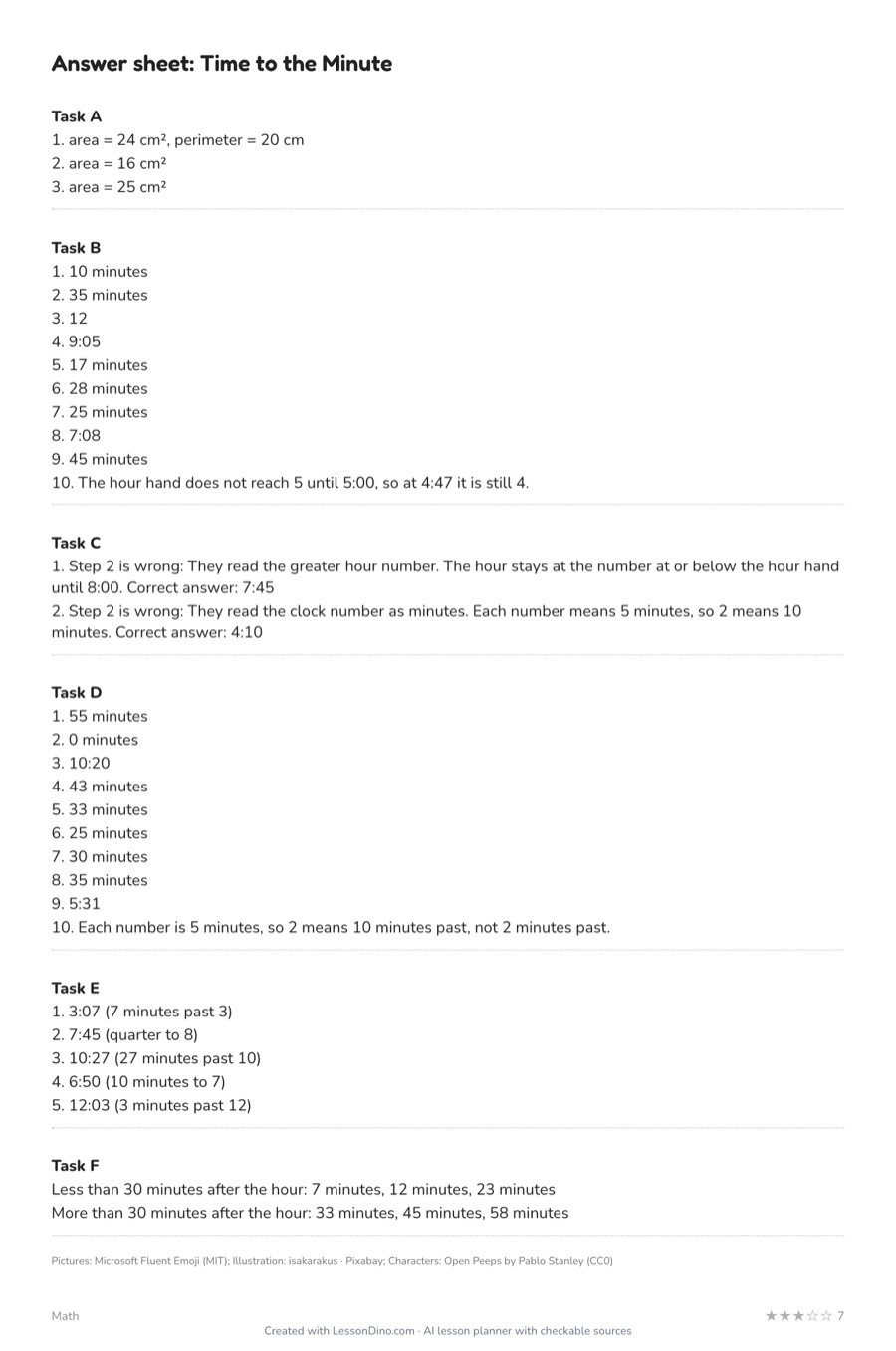
Answers
Show the answers
- The minute hand points to 2. How many minutes after the hour is it? 10 minutes
- The minute hand points to 7. How many minutes after the hour is it? 35 minutes
- The clock shows 4:00. What number does the minute hand point to? 12
- Write nine five in digital time. 9:05
- The minute hand is 2 small marks past the 3. How many minutes after the hour is it? 17 minutes
- A clock shows 6:28. How many minutes after the hour is it? 28 minutes
- Basketball practice started at 2:10 and ended at 2:35. How many minutes passed? 25 minutes
- The short hand is just past 7 and the long hand shows 8 minutes. What time is it? 7:08
- Class started at 9:05 and ended at 9:50. How many minutes did class last? 45 minutes
- Explain how you know the hour is 4 when the time is 4:47 and the hour hand is close to 5. The hour hand does not reach 5 until 5:00, so at 4:47 it is still 4.
- The minute hand points to 11. How many minutes after the hour is it? 55 minutes
- The minute hand points to 12. How many minutes after the hour is it? 0 minutes
- The hour hand is just past 10 and the minute hand points to 4. What digital time is it? 10:20
- The minute hand is 3 small marks past the 8. How many minutes after the hour is it? 43 minutes
- A timer started at 4:05 and stopped at 4:38. How many minutes passed? 33 minutes
- A reading group started at 11:40 and ended at 12:05. How many minutes did it last? 25 minutes
- Recess started at 10:25 and ended at 10:55. How many minutes was recess? 30 minutes
- A student practiced math facts from 3:12 to 3:47. How many minutes of practice? 35 minutes
- The short hand is between 5 and 6 and the long hand is 1 mark past the 6. What time is it? 5:31
- Explain how you know 6:02 is not the same as 6:10 when the minute hand points to 2. Each number is 5 minutes, so 2 means 10 minutes past, not 2 minutes past.
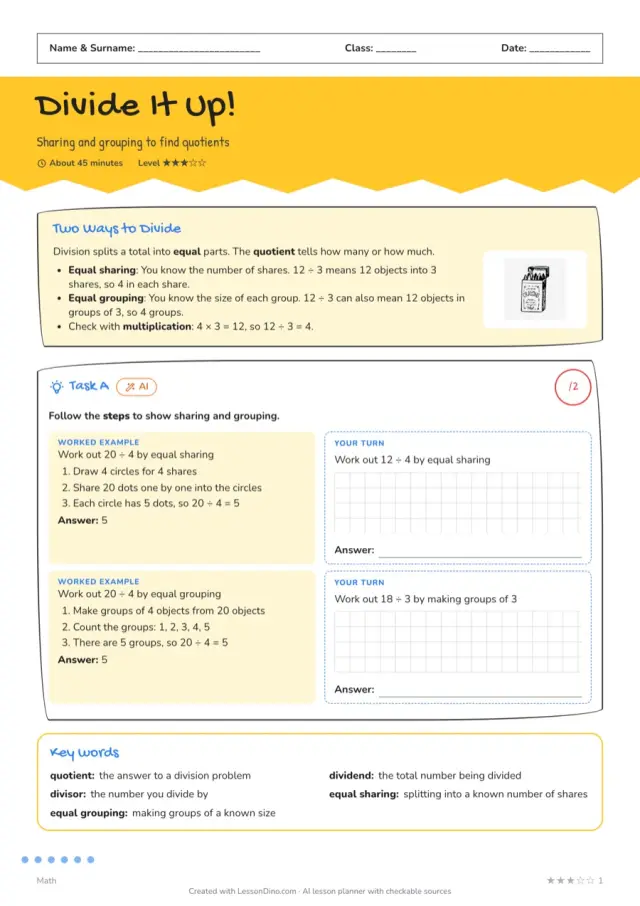
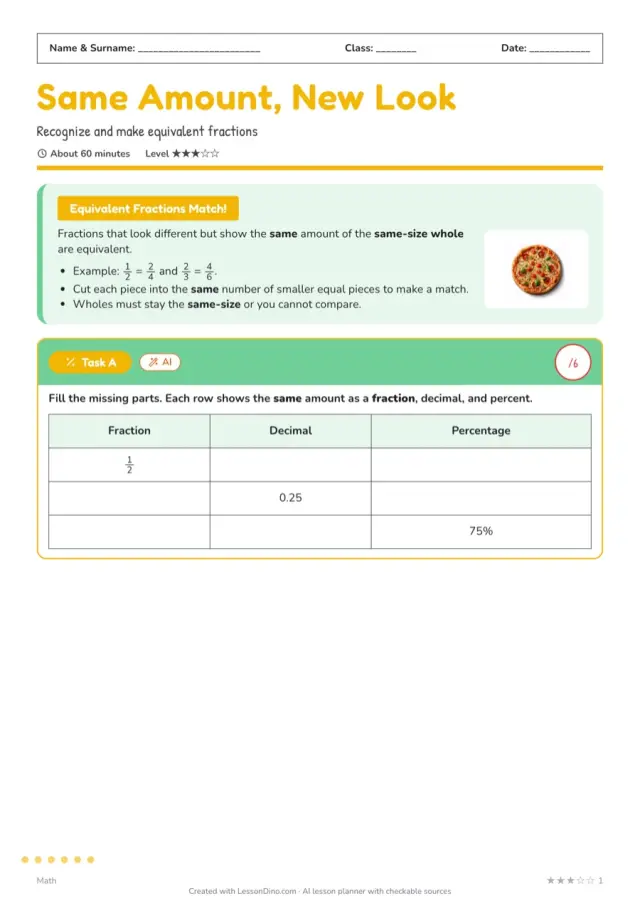
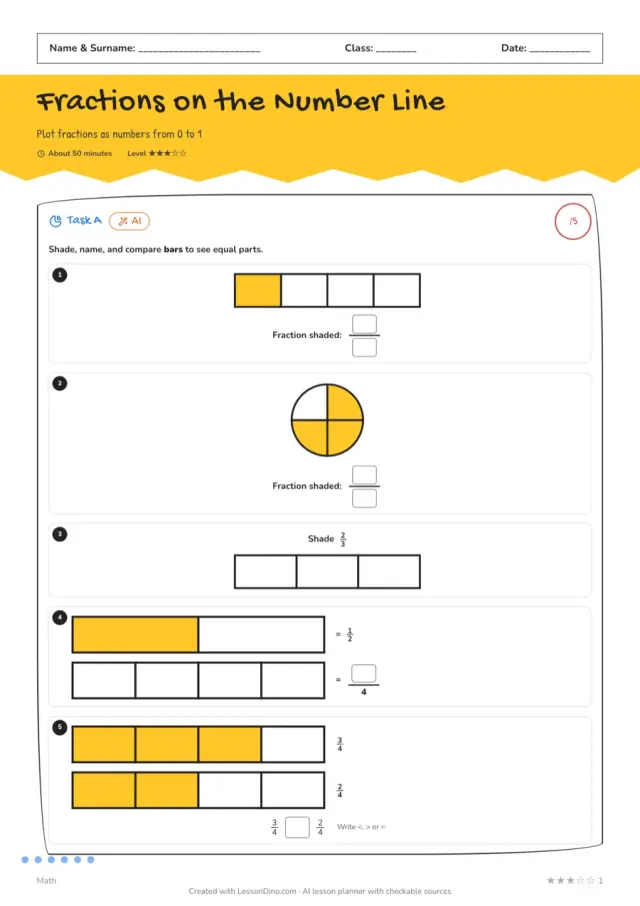
The answer sheet is the last picture above.
Curriculum
Tell and write time to the nearest minute and measure time intervals in minutes.
Made with Lesson Dino's AI on 17 October 2026. AI can make mistakes, so check the answers and facts against the sources before you teach.