Slides
Lesson plan
Same Amount, New Name
Students learn that different fractions can show the same amount. They fold strips to prove 1/2 = 2/4 and 2/3 = 4/6.
Objectives
- Students will recognize that 1/2 = 2/4 covers the same amount of the same-size whole.
- Students will generate simple equivalents like 2/3 = 4/6 by splitting parts equally.
- Students will explain why fractions are equivalent using a visual fraction model.
Success criteria
- I can show 1/2 = 2/4 with same-size strips.
- I can make 2/3 = 4/6 by cutting each part in half.
- I can explain why they match in my own words.
Key words
| Word | Meaning |
|---|---|
| equivalent fractions | different-looking top and bottom numbers that stand for the same amount of the same-size whole |
| whole | the full single shape or bar we start with before cutting |
| numerator | the top number that counts how many parts are shaded or used |
| denominator | the bottom number that counts how many equal parts the whole is cut into |
| bar model | same-size rectangles lined up to compare shaded lengths |
Timed plan (60 minutes)
| Time | Stage | What happens |
|---|---|---|
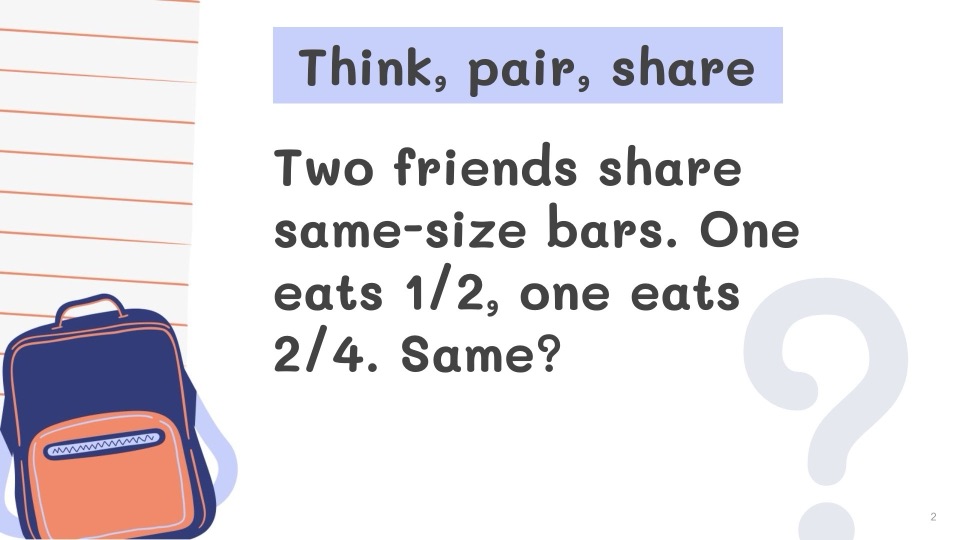
| 5 min | Starter | Hook interest and check halves and fourths language before modeling equivalence. Show Slide 1 and welcome the class to finding equivalent fractions with pictures. Show Slide 2 question about two friends with same-size bars eating 1/2 and 2/4. Say the hook and ask partners to predict: same lunch or not, and why. Take 2-3 predictions without confirming, to revisit after folding. |
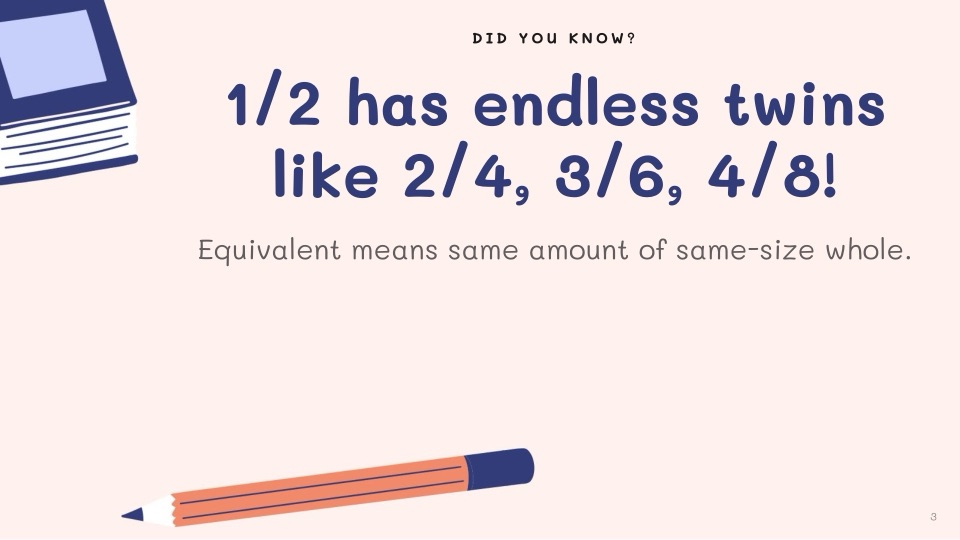
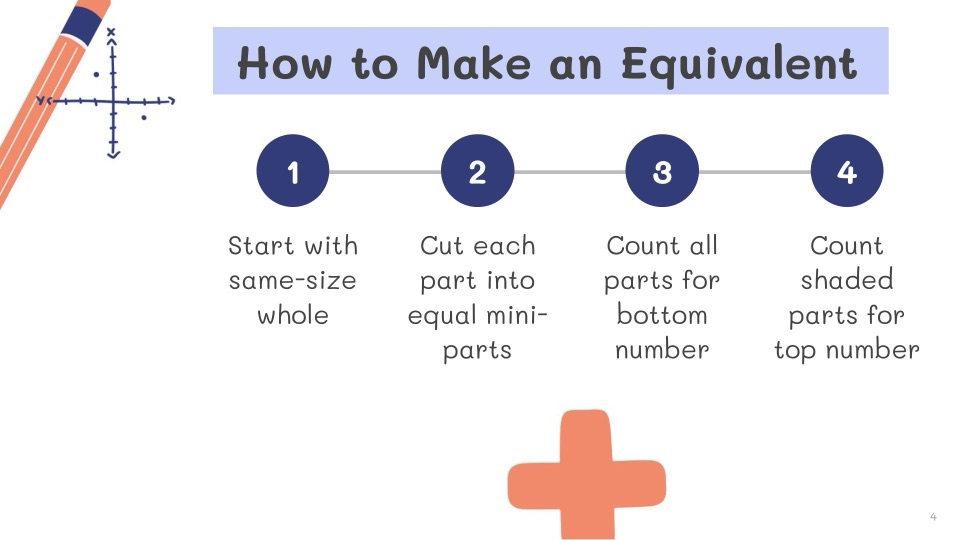
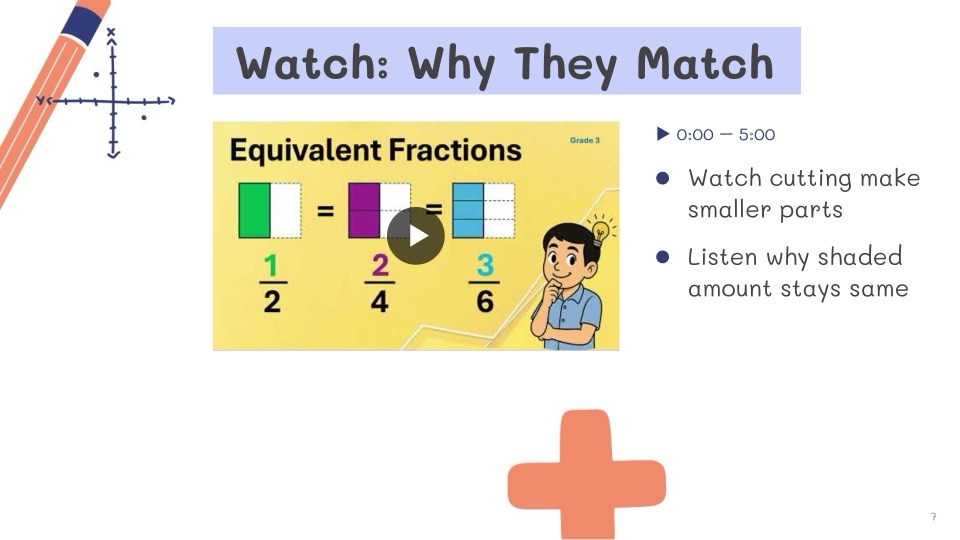
| 12 min | Teaching | Model that equivalents cover the same amount of the same-size whole. Show Slide 3 and explain that 1/2 has many twins like 2/4 and 3/6 because equivalent means same amount of same-size whole. Show Slide 4 steps and model with two same-size strips: shade 1/2, then split each part into 2 mini-parts to get 2/4. Play Video clip 1 (0:00-5:00) on Slide 5 and ask students to listen for same whole, same amount. Line up both strips to show shaded lengths match exactly. |
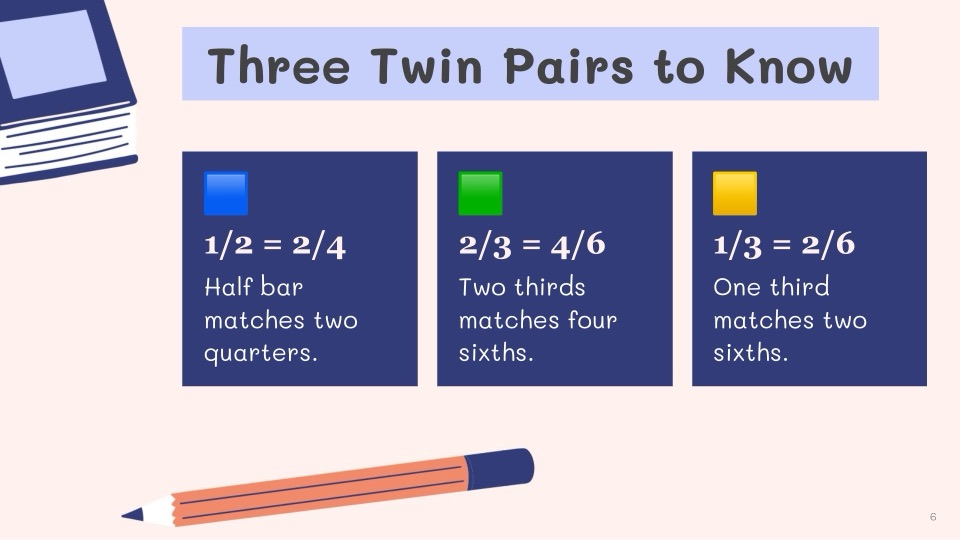
| 10 min | Guided pairs | Recognize three twin pairs and practice explaining why they match. Show Slide 6 cards for 1/2 = 2/4, 2/3 = 4/6, and 1/3 = 2/6. Model 2/3 = 4/6 with bar pictures: two thirds shaded, then cut each third in half to get four sixths. Ask pairs to rehearse the sentence: They are equivalent because the whole is the same size and the shaded part is the same size. Cold-call two pairs to explain one twin pair using the cards. |
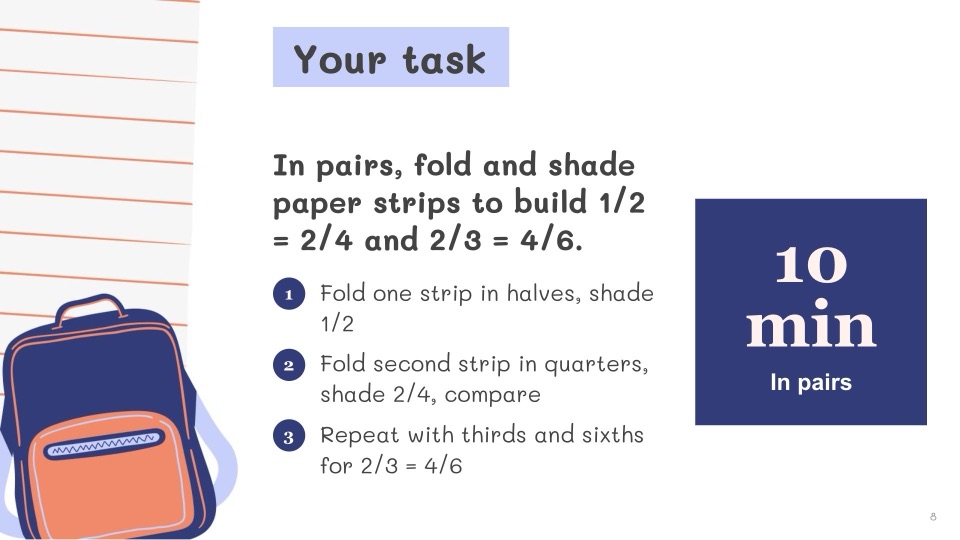
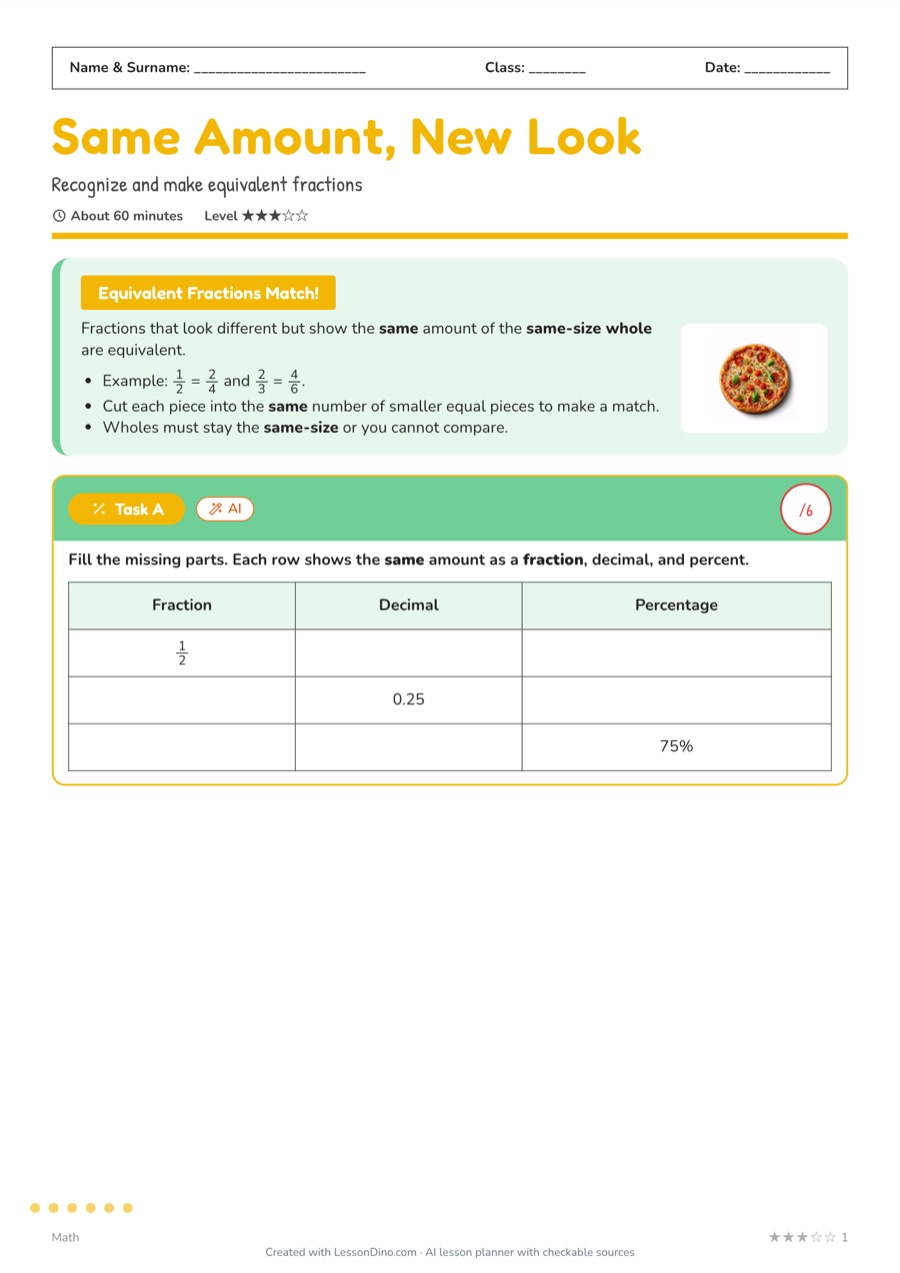
| 23 min | Main activity | Generate equivalents by folding and prove matches with strips and bars. Show Slide 8 task and hand out same-size strips and crayons. Guide Step 1: fold one strip in halves, shade 1/2; fold second strip in quarters, shade 2/4, then line up to compare. Guide Step 2: repeat with thirds and sixths to make 2/3 = 4/6 by folding thirds in half. Hand out Worksheet Task D and ask students to shade or name bars to show the same matches. |
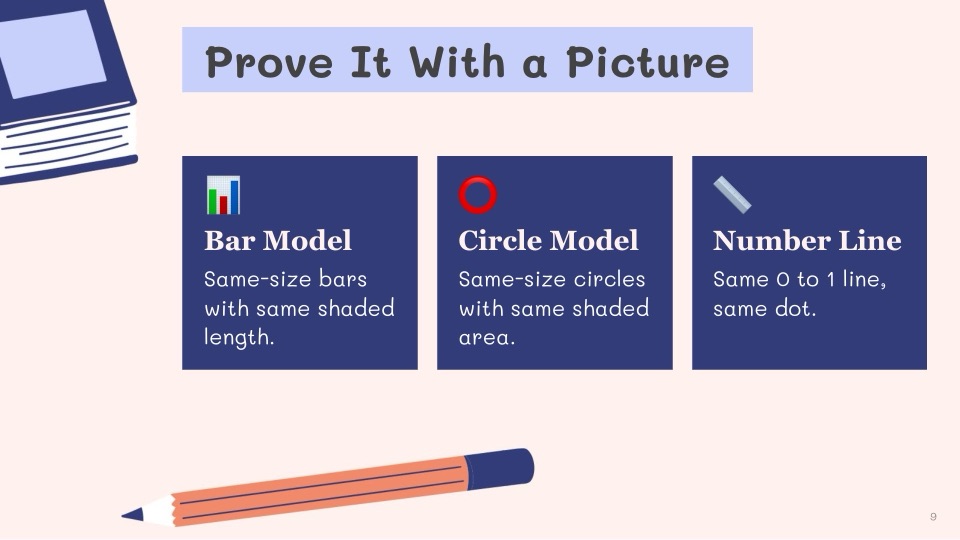
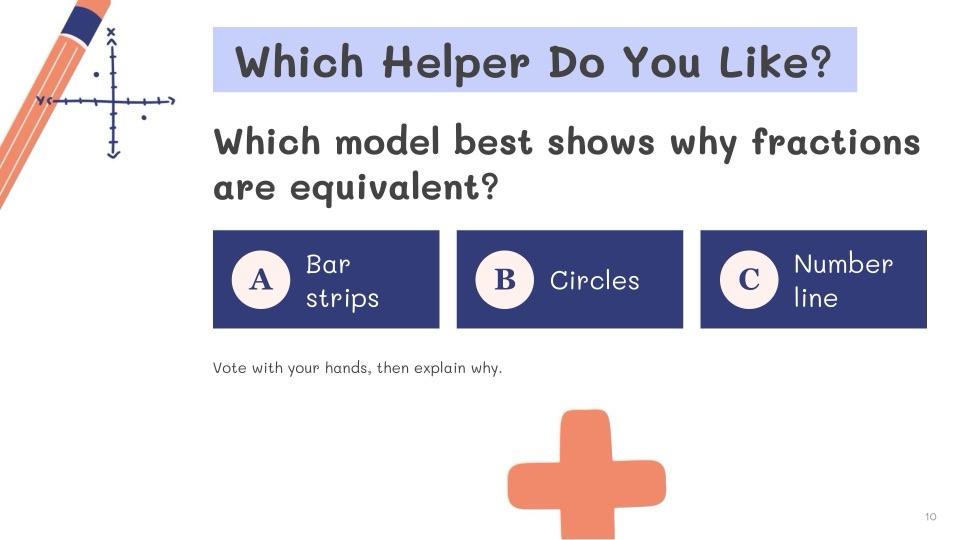
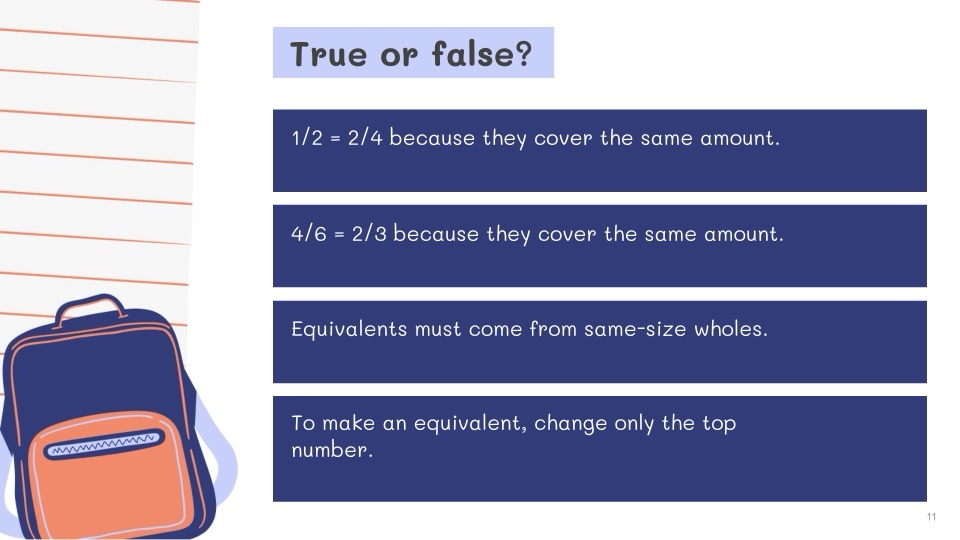
| 10 min | Plenary | Confirm the twin pairs and check who can explain equivalence. Hold up two matching class strips and ask pairs to read the equation aloud. Show Slide 10 vote and take a quick show of hands for bar strips, circles, or number line. Show Slide 11 true-or-false statements and ask students to justify with same whole, same shaded size. Set the exit ticket and preview next work on number lines. |
Common mistakes
- Thinking 1/2 and 1/3 are equivalent because each has 1 shaded part.
How to spot it: Student matches any fractions with the same numerator without checking shaded size.
Overlay same-size wholes and compare shaded area, not just count of parts, since two fractions are equivalent only if areas are the same with respect to the same-sized whole. - Comparing fractions from different-size wholes.
How to spot it: Student says a small 1/2 equals a large 1/2 strip piece by piece without lining up wholes.
Remind that fractions can only be compared when they come from wholes of the same size; re-line strips edge to edge. - Changing only the top or bottom number to make a twin.
How to spot it: Student writes 1/2 = 1/4 or 1/2 = 2/3 after cutting more parts but shading the same count.
Show you must cut each part into the same number of equal parts and count all parts and shaded parts again; more parts means smaller parts.
Support
- Start with only halves, using pre-folded strips to compare 1/2 and 2/4 side by side.
- Keep the 1 whole strip visible as a size guide and use sentence starters for the why explanation.
Stretch
- Fold a third same-size strip into 6 or 8 equal parts and find what equals 1/2.
- Build two different matches for 1/2, such as 2/4 and 3/6, and explain both.
Check questions
- Draw same-size bars to show if 1/2 = 2/4. Why or why not?
Answer: Yes, shaded lengths match for the same-size whole. - Fill the missing number: 2/3 = ?/6. How did you make it?
Answer: 4/6, by cutting each third into 2 equal parts. - Finish: 1/2 and 2/4 are equivalent because...
Answer: They are the same amount of the same-size whole / same shaded size.
Curriculum
Recognize and generate simple equivalent fractions, e.g., 1/2 = 2/4, 4/6 = 2/3. Explain why the fractions are equivalent, e.g., by using a visual fraction model.
Video clips
Clips on YouTube, from the start and end times we chose. Check each one before you show it.
-
3rd grade equivalent fractions from 0:00 to 5:00
Kids Academy: Equivalent Fractions | Math for 3rd Grade | Kids Academy
Made exactly for 3rd grade and uses visual fraction models to show 1/2 = 2/4, ideal pace for ages 8-9.
-
Why equivalents are equal from 0:00 to 5:00
Maths With Kids: Equivalent Fractions Decoded | Why Different Fractions Equal the Same Thing
Made for kids to explain why different fractions can equal the same thing with visuals, ideal for ages 8-9.
Worksheet
Sources
- 2025-2026 3rd grade Math Curriculum boepublic.parkhill.k12.mo.us
- Grade 3 Math | SFUSD sfusd.edu
- Equivalent fractions - Math Help - LibGuides at Tulsa Community College guides.library.tulsacc.edu
- Equivalent Fractions - Ximera ximera.osu.edu
- 19 Equivalent Fractions Worksheets for Practice | Endolab ... endolab.ucdavis.edu
- Equivalent fractions - Copy of DIY Maths - LibGuides at ... libguides.cccua.edu
- Equivalents Fractions - Department of Mathematics at UTSA mathresearch.utsa.edu
- Math Notes: Methods for Generating and Explaining Equivalent Fractions crdg.hawaii.edu
- Equivalent fractions - KS2 Maths resources for Year 4 - BBC bbc.co.uk
- How to find equivalent fractions - BBC Bitesize bbc.co.uk
- Kids Math: Equivalent Fractions - Ducksters ducksters.com
- Flexi answers - How can you tell if a fraction is equivalent? | CK-12 Foundation ck12.org
- Equivalent Fractions For Kids | Fractions With The Same Value learnwithsitesforkids.com
- Equivalent Fractions Explained | Definition, Examples & Quiz ... workybooks.com
- Equivalent Fractions - Dr Mike's Math Games for Kids dr-mikes-math-games-for-kids.com
- Equivalent Fractions Math Video for Kids | 3rd, 4th & 5th Grade ... generationgenius.com
- Equivalent Fractions mathsisfun.com
- equivalent fractions - calcsolver calcsolver.us
Picture credits
Made with Lesson Dino's AI on 17 October 2026. AI can make mistakes, so check facts against the sources before you teach.