The worksheet
About this worksheet
Students learn two meanings of division: shares and groups. They build and draw both meanings for 18 ÷ 3 and 56 ÷ 8. This Grade 3 Math worksheet gives students (ages 8–9) five pages of practice on division, part of the operations and algebraic thinking unit. It goes with our free Division lesson, which has the slides and a timed lesson plan.
What it covers
By the end, students should be able to:
- Students will interpret division as sharing into shares or making groups of equal size.
- Students will draw and describe sharing and grouping stories for facts within 100.
- Students will explain both meanings of 56 ÷ 8 = 7 in words and pictures.
How to use it
- Main activity (20 minutes): Hand out paper, crayons or colored pencils, rulers and Worksheet Task A.
- Support: Provide a template with 3 empty large circles on one side and empty small groups of 3 dots started on the other.
- Stretch: Students pick 28 ÷ 7 and create both drawings, then write which meaning they like best and why.
- The answer sheet is the last page, so you can print it on its own or let students check their own work.
Key vocabulary
- division: splitting a total into same-size parts
- equal: all the same in size or amount
- share: one part when a total is split fairly
- group: a small set put together in one place
- quotient: the answer found after splitting equally
Mistakes to watch for
- Thinking the quotient always means size of share, not number of shares. Match drawing to story words: into 3 shares means 6 in each; groups of 3 means 6 shares.
- Making unequal shares or groups when dealing. Deal one by one equally and recount each part to prove equal.
- Mixing up number of shares and size of share in 56 ÷ 8. Underline into 8 shares versus groups of 8 and ask: are we finding how many in each or how many groups.
What's on the worksheet
Sharing and Grouping
See the two meanings of division.
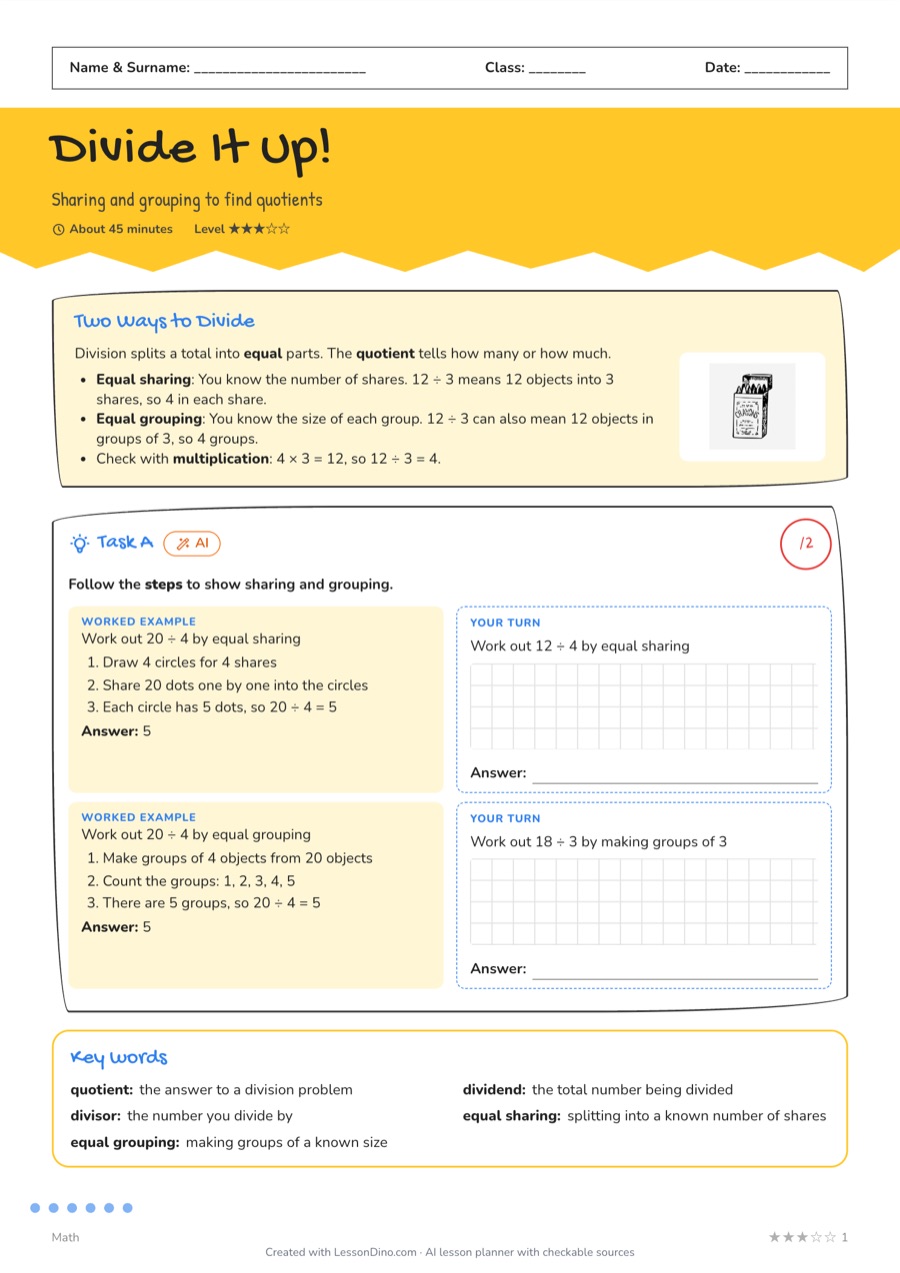
Two Ways to Divide
- Division splits a total into equal parts. The quotient tells how many or how much.
- Equal sharing: You know the number of shares. 12 ÷ 3 means 12 objects into 3 shares, so 4 in each share.
- Equal grouping: You know the size of each group. 12 ÷ 3 can also mean 12 objects in groups of 3, so 4 groups.
- Check with multiplication: 4 × 3 = 12, so 12 ÷ 3 = 4.
Follow the steps to show sharing and grouping.
| Word | Meaning |
|---|---|
| quotient | the answer to a division problem |
| dividend | the total number being divided |
| divisor | the number you divide by |
| equal sharing | splitting into a known number of shares |
| equal grouping | making groups of a known size |
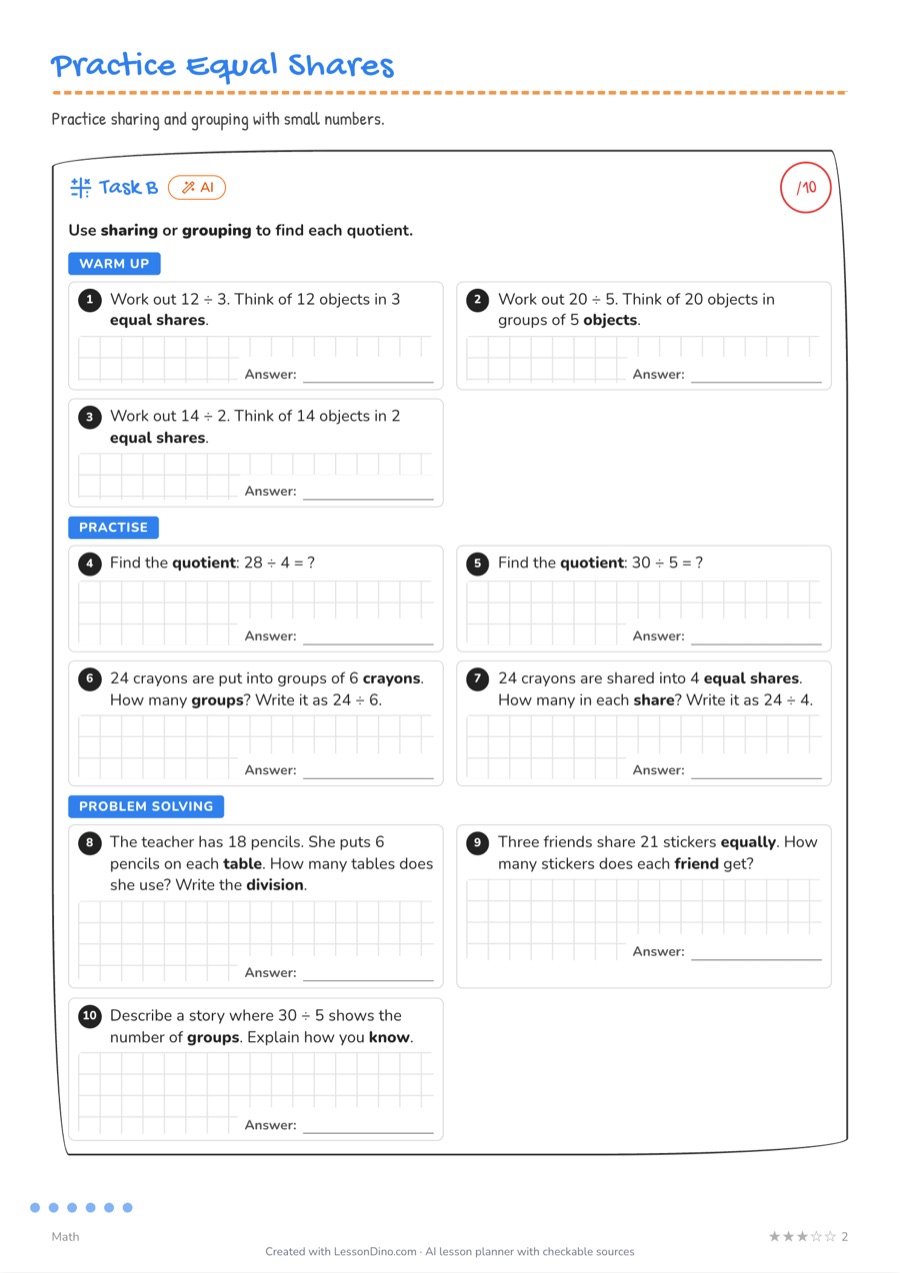
Practice Equal Shares
Practice sharing and grouping with small numbers.
Use sharing or grouping to find each quotient.
Warm up
- Work out 12 ÷ 3. Think of 12 objects in 3 equal shares.
- Work out 20 ÷ 5. Think of 20 objects in groups of 5 objects.
- Work out 14 ÷ 2. Think of 14 objects in 2 equal shares.
Practise
- Find the quotient: 28 ÷ 4 = ?
- Find the quotient: 30 ÷ 5 = ?
- 24 crayons are put into groups of 6 crayons. How many groups? Write it as 24 ÷ 6.
- 24 crayons are shared into 4 equal shares. How many in each share? Write it as 24 ÷ 4.
Problem solving
- The teacher has 18 pencils. She puts 6 pencils on each table. How many tables does she use? Write the division.
- Three friends share 21 stickers equally. How many stickers does each friend get?
- Describe a story where 30 ÷ 5 shows the number of groups. Explain how you know.
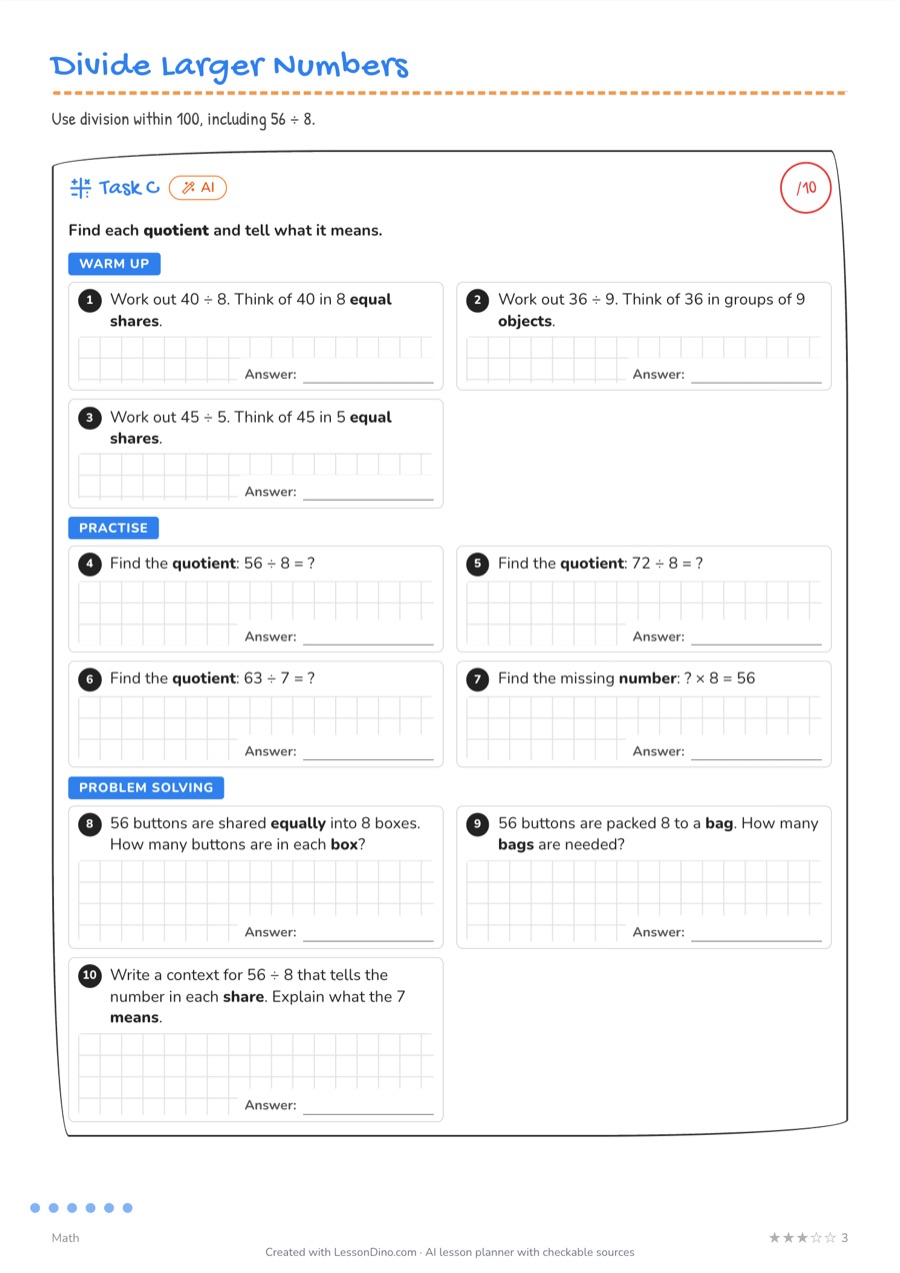
Divide Larger Numbers
Use division within 100, including 56 ÷ 8.
Find each quotient and tell what it means.
Warm up
- Work out 40 ÷ 8. Think of 40 in 8 equal shares.
- Work out 36 ÷ 9. Think of 36 in groups of 9 objects.
- Work out 45 ÷ 5. Think of 45 in 5 equal shares.
Practise
- Find the quotient: 56 ÷ 8 = ?
- Find the quotient: 72 ÷ 8 = ?
- Find the quotient: 63 ÷ 7 = ?
- Find the missing number: ? × 8 = 56
Problem solving
- 56 buttons are shared equally into 8 boxes. How many buttons are in each box?
- 56 buttons are packed 8 to a bag. How many bags are needed?
- Write a context for 56 ÷ 8 that tells the number in each share. Explain what the 7 means.
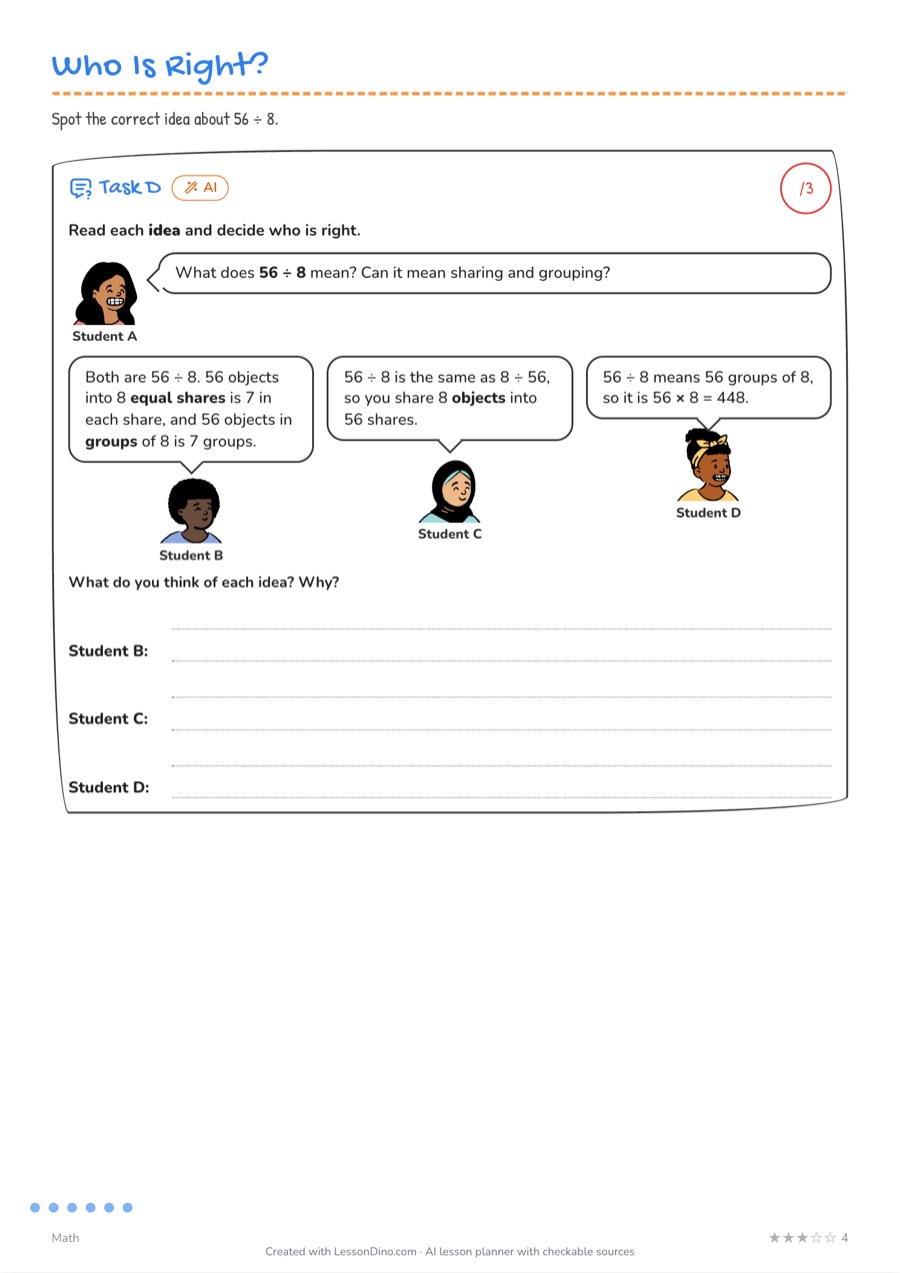
Who Is Right?
Spot the correct idea about 56 ÷ 8.
Read each idea and decide who is right.
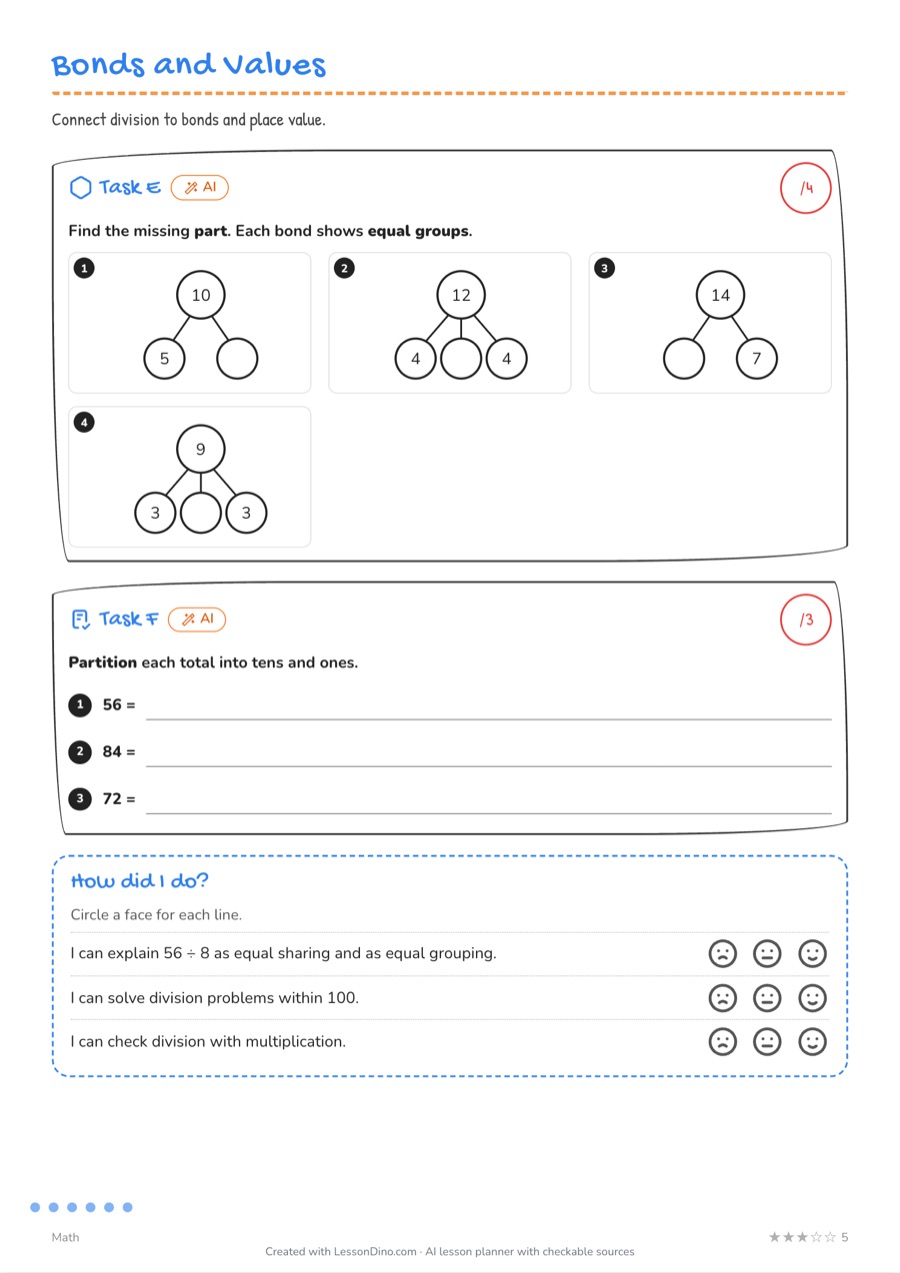
Bonds and Values
Connect division to bonds and place value.
Find the missing part. Each bond shows equal groups.
Partition each total into tens and ones.
Answers
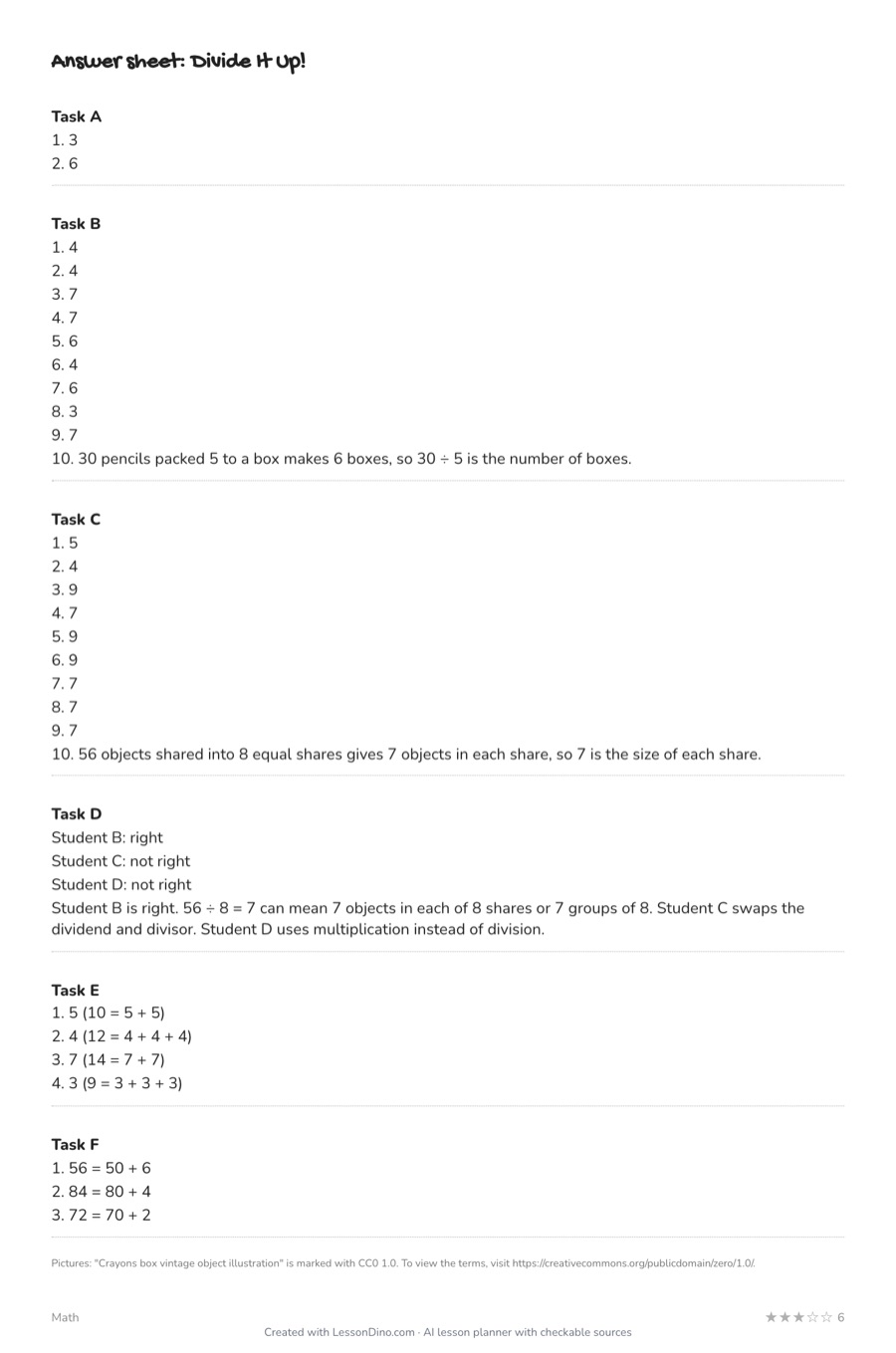
Show the answers
- Work out 12 ÷ 3. Think of 12 objects in 3 equal shares. 4
- Work out 20 ÷ 5. Think of 20 objects in groups of 5 objects. 4
- Work out 14 ÷ 2. Think of 14 objects in 2 equal shares. 7
- Find the quotient: 28 ÷ 4 = ? 7
- Find the quotient: 30 ÷ 5 = ? 6
- 24 crayons are put into groups of 6 crayons. How many groups? Write it as 24 ÷ 6. 4
- 24 crayons are shared into 4 equal shares. How many in each share? Write it as 24 ÷ 4. 6
- The teacher has 18 pencils. She puts 6 pencils on each table. How many tables does she use? Write the division. 3
- Three friends share 21 stickers equally. How many stickers does each friend get? 7
- Describe a story where 30 ÷ 5 shows the number of groups. Explain how you know. 30 pencils packed 5 to a box makes 6 boxes, so 30 ÷ 5 is the number of boxes.
- Work out 40 ÷ 8. Think of 40 in 8 equal shares. 5
- Work out 36 ÷ 9. Think of 36 in groups of 9 objects. 4
- Work out 45 ÷ 5. Think of 45 in 5 equal shares. 9
- Find the quotient: 56 ÷ 8 = ? 7
- Find the quotient: 72 ÷ 8 = ? 9
- Find the quotient: 63 ÷ 7 = ? 9
- Find the missing number: ? × 8 = 56 7
- 56 buttons are shared equally into 8 boxes. How many buttons are in each box? 7
- 56 buttons are packed 8 to a bag. How many bags are needed? 7
- Write a context for 56 ÷ 8 that tells the number in each share. Explain what the 7 means. 56 objects shared into 8 equal shares gives 7 objects in each share, so 7 is the size of each share.
The answer sheet is the last picture above.
Curriculum
Interpret whole-number quotients of whole numbers, e.g., interpret 56 ÷ 8 as the number of objects in each share when 56 objects are partitioned equally into 8 shares, or as a number of shares when 56 objects are partitioned into equal shares of 8 objects each. For example, describe a context in which a number of shares or a number of groups can be expressed as 56 ÷ 8.
Made with Lesson Dino's AI on 16 October 2026. AI can make mistakes, so check the answers and facts against the sources before you teach.