Slides
Lesson plan
Fact Arrays That Prove Division
Students learn to show facts as arrays and use them to divide. They build, draw, and quiz facts within 100.
Objectives
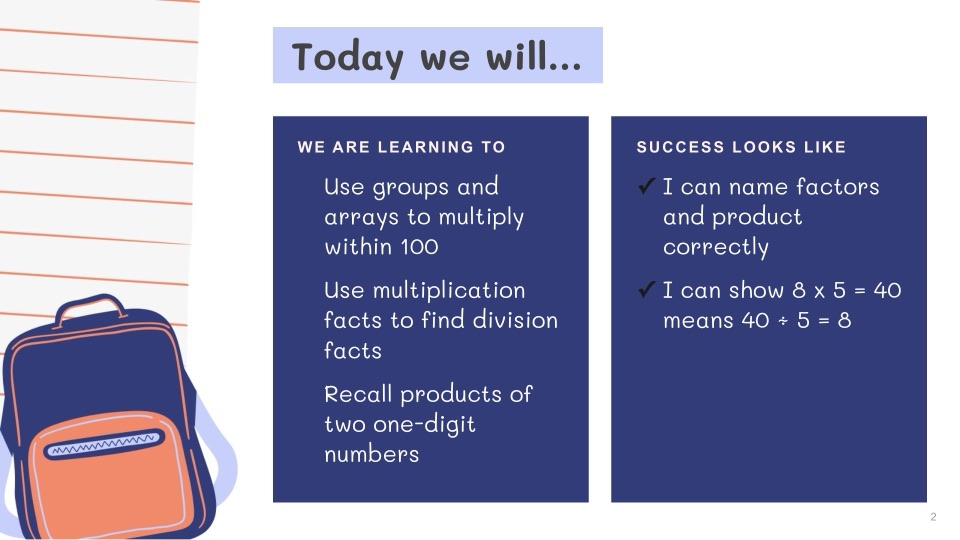
- Students will multiply within 100 using arrays and equal groups.
- Students will use a multiplication fact to find related division facts.
- Students will recall products of two one-digit numbers from memory.
Success criteria
- I can show a fact like 4 x 6 with rows and columns.
- I can use 8 x 5 = 40 to find 40 ÷ 5 = 8.
- I can recall products of two one-digit numbers quickly.
Key words
| Word | Meaning |
|---|---|
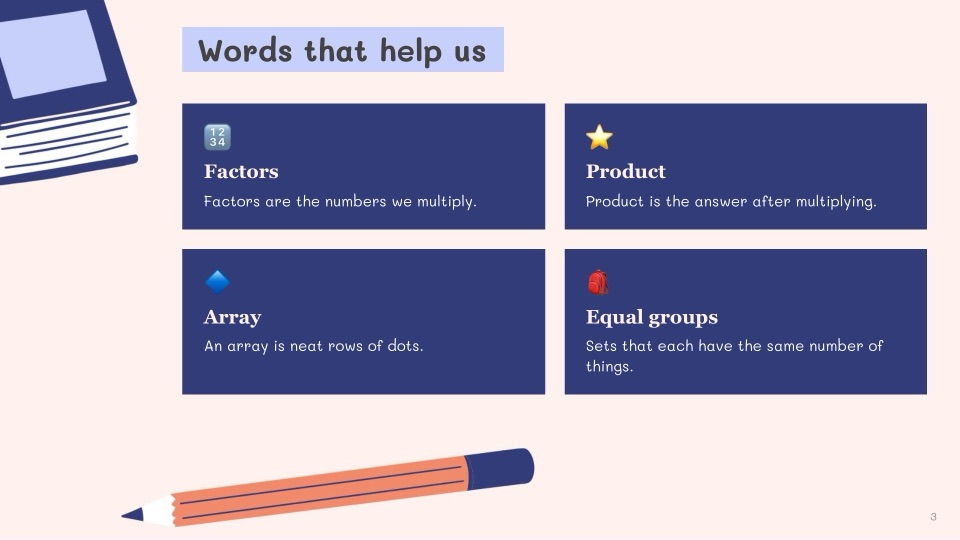
| factors | the two small numbers joined by x to make a new number |
| product | the answer you get after multiplying |
| array | neat rows of dots lined up in columns |
| division | splitting a total into equal-sized groups to share |
Timed plan (60 minutes)
| Time | Stage | What happens |
|---|---|---|
| 10 min | Starter | Activate skip-counting and equal groups to get ready for arrays. Show Slide 1: Fast Facts to 100 and read title: Use multiplication to divide in a flash! Show Slide 2 objectives and read them in student words. Say hook and lead skip-count by 2s, 5s, and 10s with claps. Ask class to show 3 groups of 5 with fingers and say the total. |
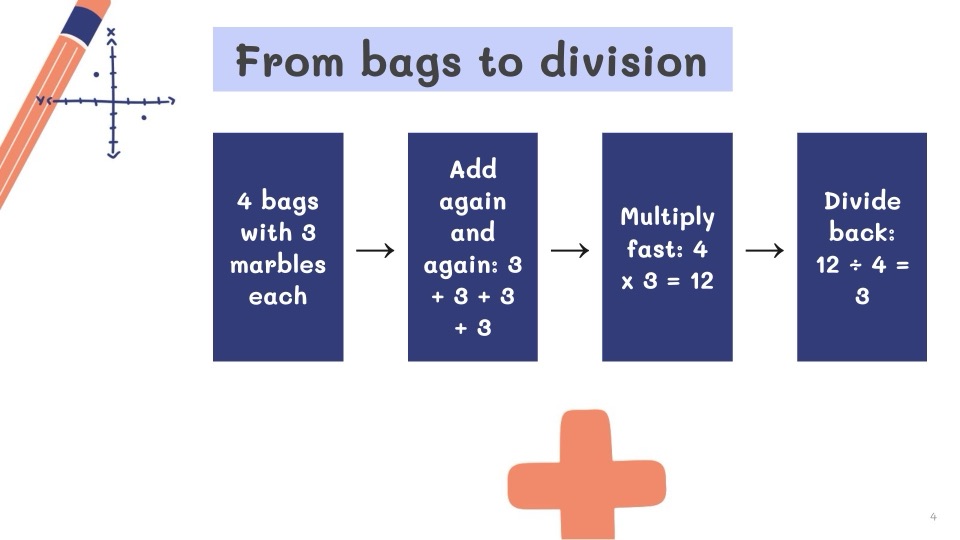
| 12 min | Teaching | Teach factors, product, and array and link addition to multiplication and division. Show Slide 3 cards and read: Factors are the numbers we multiply. Product is the answer after multiplying. An array is neat rows of dots. Show Slide 4 chain and build 4 bags with 3 marbles each with counters. Model repeated addition, then multiplication, then division on the board. Students repeat the three numbers and point to rows, columns, and total. |
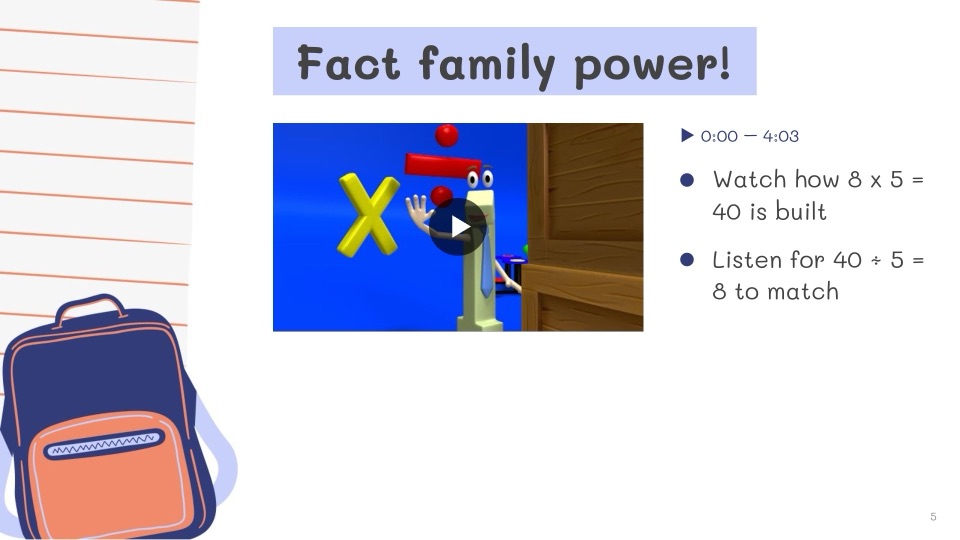
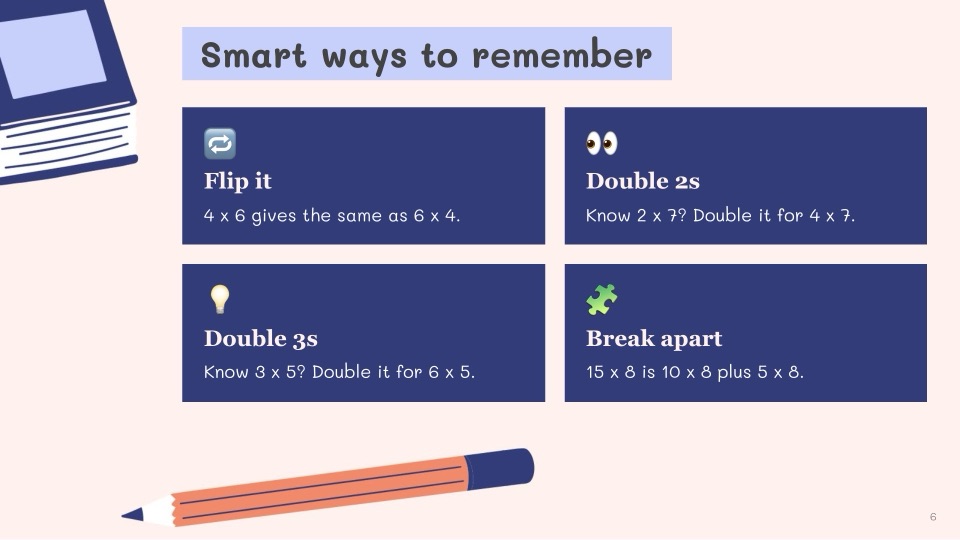
| 13 min | We do | Model using one known fact to find division facts and remember facts faster. Show Slide 5: Fact family power! Play Video clip 1 (0:00-4:03): Watch how 8 x 5 = 40 is built. Pause for class to say 40 ÷ 5 = 8 and write the family 8 x 5 = 40, 5 x 8 = 40, 40 ÷ 5 = 8, 40 ÷ 8 = 5. Show Slide 6 cards: Flip it, Double 2s, Double 3s and model doubling 2 x 7 to get 4 x 7. Lead choral recall of 4 x 6 and 6 x 4. |
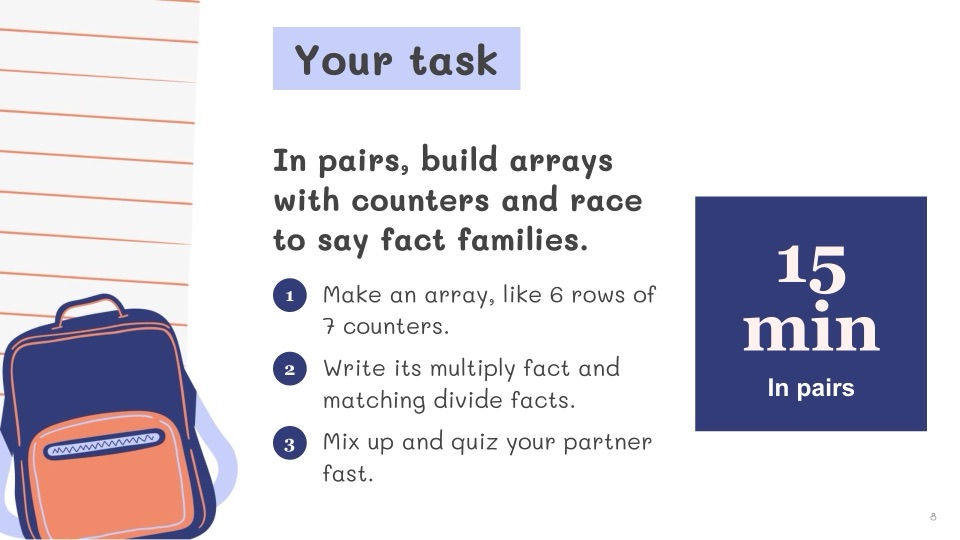
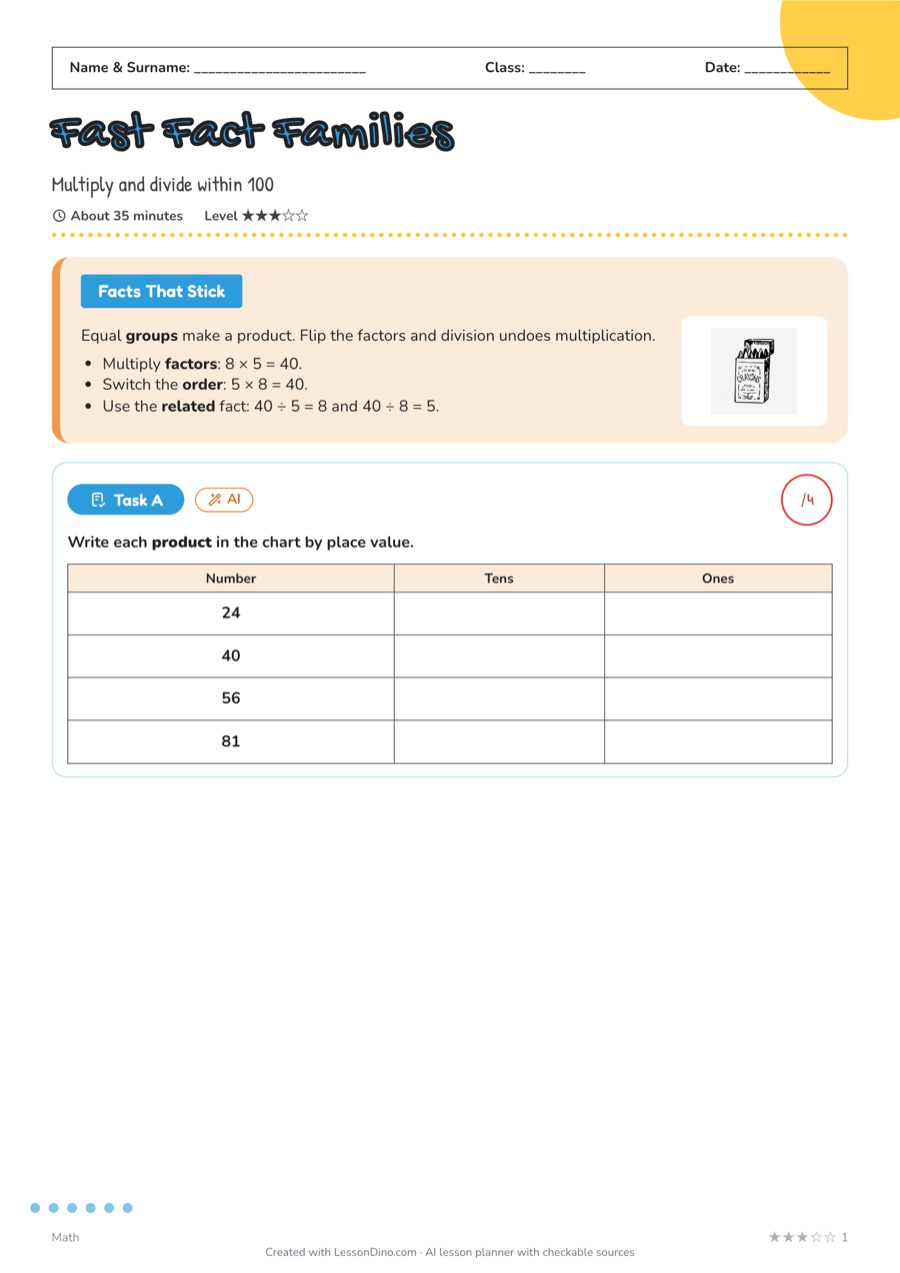
| 17 min | Main activity | Build arrays in pairs and write matching multiplication and division facts. Show Slide 8: Make an array, like 6 rows of 7 counters. Write its multiply fact and matching divide facts. Mix up and quiz your partner fast. Model 4 rows of 6 counters, draw it, label sides 4 and 6 and total 24. Hand out counters, grid paper, and Worksheet Task B practice questions to build speed with facts and set 12 minutes to build three arrays and answer them. Circulate, ask for missing numbers, and prompt fast recall. |
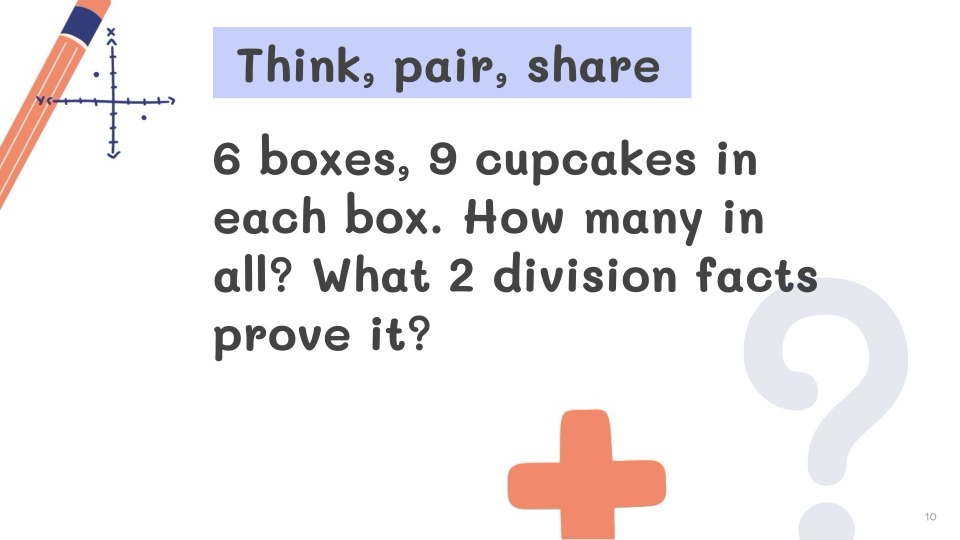
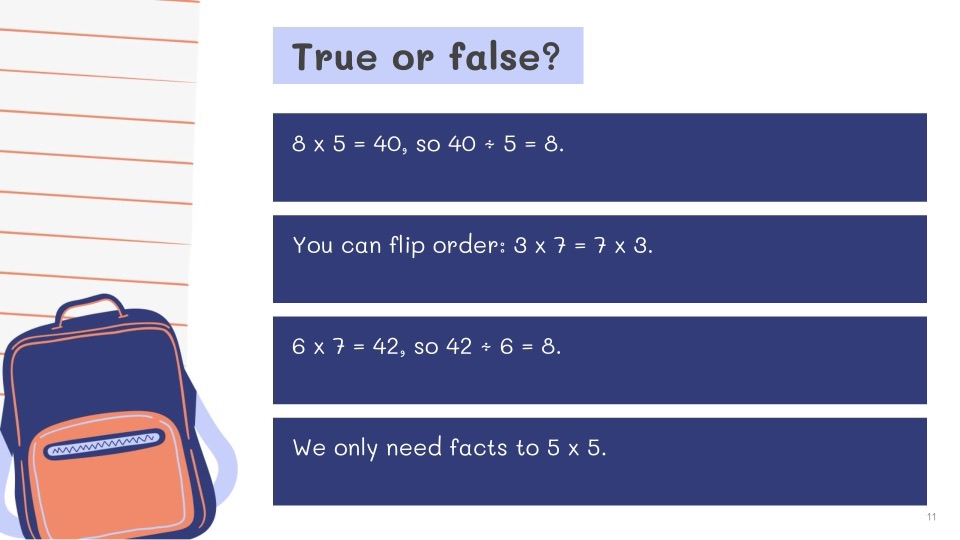
| 8 min | Plenary | Prove facts with a word problem and check recall of products and division. Show Slide 10 and read: 6 boxes, 9 cupcakes in each box. How many in all? What 2 division facts prove it? Give 2 minutes think-pair-share, then take answers and draw the array. Show Slide 11 true-or-false statements and vote true or false with fingers. Link back to success lines and set homework. |
Common mistakes
- Thinks 4 x 6 and 6 x 4 give different answers
How to spot it: Writes 24 for one order and another number for the flip
Turn the same array and show 4 x 6 gives the same as 6 x 4, both equal 24 - Mixes up which number is the total in division
How to spot it: Writes 5 ÷ 40 = 8 or 8 ÷ 40 = 5
Cover the product at the top and show the two numbers still showing make the divide fact - Counts array dots by ones and loses track
How to spot it: Slow counting, totals off by 1 or 2 for arrays to 100
Count by rows or skip-count, since developing strategies for multiplication within 100 needs groups
Support
- Use printed 10 by 10 grids and build only arrays within 30 first
- Let students check facts on a fact table, then try from memory
Stretch
- Build two different arrays with the same product and explain the pattern
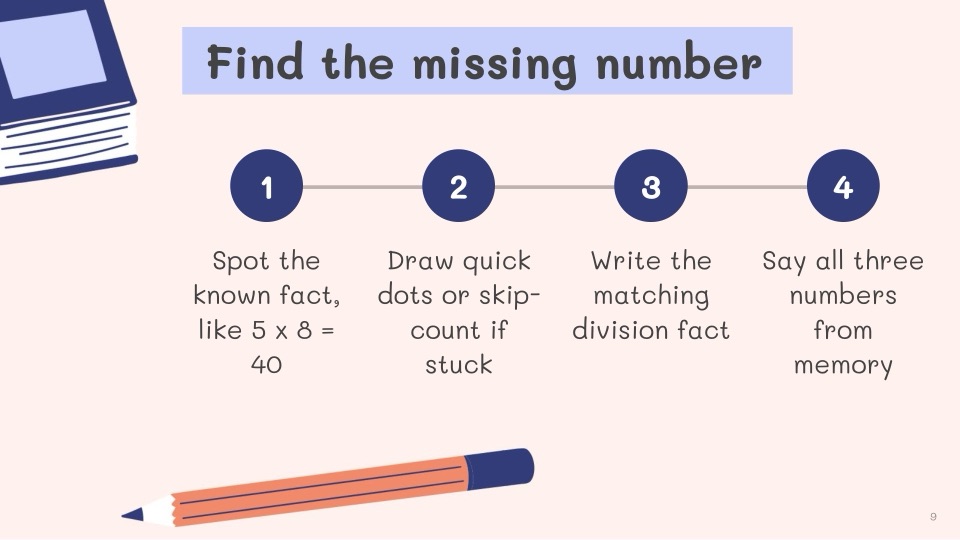
- Write missing numbers like 6 x __ = 42 and prove with division
Check questions
- 8 x 5 = 40. What is 40 ÷ 5?
Answer: 8 - Write both orders and product: 4 x 6 = ?
Answer: 4 x 6 = 24 and 6 x 4 = 24 - 6 boxes with 9 cupcakes each. Total and one division proof?
Answer: 54 cupcakes; 54 ÷ 6 = 9 or 54 ÷ 9 = 6
Curriculum
Fluently multiply and divide within 100, using strategies such as the relationship between multiplication and division (e.g., knowing that 8 × 5 = 40, one knows 40 ÷ 5 = 8) or properties of operations. By the end of Grade 3, know from memory all products of two one-digit numbers.
Video clips
Clips on YouTube, from the start and end times we chose. Check each one before you show it.
-
Fact Families: Mult and Div from 0:00 to 4:03
Math & Learning Videos 4 Kids: Multiplication and Division Relationships - Fun Math Videos for Kids 3rd Grade
Made for 3rd grade and teaches the exact 8 x 5 = 40 and 40 / 5 = 8 relationship with kid-friendly pace for ages 8-9.
-
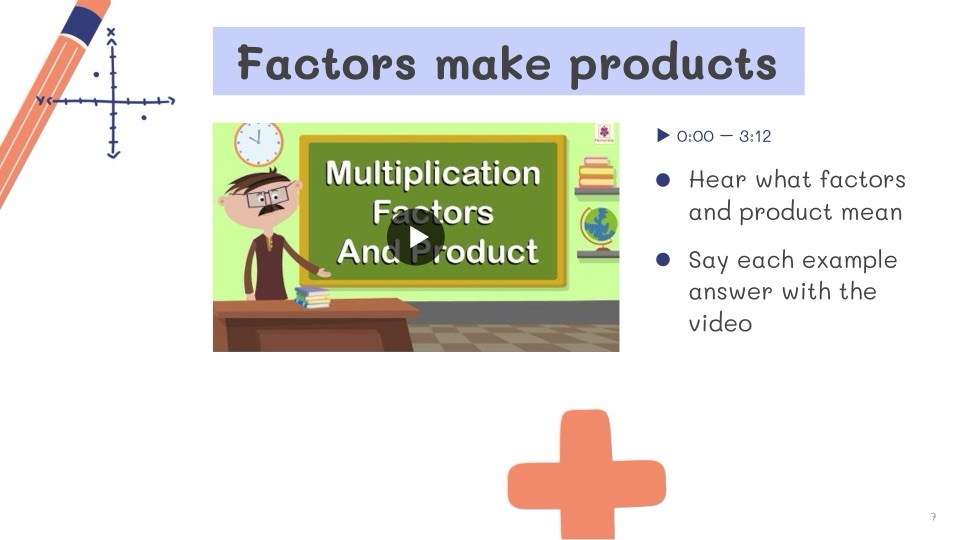
Factors and Product Basics from 0:00 to 3:12
Periwinkle: Multiplication - Factors And Product | Mathematics Grade 3 | Periwinkle
Labeled for Grade 3 and explains factors and product with simple examples at the right level for 8-9-year-olds.
Worksheet
Sources
- 2025-2026 3rd grade Math Curriculum boepublic.parkhill.k12.mo.us
- Grade 3 Math | SFUSD sfusd.edu
- Multiplication Facts Worksheets - Math-Drills math-drills.com
- Multiplication - Wikipedia en.wikipedia.org
- Multiplication Facts for Kids kids.kiddle.co
- Free Math Games - Multiplication.com multiplication.com
- Multiplication Worksheets - K5 Learning k5learning.com
- Free multiplication games at Timestables.com timestables.com
- Multiplication - Definition, Formula, Examples - Cuemath cuemath.com
- stages of learning multiplication facts lewisstreetprimary.co.uk
- multiplication facts | Find the Factors findthefactors.com
- What are 'multiplication facts'? Why are they essential to your child's success in math? phys.org
Picture credits
Made with Lesson Dino's AI on 17 October 2026. AI can make mistakes, so check facts against the sources before you teach.