The worksheet
About this worksheet
Students learn to show facts as arrays and use them to divide. They build, draw, and quiz facts within 100. This Grade 3 Math worksheet gives students (ages 8–9) five pages of practice on multiplication facts, part of the operations and algebraic thinking unit. It goes with our free Multiplication facts lesson, which has the slides and a timed lesson plan.
What it covers
By the end, students should be able to:
- Students will multiply within 100 using arrays and equal groups.
- Students will use a multiplication fact to find related division facts.
- Students will recall products of two one-digit numbers from memory.
How to use it
- Main activity (17 minutes): Hand out counters, grid paper, and Worksheet Task B practice questions to build speed with facts and set 12 minutes to build three arrays and answer them.
- Support: Use printed 10 by 10 grids and build only arrays within 30 first.
- Stretch: Build two different arrays with the same product and explain the pattern.
- The answer sheet is the last page, so you can print it on its own or let students check their own work.
Key vocabulary
- factors: the two small numbers joined by x to make a new number
- product: the answer you get after multiplying
- array: neat rows of dots lined up in columns
- division: splitting a total into equal-sized groups to share
Mistakes to watch for
- Thinks 4 x 6 and 6 x 4 give different answers. Turn the same array and show 4 x 6 gives the same as 6 x 4, both equal 24.
- Mixes up which number is the total in division. Cover the product at the top and show the two numbers still showing make the divide fact.
- Counts array dots by ones and loses track. Count by rows or skip-count, since developing strategies for multiplication within 100 needs groups.
What's on the worksheet
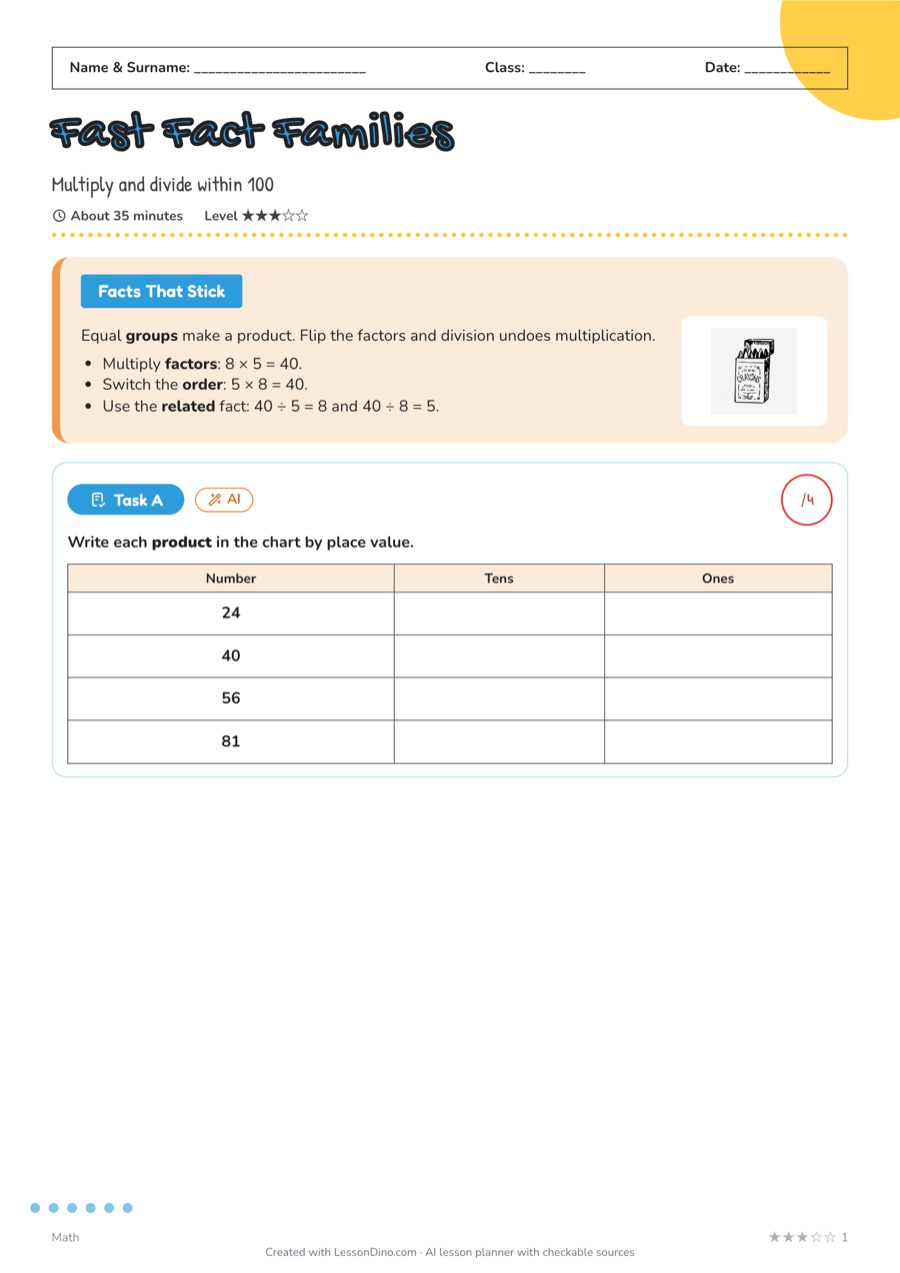
Fast Facts Start
Learn multiplication facts and their related division facts.
Facts That Stick
- Equal groups make a product. Flip the factors and division undoes multiplication.
- Multiply factors: 8 × 5 = 40.
- Switch the order: 5 × 8 = 40.
- Use the related fact: 40 ÷ 5 = 8 and 40 ÷ 8 = 5.
Write each product in the chart by place value.
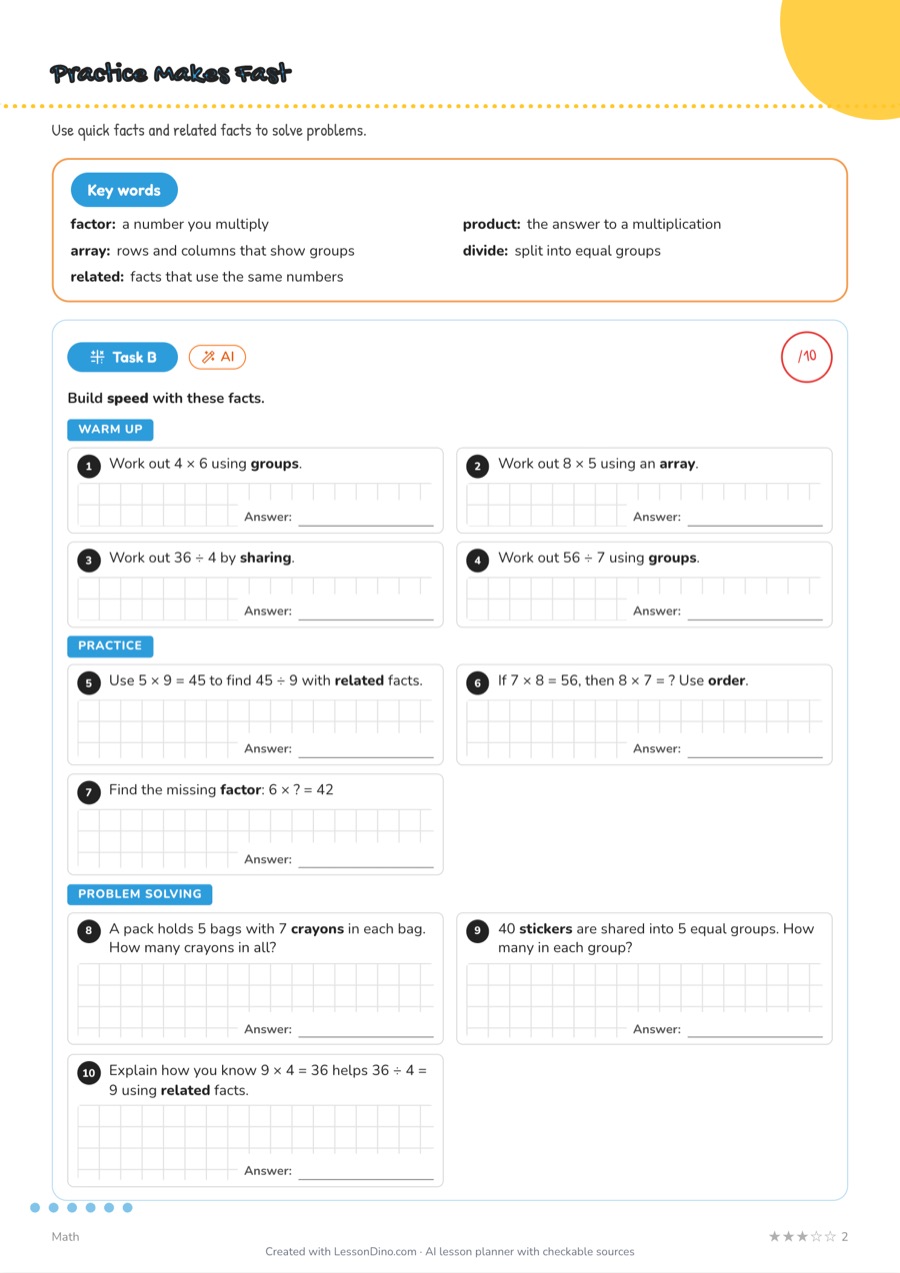
Practice Makes Fast
Use quick facts and related facts to solve problems.
| Word | Meaning |
|---|---|
| factor | a number you multiply |
| product | the answer to a multiplication |
| array | rows and columns that show groups |
| divide | split into equal groups |
| related | facts that use the same numbers |
Build speed with these facts.
Warm up
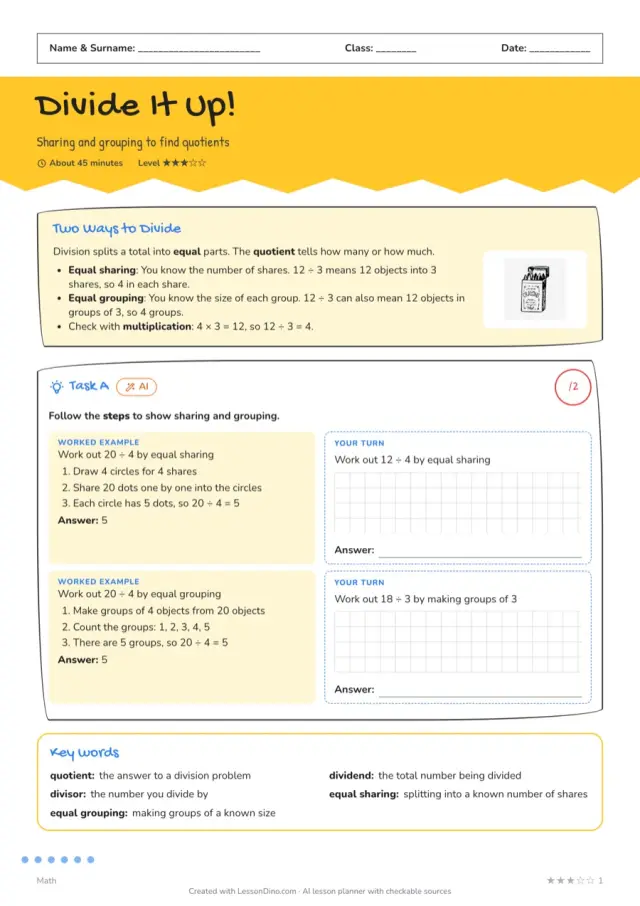
- Work out 4 × 6 using groups.
- Work out 8 × 5 using an array.
- Work out 36 ÷ 4 by sharing.
- Work out 56 ÷ 7 using groups.
Practice
- Use 5 × 9 = 45 to find 45 ÷ 9 with related facts.
- If 7 × 8 = 56, then 8 × 7 = ? Use order.
- Find the missing factor: 6 × ? = 42
Problem solving
- A pack holds 5 bags with 7 crayons in each bag. How many crayons in all?
- 40 stickers are shared into 5 equal groups. How many in each group?
- Explain how you know 9 × 4 = 36 helps 36 ÷ 4 = 9 using related facts.
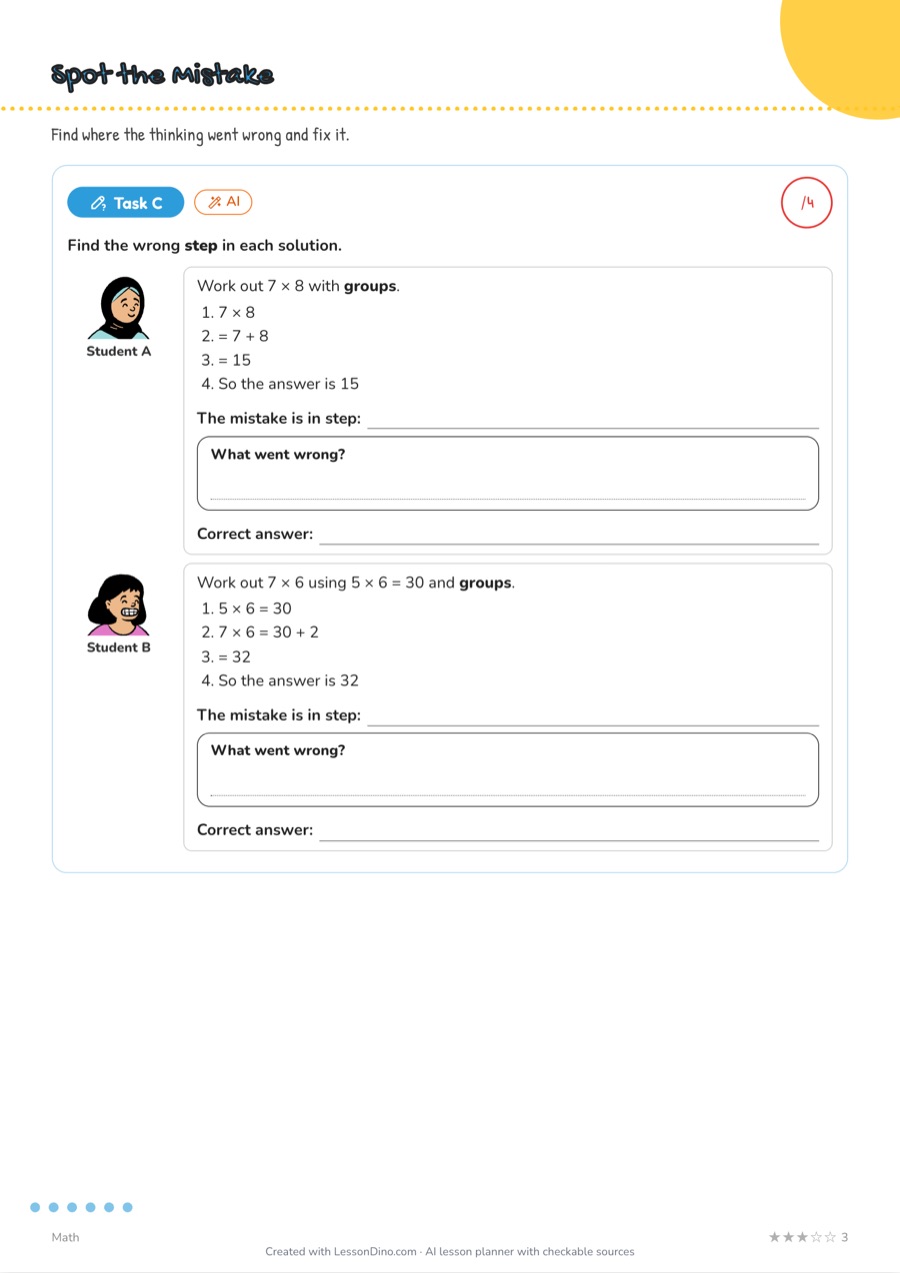
Spot the Mistake
Find where the thinking went wrong and fix it.
Find the wrong step in each solution.
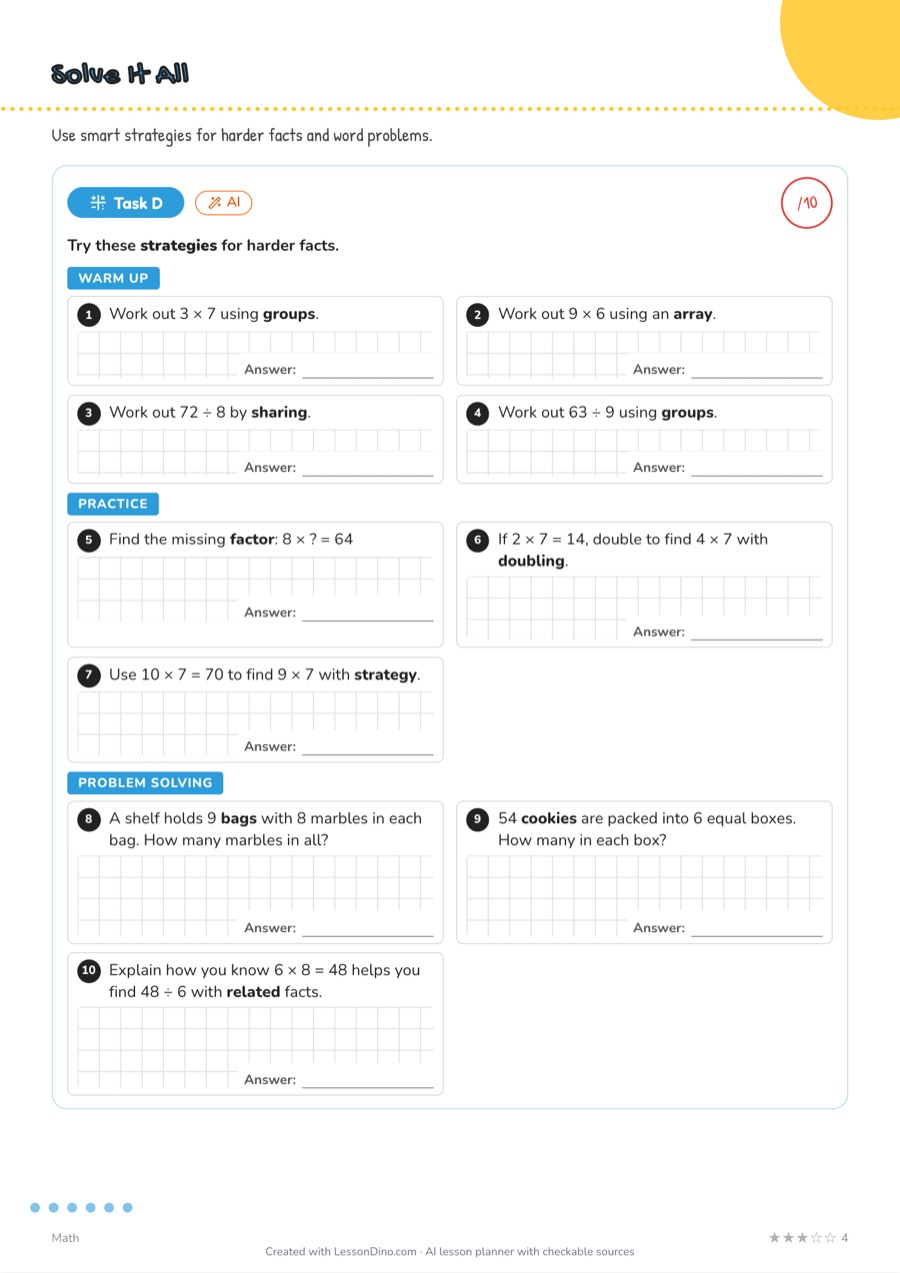
Solve It All
Use smart strategies for harder facts and word problems.
Try these strategies for harder facts.
Warm up
- Work out 3 × 7 using groups.
- Work out 9 × 6 using an array.
- Work out 72 ÷ 8 by sharing.
- Work out 63 ÷ 9 using groups.
Practice
- Find the missing factor: 8 × ? = 64
- If 2 × 7 = 14, double to find 4 × 7 with doubling.
- Use 10 × 7 = 70 to find 9 × 7 with strategy.
Problem solving
- A shelf holds 9 bags with 8 marbles in each bag. How many marbles in all?
- 54 cookies are packed into 6 equal boxes. How many in each box?
- Explain how you know 6 × 8 = 48 helps you find 48 ÷ 6 with related facts.
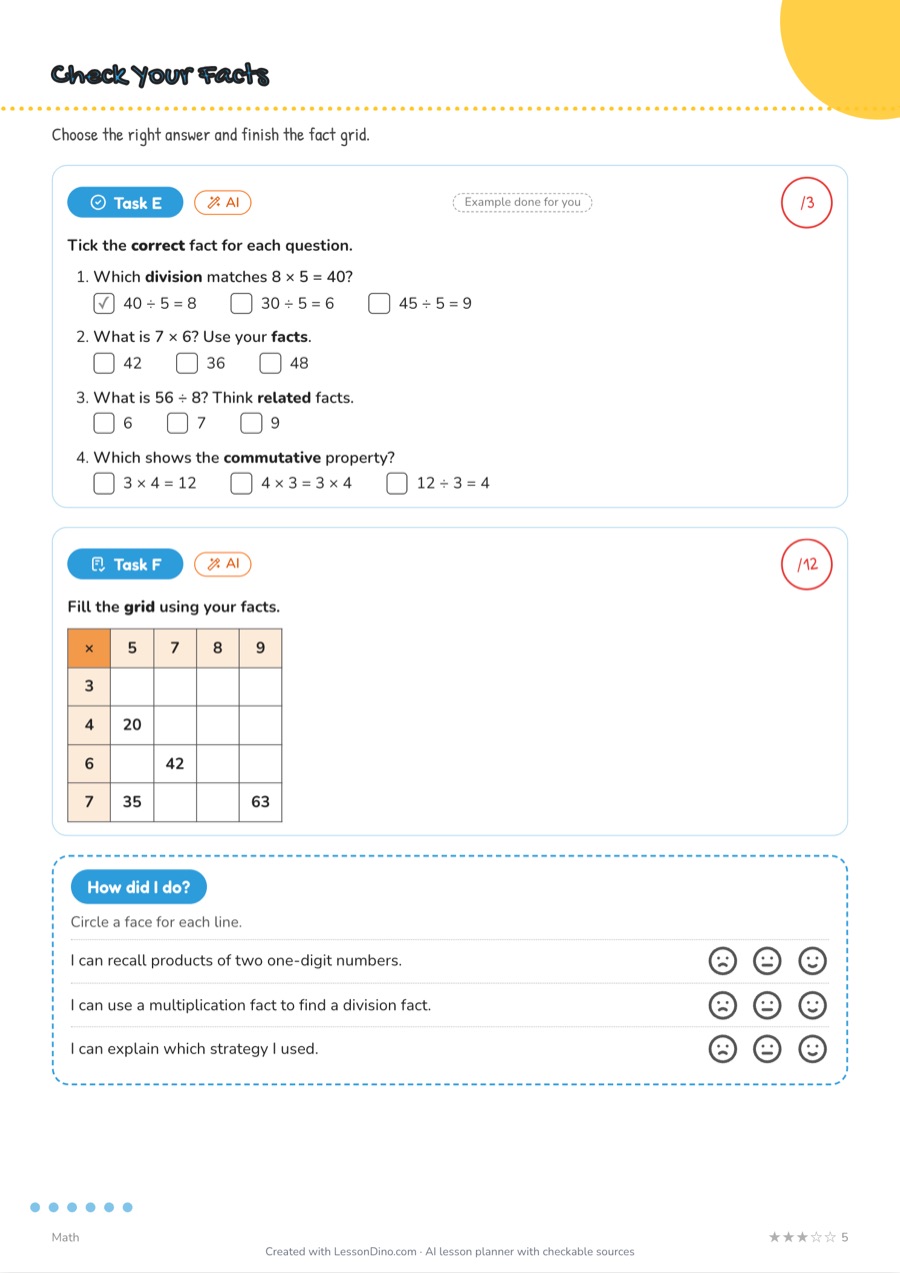
Check Your Facts
Choose the right answer and finish the fact grid.
Tick the correct fact for each question.
- Which division matches 8 × 5 = 40?
- What is 7 × 6? Use your facts.
- What is 56 ÷ 8? Think related facts.
- Which shows the commutative property?
Fill the grid using your facts.
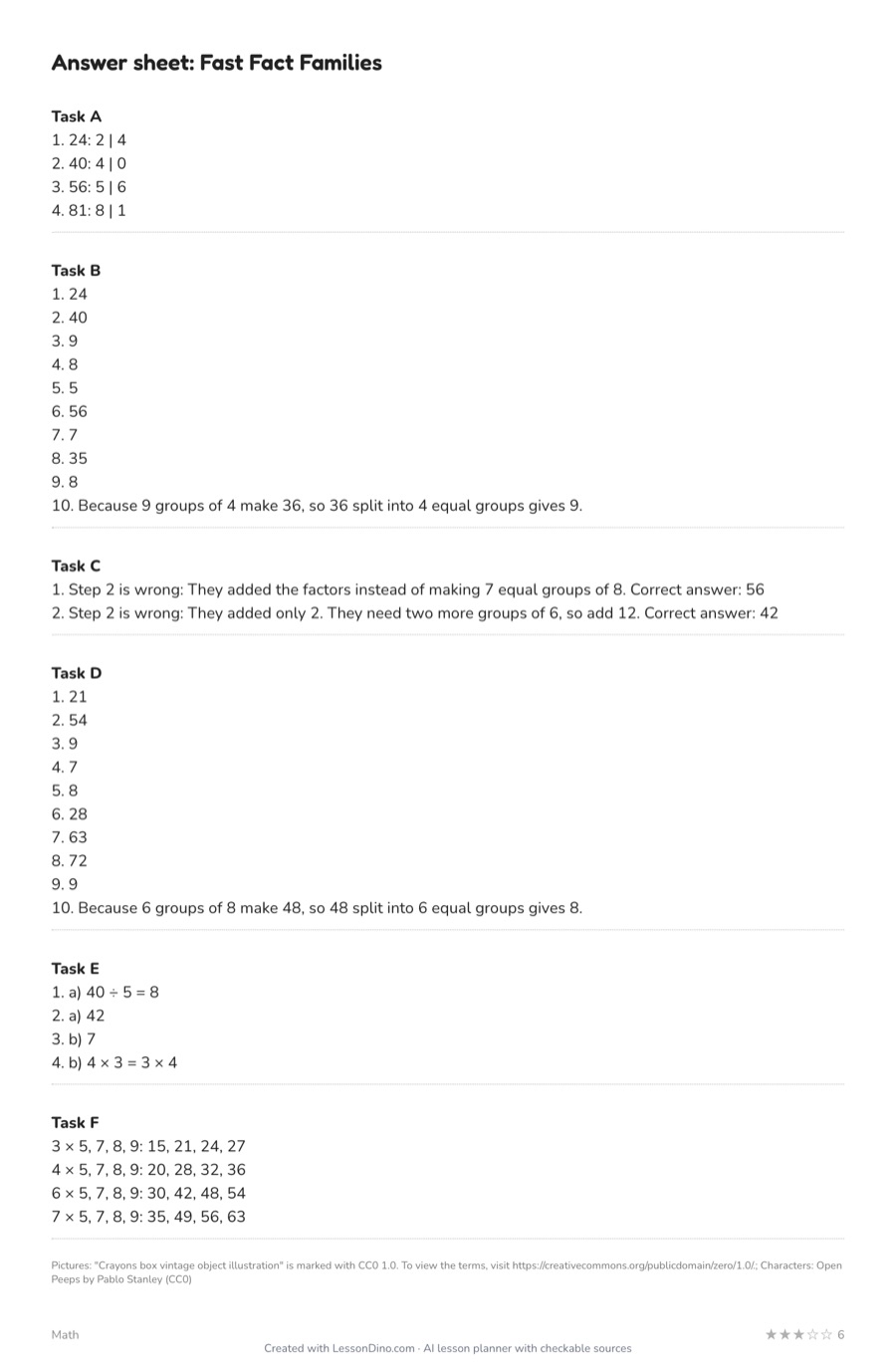
Answers
Show the answers
- Work out 4 × 6 using groups. 24
- Work out 8 × 5 using an array. 40
- Work out 36 ÷ 4 by sharing. 9
- Work out 56 ÷ 7 using groups. 8
- Use 5 × 9 = 45 to find 45 ÷ 9 with related facts. 5
- If 7 × 8 = 56, then 8 × 7 = ? Use order. 56
- Find the missing factor: 6 × ? = 42 7
- A pack holds 5 bags with 7 crayons in each bag. How many crayons in all? 35
- 40 stickers are shared into 5 equal groups. How many in each group? 8
- Explain how you know 9 × 4 = 36 helps 36 ÷ 4 = 9 using related facts. Because 9 groups of 4 make 36, so 36 split into 4 equal groups gives 9.
- Work out 3 × 7 using groups. 21
- Work out 9 × 6 using an array. 54
- Work out 72 ÷ 8 by sharing. 9
- Work out 63 ÷ 9 using groups. 7
- Find the missing factor: 8 × ? = 64 8
- If 2 × 7 = 14, double to find 4 × 7 with doubling. 28
- Use 10 × 7 = 70 to find 9 × 7 with strategy. 63
- A shelf holds 9 bags with 8 marbles in each bag. How many marbles in all? 72
- 54 cookies are packed into 6 equal boxes. How many in each box? 9
- Explain how you know 6 × 8 = 48 helps you find 48 ÷ 6 with related facts. Because 6 groups of 8 make 48, so 48 split into 6 equal groups gives 8.
The answer sheet is the last picture above.
Curriculum
Fluently multiply and divide within 100, using strategies such as the relationship between multiplication and division (e.g., knowing that 8 × 5 = 40, one knows 40 ÷ 5 = 8) or properties of operations. By the end of Grade 3, know from memory all products of two one-digit numbers.
Made with Lesson Dino's AI on 17 October 2026. AI can make mistakes, so check the answers and facts against the sources before you teach.