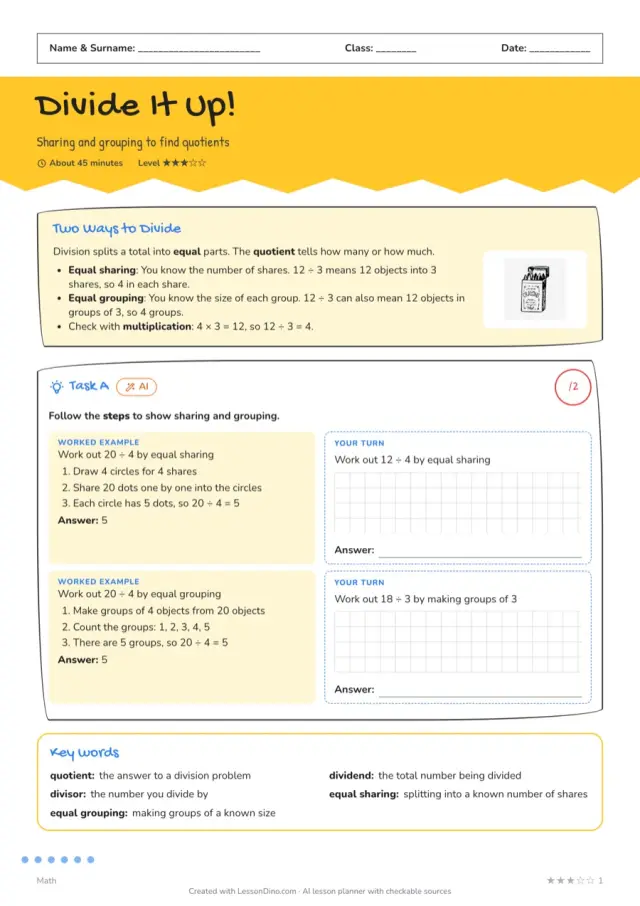
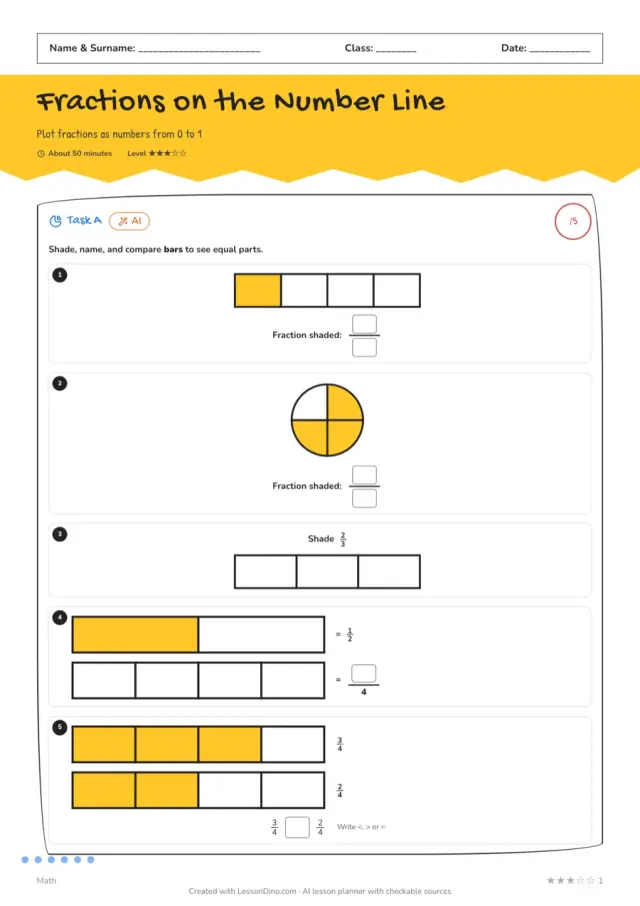
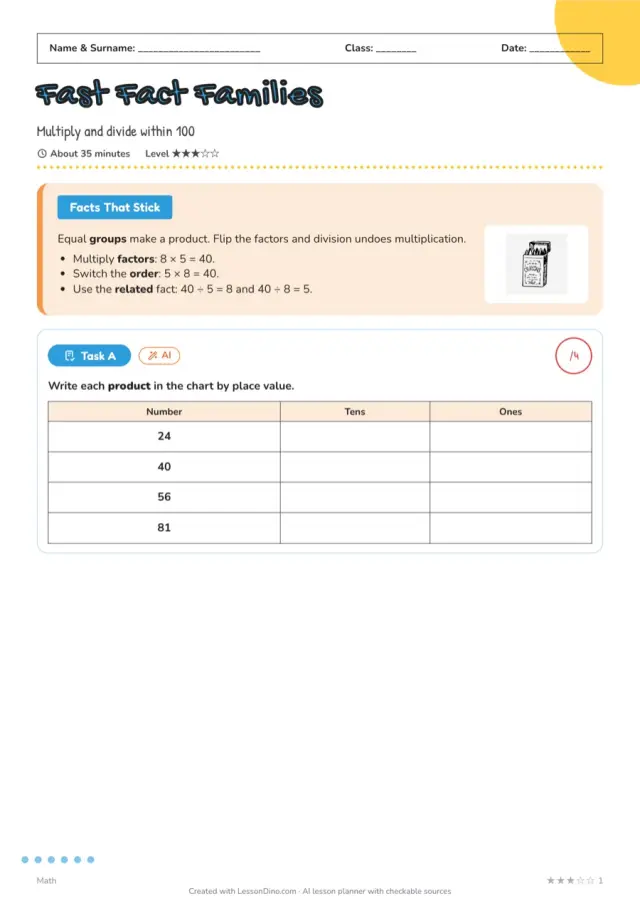
The worksheet
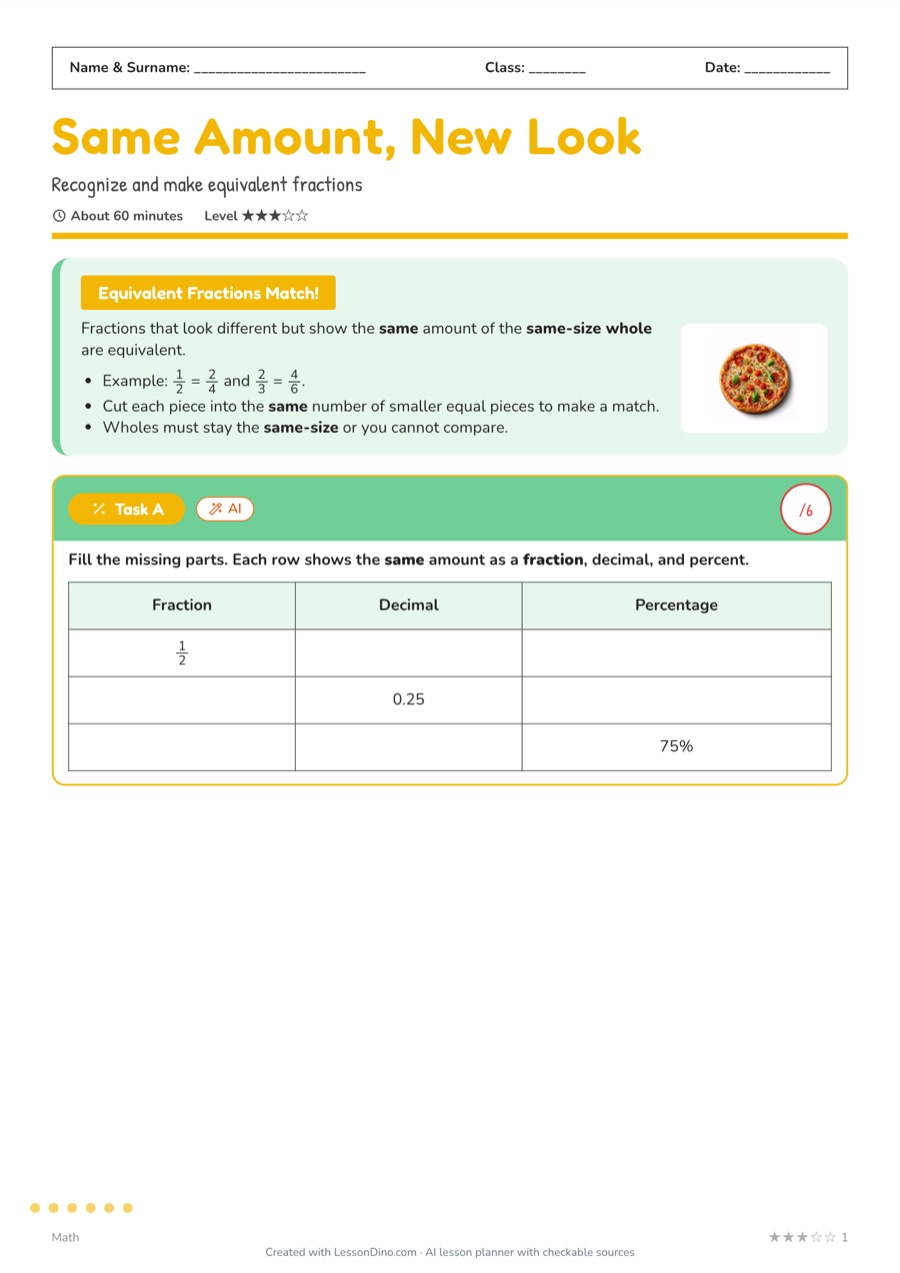
About this worksheet
Students learn that different fractions can show the same amount. They fold strips to prove 1/2 = 2/4 and 2/3 = 4/6. This Grade 3 Math worksheet gives students (ages 8–9) seven pages of practice on equivalent fractions, part of the number and operations—fractions unit. It goes with our free Equivalent fractions lesson, which has the slides and a timed lesson plan.
What it covers
By the end, students should be able to:
- Students will recognize that 1/2 = 2/4 covers the same amount of the same-size whole.
- Students will generate simple equivalents like 2/3 = 4/6 by splitting parts equally.
- Students will explain why fractions are equivalent using a visual fraction model.
How to use it
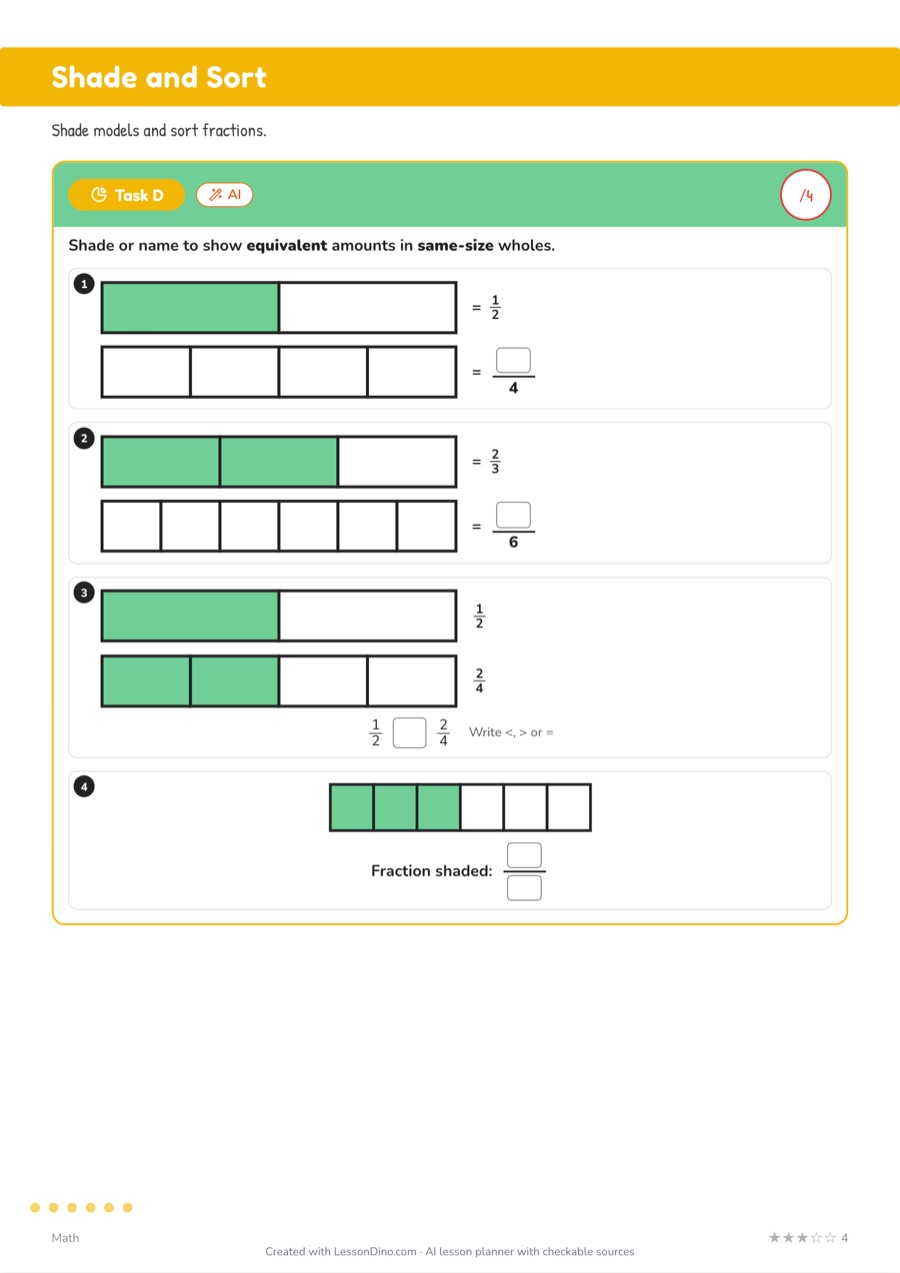
- Main activity (23 minutes): Hand out Worksheet Task D and ask students to shade or name bars to show the same matches.
- Support: Start with only halves, using pre-folded strips to compare 1/2 and 2/4 side by side.
- Stretch: Fold a third same-size strip into 6 or 8 equal parts and find what equals 1/2.
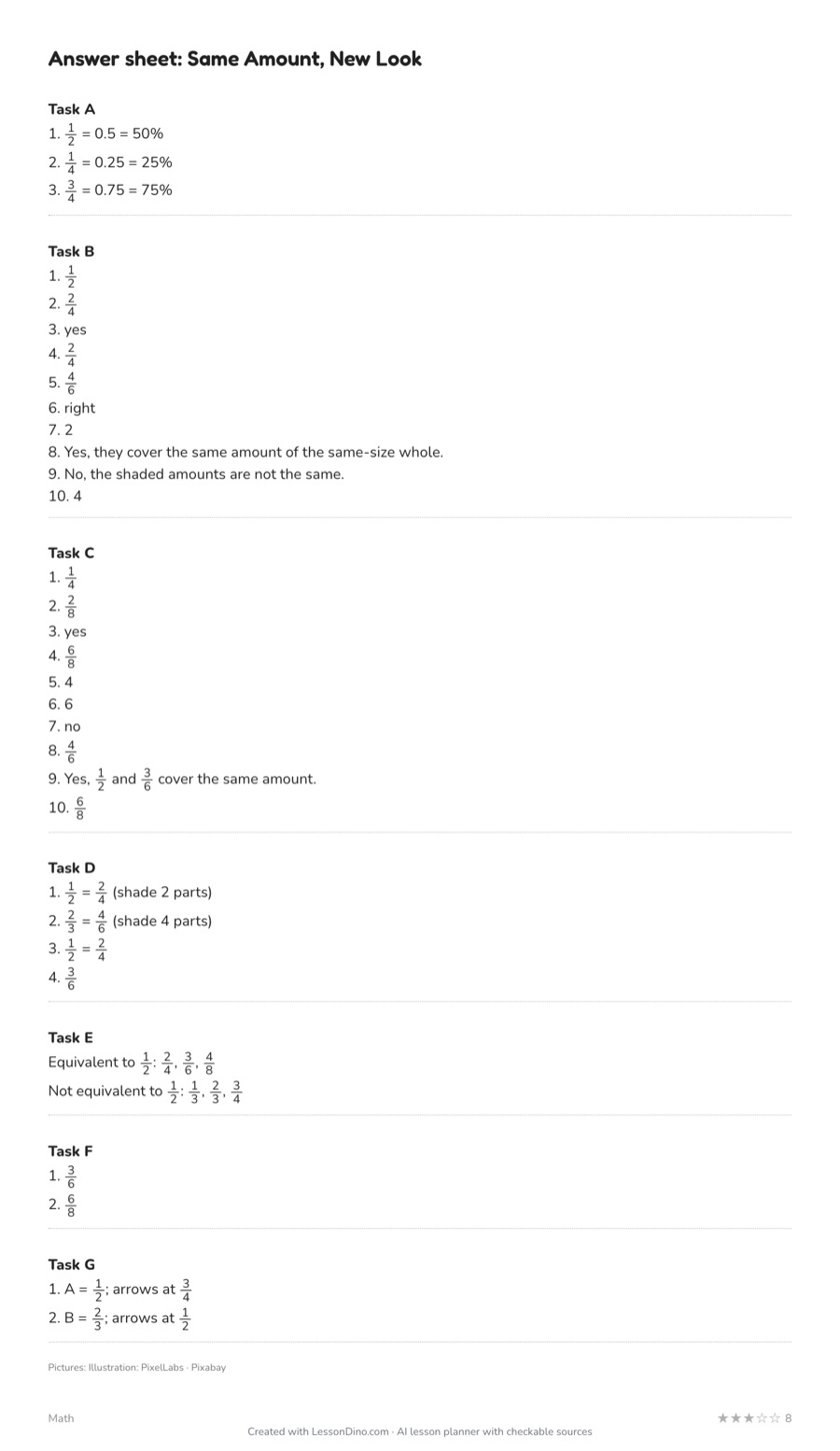
- The answer sheet is the last page, so you can print it on its own or let students check their own work.
Key vocabulary
- equivalent fractions: different-looking top and bottom numbers that stand for the same amount of the same-size whole
- whole: the full single shape or bar we start with before cutting
- numerator: the top number that counts how many parts are shaded or used
- denominator: the bottom number that counts how many equal parts the whole is cut into
- bar model: same-size rectangles lined up to compare shaded lengths
Mistakes to watch for
- Thinking 1/2 and 1/3 are equivalent because each has 1 shaded part. Overlay same-size wholes and compare shaded area, not just count of parts, since two fractions are equivalent only if areas are the same with respect to the same-sized whole.
- Comparing fractions from different-size wholes. Remind that fractions can only be compared when they come from wholes of the same size; re-line strips edge to edge.
- Changing only the top or bottom number to make a twin. Show you must cut each part into the same number of equal parts and count all parts and shaded parts again; more parts means smaller parts.
What's on the worksheet
Same Size, Same Amount
See what makes fractions equivalent.
Equivalent Fractions Match!
- Fractions that look different but show the same amount of the same-size whole are equivalent.
- Example: 1/2 = 2/4 and 2/3 = 4/6.
- Cut each piece into the same number of smaller equal pieces to make a match.
- Wholes must stay the same-size or you cannot compare.
Fill the missing parts. Each row shows the same amount as a fraction, decimal, and percent.
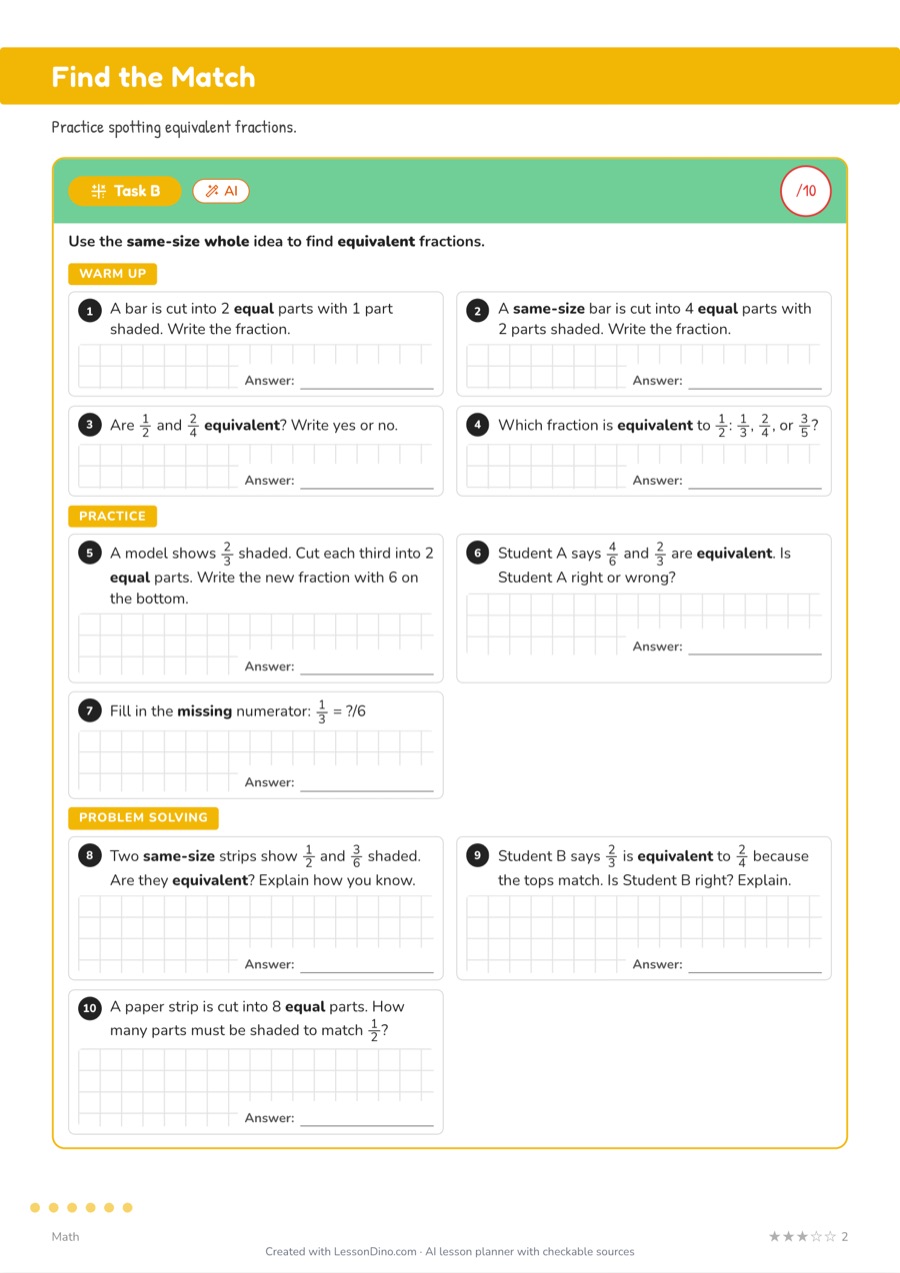
Find the Match
Practice spotting equivalent fractions.
Use the same-size whole idea to find equivalent fractions.
Warm up
- A bar is cut into 2 equal parts with 1 part shaded. Write the fraction.
- A same-size bar is cut into 4 equal parts with 2 parts shaded. Write the fraction.
- Are 1/2 and 2/4 equivalent? Write yes or no.
- Which fraction is equivalent to 1/2: 1/3, 2/4, or 3/5?
Practice
- A model shows 2/3 shaded. Cut each third into 2 equal parts. Write the new fraction with 6 on the bottom.
- Student A says 4/6 and 2/3 are equivalent. Is Student A right or wrong?
- Fill in the missing numerator: 1/3 = ?/6
Problem solving
- Two same-size strips show 1/2 and 3/6 shaded. Are they equivalent? Explain how you know.
- Student B says 2/3 is equivalent to 2/4 because the tops match. Is Student B right? Explain.
- A paper strip is cut into 8 equal parts. How many parts must be shaded to match 1/2?
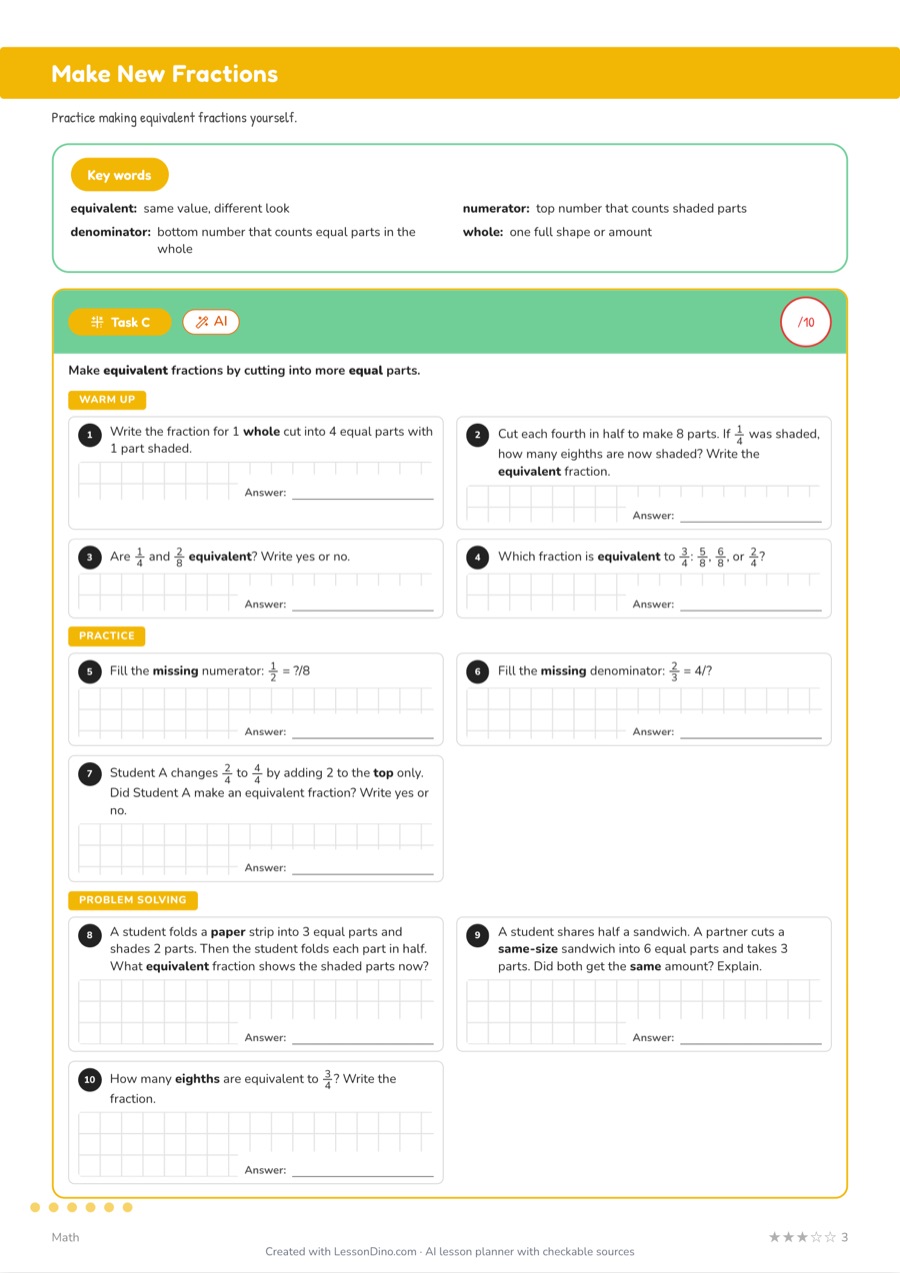
Make New Fractions
Practice making equivalent fractions yourself.
| Word | Meaning |
|---|---|
| equivalent | same value, different look |
| numerator | top number that counts shaded parts |
| denominator | bottom number that counts equal parts in the whole |
| whole | one full shape or amount |
Make equivalent fractions by cutting into more equal parts.
Warm up
- Write the fraction for 1 whole cut into 4 equal parts with 1 part shaded.
- Cut each fourth in half to make 8 parts. If 1/4 was shaded, how many eighths are now shaded? Write the equivalent fraction.
- Are 1/4 and 2/8 equivalent? Write yes or no.
- Which fraction is equivalent to 3/4: 5/8, 6/8, or 2/4?
Practice
- Fill the missing numerator: 1/2 = ?/8
- Fill the missing denominator: 2/3 = 4/?
- Student A changes 2/4 to 4/4 by adding 2 to the top only. Did Student A make an equivalent fraction? Write yes or no.
Problem solving
- A student folds a paper strip into 3 equal parts and shades 2 parts. Then the student folds each part in half. What equivalent fraction shows the shaded parts now?
- A student shares half a sandwich. A partner cuts a same-size sandwich into 6 equal parts and takes 3 parts. Did both get the same amount? Explain.
- How many eighths are equivalent to 3/4? Write the fraction.
Shade and Sort
Shade models and sort fractions.
Shade or name to show equivalent amounts in same-size wholes.
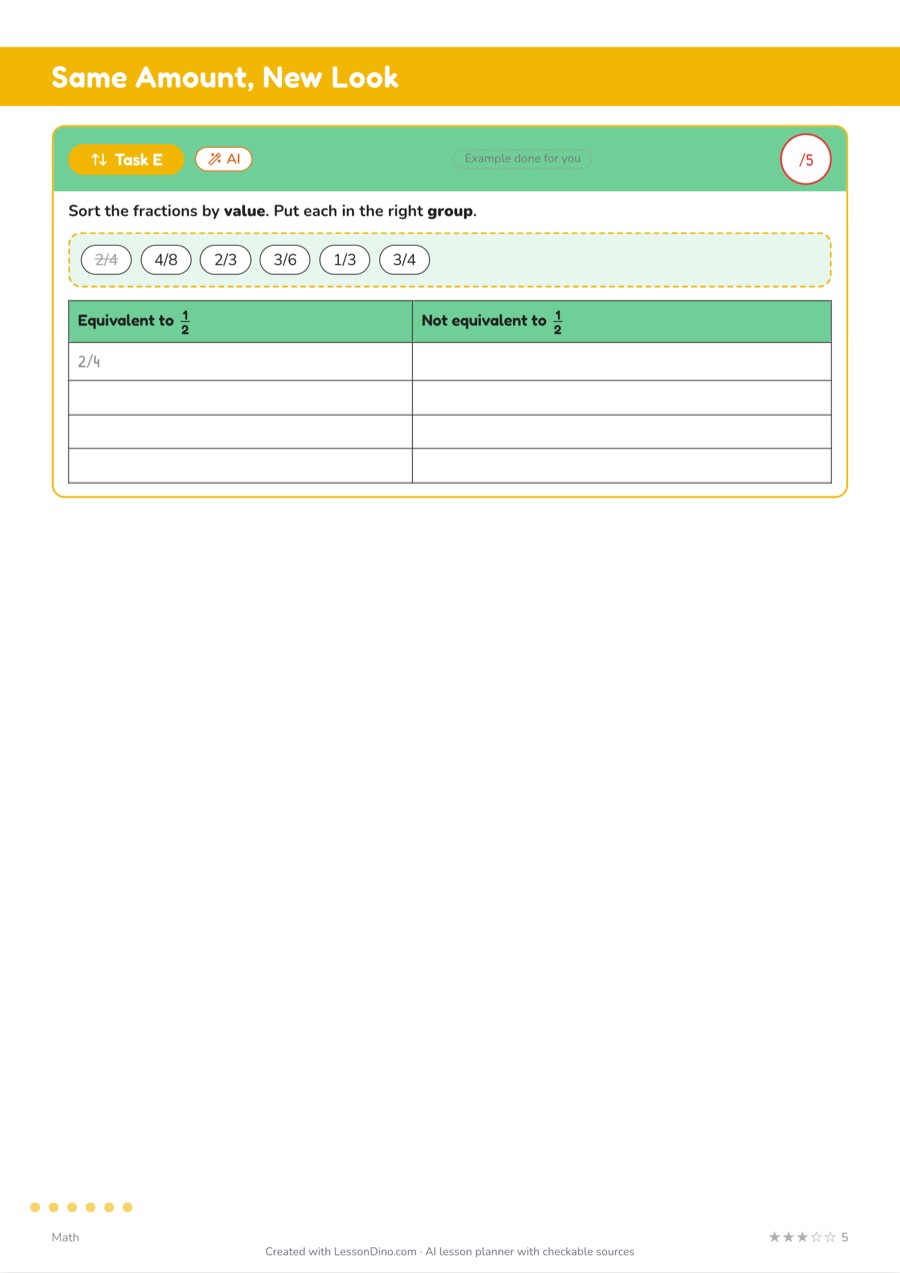
Page 5
Sort the fractions by value. Put each in the right group.
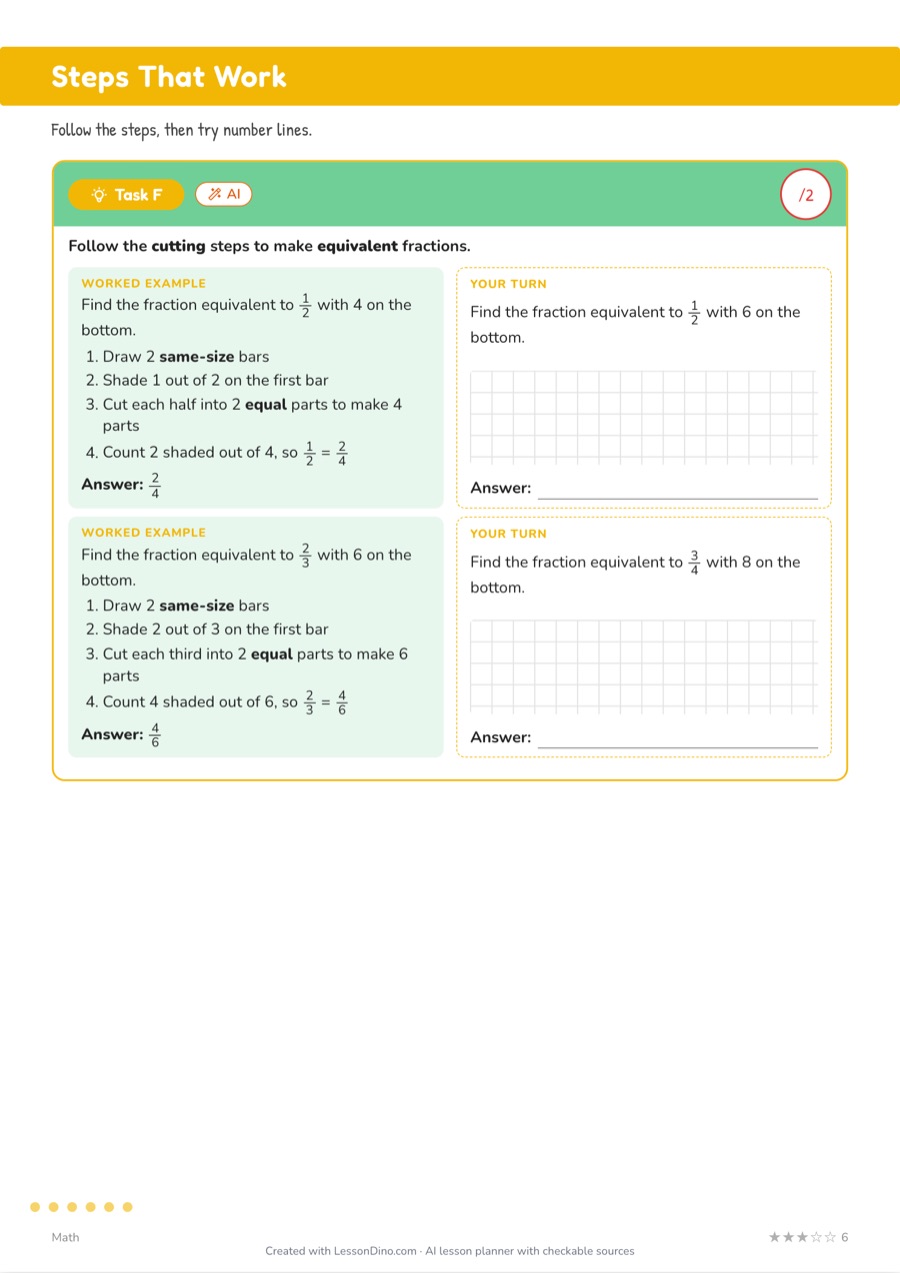
Steps That Work
Follow the steps, then try number lines.
Follow the cutting steps to make equivalent fractions.
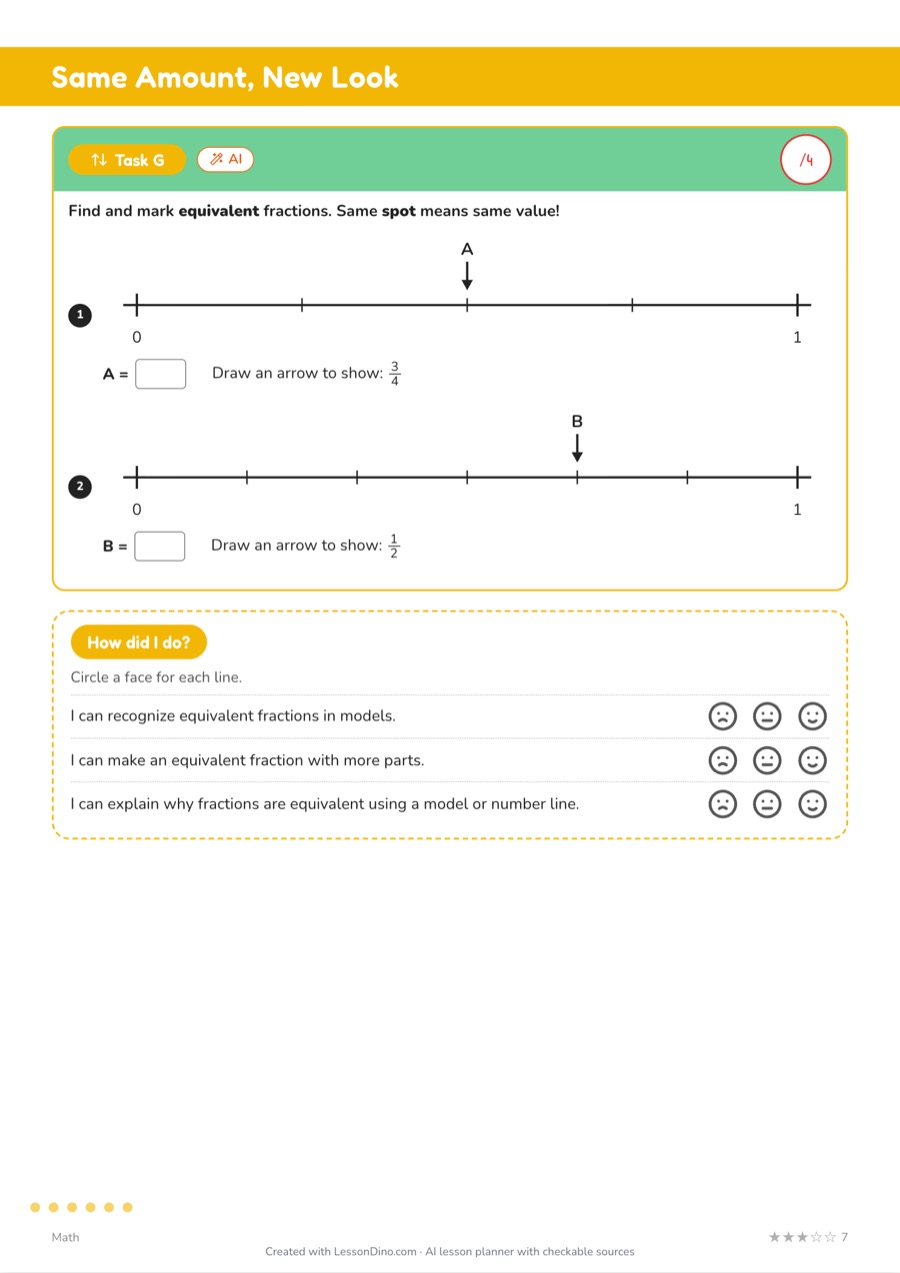
Page 7
Find and mark equivalent fractions. Same spot means same value!
Answers
Show the answers
- A bar is cut into 2 equal parts with 1 part shaded. Write the fraction. 1/2
- A same-size bar is cut into 4 equal parts with 2 parts shaded. Write the fraction. 2/4
- Are 1/2 and 2/4 equivalent? Write yes or no. yes
- Which fraction is equivalent to 1/2: 1/3, 2/4, or 3/5? 2/4
- A model shows 2/3 shaded. Cut each third into 2 equal parts. Write the new fraction with 6 on the bottom. 4/6
- Student A says 4/6 and 2/3 are equivalent. Is Student A right or wrong? right
- Fill in the missing numerator: 1/3 = ?/6 2
- Two same-size strips show 1/2 and 3/6 shaded. Are they equivalent? Explain how you know. Yes, they cover the same amount of the same-size whole.
- Student B says 2/3 is equivalent to 2/4 because the tops match. Is Student B right? Explain. No, the shaded amounts are not the same.
- A paper strip is cut into 8 equal parts. How many parts must be shaded to match 1/2? 4
- Write the fraction for 1 whole cut into 4 equal parts with 1 part shaded. 1/4
- Cut each fourth in half to make 8 parts. If 1/4 was shaded, how many eighths are now shaded? Write the equivalent fraction. 2/8
- Are 1/4 and 2/8 equivalent? Write yes or no. yes
- Which fraction is equivalent to 3/4: 5/8, 6/8, or 2/4? 6/8
- Fill the missing numerator: 1/2 = ?/8 4
- Fill the missing denominator: 2/3 = 4/? 6
- Student A changes 2/4 to 4/4 by adding 2 to the top only. Did Student A make an equivalent fraction? Write yes or no. no
- A student folds a paper strip into 3 equal parts and shades 2 parts. Then the student folds each part in half. What equivalent fraction shows the shaded parts now? 4/6
- A student shares half a sandwich. A partner cuts a same-size sandwich into 6 equal parts and takes 3 parts. Did both get the same amount? Explain. Yes, 1/2 and 3/6 cover the same amount.
- How many eighths are equivalent to 3/4? Write the fraction. 6/8
The answer sheet is the last picture above.
Curriculum
Recognize and generate simple equivalent fractions, e.g., 1/2 = 2/4, 4/6 = 2/3. Explain why the fractions are equivalent, e.g., by using a visual fraction model.
Made with Lesson Dino's AI on 17 October 2026. AI can make mistakes, so check the answers and facts against the sources before you teach.