The worksheet
About this worksheet
Students learn that a fraction is a number with an exact place on the number line. They fold, mark, and label fractions on a 0 to 1 line. This Grade 3 Math worksheet gives students (ages 8–9) five pages of practice on fractions on a number line, part of the number and operations—fractions unit. It goes with our free Fractions on a number line lesson, which has the slides and a timed lesson plan.
What it covers
By the end, students should be able to:
- Students will understand a fraction as a number on the number line.
- Students will split 0 to 1 into b equal parts to show 1/b.
- Students will plot a/b by counting a jumps of 1/b from 0.
How to use it
- Practice (10 minutes): Hand out Worksheet Task B. Read the first 0 to 1 line together.
- Support: Use 0 to 1 lines already marked with 0 and 1 and start with halves and fourths only.
- Stretch: Fold and label thirds or sixths and explain why more parts makes each part smaller.
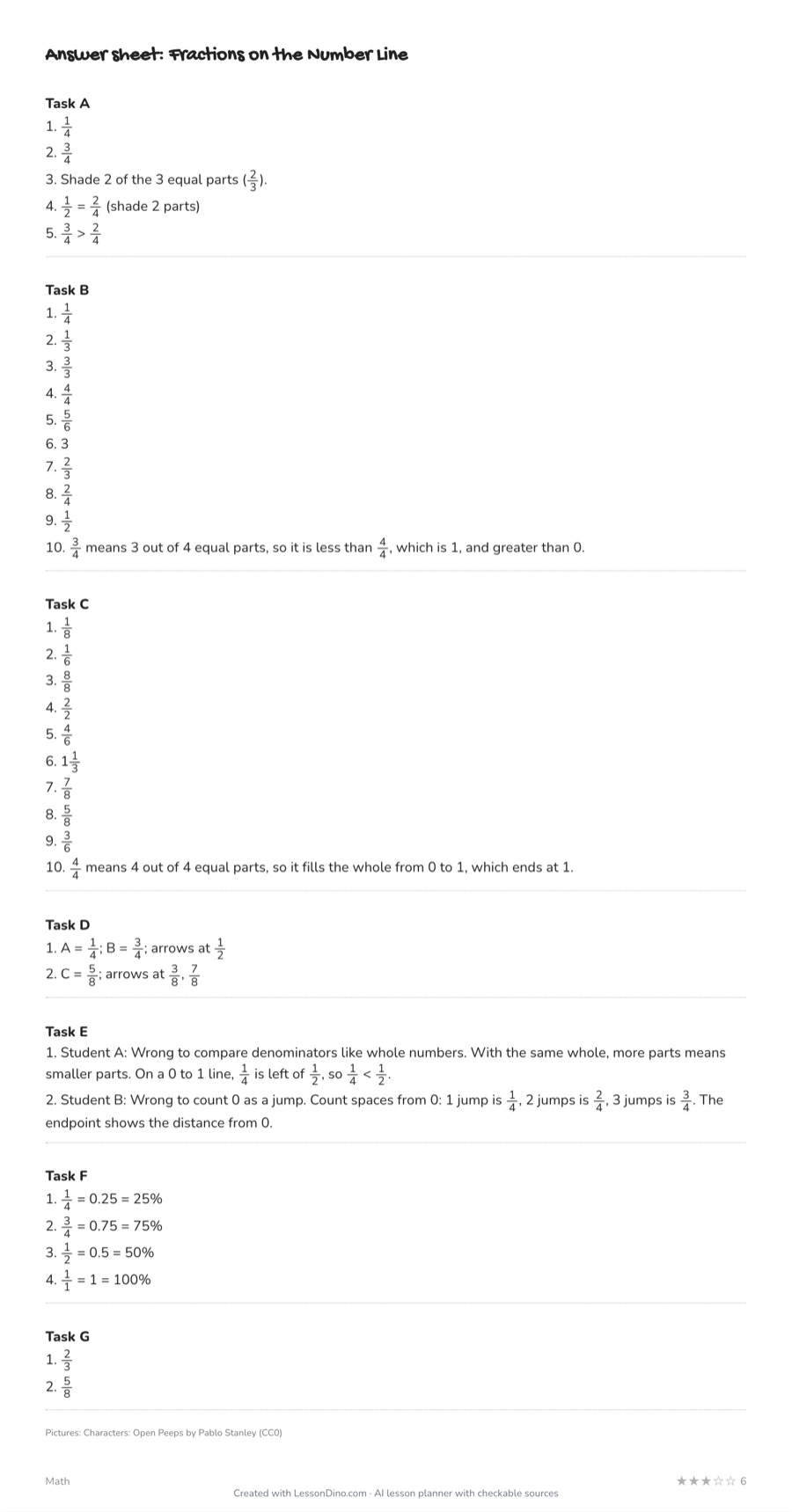
- The answer sheet is the last page, so you can print it on its own or let students check their own work.
Key vocabulary
- numerator: top number that tells how many parts we count
- denominator: bottom number that tells how many equal parts make the whole
- unit fraction: one single equal share, like 1/4
- number line: straight drawing that shows values in order from left to right
- whole: the full distance from 0 to 1 on our line
Mistakes to watch for
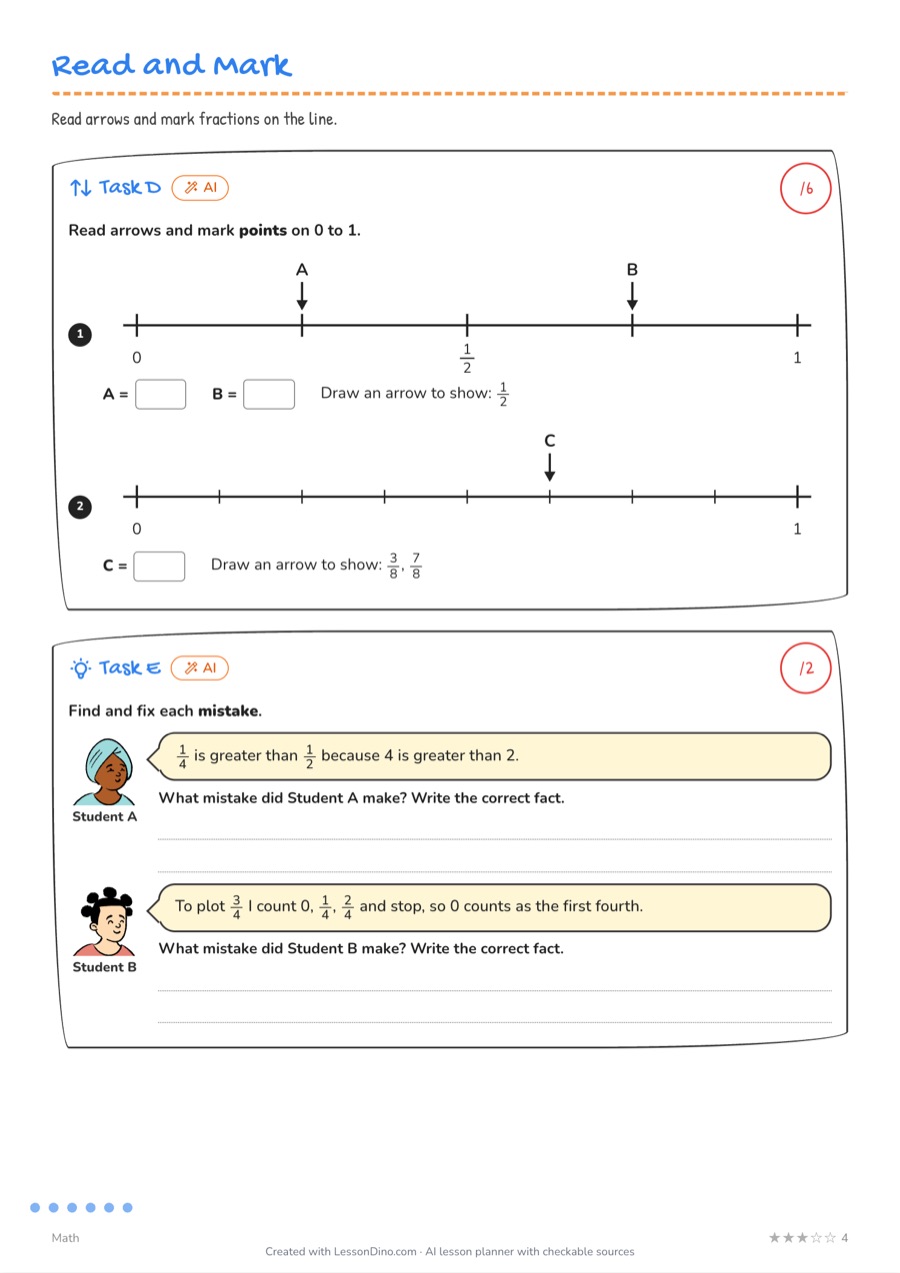
- Thinking 1/4 is larger than 1/2 because 4 is larger than 2. Point to both on the same 0 to 1 line and compare distance from 0; farther right means greater because values increase left to right.
- Counting tick marks instead of jumps from 0, labeling 0 as 1/4. Cover 0, count spaces not lines: first space end from 0 is 1/b; the endpoint of the part based at 0 locates 1/b.
- Splitting 0 to 1 into unequal parts. Refold strip to check equal lengths; each part must have size 1/b, so unequal parts cannot be unit fractions.
What's on the worksheet
Fractions Are Numbers
Learn how fractions live on the number line.
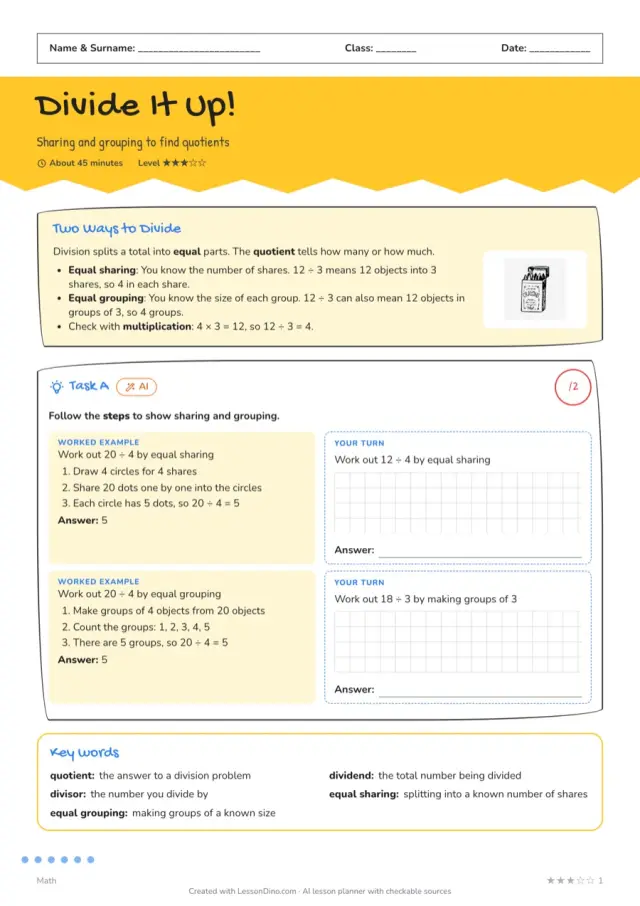
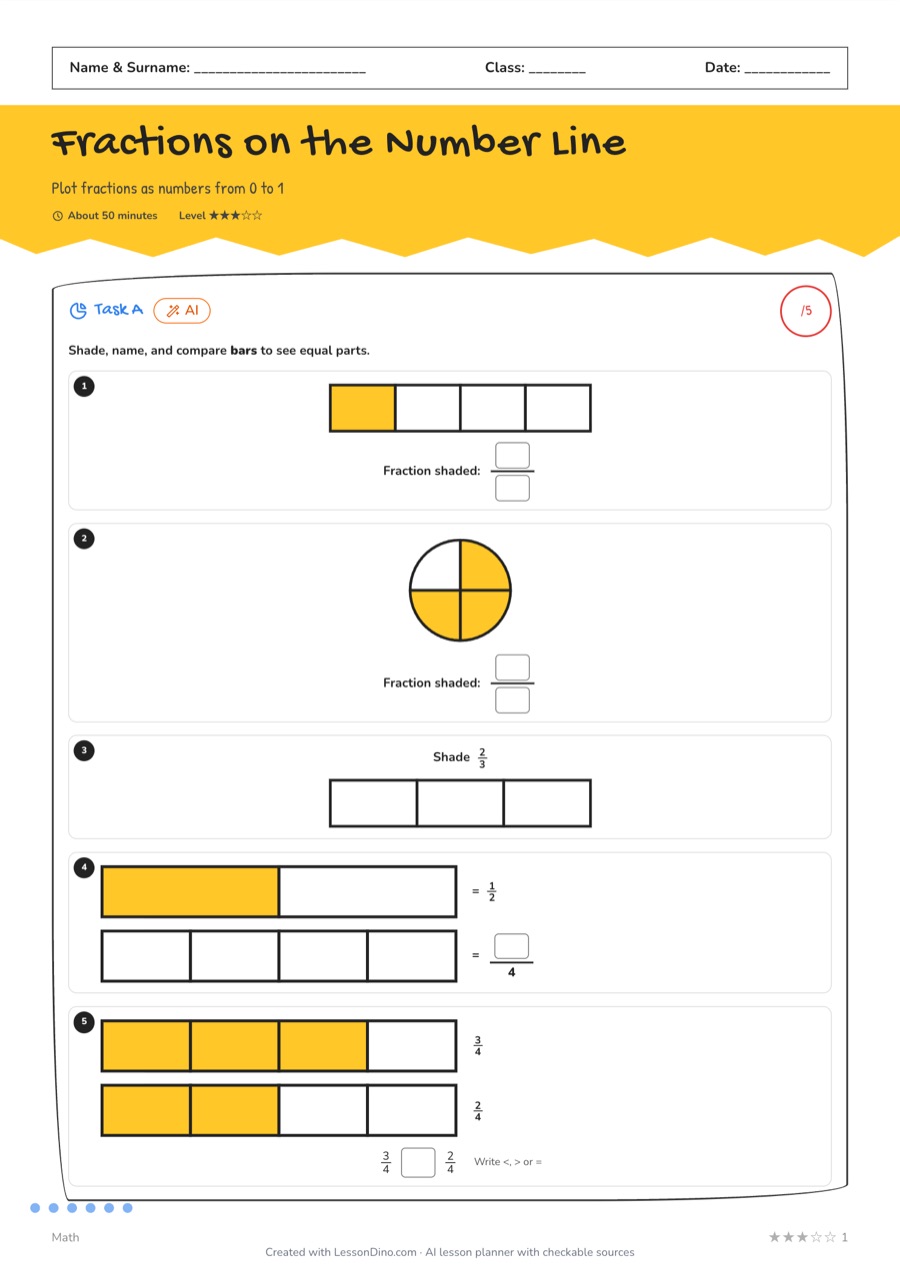
Shade, name, and compare bars to see equal parts.
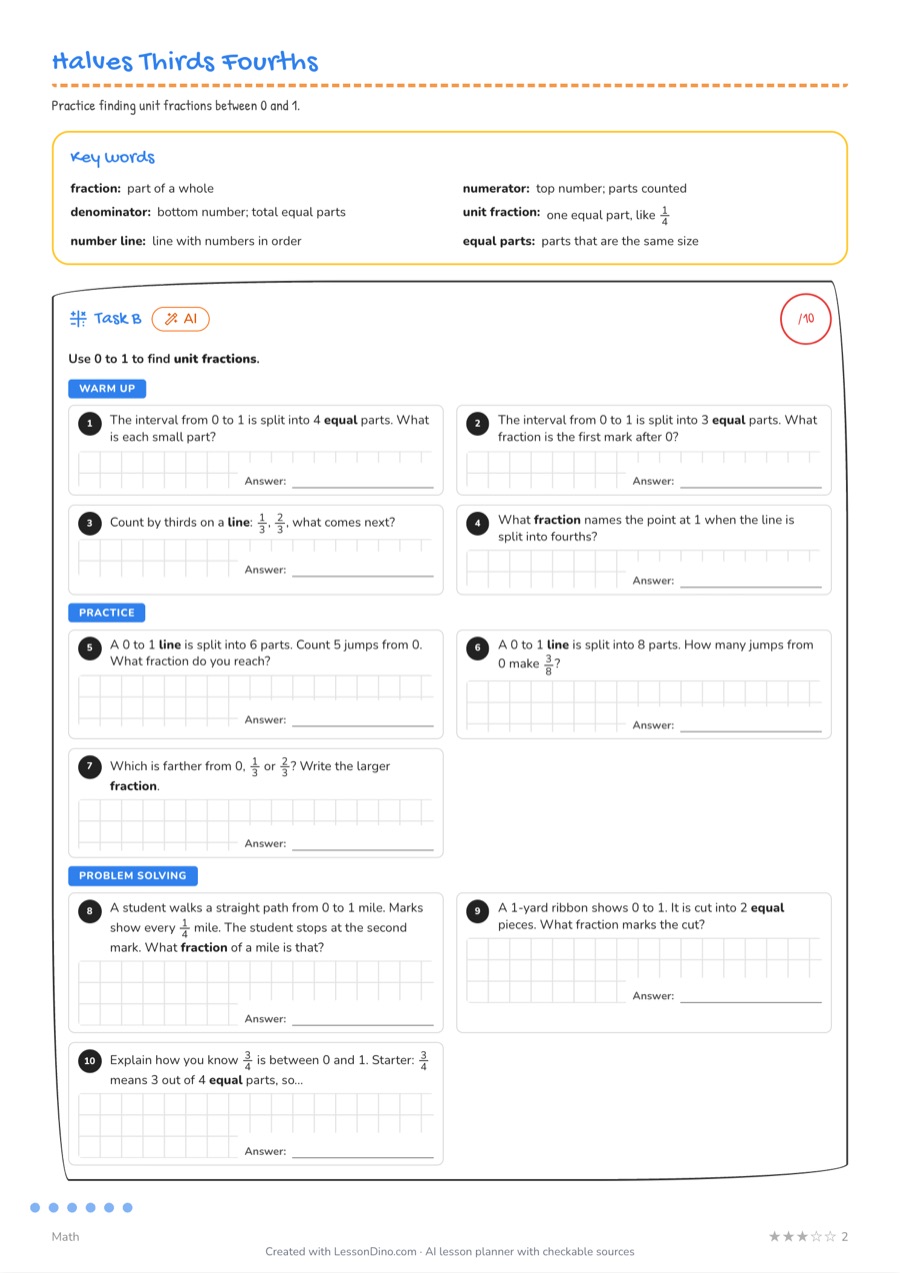
Halves Thirds Fourths
Practice finding unit fractions between 0 and 1.
| Word | Meaning |
|---|---|
| fraction | part of a whole |
| numerator | top number; parts counted |
| denominator | bottom number; total equal parts |
| unit fraction | one equal part, like 1/4 |
| number line | line with numbers in order |
| equal parts | parts that are the same size |
Use 0 to 1 to find unit fractions.
Warm up
- The interval from 0 to 1 is split into 4 equal parts. What is each small part?
- The interval from 0 to 1 is split into 3 equal parts. What fraction is the first mark after 0?
- Count by thirds on a line: 1/3, 2/3, what comes next?
- What fraction names the point at 1 when the line is split into fourths?
Practice
- A 0 to 1 line is split into 6 parts. Count 5 jumps from 0. What fraction do you reach?
- A 0 to 1 line is split into 8 parts. How many jumps from 0 make 3/8?
- Which is farther from 0, 1/3 or 2/3? Write the larger fraction.
Problem solving
- A student walks a straight path from 0 to 1 mile. Marks show every 1/4 mile. The student stops at the second mark. What fraction of a mile is that?
- A 1-yard ribbon shows 0 to 1. It is cut into 2 equal pieces. What fraction marks the cut?
- Explain how you know 3/4 is between 0 and 1. Starter: 3/4 means 3 out of 4 equal parts, so...
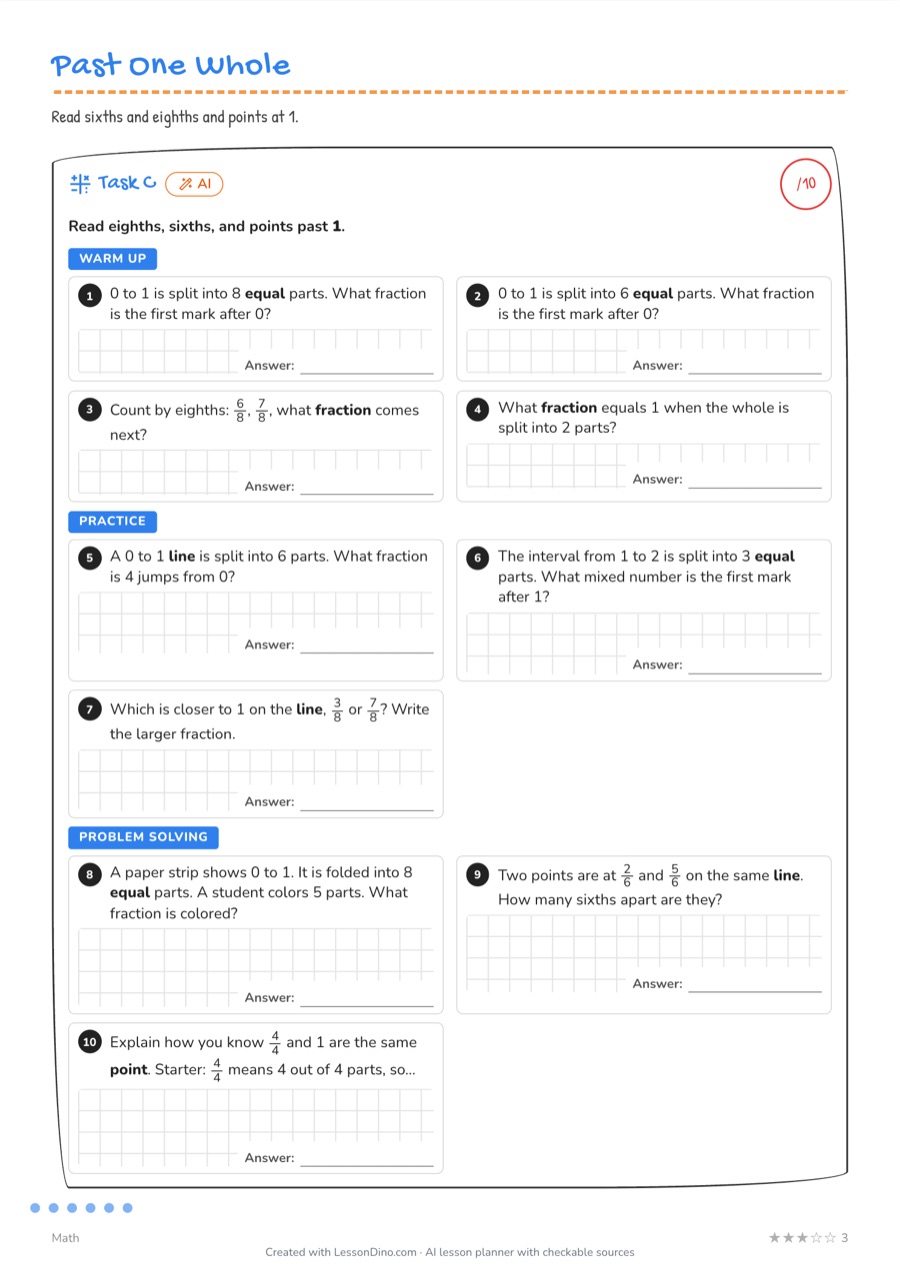
Past One Whole
Read sixths and eighths and points at 1.
Read eighths, sixths, and points past 1.
Warm up
- 0 to 1 is split into 8 equal parts. What fraction is the first mark after 0?
- 0 to 1 is split into 6 equal parts. What fraction is the first mark after 0?
- Count by eighths: 6/8, 7/8, what fraction comes next?
- What fraction equals 1 when the whole is split into 2 parts?
Practice
- A 0 to 1 line is split into 6 parts. What fraction is 4 jumps from 0?
- The interval from 1 to 2 is split into 3 equal parts. What mixed number is the first mark after 1?
- Which is closer to 1 on the line, 3/8 or 7/8? Write the larger fraction.
Problem solving
- A paper strip shows 0 to 1. It is folded into 8 equal parts. A student colors 5 parts. What fraction is colored?
- Two points are at 2/6 and 5/6 on the same line. How many sixths apart are they?
- Explain how you know 4/4 and 1 are the same point. Starter: 4/4 means 4 out of 4 parts, so...
Read and Mark
Read arrows and mark fractions on the line.
Read arrows and mark points on 0 to 1.
Find and fix each mistake.
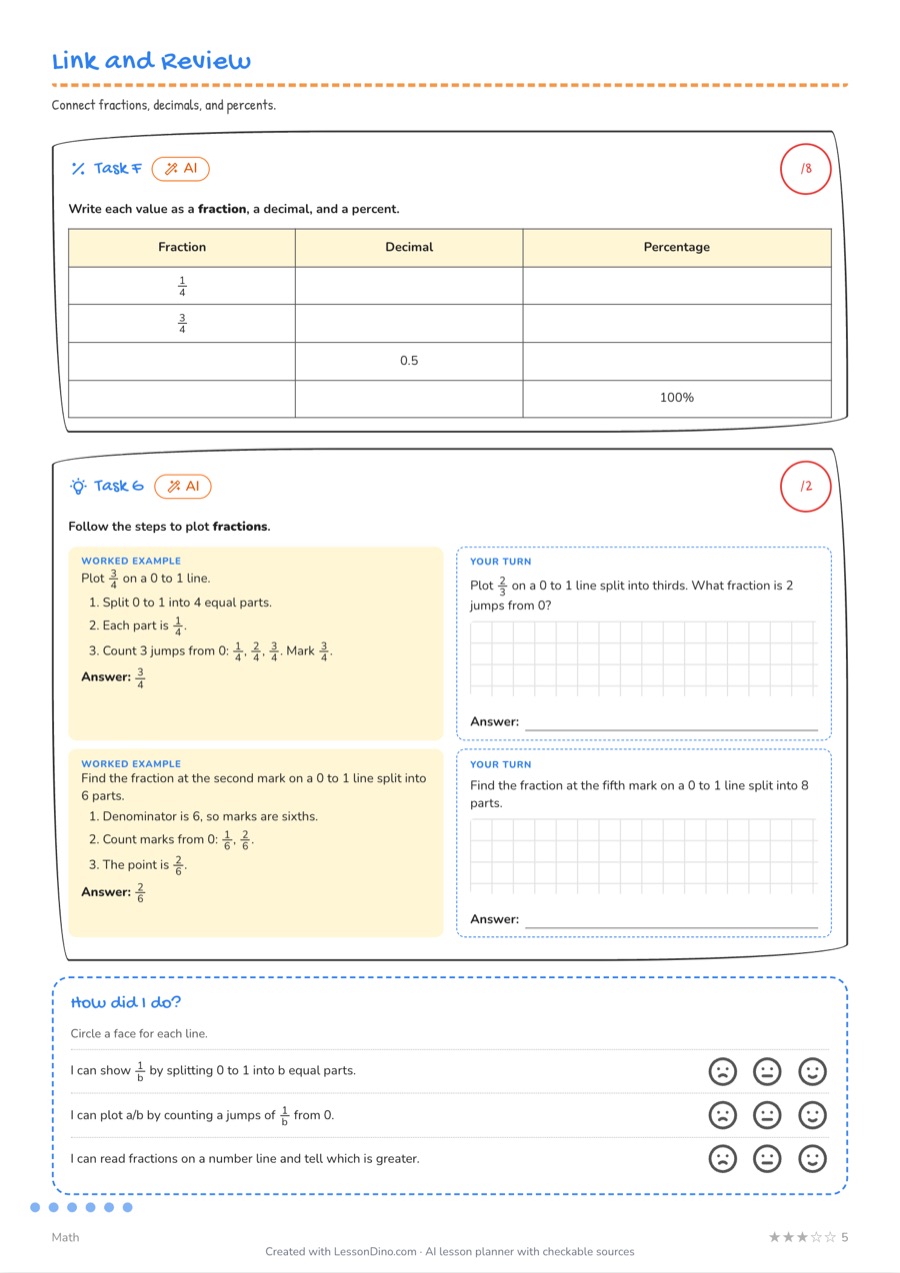
Link and Review
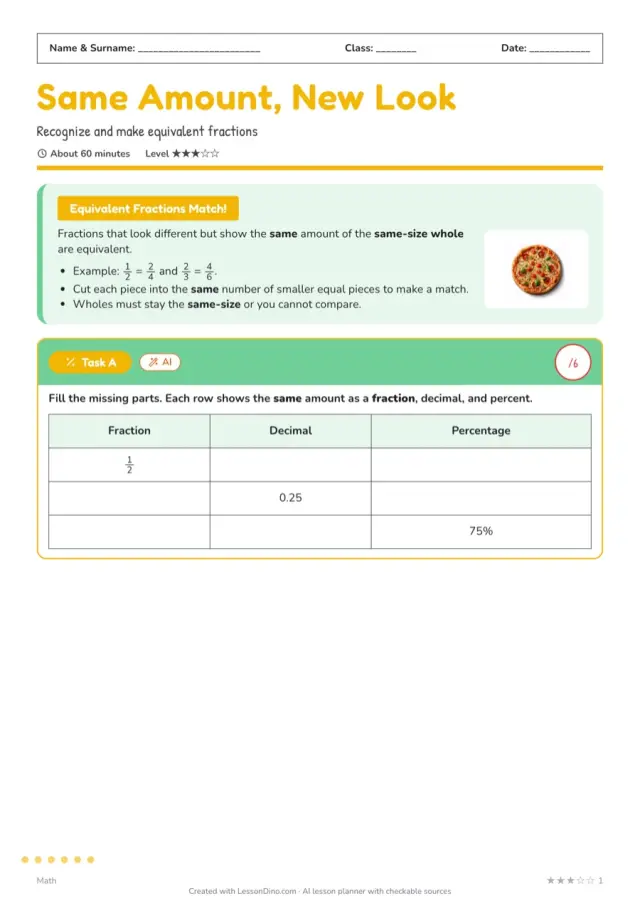
Connect fractions, decimals, and percents.
Write each value as a fraction, a decimal, and a percent.
Follow the steps to plot fractions.
Answers
Show the answers
- The interval from 0 to 1 is split into 4 equal parts. What is each small part? 1/4
- The interval from 0 to 1 is split into 3 equal parts. What fraction is the first mark after 0? 1/3
- Count by thirds on a line: 1/3, 2/3, what comes next? 3/3
- What fraction names the point at 1 when the line is split into fourths? 4/4
- A 0 to 1 line is split into 6 parts. Count 5 jumps from 0. What fraction do you reach? 5/6
- A 0 to 1 line is split into 8 parts. How many jumps from 0 make 3/8? 3
- Which is farther from 0, 1/3 or 2/3? Write the larger fraction. 2/3
- A student walks a straight path from 0 to 1 mile. Marks show every 1/4 mile. The student stops at the second mark. What fraction of a mile is that? 2/4
- A 1-yard ribbon shows 0 to 1. It is cut into 2 equal pieces. What fraction marks the cut? 1/2
- Explain how you know 3/4 is between 0 and 1. Starter: 3/4 means 3 out of 4 equal parts, so... 3/4 means 3 out of 4 equal parts, so it is less than 4/4, which is 1, and greater than 0.
- 0 to 1 is split into 8 equal parts. What fraction is the first mark after 0? 1/8
- 0 to 1 is split into 6 equal parts. What fraction is the first mark after 0? 1/6
- Count by eighths: 6/8, 7/8, what fraction comes next? 8/8
- What fraction equals 1 when the whole is split into 2 parts? 2/2
- A 0 to 1 line is split into 6 parts. What fraction is 4 jumps from 0? 4/6
- The interval from 1 to 2 is split into 3 equal parts. What mixed number is the first mark after 1? 1 1/3
- Which is closer to 1 on the line, 3/8 or 7/8? Write the larger fraction. 7/8
- A paper strip shows 0 to 1. It is folded into 8 equal parts. A student colors 5 parts. What fraction is colored? 5/8
- Two points are at 2/6 and 5/6 on the same line. How many sixths apart are they? 3/6
- Explain how you know 4/4 and 1 are the same point. Starter: 4/4 means 4 out of 4 parts, so... 4/4 means 4 out of 4 equal parts, so it fills the whole from 0 to 1, which ends at 1.
The answer sheet is the last picture above.
Curriculum
Understand a fraction as a number on the number line; represent fractions on a number line diagram.
Made with Lesson Dino's AI on 16 October 2026. AI can make mistakes, so check the answers and facts against the sources before you teach.