Slides
Lesson plan
Time to the Minute and Minutes Passed
Students learn to tell time to the minute and find minutes passed. They build clocks, read hands, and time real jobs.
Objectives
- Students will tell and write time to the nearest minute on analog and digital clocks.
- Students will measure time intervals in minutes using number lines and counting.
Success criteria
- I can read hands and write the time to the minute.
- I can find how many minutes passed from start to end.
Key words
| Word | Meaning |
|---|---|
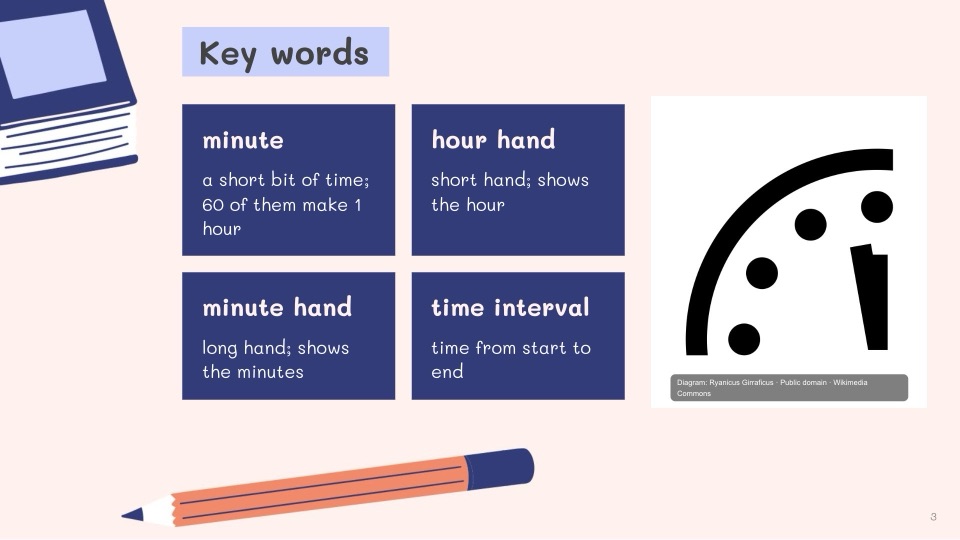
| minute | a short bit of time; 60 of them make one full turn of the long pointer |
| hour hand | short pointer that shows the current 60-minute block that has started |
| minute hand | long pointer that shows how far past the block start we are |
| time interval | amount that passes from the start to the end of an activity |
Timed plan (60 minutes)
| Time | Stage | What happens |
|---|---|---|
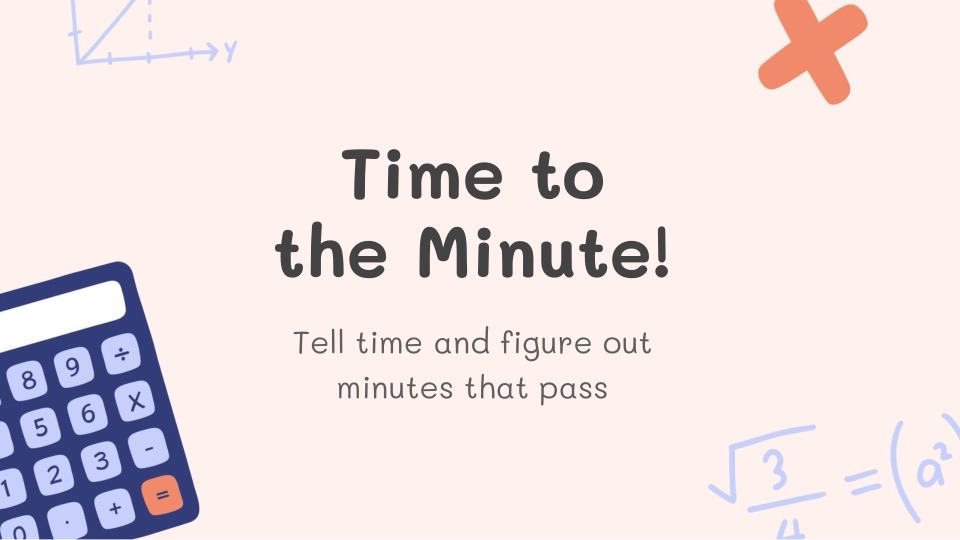
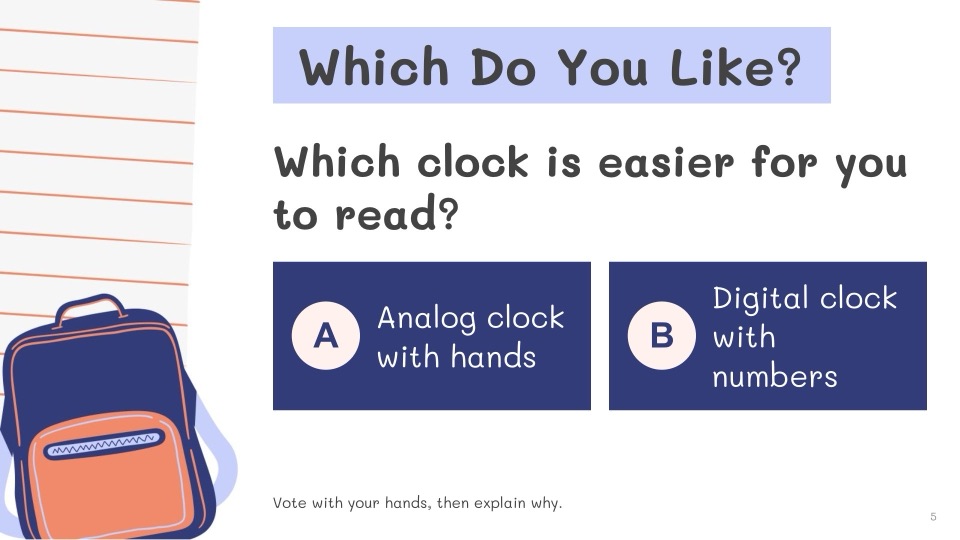
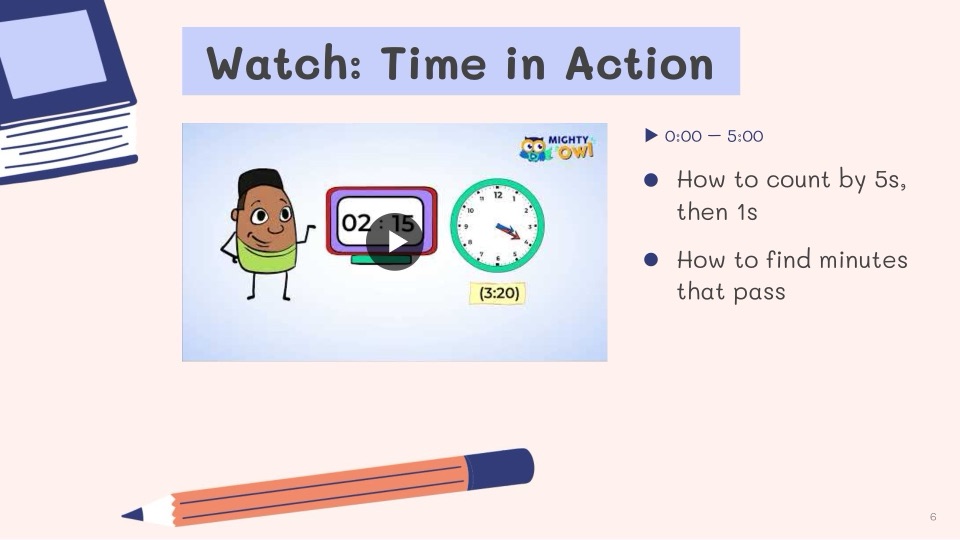
| 5 min | Starter | Hook interest in timing and recall hour, half hour, and clock choices. Show Slide 1 Time to the Minute and read its goal. Ask the hook: If we start reading at 9:05 and stop at 9:23, how many minutes did we actually read? Show Slide 5 vote and take a quick show of hands for analog or digital. Play Video clip 5 (0:00-1:49) to focus on the long pointer movement. |
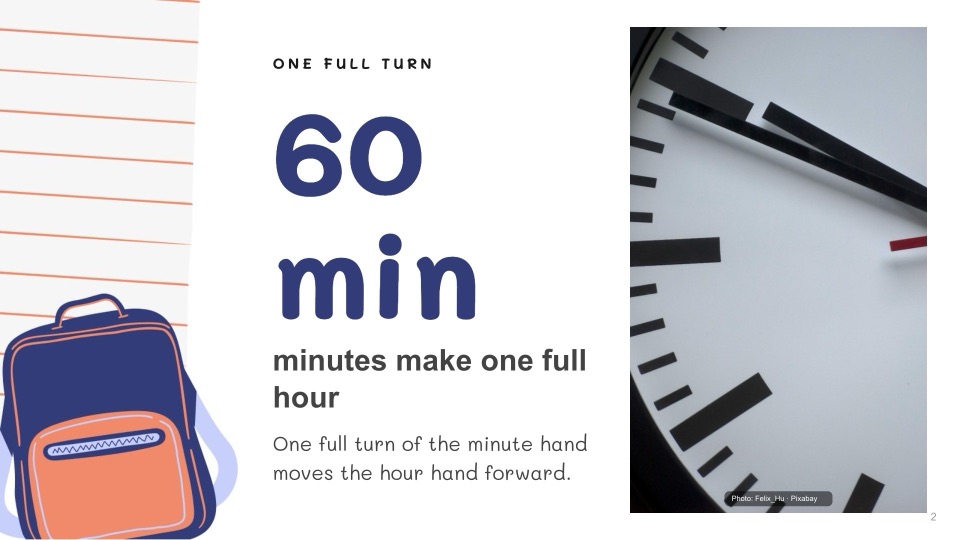
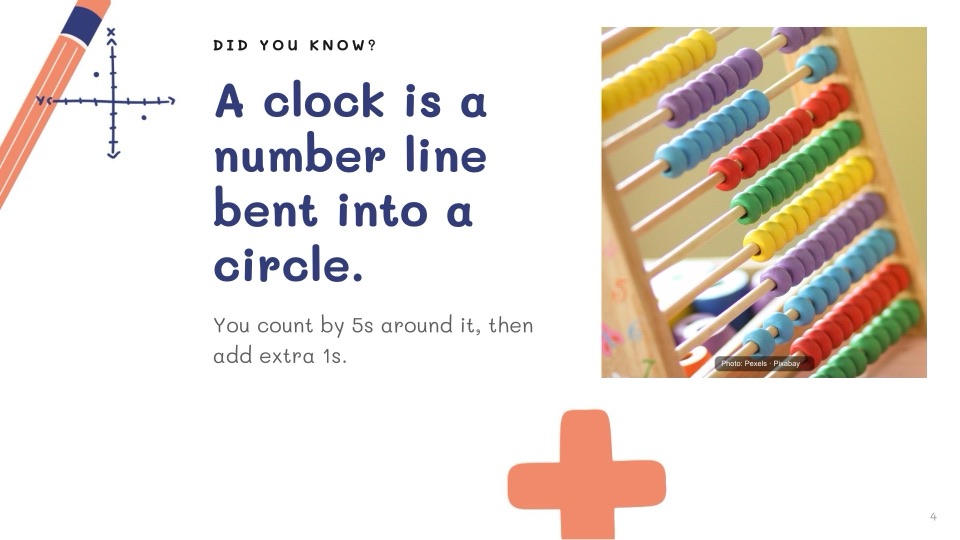
| 12 min | Teaching | Model how to find the hour first, then count minutes by 5s and 1s. Show Slides 2-4: one full turn of the minute hand moves the hour hand forward and is 60 minutes, and a clock is a number line bent into a circle. Show Slide 7: first find the hour, then count the minutes past it. Model 4:37 on demo clock. Think aloud skip-count by 5s to find the 5-minute interval, then count by 1s to read the exact minute. Show 7:45 and stress when the hour hand is on the 8 it is 8 o'clock, and anytime before that is minutes past 7. |
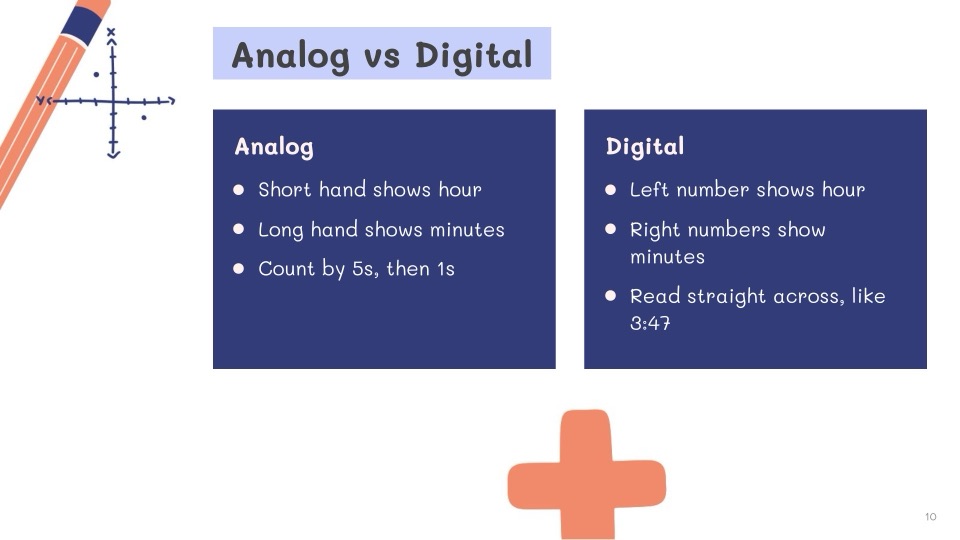
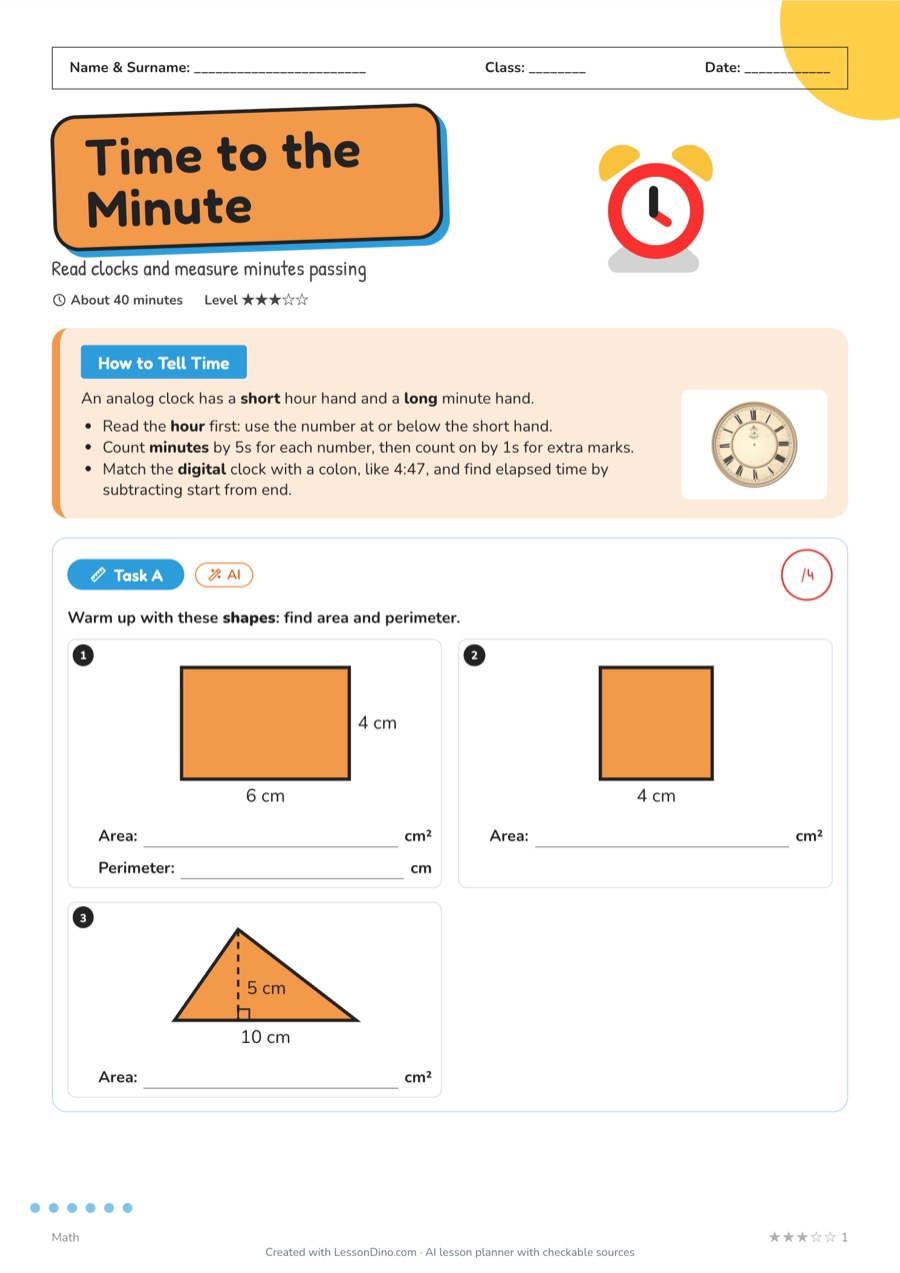
| 13 min | Guided practice | Practice reading analog clocks and writing matching digital times. Show Slide 10 Analog vs Digital and review short shows hour, long shows minutes, count by 5s then 1s. Review benchmarks: at full hours the minute hand is on 12, in half an hour it is on 6; on 3 it is quarter past, on 9 it is quarter to. Hand out Worksheet Task E and do the first clock together with Student A reading hour and Student B reading minutes. Circulate as pairs write each time shown to the minute with a colon. |
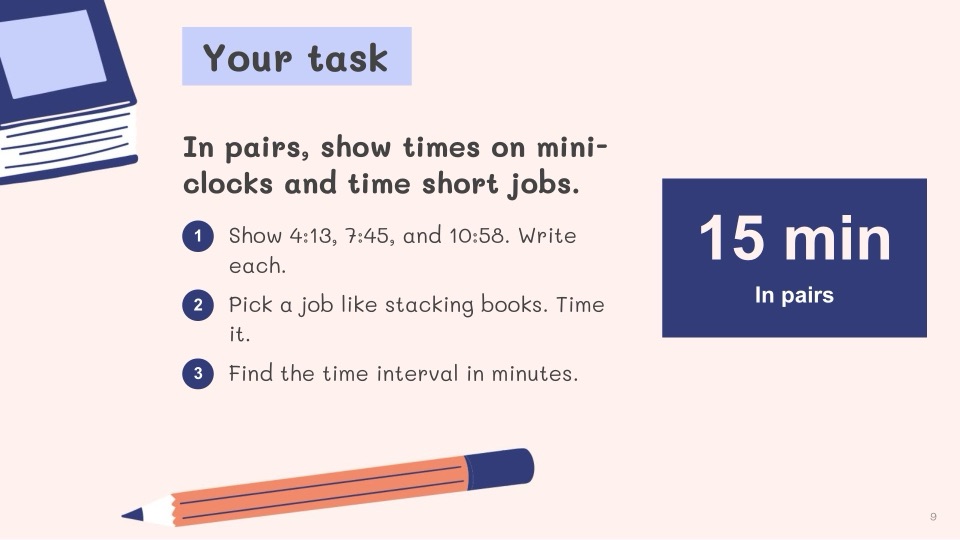
| 15 min | Main activity | Measure elapsed time in minutes for real jobs using a number line. Show Slide 9 task: show times, time a job like stacking books, and find the time interval in minutes. Model 9:05 to 9:23: plot start and end on a 0-60 line and find the distance between the two points. Explain another term for time interval is elapsed time, the amount from start to end, solved by adding or subtracting minutes. Hand out Task D and number lines; groups time a short job and solve its interval. |
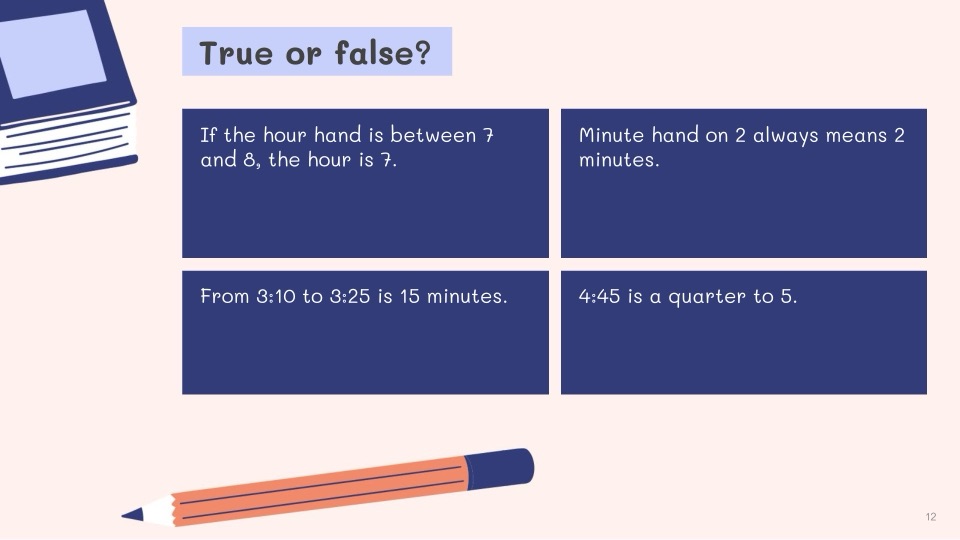
| 15 min | Plenary | Fix common errors and confirm telling time and intervals to the minute. Show Slide 11 recess question and have pairs solve 10:05 to 10:27 on number lines. Show Slide 12 true-or-false and vote on each: hour stays 7 until 8 o'clock, and minute hand on 2 means 10 minutes. Model one error: reading 4:10 as 4:02 because each number has two values, hour and minutes. Collect exit slips and link back to success lines. |
Common mistakes
- Reads 7:45 as 8:45 because short pointer is near 8.
How to spot it: Student writes hour one higher when pointer is between numbers.
Cover long pointer, name hour only by number at or below short pointer; when pointer is on 8 it is 8 o'clock, before that is minutes past 7. - Reads 4:10 as 4:02, using face value of 2.
How to spot it: Student says 2 minutes when long pointer points to 2.
Remind each number has two values; label 5 by 1, 10 by 2, 30 by 6 and skip-count by 5s, then 1s. - Swaps pointers, reading long as hour, like 2:45 as 9:15.
How to spot it: Student states hour first from long pointer.
Always read shorter pointer first, then longer pointer; have student trace short then long aloud.
Support
- Give a clock already labeled with 5, 10, 15 minutes around the edge to support skip-counting.
- Keep intervals under 20 minutes in the same hour and estimate first, then count exactly.
Stretch
- Set two times 1-2 minutes apart to read, write, and order.
- Solve two-step totals and cross-hour intervals like 9:55 to 10:07.
Check questions
- Clock shows short pointer between 7 and 8 and long pointer on 9. Write the time.
Answer: 7:45 - Recess is 10:05 to 10:27. How many minutes passed?
Answer: 22 minutes - True or false: minute pointer on 2 means 10 minutes. Explain.
Answer: True - each number is 5 minutes, 2 x 5 = 10
Curriculum
Tell and write time to the nearest minute and measure time intervals in minutes.
Video clips
Clips on YouTube, from the start and end times we chose. Check each one before you show it.
-
3rd grade telling and elapsed time from 0:00 to 5:00
MightyOwl: Telling Time and Elapsed Time Problems | MightyOwl Math | 3rd Grade
Covers both telling time and elapsed time problems for 3rd grade, perfect for ages 8-9.
-
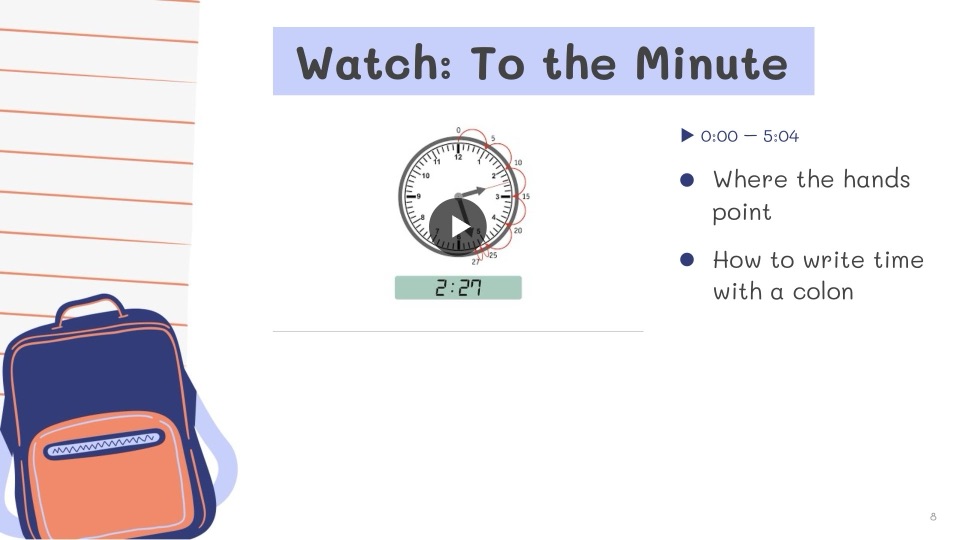
Time to the minute Grade 3 from 0:00 to 5:04
MATH-N-ROLL: Time to the Minute. Grade 3
Made for Grade 3 to read time to the minute on analog clocks, right for ages 8-9.
Worksheet
Sources
- 2025-2026 3rd grade Math Curriculum boepublic.parkhill.k12.mo.us
- Pre-Kindergarten Math sfusd.edu
- TI tell time nearest minute 3 5 generationgenius.com
- Hands of a Clock, Telling The Time Worksheet #15 - Academy Simple academysimple.com
- Joe Biden Wikipedia
- John Mulaney & the Sack Lunch Bunch Wikipedia
Picture credits
Made with Lesson Dino's AI on 17 October 2026. AI can make mistakes, so check facts against the sources before you teach.