Slides
Lesson plan
Shrink It Down: Summarising Across Paragraphs
Pupils learn to find the thread across paragraphs and group details. They shrink a text about hedgehogs onto one paper strip.
Objectives
- Students will summarise the main ideas drawn from more than one paragraph.
- Students will identify key details that support the main ideas across paragraphs.
Success criteria
- I can find the thread that links ideas across paragraphs.
- I can group small details into one bigger idea.
- I can write a 1-2 sentence summary in my own words.
Key words
| Word | Meaning |
|---|---|
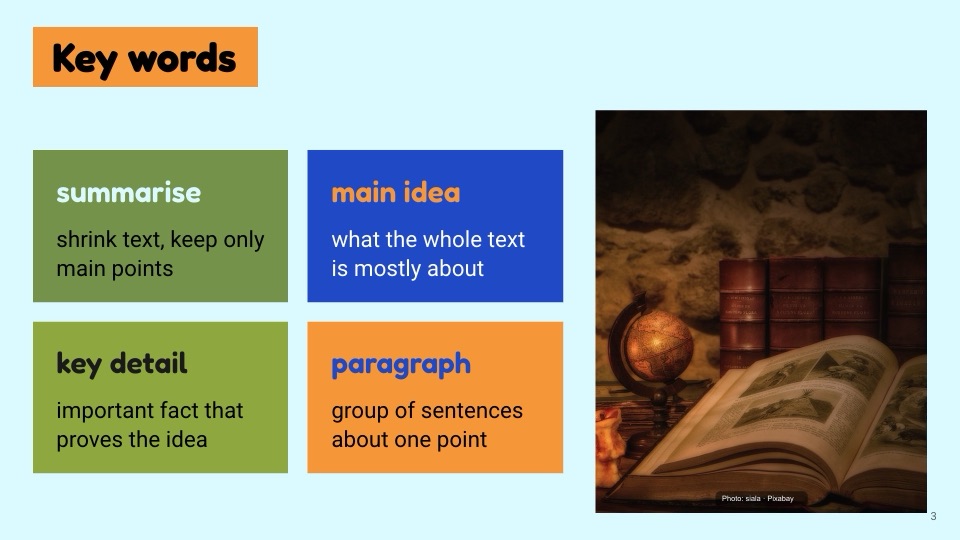
| summarise | to make a text much shorter, keeping only the most important points |
| main idea | what the whole piece of writing is mostly about, the thread every sentence serves |
| key detail | an important fact or example that shows the point is true |
| paragraph | a group of sentences about one part of a longer text |
Timed plan (60 minutes)
| Time | Stage | What happens |
|---|---|---|
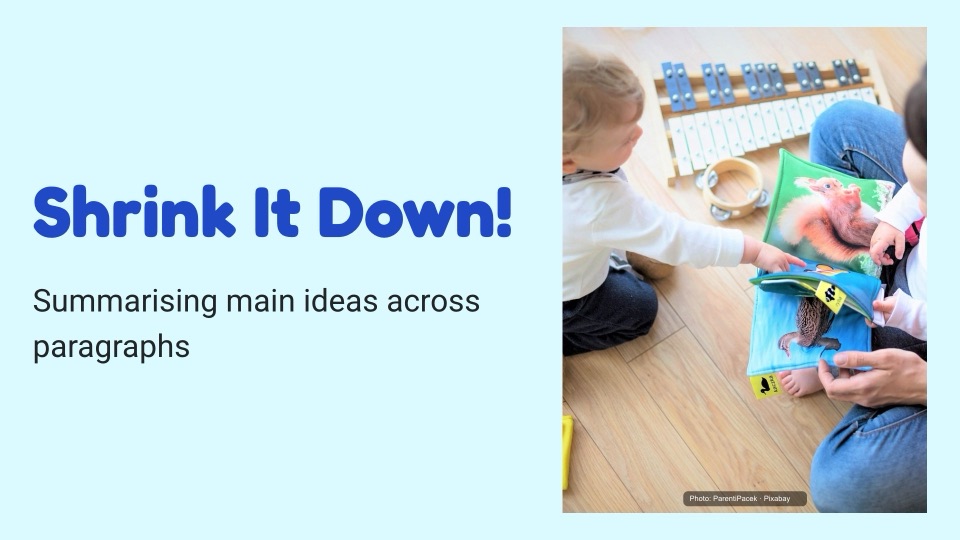
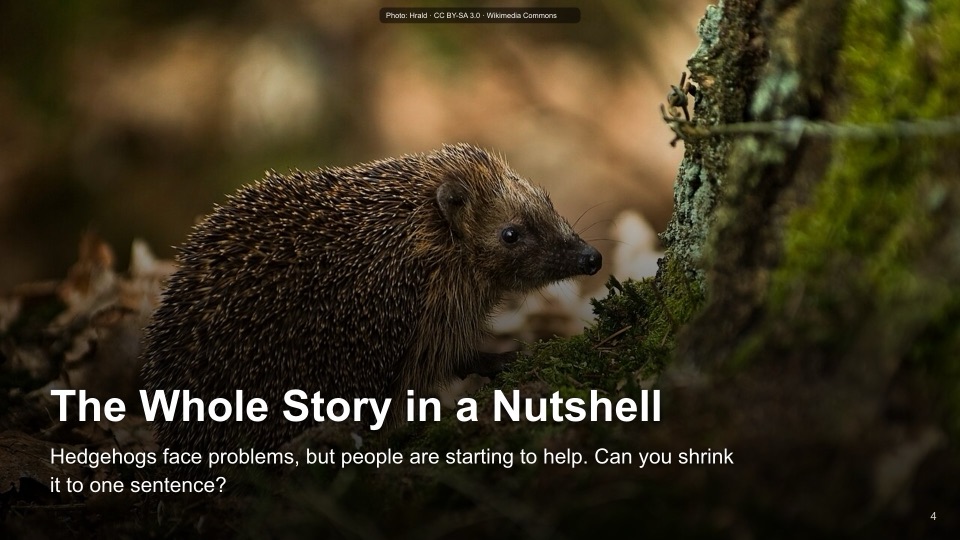
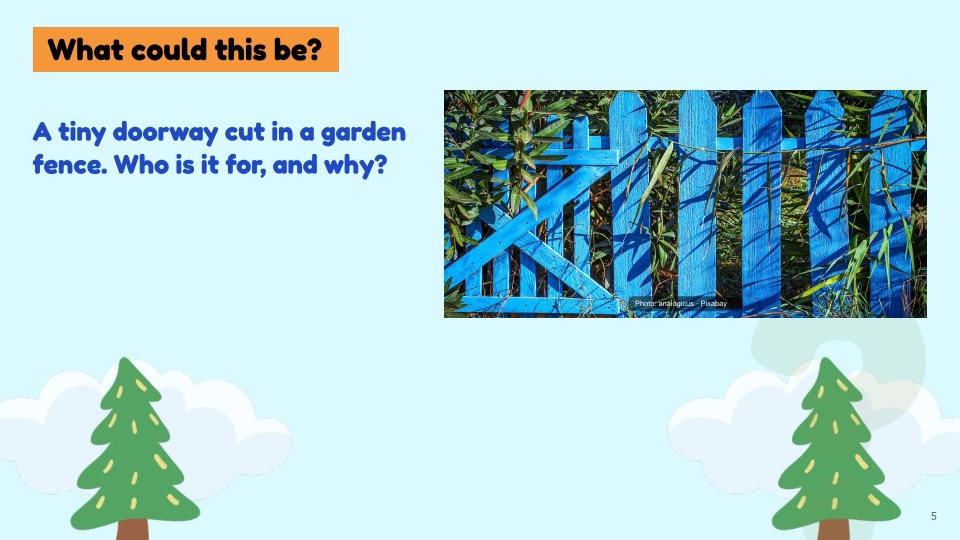
| 5 min | Starter | To hook pupils with shrinking and recall the difference between a main idea and details. Show Slide 1 title, then Slide 4: Hedgehogs face problems, but people are starting to help. Hold up a full page and one narrow paper strip and say the hook: what would you save and what would you drop? Show Slide 5 mystery of a tiny doorway cut in a garden fence and take 3 ideas on who it is for. Confirm it is a hedgehog highway - a hole that lets hedgehogs move and find food. |
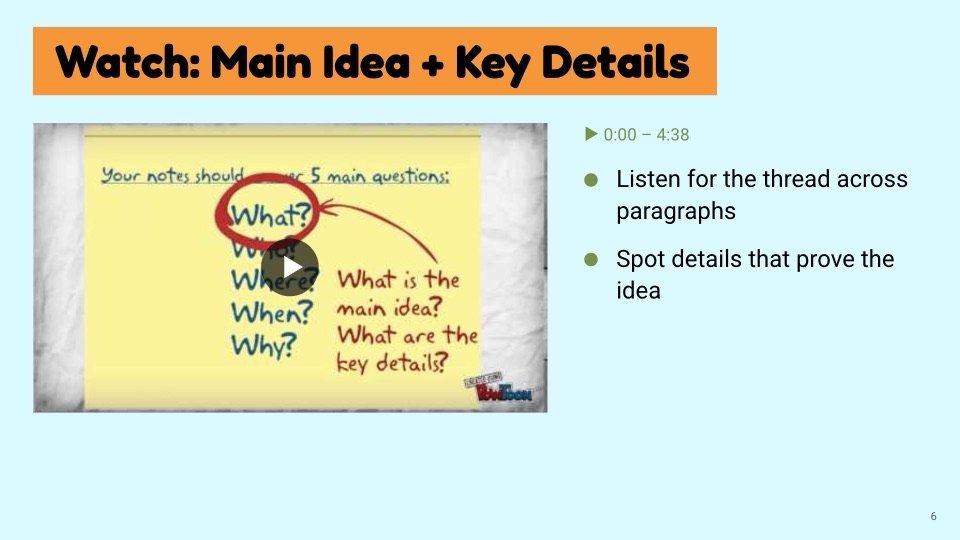
| 12 min | Teaching | To model finding the thread across paragraphs and grouping details into one idea. Show Slides 2-3 objectives and key words, then Slide 6 video. Play Video clip 1 (0:00-4:38) and ask pupils to listen for the thread across paragraphs. Model with Paragraph 2 on the board, underlining roads, fences and pellets as one group. Show Slide 7 and model reading the first sentence of each paragraph to find each point quickly, because a topic sentence is often the first sentence in a paragraph. |
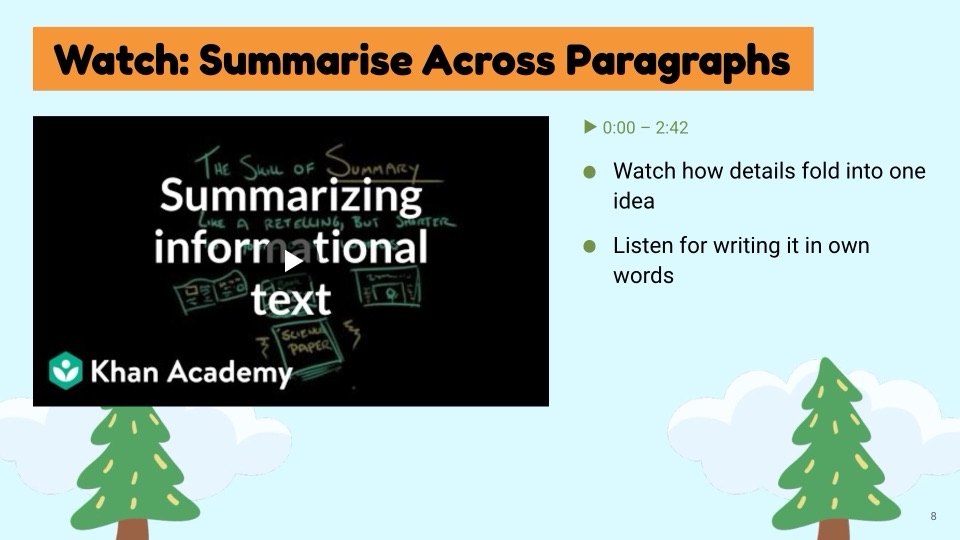
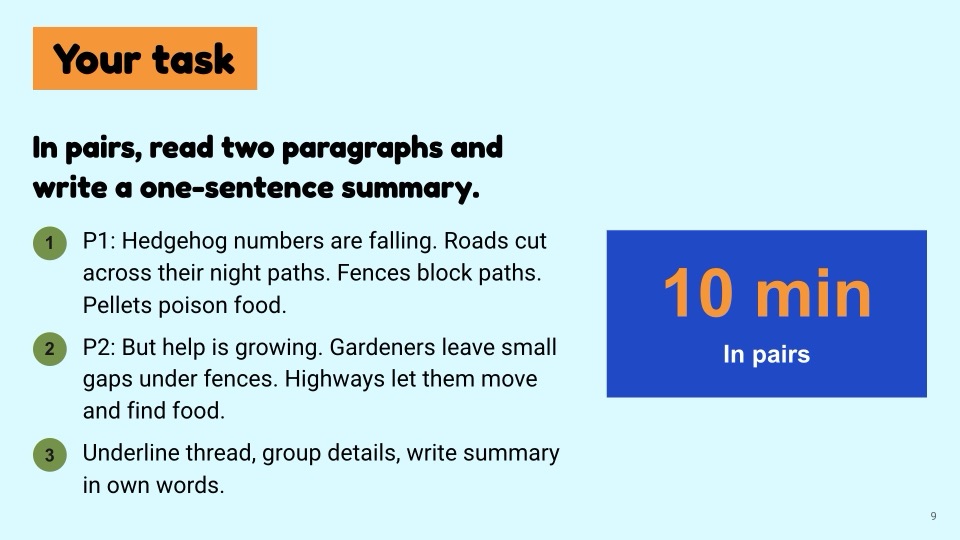
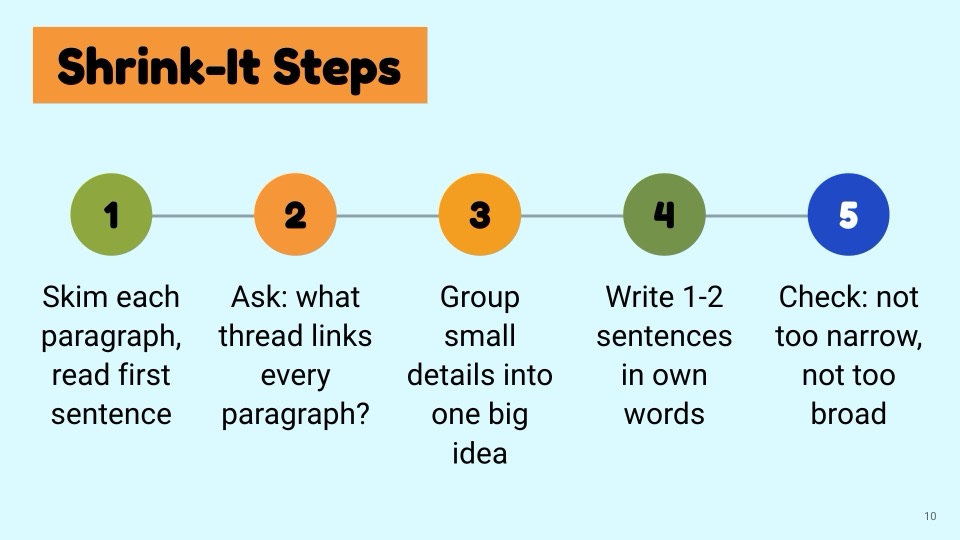
| 10 min | Guided practice | To practise skimming, scanning and folding details before independent writing. Show Slide 8 video prompt and play Video clip 3 (0:00-2:42). Display Slide 9 P1 and P2 lines and Slide 10 Shrink-It Steps. Guide skimming for general feel and scanning for key words to find specific information. Cold-call pairs to group small details into one big idea in their own words. |
| 23 min | Main activity | To summarise two paragraphs on one paper strip by keeping the spine and folding details. Give out printed Hedgehogs in Trouble paragraphs 2-3, paper strips, highlighters and glue sticks. Instruct: underline the repeated thread, cut out loud details by crossing them through, keep the spine. Circulate, prompting pairs to group examples into human obstacles and growing help. Stop at 18 minutes for 3 pairs to glue and read their one-sentence join of both paragraphs. |
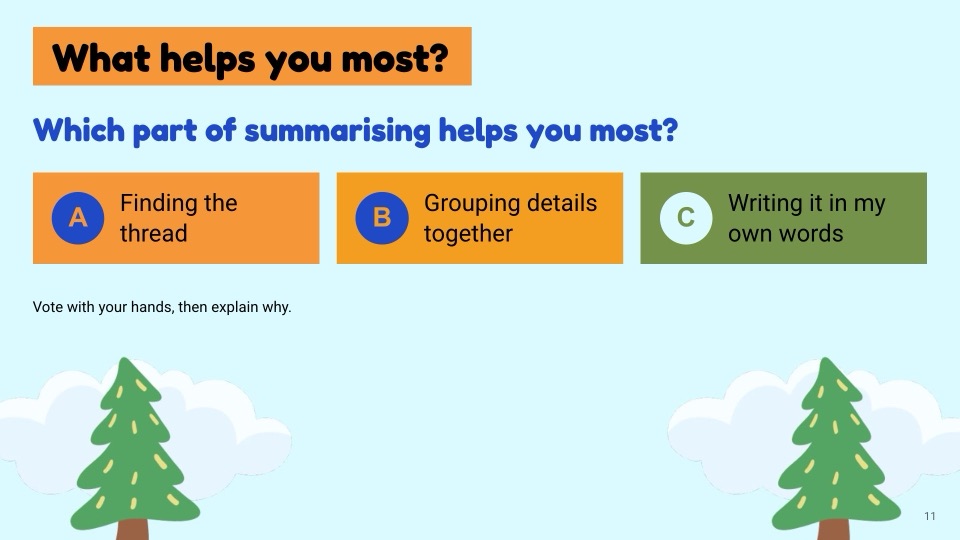
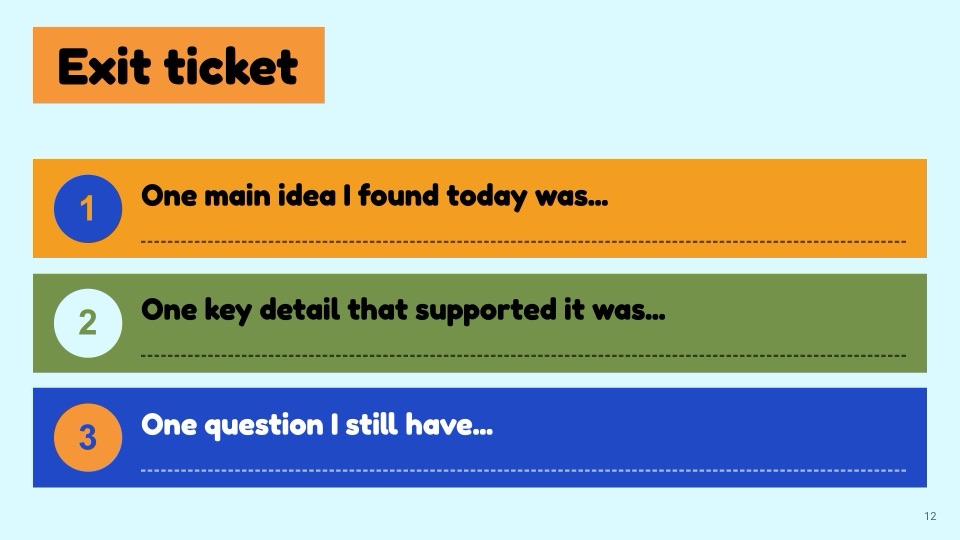
| 10 min | Plenary | To check summaries against success criteria and name next steps. Show Slide 11 vote: which part helped most - finding thread, grouping details, writing in own words. Take votes and ask two pupils to explain their choice in one sentence with proof. Show Slide 12 exit ticket and give 4 minutes to write two lines in books. Collect and link back to objectives on Slide 2. |
Common mistakes
- Copying whole sentences or writing everything instead of shrinking.
How to spot it: Summary is 3+ sentences long with exact phrases from the text.
Cover the text and retell in 1-2 own-word sentences; check it sums up in a few words, not the whole story. - Choosing the loudest detail as the main idea, e.g. only slug pellets.
How to spot it: Summary mentions one example and misses the second paragraph turn.
Ask what every sentence serves; fold roads, fences and pellets into human obstacles and add but help is growing. - Writing a vague theme that is too broad, e.g. about animals.
How to spot it: Summary could fit any text and has no key details.
Add the thread + turn + one grouped detail, using topic sentences to locate each paragraph point.
Support
- Give texts where thread words are already highlighted and topic sentences underlined
- Provide word bank and sentence frame: falling because ___, but help is growing when ___
- Allow skimming first sentences fully before scanning for details
Stretch
- Add which key detail best supports each part of the summary
- Rewrite a too-narrow option to include the second paragraph turn
- Summarise a second two-paragraph text without writing until the final sentence
Check questions
- What is the main idea linking paragraphs 2 and 3 of Hedgehogs in Trouble?
Answer: Hedgehog numbers are falling because of human obstacles, but help is growing. - Name one key detail that supports the falling-numbers part.
Answer: Roads cut paths / fences block gaps / pellets poison food. - Name one key detail that supports the help-is-growing part.
Answer: Gardeners leave hedgehog highways / councils cut grass less and warn drivers.
Curriculum
summarising the main ideas drawn from more than 1 paragraph, identifying key details that support the main ideas
Video clips
Clips on YouTube, from the start and end times we chose. Check each one before you show it.
-
Summarise a text with main idea and key details from 0:00 to 4:38
eSpark: Summarize a Text | Main Idea and Key Details | 5th Grade Reading | eSpark Instructional Video
Directly teaches summarising main ideas with key details across paragraphs at the right pace and vocabulary for 9-10-year-olds.
-
Summarising informational text from 0:00 to 2:42
Khan Academy: Summarizing informational text | Reading | Khan Academy
Clear Khan Academy explanation of summarising across paragraphs, ideal for Year 5 aged 9-10.
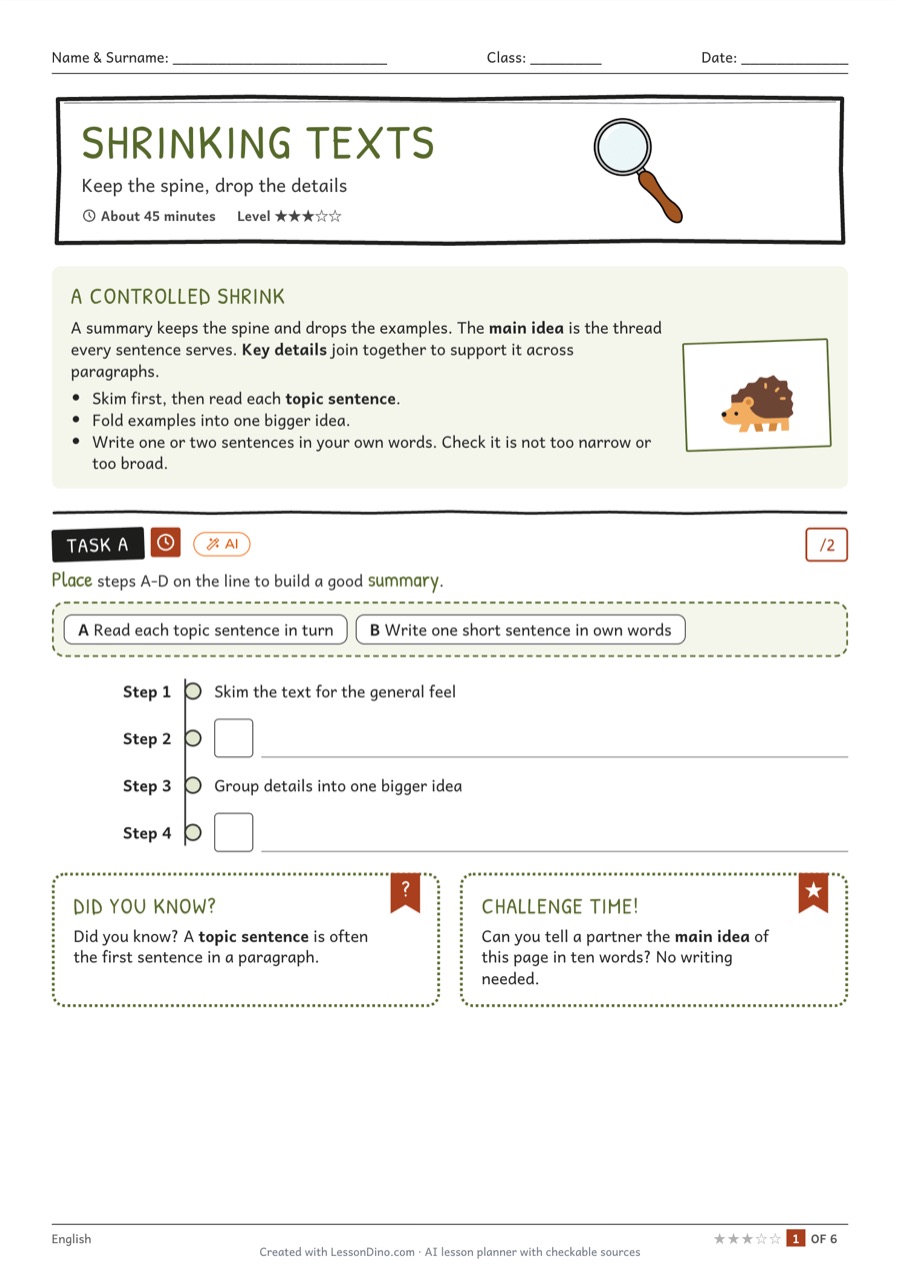
Worksheet
Sources
- Year 5 Curriculum plan 2023 24 1 queenshill.norfolk.sch.uk
- Year 5 and 6 English Overview - st-josephs.leicester.sch.uk st-josephs.leicester.sch.uk
- Summarising and Main Ideas (KS2) | MindBlaze mindblaze.uk
- Reading skills - summarising material - BBC Bitesize bbc.co.uk
- Retrieving and summarising information - English - Learning ... bbc.co.uk
Picture credits
- Photo: ParentiPacek · Pixabay
- Photo: siala · Pixabay
- Photo: Hrald · CC BY-SA 3.0 · Wikimedia Commons
- Photo: analogicus · Pixabay
- Microsoft Fluent Emoji (MIT)
- Pictograms: Sergio Palao, ARASAAC (arasaac.org) · CC BY-NC-SA
Made with Lesson Dino's AI on 17 October 2026. AI can make mistakes, so check facts against the sources before you teach.