Slides
Lesson plan
Might, Must or Will? Showing Possibility
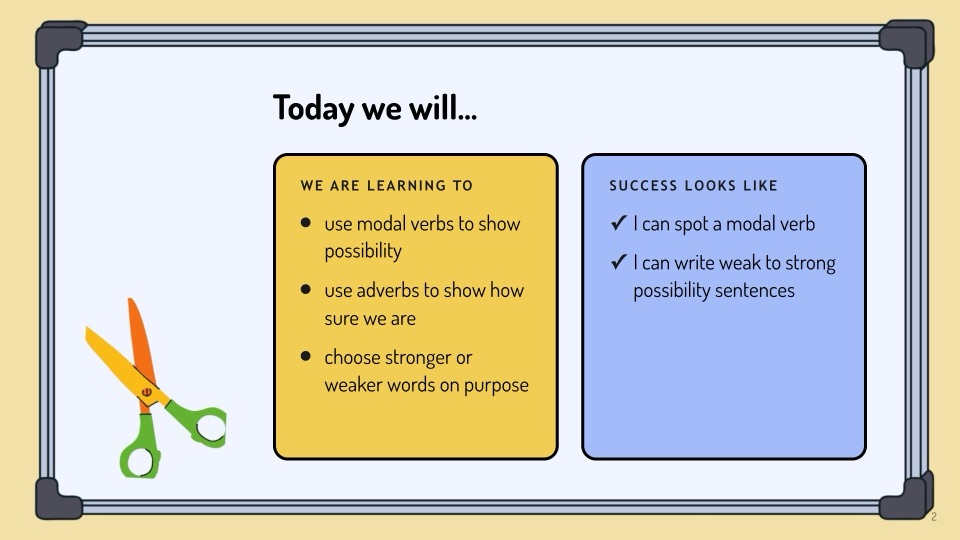
Pupils learn to show how sure they are with modal verbs and adverbs. They order words on a washing line and write ranked predictions.
Objectives
- Students will use modal verbs to show degrees of possibility.
- Students will use adverbs to show how sure they are.
- Students will choose stronger or weaker words on purpose.
Success criteria
- I can spot a modal verb in a sentence.
- I can write certain, possible and impossible sentences.
- I can choose a stronger or weaker word to match certainty.
Key words
| Word | Meaning |
|---|---|
| modal verb | a little helper that goes with an action to show how likely or needed it is |
| adverb | a describing word that says more about how surely something happens |
| possibility | how likely it is that something will happen |
| certain | very sure, with almost no doubt |
| impossible | something that cannot happen or be true |
| base form | the simplest form of an action, with no extra ending added |
Timed plan (60 minutes)
| Time | Stage | What happens |
|---|---|---|
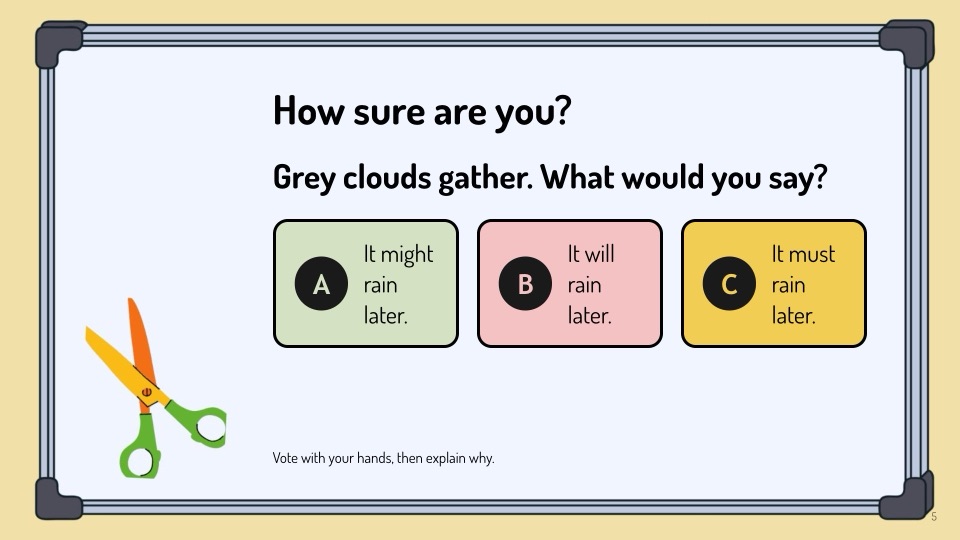
| 8 min | Starter | To hook pupils and check that will is stronger than might. Welcome class, show Slides 1-2 and read the three aims in pupil words. Use the hook: If I say it will rain and if I say it might rain, which one means you should grab a coat? Show Slide 5 vote: Grey clouds gather. Read aloud It might rain later, It will rain later, It must rain later. Take a vote by hands up and ask two pupils to justify which is most sure. |
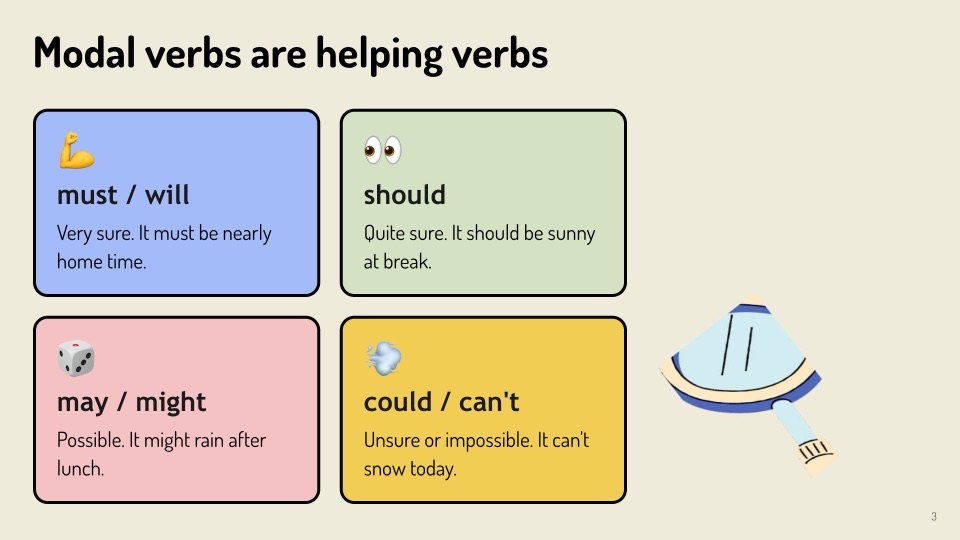
| 10 min | Teaching | To teach the modal possibility scale from shaky to sure. Show Slide 3 cards and read the three strengths: must/will very sure, should quite sure, may/might possible. Show Slide 4 and teach there are 10 main modal verbs will, would, can, could, may, might, shall, should, must and ought. Peg will at certain end and might in middle, then place must, should, could and may with class help. Model three versions about rain tomorrow and point to the modal to justify strength. |
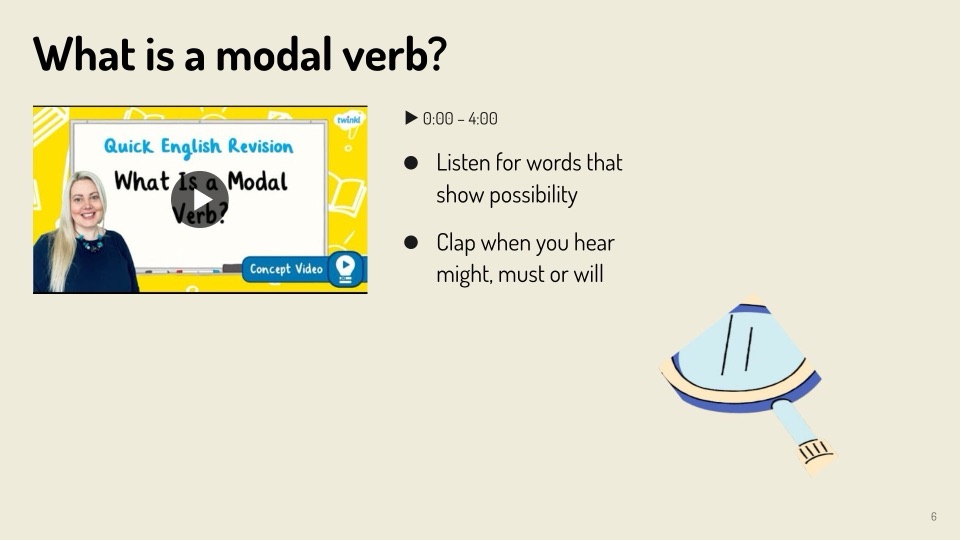
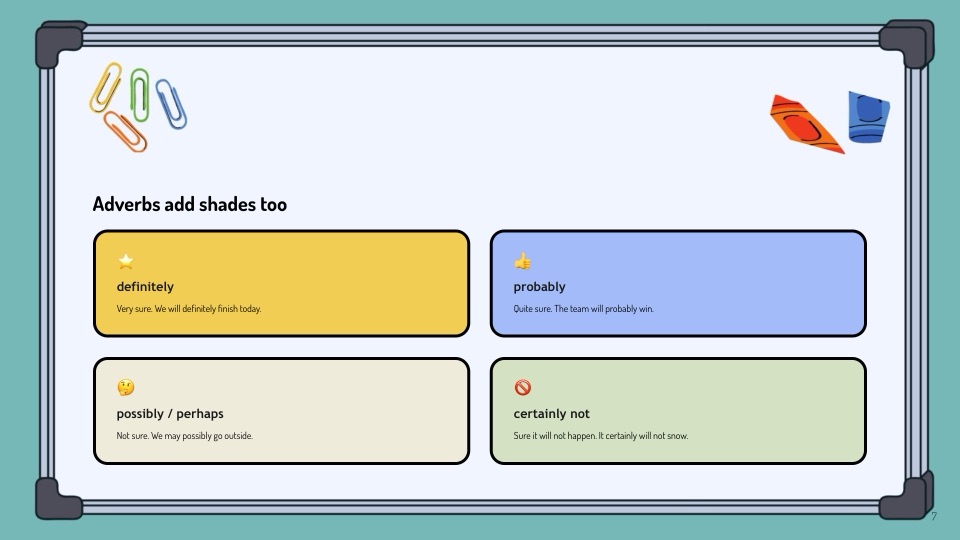
| 12 min | Teaching | To teach correct modal grammar and how adverbs fine-tune certainty. Play Video clip 1 (0:00-4:00) on Slide 6; pupils clap when they hear might, must or will. Pause twice to ask what the modal adds to the main verb, teaching modal verbs do not show actions on their own, they always need to work with a main verb. Show Slide 7 cards: definitely very sure, probably quite sure, possibly/perhaps not sure. Model correct form: modal directly before the main verb in its base form, with no to, -s, -ed or -ing ending. |
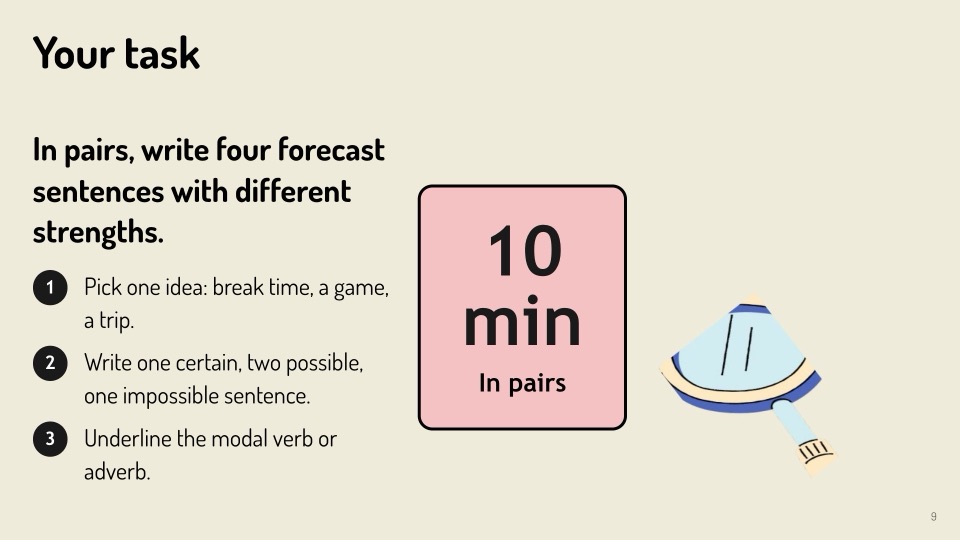
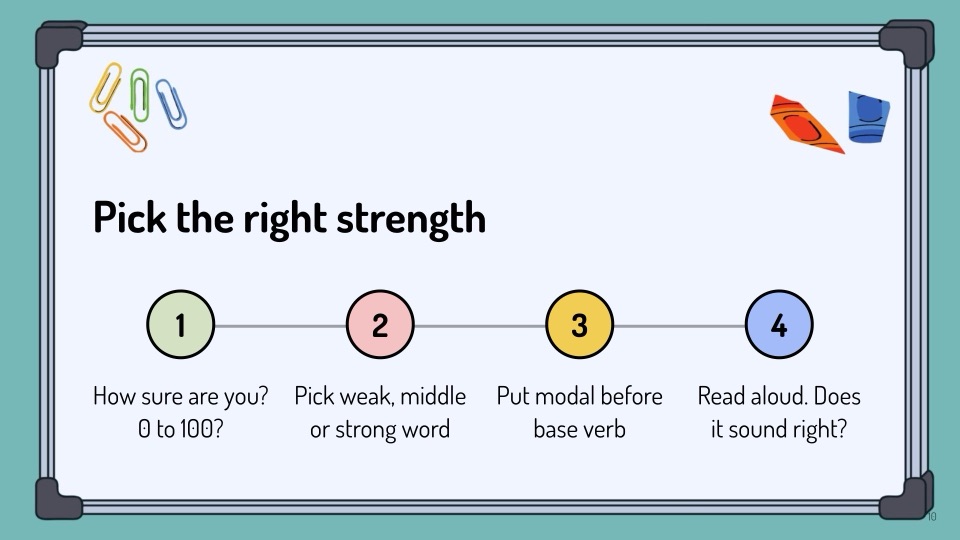
| 20 min | Main activity | To order modals and adverbs and write ranked sentences. Set the Possibility Washing Line task and show Slides 9-10 steps: How sure 0 to 100, pick weak, middle or strong word, put modal before base verb. Give groups cards to peg from shaky to sure, then match definitely, probably, possibly and perhaps to the same line. Hand out Worksheet Task F; pairs cut or number the sentences from weakest possibility to strongest certainty to check the line. Circulate, prompt full sentences with because where needed, and select three groups to read their certain, possible, impossible set. |
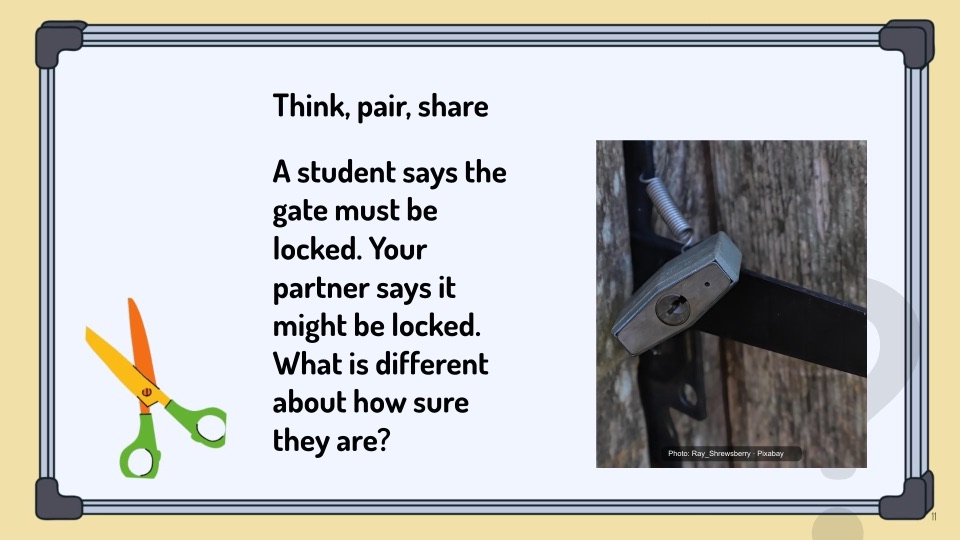
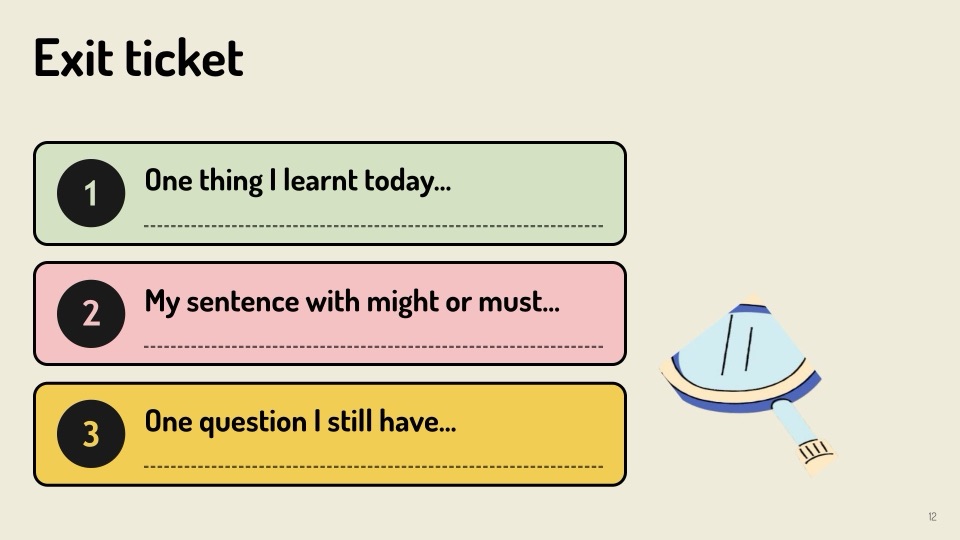
| 10 min | Plenary | To compare must and might and check exit success. Show Slide 11 question: A student says the gate must be locked. Your partner says it might be locked. What is different? Take paired talk for one minute, then collect answers about strength and evidence needed. Show Slide 12 exit ticket and give two minutes to write one sentence with might or must. Summarise scale and preview next writing where precise modals make ideas clear. |
Common mistakes
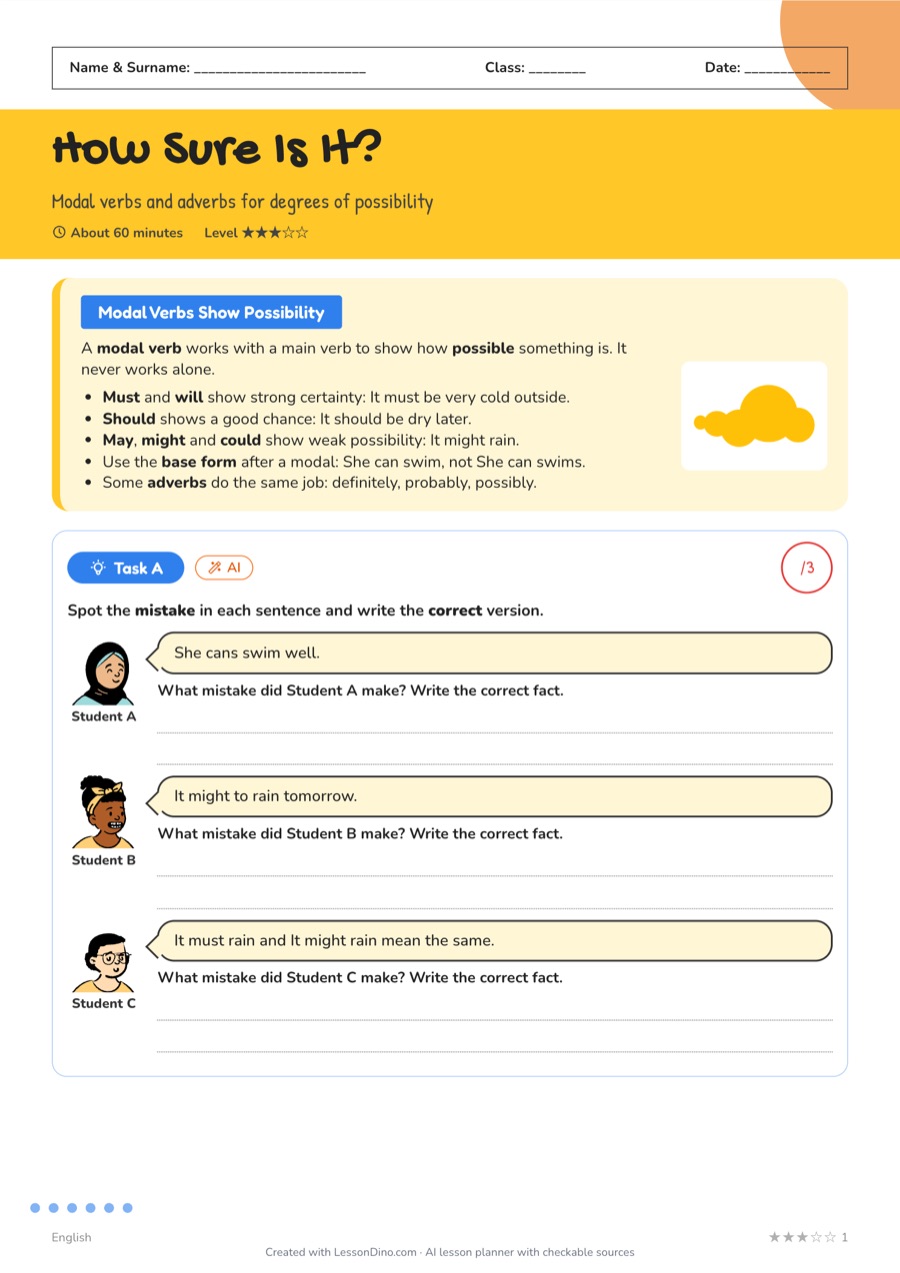
- Adding to, -s, -ed or -ing after a modal, for example She must to finish or He cans swim
How to spot it: Look right after the modal; the next word should be a plain action with no ending
Put the base form straight after with no to: She must finish, He can swim, because a modal verb is always followed directly by the base form and core modals do not normally take -s - Stacking two modals, for example She might could go
How to spot it: Hear or see two helpers before one action
Keep only the one that matches meaning, for example She might go, because use only one modal verb per verb phrase in standard English - Treating should and must as equal, or might as certain
How to spot it: Advice and strong rule sorted together, or might placed at certain end
Teach must is a lot more forceful than should, which sounds more like advice; will shows certain or extremely likely while may and might express less certainty
Support
- Use partly finished washing line with will at certain end and might in middle so pupils only place must, should, could and may.
- Provide word bank with must, can't, could, might plus base verbs to copy and sentence frames It must be... because...
Stretch
- Add certainly, probably, maybe and definitely to sentences and explain how the adverb changes degree even when modal stays same.
- Rewrite soft rules as strong rules and strong as soft, and argue whether a safety rule should use should or must.
Check questions
- Circle the modal verb: It might rain after break.
Answer: might - Which is stronger: It should be sunny or It must be nearly home time?
Answer: It must be nearly home time, must is very sure. - Fix it: She cans swim well.
Answer: She can swim well, no -s after can.
Curriculum
using modal verbs or adverbs to indicate degrees of possibility
Video clips
Clips on YouTube, from the start and end times we chose. Check each one before you show it.
-
What is a Modal Verb? from 0:00 to 4:00
Twinkl Educational Publishing: What is a Modal Verb? | KS2 English Concept for Kids
Made for KS2 so vocabulary and pace are perfect for 9-10 and it directly introduces modal verbs.
-
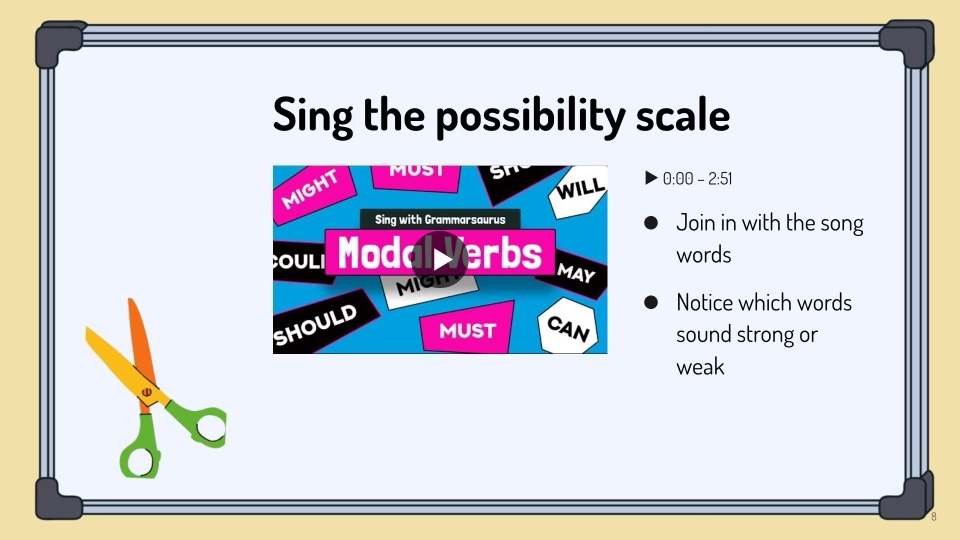
Sing with Grammarsaurus - Modal Verbs from 0:00 to 2:51
Grammarsaurus: Sing with Grammarsaurus - Modal Verbs
UK primary song made for ages 9-10 that makes modal verbs for possibility memorable.
Worksheet
Sources
- Year 5 Curriculum plan 2023 24 1 queenshill.norfolk.sch.uk
- glossary gov.uk
- What are modal verbs? - KS2 English - BBC Bitesize bbc.co.uk
- Modal verbs - BBC Bitesize bbc.co.uk
- Modal verbs | TeachingEnglish | British Council teachingenglish.org.uk
- What Is a Modal Verb? | Definition & Examples - Scribbr scribbr.co.uk
- Modal Verbs in English, Complete Guide | ELS elitelanguage.co.uk
- Modal Verbs - English XP englishxp.co.uk
- Modal verbs for students of KS3 English - BBC Bitesize bbc.co.uk
- Verb Facts for Kids kids.kiddle.co
- Regular and irregular verbs en.wikipedia.org
- Modal Verbs for Kids: Rules, Uses, and Examples - Engrary engrary.com
- Modal Verbs In English - Types, Usage and Examples firstcry.com
- Modal Verb Examples: What is a Modal Verb? - ESL Kids World eslkidsworld.com
- Modal Verbs for Kids - Simple Guide with Examples - ilmish ilmish.com
- Modal Verbs for Kids: Can, Could, Should, Must & More | Tiny ... tinystepslearning.com
- MODAL VERBS colegiosanbuenaventura.es
- Modal Verbs: Definition, Examples & Exam Questions | English revisionlibrary.co.uk
- modal verbs northcave-school.co.uk
Picture credits
Made with Lesson Dino's AI on 17 October 2026. AI can make mistakes, so check facts against the sources before you teach.