Slides
Lesson plan
Finding the Theme: Clues, Growth, and Summary
Students learn to find theme and trace how it grows. They track clues and write a short objective summary.
Objectives
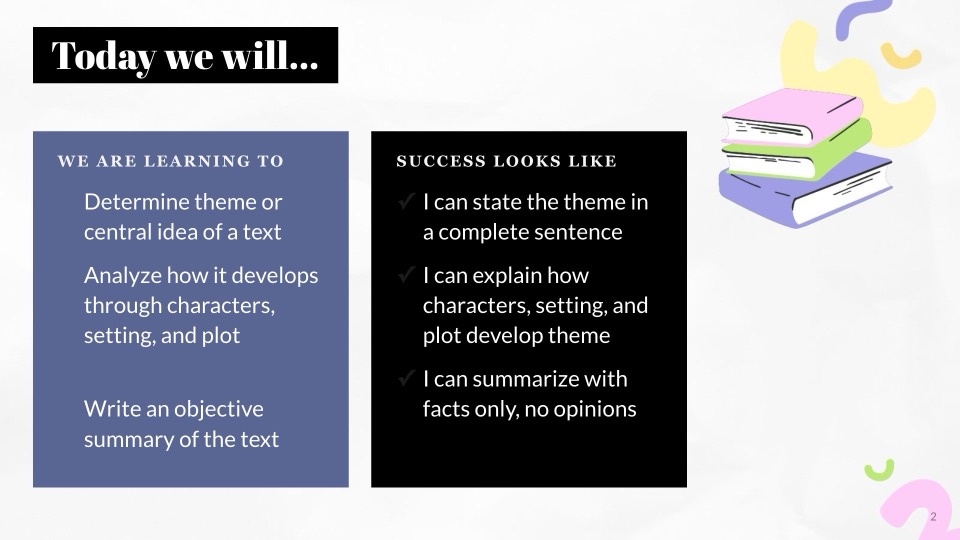
- Students will determine a theme and trace its growth from start to end.
- Students will explain how character, setting, and plot develop theme with evidence.
- Students will write an objective summary of key events in order.
Success criteria
- I can state the theme in one full sentence about life.
- I can show how character, setting, and plot built the theme.
- I can write a short summary with facts only and no opinions.
Key words
| Word | Meaning |
|---|---|
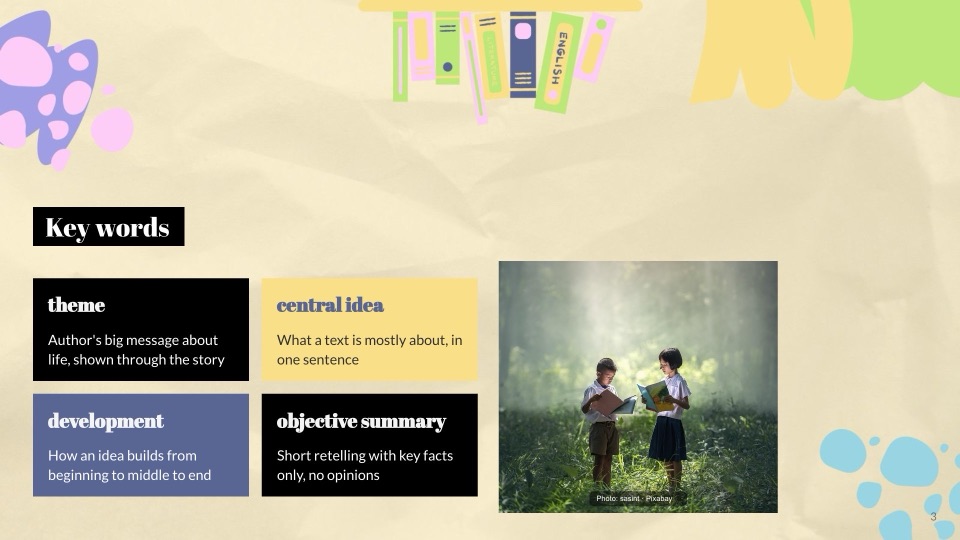
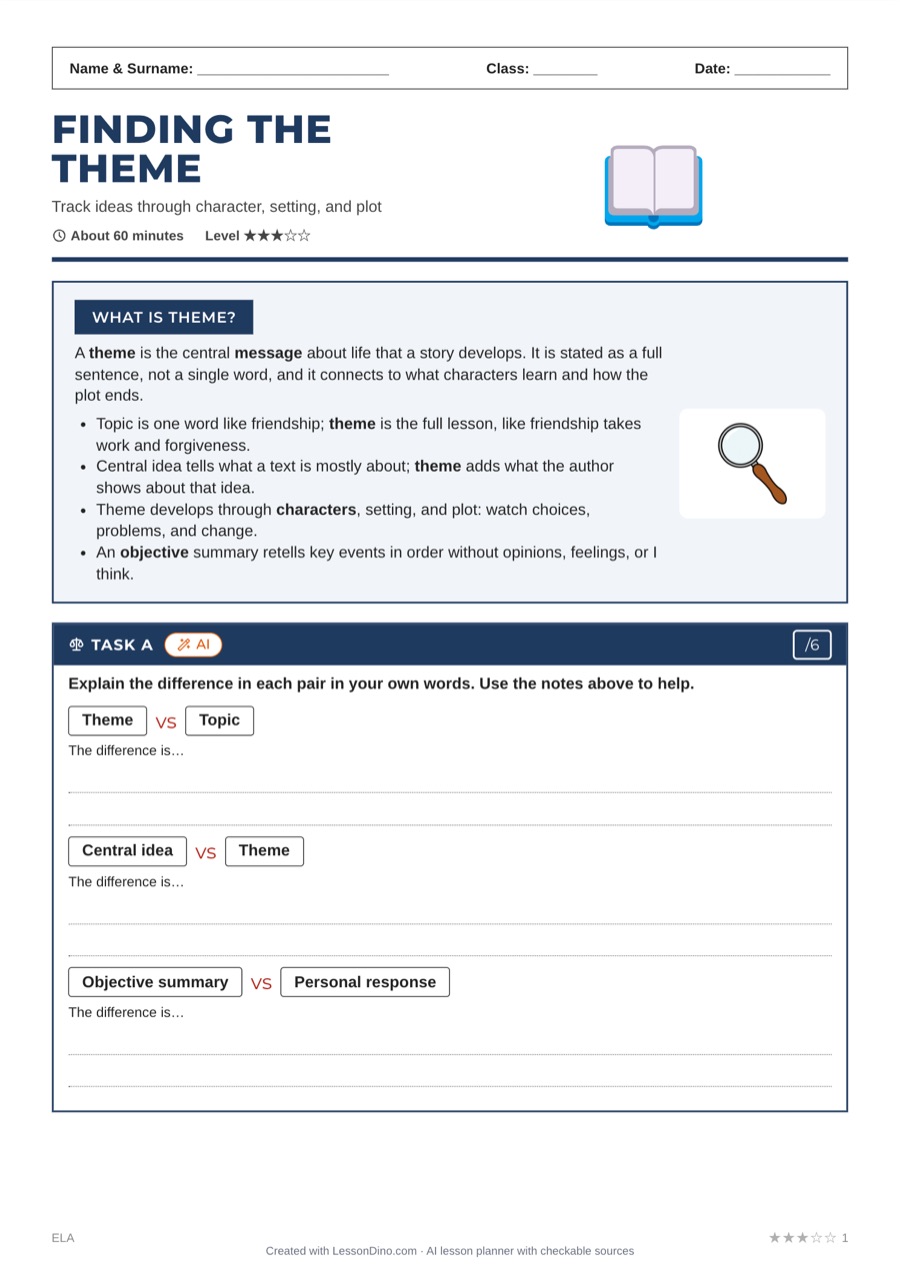
| theme | the author's big message about life shown by the story |
| central idea | what a text is mostly about, said in one sentence |
| development | how a message gets clearer step by step through a story |
| objective summary | a short retelling with only important facts in order and no opinions |
| setting | where and when a story happens, plus the mood of the place |
Timed plan (60 minutes)
| Time | Stage | What happens |
|---|---|---|
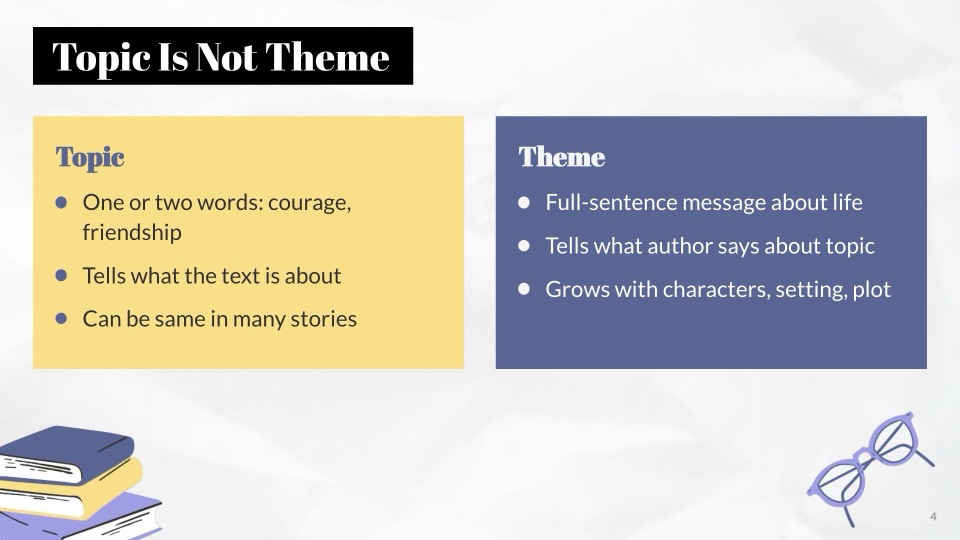
| 8 min | Starter | Activate topic versus theme and set the goal of hunting theme clues. Show Slide 1 title and Slide 2 objectives and read the I can statements aloud. Show Slide 3 key words and Slide 4 Topic Is Not Theme for sorting talk. Say the hook and model one topic to theme change with courage. Cold-call two students to turn friendship into a full theme sentence. |
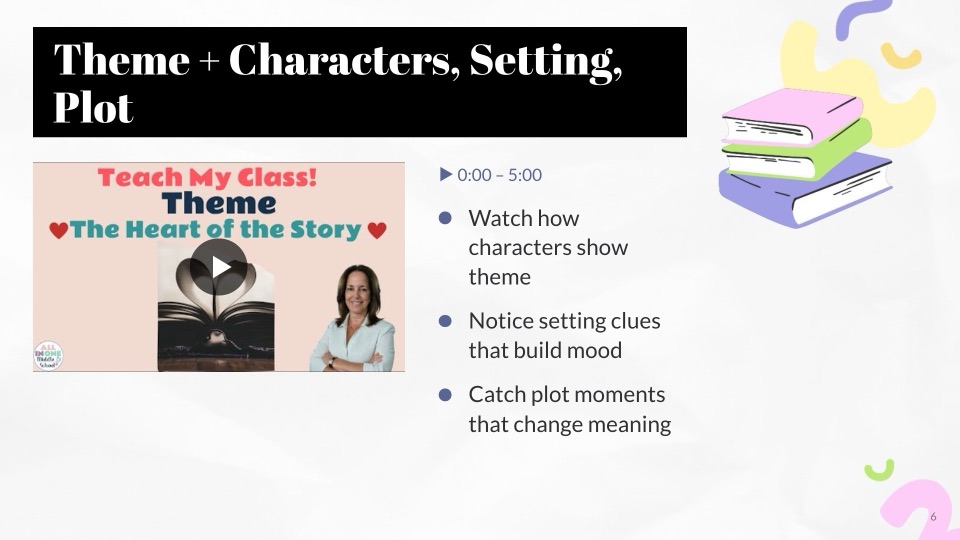
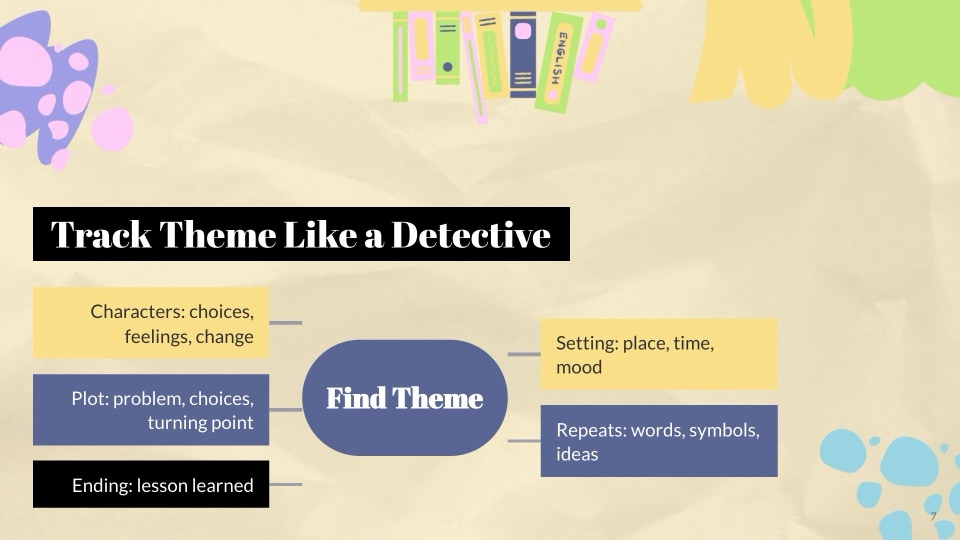
| 12 min | Teaching | Model how to spot theme clues in character, setting, and plot. Play Video clip 3 (0:00-5:00) on Slide 6 about how characters show theme. Show Slide 7 Track Theme Like a Detective mindmap and think aloud with paragraph 1. Model color coding: pink for character choice, yellow for setting detail, blue for plot turn. Model paragraph 2 clue and ask how the idea gets stronger or shifts. |
| 25 min | Main Activity | Track theme development across beginning, middle, and end in groups. Hand out The Empty Lot passage and three sticky-note colors with chart paper. Direct silent individual reading, because reading is generally an individual activity done silently. Direct groups to lay notes in order: beginning, middle, end for character, setting, plot. Circulate with prompts about what the main character wanted, chose, and what changed after. |
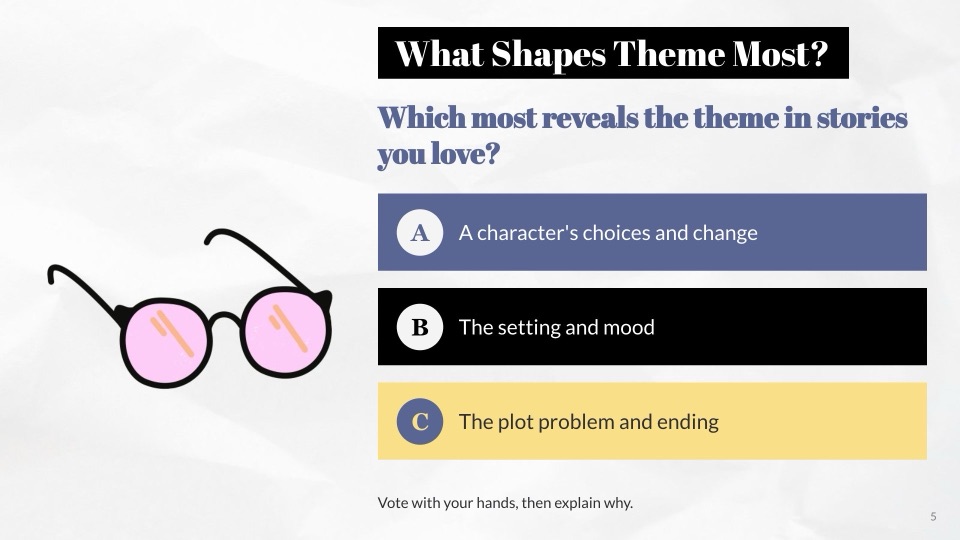
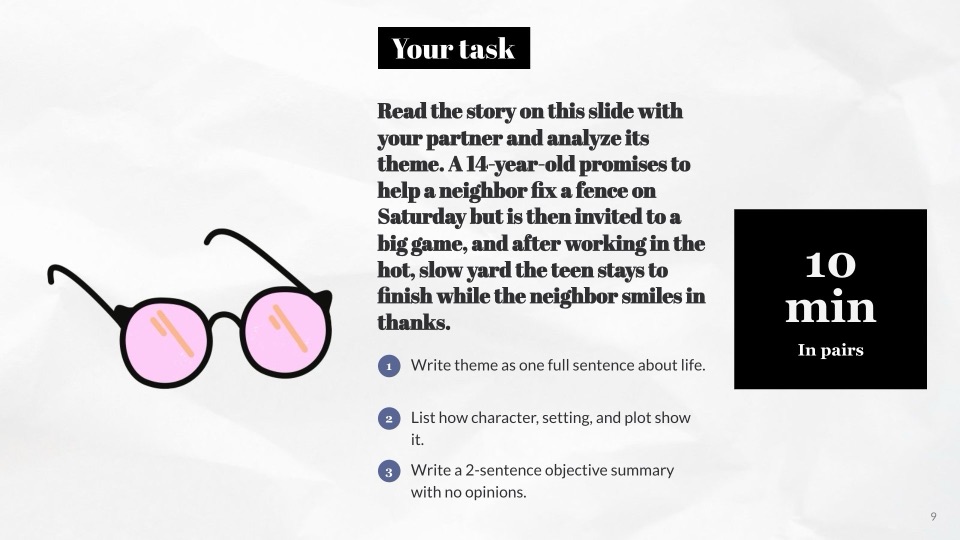
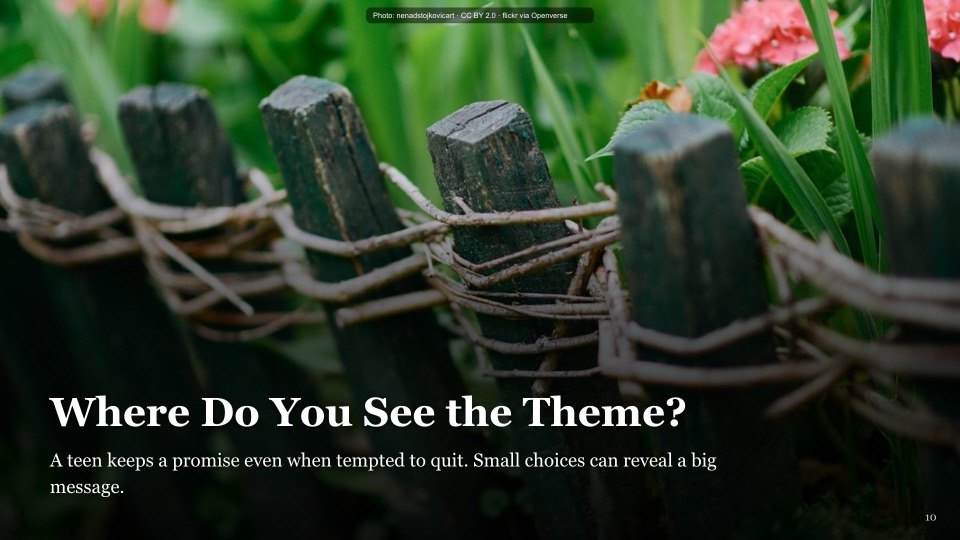
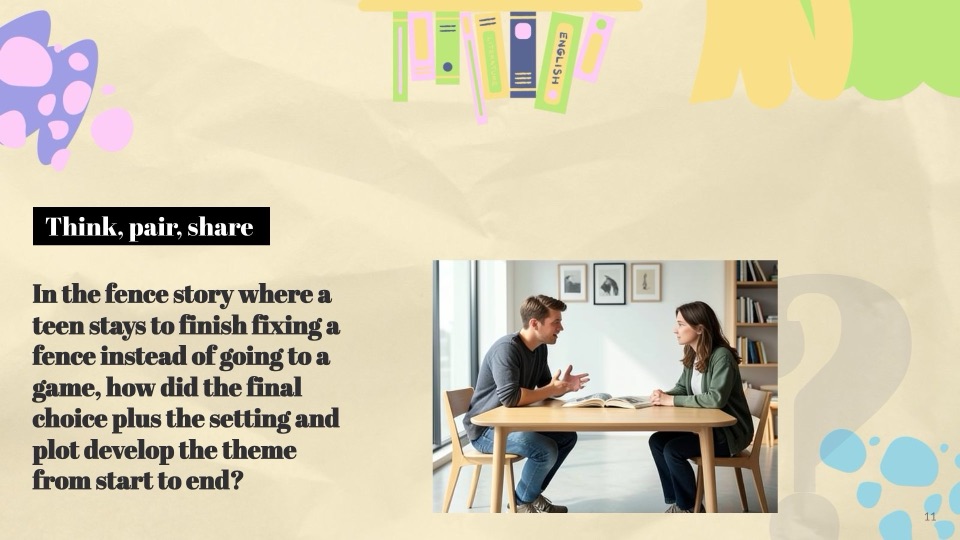
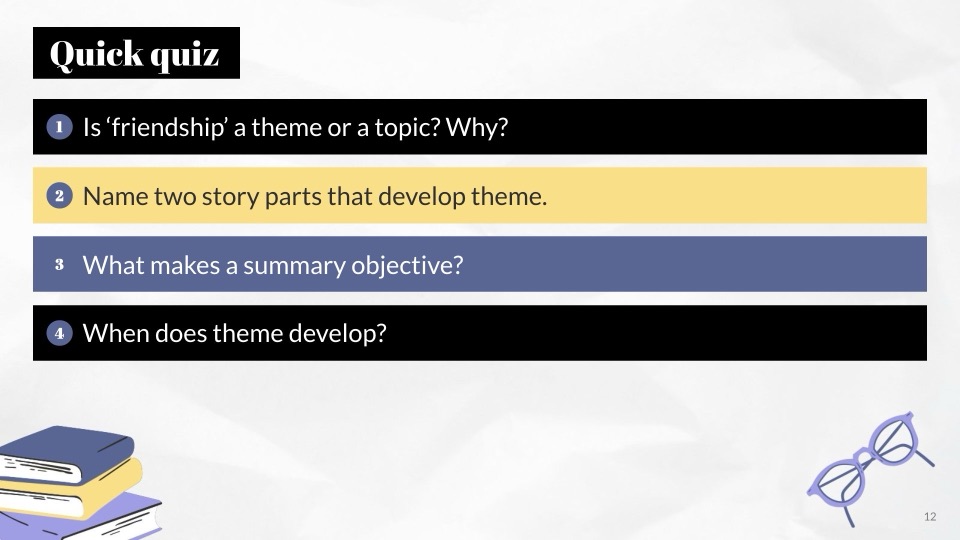
| 15 min | Plenary | Practice objective summary and confirm theme versus summary are separate. Show Slide 10 photo caption and model crossing out opinion words like best and boring. Guide pairs in frequent process-based writing to draft and quickly revise a two-sentence summary. Show Slide 12 quiz and check topic versus theme and story parts. Have two pairs read summaries and lead thumbs-up vote for objective, complete, short. |
Common mistakes
- Writing a one-word topic like courage as the theme
How to spot it: Theme line is one word or label with no message about life
Expand to full sentence using stem: ___ leads to ___ or ___ requires ___, then link to character, setting, plot. - Adding opinions like I think, best, boring to a summary
How to spot it: Summary has feeling words or judgments instead of only facts in order
Cross out opinion words and keep who, problem, key events, and ending only. - Finding theme only at the end and ignoring growth
How to spot it: Evidence comes from one paragraph with no beginning-middle-end change
Require one clue from beginning, middle, and end and ask how each makes the message clearer.
Support
- Use frame with blanks for character, setting, and plot plus word bank: bravery, fairness, growing up, pressure
- Let students discuss with a partner first and use action-reason-result chart before whole-class share
- Provide caption starters first, next, then, finally for ordering events
Stretch
- Track a second, smaller theme and explain where the two themes connect or conflict
- Argue how the story would point to a different theme if the main character had made the opposite choice
- Add a separate theme line after summary and cite one early and one late action to show growth
Check questions
- State a theme for The Empty Lot in one full sentence.
Answer: Belonging grows when people keep trying and care for a place together. - How did setting help develop that theme? Give one detail.
Answer: The trash-filled lot in August felt lonely, then the shared October garden showed belonging. - Write a one-sentence objective summary of the text with no opinions.
Answer: A 14-year-old planted a lot garden, lost sprouts in a storm, then replanted with neighbors and shared the harvest.
Curriculum
Determine a theme or central idea of a text and analyze its development over the course of the text, including its relationship to the characters, setting, and plot; provide an objective summary of the text.
Video clips
Clips on YouTube, from the start and end times we chose. Check each one before you show it.
-
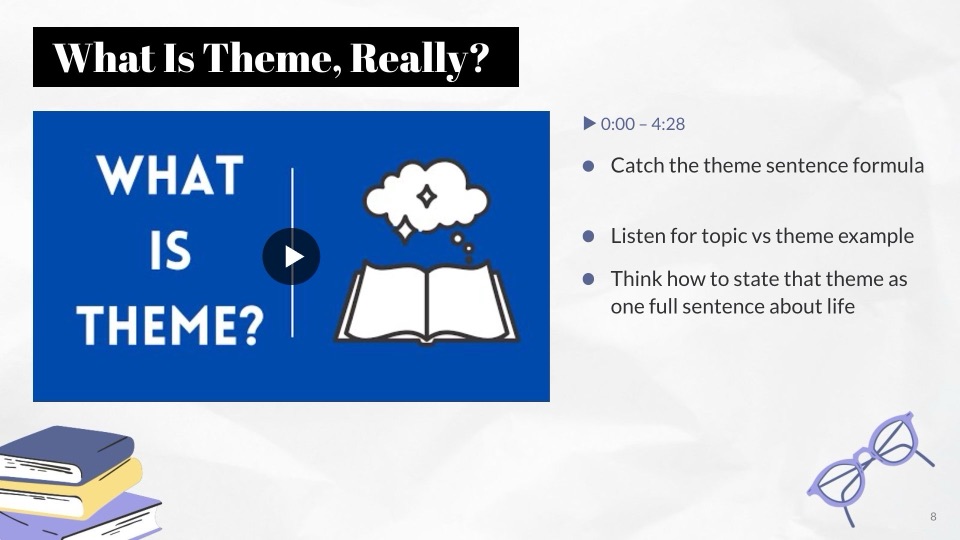
What is theme? from 0:00 to 4:28
5 Minute English Teacher: What Is Theme? | 5-Minute ELA Mini Lesson for Middle & High School Students
Made specifically for middle and high school students, so ideal for Grade 8 and directly about theme.
-
Theme in literature from 0:00 to 5:00
Teach My Class with All in One Middle School: How to Understand Theme in Literature | Teach My Class I ELA Lessons for Middle School
Made as a middle school ELA lesson for ages 13-14 and links theme to characters, setting, and plot.
Worksheet
Sources
- English Language Arts cps.edu
- Grade 8 ELA Curriculum and Pacing Guide - ortn.edu ortn.edu
- Reading - Wikipedia en.m.wikipedia.org
- Taco Theme | Reading With Expression Game | Reading Comprehension | Ci – AimeesEdventuresLLC shopedventures.com
- Reading, Berkshire - Wikipedia en.m.wikipedia.org
Picture credits
- Photo: sasint · Pixabay
- Photo: nenadstojkovicart · CC BY 2.0 · flickr via Openverse
- AI illustration · Cloudflare
- Microsoft Fluent Emoji (MIT)
- Pictograms: Sergio Palao, ARASAAC (arasaac.org) · CC BY-NC-SA
Made with Lesson Dino's AI on 17 October 2026. AI can make mistakes, so check facts against the sources before you teach.