Slides

Lesson plan
Three Rungs to X: Multi-Step Angle Equations
Students learn to link complementary, supplementary, vertical and adjacent facts in a chain. They climb a three-rung puzzle to write equations and solve for x.
Objectives
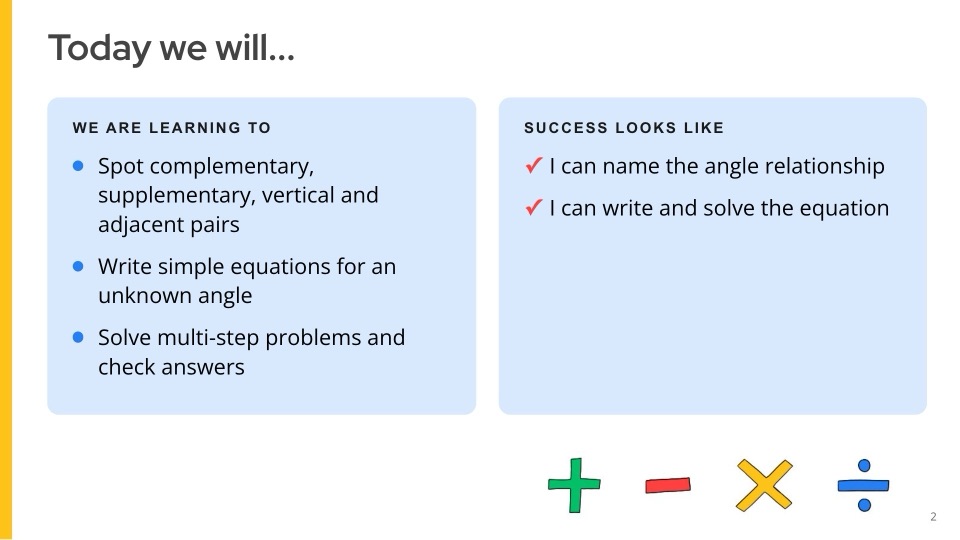
- Students will identify complementary, supplementary, vertical and adjacent angle pairs.
- Students will write simple equations for an unknown angle in a figure.
- Students will solve multi-step angle problems and check their answers.
Success criteria
- I can name the angle pair and pick 90, 180, or equal.
- I can write an equation for the unknown angle.
- I can solve the chain and check each step.
Key words
| Word | Meaning |
|---|---|
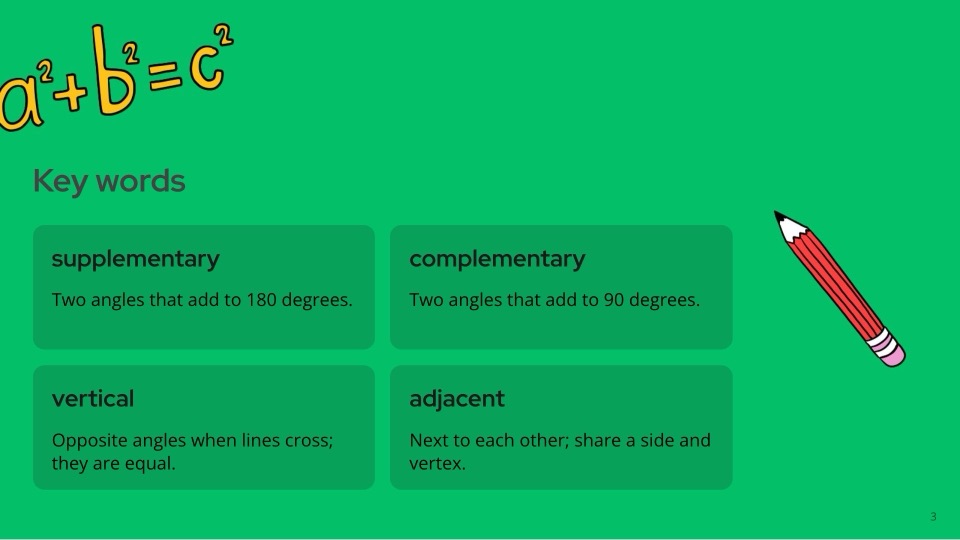
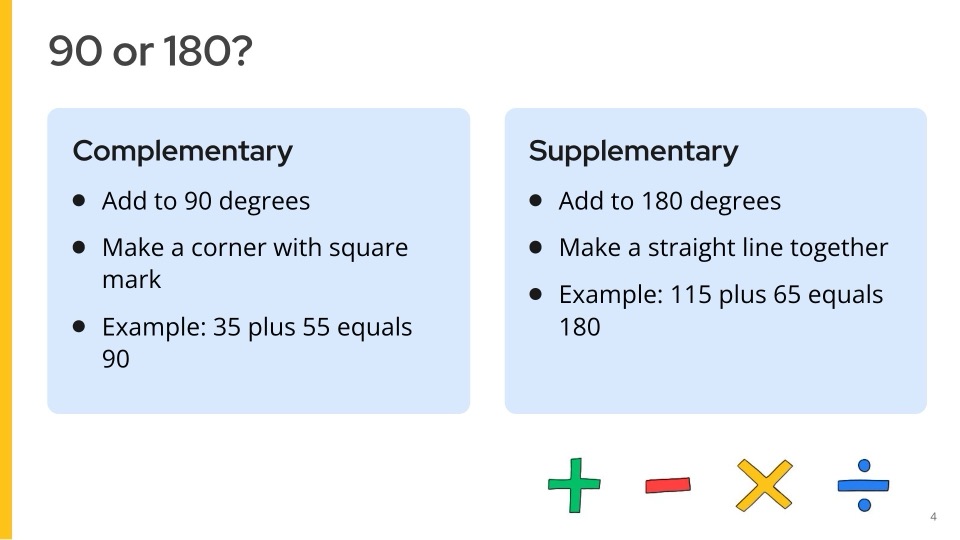
| supplementary | Two angles that together make a straight line, totaling 180 degrees. |
| complementary | Two angles that together make a square corner, totaling 90 degrees. |
| vertical | Angles opposite each other where two lines cross; they have the same size. |
| adjacent | Angles next to each other that share a side and a corner point. |
Timed plan (60 minutes)
| Time | Stage | What happens |
|---|---|---|
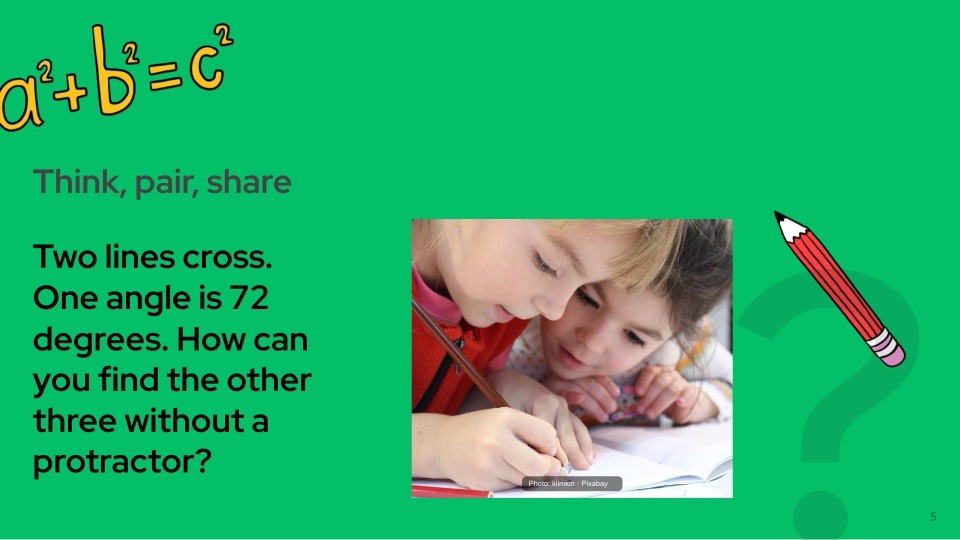
| 7 min | Starter | Hook students and recall 90-degree corners and 180-degree lines for equation work. Show Slide 1 title and Slide 2 objectives and read them in student words. Deliver the hook with energy and hold up a blank ladder sheet. Show Slide 5 question: Two lines cross. One angle is 72 degrees. Ask pairs to discuss how to find the other three without a protractor. |
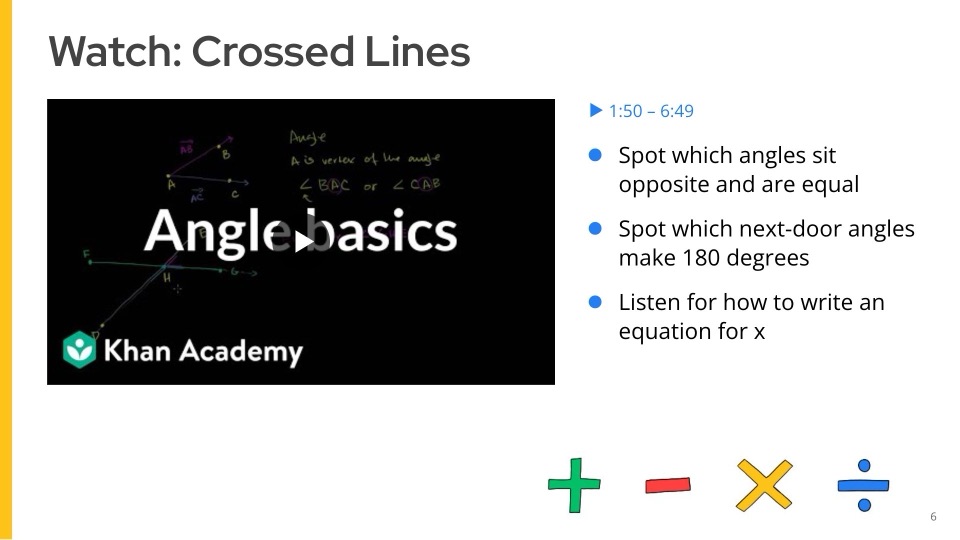
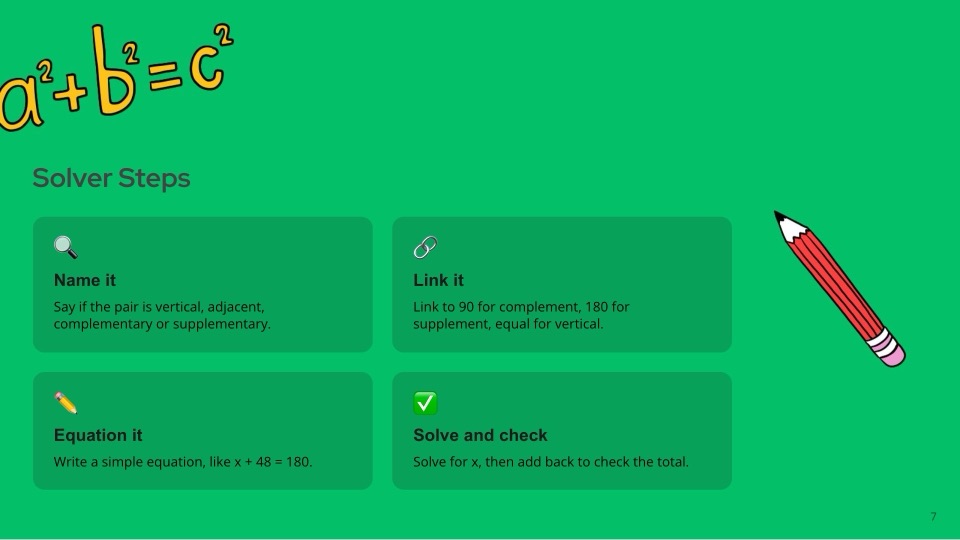
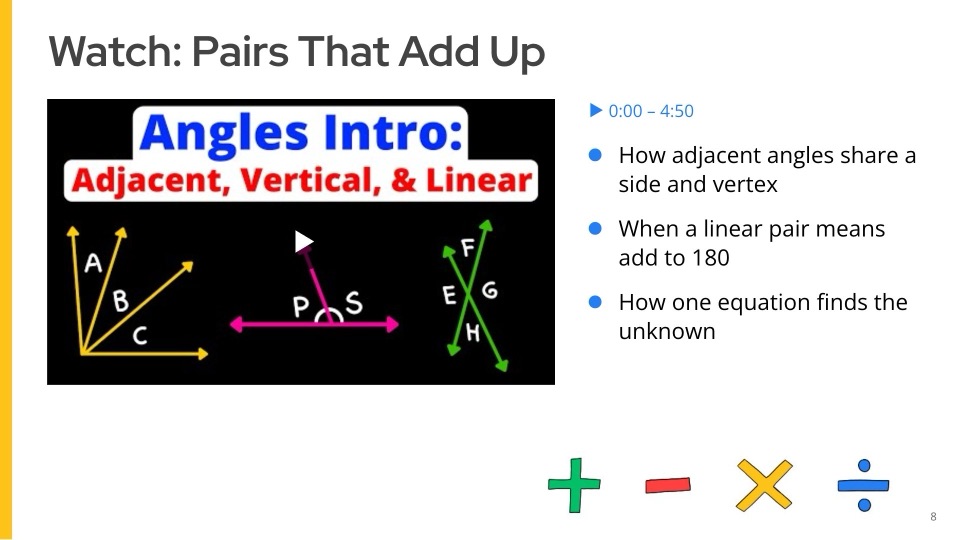
| 12 min | Teaching | Teach the four angle facts and how each fact becomes an equation. Show Slides 3-4 and have students repeat each pair and total. Play Video clip 1 on Slide 6 and pause to label opposite equal and next-door 180. Show Slide 7 Solver Steps and model Name it, Link it, Solve it. Model the scissors X with 38 degrees and solve for both unknowns on the board. |
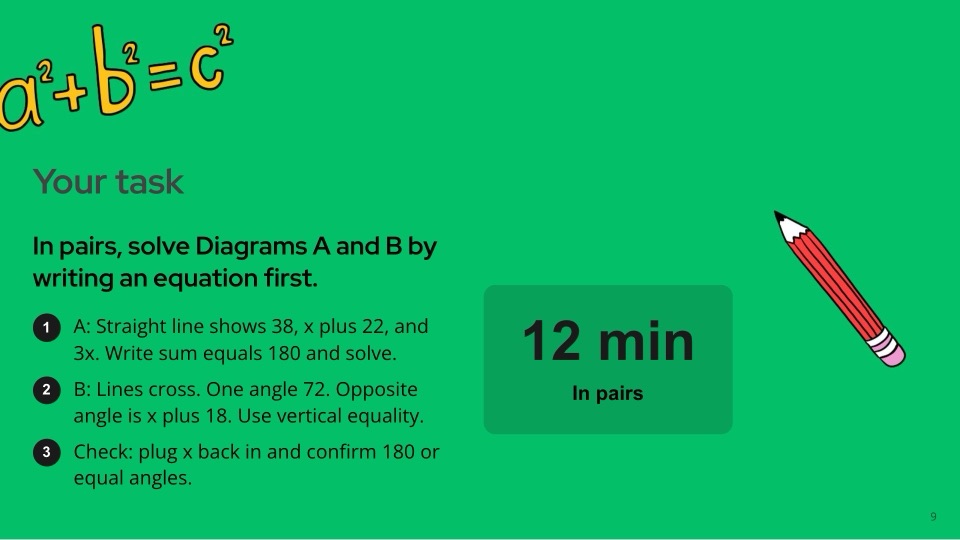
| 11 min | Guided Practice | Practice writing and solving one- and two-part equations together. Show Slide 9 first example: straight line shows 38, x plus 22, and 3x. Think aloud to combine terms and solve, then check by adding back to 180. Show Slide 9 second example: lines cross, one angle 72, opposite is x plus 18. Have class call out each step for the vertical equation. |
| 20 min | Main Activity | Solve a three-step chain that uses complement, vertical, and supplement in order. Hand out printed ladder sheets and pencils and show the three rungs. Direct Rung 1: right-angle corner with 27 degrees and a, write a + 27 = 90. Direct Rung 2: use a as a vertical match to get b, then Rung 3 b next to x on a line. Circulate, check equations, and push finishers to the stretch. |
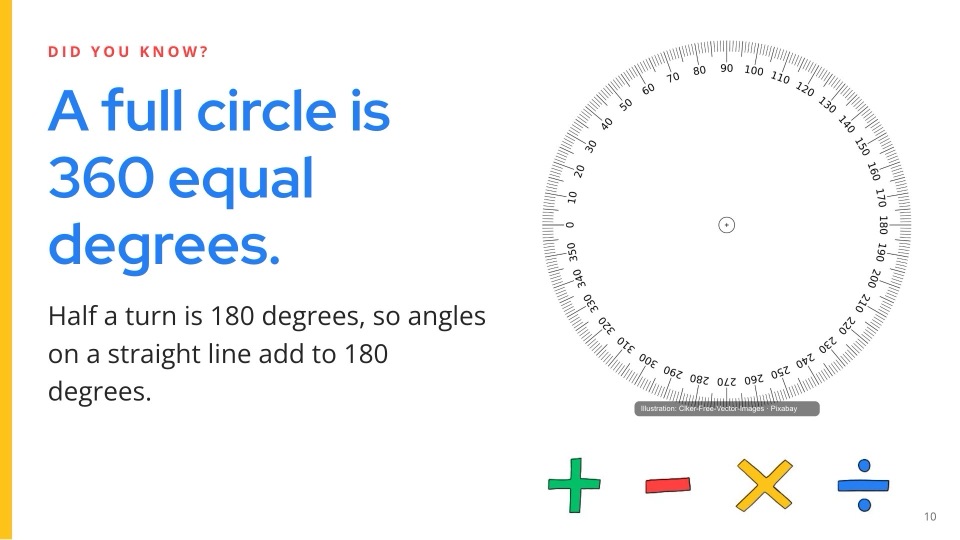
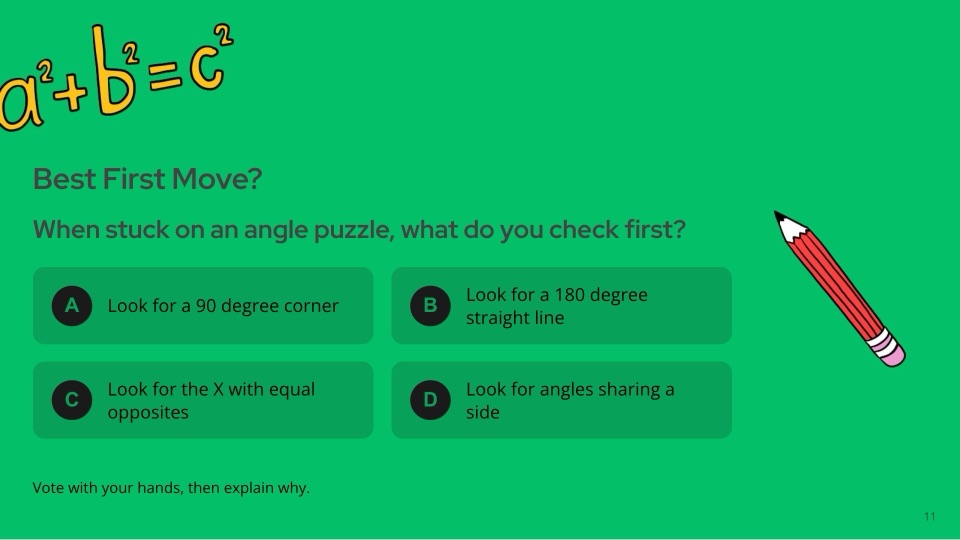
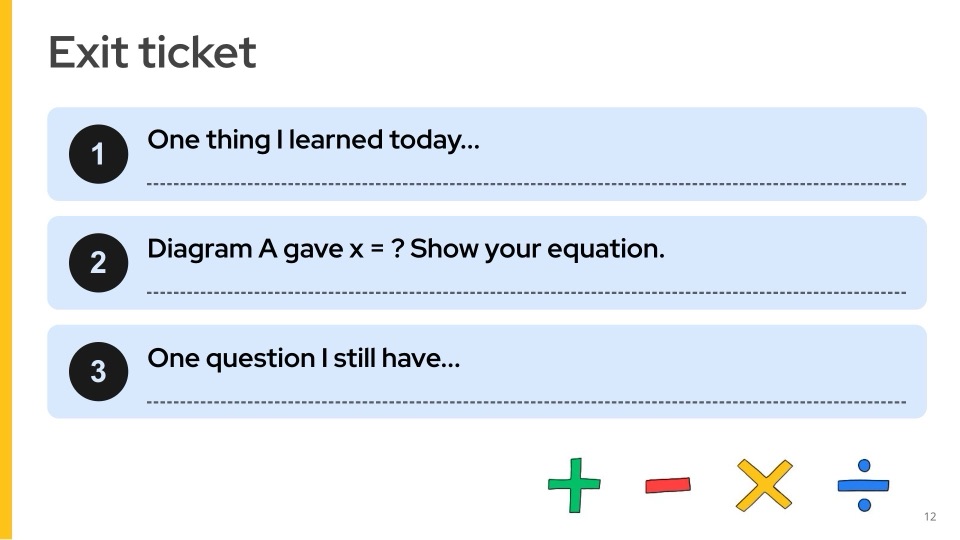
| 10 min | Plenary | Review best first moves and prove learning against success criteria. Show Slide 10 fact: full circle is 360, half turn is 180. Run Slide 11 vote: Best First Move when stuck on a puzzle. Show Slide 12 exit ticket and have students write equation and answer. Close by linking votes to success criteria. |
Common mistakes
- Using 90 instead of 180 for angles on a straight line, or the reverse.
How to spot it: Equation shows = 90 for a straight-line trio, or = 180 for a square corner.
Mark the square corner and straight line. Ask: Is this a corner family that adds to 90 degrees or a line family that adds to 180 degrees? - Treating adjacent angles as always equal like vertical angles.
How to spot it: Student sets next-door angles equal instead of adding them.
Show the X. Adjacent angles share a side and add to 180, while only opposite angles are equal. Rewrite as sum = 180.
Support
- Pre-fill the first ladder equation a + 27 = 90 and let students solve and carry forward.
- Provide equation starters and color key for 90-degree corner and 180-degree line.
Stretch
- Change Rung 3 to 2x + b on the line for a two-step finish.
- Require combining terms like x + 2x or solving 3x + 2x on a line.
Check questions
- A square corner has 38 degrees and x. Write the equation and find x.
Answer: x + 38 = 90, x = 52. - Two lines cross. One angle is 72 degrees, the opposite is x + 18. Find x.
Answer: x + 18 = 72, x = 54. - Angles 38, x + 22, and 3x sit on a straight line. Write the equation and find x.
Answer: 38 + x + 22 + 3x = 180, x = 30.
Curriculum
Use facts about supplementary, complementary, vertical, and adjacent angles in a multi-step problem to write and solve simple equations for an unknown angle in a figure.
Video clips
Clips on YouTube, from the start and end times we chose. Check each one before you show it.
-
Vertical and adjacent on intersecting lines from 1:50 to 6:49
Khan Academy: Angle basics | Angles and intersecting lines | Geometry | Khan Academy
Shows vertical, adjacent, and supplementary pairs with simple diagrams at the right pace and vocabulary for 12-13-year-olds learning to write equations for unknown angles.
-
Adjacent, vertical and linear pairs from 0:00 to 4:50
Eat Pi: Intro to Adjacent Angles, Vertical Angles, & Linear Pairs | Geometry | Eat Pi
Explains adjacent, vertical, and linear-pair ideas step-by-step in middle-school language that fits 12-13-year-olds ready for multi-step problems.
Worksheet
Sources
- Grade 7 | Common Core State Standards Initiative thecorestandards.org
- Grade 7 » Geometry | Common Core State Standards Initiative thecorestandards.org
- Measurement of Angles - Clark University mathcs.clarku.edu
- The Measurement of Angles - Emory University mathcenter.oxford.emory.edu
- Points, Lines, and Angles - Ximera ximera.osu.edu
- Angles and Lines - Andrews University andrews.edu
- Conceptualization of Angles - ed files.eric.ed.gov
- 4-01 Angle Measures - Andrews University andrews.edu
- What is an angle? - KS2 Maths - Year 5 - BBC Bitesize bbc.co.uk
- Angles - KS3 Maths - BBC Bitesize bbc.co.uk
- Angles GCSE | KS4 | Y10 Maths Foundation | Lesson Resources thenational.academy
- Angles | Geometry (all content) | Math | Khan Academy khanacademy.org
- Angle relationships | Basic geometry and measurement | Math ... en.khanacademy.org
- Angles: Foreword web.mit.edu
- Angle types review (article) | Angles | Khan Academy en.khanacademy.org
- Measuring angles | Basic geometry and measurement | Math ... khanacademy.org
- [2402.12799] Absence of small magic angles for disordered tunnel… arxiv.org
- Learn Angles - GeoGebra Math Resources geogebra.org
- Interactive Angles - Acute, Obtuse, Measure with Protractor subjectcoach.com
- Angles Worksheets mathworksheets4kids.com
- Angles - Acute, Obtuse, Straight and Right - Math is Fun mathsisfun.com
- dg.differential geometry - Cone angles for Riemannian metrics in… mathoverflow.net
- angles - npm Package Health Analysis | Snyk snyk.io
- Measuring Angles | Math Fun Worksheets mathfunworksheets.com
- BYJU'S Online learning Programs For K3, K10, K12, NEET, JEE ... byjus.com
Picture credits
Made with Lesson Dino's AI on 17 October 2026. AI can make mistakes, so check facts against the sources before you teach.