The worksheet
About this worksheet
Students learn that probability is a number from 0 to 1 that shows likelihood. They place events on a human number line as unlikely, even chance, or likely. This Grade 7 Math worksheet gives students (ages 12–13) five pages of practice on probability, part of the statistics and probability unit. It goes with our free Probability lesson, which has the slides and a timed lesson plan.
What it covers
By the end, students should be able to:
- Students will understand probability is a number between 0 and 1 that shows likelihood.
- Students will describe events as unlikely near 0, even chance around 1/2, or likely near 1.
- Students will compare probability numbers to decide which event is more likely.
How to use it
- Practice (10 minutes): Hand out Worksheet Task B and read the directions together.
- Support: Give students a small paper number line with 0, 1/2, and 1 already marked to hold while they decide where to stand.
- Stretch: Students must explain why a 0.52 and a 0.48 both count as around 1/2, neither unlikely nor likely.
- The answer sheet is the last page, so you can print it on its own or let students check their own work.
Key vocabulary
- probability: how likely a chance event is, from 0 to 1
- unlikely: near 0; probably will not happen
- even chance: around 1/2; neither unlikely nor likely
- likely: close to 1; has a strong chance of happening
Mistakes to watch for
- Thinking probability can be greater than 1 or less than 0. Point to the 0 to 1 line and restate probability is always between 0 and 1, where 0 indicates impossibility and 1 indicates certainty.
- Thinking 1/2 means heads must happen every other flip exactly. Remind that 1/2 is the long-run chance for a fair coin; short sets vary but stay near 1/2, neither unlikely nor likely.
- Mixing up which fraction is larger, for example 1/6 larger than 4/5. Convert to decimals: 1/6 is about 0.17 near 0 and 4/5 = 0.8 near 1; larger numbers mean more likely.
What's on the worksheet
Chance From 0 to 1
See how probability numbers show likelihood.
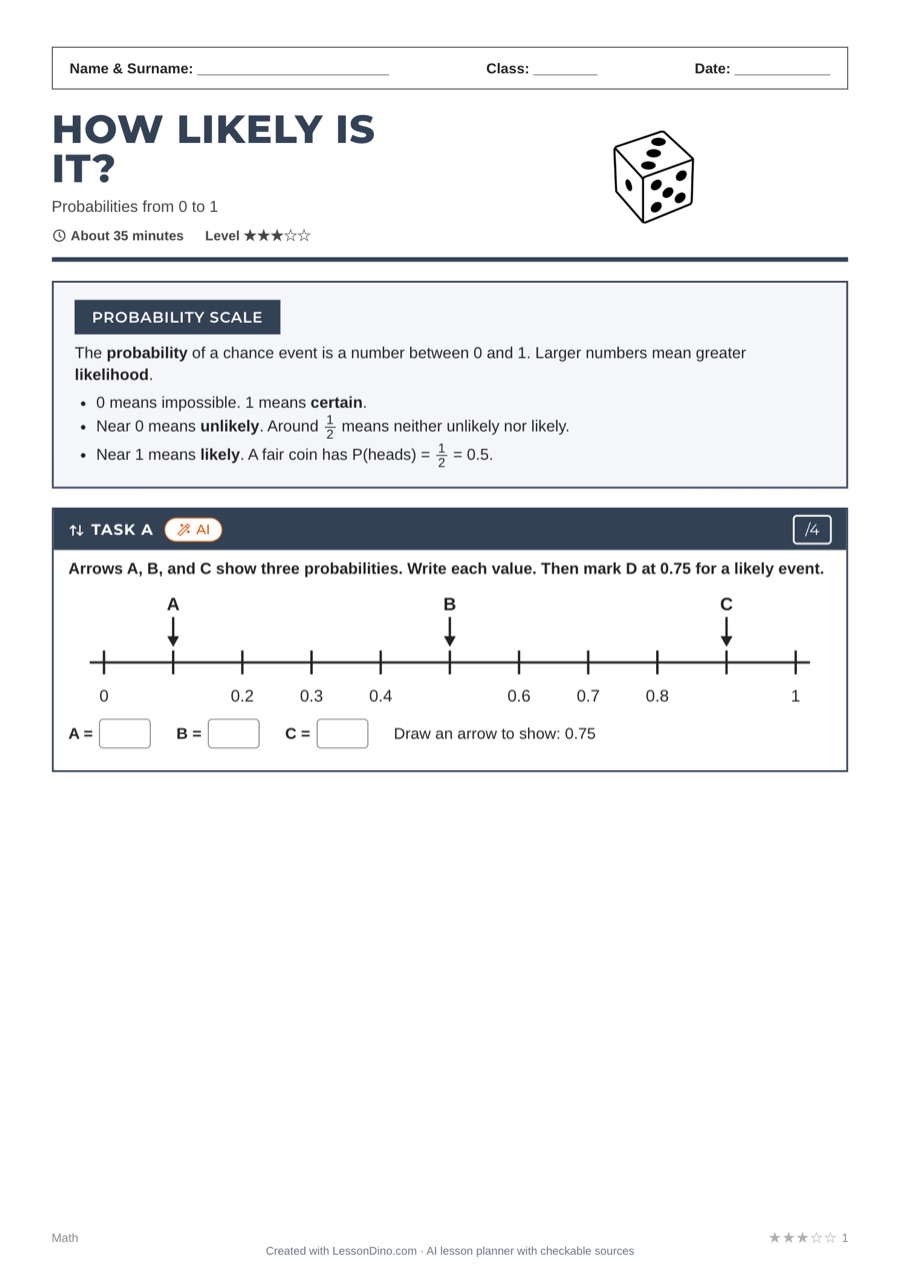
Probability Scale
- The probability of a chance event is a number between 0 and 1. Larger numbers mean greater likelihood.
- 0 means impossible. 1 means certain.
- Near 0 means unlikely. Around 1/2 means neither unlikely nor likely.
- Near 1 means likely. A fair coin has P(heads) = 1/2 = 0.5.
Arrows A, B, and C show three probabilities. Write each value. Then mark D at 0.75 for a likely event.
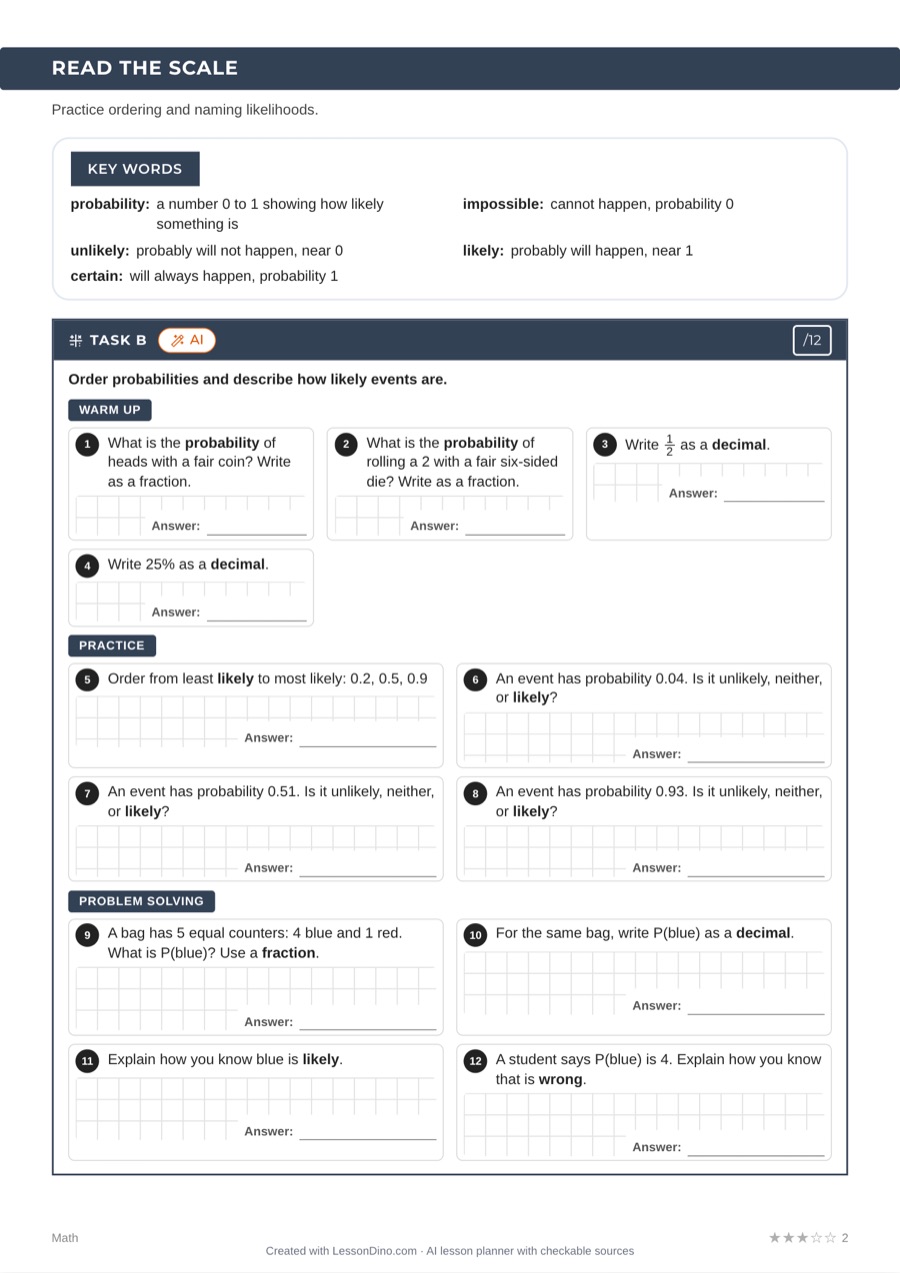
Read the Scale
Practice ordering and naming likelihoods.
| Word | Meaning |
|---|---|
| probability | a number 0 to 1 showing how likely something is |
| impossible | cannot happen, probability 0 |
| unlikely | probably will not happen, near 0 |
| likely | probably will happen, near 1 |
| certain | will always happen, probability 1 |
Order probabilities and describe how likely events are.
Warm up
- What is the probability of heads with a fair coin? Write as a fraction.
- What is the probability of rolling a 2 with a fair six-sided die? Write as a fraction.
- Write 1/2 as a decimal.
- Write 25% as a decimal.
Practice
- Order from least likely to most likely: 0.2, 0.5, 0.9
- An event has probability 0.04. Is it unlikely, neither, or likely?
- An event has probability 0.51. Is it unlikely, neither, or likely?
- An event has probability 0.93. Is it unlikely, neither, or likely?
Problem solving
- A bag has 5 equal counters: 4 blue and 1 red. What is P(blue)? Use a fraction.
- For the same bag, write P(blue) as a decimal.
- Explain how you know blue is likely.
- A student says P(blue) is 4. Explain how you know that is wrong.
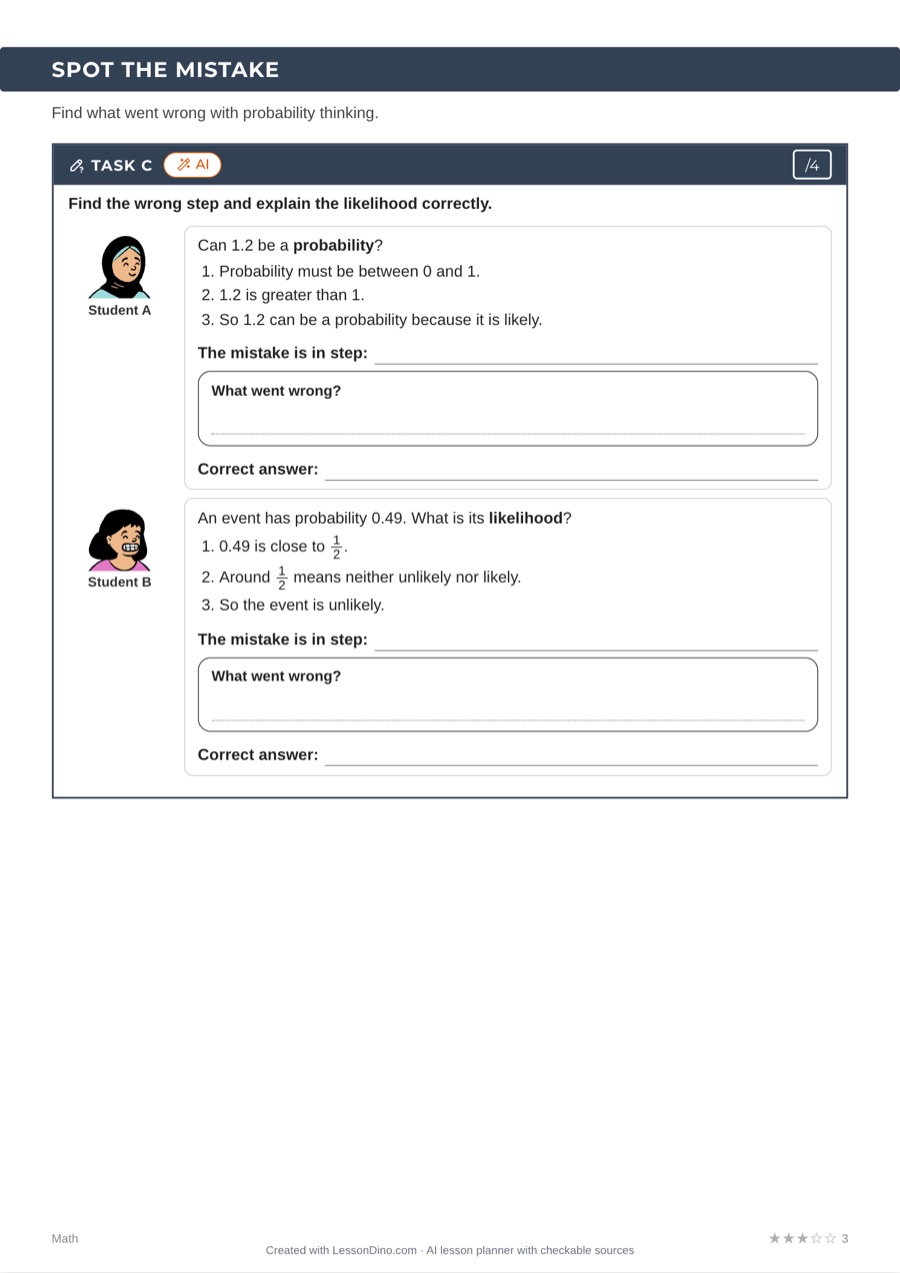
Spot the Mistake
Find what went wrong with probability thinking.
Find the wrong step and explain the likelihood correctly.
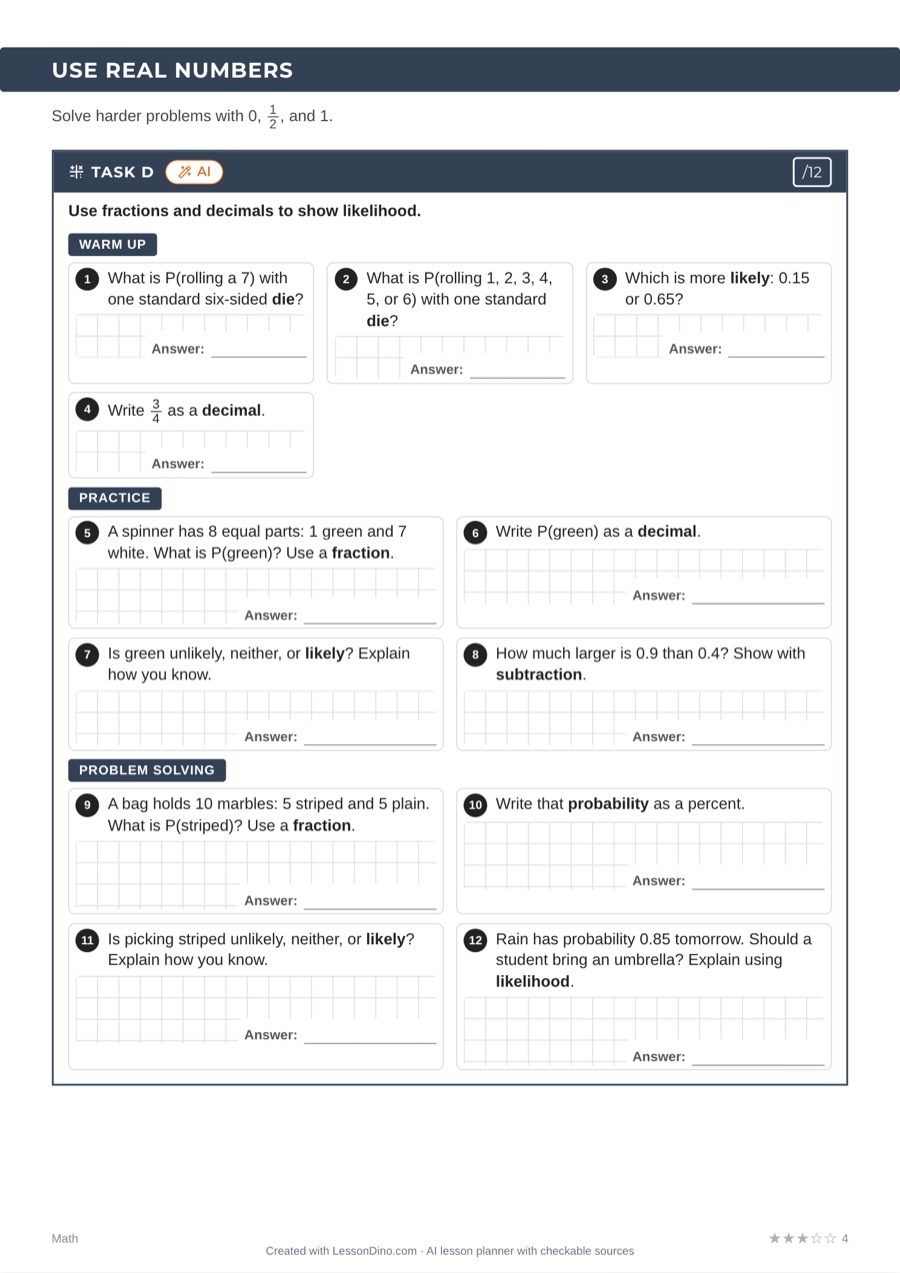
Use Real Numbers
Solve harder problems with 0, 1/2, and 1.
Use fractions and decimals to show likelihood.
Warm up
- What is P(rolling a 7) with one standard six-sided die?
- What is P(rolling 1, 2, 3, 4, 5, or 6) with one standard die?
- Which is more likely: 0.15 or 0.65?
- Write 3/4 as a decimal.
Practice
- A spinner has 8 equal parts: 1 green and 7 white. What is P(green)? Use a fraction.
- Write P(green) as a decimal.
- Is green unlikely, neither, or likely? Explain how you know.
- How much larger is 0.9 than 0.4? Show with subtraction.
Problem solving
- A bag holds 10 marbles: 5 striped and 5 plain. What is P(striped)? Use a fraction.
- Write that probability as a percent.
- Is picking striped unlikely, neither, or likely? Explain how you know.
- Rain has probability 0.85 tomorrow. Should a student bring an umbrella? Explain using likelihood.
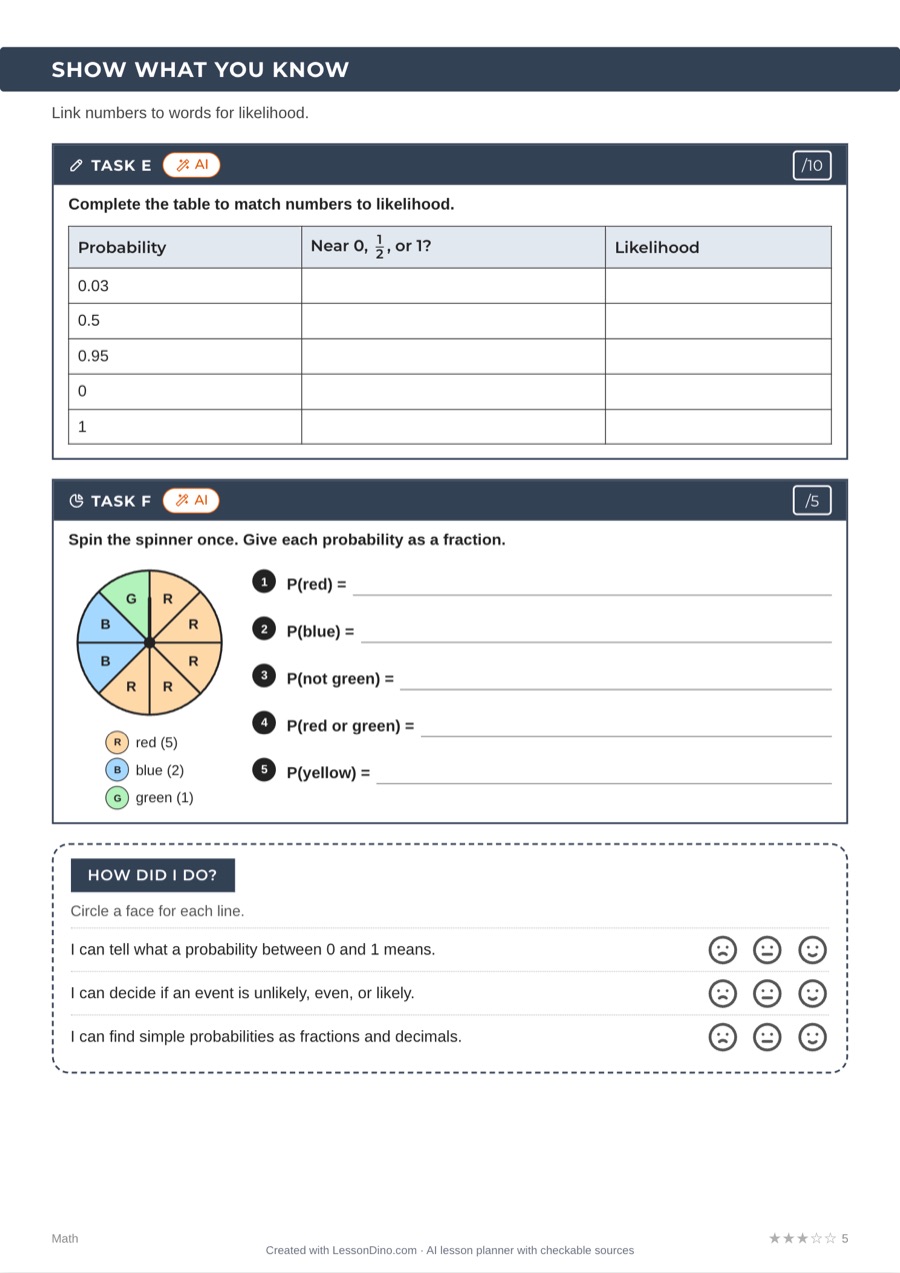
Show What You Know
Link numbers to words for likelihood.
Complete the table to match numbers to likelihood.
Spin the spinner once. Give each probability as a fraction.
- red
- blue
- not green
- red or green
- yellow
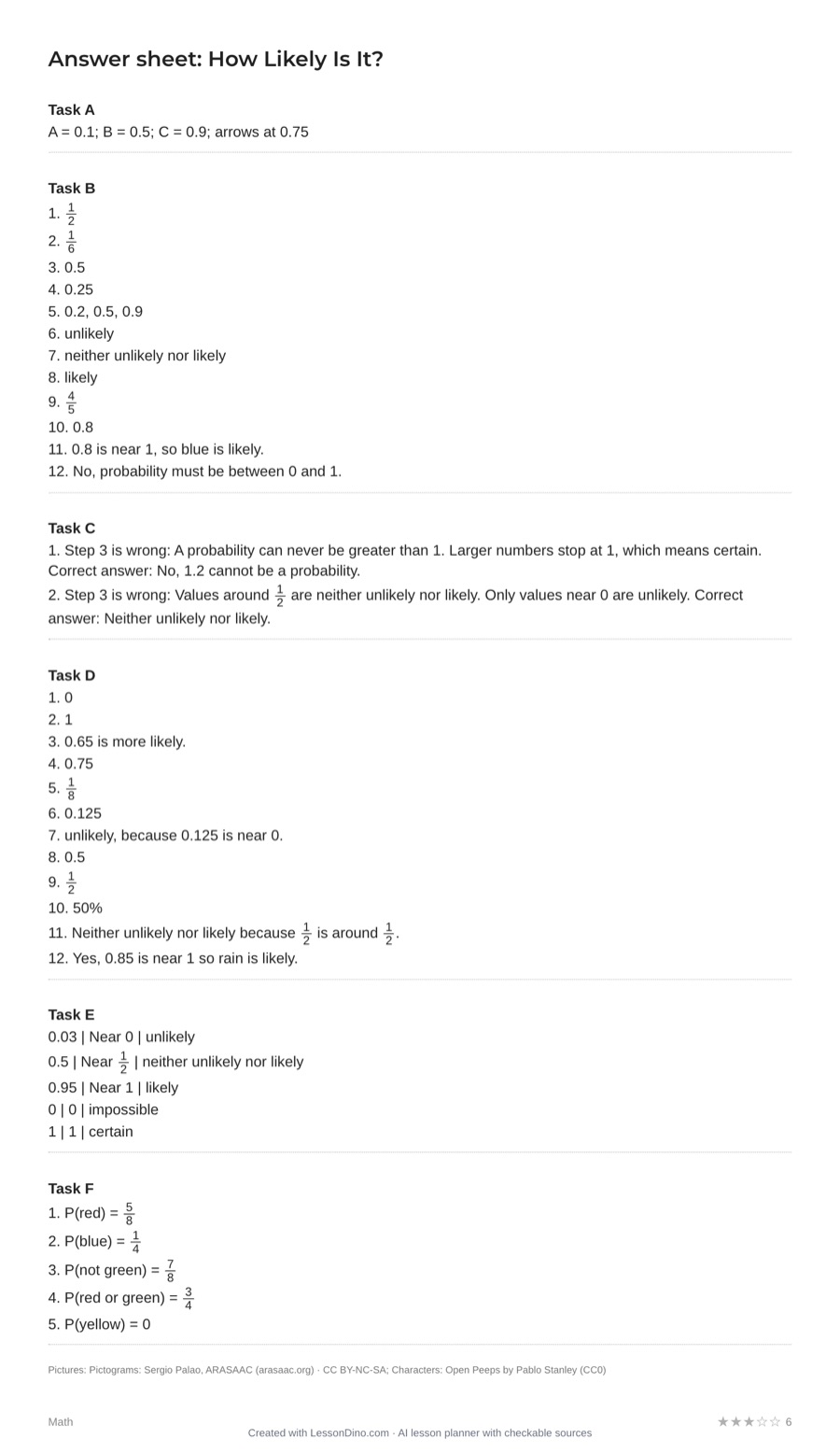
Answers
Show the answers
- What is the probability of heads with a fair coin? Write as a fraction. 1/2
- What is the probability of rolling a 2 with a fair six-sided die? Write as a fraction. 1/6
- Write 1/2 as a decimal. 0.5
- Write 25% as a decimal. 0.25
- Order from least likely to most likely: 0.2, 0.5, 0.9 0.2, 0.5, 0.9
- An event has probability 0.04. Is it unlikely, neither, or likely? unlikely
- An event has probability 0.51. Is it unlikely, neither, or likely? neither unlikely nor likely
- An event has probability 0.93. Is it unlikely, neither, or likely? likely
- A bag has 5 equal counters: 4 blue and 1 red. What is P(blue)? Use a fraction. 4/5
- For the same bag, write P(blue) as a decimal. 0.8
- Explain how you know blue is likely. 0.8 is near 1, so blue is likely.
- A student says P(blue) is 4. Explain how you know that is wrong. No, probability must be between 0 and 1.
- What is P(rolling a 7) with one standard six-sided die? 0
- What is P(rolling 1, 2, 3, 4, 5, or 6) with one standard die? 1
- Which is more likely: 0.15 or 0.65? 0.65 is more likely.
- Write 3/4 as a decimal. 0.75
- A spinner has 8 equal parts: 1 green and 7 white. What is P(green)? Use a fraction. 1/8
- Write P(green) as a decimal. 0.125
- Is green unlikely, neither, or likely? Explain how you know. unlikely, because 0.125 is near 0.
- How much larger is 0.9 than 0.4? Show with subtraction. 0.5
- A bag holds 10 marbles: 5 striped and 5 plain. What is P(striped)? Use a fraction. 1/2
- Write that probability as a percent. 50%
- Is picking striped unlikely, neither, or likely? Explain how you know. Neither unlikely nor likely because 1/2 is around 1/2.
- Rain has probability 0.85 tomorrow. Should a student bring an umbrella? Explain using likelihood. Yes, 0.85 is near 1 so rain is likely.
The answer sheet is the last picture above.
Curriculum
Understand that the probability of a chance event is a number between 0 and 1 that expresses the likelihood of the event occurring. Larger numbers indicate greater likelihood. A probability near 0 indicates an unlikely event, a probability around 1/2 indicates an event that is neither unlikely nor likely, and a probability near 1 indicates a likely event.
Made with Lesson Dino's AI on 17 October 2026. AI can make mistakes, so check the answers and facts against the sources before you teach.