The worksheet
About this worksheet
Students learn the formulas for circumference and area. They cut circles into slices to see why the formulas work. This Grade 7 Math worksheet gives students (ages 12–13) six pages of practice on circumference and area of circles, part of the geometry unit. It goes with our free Circumference and area of circles lesson, which has the slides and a timed lesson plan.
What it covers
By the end, students should be able to:
- Students will know C = pi x d and A = pi x r squared and use them.
- Students will explain how half circumference times radius gives area formula informally.
How to use it
- Main activity (18 minutes): Give Worksheet Task E (Put in order: Put the steps that show where the area formula comes from in order.).
- Practice (14 minutes): Hand out Worksheet Task B (Practice questions: Practice finding circumference and area. Use π ≈ 3.14).
- Support: Pre-cut 8 wedges with rectangle outline, mark center dot for diameter through center.
- Stretch: Predict circumference from diameter before measuring, try 32 slices, work backward from area to circumference.
- The answer sheet is the last page, so you can print it on its own or let students check their own work.
Key vocabulary
- circumference: distance all the way around the outside edge of a circle
- area: amount of flat space inside an outline
- radius: distance from the middle point to the edge
- diameter: straight distance across through the middle point
- pi: number about 3.14 showing how many across-lengths fit around
Mistakes to watch for
- Using diameter instead of radius in A = pi x r squared. Halve diameter to radius first, because diameter is two times radius.
- Mixing formulas and units, giving area in inches. Sort fence versus floor: around uses C = pi x d, inside uses A = pi x r squared; area is in square units.
- Writing = with 3.14 instead of approximately equals. Use about sign, because 3.14 is only approximate and pi never ends or repeats.
What's on the worksheet
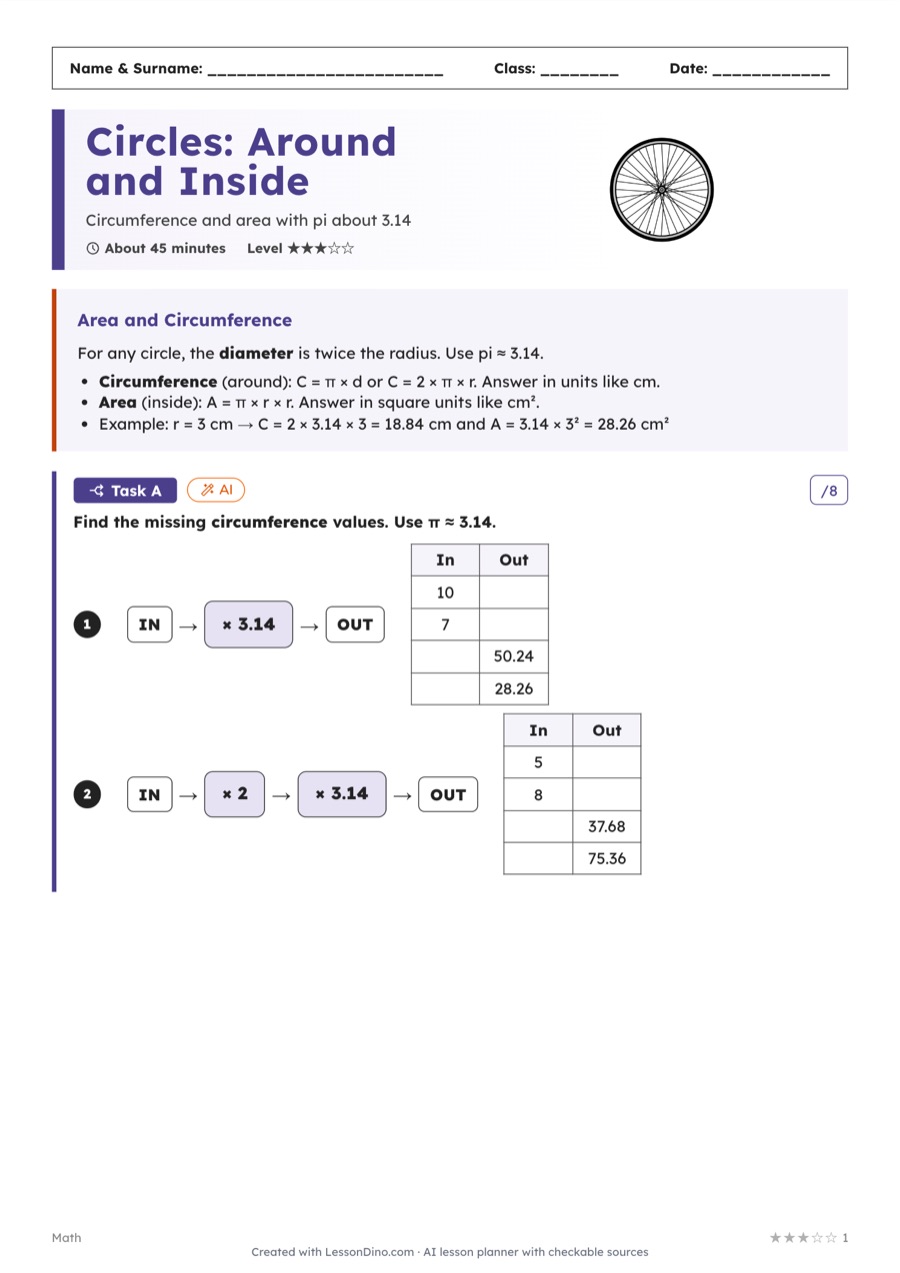
Around and Inside
Learn the circle formulas and try the machines.
Area and Circumference
- For any circle, the diameter is twice the radius. Use pi ≈ 3.14.
- Circumference (around): C = π × d or C = 2 × π × r. Answer in units like cm.
- Area (inside): A = π × r × r. Answer in square units like cm².
- Example: r = 3 cm → C = 2 × 3.14 × 3 = 18.84 cm and A = 3.14 × 3² = 28.26 cm²
Find the missing circumference values. Use π ≈ 3.14.
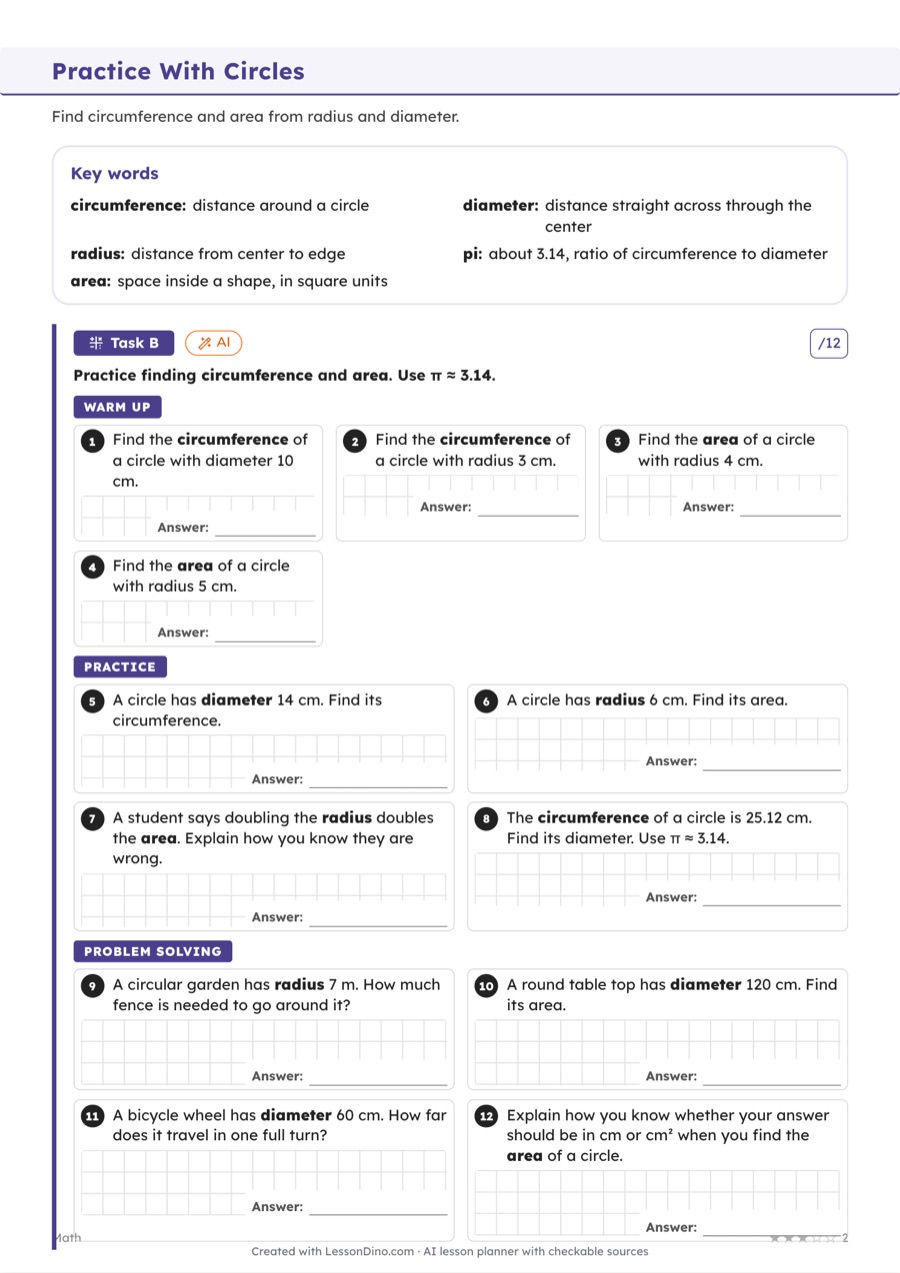
Practice With Circles
Find circumference and area from radius and diameter.
| Word | Meaning |
|---|---|
| circumference | distance around a circle |
| diameter | distance straight across through the center |
| radius | distance from center to edge |
| pi | about 3.14, ratio of circumference to diameter |
| area | space inside a shape, in square units |
Practice finding circumference and area. Use π ≈ 3.14.
Warm up
- Find the circumference of a circle with diameter 10 cm.
- Find the circumference of a circle with radius 3 cm.
- Find the area of a circle with radius 4 cm.
- Find the area of a circle with radius 5 cm.
Practice
- A circle has diameter 14 cm. Find its circumference.
- A circle has radius 6 cm. Find its area.
- A student says doubling the radius doubles the area. Explain how you know they are wrong.
- The circumference of a circle is 25.12 cm. Find its diameter. Use π ≈ 3.14.
Problem solving
- A circular garden has radius 7 m. How much fence is needed to go around it?
- A round table top has diameter 120 cm. Find its area.
- A bicycle wheel has diameter 60 cm. How far does it travel in one full turn?
- Explain how you know whether your answer should be in cm or cm² when you find the area of a circle.
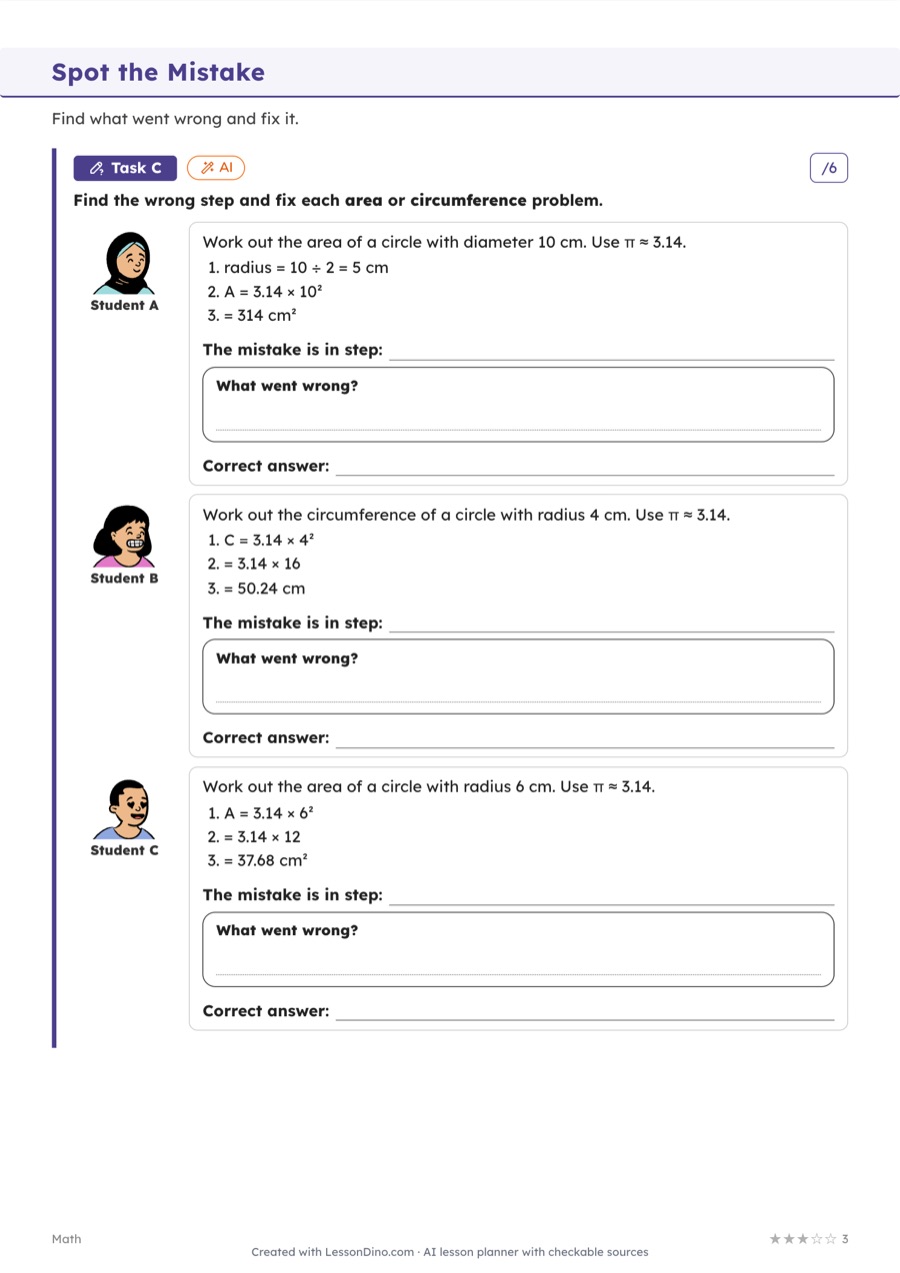
Spot the Mistake
Find what went wrong and fix it.
Find the wrong step and fix each area or circumference problem.
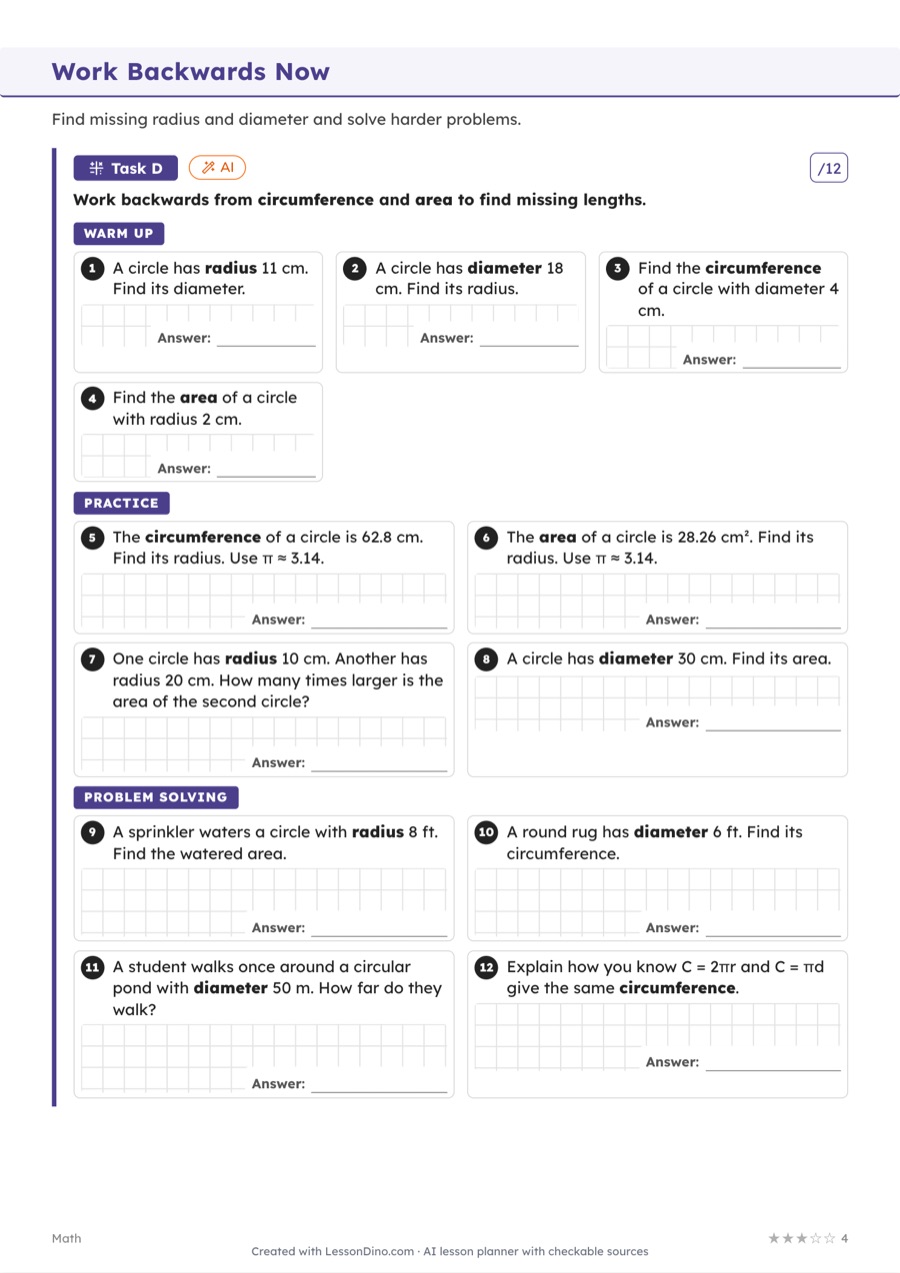
Work Backwards Now
Find missing radius and diameter and solve harder problems.
Work backwards from circumference and area to find missing lengths.
Warm up
- A circle has radius 11 cm. Find its diameter.
- A circle has diameter 18 cm. Find its radius.
- Find the circumference of a circle with diameter 4 cm.
- Find the area of a circle with radius 2 cm.
Practice
- The circumference of a circle is 62.8 cm. Find its radius. Use π ≈ 3.14.
- The area of a circle is 28.26 cm². Find its radius. Use π ≈ 3.14.
- One circle has radius 10 cm. Another has radius 20 cm. How many times larger is the area of the second circle?
- A circle has diameter 30 cm. Find its area.
Problem solving
- A sprinkler waters a circle with radius 8 ft. Find the watered area.
- A round rug has diameter 6 ft. Find its circumference.
- A student walks once around a circular pond with diameter 50 m. How far do they walk?
- Explain how you know C = 2πr and C = πd give the same circumference.
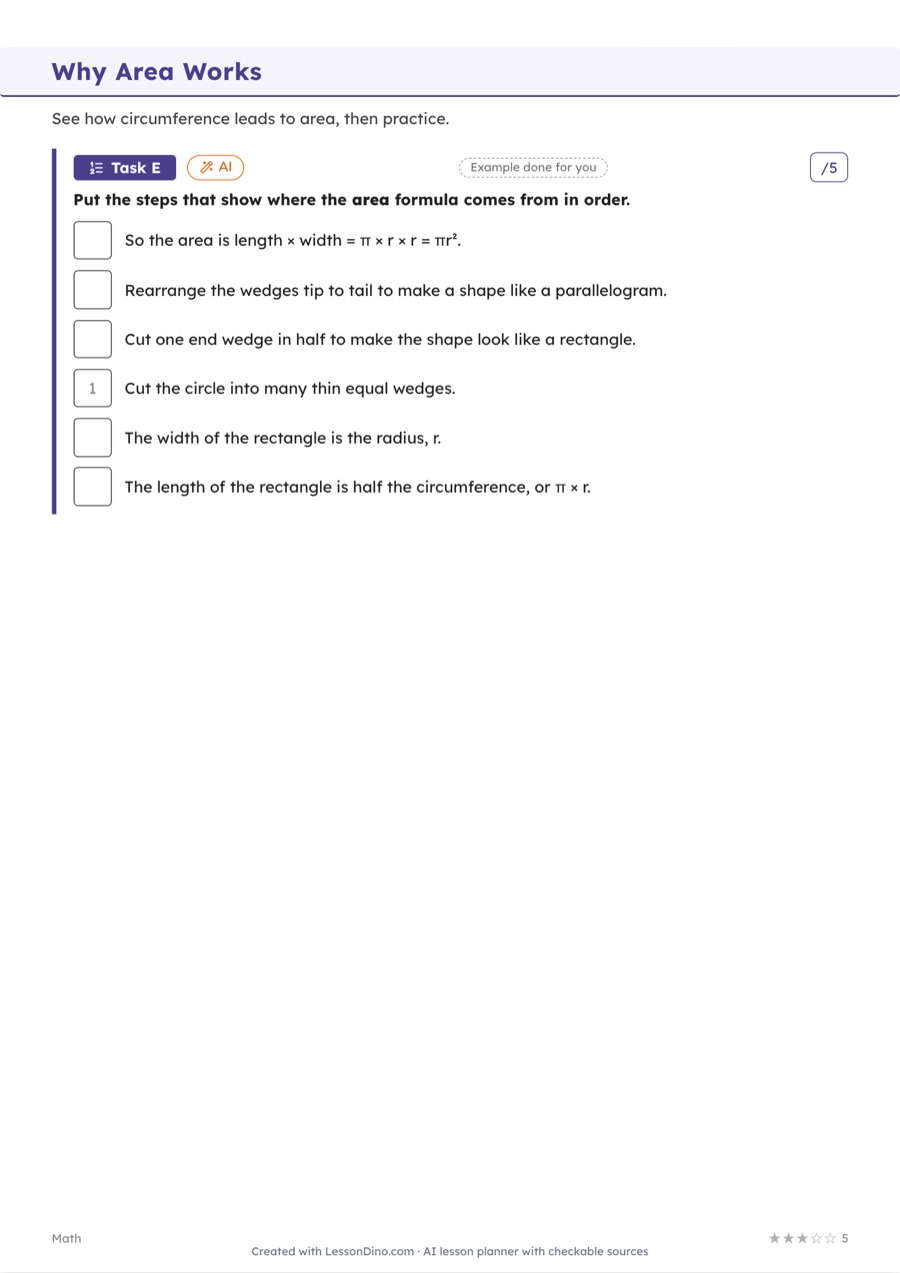
Why Area Works
See how circumference leads to area, then practice.
Put the steps that show where the area formula comes from in order.
Page 6
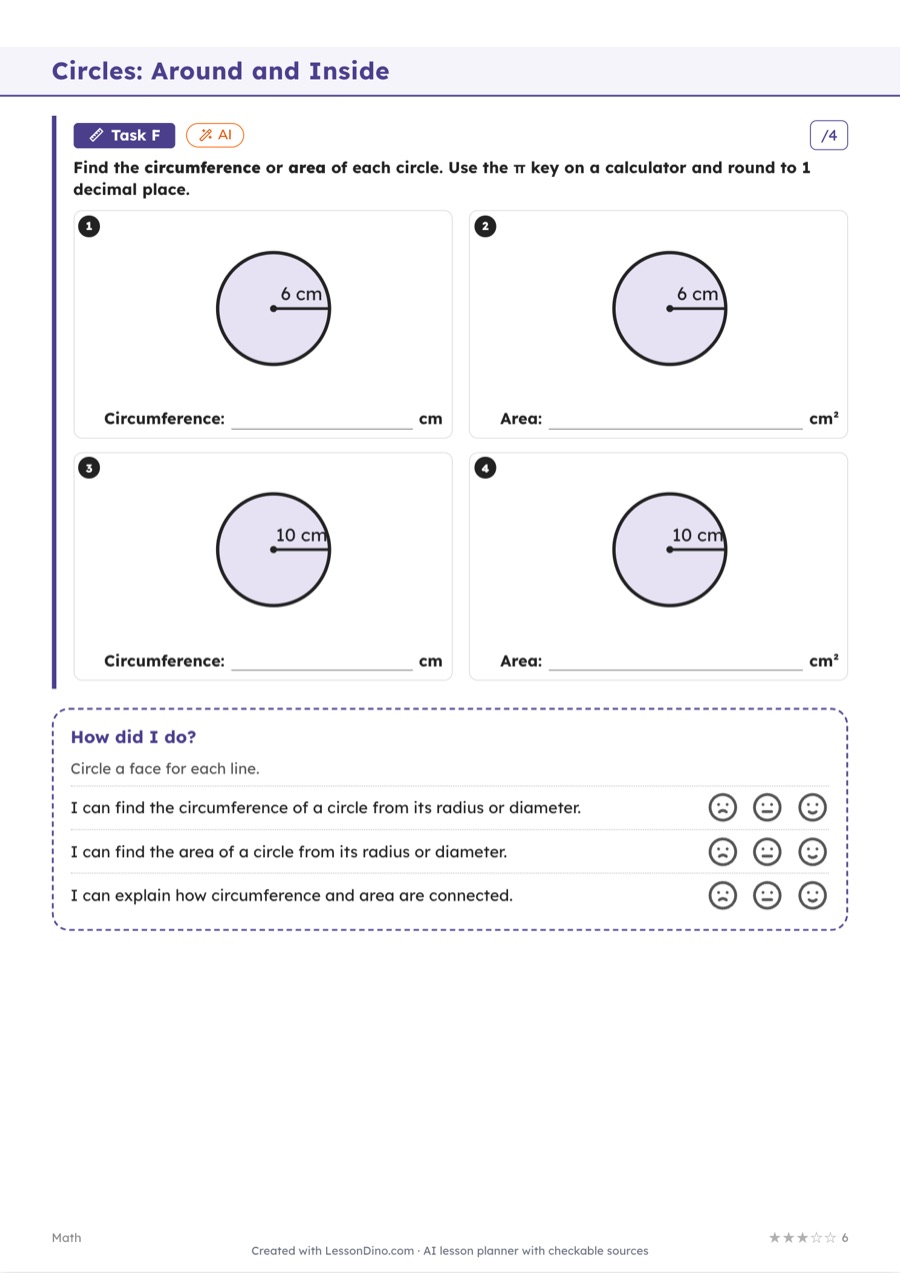
Find the circumference or area of each circle. Use the π key on a calculator and round to 1 decimal place.
Answers
Show the answers
- Find the circumference of a circle with diameter 10 cm. 31.4 cm
- Find the circumference of a circle with radius 3 cm. 18.84 cm
- Find the area of a circle with radius 4 cm. 50.24 cm²
- Find the area of a circle with radius 5 cm. 78.5 cm²
- A circle has diameter 14 cm. Find its circumference. 43.96 cm
- A circle has radius 6 cm. Find its area. 113.04 cm²
- A student says doubling the radius doubles the area. Explain how you know they are wrong. Doubling the radius makes the area 4 times as large, because area uses r squared.
- The circumference of a circle is 25.12 cm. Find its diameter. Use π ≈ 3.14. 8 cm
- A circular garden has radius 7 m. How much fence is needed to go around it? 43.96 m
- A round table top has diameter 120 cm. Find its area. 11304 cm²
- A bicycle wheel has diameter 60 cm. How far does it travel in one full turn? 188.4 cm
- Explain how you know whether your answer should be in cm or cm² when you find the area of a circle. Area measures surface covered, so it is always in square units like cm².
- A circle has radius 11 cm. Find its diameter. 22 cm
- A circle has diameter 18 cm. Find its radius. 9 cm
- Find the circumference of a circle with diameter 4 cm. 12.56 cm
- Find the area of a circle with radius 2 cm. 12.56 cm²
- The circumference of a circle is 62.8 cm. Find its radius. Use π ≈ 3.14. 10 cm
- The area of a circle is 28.26 cm². Find its radius. Use π ≈ 3.14. 3 cm
- One circle has radius 10 cm. Another has radius 20 cm. How many times larger is the area of the second circle? 4 times
- A circle has diameter 30 cm. Find its area. 706.5 cm²
- A sprinkler waters a circle with radius 8 ft. Find the watered area. 200.96 ft²
- A round rug has diameter 6 ft. Find its circumference. 18.84 ft
- A student walks once around a circular pond with diameter 50 m. How far do they walk? 157 m
- Explain how you know C = 2πr and C = πd give the same circumference. Because d = 2r, so π × d = π × 2 × r = 2πr.
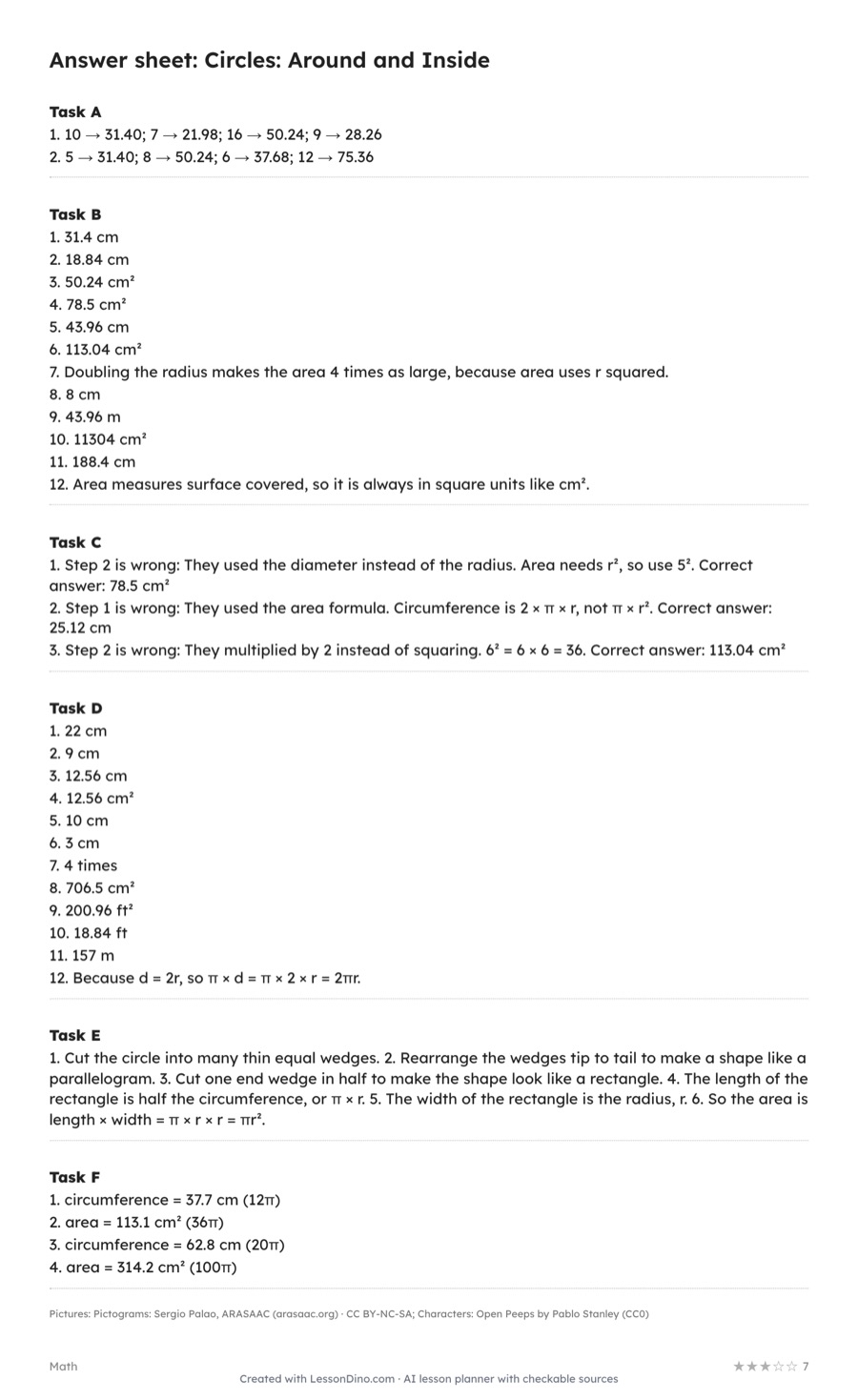
The answer sheet is the last picture above.
Curriculum
Know the formulas for the area and circumference of a circle and use them to solve problems; give an informal derivation of the relationship between the circumference and area of a circle.
Made with Lesson Dino's AI on 17 October 2026. AI can make mistakes, so check the answers and facts against the sources before you teach.