The worksheet
About this worksheet
Students learn to link complementary, supplementary, vertical and adjacent facts in a chain. They climb a three-rung puzzle to write equations and solve for x. This Grade 7 Math worksheet gives students (ages 12–13) six pages of practice on angles, part of the geometry unit. It goes with our free Angles lesson, which has the slides and a timed lesson plan.
What it covers
By the end, students should be able to:
- Students will identify complementary, supplementary, vertical and adjacent angle pairs.
- Students will write simple equations for an unknown angle in a figure.
- Students will solve multi-step angle problems and check their answers.
How to use it
- Use it for practice after the teaching part of the lesson, once students have seen the worked examples on the slides.
- Support: Pre-fill the first ladder equation a + 27 = 90 and let students solve and carry forward.
- Stretch: Change Rung 3 to 2x + b on the line for a two-step finish.
- The answer sheet is the last page, so you can print it on its own or let students check their own work.
Key vocabulary
- supplementary: Two angles that together make a straight line, totaling 180 degrees.
- complementary: Two angles that together make a square corner, totaling 90 degrees.
- vertical: Angles opposite each other where two lines cross; they have the same size.
- adjacent: Angles next to each other that share a side and a corner point.
Mistakes to watch for
- Using 90 instead of 180 for angles on a straight line, or the reverse. Mark the square corner and straight line. Ask: Is this a corner family that adds to 90 degrees or a line family that adds to 180 degrees?
- Treating adjacent angles as always equal like vertical angles. Show the X. Adjacent angles share a side and add to 180, while only opposite angles are equal. Rewrite as sum = 180.
What's on the worksheet
Angle Facts First
Review the key facts, then practice working backwards.
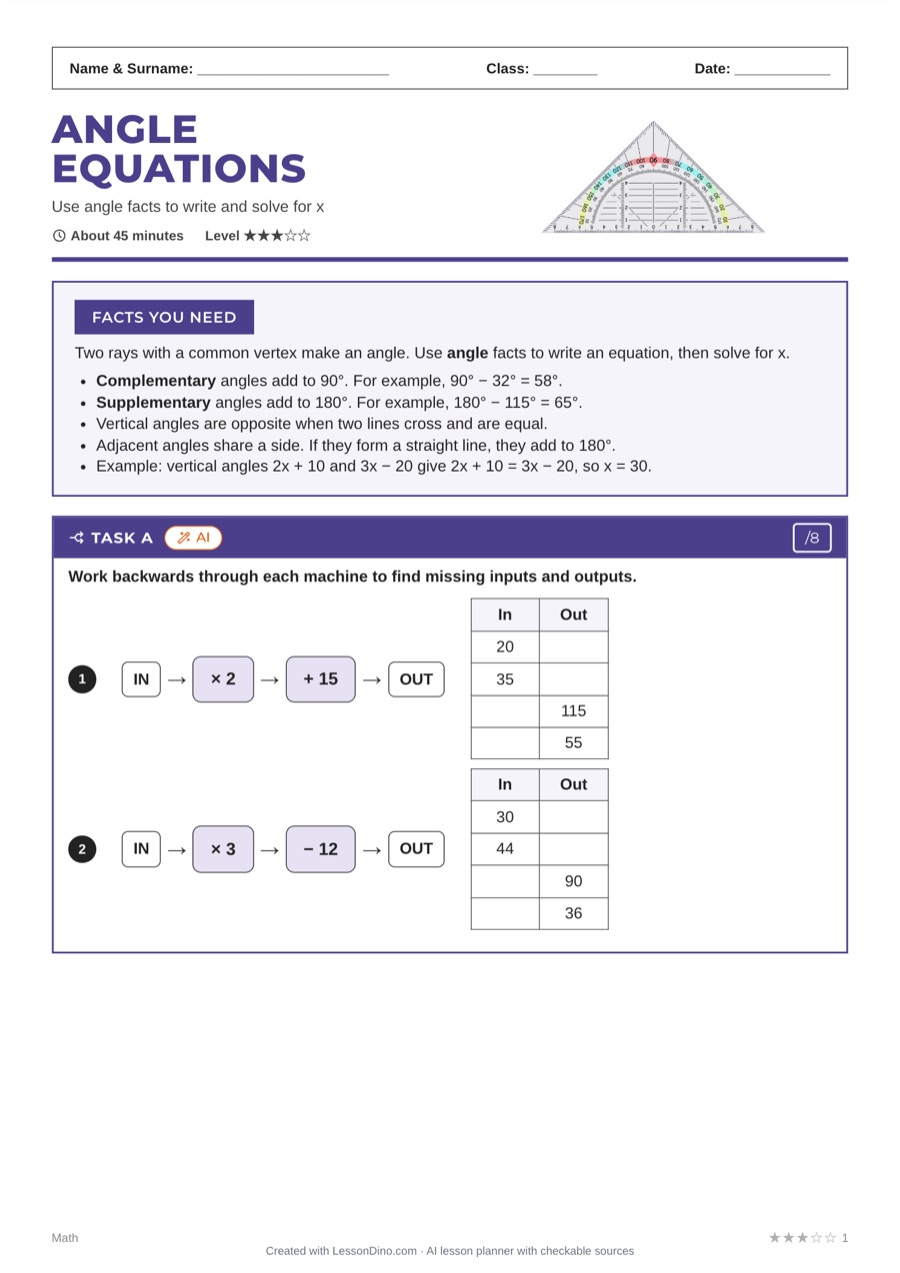
Facts You Need
- Two rays with a common vertex make an angle. Use angle facts to write an equation, then solve for x.
- Complementary angles add to 90°. For example, 90° − 32° = 58°.
- Supplementary angles add to 180°. For example, 180° − 115° = 65°.
- Vertical angles are opposite when two lines cross and are equal.
- Adjacent angles share a side. If they form a straight line, they add to 180°.
- Example: vertical angles 2x + 10 and 3x − 20 give 2x + 10 = 3x − 20, so x = 30.
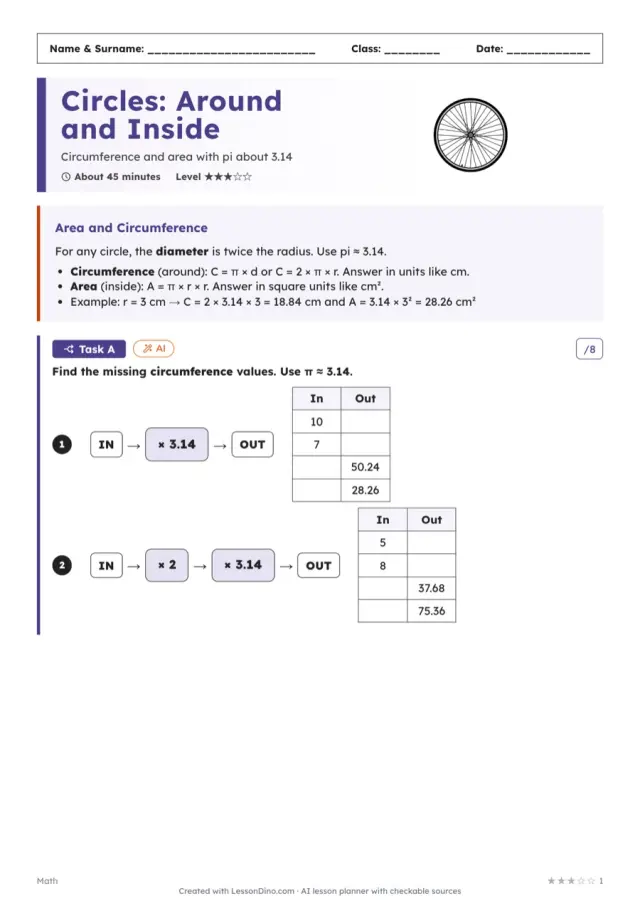
Work backwards through each machine to find missing inputs and outputs.
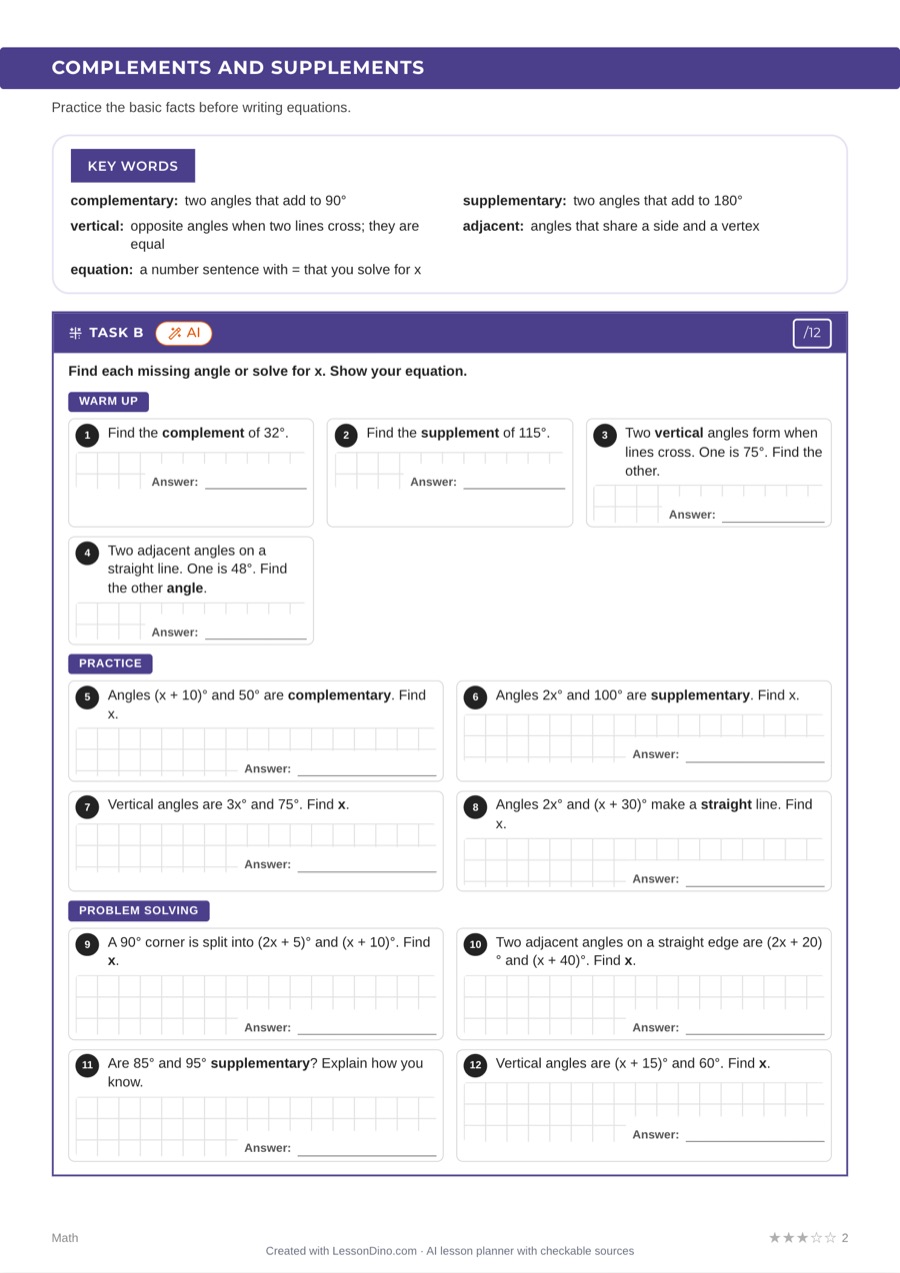
Complements and Supplements
Practice the basic facts before writing equations.
| Word | Meaning |
|---|---|
| complementary | two angles that add to 90° |
| supplementary | two angles that add to 180° |
| vertical | opposite angles when two lines cross; they are equal |
| adjacent | angles that share a side and a vertex |
| equation | a number sentence with = that you solve for x |
Find each missing angle or solve for x. Show your equation.
Warm up
- Find the complement of 32°.
- Find the supplement of 115°.
- Two vertical angles form when lines cross. One is 75°. Find the other.
- Two adjacent angles on a straight line. One is 48°. Find the other angle.
Practice
- Angles (x + 10)° and 50° are complementary. Find x.
- Angles 2x° and 100° are supplementary. Find x.
- Vertical angles are 3x° and 75°. Find x.
- Angles 2x° and (x + 30)° make a straight line. Find x.
Problem solving
- A 90° corner is split into (2x + 5)° and (x + 10)°. Find x.
- Two adjacent angles on a straight edge are (2x + 20)° and (x + 40)°. Find x.
- Are 85° and 95° supplementary? Explain how you know.
- Vertical angles are (x + 15)° and 60°. Find x.
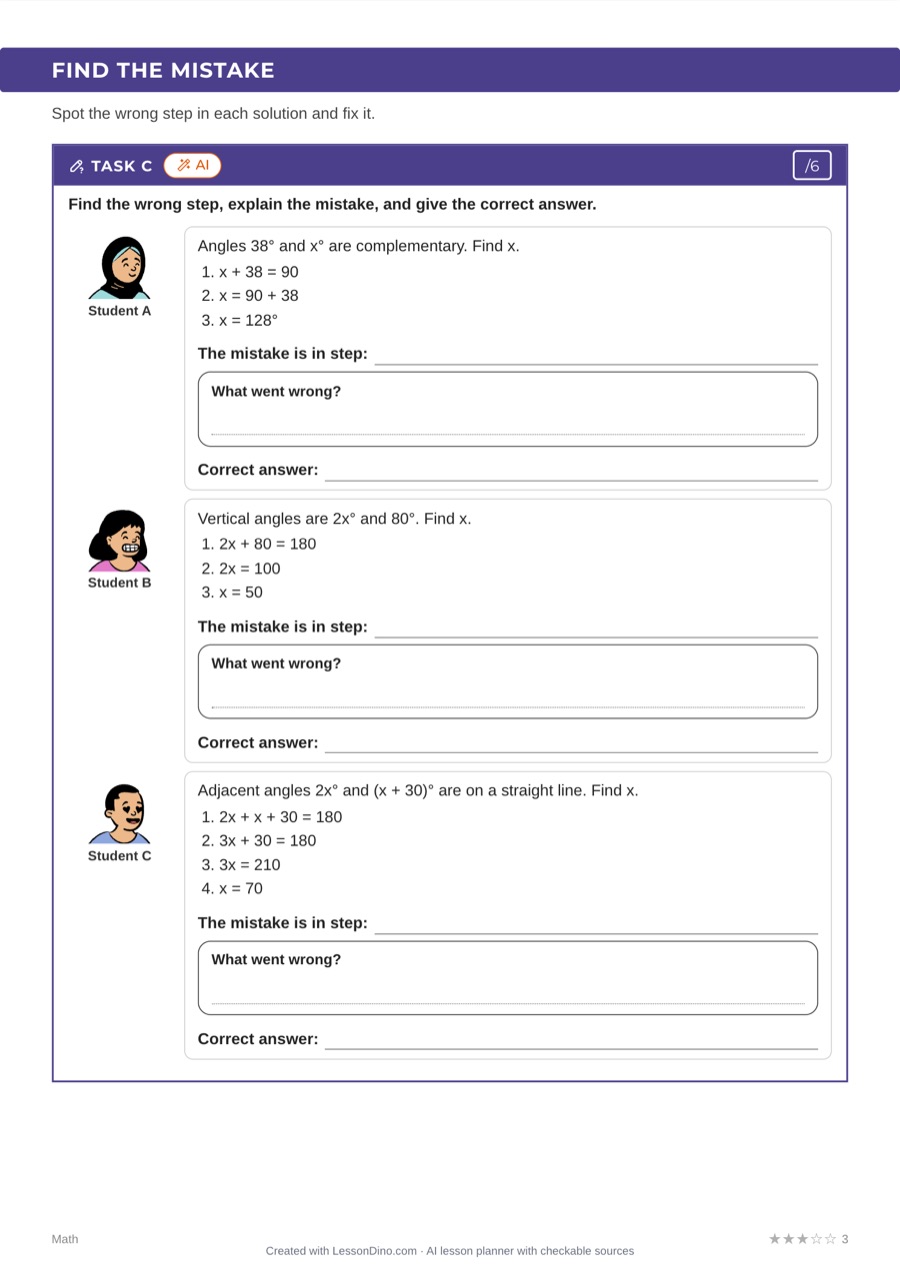
Find the Mistake
Spot the wrong step in each solution and fix it.
Find the wrong step, explain the mistake, and give the correct answer.
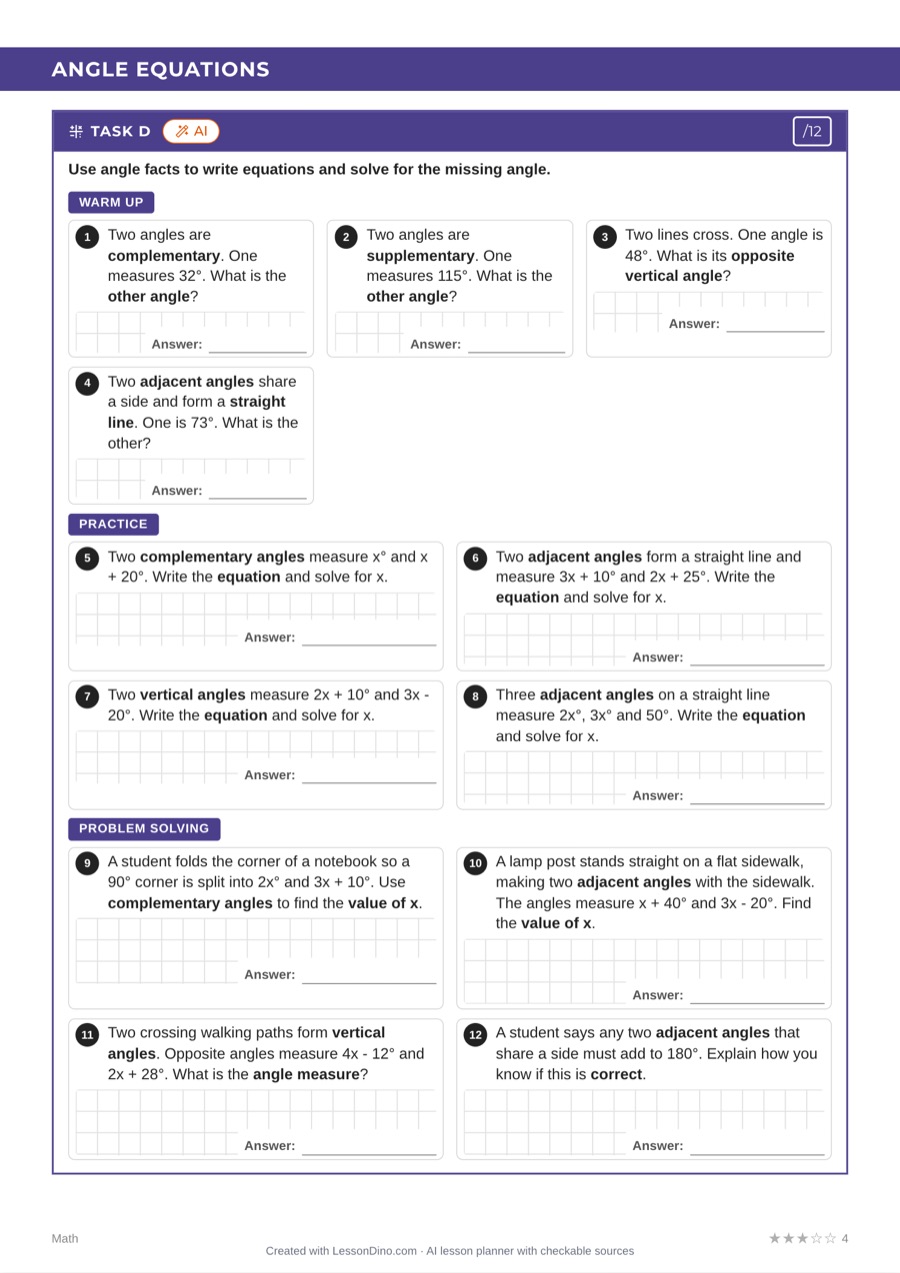
Page 4
Use angle facts to write equations and solve for the missing angle.
Warm up
- Two angles are complementary. One measures 32°. What is the other angle?
- Two angles are supplementary. One measures 115°. What is the other angle?
- Two lines cross. One angle is 48°. What is its opposite vertical angle?
- Two adjacent angles share a side and form a straight line. One is 73°. What is the other?
Practice
- Two complementary angles measure x° and x + 20°. Write the equation and solve for x.
- Two adjacent angles form a straight line and measure 3x + 10° and 2x + 25°. Write the equation and solve for x.
- Two vertical angles measure 2x + 10° and 3x - 20°. Write the equation and solve for x.
- Three adjacent angles on a straight line measure 2x°, 3x° and 50°. Write the equation and solve for x.
Problem solving
- A student folds the corner of a notebook so a 90° corner is split into 2x° and 3x + 10°. Use complementary angles to find the value of x.
- A lamp post stands straight on a flat sidewalk, making two adjacent angles with the sidewalk. The angles measure x + 40° and 3x - 20°. Find the value of x.
- Two crossing walking paths form vertical angles. Opposite angles measure 4x - 12° and 2x + 28°. What is the angle measure?
- A student says any two adjacent angles that share a side must add to 180°. Explain how you know if this is correct.
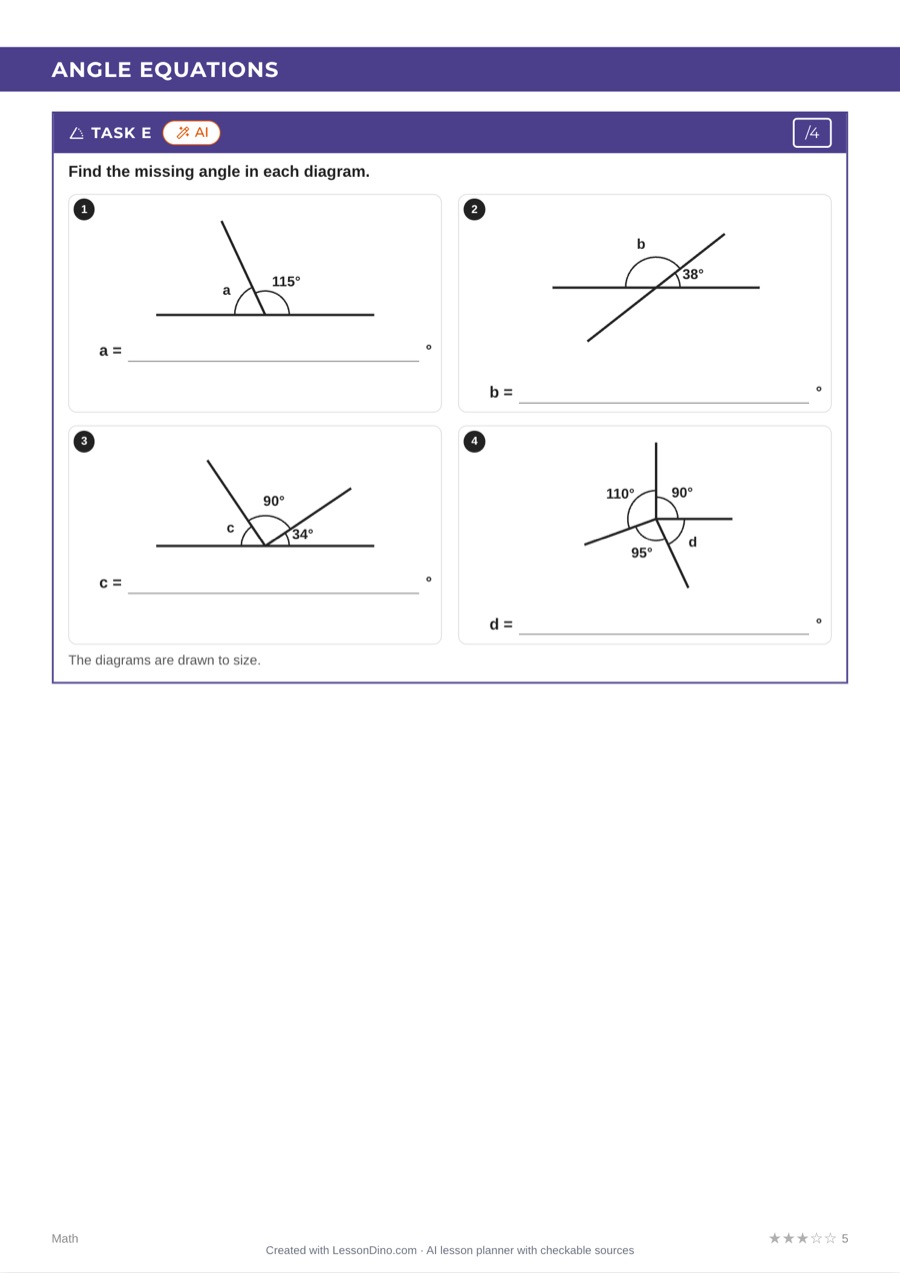
Page 5
Find the missing angle in each diagram.
Page 6
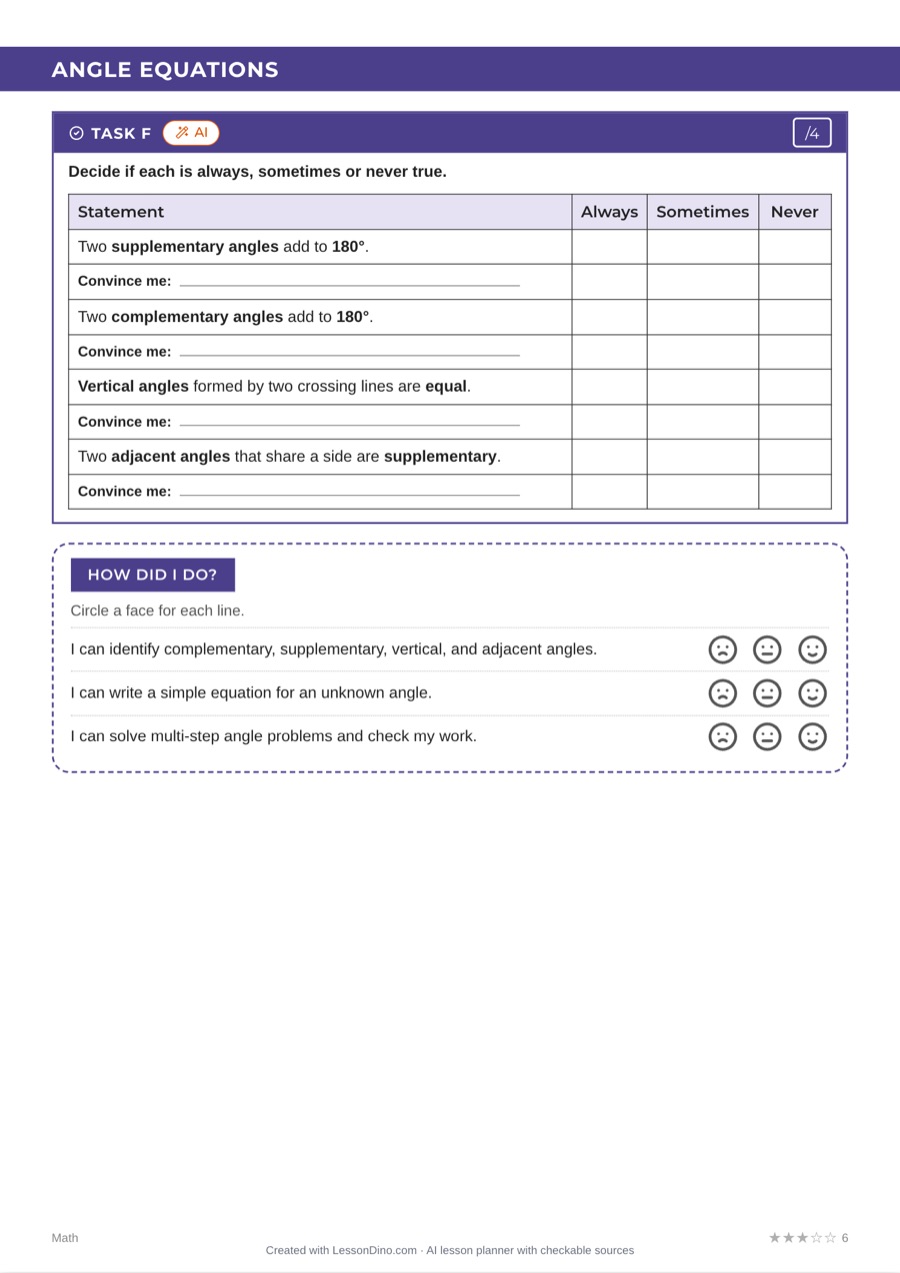
Decide if each is always, sometimes or never true.
Answers
Show the answers
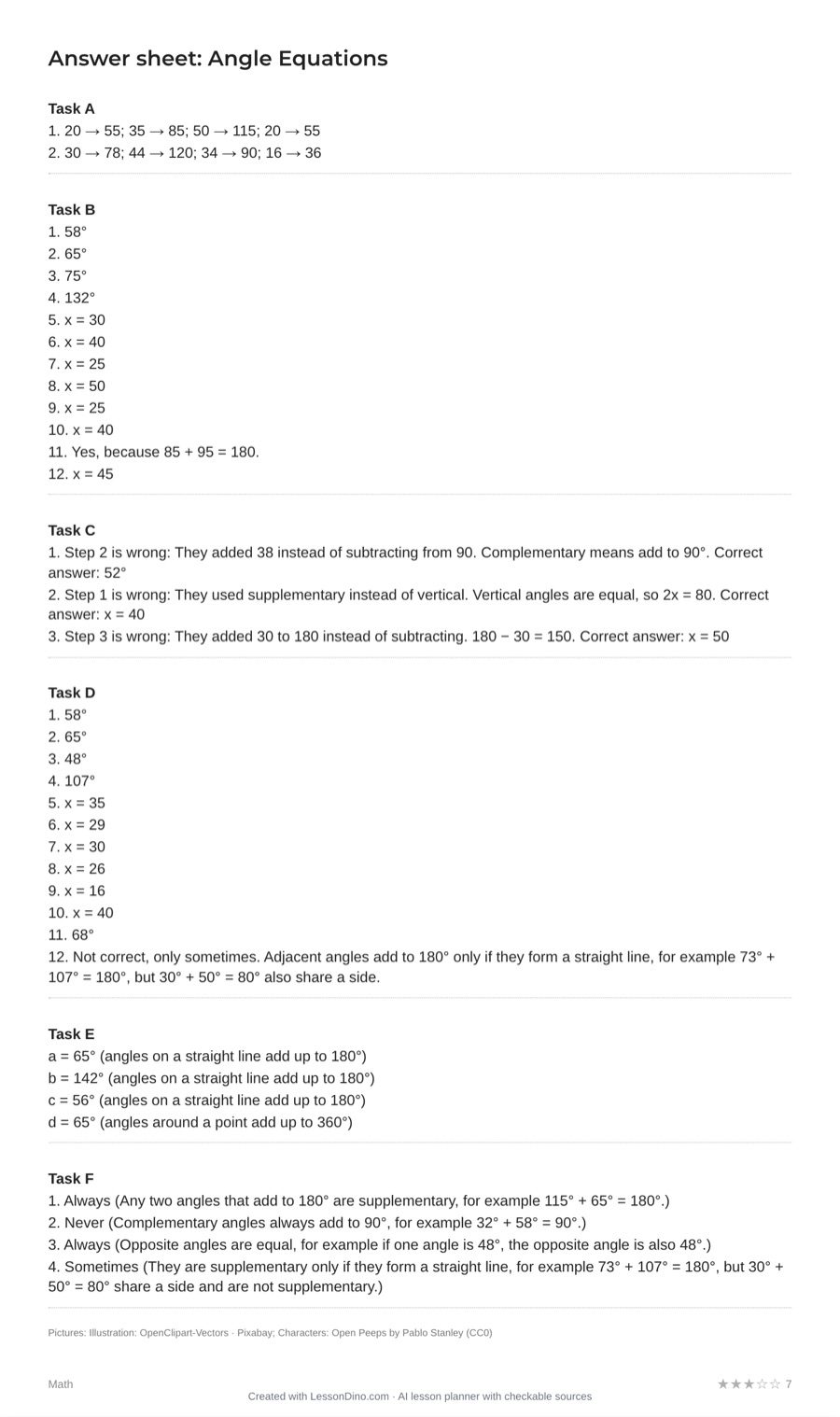
- Find the complement of 32°. 58°
- Find the supplement of 115°. 65°
- Two vertical angles form when lines cross. One is 75°. Find the other. 75°
- Two adjacent angles on a straight line. One is 48°. Find the other angle. 132°
- Angles (x + 10)° and 50° are complementary. Find x. x = 30
- Angles 2x° and 100° are supplementary. Find x. x = 40
- Vertical angles are 3x° and 75°. Find x. x = 25
- Angles 2x° and (x + 30)° make a straight line. Find x. x = 50
- A 90° corner is split into (2x + 5)° and (x + 10)°. Find x. x = 25
- Two adjacent angles on a straight edge are (2x + 20)° and (x + 40)°. Find x. x = 40
- Are 85° and 95° supplementary? Explain how you know. Yes, because 85 + 95 = 180.
- Vertical angles are (x + 15)° and 60°. Find x. x = 45
- Two angles are complementary. One measures 32°. What is the other angle? 58°
- Two angles are supplementary. One measures 115°. What is the other angle? 65°
- Two lines cross. One angle is 48°. What is its opposite vertical angle? 48°
- Two adjacent angles share a side and form a straight line. One is 73°. What is the other? 107°
- Two complementary angles measure x° and x + 20°. Write the equation and solve for x. x = 35
- Two adjacent angles form a straight line and measure 3x + 10° and 2x + 25°. Write the equation and solve for x. x = 29
- Two vertical angles measure 2x + 10° and 3x - 20°. Write the equation and solve for x. x = 30
- Three adjacent angles on a straight line measure 2x°, 3x° and 50°. Write the equation and solve for x. x = 26
- A student folds the corner of a notebook so a 90° corner is split into 2x° and 3x + 10°. Use complementary angles to find the value of x. x = 16
- A lamp post stands straight on a flat sidewalk, making two adjacent angles with the sidewalk. The angles measure x + 40° and 3x - 20°. Find the value of x. x = 40
- Two crossing walking paths form vertical angles. Opposite angles measure 4x - 12° and 2x + 28°. What is the angle measure? 68°
- A student says any two adjacent angles that share a side must add to 180°. Explain how you know if this is correct. Not correct, only sometimes. Adjacent angles add to 180° only if they form a straight line, for example 73° + 107° = 180°, but 30° + 50° = 80° also share a side.
The answer sheet is the last picture above.
Curriculum
Use facts about supplementary, complementary, vertical, and adjacent angles in a multi-step problem to write and solve simple equations for an unknown angle in a figure.
Made with Lesson Dino's AI on 17 October 2026. AI can make mistakes, so check the answers and facts against the sources before you teach.