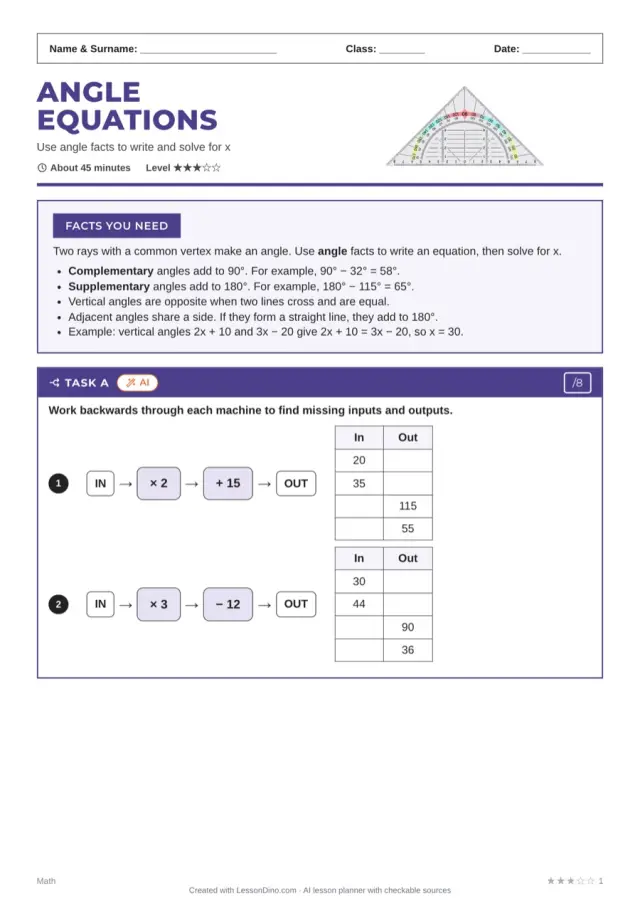
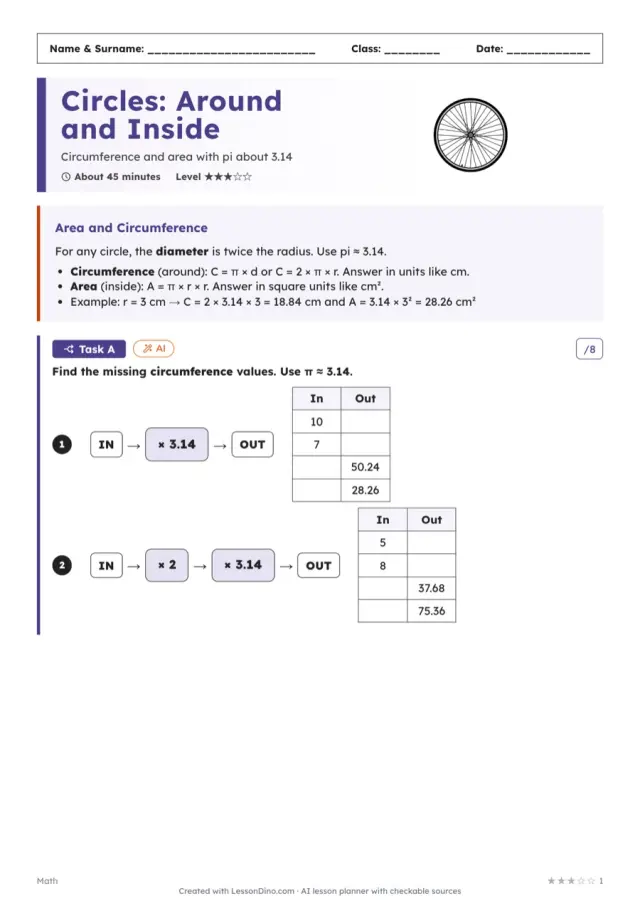
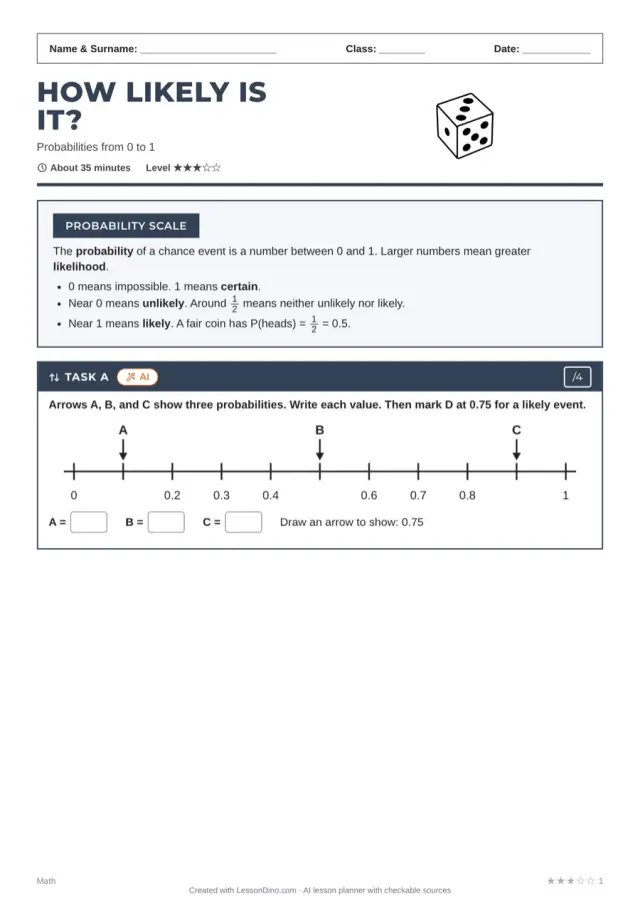
The worksheet
About this worksheet
Students learn to add integers and subtract by adding the opposite. They model moves on horizontal and vertical number lines to find sums and differences. This Grade 7 Math worksheet gives students (ages 12–13) six pages of practice on adding and subtracting integers, part of the the number system unit. It goes with our free Adding and subtracting integers lesson, which has the slides and a timed lesson plan.
What it covers
By the end, students should be able to:
- Students will add integers using number line moves and absolute value.
- Students will subtract integers by rewriting subtraction as adding the opposite.
- Students will represent addition and subtraction on horizontal and vertical number lines.
How to use it
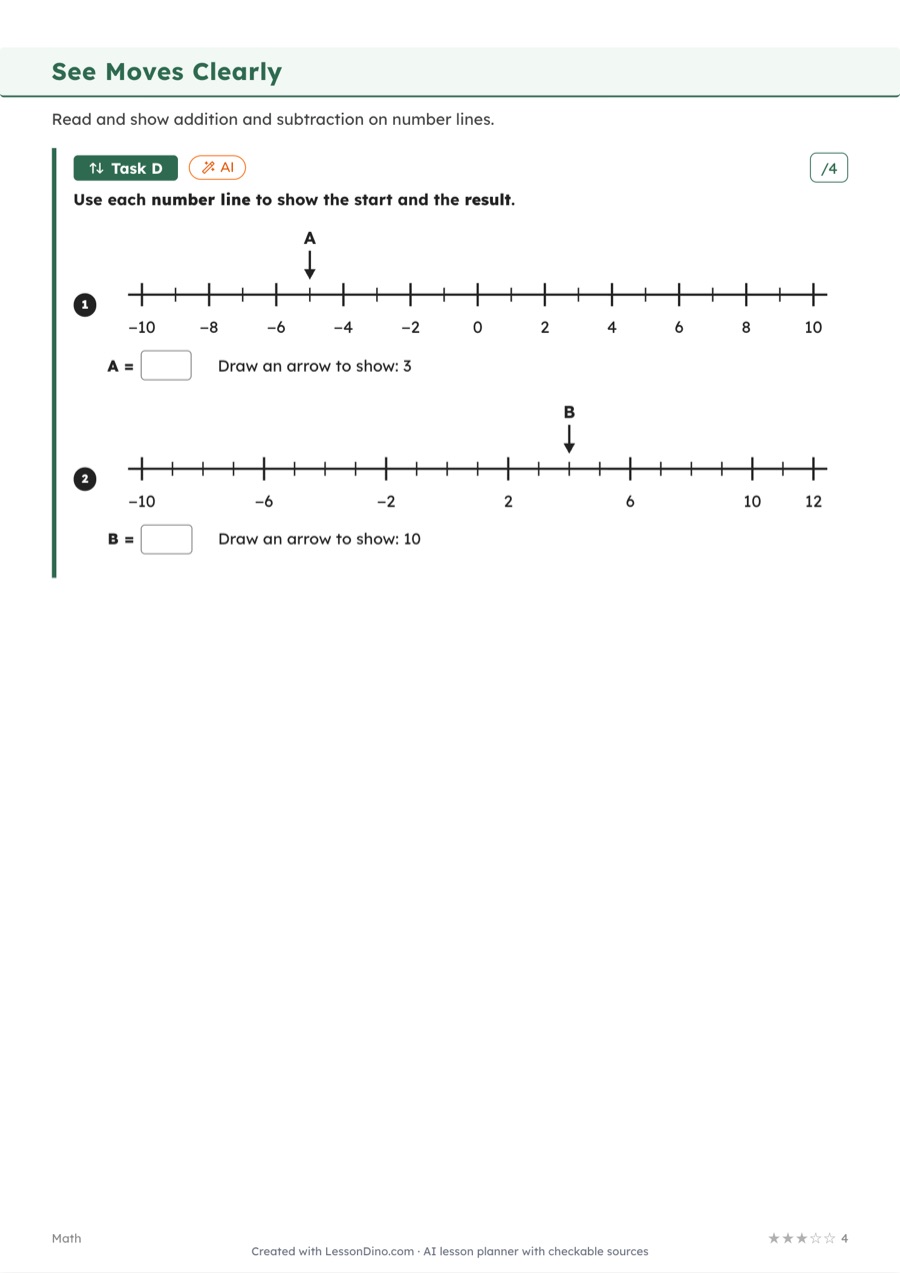
- Main activity (20 minutes): Have pairs complete Worksheet Task D to show each start and result with labeled arrows, then label tower moves with expressions.
- Support: Let students keep a -10 to 10 line that can be turned vertical or horizontal for reference while they draw.
- Stretch: Add a two-step dive such as 13 - 27 = 13 + (-27) = -14 shown with two arrows.
- The answer sheet is the last page, so you can print it on its own or let students check their own work.
Key vocabulary
- integer: a whole number that can be above zero, below zero, or zero
- absolute value: how far a number is from zero, so 5 and -5 are both 5 away from zero
- additive inverse: the partner number that, when put together with the first number, makes 0
- zero pair: a number and its partner together that cancel out completely, worth nothing
- opposite: the number the same distance from zero but on the other side, used when subtraction is rewritten as addition
Mistakes to watch for
- Treating 4 - (-6) as 4 - 6 to get -2. Rewrite as 4 + 6 = 10 and check on the line that subtracting a negative moves opposite, up by 6.
- Thinking subtract always makes smaller, so 5 - (-3) must be less than 5. Use debt removal: losing debt raises net worth, so 5 - (-3) = 5 + 3 = 8 is larger.
- Mixing signs when adding different signs, such as (-7) + 4 = -11. Subtract smaller absolute value from larger and take sign of larger: 7-4=3, larger is negative, so -3.
What's on the worksheet
Start With Number Lines
How to add and subtract integers on a number line.
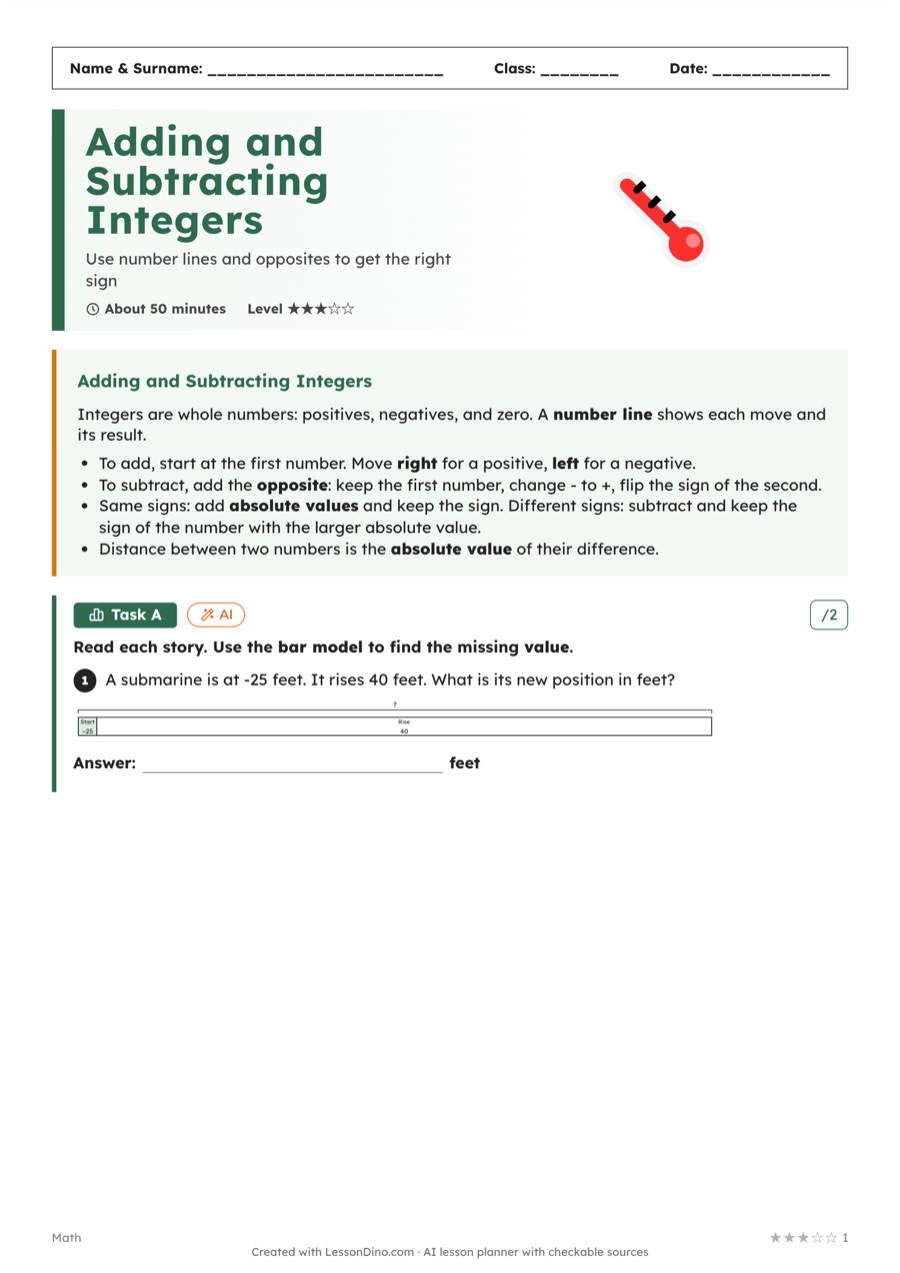
Adding and Subtracting Integers
- Integers are whole numbers: positives, negatives, and zero. A number line shows each move and its result.
- To add, start at the first number. Move right for a positive, left for a negative.
- To subtract, add the opposite: keep the first number, change - to +, flip the sign of the second.
- Same signs: add absolute values and keep the sign. Different signs: subtract and keep the sign of the number with the larger absolute value.
- Distance between two numbers is the absolute value of their difference.
Read each story. Use the bar model to find the missing value.
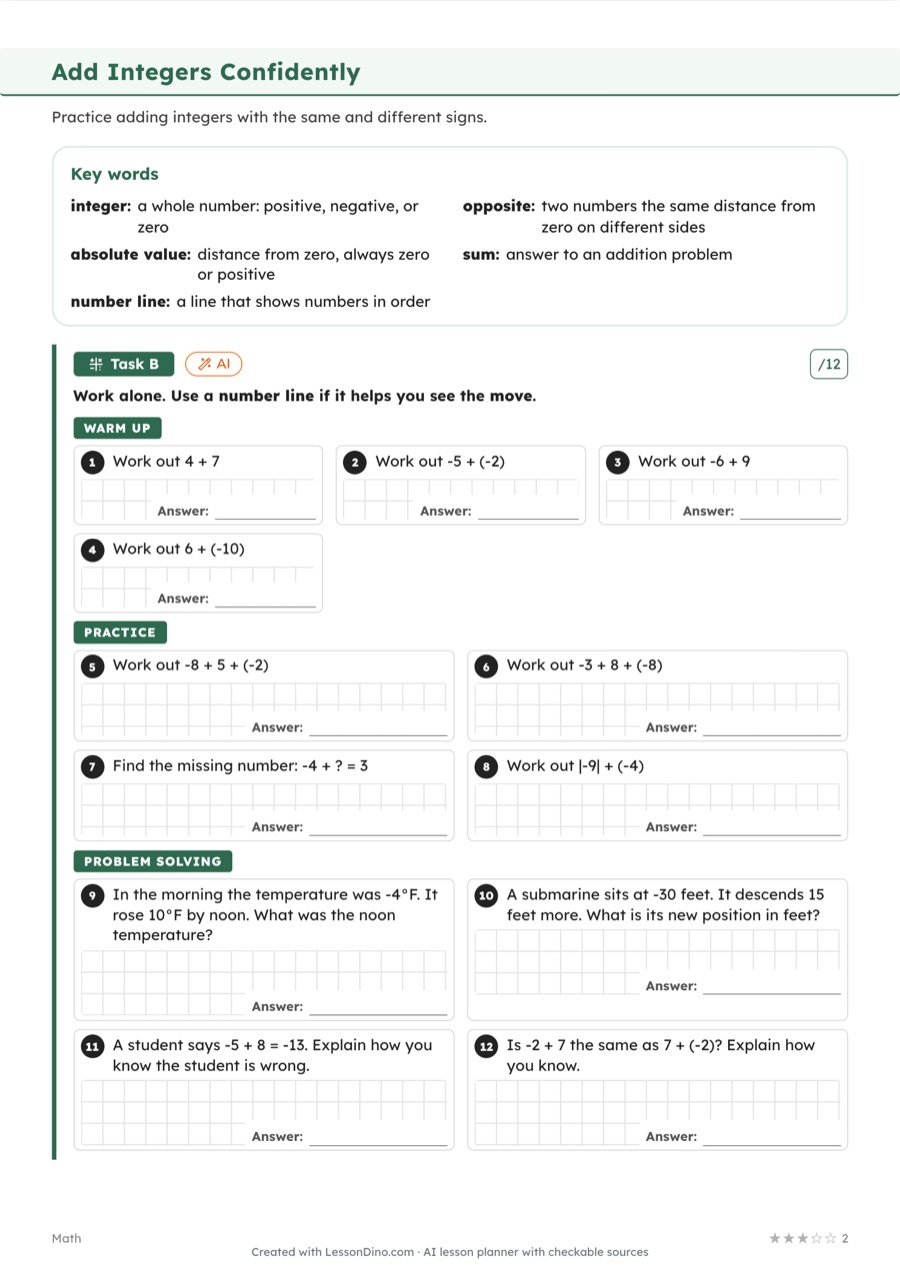
Add Integers Confidently
Practice adding integers with the same and different signs.
| Word | Meaning |
|---|---|
| integer | a whole number: positive, negative, or zero |
| opposite | two numbers the same distance from zero on different sides |
| absolute value | distance from zero, always zero or positive |
| sum | answer to an addition problem |
| number line | a line that shows numbers in order |
Work alone. Use a number line if it helps you see the move.
Warm up
- Work out 4 + 7
- Work out -5 + (-2)
- Work out -6 + 9
- Work out 6 + (-10)
Practice
- Work out -8 + 5 + (-2)
- Work out -3 + 8 + (-8)
- Find the missing number: -4 + ? = 3
- Work out |-9| + (-4)
Problem solving
- In the morning the temperature was -4°F. It rose 10°F by noon. What was the noon temperature?
- A submarine sits at -30 feet. It descends 15 feet more. What is its new position in feet?
- A student says -5 + 8 = -13. Explain how you know the student is wrong.
- Is -2 + 7 the same as 7 + (-2)? Explain how you know.
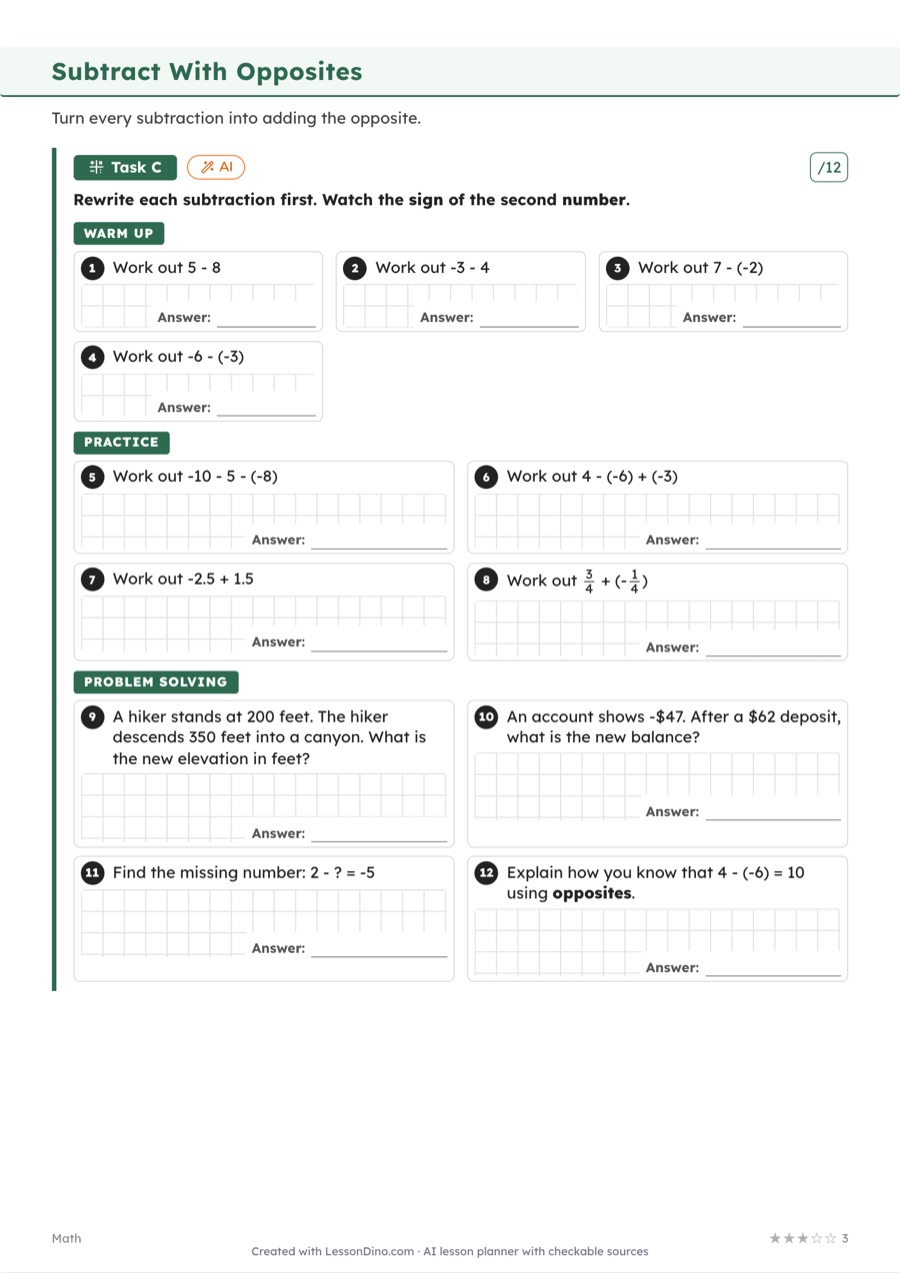
Subtract With Opposites
Turn every subtraction into adding the opposite.
Rewrite each subtraction first. Watch the sign of the second number.
Warm up
- Work out 5 - 8
- Work out -3 - 4
- Work out 7 - (-2)
- Work out -6 - (-3)
Practice
- Work out -10 - 5 - (-8)
- Work out 4 - (-6) + (-3)
- Work out -2.5 + 1.5
- Work out 3/4 + (-1/4)
Problem solving
- A hiker stands at 200 feet. The hiker descends 350 feet into a canyon. What is the new elevation in feet?
- An account shows -$47. After a $62 deposit, what is the new balance?
- Find the missing number: 2 - ? = -5
- Explain how you know that 4 - (-6) = 10 using opposites.
See Moves Clearly
Read and show addition and subtraction on number lines.
Use each number line to show the start and the result.
Page 5
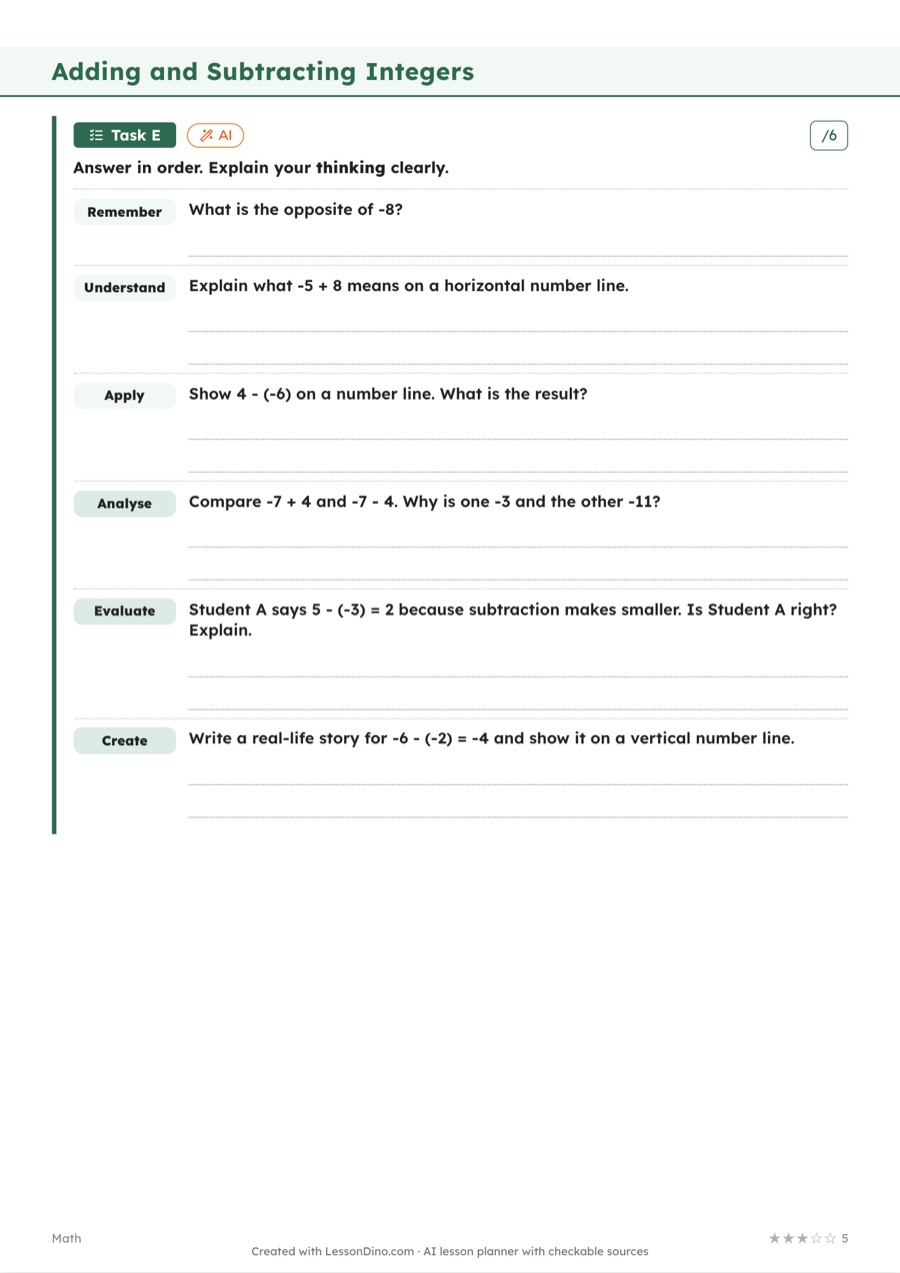
Answer in order. Explain your thinking clearly.
- What is the opposite of -8?
- Explain what -5 + 8 means on a horizontal number line.
- Show 4 - (-6) on a number line. What is the result?
- Compare -7 + 4 and -7 - 4. Why is one -3 and the other -11?
- Student A says 5 - (-3) = 2 because subtraction makes smaller. Is Student A right? Explain.
- Write a real-life story for -6 - (-2) = -4 and show it on a vertical number line.
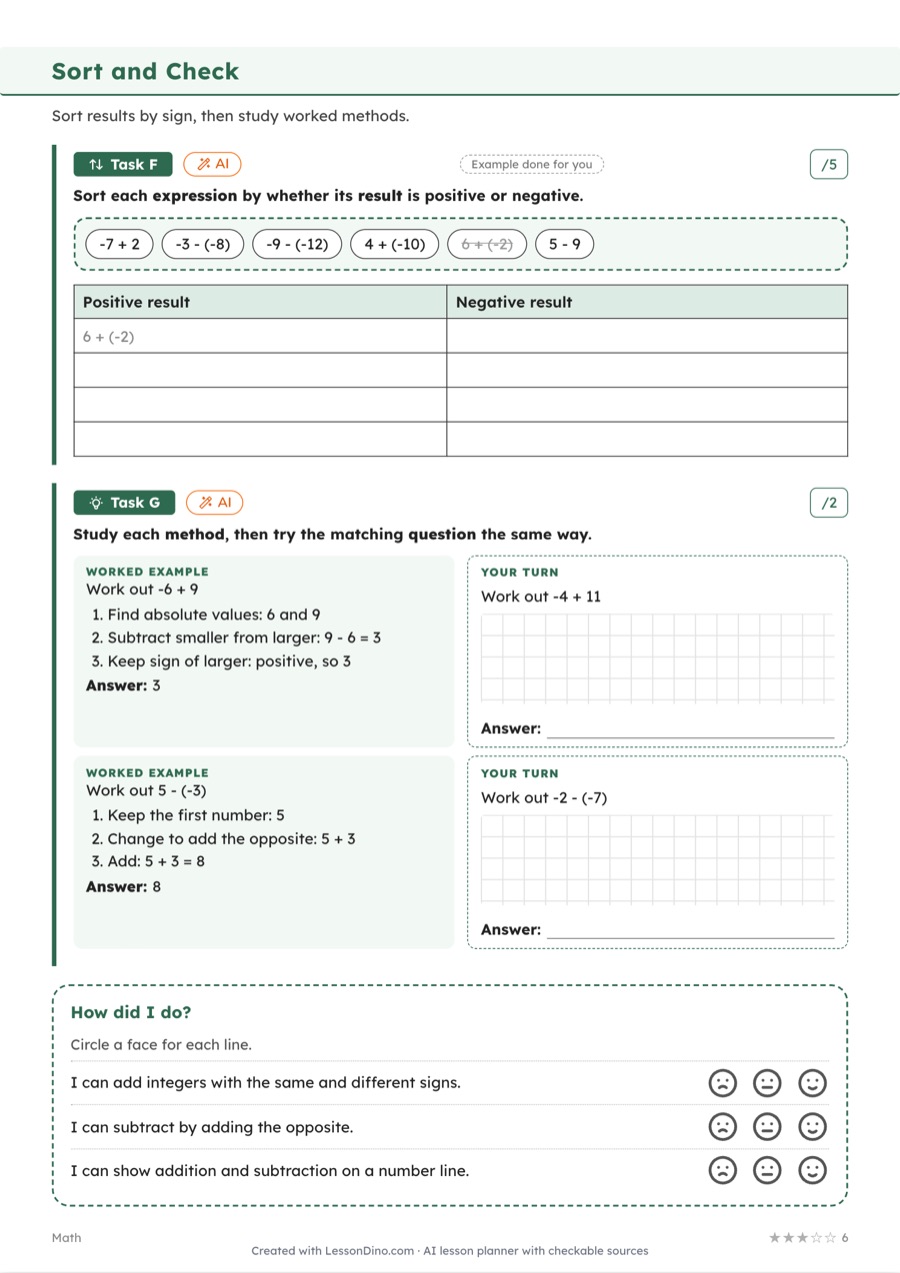
Sort and Check
Sort results by sign, then study worked methods.
Sort each expression by whether its result is positive or negative.
Study each method, then try the matching question the same way.
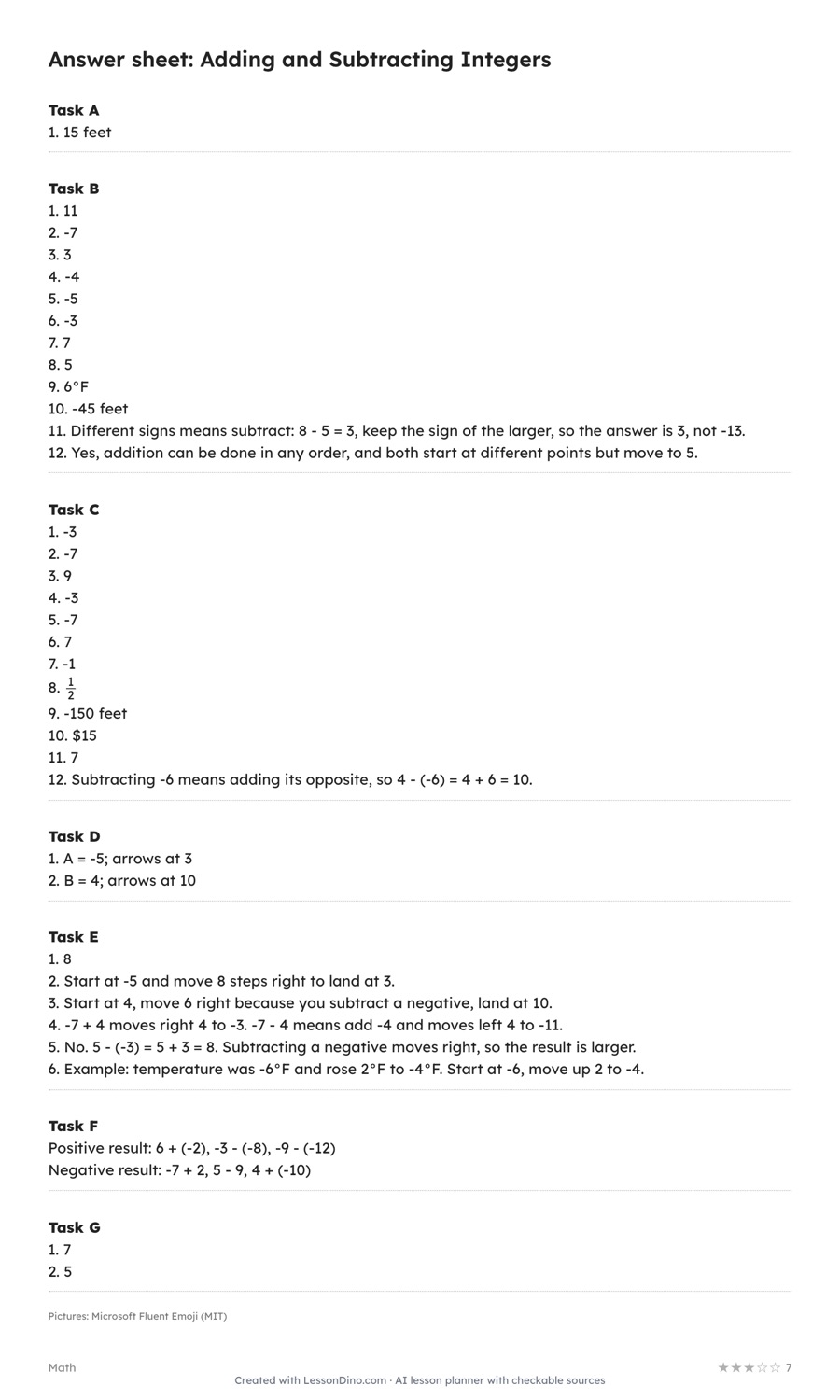
Answers
Show the answers
- Work out 4 + 7 11
- Work out -5 + (-2) -7
- Work out -6 + 9 3
- Work out 6 + (-10) -4
- Work out -8 + 5 + (-2) -5
- Work out -3 + 8 + (-8) -3
- Find the missing number: -4 + ? = 3 7
- Work out |-9| + (-4) 5
- In the morning the temperature was -4°F. It rose 10°F by noon. What was the noon temperature? 6°F
- A submarine sits at -30 feet. It descends 15 feet more. What is its new position in feet? -45 feet
- A student says -5 + 8 = -13. Explain how you know the student is wrong. Different signs means subtract: 8 - 5 = 3, keep the sign of the larger, so the answer is 3, not -13.
- Is -2 + 7 the same as 7 + (-2)? Explain how you know. Yes, addition can be done in any order, and both start at different points but move to 5.
- Work out 5 - 8 -3
- Work out -3 - 4 -7
- Work out 7 - (-2) 9
- Work out -6 - (-3) -3
- Work out -10 - 5 - (-8) -7
- Work out 4 - (-6) + (-3) 7
- Work out -2.5 + 1.5 -1
- Work out 3/4 + (-1/4) 1/2
- A hiker stands at 200 feet. The hiker descends 350 feet into a canyon. What is the new elevation in feet? -150 feet
- An account shows -$47. After a $62 deposit, what is the new balance? $15
- Find the missing number: 2 - ? = -5 7
- Explain how you know that 4 - (-6) = 10 using opposites. Subtracting -6 means adding its opposite, so 4 - (-6) = 4 + 6 = 10.
- What is the opposite of -8? 8
- Explain what -5 + 8 means on a horizontal number line. Start at -5 and move 8 steps right to land at 3.
- Show 4 - (-6) on a number line. What is the result? Start at 4, move 6 right because you subtract a negative, land at 10.
- Compare -7 + 4 and -7 - 4. Why is one -3 and the other -11? -7 + 4 moves right 4 to -3. -7 - 4 means add -4 and moves left 4 to -11.
- Student A says 5 - (-3) = 2 because subtraction makes smaller. Is Student A right? Explain. No. 5 - (-3) = 5 + 3 = 8. Subtracting a negative moves right, so the result is larger.
- Write a real-life story for -6 - (-2) = -4 and show it on a vertical number line. Example: temperature was -6°F and rose 2°F to -4°F. Start at -6, move up 2 to -4.
The answer sheet is the last picture above.
Curriculum
Apply and extend previous understandings of addition and subtraction to add and subtract rational numbers; represent addition and subtraction on a horizontal or vertical number line diagram.
Made with Lesson Dino's AI on 17 October 2026. AI can make mistakes, so check the answers and facts against the sources before you teach.