Slides
Lesson plan
From 0 to 1: How Likely Is It?
Students learn that probability is a number from 0 to 1 that shows likelihood. They place events on a human number line as unlikely, even chance, or likely.
Objectives
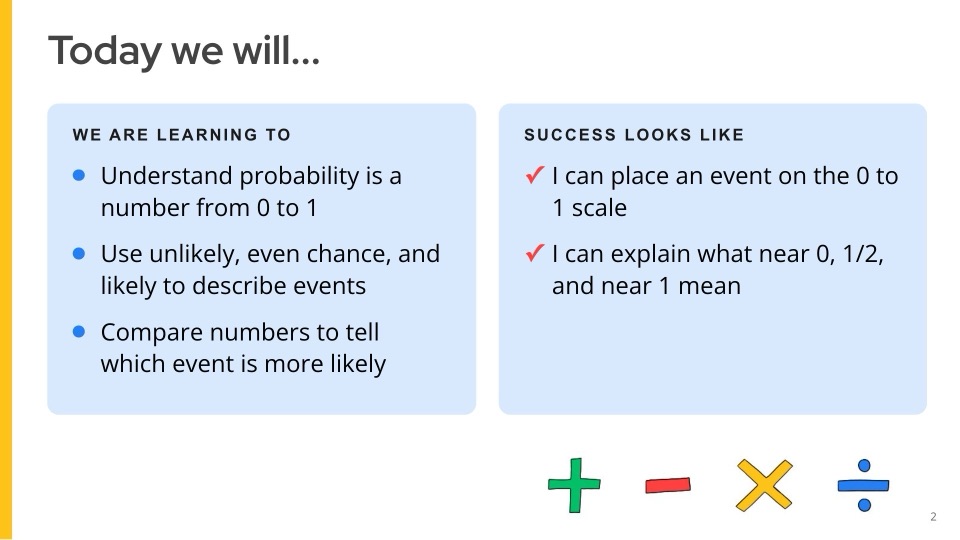
- Students will understand probability is a number between 0 and 1 that shows likelihood.
- Students will describe events as unlikely near 0, even chance around 1/2, or likely near 1.
- Students will compare probability numbers to decide which event is more likely.
Success criteria
- I can place a chance event on a 0 to 1 scale.
- I can label events unlikely, even chance, or likely.
- I can compare two probabilities to tell which is more likely.
Key words
| Word | Meaning |
|---|---|
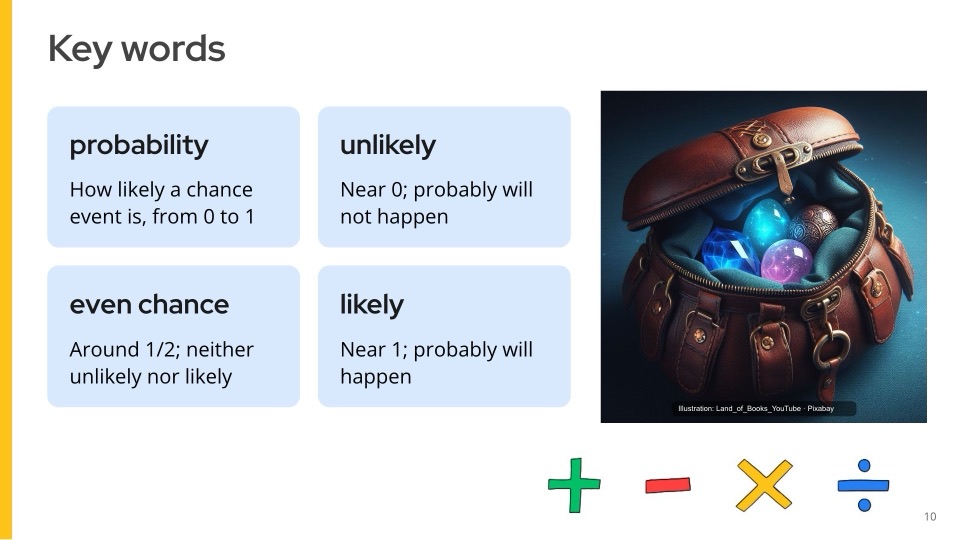
| probability | how likely a chance event is, from 0 to 1 |
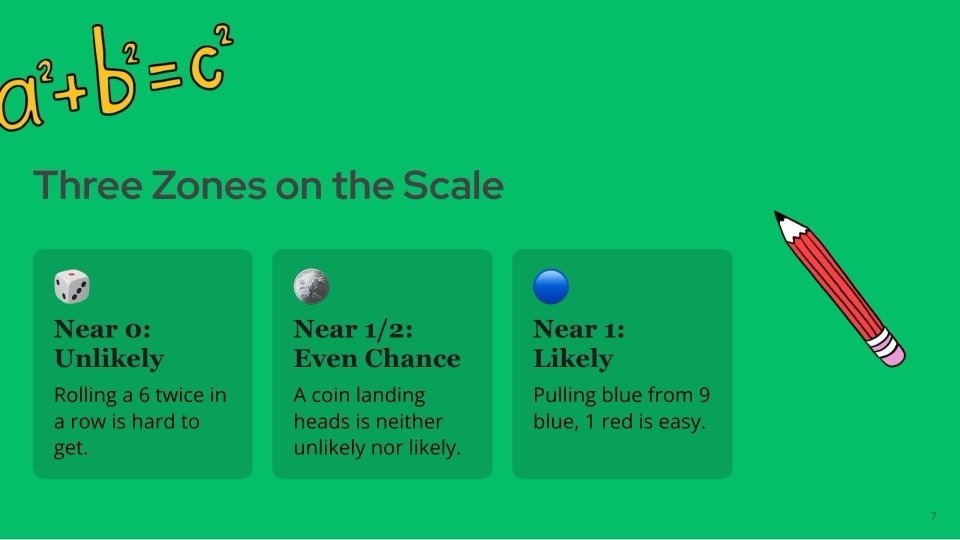
| unlikely | near 0; probably will not happen |
| even chance | around 1/2; neither unlikely nor likely |
| likely | close to 1; has a strong chance of happening |
Timed plan (60 minutes)
| Time | Stage | What happens |
|---|---|---|
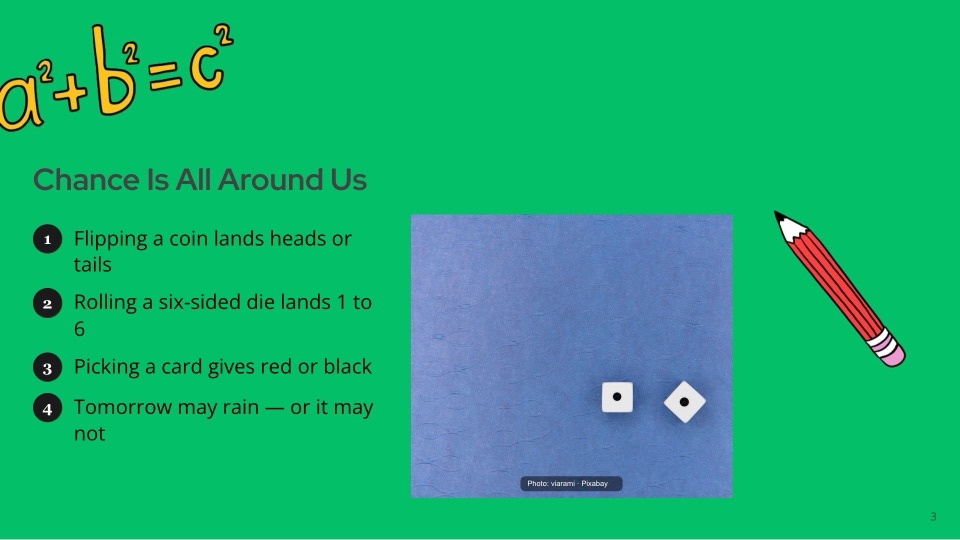
| 5 min | Starter | Activate everyday ideas of chance and connect 0 to no chance and 1 to a sure thing. Show Slide 1 How Likely Is It? and Slide 2 objectives, then Slide 3 Chance Is All Around Us. Read the Slide 3 examples: flipping a coin, rolling a six-sided die, picking a card, and rain tomorrow. Use the hook to point to the floor tape line marked 0, 1/2, and 1. Ask students to point or take one step to show where rolling a 6 would sit. |
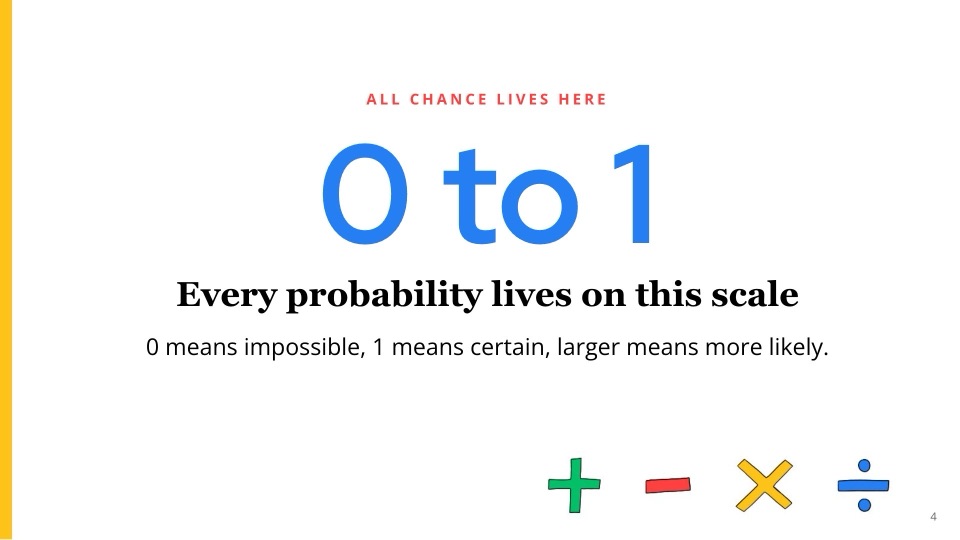
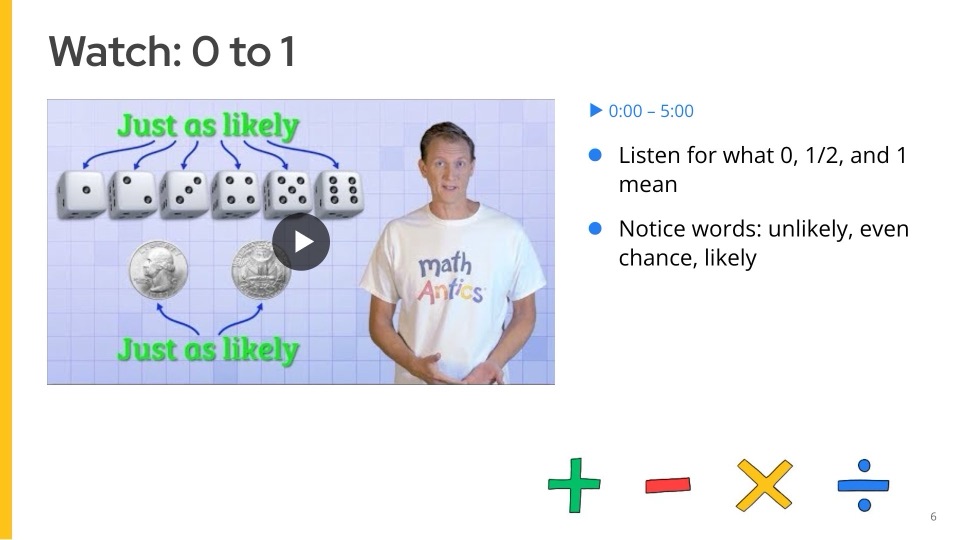
| 12 min | Teaching | Explain that every probability lives from 0 to 1 and what 0, 1/2, and 1 mean. Show Slide 4 All Chance Lives Here and read that 0 means impossible, 1 means certain, larger means more likely. Explain that probability is a number between 0 and 1, where 0 indicates impossibility and 1 indicates certainty, and the further right a number sits the more likely the event. Play Video clip 1 on Slide 6 and ask students to listen for what 0, 1/2, and 1 mean. Model a fair coin toss and place 1/2 in the middle as neither unlikely nor likely. |
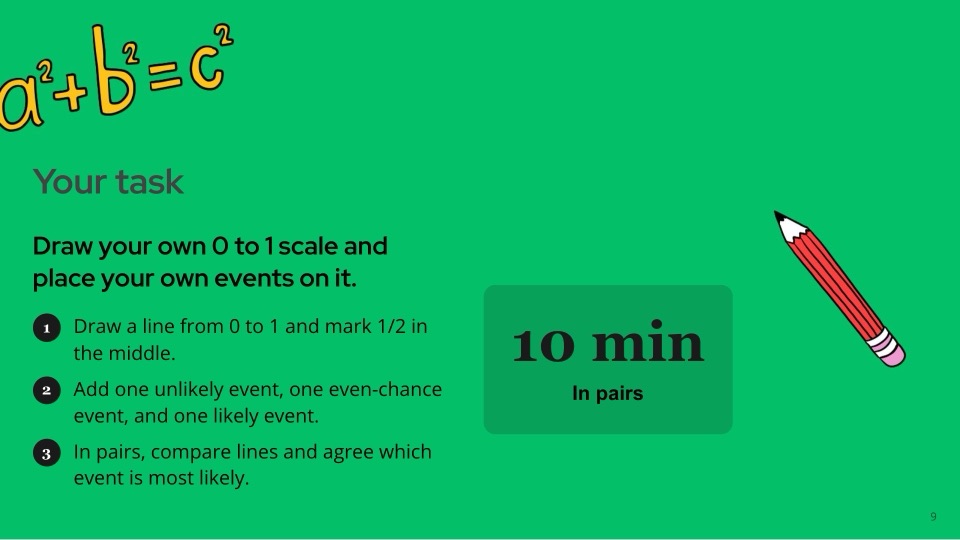
| 25 min | Main activity | Place chance events on the 0 to 1 scale to show unlikely, even chance, and likely. Show Slide 7 Three Zones on the Scale and read the Near 0 and Near 1/2 cards with the class. Call out events one at a time and have students walk slowly to the spot on the tape line that fits. Use rolling a 7 on one standard die is impossible and rolling a number between 1 and 6 is certain as end points. Hand out sticky notes for Slide 9 task so each student writes one unlikely event and one likely event and sticks them in place. |
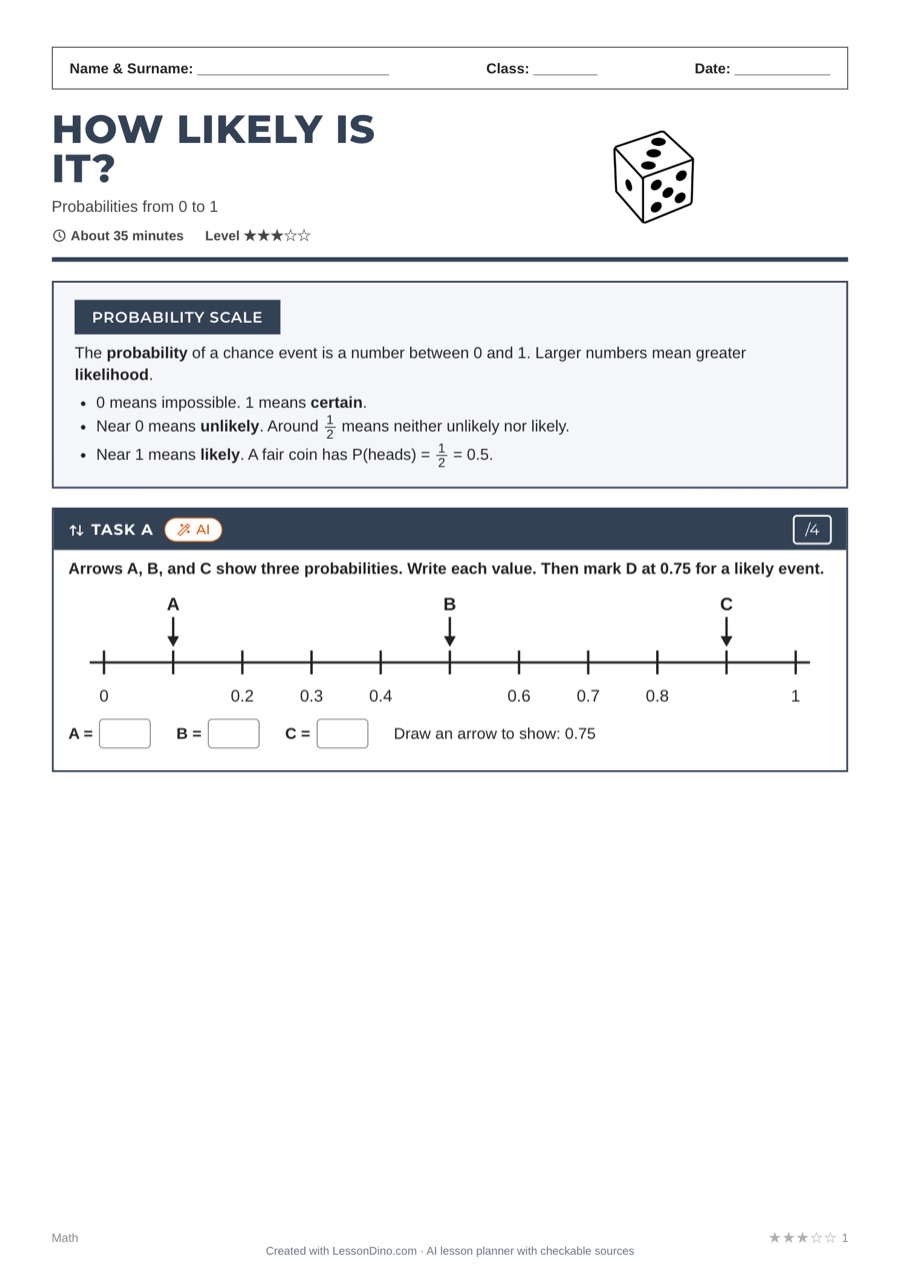
| 10 min | Practice | Order given probabilities and match numbers to unlikely, even chance, and likely. Hand out Worksheet Task B and read the directions together. Model ordering two values: 1/6 is near 0 and unlikely, 4/5 = 0.8 is near 1 and likely. Give pairs 7 minutes to order probabilities and write unlikely, even chance, or likely for each. Circulate and prompt pairs to compare sizes left to right from 0 to 1. |
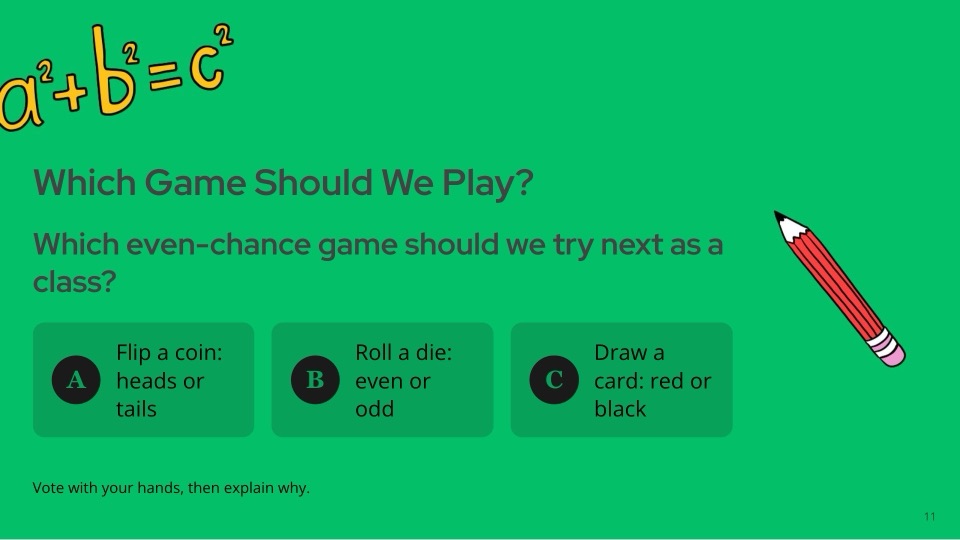
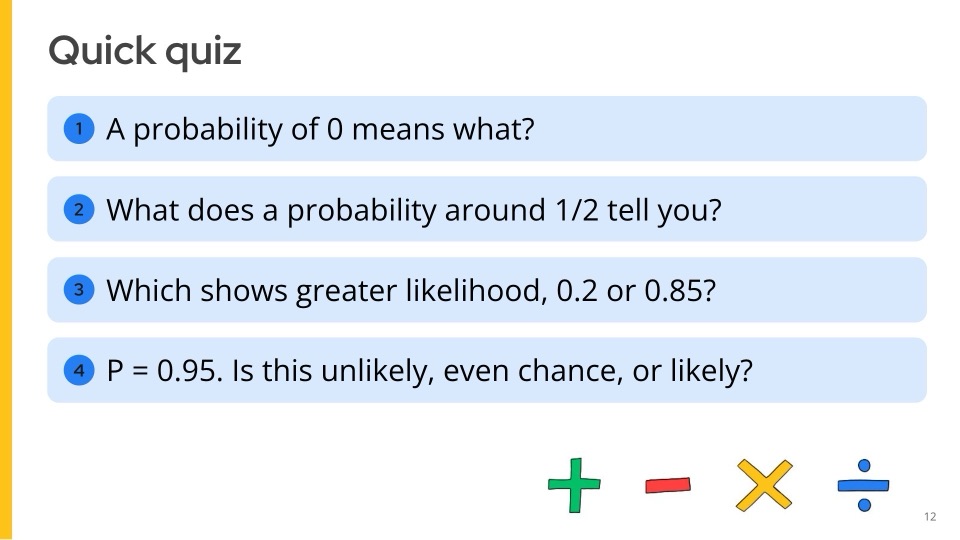
| 8 min | Plenary | Review key words and check that students can use the 0 to 1 scale. Show Slide 10 Key words and have class say each meaning together. Run Slide 11 vote on which even-chance game to try next: coin heads or tails, die even or odd, card red or black. Use Slide 12 Quick quiz for final check on 0 and around 1/2. Link the vote choices to around 1/2, neither unlikely nor likely. |
Common mistakes
- Thinking probability can be greater than 1 or less than 0
How to spot it: Student writes 1.2 or 120% or a negative as a probability
Point to the 0 to 1 line and restate probability is always between 0 and 1, where 0 indicates impossibility and 1 indicates certainty. - Thinking 1/2 means heads must happen every other flip exactly
How to spot it: Student says 10 flips must give exactly 5 heads
Remind that 1/2 is the long-run chance for a fair coin; short sets vary but stay near 1/2, neither unlikely nor likely. - Mixing up which fraction is larger, for example 1/6 larger than 4/5
How to spot it: Orders 4/5 before 1/6 or labels 1/6 as likely
Convert to decimals: 1/6 is about 0.17 near 0 and 4/5 = 0.8 near 1; larger numbers mean more likely.
Support
- Give students a small paper number line with 0, 1/2, and 1 already marked to hold while they decide where to stand.
- Provide sentence starters like This is near 0 because it has few ways to happen out of many outcomes.
- Allow pointing to sorting cards instead of explaining aloud in plenary.
Stretch
- Students must explain why a 0.52 and a 0.48 both count as around 1/2, neither unlikely nor likely.
- Students create one new event for each category and order all three by exact size.
- Students design a spinner worth 3/8 and argue whether it is unlikely, even, or likely.
Check questions
- A bag has 4 blue and 1 red marble. What is P(blue) and is it unlikely, even chance, or likely?
Answer: 4/5 = 0.8, likely near 1. - What does P = 1/2 mean in words?
Answer: Even chance, neither unlikely nor likely, like heads on a fair coin. - Which is more likely: rolling a 5 (1/6) or flipping heads (1/2)? Why?
Answer: Flipping heads, because 1/2 is larger than 1/6 and larger means more likely.
Curriculum
Understand that the probability of a chance event is a number between 0 and 1 that expresses the likelihood of the event occurring. Larger numbers indicate greater likelihood. A probability near 0 indicates an unlikely event, a probability around 1/2 indicates an event that is neither unlikely nor likely, and a probability near 1 indicates a likely event.
Video clips
Clips on YouTube, from the start and end times we chose. Check each one before you show it.
-
Basic probability 0 to 1 from 0:00 to 5:00
mathantics: Math Antics - Basic Probability
Teaches probability as 0 to 1 with unlikely, even, and likely language at a clear pace that suits 12-13-year-olds.
-
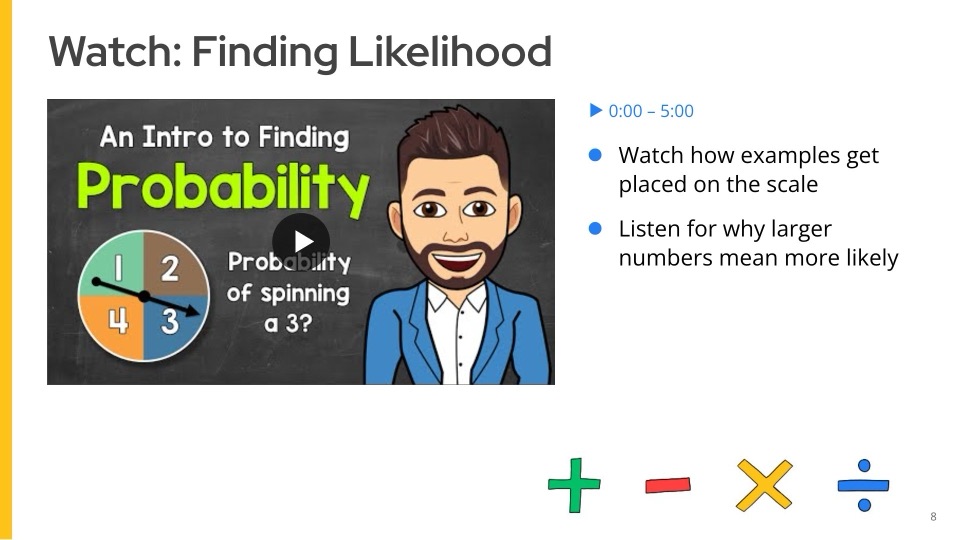
Intro to finding probability from 0:00 to 5:00
Math with Mr. J: An Intro to Finding Probability | Basic Probability | Math with Mr. J
Made for middle school and directly models likelihood words for probabilities near 0, 1/2, and 1 for 12-13-year-olds.
Worksheet
Sources
- Grade 7 | Common Core State Standards Initiative thecorestandards.org
- 7th grade Math Curriculum 2025 - thoreaums.fcps.edu thoreaums.fcps.edu
- Seeing Theory - Basic Probability seeing-theory.brown.edu
- Notes on Probability - Stanford University web.stanford.edu
- Introduction to Probability and Statistics | Mathematics ... ocw.mit.edu
- Probability davidmorin.physics.fas.harvard.edu
- Basic probability - Student Academic Success - Monash University monash.edu
- Posterior probability en.wikipedia.org
- Flexi answers - What are the probabilities? | CK-12 Foundation ck12.org
- Probability for Data Miners cs.cmu.edu
- 2 Properties of Probability – STAT 414 | Introduction to ... online.stat.psu.edu
- Probability | Statistics essentials | Math | Khan Academy khanacademy.org
- Fixation probability for a beneficial allele and a mutant strate… pubmed.ncbi.nlm.nih.gov
- Probability Distribution Learning: A theoretical framework for D… arxiv.org
- Probability Math - Discworld & Terry Pratchett Wiki wiki.lspace.org
- Probability Worksheets - Free & Printable superteacherworksheets.com
- Probability Worksheets mathworksheets4kids.com
- Probability - Math is Fun mathsisfun.com
- Free Probability and Statistics Worksheets mathfunworksheets.com
- probability distributions - For which $f$ does $\int f d\mu_n\to… mathoverflow.net
- Basic Probability: Formulas, Rules & Worked Examples statisticsfundamentals.com
- In a class of 60 students, 30 opted for NCC, 32 opted for NSS and 24 opted for both NCC and NSS. If one of these students is selected at random, find the probability that the student opted for NCC. cuemath.com
- Answers to: The student body of a large university consists of 30% Business majors. A random sample of 20 students is selected. a. What is the probability that among the students in the sample at leas classace.io
- The Probability of Becoming an Olympian: Unveiling the Odds blog.myswimpro.com
- The probability that the location in the United States is chosen at rando.. askfilo.com
Picture credits
- Photo: viarami · Pixabay
- Illustration: Land_of_Books_YouTube · Pixabay
- Pictograms: Sergio Palao, ARASAAC (arasaac.org) · CC BY-NC-SA
Made with Lesson Dino's AI on 17 October 2026. AI can make mistakes, so check facts against the sources before you teach.