Slides
Lesson plan
Link the Story Chain
Students learn to sequence events and add showing details. They build a paper-chain story and draft a short narrative scene.
Objectives
- Students will sequence real or imagined events from exposition to resolution clearly.
- Students will use dialogue and action as effective technique to move events forward.
- Students will add relevant sensory details that show experience instead of telling it.
Success criteria
- I can order 4-5 events from exposition to resolution.
- I can show feelings with senses and dialogue.
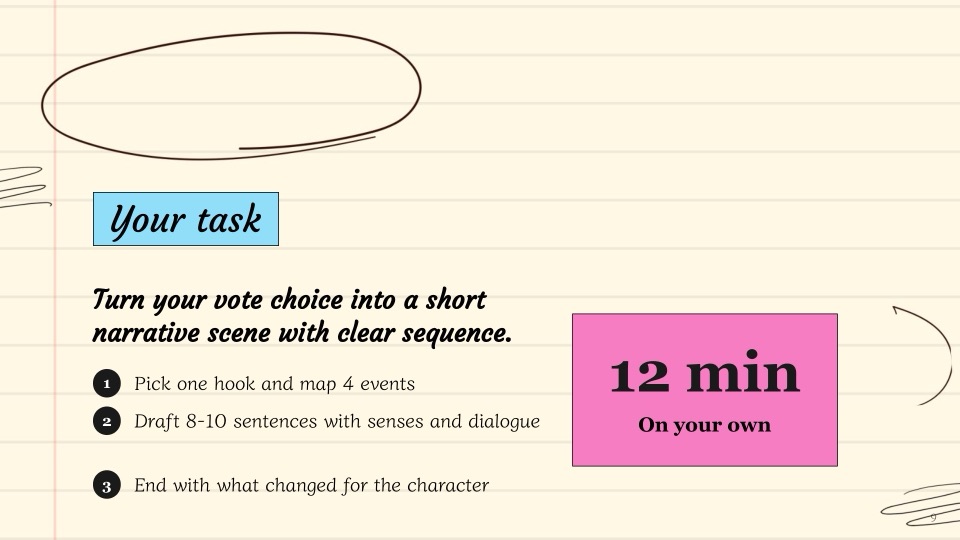
- I can write 8-10 sentences about a real or imagined event.
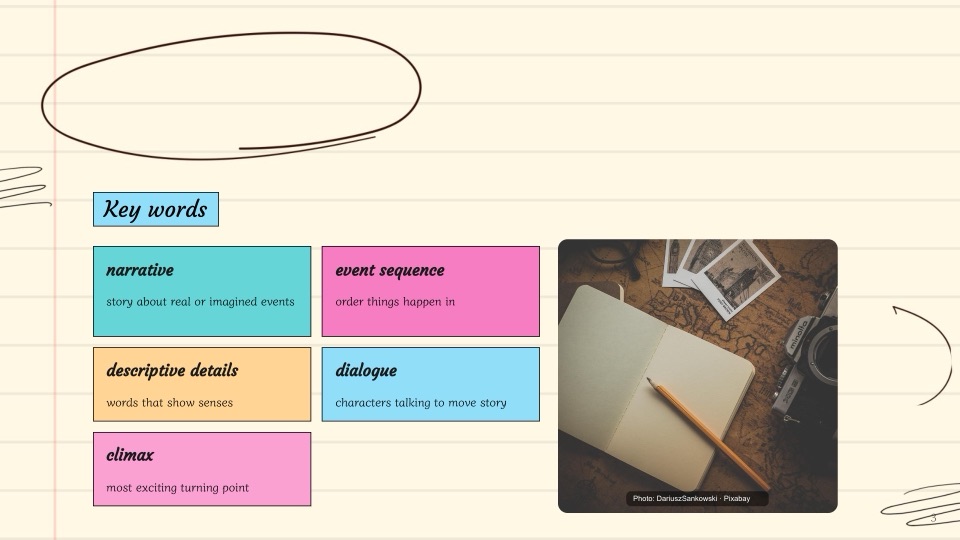
Key words
| Word | Meaning |
|---|---|
| narrative | a story about real or imagined events |
| event sequence | the order things happen in |
| descriptive details | words that show what can be seen, heard, and felt |
| dialogue | talking between people in a story |
| climax | the biggest, most exciting moment in a story |
Timed plan (60 minutes)
| Time | Stage | What happens |
|---|---|---|
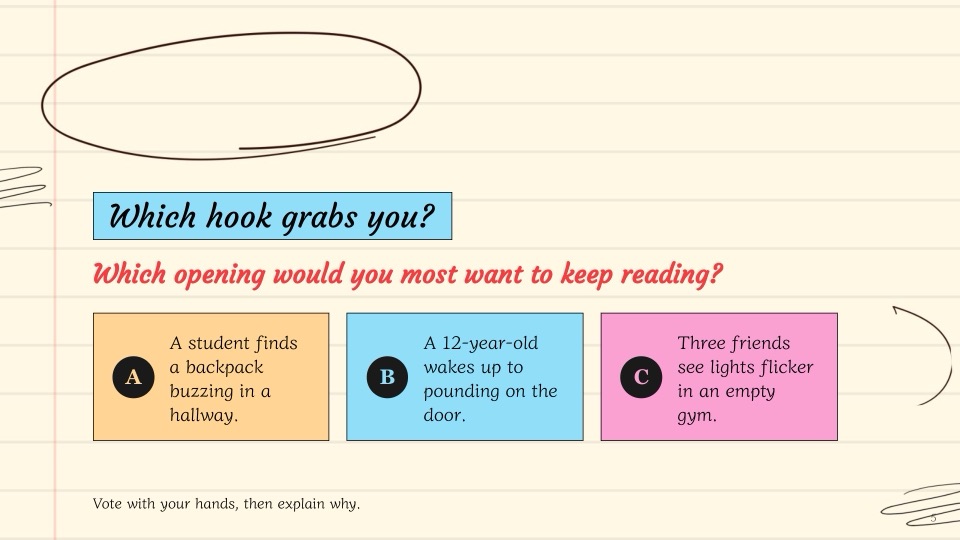
| 7 min | Starter | Hook students and recall what makes a narrative feel real. Welcome the class and say the hook while holding up a short paper chain. Show title and big idea slides and read them aloud. Take a quick vote on the three story hooks to activate ideas about real or imagined events. Link votes to today’s goal of building a sequence that does not fall apart. |
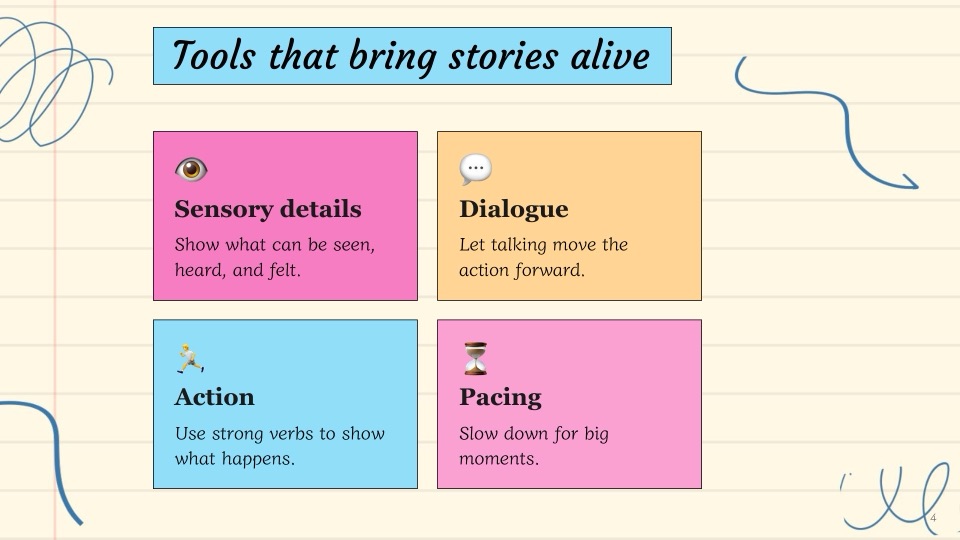
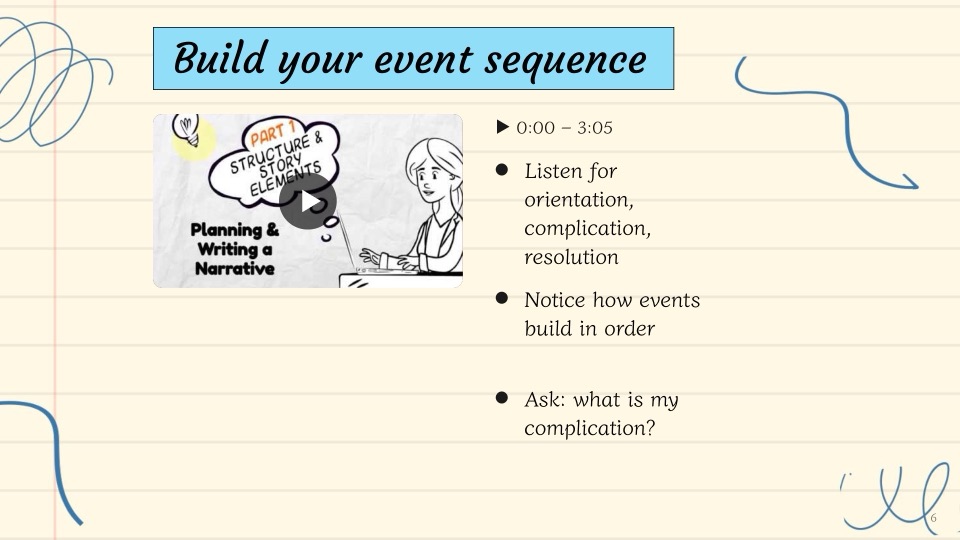
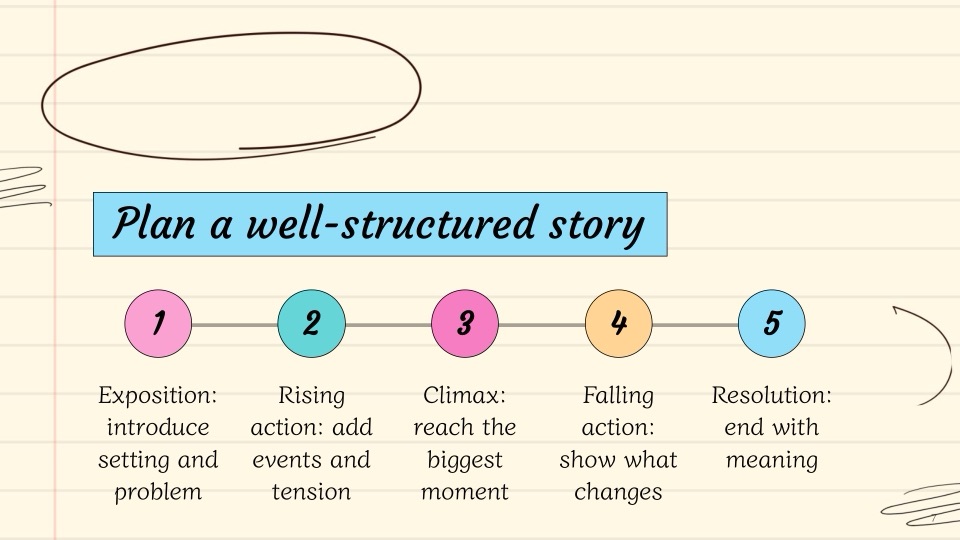
| 10 min | Teaching - structure | Teach well-structured event sequences from exposition to resolution. Teach key words and tools for stories using the word and tool slides. Play the video on building event sequence and tell students to listen for orientation, complication, resolution. Model the five-part structure in order: exposition, rising action, climax, falling action, resolution, since the five-part structure divides a story that way. Think aloud your complication question for a rainy-day plan: what goes wrong after school? |
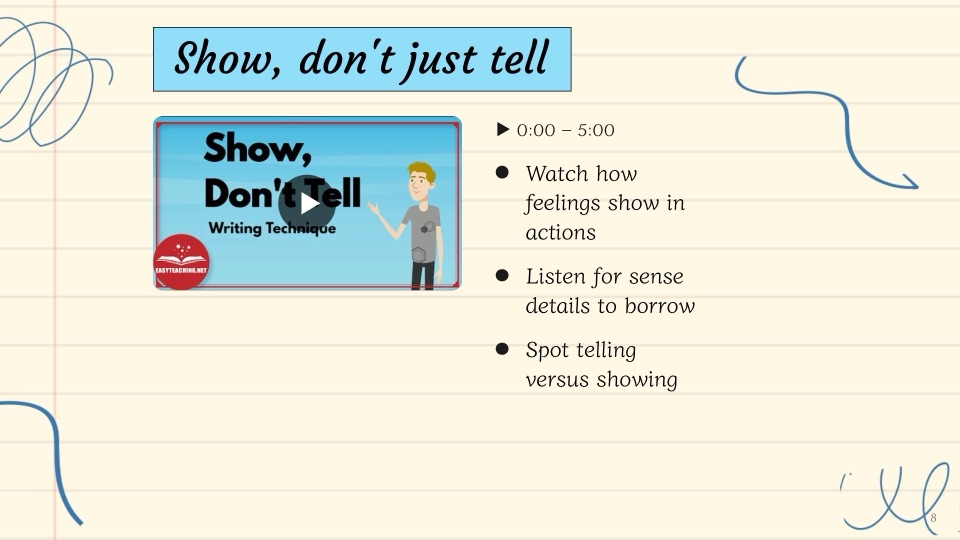
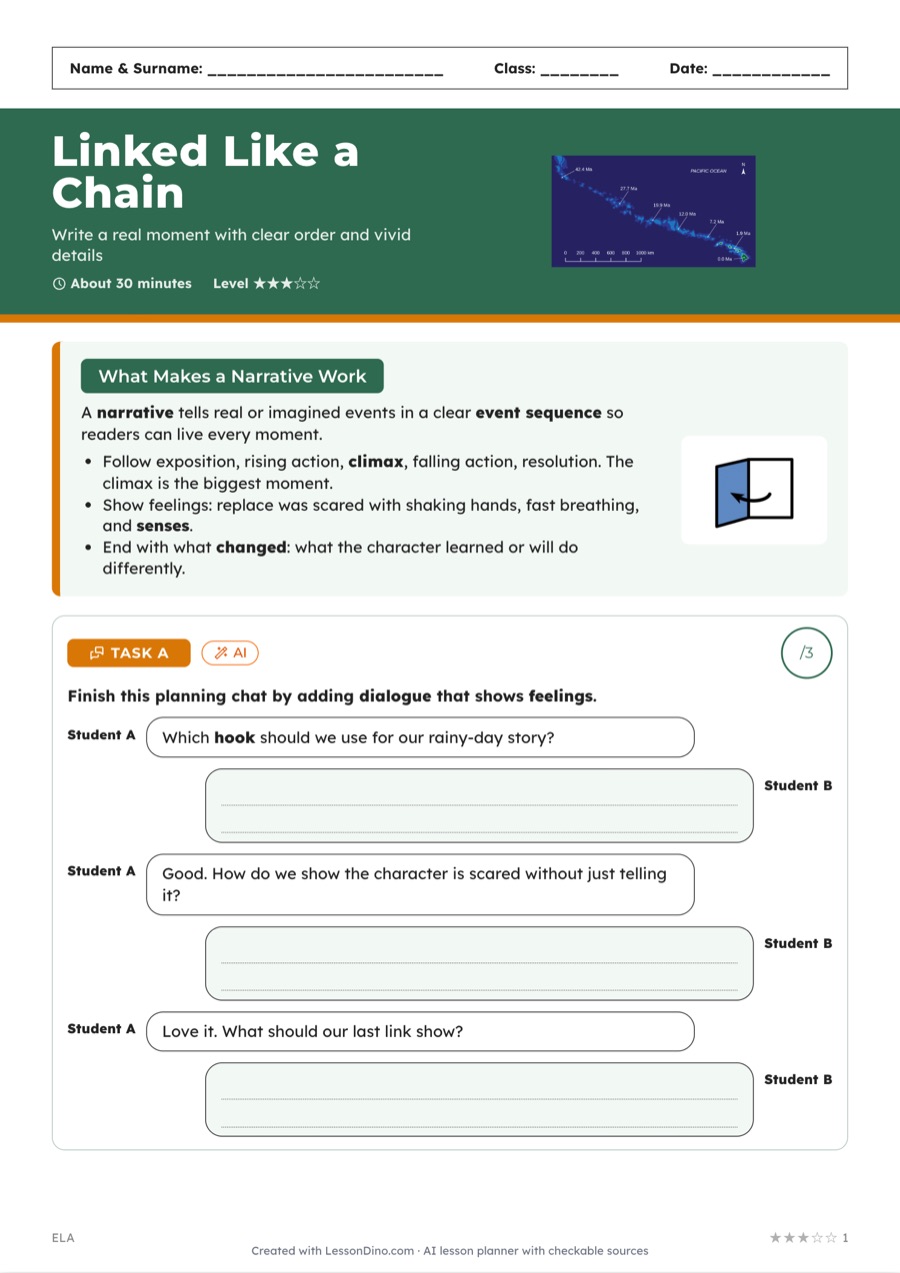
| 11 min | Teaching - show and talk | Teach showing details and dialogue that move action forward. Play the video on showing feelings in actions and sense details to borrow. Model telling versus showing with the scared sentence, since writers use show not tell to pull the reader in. Model dialogue with action beats between Student A and Student B, because narrative writing often includes dialogue, characters, and a plot. Guide pairs to start Worksheet Task A adding dialogue that shows feelings. |
| 22 min | Main activity | Build a well-structured sequence of real or imagined events as a paper chain. Hand out strips, markers, and tape and name the class story: a rainy-day plan after school. Direct each student to write one event on a strip, then have groups organize strips so they connect logically, because narrative writing presents readers with a sequence of events. Use Worksheet Task B thinking to check consequences: what happens after the zipper breaks and what happens next. Guide groups to tape the chain, add detail strips, then retell link by link to check flow. |
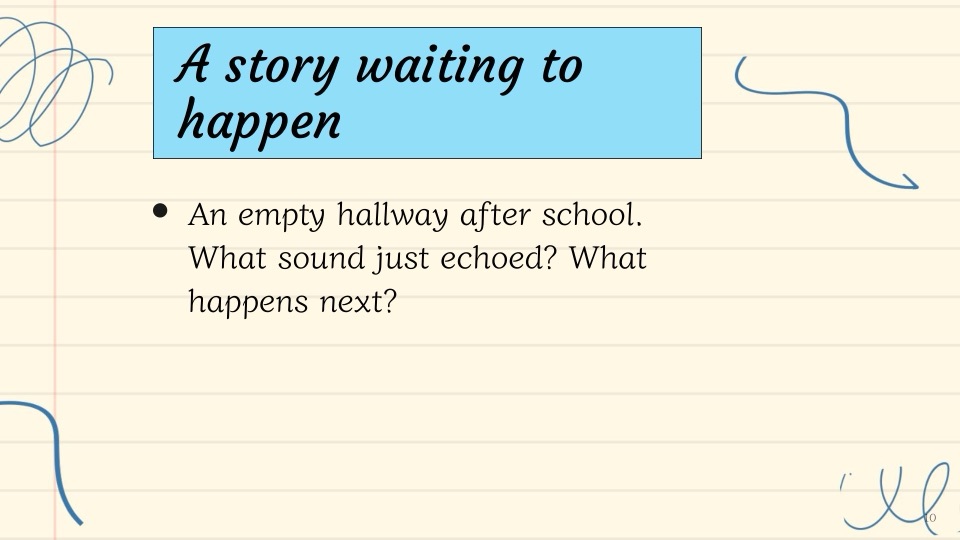
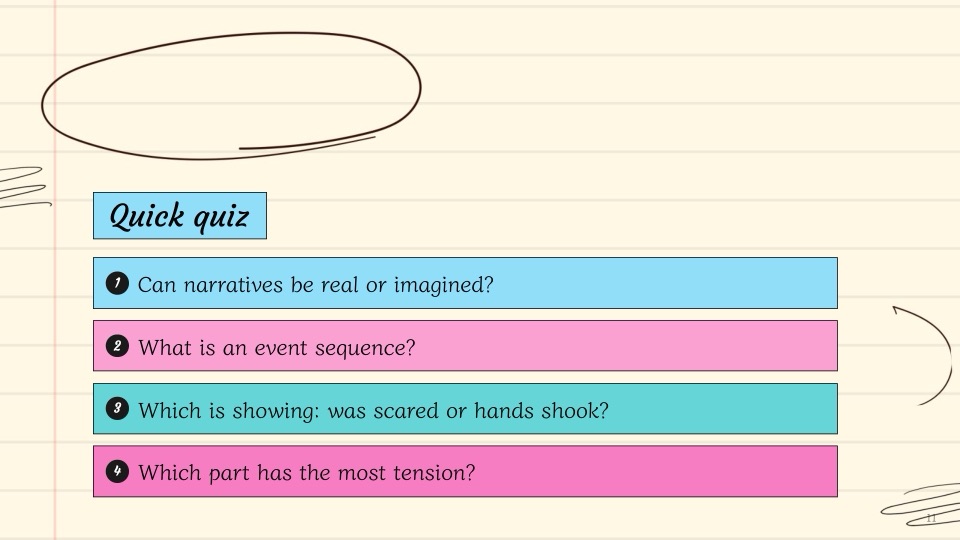
| 10 min | Plenary | Review success criteria and check narrative understanding. Hang two strong chains and ask groups to point to the sensory phrase that gives the moment away. Use the hallway prompt to invite one oral what-happens-next sentence with showing detail. Run the quick quiz and exit ticket on paper. Connect back to writing real or imagined events with technique, details, and sequence. |
Common mistakes
- Listing events out of order with no build to a climax
How to spot it: Chain retell jumps or climax comes first
Re-sort using exposition to resolution order and ask what builds tension to the biggest moment - Telling feelings instead of showing senses and actions
How to spot it: Sentences use was scared, was happy with no senses
Rewrite with show not tell to help readers see, hear, and feel what happened - Dialogue that only talks and does not move action
How to spot it: Three lines with no beats or same voice for both speakers
Add action beats and specific word choice, since dialogue, characters, and plot work together
Support
- Label five strips with exposition, rising action, climax, falling action, and resolution to guide placement
- Give sight, sound, smell, touch word bank plus starters My hands and The air smelled
- Provide frames for dialogue tags and ending insight: At first I thought ___, but now I ___
Stretch
- Add a second colorful detail strip to two links that shows color, sound, or texture
- Add a contrasting action that hides the feeling, like whistling while hands shake
- Start in the middle of the action, then drop in one sentence that hints at what happened earlier
Check questions
- Can narratives be real or imagined?
Answer: Both. - What is an event sequence?
Answer: The order events happen in. - Which is showing: was scared or hands shook?
Answer: Hands shook.
Curriculum
Write narratives to develop real or imagined experiences or events using effective technique, relevant descriptive details, and well-structured event sequences.
Video clips
Clips on YouTube, from the start and end times we chose. Check each one before you show it.
-
Narrative structure and elements from 0:00 to 3:05
EasyTeaching: Writing a Narrative: Part 1 Structure & Elements | EasyTeaching
Covers orientation, complication, and resolution with clear visuals ideal for ages 11-12 learning well-structured event sequences.
-
Show, don't tell technique from 0:00 to 5:00
EasyTeaching: Show, Don't Tell Writing Technique | EasyTeaching
Explains show-don't-tell with kid-friendly examples that match Grade 6 vocabulary and support effective technique.
Worksheet
Sources
- How to Read the Standards thecorestandards.org
- English Language Arts cps.edu
- Beginning Creative Writing - Harvard Division of Continuing ... coursebrowser.dce.harvard.edu
- Fundamentals in Creative Writing: The Grammar of Narrative creativewriting.uchicago.edu
- THE EFFECTS OF CREATIVE WRITING ACTIVITIES ON NARRATIVE TEXT ... files.eric.ed.gov
- Introduction - Creative Writing - LibGuides at Malone University libraryguides.malone.edu
- What is Creative Writing? | SNHU snhu.edu
- Narrative and Creative Writing for Nonfiction - eCornell ecornell.cornell.edu
- Writing Skills - Creative and narrative writing - BBC Bitesize bbc.co.uk
- Crafting an engaging narrative KS4 | Y10 English AQA | Lesson ... thenational.academy
- Writing a full narrative piece using the five part narrative ... thenational.academy
- Creative writing - KS2 English - BBC Bitesize bbc.co.uk
- UNIVERSITY WRITING CENTER calbaptist.edu
- Modes of Writing - Eastern easternct.edu
Picture credits
- Photo: StockSnap · Pixabay
- Photo: Sunriseforever · Pixabay
- Photo: DariuszSankowski · Pixabay
- Pictograms: Sergio Palao, ARASAAC (arasaac.org) · CC BY-NC-SA
- Drawing: Carie Frantz with data from Eakins et al. (2023) and Clague · CC BY-SA 4.0 · Wikimedia Commons
Made with Lesson Dino's AI on 17 October 2026. AI can make mistakes, so check facts against the sources before you teach.