The worksheet
About this worksheet
Students learn to interpret figures of speech in context. They discuss personification and sort literal from figurative meaning. This Grade 6 ELA worksheet gives students (ages 11–12) five pages of practice on figures of speech, part of the language unit. It goes with our free Figures of speech lesson, which has the slides and a timed lesson plan.
What it covers
By the end, students should be able to:
- Students will interpret personification in context using nearby clues.
- Students will tell literal meaning from figurative meaning in sentences.
- Students will explain the real meaning of figures in own words.
How to use it
- Use it for practice after the teaching part of the lesson, once students have seen the worked examples on the slides.
- Support: Provide a choice of two plain meanings for each personification line.
- Stretch: Have students explain what changes if the human action is swapped for a different one.
- The answer sheet is the last page, so you can print it on its own or let students check their own work.
Key vocabulary
- personification: giving a thing an action only a person can do
- metaphor: a comparison between two things without using like or as
- simile: a comparison between two things using like or as
- hyperbole: a big exaggeration on purpose to show feeling
- context: the words and situation around a tricky phrase
- figurative language: words that create meaning by comparing one thing to another thing
Mistakes to watch for
- Taking the figure as exactly true, like wind really talked. Ask could this really happen, then replace with real action: blew softly, because literal states exactly what it is.
- Naming any comparison as personification. Ask if a human action is given to a thing; if not, test for metaphor as analogy between two things.
- Ignoring context clues and giving a memorized meaning. Require circling two nearby clues and explaining meaning right there in that scene.
What's on the worksheet
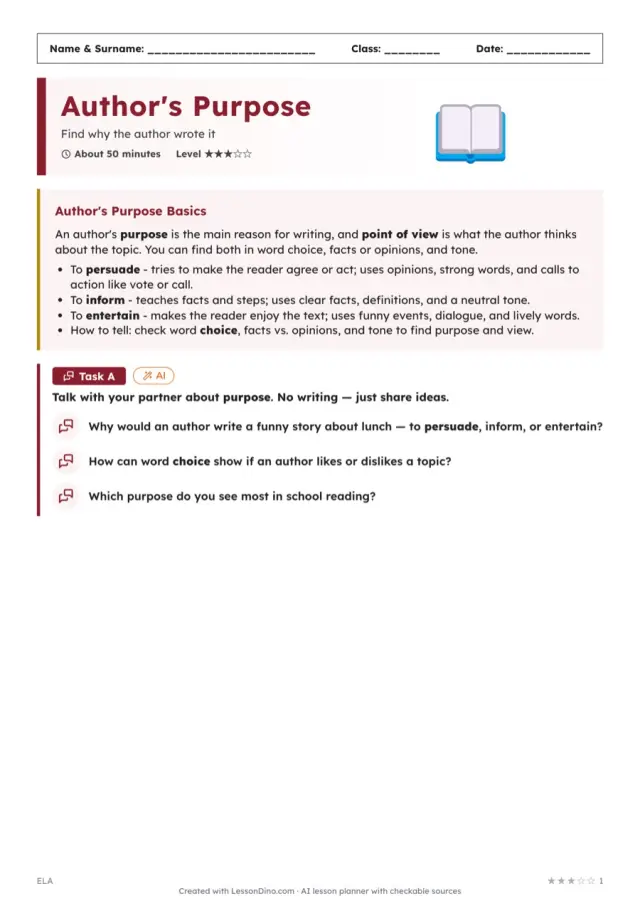
Words That Paint
Learn what figures of speech do, then break down one example.
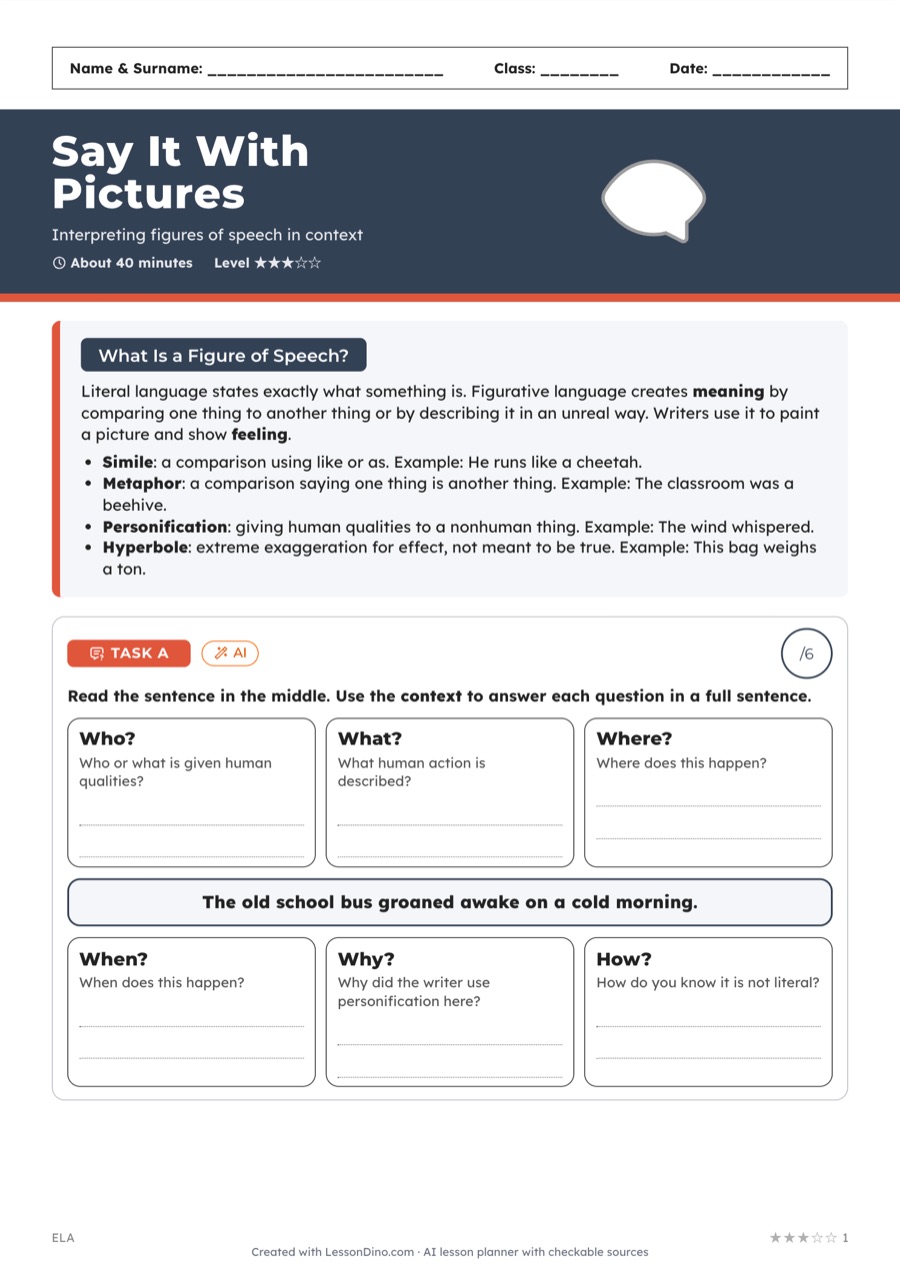
What Is a Figure of Speech?
- Literal language states exactly what something is. Figurative language creates meaning by comparing one thing to another thing or by describing it in an unreal way. Writers use it to paint a picture and show feeling.
- Simile: a comparison using like or as. Example: He runs like a cheetah.
- Metaphor: a comparison saying one thing is another thing. Example: The classroom was a beehive.
- Personification: giving human qualities to a nonhuman thing. Example: The wind whispered.
- Hyperbole: extreme exaggeration for effect, not meant to be true. Example: This bag weighs a ton.
Read the sentence in the middle. Use the context to answer each question in a full sentence.
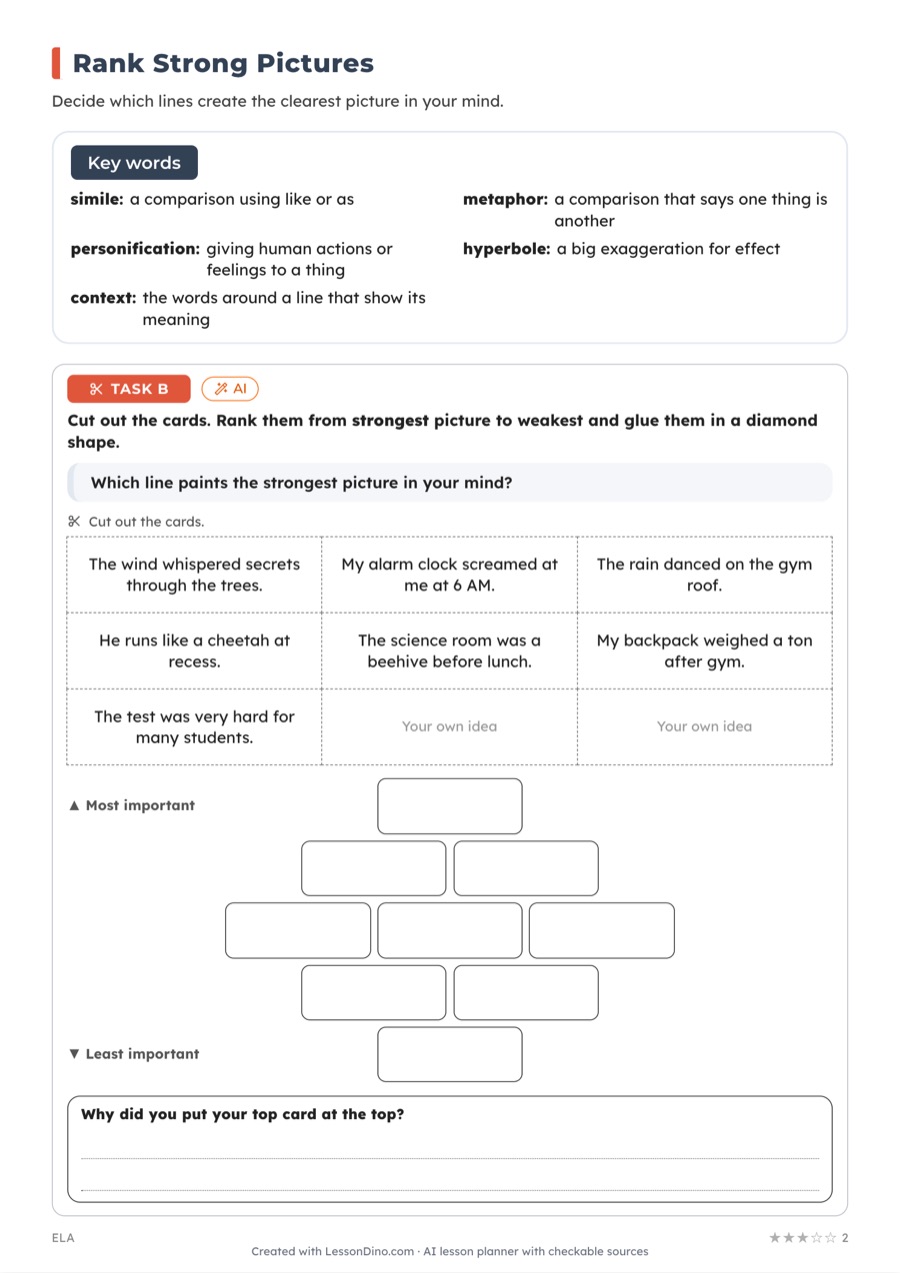
Rank Strong Pictures
Decide which lines create the clearest picture in your mind.
| Word | Meaning |
|---|---|
| simile | a comparison using like or as |
| metaphor | a comparison that says one thing is another |
| personification | giving human actions or feelings to a thing |
| hyperbole | a big exaggeration for effect |
| context | the words around a line that show its meaning |
Cut out the cards. Rank them from strongest picture to weakest and glue them in a diamond shape.
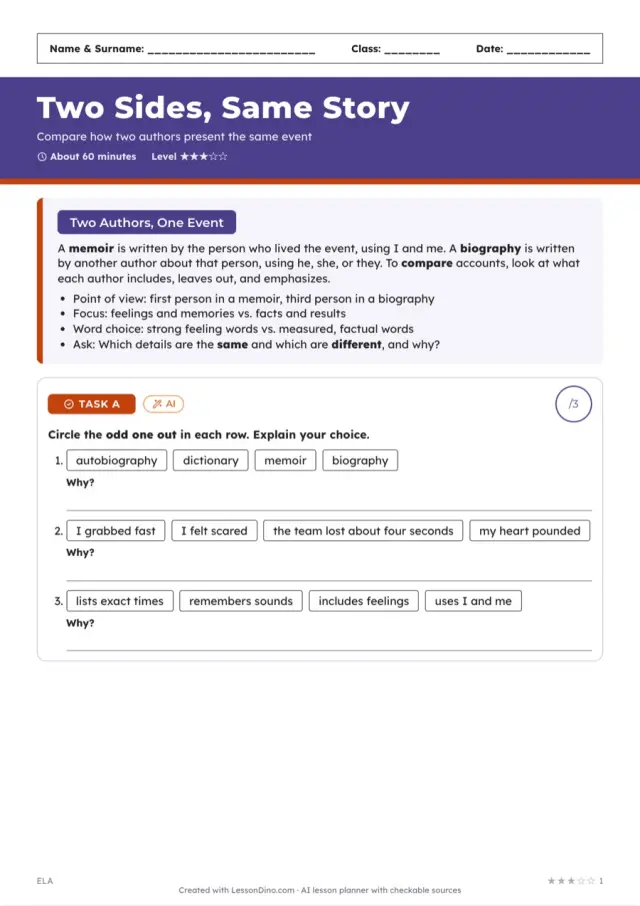
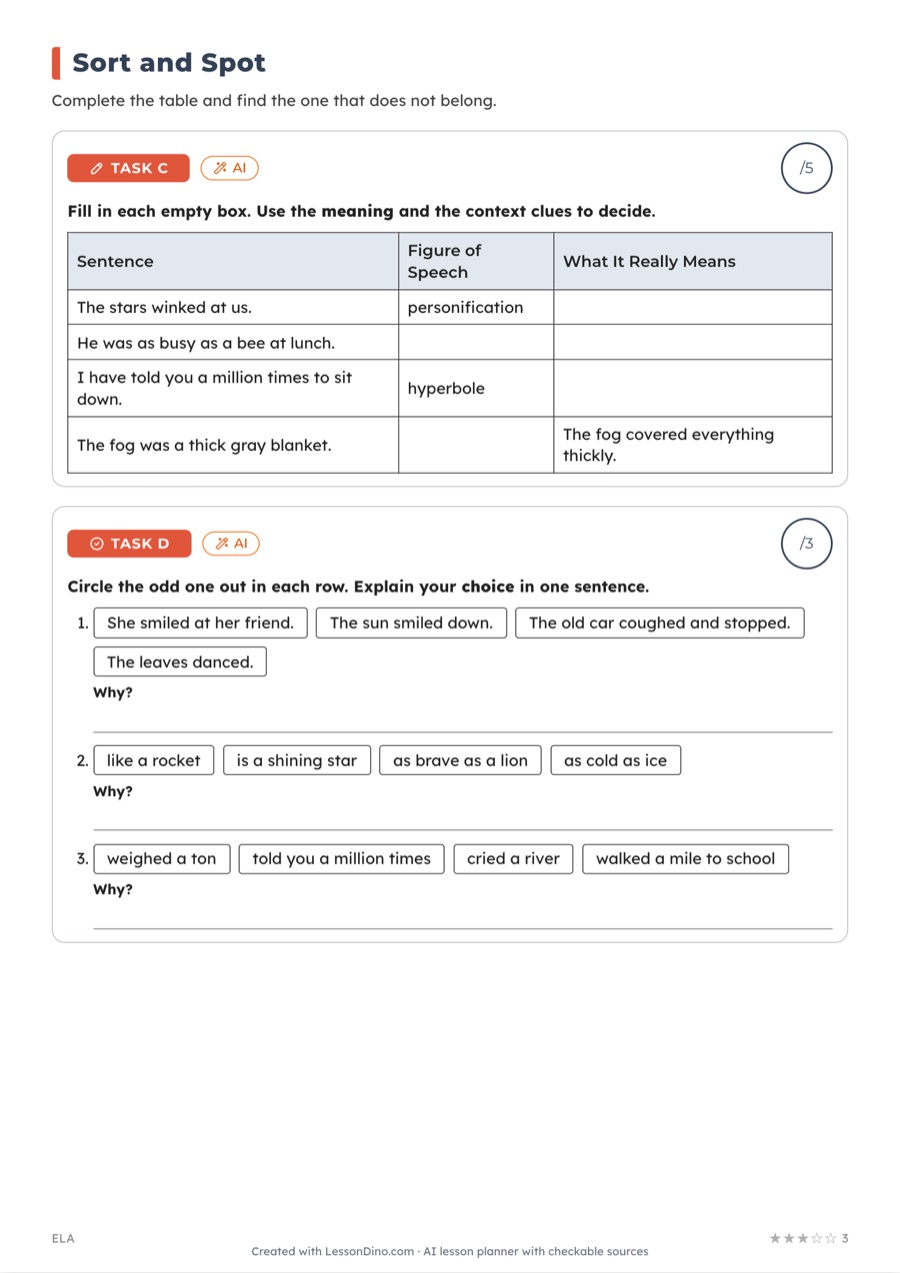
Sort and Spot
Complete the table and find the one that does not belong.
Fill in each empty box. Use the meaning and the context clues to decide.
Circle the odd one out in each row. Explain your choice in one sentence.
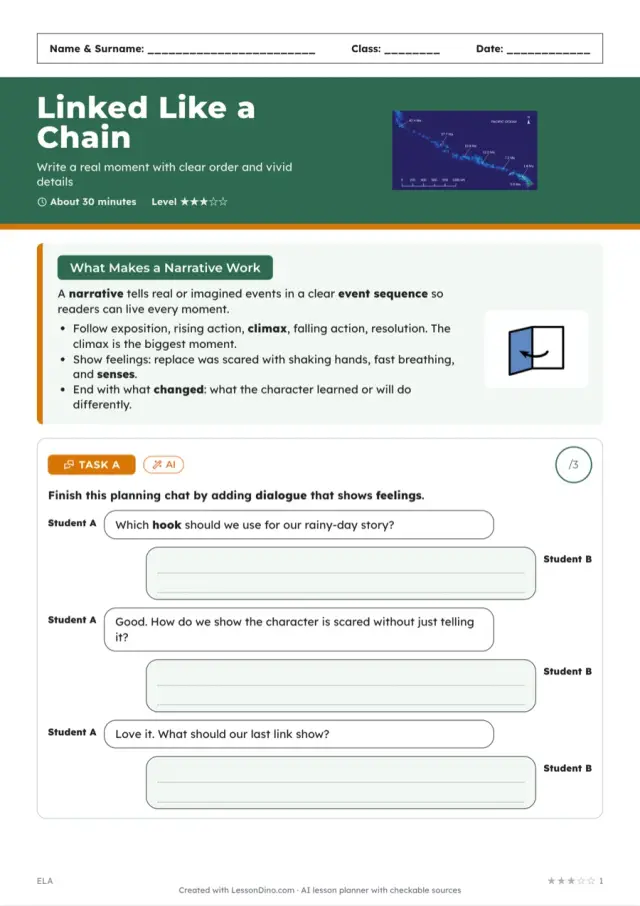
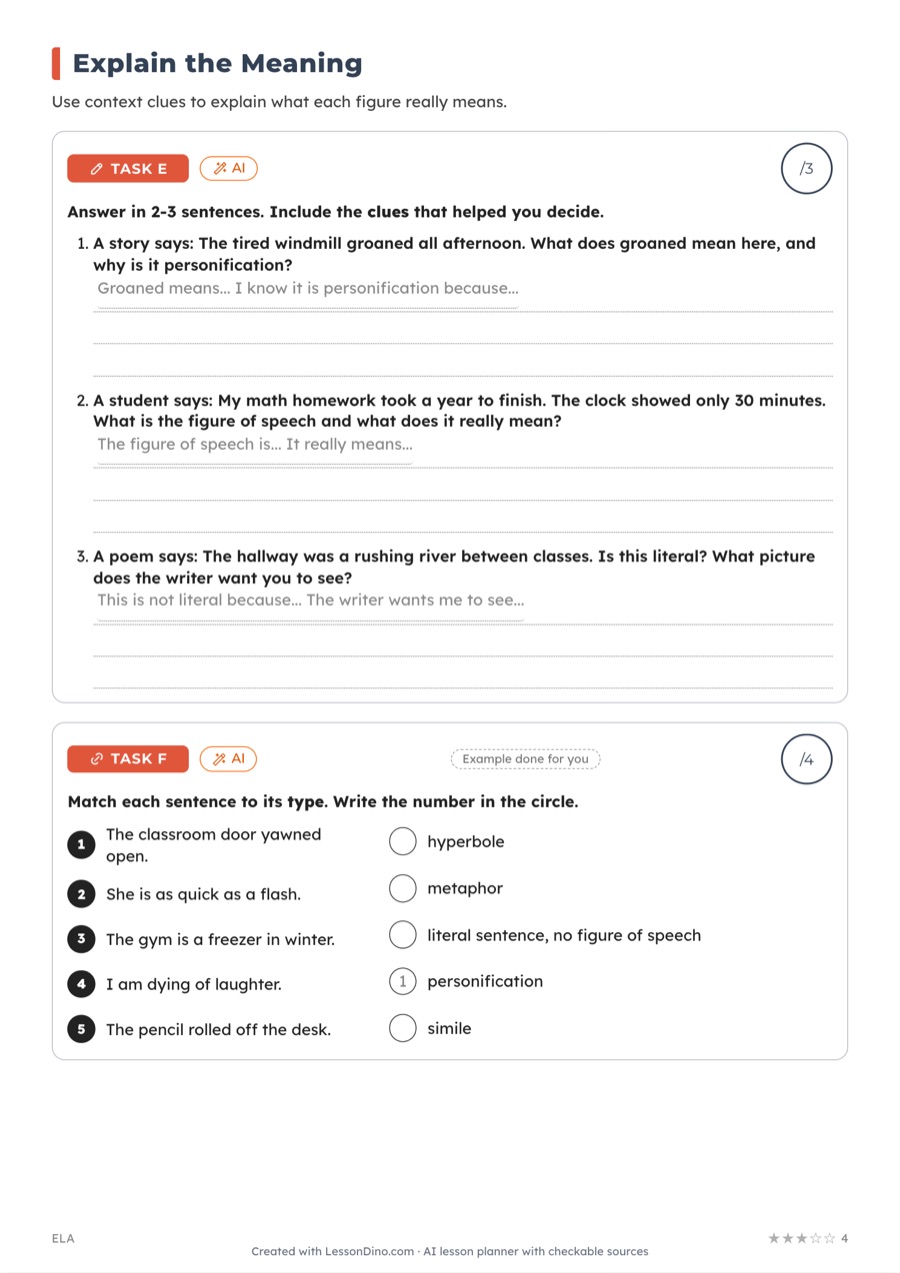
Explain the Meaning
Use context clues to explain what each figure really means.
Answer in 2-3 sentences. Include the clues that helped you decide.
- A story says: The tired windmill groaned all afternoon. What does groaned mean here, and why is it personification?
- A student says: My math homework took a year to finish. The clock showed only 30 minutes. What is the figure of speech and what does it really mean?
- A poem says: The hallway was a rushing river between classes. Is this literal? What picture does the writer want you to see?
Match each sentence to its type. Write the number in the circle.
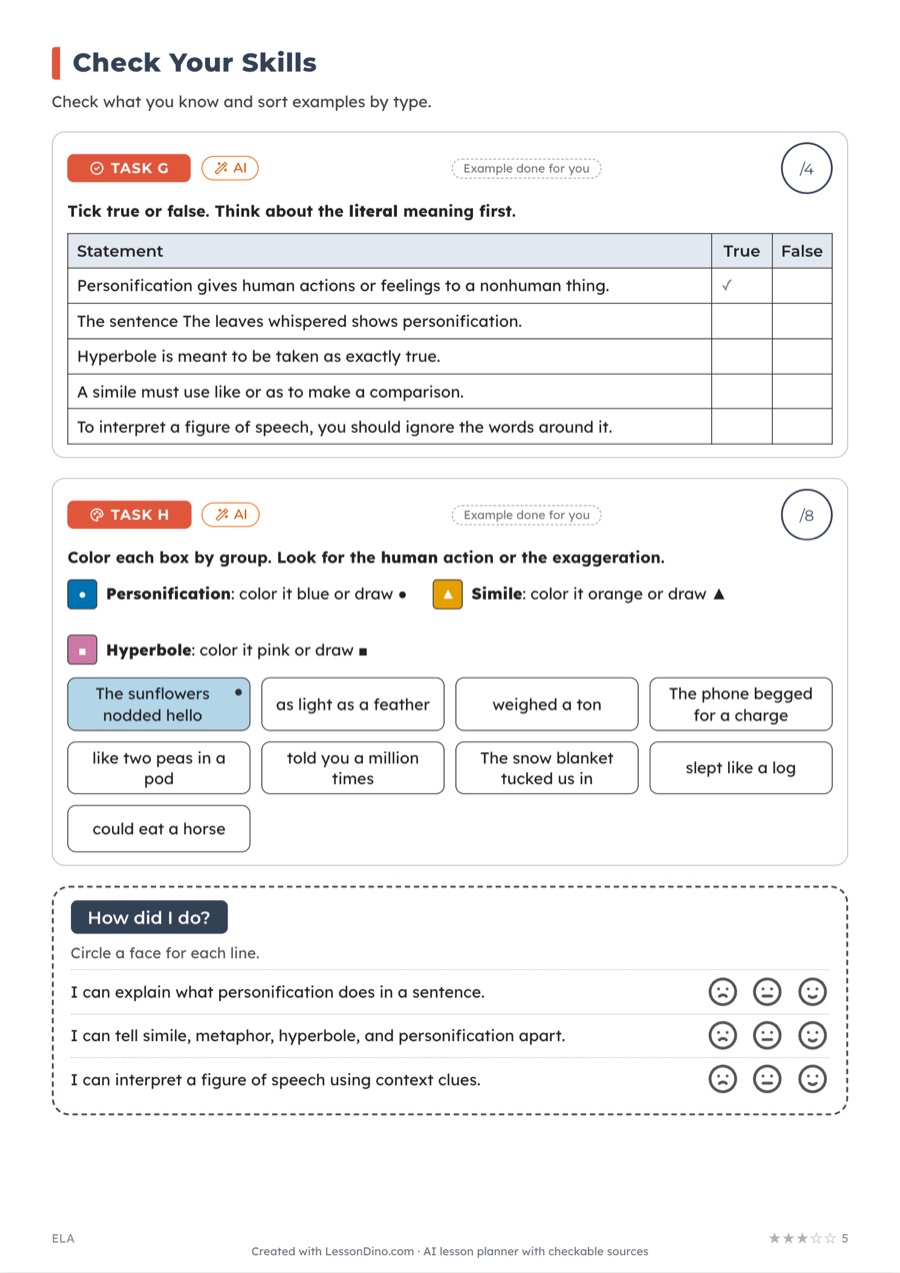
Check Your Skills
Check what you know and sort examples by type.
Tick true or false. Think about the literal meaning first.
Color each box by group. Look for the human action or the exaggeration.
Answers
Show the answers
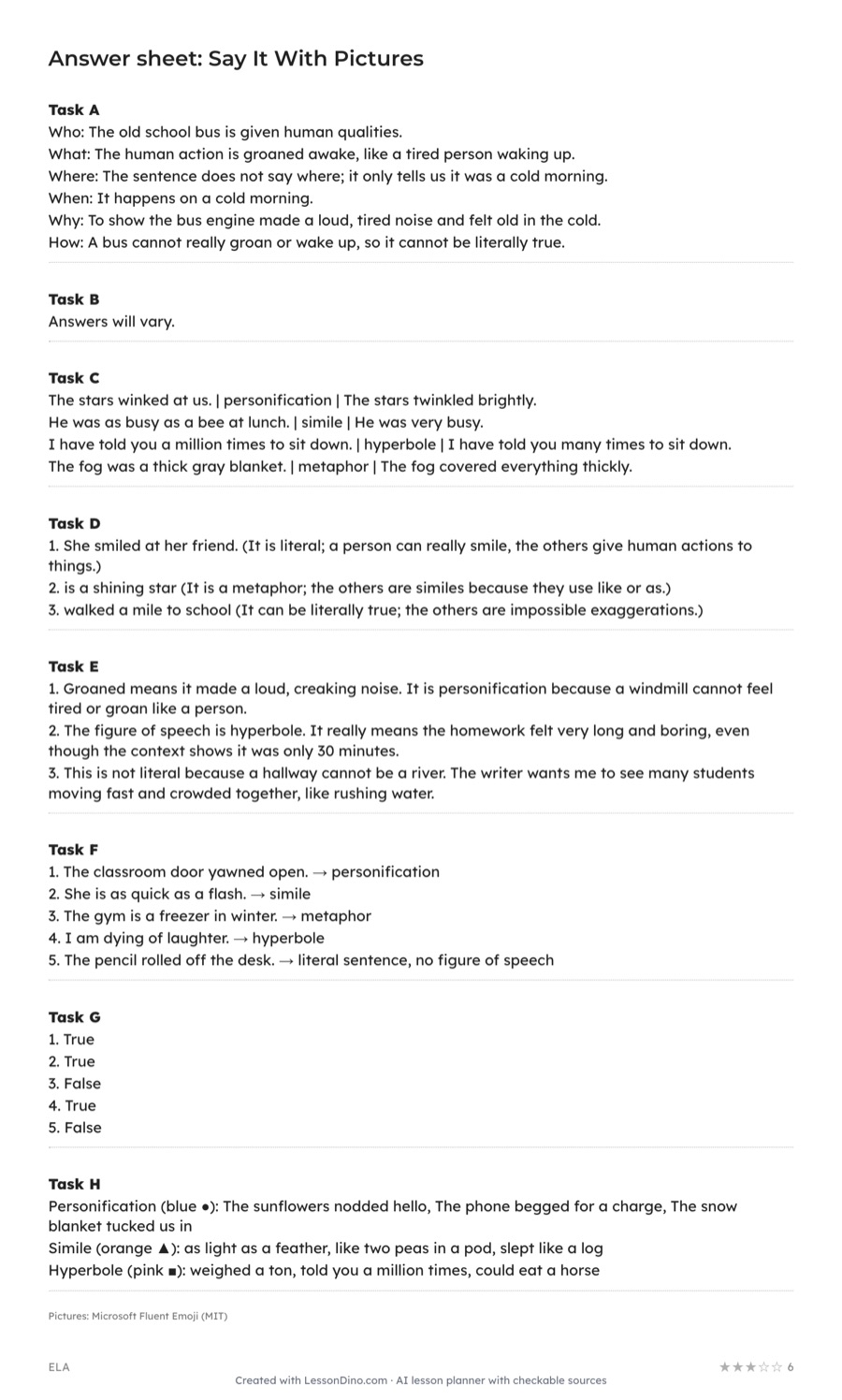
- A story says: The tired windmill groaned all afternoon. What does groaned mean here, and why is it personification? Groaned means it made a loud, creaking noise. It is personification because a windmill cannot feel tired or groan like a person.
- A student says: My math homework took a year to finish. The clock showed only 30 minutes. What is the figure of speech and what does it really mean? The figure of speech is hyperbole. It really means the homework felt very long and boring, even though the context shows it was only 30 minutes.
- A poem says: The hallway was a rushing river between classes. Is this literal? What picture does the writer want you to see? This is not literal because a hallway cannot be a river. The writer wants me to see many students moving fast and crowded together, like rushing water.
The answer sheet is the last picture above.
Curriculum
Interpret figures of speech (e.g., personification) in context.
Made with Lesson Dino's AI on 17 October 2026. AI can make mistakes, so check the answers and facts against the sources before you teach.