Slides
Lesson plan
Detective Eyes: Purpose and Point of View
Students learn to name purpose and point of view and spot how authors show it. They hunt for clues with magnifiers and prove ideas with evidence.
Objectives
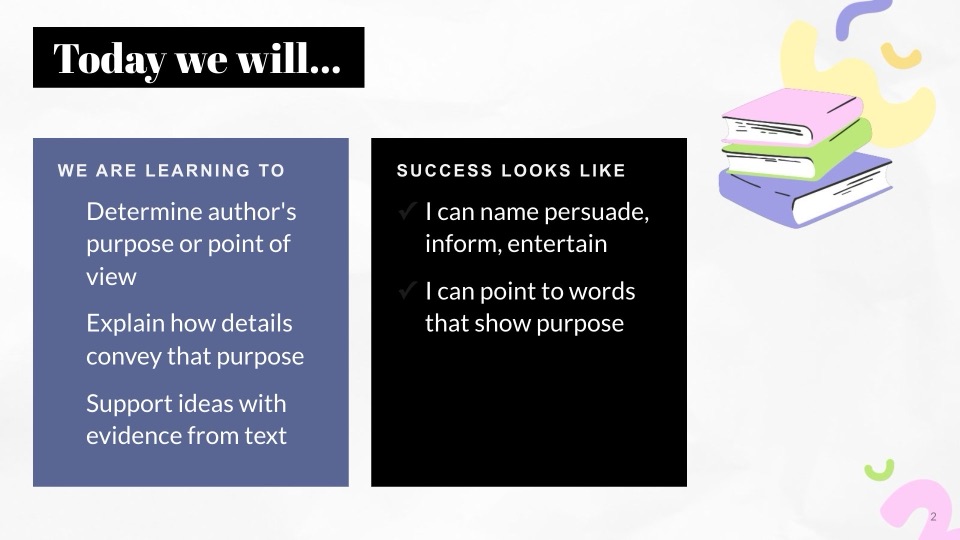
- Students will determine author's purpose or point of view using text details.
- Students will explain how word choice and text features convey that purpose.
- Students will support ideas about purpose with evidence from the text.
Success criteria
- I can name persuade, inform, entertain and tell point of view.
- I can explain how words and facts show the author's purpose.
- I can use text evidence to prove purpose or point of view.
Key words
| Word | Meaning |
|---|---|
| purpose | the reason someone writes something |
| point of view | what a writer thinks or feels about a topic |
| persuade | to get someone to do or believe something |
| inform | to give facts and explain something clearly |
| entertain | to make someone enjoy with a funny or exciting story |
| evidence | a detail from the text that proves an idea |
Timed plan (60 minutes)
| Time | Stage | What happens |
|---|---|---|
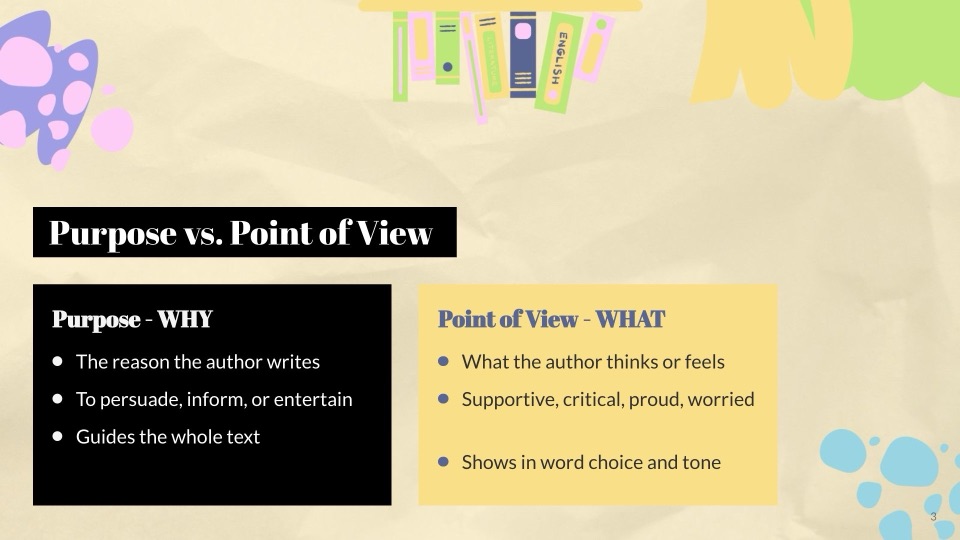
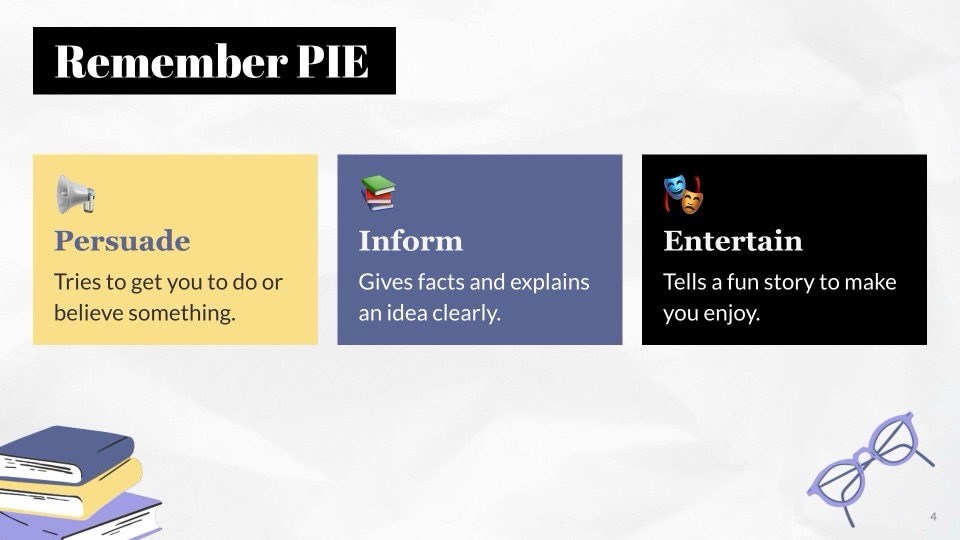
| 5 min | Starter | Activate PIE knowledge and hook curiosity for detective reading. Greet class and show Slide 4 Remember PIE cards. Say hook line and model hand signals: desk slap for persuade, book shape for inform, laugh clap for entertain. Read three quick lines about a rainy weekend, one to persuade, one to inform, one to entertain, and have class signal. Link signals to Slide 3 Purpose vs Point of View: purpose is WHY, point of view is WHAT the author thinks. |
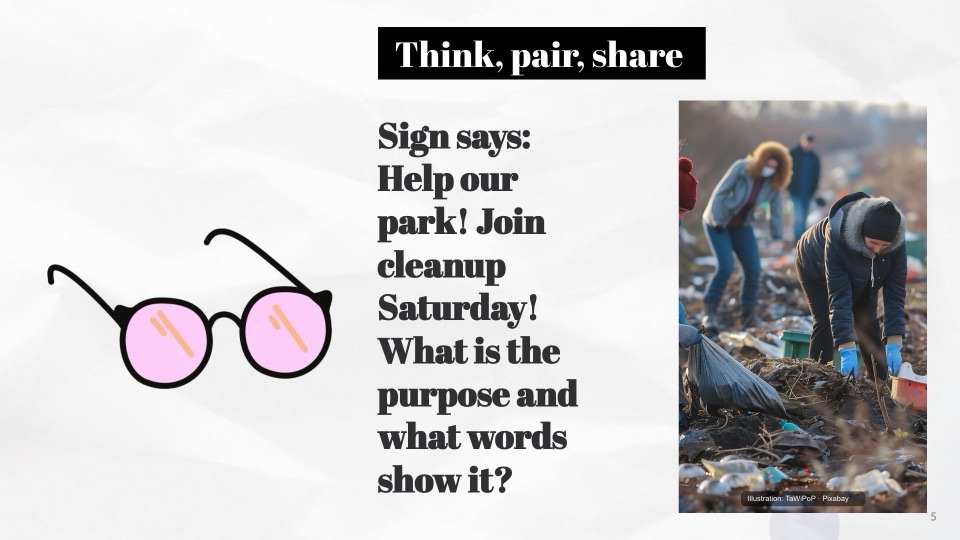
| 10 min | Teaching | Model how to name purpose and point of view and prove it with words. Display Slide 5 question: Sign says: Help our park! Join cleanup Saturday! Think aloud: circle Help, Join, and exclamation as fingerprints. Model that there are three main reasons people write: to persuade, to inform, and to entertain. Write model sentence frame on board and explain an author is the creator of the original piece, so word choice is on purpose. |
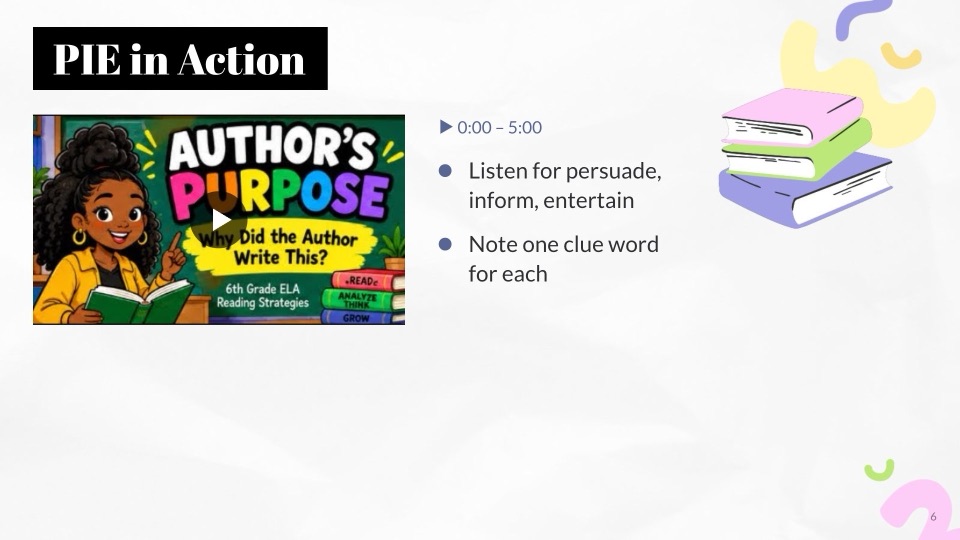
| 10 min | Guided Practice | Build shared language for clues through video and discussion. Show Slide 6 PIE in Action and play Video clip 1 (0:00-5:00). Pause twice to ask class to name one clue word for persuade, inform, entertain. Show Slide 7 Did you know? Every text is made to persuade, inform, or entertain readers. Chart class ideas into facts vs opinions vs funny story words for extensive discussion. |
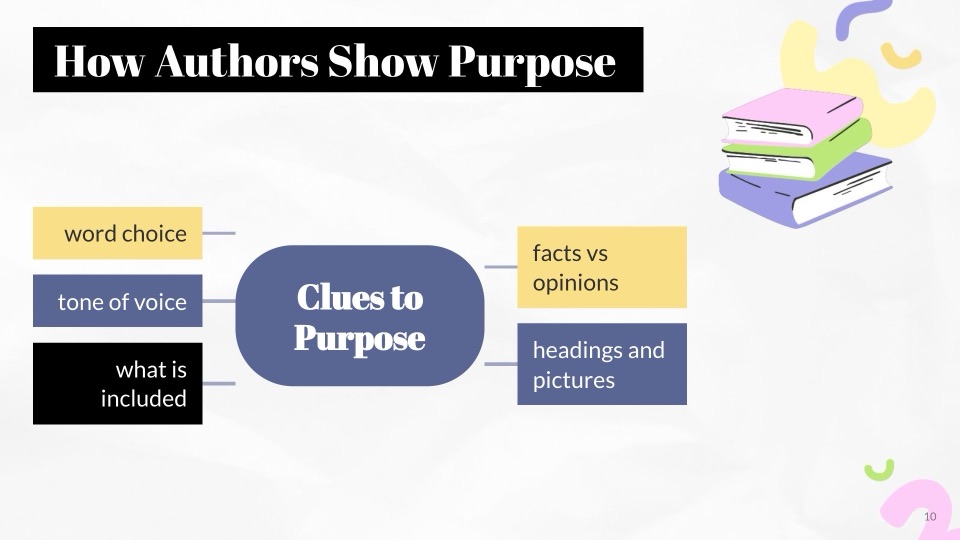
| 20 min | Main Activity | Connect purpose to specific text features like facts, opinions, and language. Hand out paper frames, printed passages, highlighters, and evidence chart. Model magnifier routine on Passage Should School Start Later paragraph 4 using Slide 10 Clues to Purpose: word choice, facts vs opinions, tone of voice. Assign half the groups the persuade passage and half the inform passage to log facts, strong words, questions, and tone. Circulate, prompt with checklist, and select two groups to share purpose plus two fingerprints. |
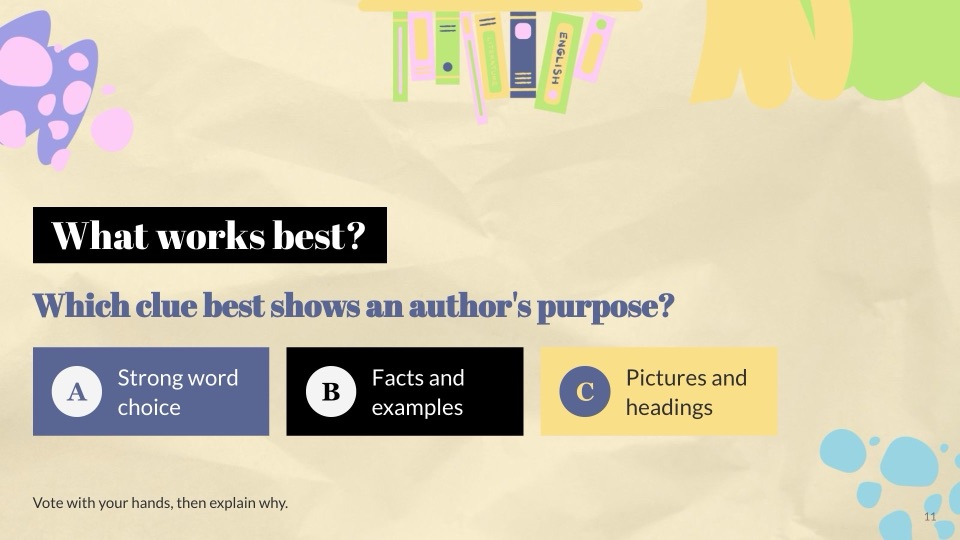
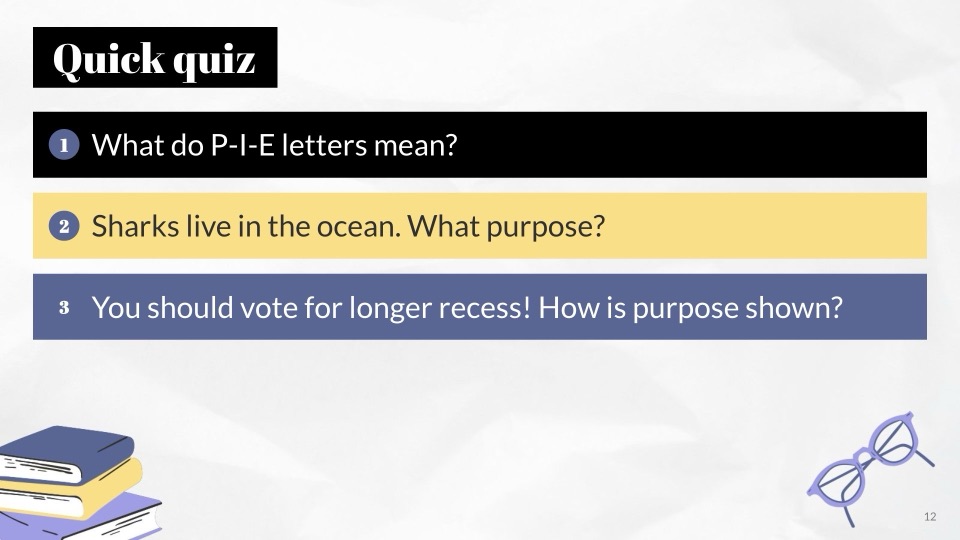
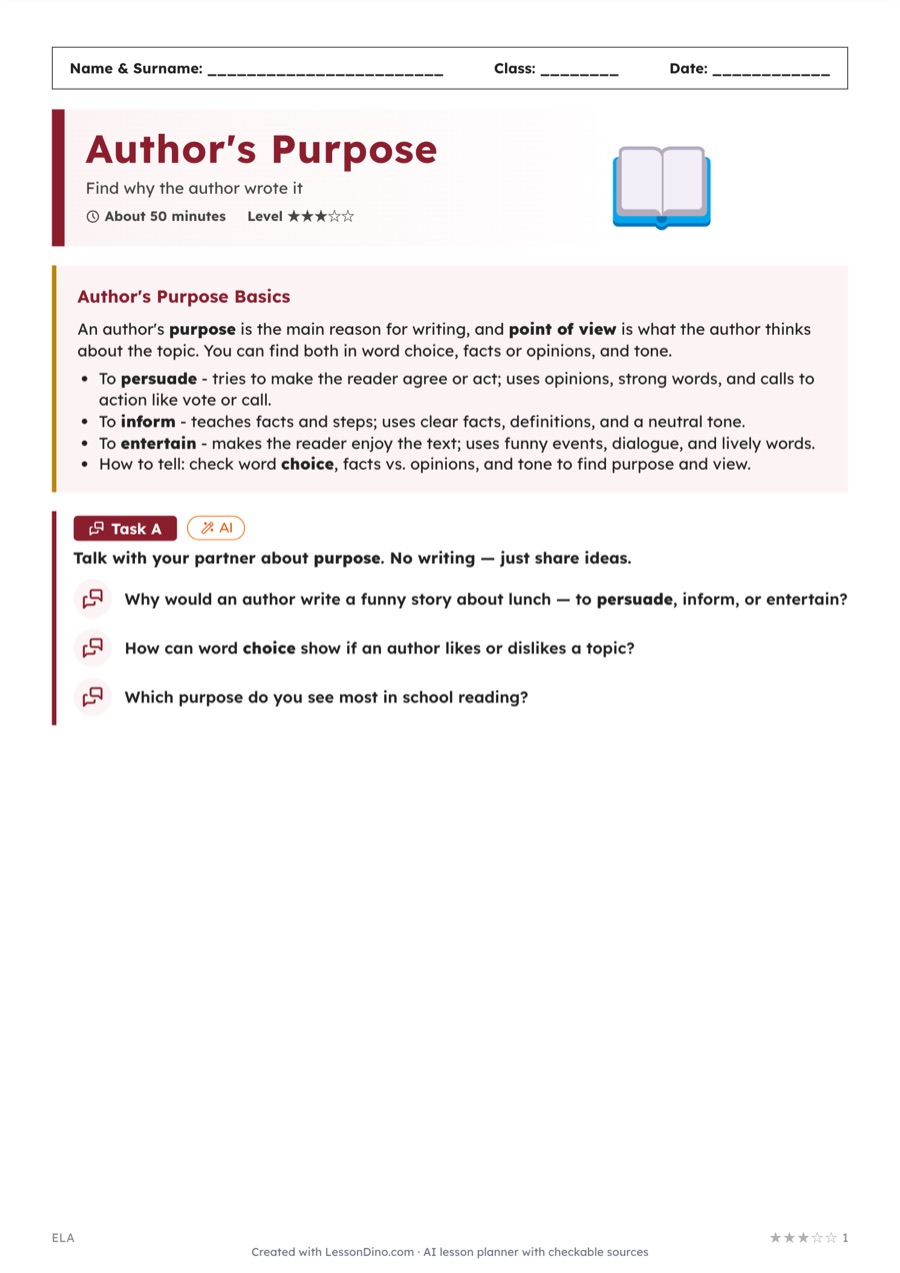
| 15 min | Plenary | Consolidate learning and check who can prove purpose with evidence. Lead Slide 11 vote: Which clue best shows purpose? Strong word choice, facts and examples, pictures and headings. Hand out Worksheet Task G Swap it and have students swap each wrong label for correct purpose using evidence. Run Slide 12 Quick quiz with mini whiteboards for three questions. Restate objectives and preview that word choice shows feelings and purpose. |
Common mistakes
- Mixing up purpose (why) and point of view (what author thinks).
How to spot it: Student says purpose is the author likes later start.
Restate frames: Purpose is to persuade; point of view is author thinks later start is healthier. - Thinking topic is purpose, e.g., purpose is recycling.
How to spot it: Chart says purpose is paper.
Ask: Did author explain steps to inform or push action to persuade? Point to facts vs should/must language. - Thinking any fact means inform.
How to spot it: Labels Should School Start Later as inform because it cites sleep research.
Show facts can serve persuade; check tone and action words like must, vote, call that convey push.
Support
- Give students who need help a checklist with examples of fact language and persuasion language to tick off.
- Provide sentence frames like The author thinks ___ because the text says ___ and pre-highlight two examples.
Stretch
- Ask ready teams to compare two texts on the same topic with different purposes and chart the contrasts.
- Have ready writers list two words the author could change to flip purpose and explain the effect.
Check questions
- Name the three purposes and one clue word for each.
Answer: Persuade - should/must/vote; Inform - facts/steps/numbers; Entertain - funny/story words. - Passage How Paper Gets Recycled explains steps. What is purpose and how is it conveyed?
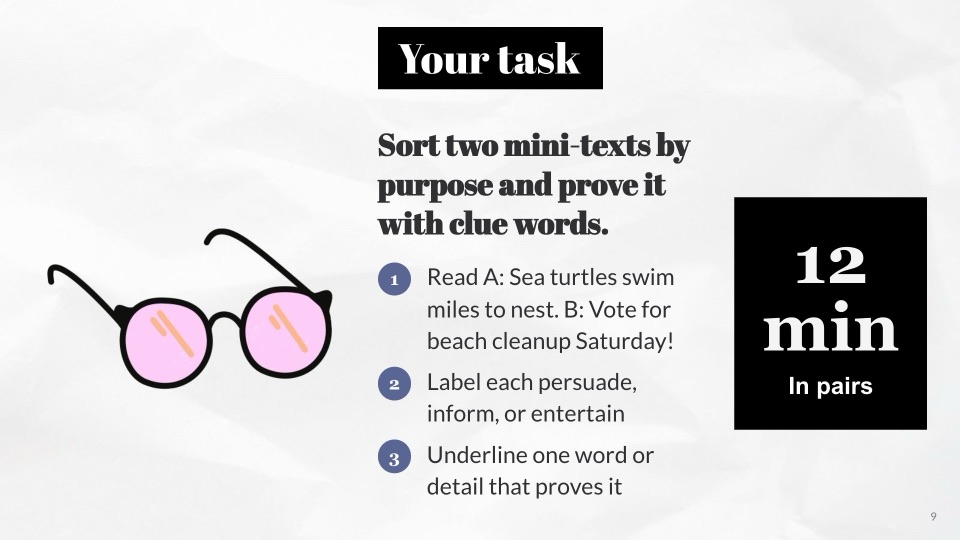
Answer: Inform, conveyed with facts, order words, and neutral tone. - Author writes Vote for beach cleanup Saturday! What is point of view and proof?
Answer: Author supports cleanup; proof is Vote and exclamation showing strong feeling.
Curriculum
Determine an author's point of view or purpose in a text and explain how it is conveyed in the text.
Video clips
Clips on YouTube, from the start and end times we chose. Check each one before you show it.
-
6th Grade PIE Explained from 0:00 to 5:00
ELA Made Easy with Ms. Miller: Author’s Purpose Made Easy! 🥧 Persuade, Inform & Entertain | 6th Grade ELA
Made explicitly for 6th grade so pace and vocabulary are perfect for 11-12-year-olds learning persuade, inform, entertain.
-
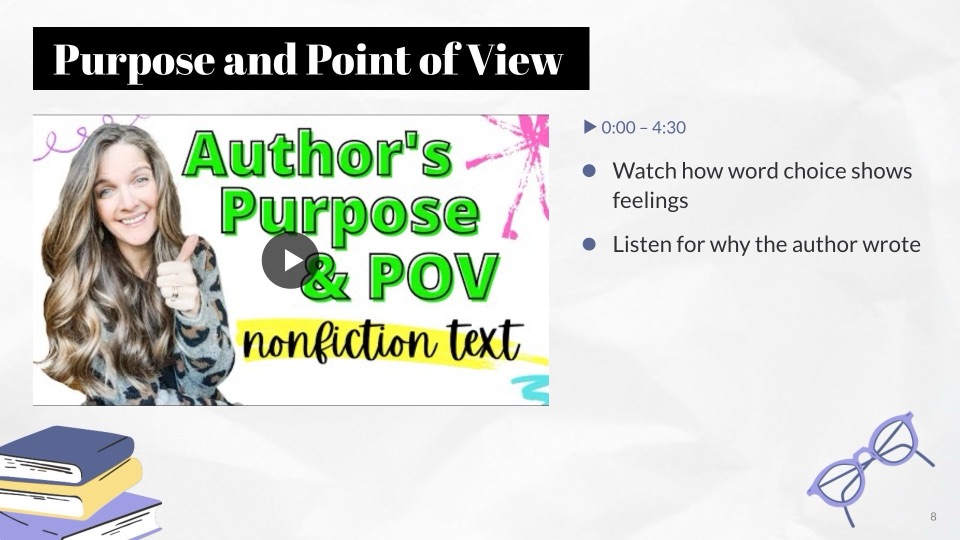
Purpose and Point of View in Nonfiction from 0:00 to 4:30
Teaching Intentionally: Author's Purpose and Point of View Mini lesson for Nonfiction Text
Covers both purpose and point of view in nonfiction with language ideal for 11-12-year-olds.
Worksheet
Sources
- ELA Grade 6 - Chicago Public Schools cps.edu
- English Language Arts - Chicago Public Schools cps.edu
- Author - Wikipedia en.wikipedia.org
- Reading Lesson: Author S Purpose - Docsbay docsbay.net
- Author - Simple English Wikipedia, the free encyclopedia simple.wikipedia.org
Picture credits
- Photo: dianacibotari1991 · Pixabay
- Illustration: TaWiPoP · Pixabay
- Microsoft Fluent Emoji (MIT)
Made with Lesson Dino's AI on 17 October 2026. AI can make mistakes, so check facts against the sources before you teach.