Slides
Lesson plan
What Objects Really Mean
Students learn to interpret figures of speech in context. They discuss personification and sort literal from figurative meaning.
Objectives
- Students will interpret personification in context using nearby clues.
- Students will tell literal meaning from figurative meaning in sentences.
- Students will explain the real meaning of figures in own words.
Success criteria
- I can tell if a line is literal or figurative.
- I can name the figure and use clues to tell meaning.
- I can explain the real meaning in my own words.
Key words
| Word | Meaning |
|---|---|
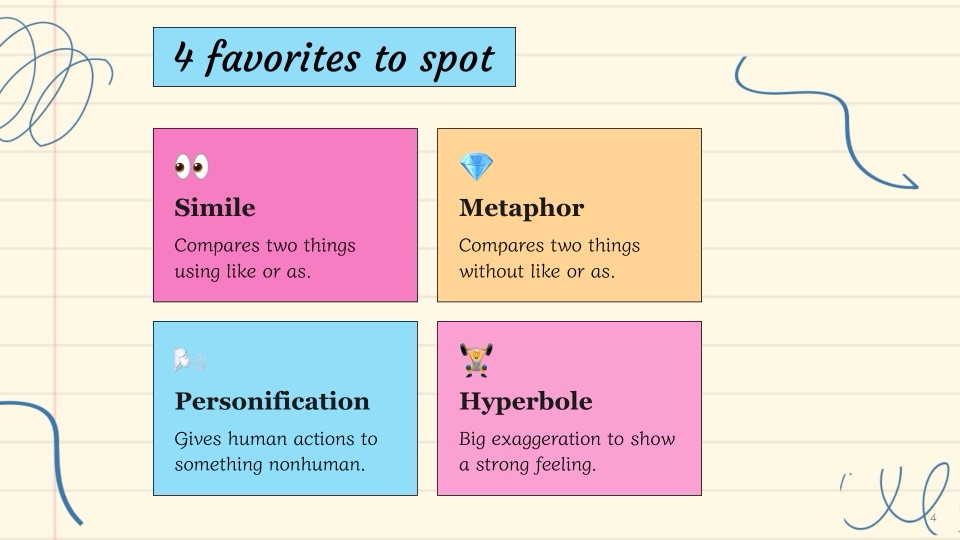
| personification | giving a thing an action only a person can do |
| metaphor | a comparison between two things without using like or as |
| simile | a comparison between two things using like or as |
| hyperbole | a big exaggeration on purpose to show feeling |
| context | the words and situation around a tricky phrase |
| figurative language | words that create meaning by comparing one thing to another thing |
Timed plan (60 minutes)
| Time | Stage | What happens |
|---|---|---|
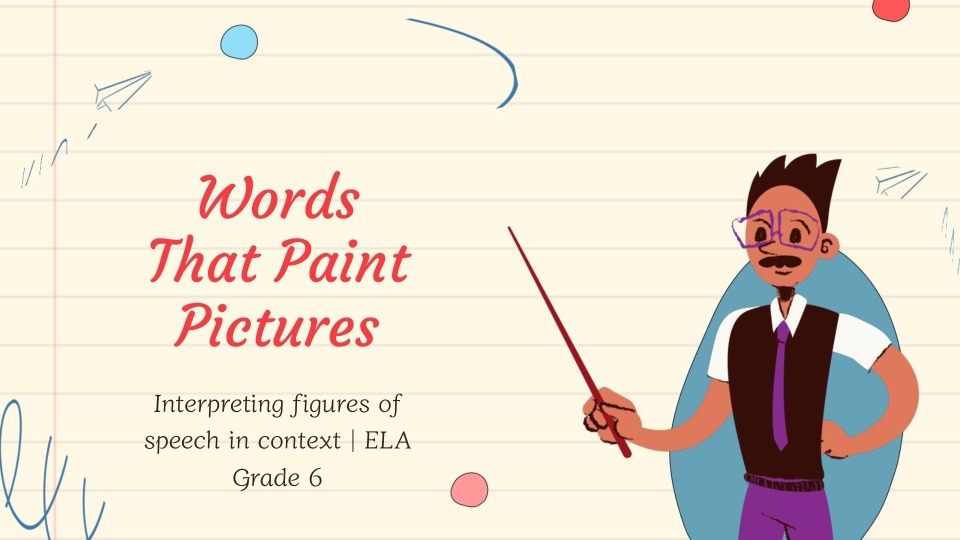
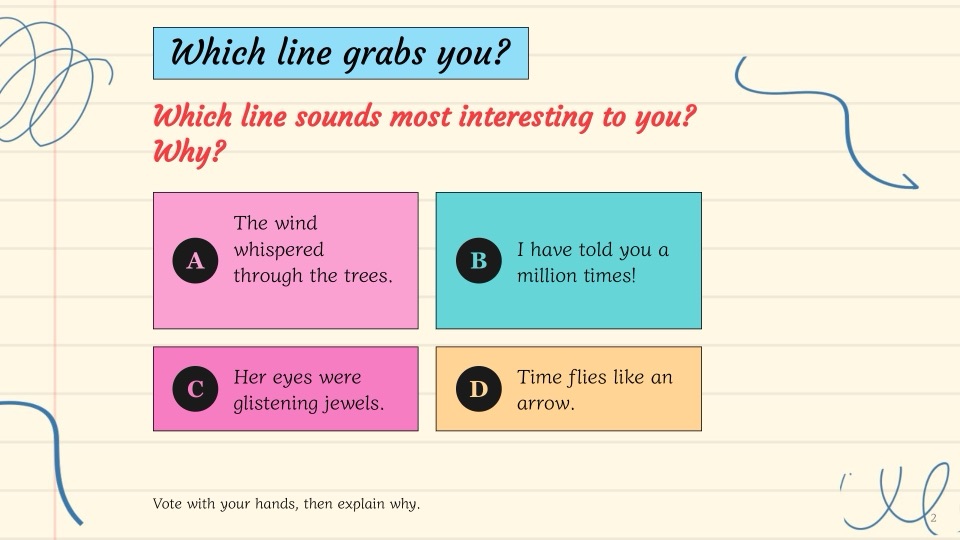
| 5 min | Starter | To hook interest and surface ideas about literal and figurative lines. Show Slide 1 Words That Paint Pictures and state the goal: interpreting figures of speech in context. Show Slide 2 Which line grabs you with lines The wind whispered through the trees, I have told you a million times!, Her eyes were glistening jewels. Use the hook: Can an alarm clock yell? Can a door groan? Let's figure out what a writer means when objects act like people. Take a quick vote on which line sounds most interesting and ask why. |
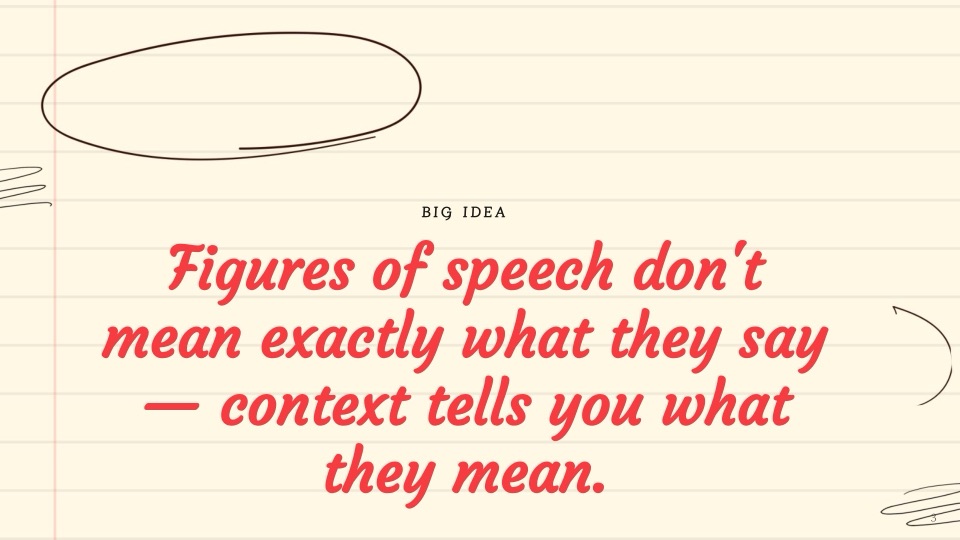
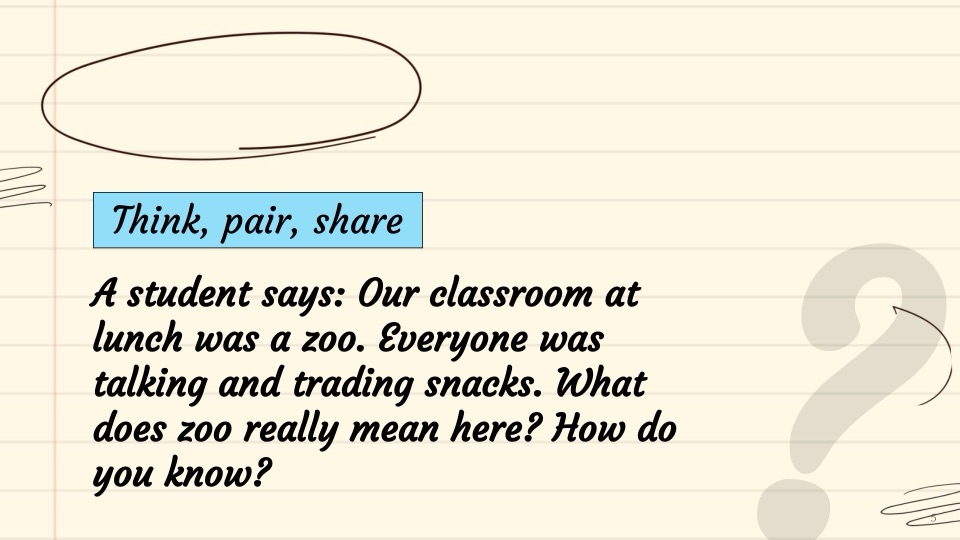
| 12 min | Teaching | To teach literal vs figurative meaning and model interpreting a metaphor in context. Show Slide 3 Big idea: Figures of speech don't mean exactly what they say — context tells you what they mean. Show Slide 4 cards for simile, metaphor, personification and hyperbole and explain each in plain words. Explain that literal language states exactly what something is, while figurative language creates meaning by comparing one thing to another thing. Model Slide 5 Think, pair, share with the zoo paragraph using the four steps: read context, check if literal is possible, name the figure, say the real meaning. |
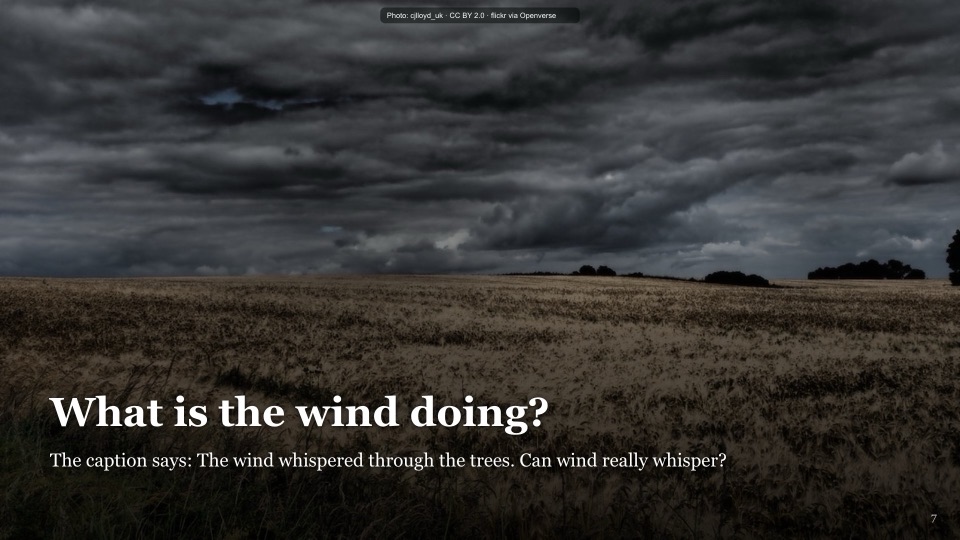
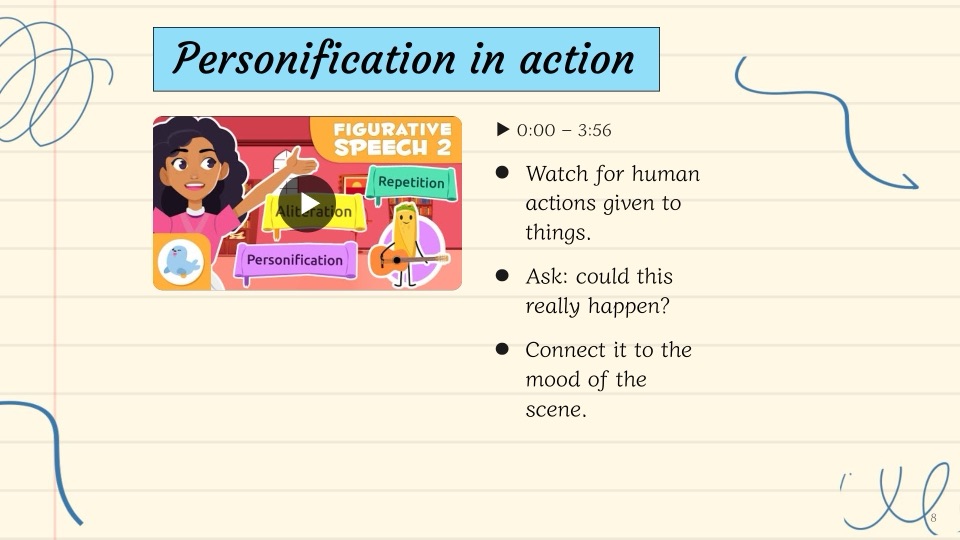
| 13 min | Guided Practice | To model how to interpret personification using picture and video. Show Slide 7 photo with caption The wind whispered through the trees and ask Can wind really whisper? Play Video clip 3 (0:00–3:56) on Slide 8 Personification in action and tell students to listen for human actions given to things. Think aloud: human action is whispered, wind cannot whisper, feeling is soft and quiet evening. Show how to underline the human action and write the real meaning: blew softly and quietly. |
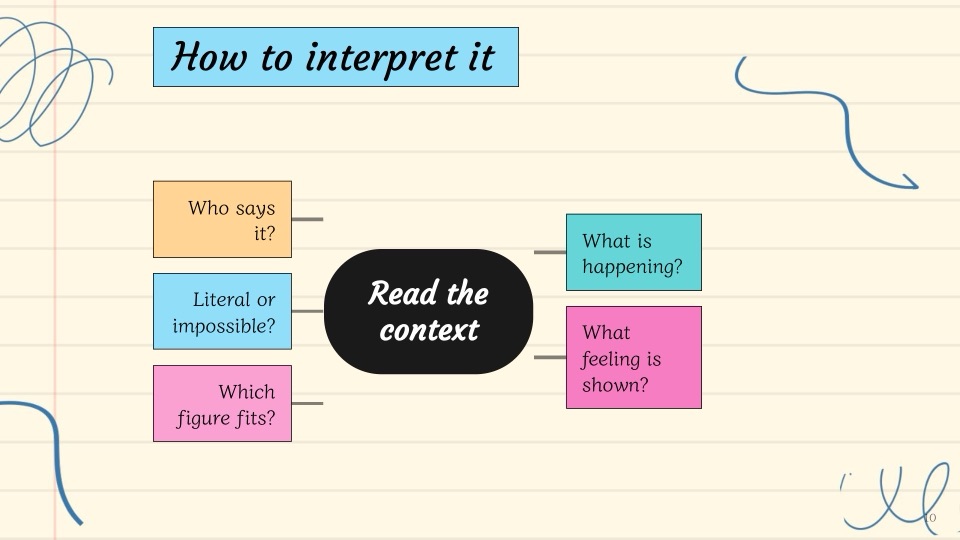
| 20 min | Main Activity | To interpret personification in context in pairs and explain the real meaning. Project these three paragraphs: 1) The wind whispered through the trees outside the school doors. Leaves shook a little. We pulled our jackets closer. 2) My backpack clung to my shoulders on the stairs. It was packed with heavy books. I had to stop and shift it. 3) The hallway lights stared down at us. The hall was bright and quiet before the first bell. Nobody talked. Show Slide 10 How to interpret it mindmap: Read the context, Who says it, What is happening, Literal or impossible, What feeling is shown, Which figure fits. Direct pairs to read, highlight the human action, circle two context clues, and write the real meaning for each paragraph. Circulate, prompt with could this really happen and what picture does it give in this place and moment. |
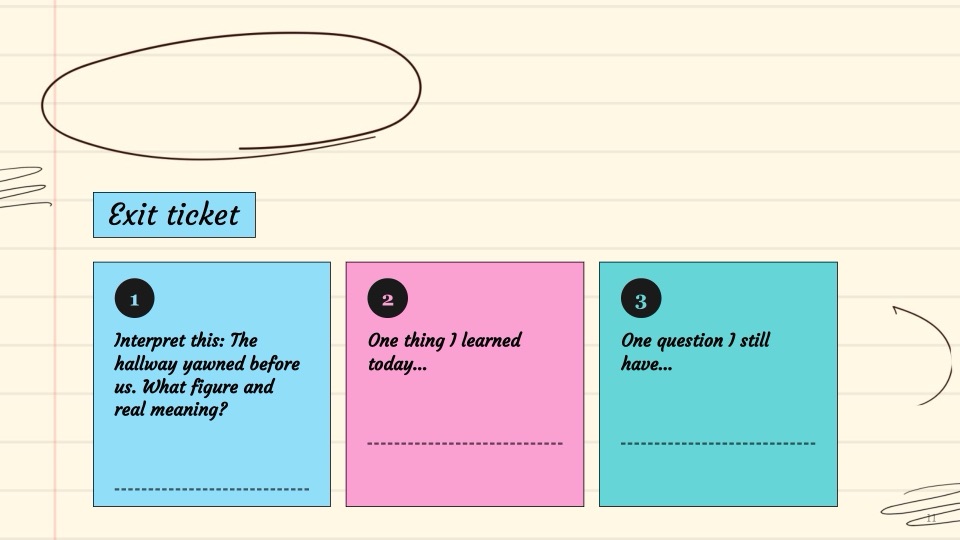
| 10 min | Plenary | To check interpreting of personification and review literal vs figurative. Show Slide 11 Exit ticket: Interpret this: The hallway yawned before us. Ask students to write figure type and real meaning plus One thing I learned and One question. Collect and read two strong answers aloud, naming human action, clues, and real meaning. Restate big idea: figures do not mean exactly what they say, context tells meaning. |
Common mistakes
- Taking the figure as exactly true, like wind really talked
How to spot it: Student draws or writes talking wind with a mouth
Ask could this really happen, then replace with real action: blew softly, because literal states exactly what it is. - Naming any comparison as personification
How to spot it: Student calls Her eyes were glistening jewels personification
Ask if a human action is given to a thing; if not, test for metaphor as analogy between two things. - Ignoring context clues and giving a memorized meaning
How to spot it: Same meaning for whispered in a storm and a calm night
Require circling two nearby clues and explaining meaning right there in that scene.
Support
- Provide a choice of two plain meanings for each personification line
- Pre-underline the human action and clue words for students who need help
- Use sentence frames for the real meaning in context
Stretch
- Have students explain what changes if the human action is swapped for a different one
- Have students explain why the writer used the figurative version instead of the literal version
- Have students explain how meaning would change in a different mood or place
Check questions
- The hallway yawned before us. What figure is this and what does it really mean?
Answer: Personification; the hallway stretched long and open ahead and felt empty. - My backpack weighs a ton. Literal or figurative? What does it really mean?
Answer: Figurative hyperbole; it is very heavy, not 2000 pounds, it exaggerates to show feeling. - Lunch line moved like a snail. What figure and real meaning?
Answer: Simile with like; the line moved very slowly.
Curriculum
Interpret figures of speech (e.g., personification) in context.
Video clips
Clips on YouTube, from the start and end times we chose. Check each one before you show it.
-
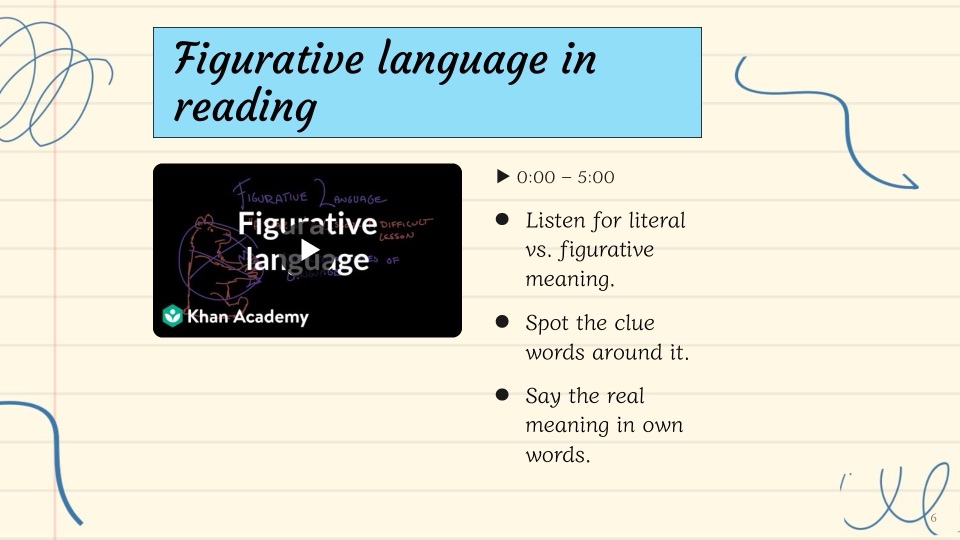
Khan figurative language in reading from 0:00 to 5:00
Khan Academy: Figurative language | Reading | Khan Academy
Teaches interpreting figurative language in context with clear examples at the right pace and vocabulary for ages 11-12.
-
Personification for kids part 2 from 0:00 to 3:56
Smile and Learn - English: FIGURATIVE SPEECH for Kids 🧾 Personification, Alliteration and Repetition ✏️ ✍️ Episode 2
Focuses on personification with simple visuals and explanations well-paced for ages 11-12.
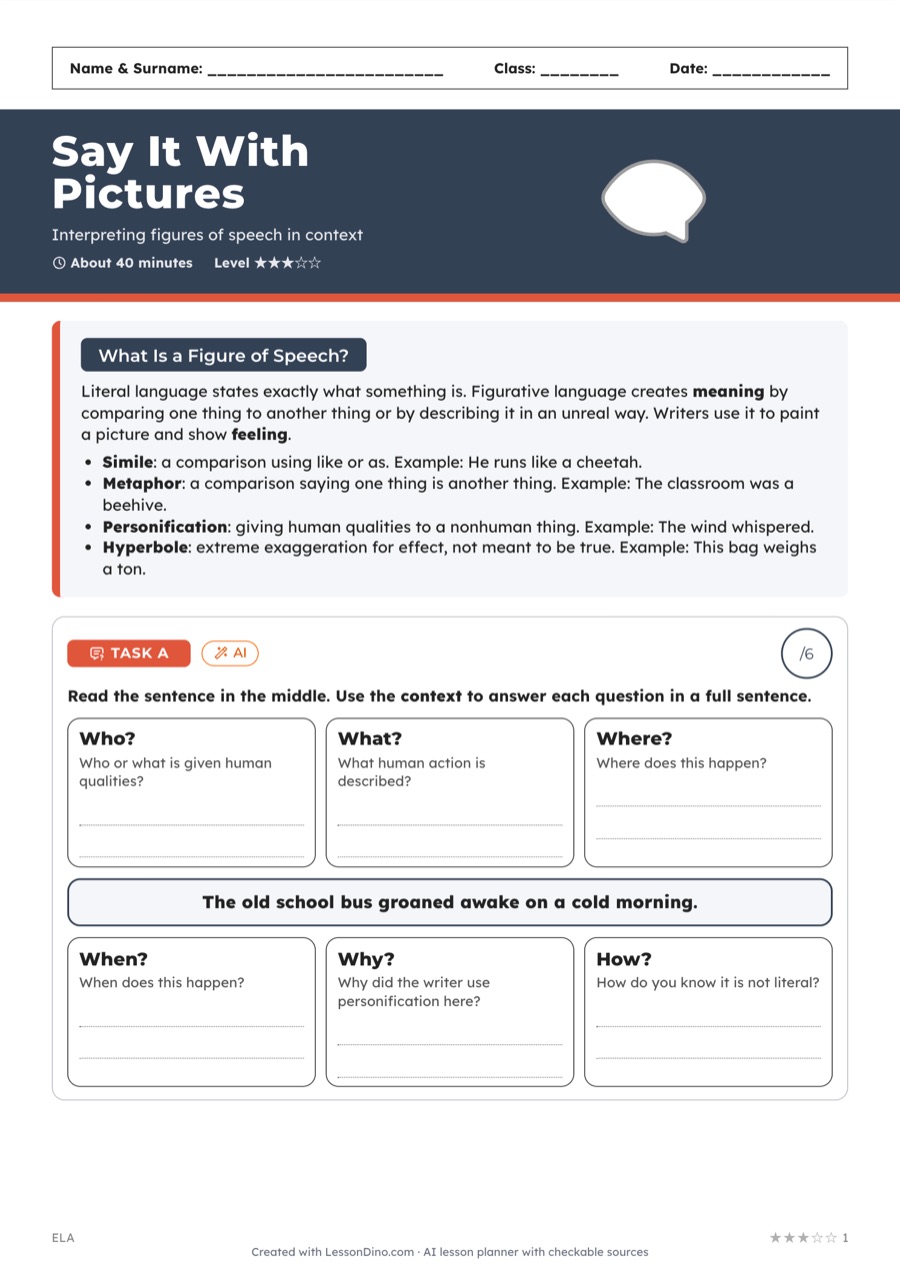
Worksheet
Sources
- ELA Grade 6 - Chicago Public Schools cps.edu
- English Language Arts - Chicago Public Schools cps.edu
- Figures of Speech - UW Faculty Web Server faculty.washington.edu
- Lesson 12: Figures of Speech in Poetry – Introduction to ... pressbooks.hcfl.edu
- FIGURES: EXAMPLES - sites.dwrl.utexas.edu sites.dwrl.utexas.edu
- Figures of Speech and Thought - BYU Humanities rhetoric.byu.edu
- Figures of Speech: Hyperbole, Puns, Clichés and Portmanteaus - English Teacher Site englishteachersite.com
- Which of these is a figure of speech... | Trivia Answers | QuizzClub quizzclub.com
Picture credits
- Photo: sasint · Pixabay
- Photo: cjlloyd_uk · CC BY 2.0 · flickr via Openverse
- Microsoft Fluent Emoji (MIT)
Made with Lesson Dino's AI on 17 October 2026. AI can make mistakes, so check facts against the sources before you teach.