Slides
Lesson plan
Shadow Trackers: Graphing a Day of Shadows
Students learn how daylight changes shadow length and direction. They model the sun and graph three readings to find the pattern.
Objectives
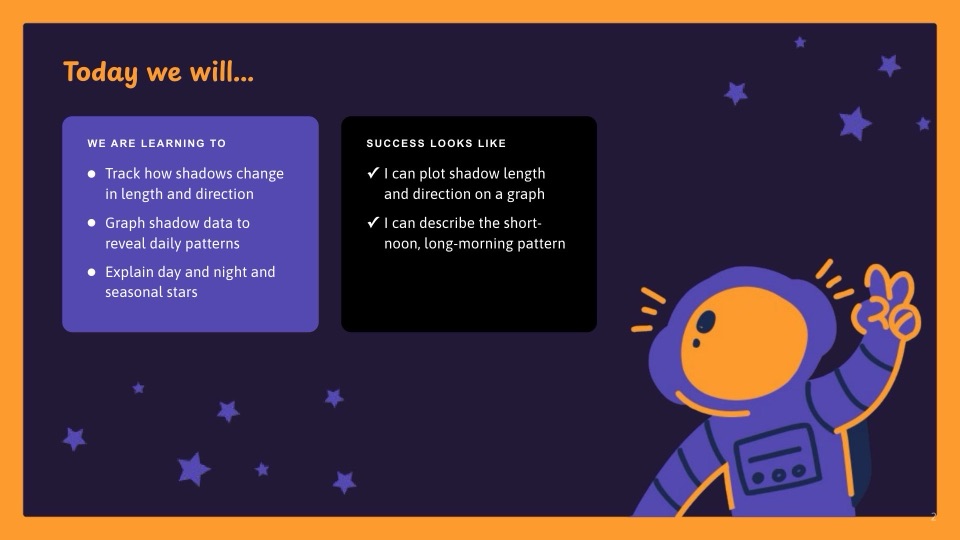
- Students will measure shadow length and direction and plot them in a bar graph.
- Students will describe the daily shadow pattern using evidence from their graph.
- Students will explain how spin makes day and night and shifts seasonal stars.
Success criteria
- I can plot shadow length for morning, noon, and afternoon.
- I can describe the short-noon, long-morning shadow pattern with direction.
- I can explain spin makes night and stars shift with seasons.
Key words
| Word | Meaning |
|---|---|
| shadow | dark shape on the ground where light is blocked |
| opaque | letting no light through, so a dark area forms behind |
| direction | where something points, like east, west, north, or south |
| graph | drawing with thick columns that compares amounts across times |
| solstice | day with the most or fewest daylight hours in the year |
| spin | turning around in one spot, which makes day and night |
Timed plan (60 minutes)
| Time | Stage | What happens |
|---|---|---|
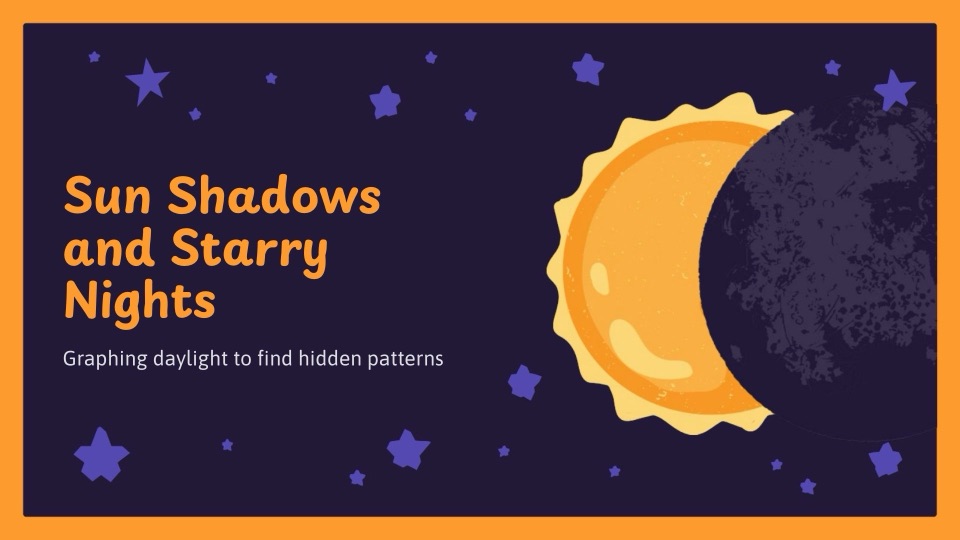
| 5 min | Starter | Hook interest and set the graphing goal for the day. Show Slide 1 title Sun Shadows and Starry Nights and read the focus on graphing daylight. Hold up the pencil pole and say the hook question to the class. Show Slide 2 objectives and point to plot, describe, and track shadows. Ask for quick predictions of morning versus noon shadow length. |
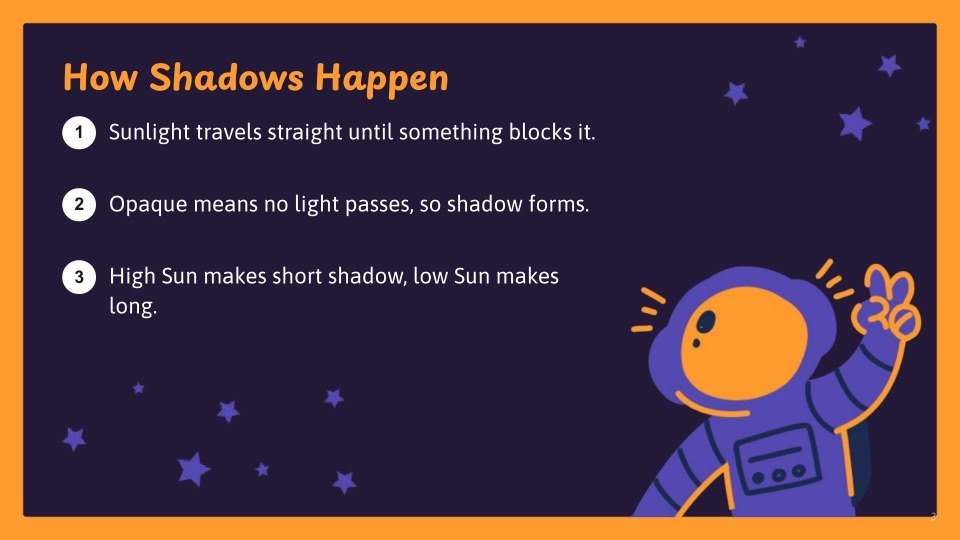
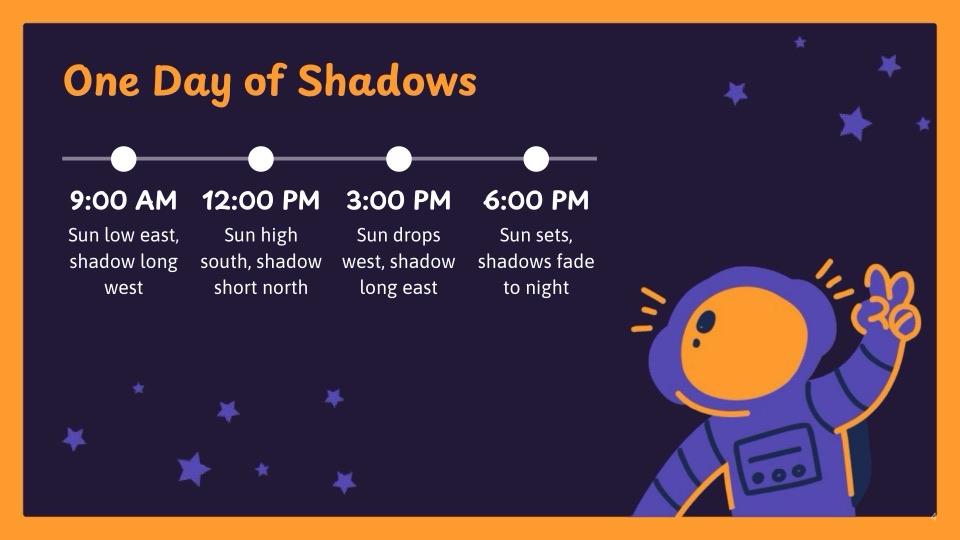
| 10 min | Teaching | Explain how shadows form and how they change through the day. Show Slide 3 and model with flashlight and hand how blocked light makes a shadow. Show Slide 4 timeline for 9:00 a.m., 12:00 p.m., and 3:00 p.m. sun and shadow positions. Think aloud the noon example with numbers and direction arrows. Run Slide 5 think, pair, share on why noon is shortest. |
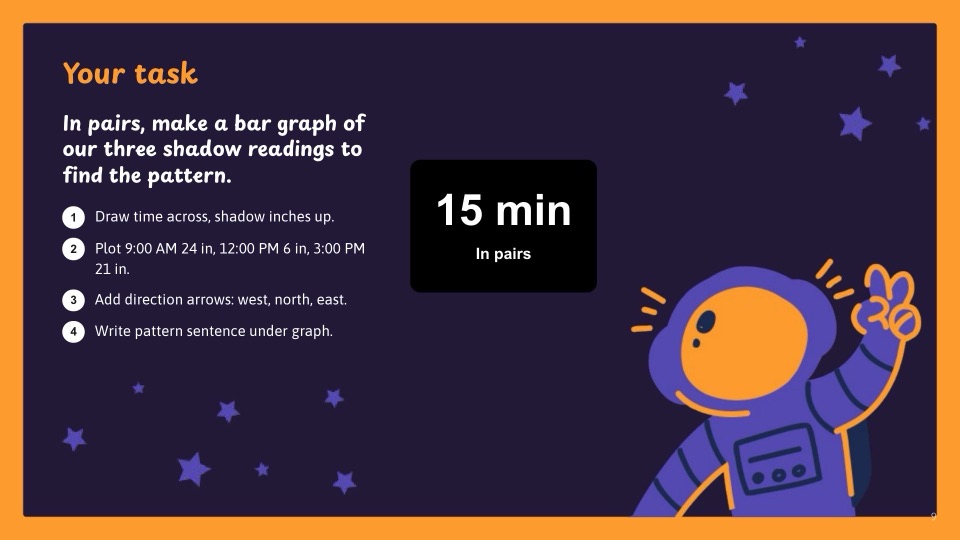
| 25 min | Main activity | Collect model data and graph length and direction to reveal the daily pattern. Show Slide 9 task and hand out Worksheet Task B, graph paper, and measuring tools. Model one reading: set lamp at 9:00 a.m. east low, mark tip, measure in inches, note west. Guide pairs to test 12:00 p.m. south-high and 3:00 p.m. west-low and plot three bars. Circulate to check bar heights, direction arrows, and U-shaped pattern. |
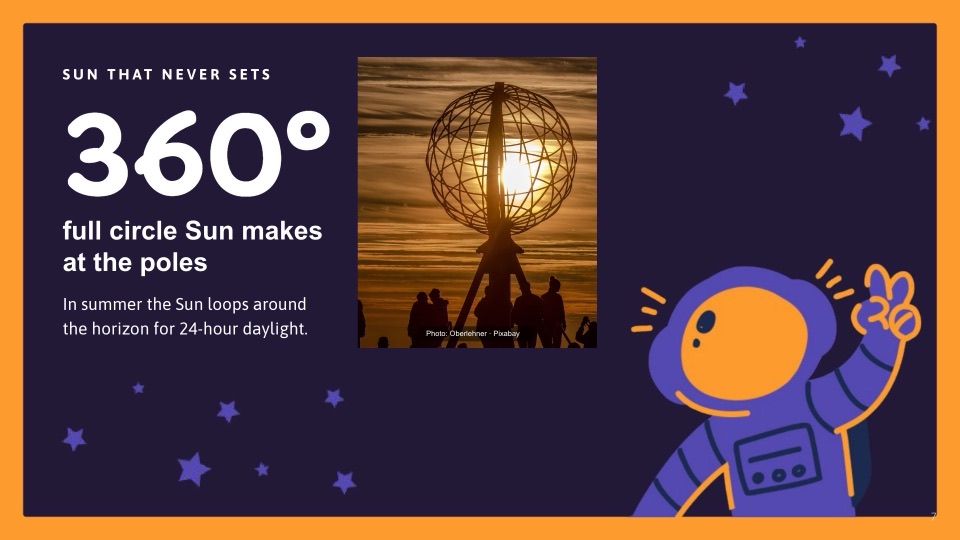
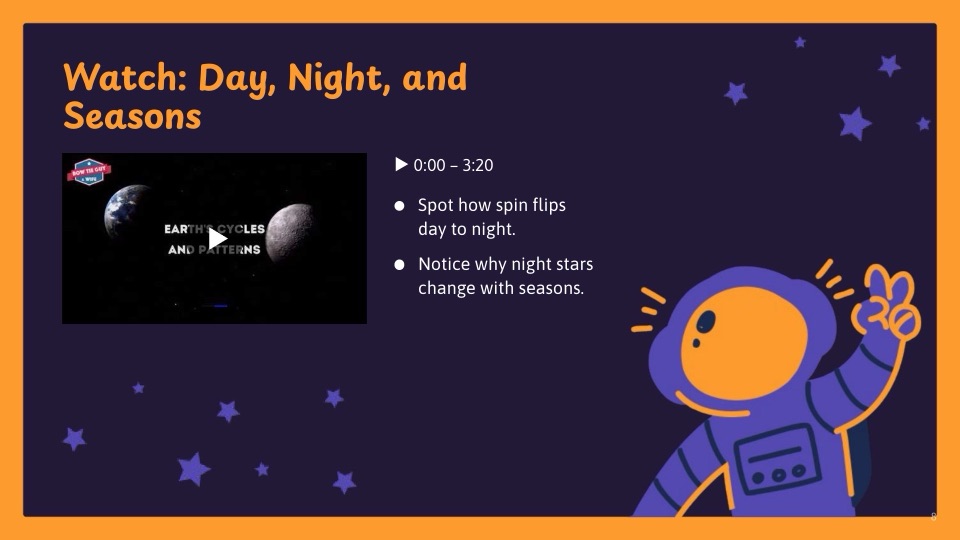
| 10 min | Discussion | Link daily shadows to day and night spin and seasonal daylight and stars. Play Video clip 2 on Slide 8 and tell students to spot spin and seasonal star change. Show Slide 7 360-degree polar sun and explain 24-hour daylight in summer. Lead talk on June versus December daylight bars using solstice facts. Connect back to graphs: high summer sun means shorter noon shadows. |
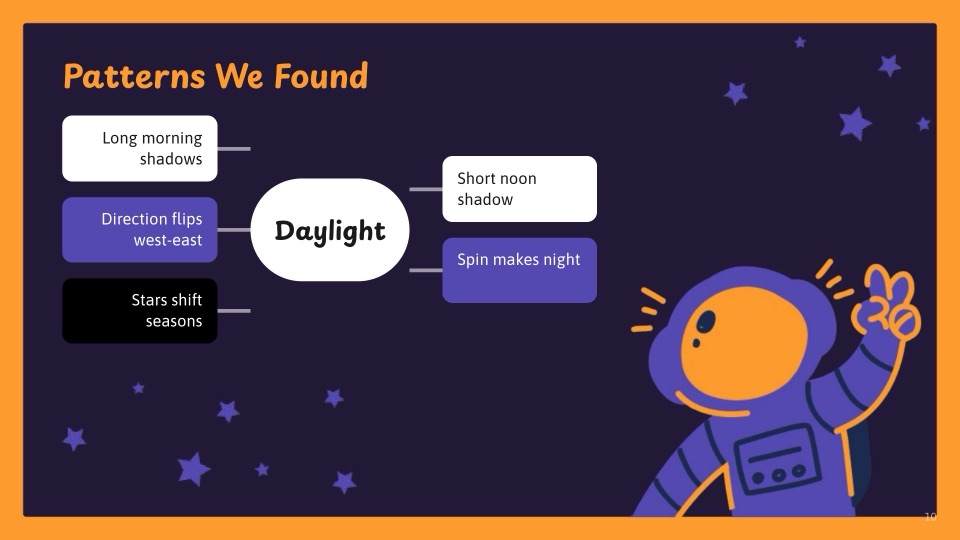
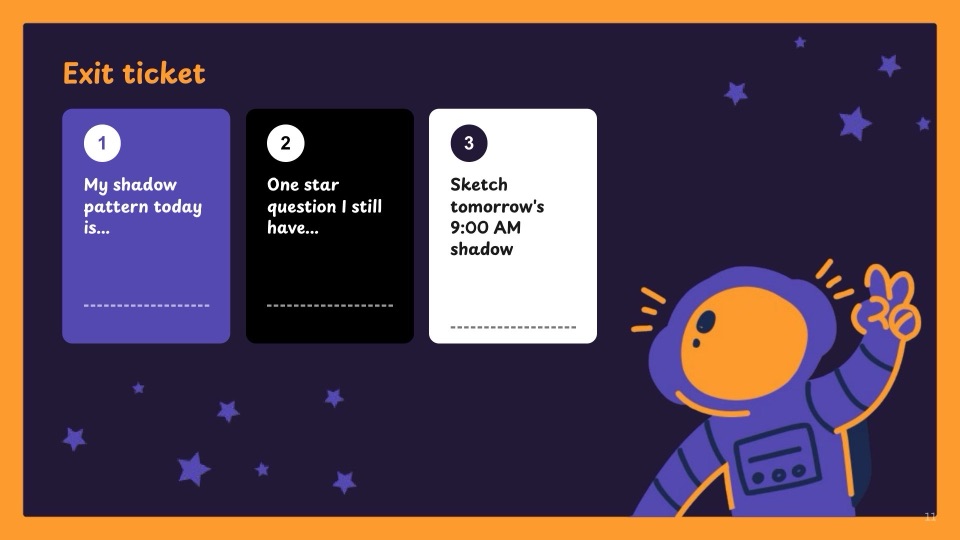
| 10 min | Plenary | Check the objectives and prove patterns with graph evidence. Show Slide 10 mindmap and have pairs point to long morning, short noon, direction flip. Add class data dots to the poster and circle tall-short-tall as proof. Show Slide 11 exit ticket and model the first sentence stem. Collect exit lines and preview tomorrow's 9:00 a.m. shadow sketch. |
Common mistakes
- Thinking the sun moves around Earth to make shadows move
How to spot it: Arrows show sun circling the pole or shadows labeled as sun moving
Model spin with globe and still light to show our turn changes sun position and shadow to the opposite side - Plotting noon as the tallest bar
How to spot it: Bar graph shows 12:00 p.m. higher than 9:00 a.m. and 3:00 p.m.
Re-measure high light versus low light to show high sun makes short shadow under the object - Saying a shadow is light shining
How to spot it: Students describe shadow as made of light
Remind that light travels straight until blocked, so the dark area behind an opaque object is the shadow
Support
- Give pre-drawn axes for Worksheet Task B so students only plot three bars and arrows
- Assign holder, measurer, and recorder jobs for each pair
- Keep compass card and vocabulary bank on desks during graphing
Stretch
- Predict and test a 5:00 p.m. low western sun and justify the tallest bar
- Explain whether summer or winter noon shadows are shorter using high solar noon sun in summer
- Predict which seasonal star window would be best next month if the pattern continues
Check questions
- What pattern did your 9:00 a.m., 12:00 p.m., and 3:00 p.m. bars show?
Answer: Tall-short-tall; shortest at noon, longer morning and afternoon. - The sun is in the west. Where is the shadow and why?
Answer: In the east, on the opposite side from the light. - Why do we have day and night and different stars in different seasons?
Answer: Spin turns us toward and away from light; seasonal position changes night facing.
Curriculum
Represent data in graphical displays to reveal patterns of daily changes in length and direction of shadows, day and night, and the seasonal appearance of some stars in the night sky.
Video clips
Clips on YouTube, from the start and end times we chose. Check each one before you show it.
-
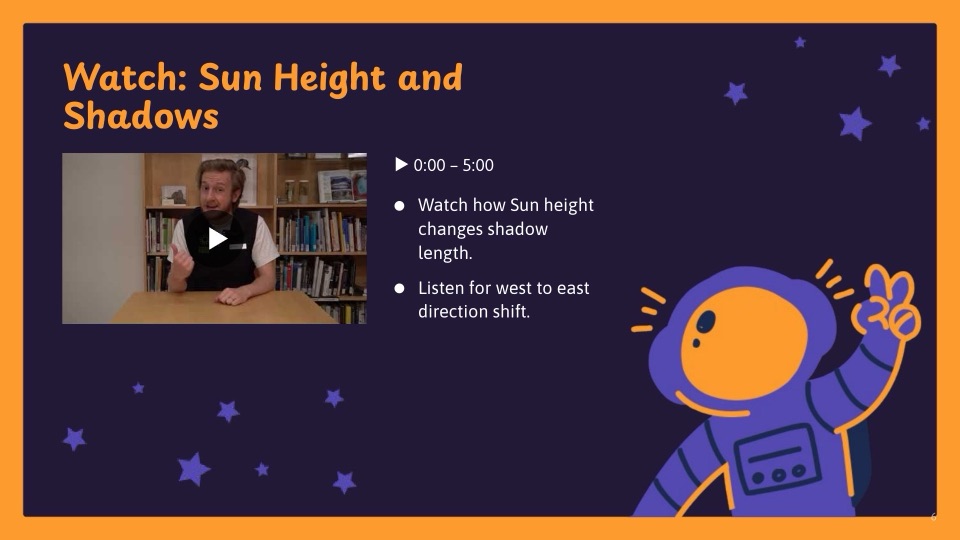
Sun and shadows from 0:00 to 5:00
California Academy of Sciences: Sun and Shadows | California Academy of Sciences
Museum explainer directly about Sun position and shadow length/direction with clear vocabulary perfect for ages 10-11.
-
Day, night, seasons and shadows from 0:00 to 3:20
Bow Tie Guy and Wife: Earth’s Cycles and Patterns (Day & Night - Sun - Seasons - Moon Phases - Shadows...) - Science Video
Covers daily shadow patterns plus day/night and seasons in one overview at the right pace for ages 10-11.
Worksheet
Sources
- Grade 5 Science Curriculum - Fairfax County Public Schools fcps.edu
- Science Grade 5 - Chicago Public Schools cps.edu
- Darkness and daylight, or lights and shadows of New York ... search.library.wisc.edu
- Shadows near the Moon’s South Pole - Science@NASA science.nasa.gov
- Tropical Solstice Shadows - Science@NASA science.nasa.gov
- NASA SVS | Shadows near the Moon's South Pole svs.gsfc.nasa.gov
- Light and shadows - KS2 Science curriculum - BBC Bitesize bbc.co.uk
- Light and shadows - BBC Bitesize bbc.co.uk
Picture credits
- Illustration: tanrıca · Pixabay
- Photo: Oberlehner · Pixabay
- Microsoft Fluent Emoji (MIT)
Made with Lesson Dino's AI on 17 October 2026. AI can make mistakes, so check facts against the sources before you teach.