Slides
Lesson plan
Author Blueprints: Spotting Text Structure
Students learn four text structures authors use to organize ideas. They read parts of a text and make blueprint posters to name each structure.
Objectives
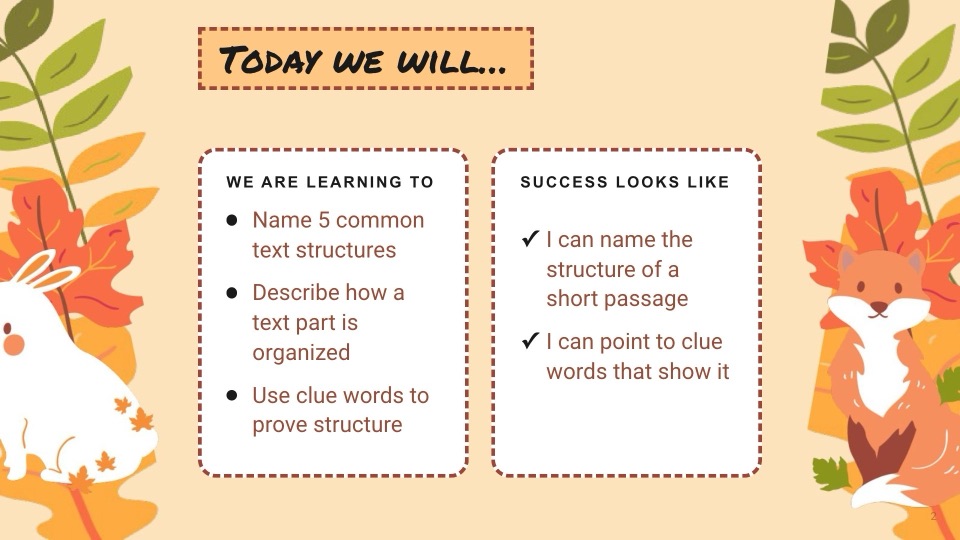
- Students will name four text structures and what each organizes.
- Students will describe the overall structure of part of informational text.
- Students will use signal words and details to prove structure choice.
Success criteria
- I can name chronology, comparison, cause/effect, and problem/solution.
- I can describe how a part of a text is organized.
- I can use clue words and details to prove the structure.
Key words
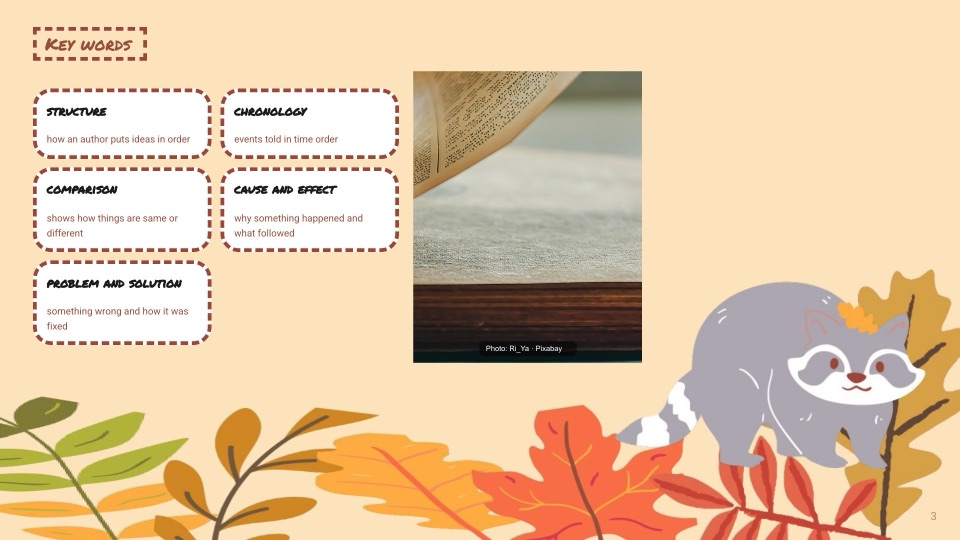
| Word | Meaning |
|---|---|
| structure | how an author puts ideas in order |
| chronology | events told in time order |
| comparison | shows how things are same or different |
| cause and effect | tells why something happened and what followed |
| problem and solution | names what is wrong and how to make it right |
Timed plan (60 minutes)
| Time | Stage | What happens |
|---|---|---|
| 5 min | Starter | Hook students with the blueprint idea and recall why order and comparison help readers. Show Slide 1 and say the hook, then show Slide 2 objectives in student words. Show Slide 5 and read the question aloud for think, pair, share. Give 30 seconds think time, 60 seconds pair talk, then take 2 answers. Link answers to goal: today you will draw the author's blueprint for part of a text. |
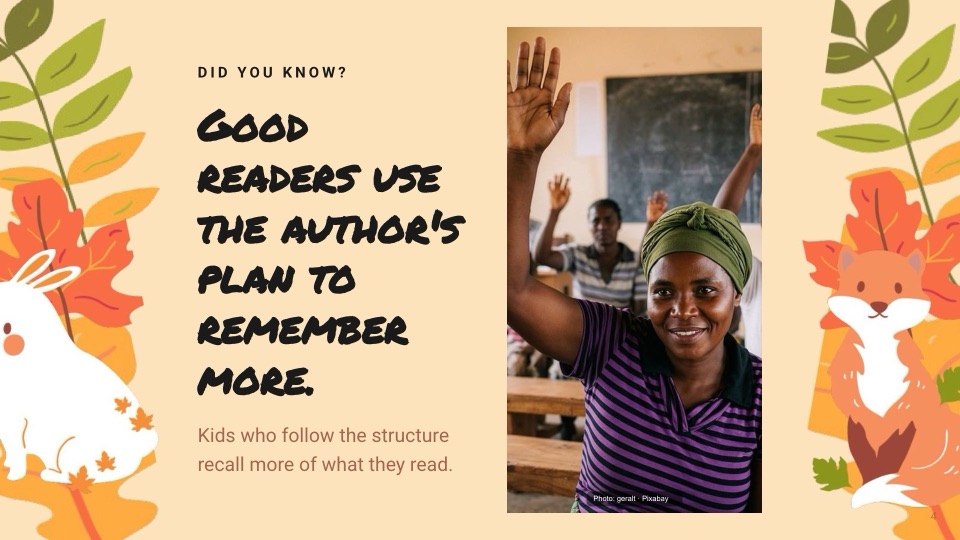
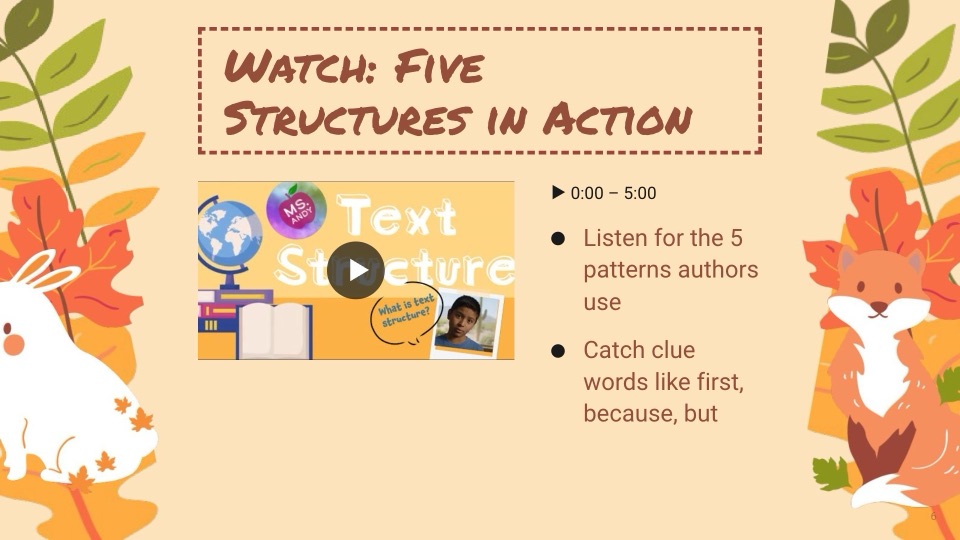
| 10 min | Teaching | Teach four structures, signal words, and why following structure helps memory. Show Slide 3, teach each word with a hand motion for time order, balance, chain, and fix. Show Slide 4 and explain that kids who follow the structure recall more of what they read. Play Slide 6 Video clip 1 (0:00-5:00) and ask students to catch clue words like first, because, but. Recap four patterns: chronology shows order in time, comparison shows alike and different, cause/effect shows why, problem/solution gives a fix. |
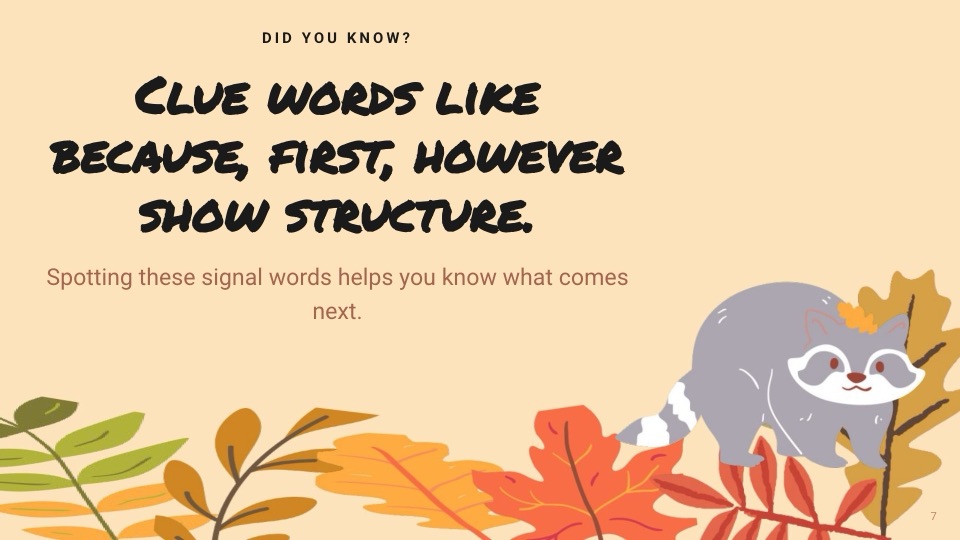
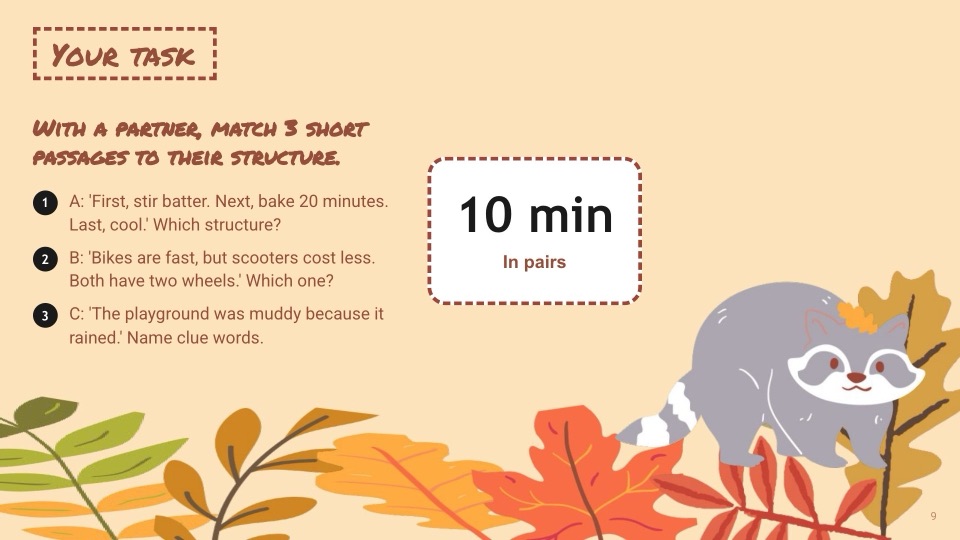
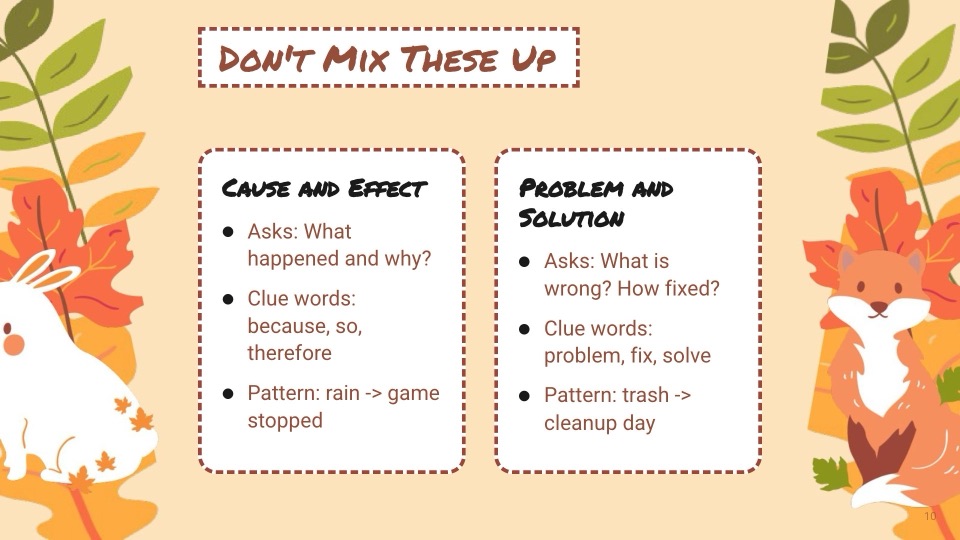
| 10 min | Guided Practice | Model how to use clue words and details to name the structure of a short passage. Show Slide 7 and remind students that spotting signal words helps you know what comes next. Show Slide 9 example A and think aloud step by step to name chronology. Show Slide 9 example B and think aloud to name comparison with a partner check. Show Slide 10 to contrast cause and effect that asks what happened and why with problem and solution that asks what is wrong and how to fix. |
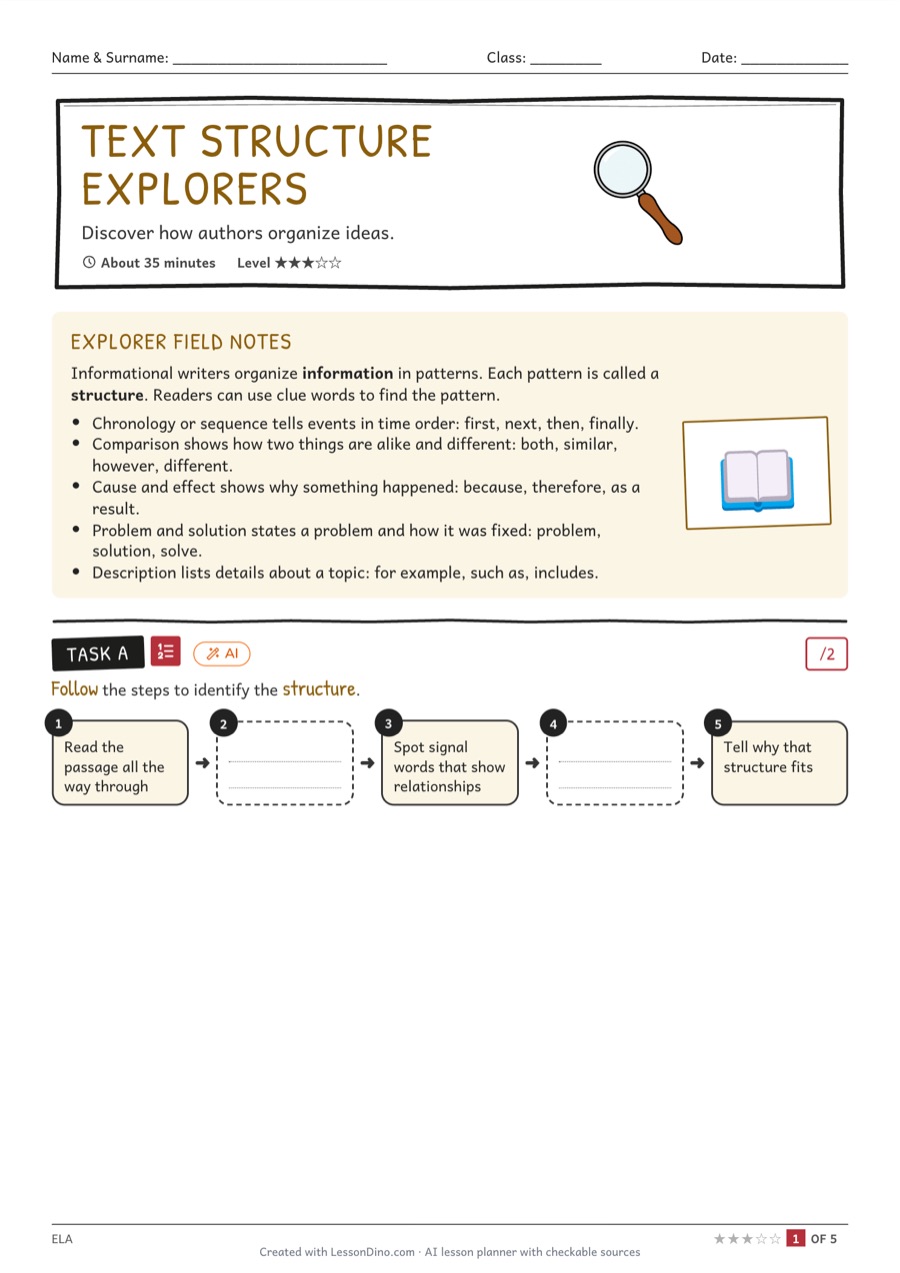
| 25 min | Main Activity | Describe the overall structure of part of a text and show it as a blueprint poster. Give each group Worksheet Task E - Annotate a text: Study the lines and mark the evidence using Passage "A Playground Problem" paragraphs 1-4 and assign one paragraph per group. Direct groups to annotate: underline signal words and circle one detail that proves the pattern. Hand out large paper and choice board starters and show poster needs: structure name, signal words, visual like timeline, Venn, chain, or problem-to-solution arrow, since using visual representations helps show the pattern. Circulate, ask why questions, and keep time with 5-minute check-ins. |
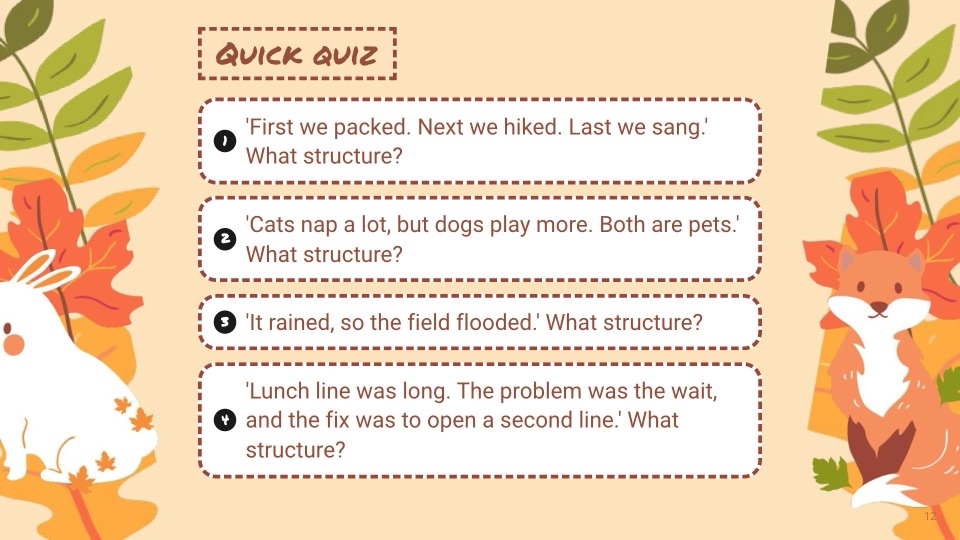
| 10 min | Plenary | Share blueprints and check that students can name and prove structure. Have groups hang posters and point to signal words and details that prove the structure choice. Connect parts: problem in paragraph 1, why in paragraph 2, choices in paragraph 3, fix in paragraph 4. Show Slide 12 Quick quiz and take answers with proof. Restate objectives and preview using structure in writing. |
Common mistakes
- Mixing cause/effect with problem/solution
How to spot it: Student calls any because sentence a problem or any fix a cause
Ask: does it only explain why with because, as a result of, therefore or does it name what is wrong then fix it? - Calling comparison only when things are different
How to spot it: Student misses Both, alike, same as and labels as description
Remind that comparison shows alike and different; check middle of Venn for shared details. - Calling any time word chronology
How to spot it: Student sees morning or next and ignores order of steps
Ask: can you draw it as first, second, next, finally in order? If not, look again.
Support
- Give choice board poster starters and pre-underlined clue words for two choices first
- Provide sentence starter: I know this is ___ because the author says ___.
- Allow pointing to visual timeline, Venn, chain, or arrow to show proof
Stretch
- Have students add a note on why the author likely picked that structure for that part
- Have students write a new sentence that still fits the same structure
- Have students argue which structure would work if the author switched topics
Check questions
- 'First we packed. Next we hiked. Last we sang.' What structure and why?
Answer: Chronology; signal words First, Next, Last show time order. - Paragraph 2 says puddles stayed because ground was flat. What is the structure of that part?
Answer: Cause and effect; because and As a result show why water stayed. - Paragraph 3 says students compared two ideas. What structure and what detail proves it?
Answer: Comparison; One idea was sand, The other idea was better and different with stones.
Curriculum
Describe the overall structure (e.g., chronology, comparison, cause/effect, problem/solution) of events, ideas, concepts, or information in a text or part of a text.
Video clips
Clips on YouTube, from the start and end times we chose. Check each one before you show it.
-
5 types for grades 3-5 from 0:00 to 5:00
Ms. Andy: The 5 Types of Text Structure| Comparing Text Structures| Informational Texts| Reading Grades 3-5
Made specifically for grades 3-5 and explains all 5 structures with clear examples at the right pace for ages 9-10.
-
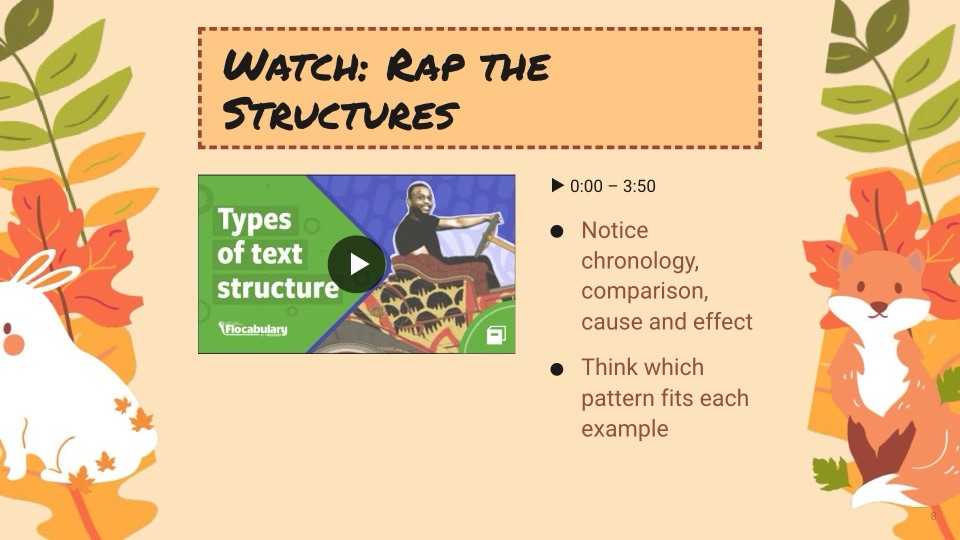
5 types rap from 0:00 to 3:50
Flocabulary: The 5 Types of Text Structure | Educational Rap for Language Arts Students
Covers chronology, comparison, cause/effect, problem/solution and description with memorable examples perfect for Grade 4 ages 9-10.
Worksheet
Sources
- Tennessee English Language Arts Standards - TN.gov tn.gov
- English Language Arts Standards » Anchor Standards » College ... thecorestandards.org
- Organization and Structure - Purdue OWL® - Purdue University owl.purdue.edu
- Text Structure: Cause and Effect - ed files.eric.ed.gov
- Text Structure: Definitions & Examples help.wi.mit.edu
- Understanding Text Structure - University of Delaware www1.udel.edu
- Text Structure Strategies for Improving Expository Reading ... registrar.ecu.edu
- What Is Text Structure - Online Lesson articulate.strayer.edu
- How to investigate structure in non-fiction texts for KS3 ... bbc.co.uk
- Reading skills - Structure - BBC Bitesize bbc.co.uk
- Deconstructing Kids’ Nonfiction: List Text Structure and the Five-Paragraph Essay | School Library Journal schoollibraryjournal.com
- Types of text: English primary resource | National Geographic ... natgeokids.com
- [1904.03478] The Mathematics of Text Structure arxiv.org
- What is Text Structure? | Teaching Text Structure to Young ... k12reader.com
- What is Portable Text? Definition and structure explained | Sani… sanity.io
- Teaching Text Structure - Reading Rockets readingrockets.org
- Text Structure and Styling | Google Slides | Google for Deve… developers.google.com
- What Is Text Structure? Types and Examples for Teachers whatihavelearnedteaching.com
- Text Structure: Build Reading Comprehension - Teach Your ... blog.reading.com
- SEO Friendly Text Structure - SEO Tips - Visualmodo visualmodo.com
- Why text structure is important for SEO • Yoast yoast.com
- Teaching Text Structure (And What To Do When Students Struggle) jenniferfindley.com
- Expository Text: Structures, Examples & Activities storyboardthat.com
- Text Structure Examples and Activities for 3rd, 4th, and 5th ... thriftyinthirdgrade.com
- Flocabulary - Educational Hip-Hop flocabulary.com
Picture credits
- Illustration: u_ozhkrzut0x · Pixabay
- Photo: Ri_Ya · Pixabay
- Photo: geralt · Pixabay
- Pictograms: Sergio Palao, ARASAAC (arasaac.org) · CC BY-NC-SA
- Microsoft Fluent Emoji (MIT)
Made with Lesson Dino's AI on 17 October 2026. AI can make mistakes, so check facts against the sources before you teach.