Slides
Lesson plan
Tiny Moment, Big Story
Students learn to tell one small event in order with actions, thoughts, and feelings. They write 4 to 5 sentences using time words and a closing feeling.
Objectives
- Students will write a short narrative about one real event in order.
- Students will include action, thought, and feeling details with time words.
- Students will end the narrative with a sense of closure.
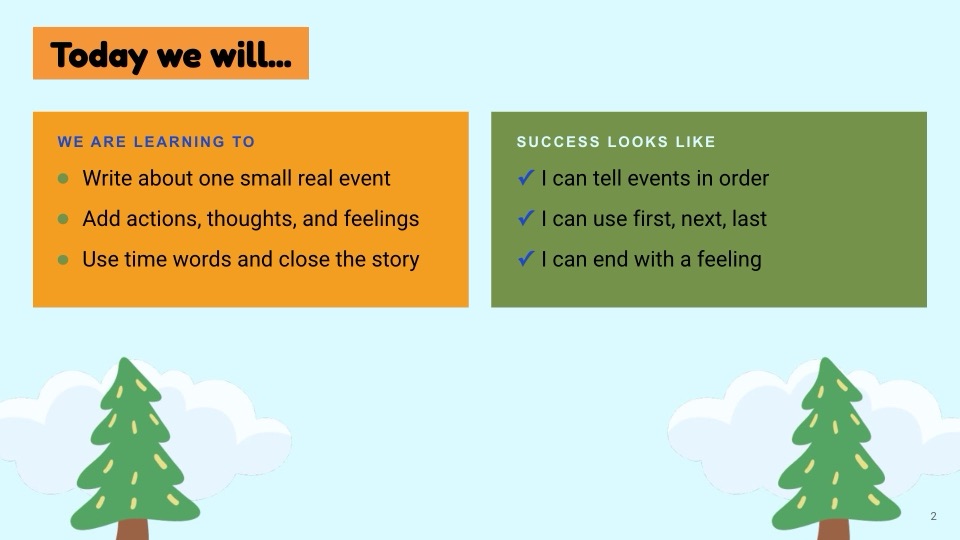
Success criteria
- I can tell events in order using first, next, then, last.
- I can show actions, thoughts, and feelings with details.
- I can end my story with a finished closing feeling.
Key words
| Word | Meaning |
|---|---|
| narrative | a story that tells what happened in order from start to end |
| event | one thing that happens in a story |
| detail | a small part that helps you see, hear, or feel what happened |
| temporal word | like first, next, then, or last that shows order in time |
| closure | a finished feeling at the end that shows the problem is over |
Timed plan (60 minutes)
| Time | Stage | What happens |
|---|---|---|
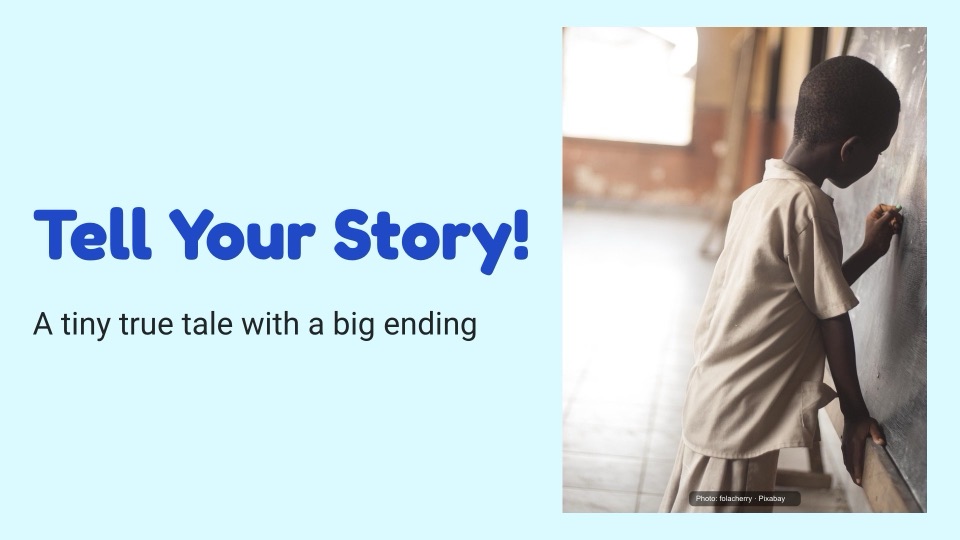
| 5 min | Starter | Hook interest and recall tiny real events that can stretch into a story. Show Slide 1 and greet the class with energy. Say the hook: Yesterday a student saw a trash can tip over in the wind. Think aloud: That tiny moment is a whole story if we stretch it out with first, next, last. Ask partners to tell each other one tiny thing they saw or did yesterday. |
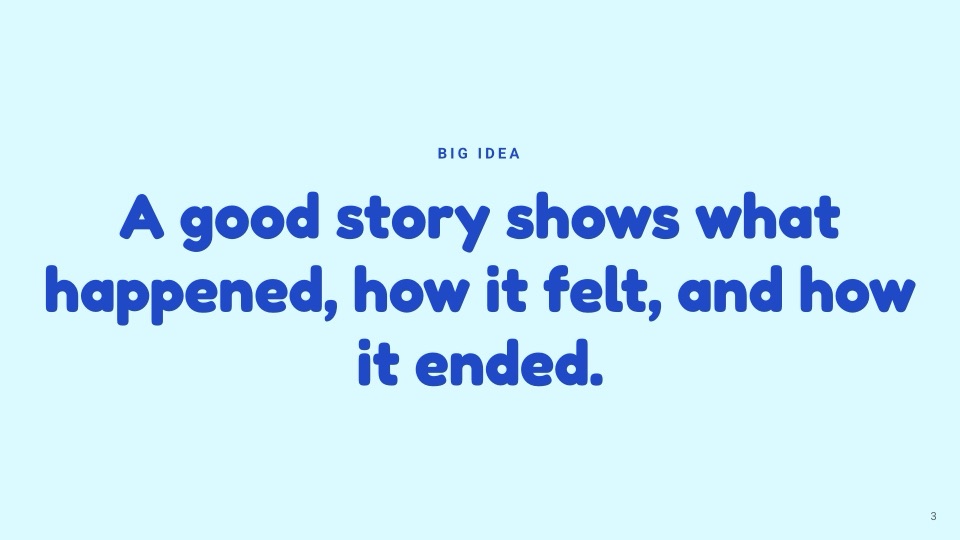
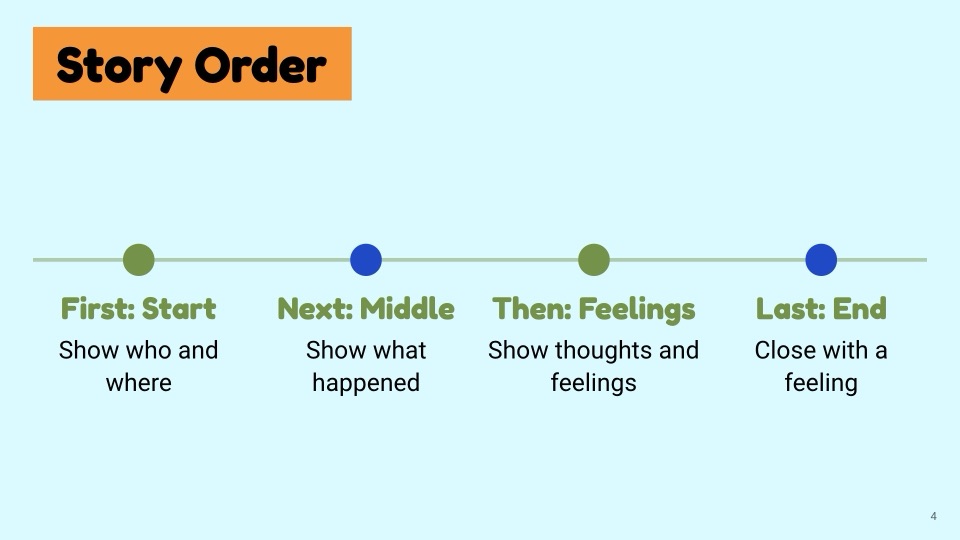
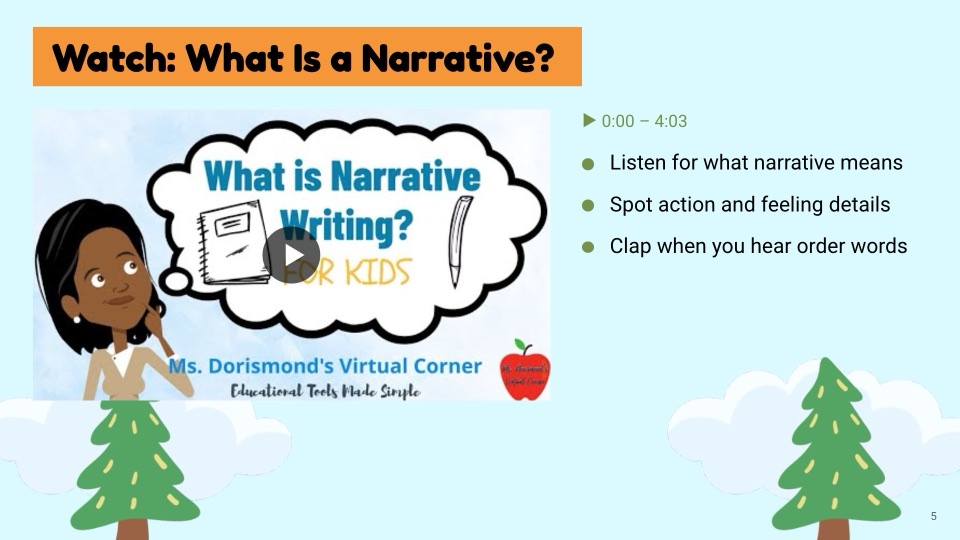
| 10 min | Teaching | Teach what a narrative includes and how time words show order. Show Slide 3 and read the big idea together. Show Slide 4 timeline and point to First, Next, Then, Last parts. Play Video clip 3 and ask students to listen for what a narrative means and clap on order words. Pause twice to name an action detail and a feeling detail heard. |
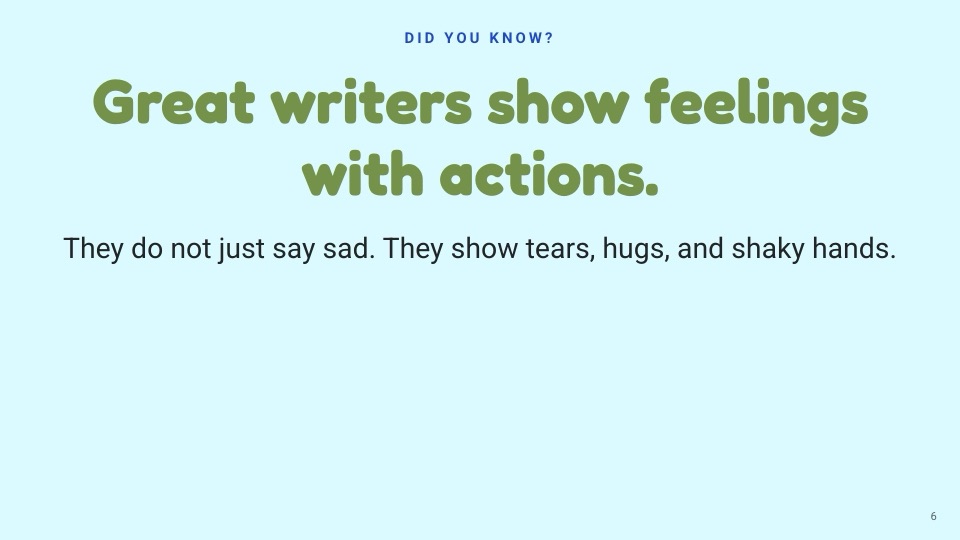
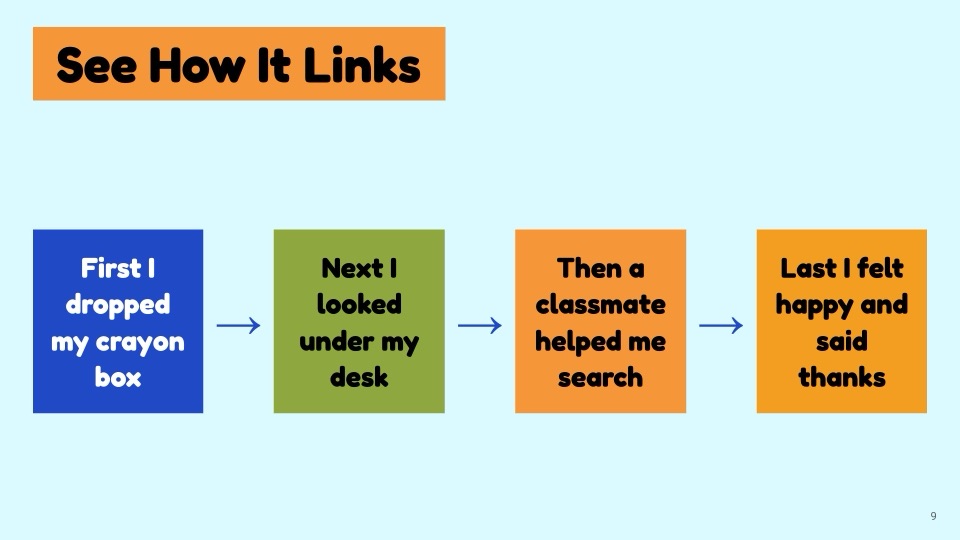
| 10 min | Model Together | Model how to show actions, thoughts, and feelings and close the story. Show Slide 6 and model: do not just say sad, show tears, hugs, and shaky hands. Show Slide 9 chain and read the four sentences aloud, pointing to each time word. Think aloud to add a thought: I thought no one would help me, then label action, thought, feeling. Explain that the last line must connect to the problem to feel finished. |
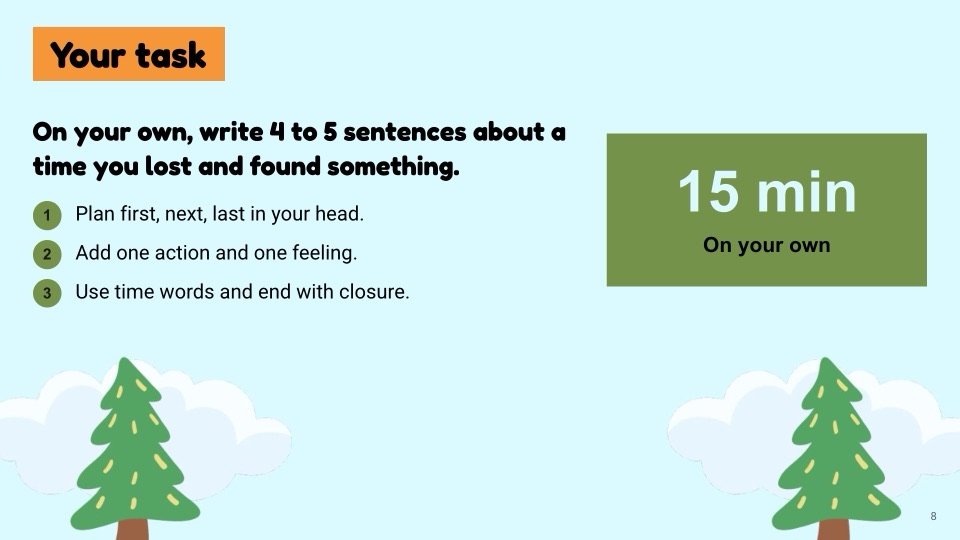
| 25 min | Main Activity | Write a short elaborated narrative with time words and closure. Show Slide 8 and read the task: plan first, next, last, add action and feeling, end with closure. Model quick planning in your head using the trash can tip: first tip, next chase, last fix. Hand out notebooks and detail checklist and set 15 minutes to write 4 to 5 sentences. Circulate, prompt for thought bubble thinking and closing feeling, and have early finishers add sound or color. |
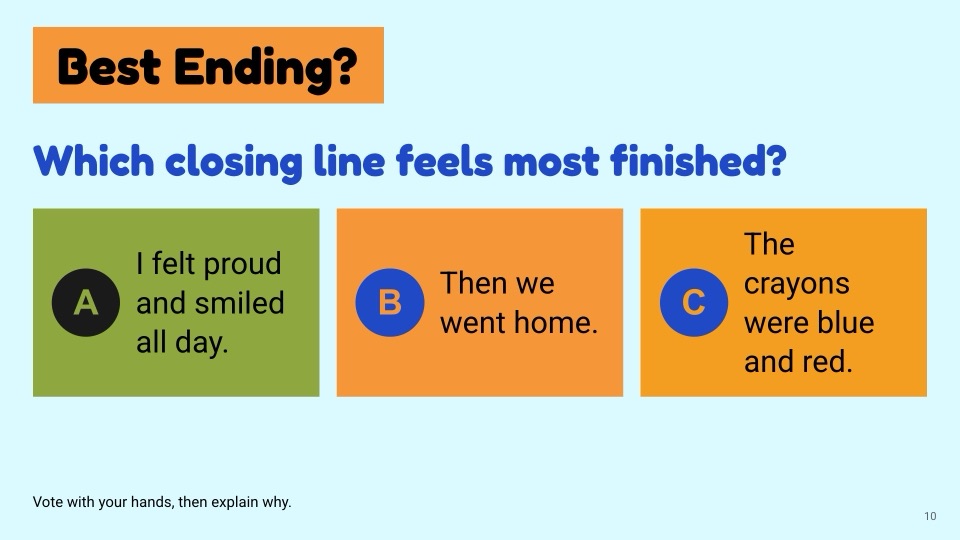
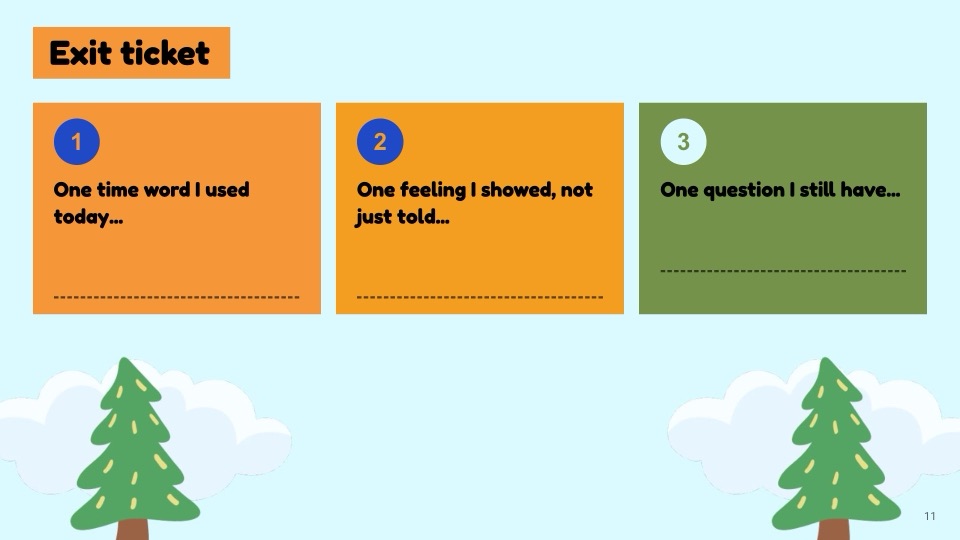
| 10 min | Plenary | Judge closure and review order words and feeling details. Show Slide 10 and read the three choices aloud. Have class vote thumbs up for the line that feels most finished and explain why. Show Slide 11 and have students write exit ticket lines in notebooks. Collect notebooks and restate: story shows what happened, how it felt, how it ended. |
Common mistakes
- Events told out of order or missing time words
How to spot it: Story jumps from end to start or has no first, next, then, last
Use 3-box plan in order and point to each time word as you retell. - Telling feeling only, like I was sad, with no action
How to spot it: No faces, hands, sounds, or colors the reader can picture
Show and not just tell: add tears, hugs, shaky hands, or loud clatter. - Story just stops with no closure
How to spot it: Last line adds new detail but does not solve problem or tell feeling
Add Finally or In the end plus closing feeling linked to the problem.
Support
- Use five-line frame with starters First___, Next___, Then___, Last___ or dictate to a partner.
- Provide word bank for feelings and actions like stomped, whispered, shivered, grinned and I felt ___ because ___.
Stretch
- Add sound or color detail and a title that fits the problem and solution.
- Add a speech or thought bubble line starting I thought ___ and a second feeling that changes.
Check questions
- Write one time word you used today and use it in order.
Answer: First, next, then, after that, or finally used to start an event in order. - Write one feeling you showed, not just told.
Answer: Example: My hands shook and I hugged my bag to show I was scared. - Which ending gives closure: I felt proud and smiled all day?
Answer: Yes, it tells the closing feeling after the problem is solved.
Curriculum
Write narratives in which they recount a well-elaborated event or short sequence of events, include details to describe actions, thoughts, and feelings, use temporal words to signal event order, and provide a sense of closure.
Video clips
Clips on YouTube, from the start and end times we chose. Check each one before you show it.
-
Narrative writing for 1st and 2nd grade from 0:00 to 4:03
Ms. Dorismond's Virtual Corner: ✏️ What is Narrative Writing? | Narrative Writing for Kids 1st & 2nd Grade
Made specifically for ages 7-8 and explains narrative as recounting events with details in simple vocabulary and pace.
-
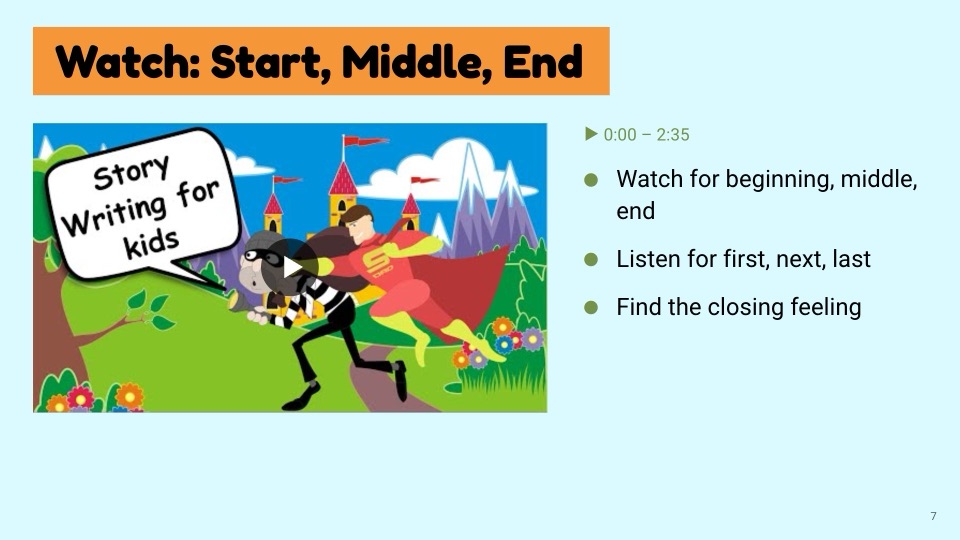
Beginning, middle, end story from 0:00 to 2:35
The Evelyn Winters Adventure: Writing a story with beginning, middle, end - tutorial for kids
Teaches beginning-middle-end structure with a kid-friendly tutorial perfect for 7-8-year-olds learning event order and closure.
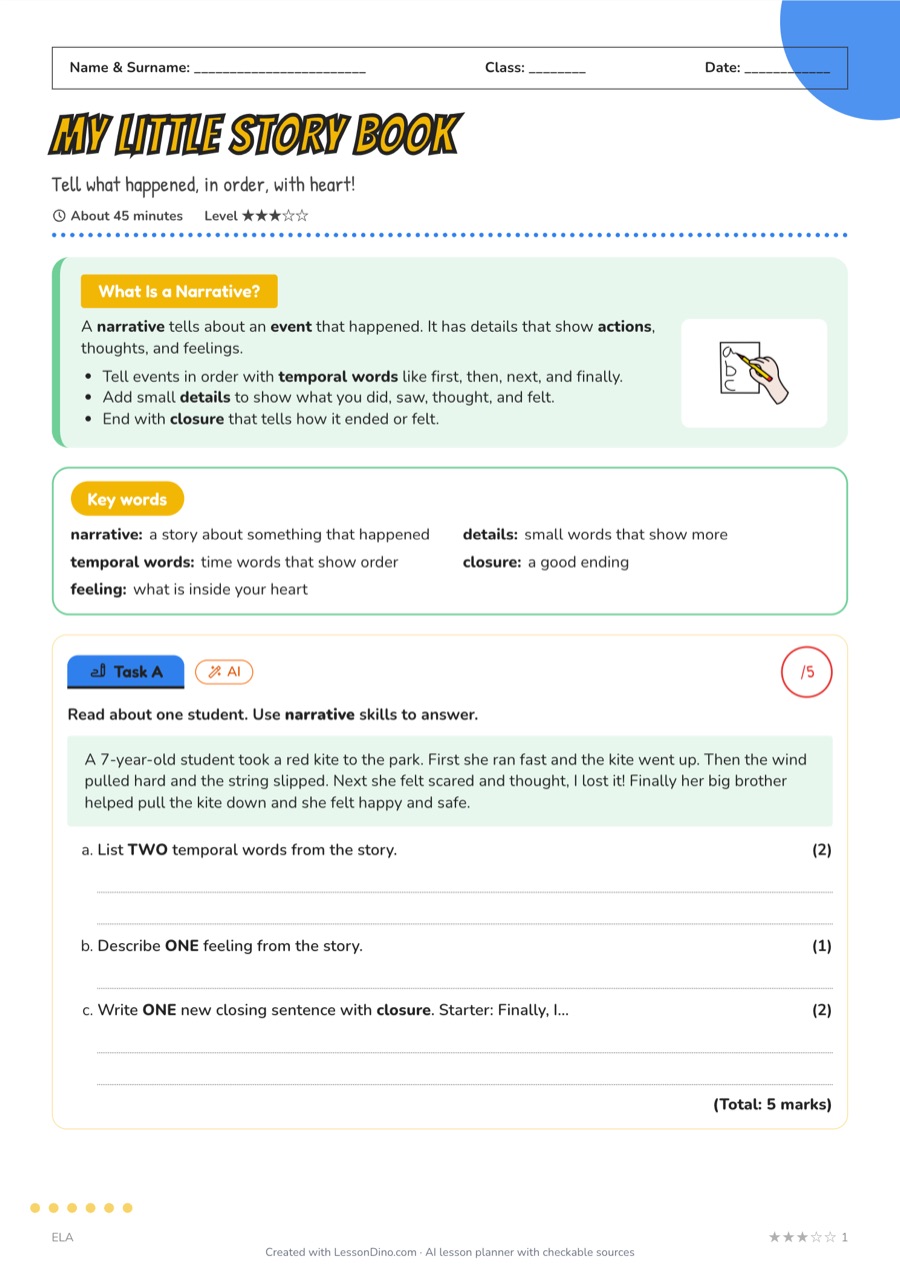
Worksheet
Sources
- How to Read the Standards thecorestandards.org
- CCSS for ELA - Content Standards (CA Dept of Education) cde.ca.gov
- Beginning Creative Writing - Harvard Division of Continuing ... coursebrowser.dce.harvard.edu
- Fundamentals in Creative Writing: The Grammar of Narrative creativewriting.uchicago.edu
- THE EFFECTS OF CREATIVE WRITING ACTIVITIES ON NARRATIVE TEXT ... files.eric.ed.gov
- Introduction - Creative Writing - LibGuides at Malone University libraryguides.malone.edu
- What is Creative Writing? | SNHU snhu.edu
- Narrative and Creative Writing for Nonfiction - eCornell ecornell.cornell.edu
- Writing Skills - Creative and narrative writing - BBC Bitesize bbc.co.uk
- UNIVERSITY WRITING CENTER calbaptist.edu
- Modes of Writing - Eastern easternct.edu
Picture credits
- Photo: folacherry · Pixabay
- Pictograms: Sergio Palao, ARASAAC (arasaac.org) · CC BY-NC-SA
Made with Lesson Dino's AI on 16 October 2026. AI can make mistakes, so check facts against the sources before you teach.