Slides
Lesson plan
Slow and Steady: Retell a Fable and Find the Moral
Students retell The Tortoise and the Hare in order. They find the moral and match two more fables to lessons.
Objectives
- Students will recount The Tortoise and the Hare in order with key details.
- Students will answer who, what, and where to show story understanding.
- Students will determine the central moral in one short sentence.
Success criteria
- I can retell first, next, and last in order.
- I can answer who, what, and where about the fable.
- I can say the lesson in one short sentence.
Key words
| Word | Meaning |
|---|---|
| fable | a short tale that teaches a lesson |
| moral | the lesson about good behavior at the end of a tale |
| recount | to tell again what happened in order |
| steady | keeping going without stopping |
| detail | a small but important piece of information |
Timed plan (60 minutes)
| Time | Stage | What happens |
|---|---|---|
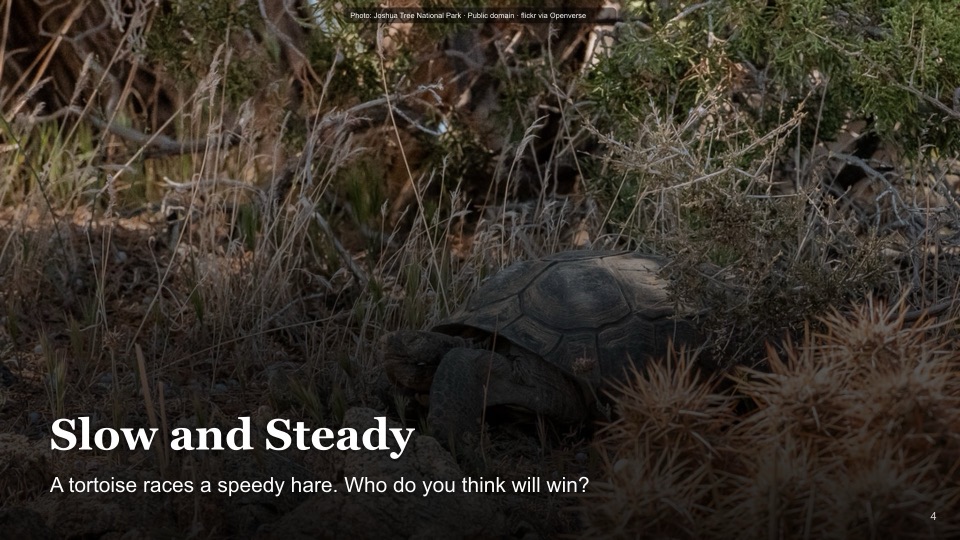
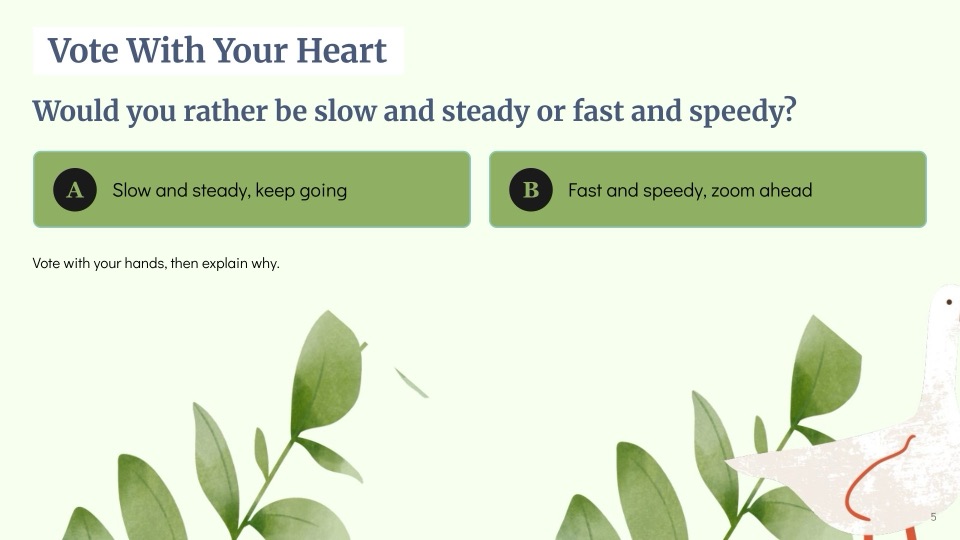
| 8 min | Starter | Hook interest in the race and surface ideas about winning. Show Slide 4 photo of a tortoise racing a speedy hare and say the hook. Show Slide 5 vote: Would you rather be slow and steady or fast and speedy? Take a quick count for each choice and ask two students to give a reason. Link votes to today’s goal: retell the race in order and find its lesson. |
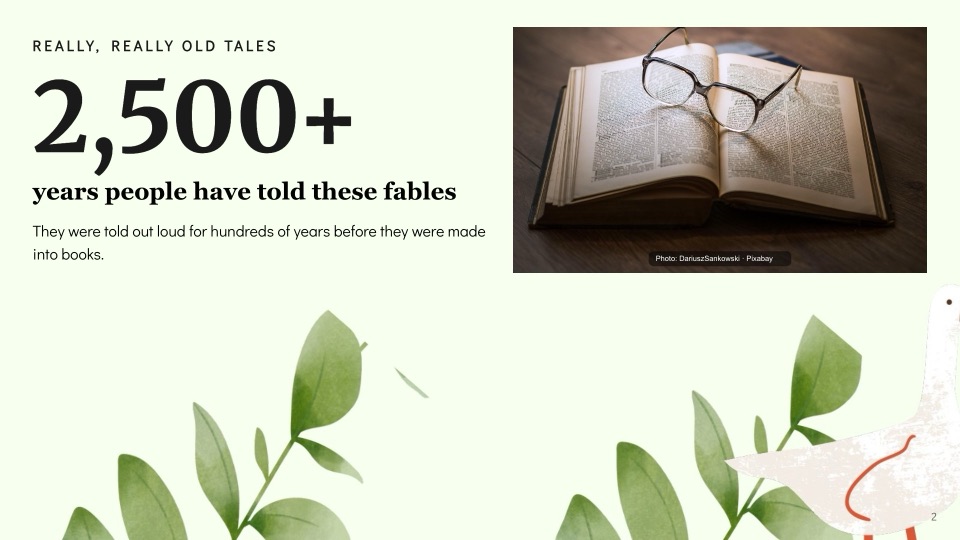
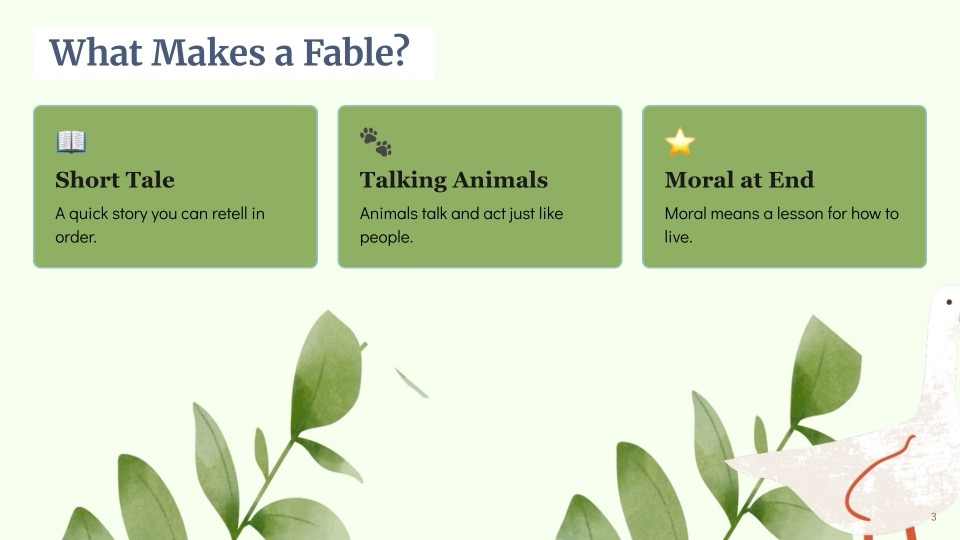
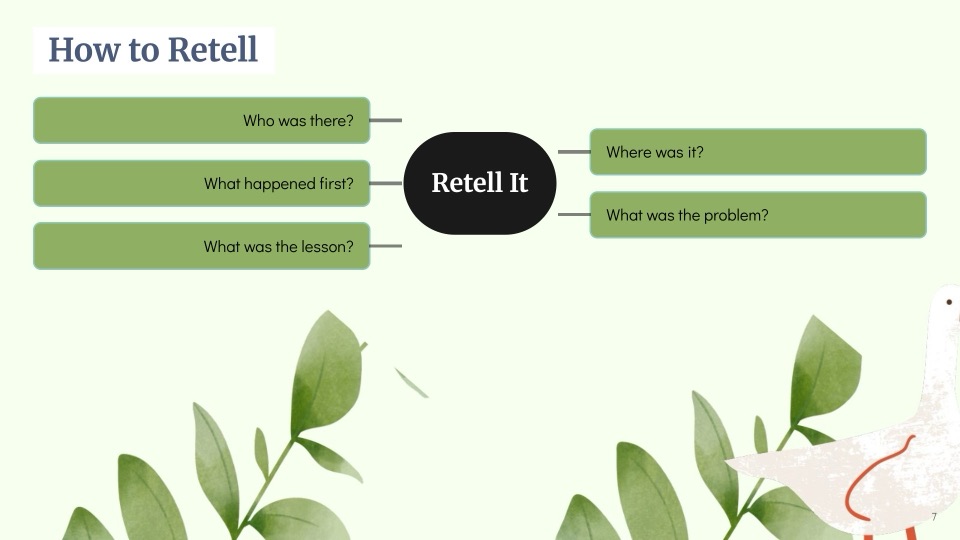
| 12 min | Teaching | Teach what a fable is and how to retell it. Show Slide 2 and explain fables were told out loud for hundreds of years and for 2,500+ years people have told these fables. Show Slide 3 cards: a fable is a short story that teaches a lesson called a moral, animals talk and act just like people, and fables almost always end with a moral. Show Slide 7 mindmap: Who was there? Where was it? What happened first? What was the problem? What was the lesson? Model a retell of paragraph 1 using who, what, where, and first, next, last to show key details. |
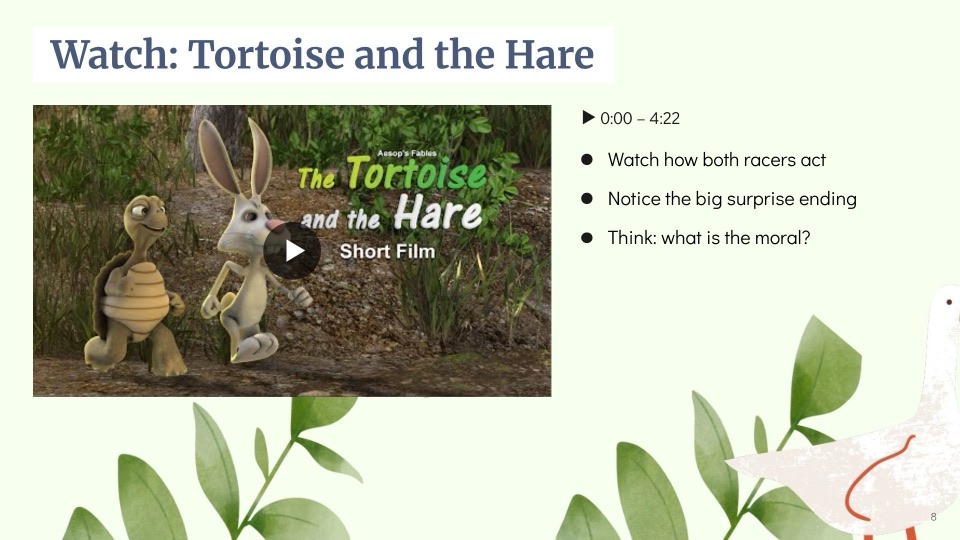
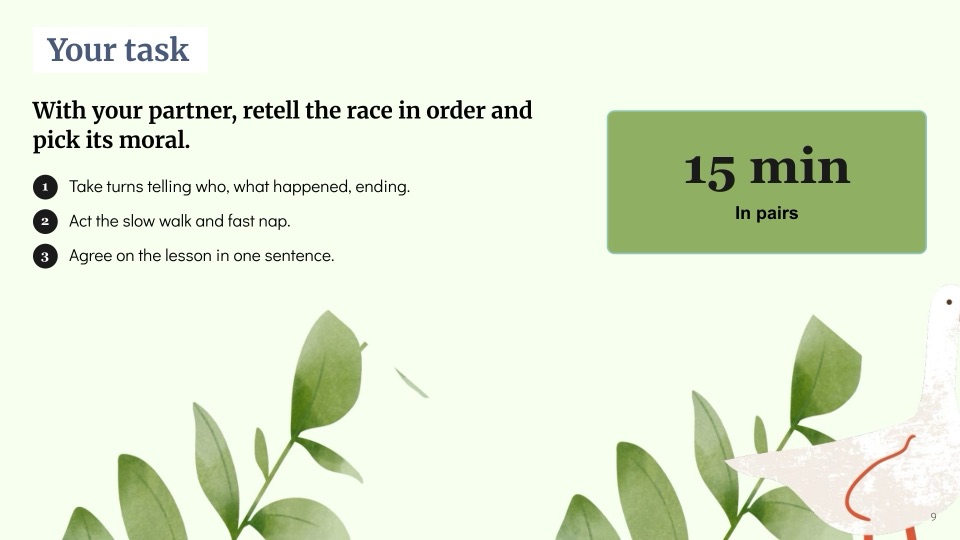
| 25 min | Main activity | Retell The Tortoise and the Hare in order and agree on the moral. Play Slide 8 Video clip 2 The Tortoise and the Hare 0:00–4:22. Tell students to watch how both racers act and notice the big surprise ending. Read aloud paragraph 1 and hand out 4 picture cards and sentence strips per pair. Model putting pictures in order to show the beginning, middle, and end, and how the ending concludes the action. Set Slide 9 task: take turns telling who and what happened, act the slow walk and fast nap, agree on the lesson in one sentence. |
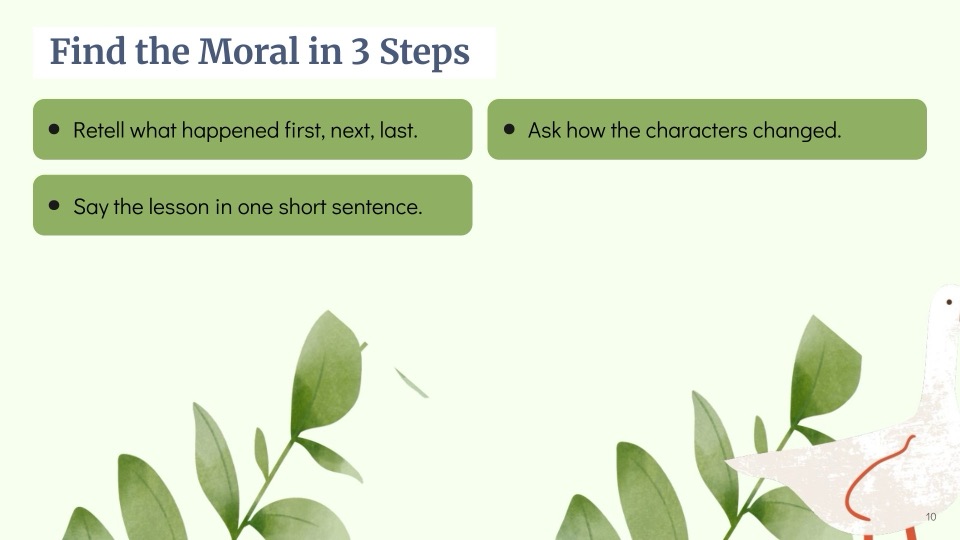
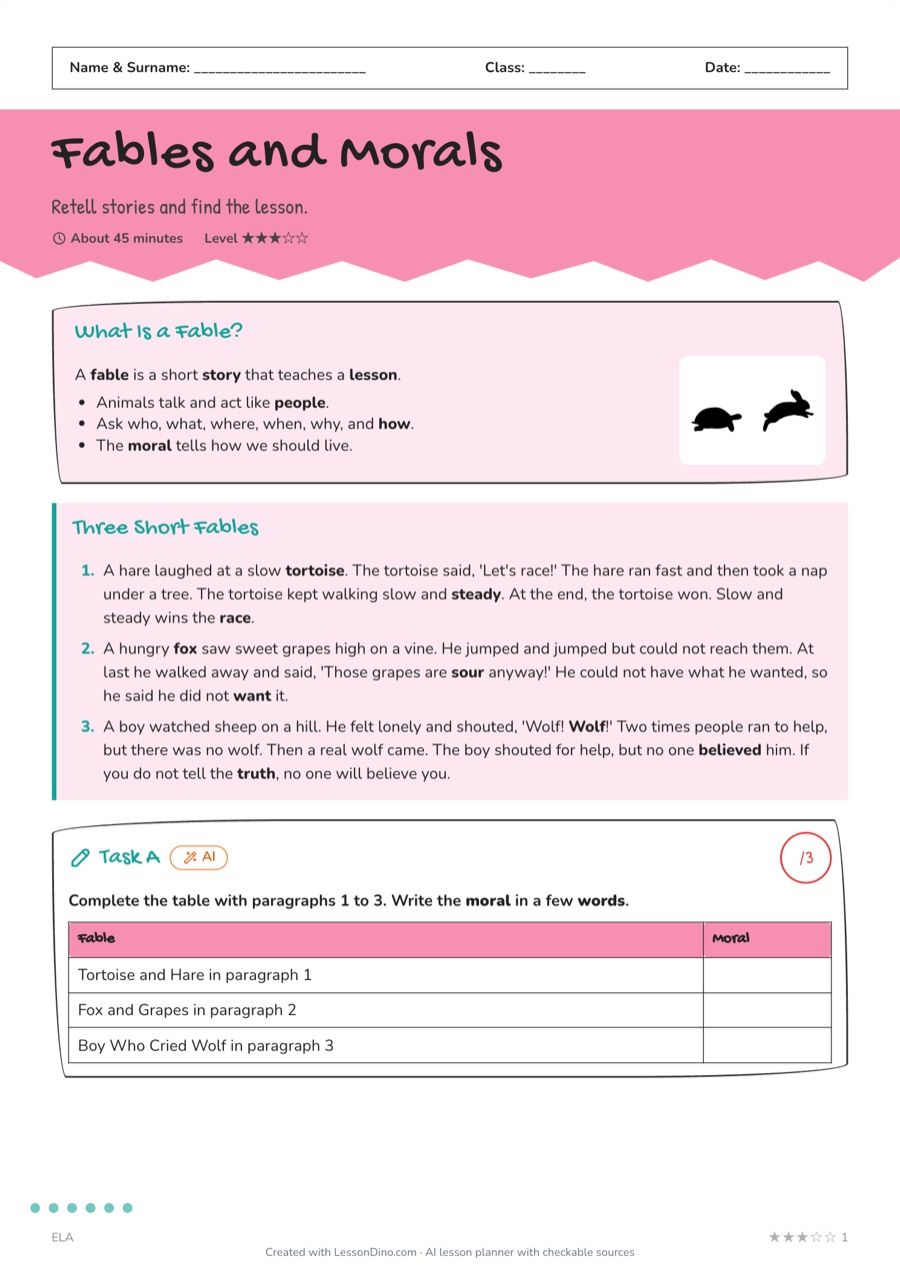
| 10 min | Practice | Apply the 3 steps to find morals in two more short fables. Show Slide 10: Retell what happened first, next, last. Ask how the characters changed. Say the lesson in one short sentence. Hand out Worksheet Task A and point to Passage Three Short Fables paragraphs 1 to 3. Read paragraphs 1 to 3 aloud while students follow, then let them complete the table rows for the moral in a few words. Collect two quick examples to show how characters’ actions teach the lesson. |
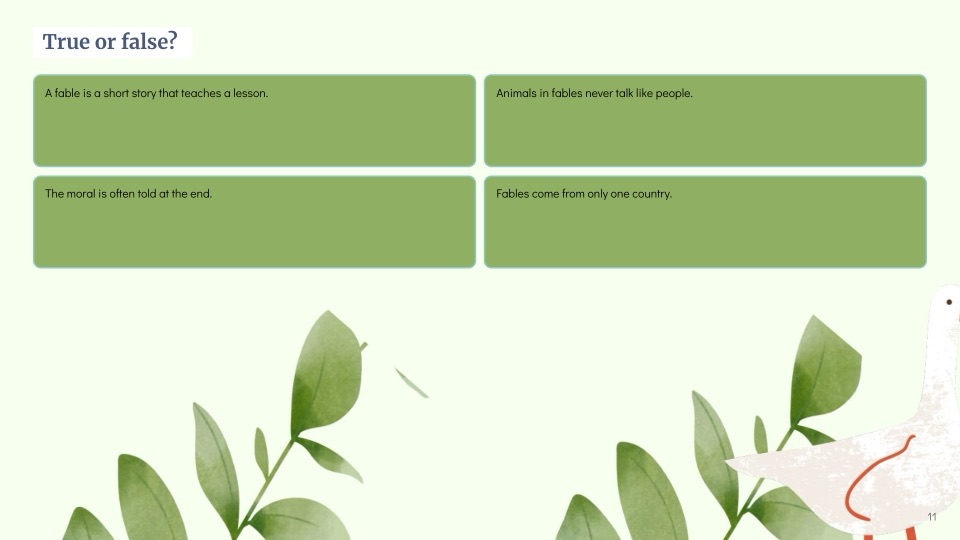
| 5 min | Plenary | Check fable features and morals against the success criteria. Show Slide 11 True or false? Read each line together. Ask students to show thumbs up for true, thumbs down for false and fix false lines. Restate: fable is short with talking animals, teaches a moral, and we retell first, next, last. |
Common mistakes
- Retelling details but missing the lesson
How to spot it: Retell lists what happened but no moral sentence
Ask: What did the actions teach? Point to ending line and say it in 6-8 words. - Thinking animals in fables act only like animals
How to spot it: Says a fox or hare cannot talk or plan
Remind: in fables animals think and talk like humans while still acting like themselves. - Mixing beginning, middle, and end order
How to spot it: Nap placed first or win placed in middle
Reorder cards and label how the beginning introduces the story and the ending concludes the action.
Support
- Use fewer cards, starters, and picture prompts for ordering and retelling.
- Pre-teach fable, moral, first, next, last with gestures.
Stretch
- Add character thinking, compare two morals, or tell the lesson in own words.
- Explain why a different moral does not fit.
Check questions
- Retell The Tortoise and the Hare: what happened first, next, last?
Answer: First race starts, next hare naps and tortoise keeps walking, last tortoise wins. - What is a moral?
Answer: A lesson about how to behave, often at the end of a fable. - What is the lesson of The Boy Who Cried Wolf?
Answer: If you do not tell the truth, no one will believe you.
Curriculum
Recount stories, including fables and folktales from diverse cultures, and determine their central message, lesson, or moral.
Video clips
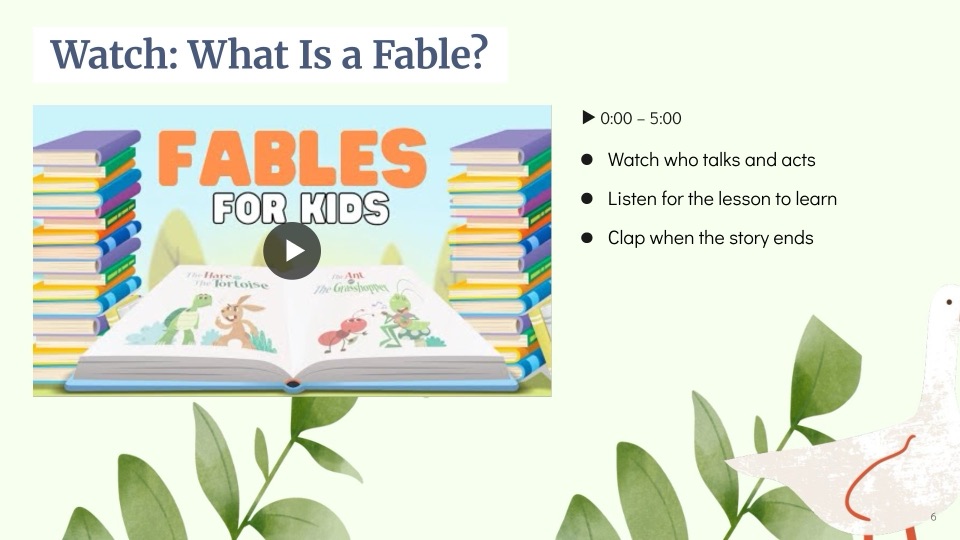
Clips on YouTube, from the start and end times we chose. Check each one before you show it.
-
What makes a story a fable? from 0:00 to 5:00
Learn Bright: Fables for Kids | What makes a story a fable?
Clearly explains fables, animal characters, and morals with simple language perfect for ages 7-8.
-
The Tortoise and the Hare from 0:00 to 4:22
Animaza Studios: Aesop's Fables "The Tortoise and the Hare" Short Film
Animated Aesop retelling with slow clear narration ideal for 7-8-year-olds to recount.
Worksheet
Sources
- English Language Arts Standards » Reading: Literature » Grade 2 thecorestandards.org
- ELA Grade 2 - Chicago Public Schools cps.edu
- Learning from Fables: Moral Values in Three Selected English Stories files.eric.ed.gov
- Words to the Wise: Aesop's Fables Interactive Book - Read.gov read.gov
- Aesop’s Fables - Internet Encyclopedia of Philosophy iep.utm.edu
- Fable Facts for Kids kids.kiddle.co
- Aesop's Fables Facts for Kids kids.kiddle.co
- fable - Students | Britannica Kids | Homework Help kids.britannica.com
- What are the morals in Aesop fables? – Swirlzcupcakes.com swirlzcupcakes.com
- Moral Lessons & Themes in Fables to Teach Kids | FableReads fablereads.com
- Moral Fables for Kids - A Moral Stories amoralstories.com
- Best Fables Stories with Morals for Kids kidsgen.com
- What is a Fable? Definition, Examples of Fables in Literature writingexplained.org
Picture credits
- Illustration: akadarcee · Pixabay
- Photo: DariuszSankowski · Pixabay
- Photo: Joshua Tree National Park · Public domain · flickr via Openverse
- Illustration: OpenClipart-Vectors · Pixabay
- Pictograms: Sergio Palao, ARASAAC (arasaac.org) · CC BY-NC-SA
Made with Lesson Dino's AI on 17 October 2026. AI can make mistakes, so check facts against the sources before you teach.