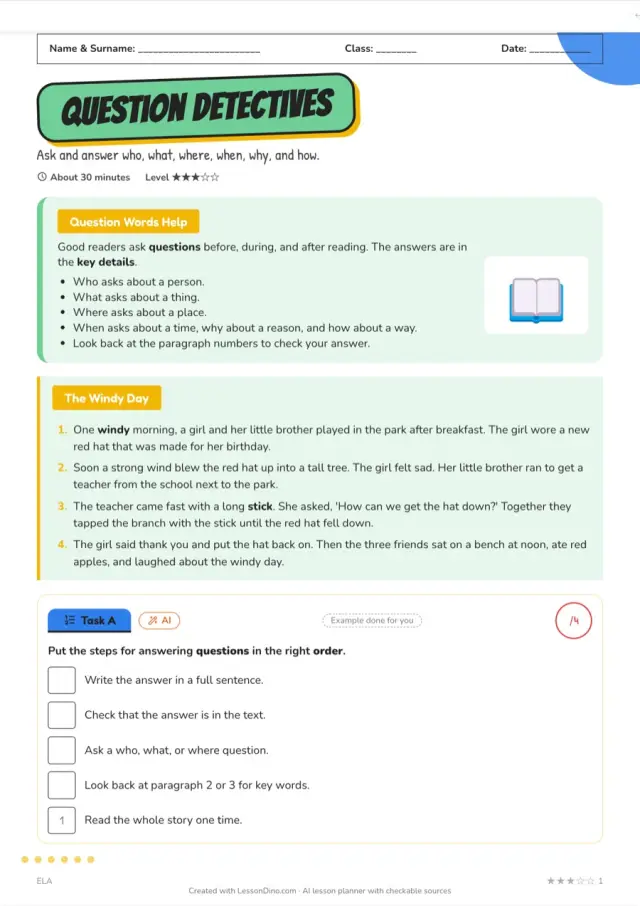
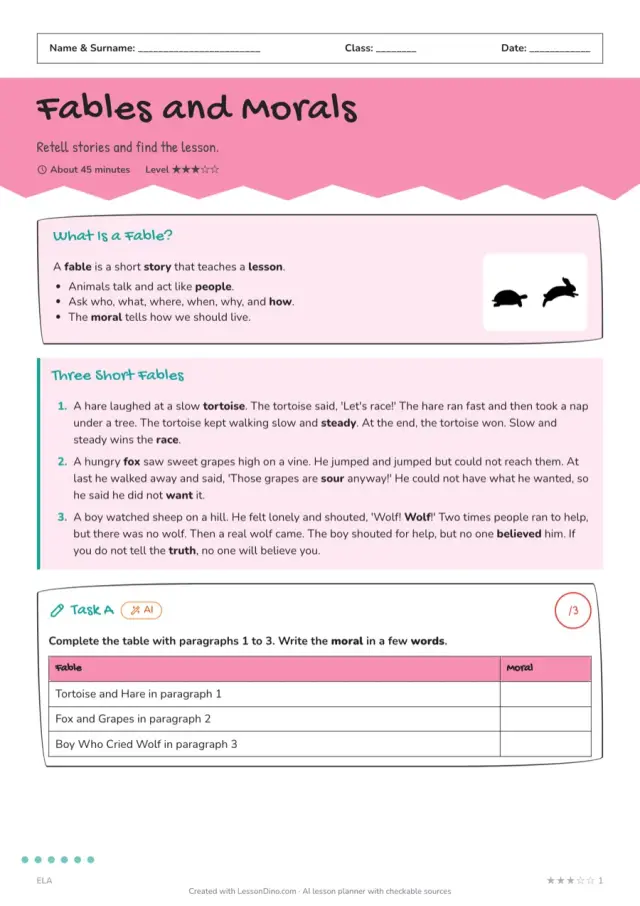
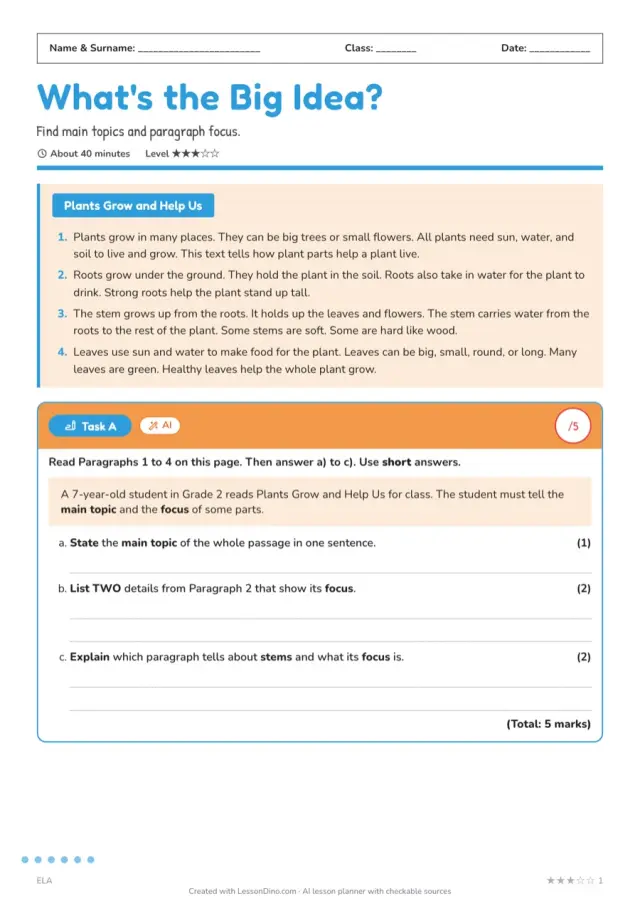
The worksheet
About this worksheet
Students learn five tricky plurals that change or stay the same. They sort pairs and use them in short sentences. This Grade 2 ELA worksheet gives students (ages 7–8) six pages of practice on irregular plural nouns, part of the language unit. It goes with our free Irregular plural nouns lesson, which has the slides and a timed lesson plan.
What it covers
By the end, students should be able to:
- Students will match foot, tooth, mouse, child, fish to their plural forms.
- Students will use feet, teeth, mice, children, fish correctly in short sentences.
How to use it
- Use it for practice after the teaching part of the lesson, once students have seen the worked examples on the slides.
- Support: Start with only three pairs, child-children, foot-feet, and fish-fish, with picture clues on each card.
- Stretch: Ask the student to write two sentences using any two sorted irregular plurals.
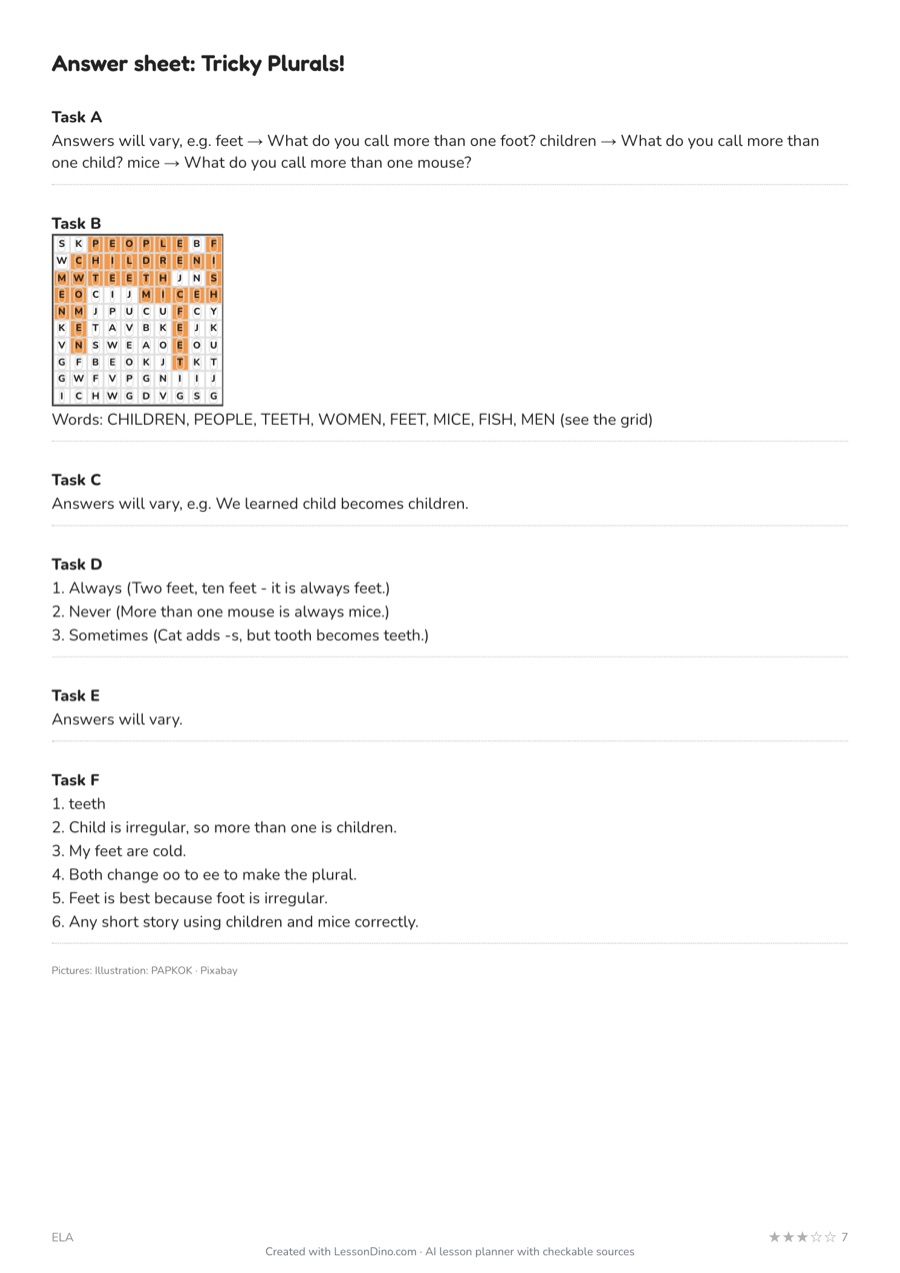
- The answer sheet is the last page, so you can print it on its own or let students check their own work.
Key vocabulary
- singular: telling about only one person, animal, or thing
- plural: telling about more than one person, animal, or thing
- regular plural: more than one made by adding -s or -es
- irregular plural: more than one that changes in a special way, not just adding -s
Mistakes to watch for
- Writing childs, mouses, foots, tooths by adding -s. Remind that adding -s creates incorrect forms such as childs or mouses; replace with children, mice, feet, teeth.
- Writing fishes or sheeps for everyday more than one. Remind that fish commonly works as both singular and plural and the usual plural of fish is fish.
What's on the worksheet
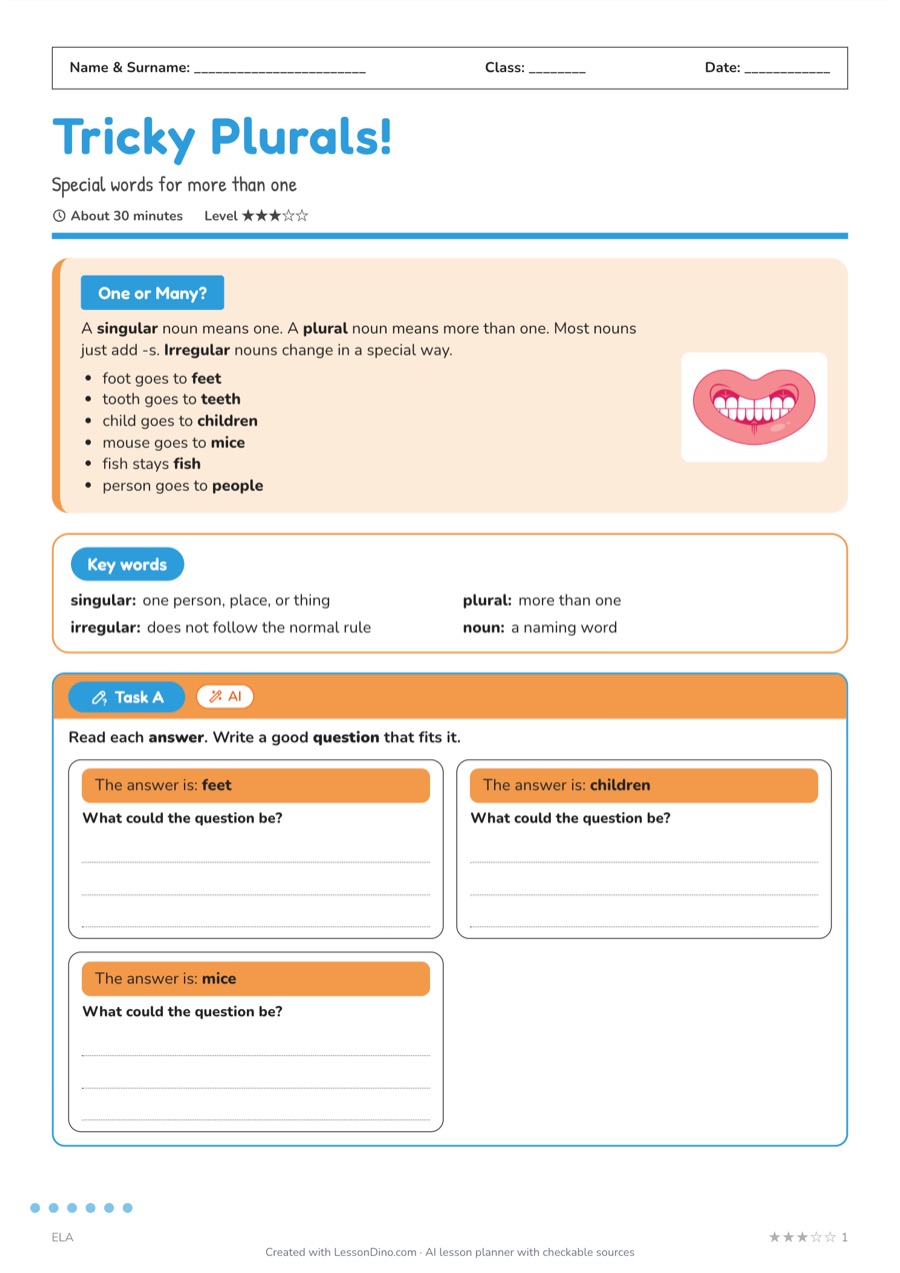
Tricky Plural Power
Learn how special nouns change when there is more than one.
One or Many?
- A singular noun means one. A plural noun means more than one. Most nouns just add -s. Irregular nouns change in a special way.
- foot goes to feet
- tooth goes to teeth
- child goes to children
- mouse goes to mice
- fish stays fish
- person goes to people
| Word | Meaning |
|---|---|
| singular | one person, place, or thing |
| plural | more than one |
| irregular | does not follow the normal rule |
| noun | a naming word |
Read each answer. Write a good question that fits it.
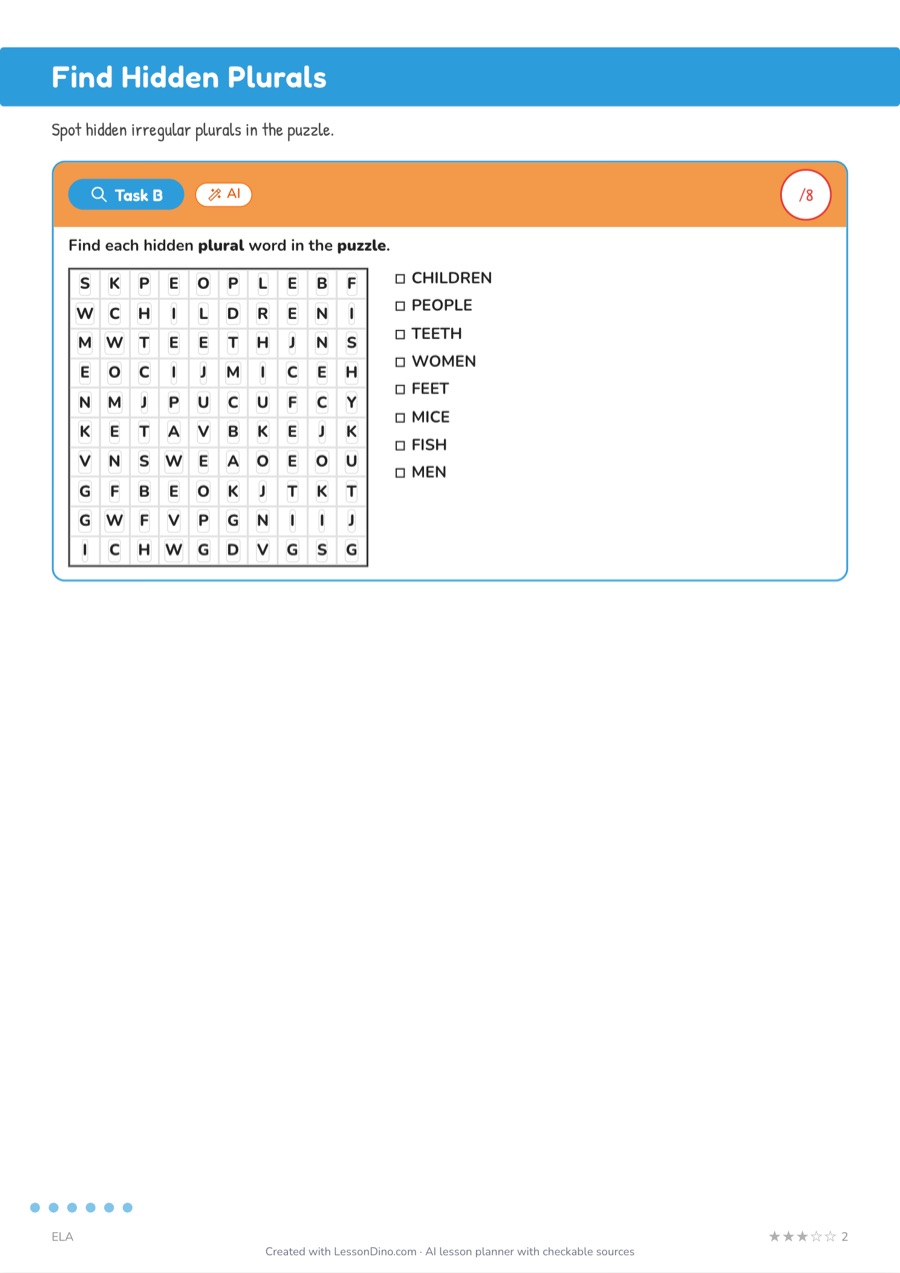
Find Hidden Plurals
Spot hidden irregular plurals in the puzzle.
Find each hidden plural word in the puzzle.
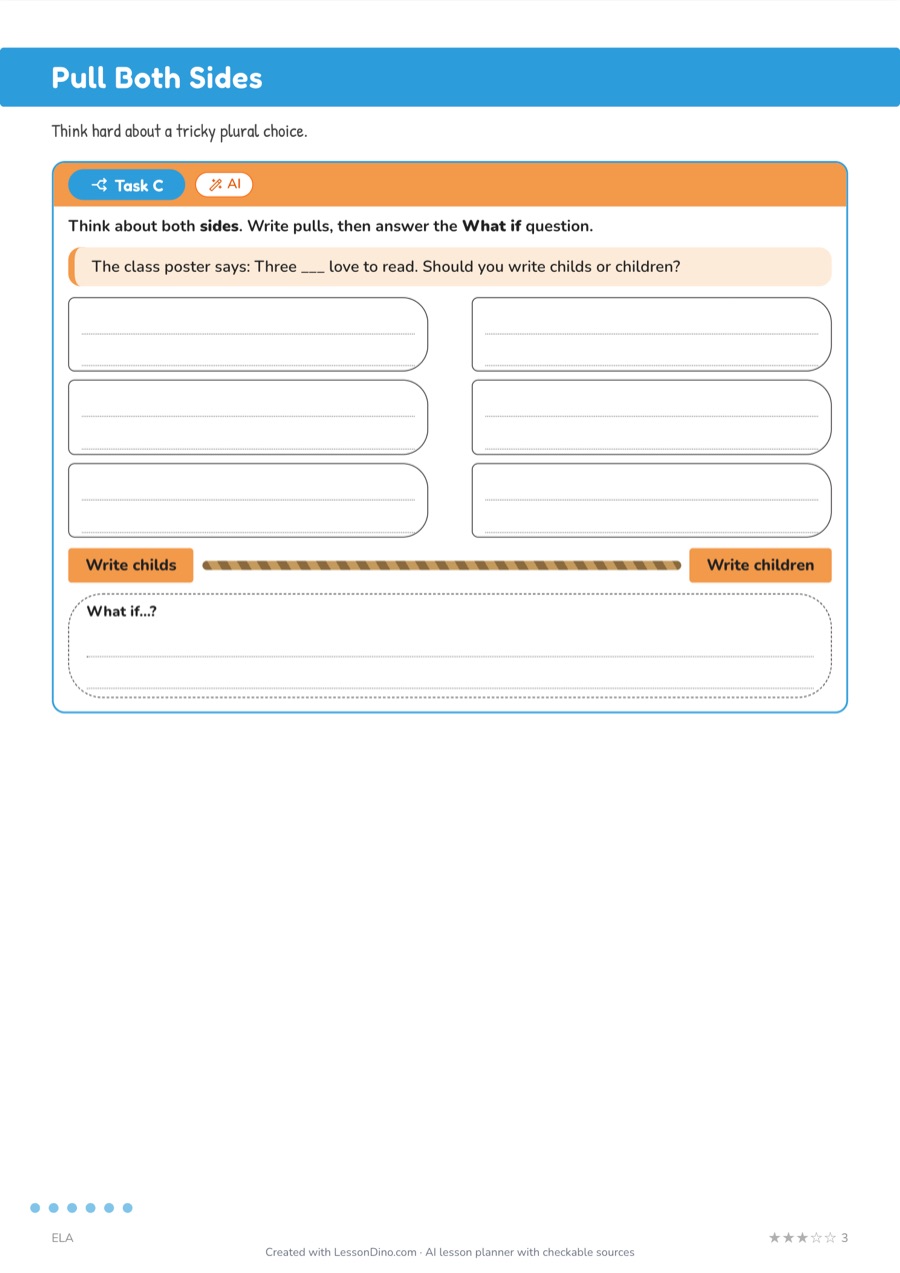
Pull Both Sides
Think hard about a tricky plural choice.
Think about both sides. Write pulls, then answer the What if question.
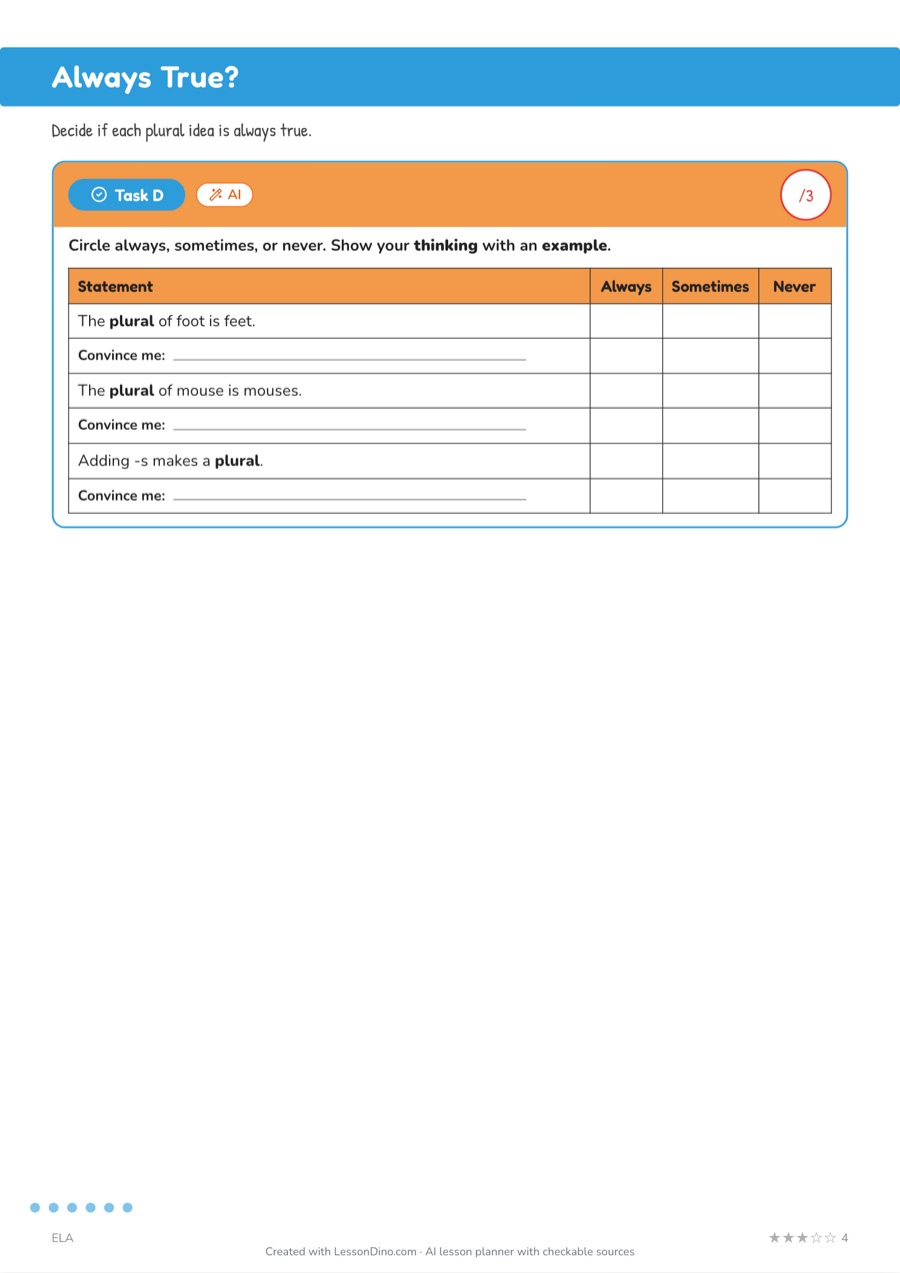
Always True?
Decide if each plural idea is always true.
Circle always, sometimes, or never. Show your thinking with an example.
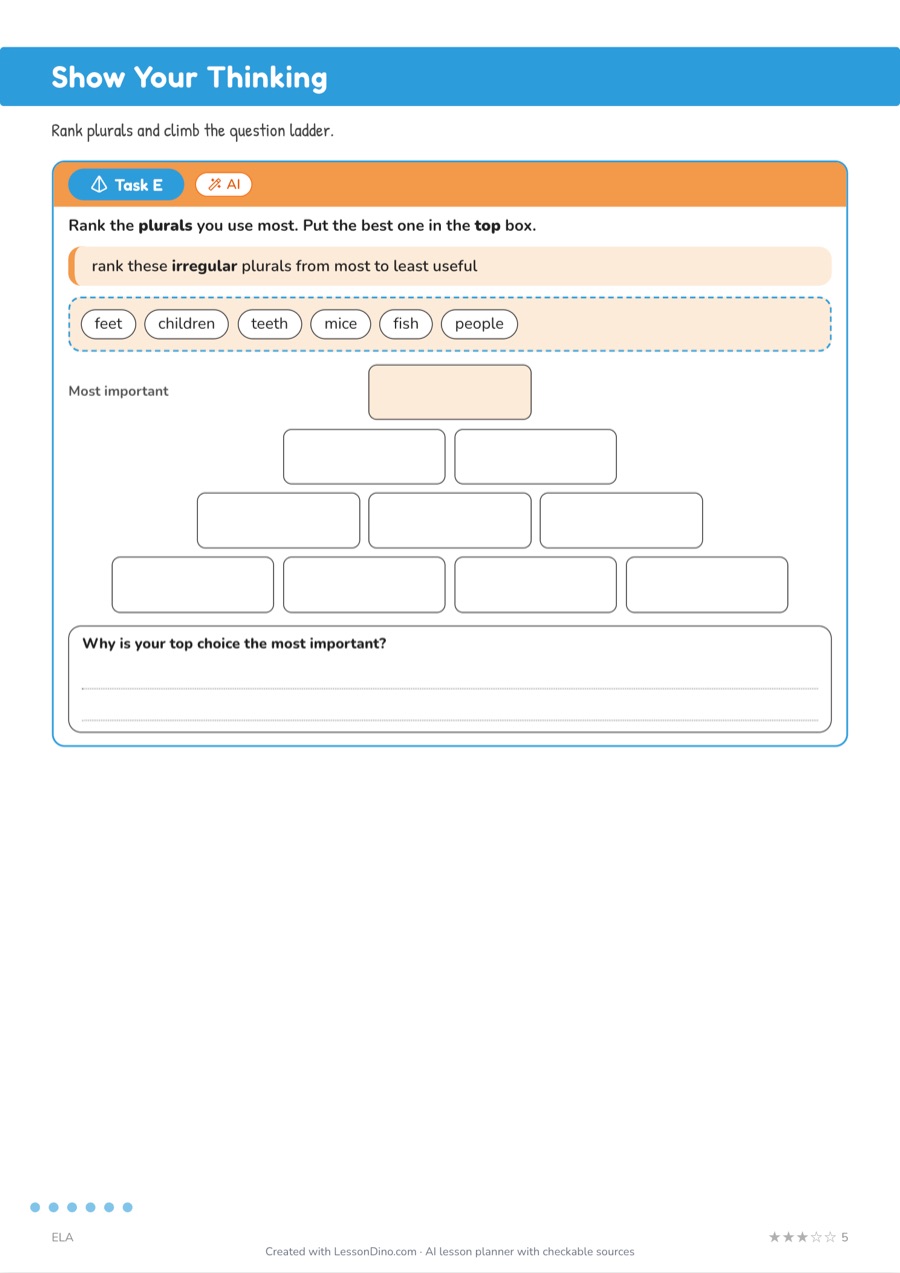
Show Your Thinking
Rank plurals and climb the question ladder.
Rank the plurals you use most. Put the best one in the top box.
Page 6
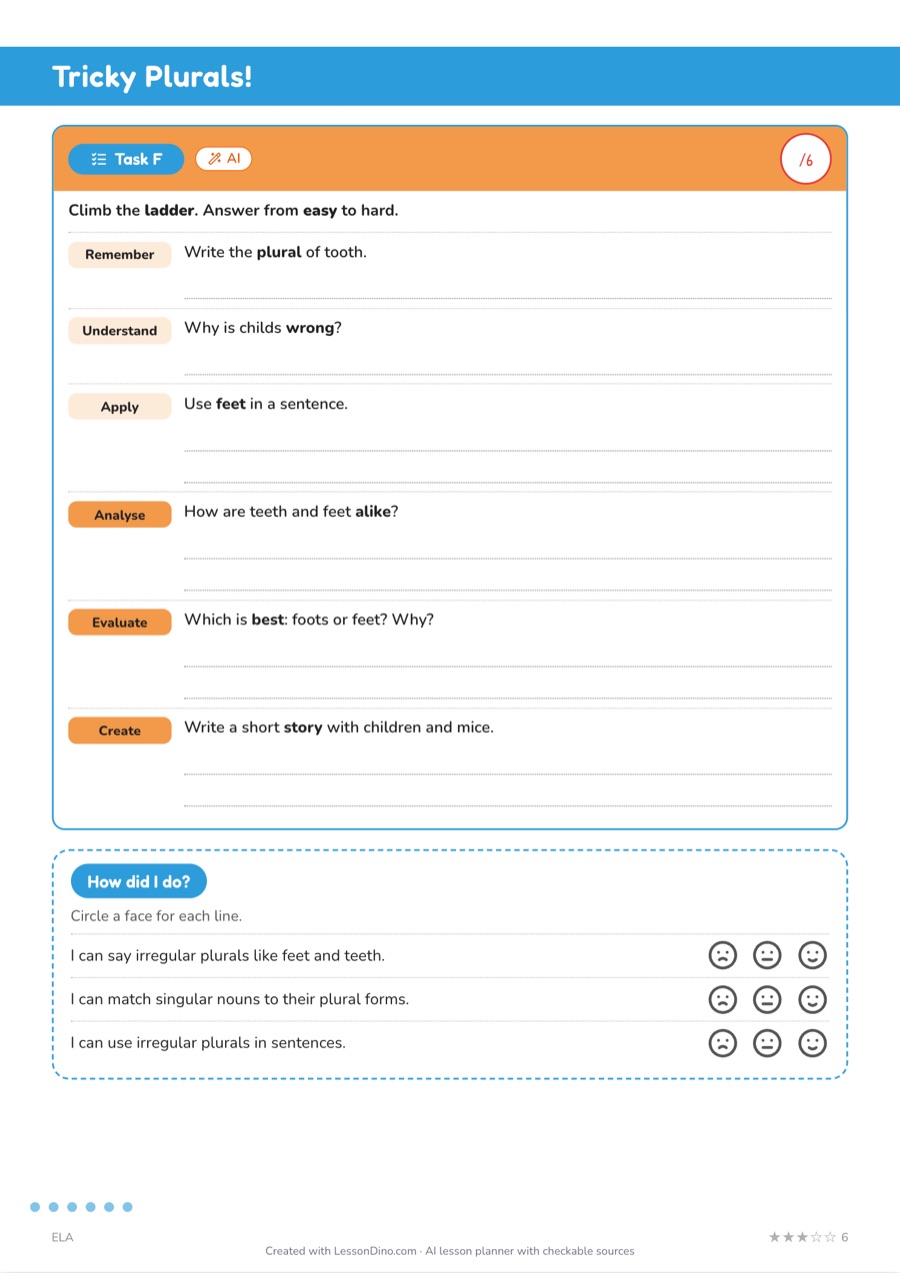
Climb the ladder. Answer from easy to hard.
- Write the plural of tooth.
- Why is childs wrong?
- Use feet in a sentence.
- How are teeth and feet alike?
- Which is best: foots or feet? Why?
- Write a short story with children and mice.
Answers
Show the answers
- Write the plural of tooth. teeth
- Why is childs wrong? Child is irregular, so more than one is children.
- Use feet in a sentence. My feet are cold.
- How are teeth and feet alike? Both change oo to ee to make the plural.
- Which is best: foots or feet? Why? Feet is best because foot is irregular.
- Write a short story with children and mice. Any short story using children and mice correctly.
The answer sheet is the last picture above.
Curriculum
Form and use frequently occurring irregular plural nouns (e.g., feet, children, teeth, mice, fish).
Made with Lesson Dino's AI on 16 October 2026. AI can make mistakes, so check the answers and facts against the sources before you teach.