Slides
Lesson plan
Ask and Answer About Key Details
Students learn to ask and answer who, what, where, when, why, and how questions. They practice in pairs to find key details as proof in a short text.
Objectives
- Students will ask who, what, where, when, why, and how questions about a story.
- Students will answer questions using key details from a short text to show understanding.
- Students will take turns asking and answering with a partner using text proof.
Success criteria
- I can ask a who, what, where, when, why, or how question.
- I can answer using key details from the text.
- I can take turns asking and answering with my partner.
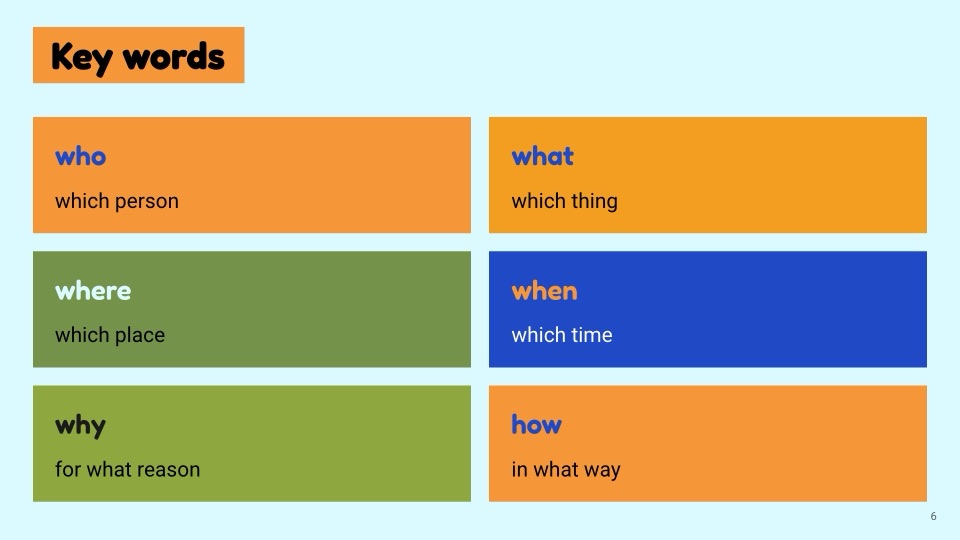
Key words
| Word | Meaning |
|---|---|
| who | which person did it or is talked about |
| what | which thing happened or is talked about |
| where | which place it happened in |
| when | which time it happened at |
| why | for what reason it happened |
| how | in what way it happened |
Timed plan (60 minutes)
| Time | Stage | What happens |
|---|---|---|
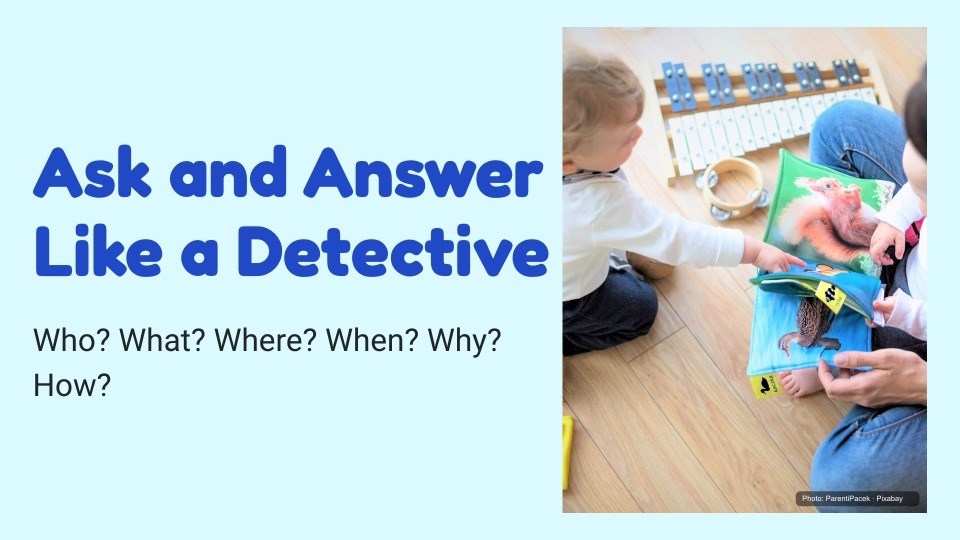
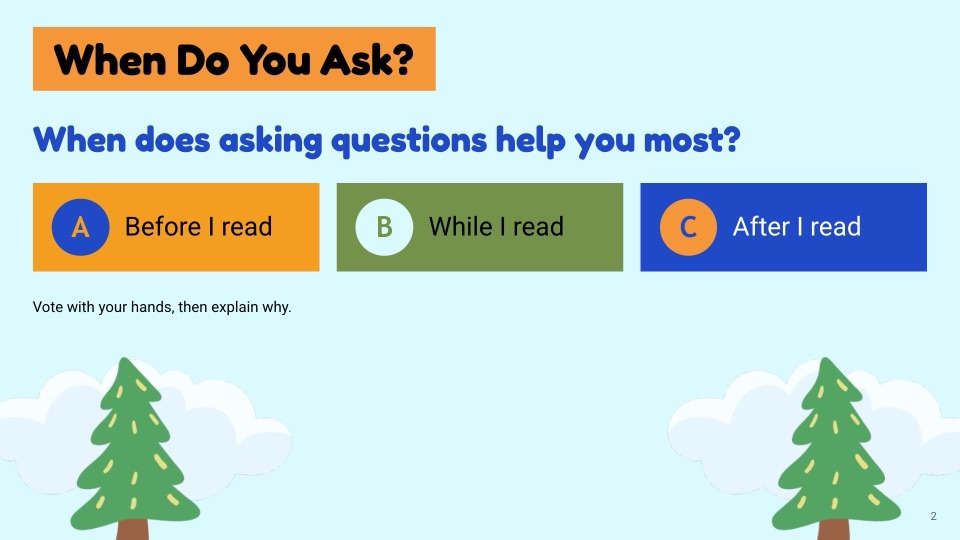
| 8 min | Starter | To recall the six question words and link asking questions to understanding a story. Show Slide 1: Ask and Answer Like a Detective [title]: Who? What? Where? When? Why? How? and chant the six words together. Show Slide 2 vote: When does asking questions help you most? Before I read, While I read, After I read, and take a quick hands-up vote. Explain that good readers ask questions while reading and that asking during reading helps monitor comprehension and check predictions. Introduce partner teamwork with the hook and pair students to whisper one question word they remember. |
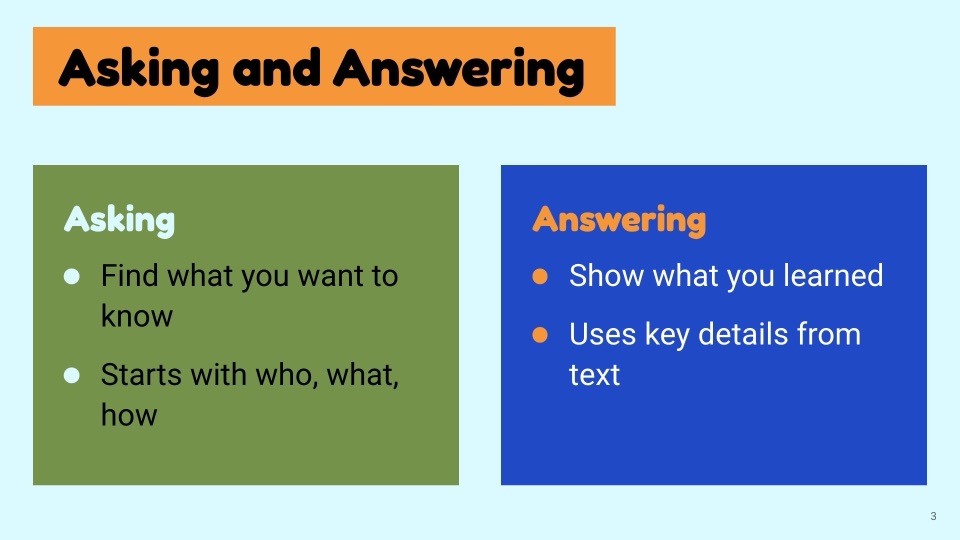
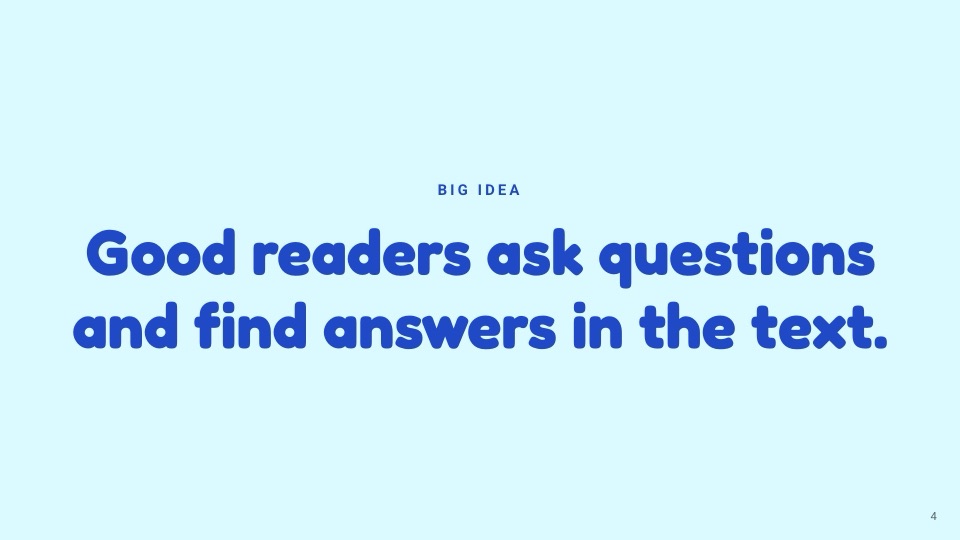
| 12 min | Teaching | To teach what asking and answering mean and what each question word looks for. Show Slide 3 compare of Asking and Answering and Slide 4 statement: Good readers ask questions and find answers in the text. Play Video clip 5 (0:00-0:55) and ask students to listen for who, what, and where and how answers are found. Show Slide 6 key words: who, which person, what, which thing, where, which place, when, which time, why, for what reason, how, in what way, and practice each with a gesture. Model with the Slide 8 text: On Saturday a student flew a red kite in the park. It stuck in a tree. A neighbor helped get it down. |
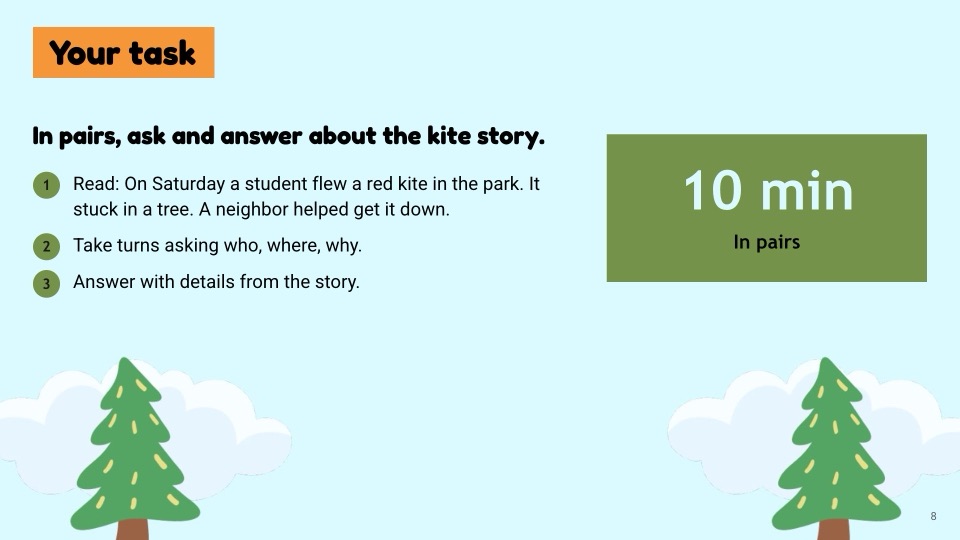
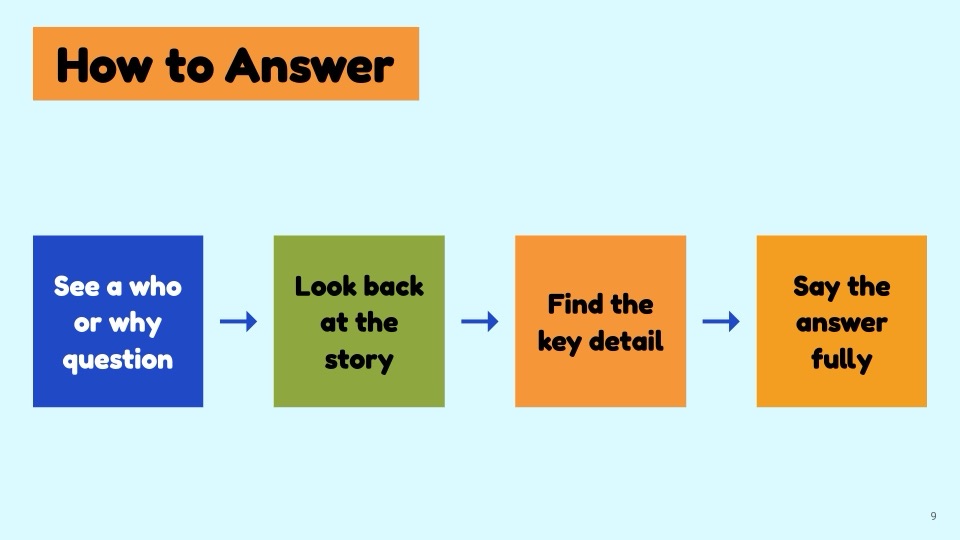
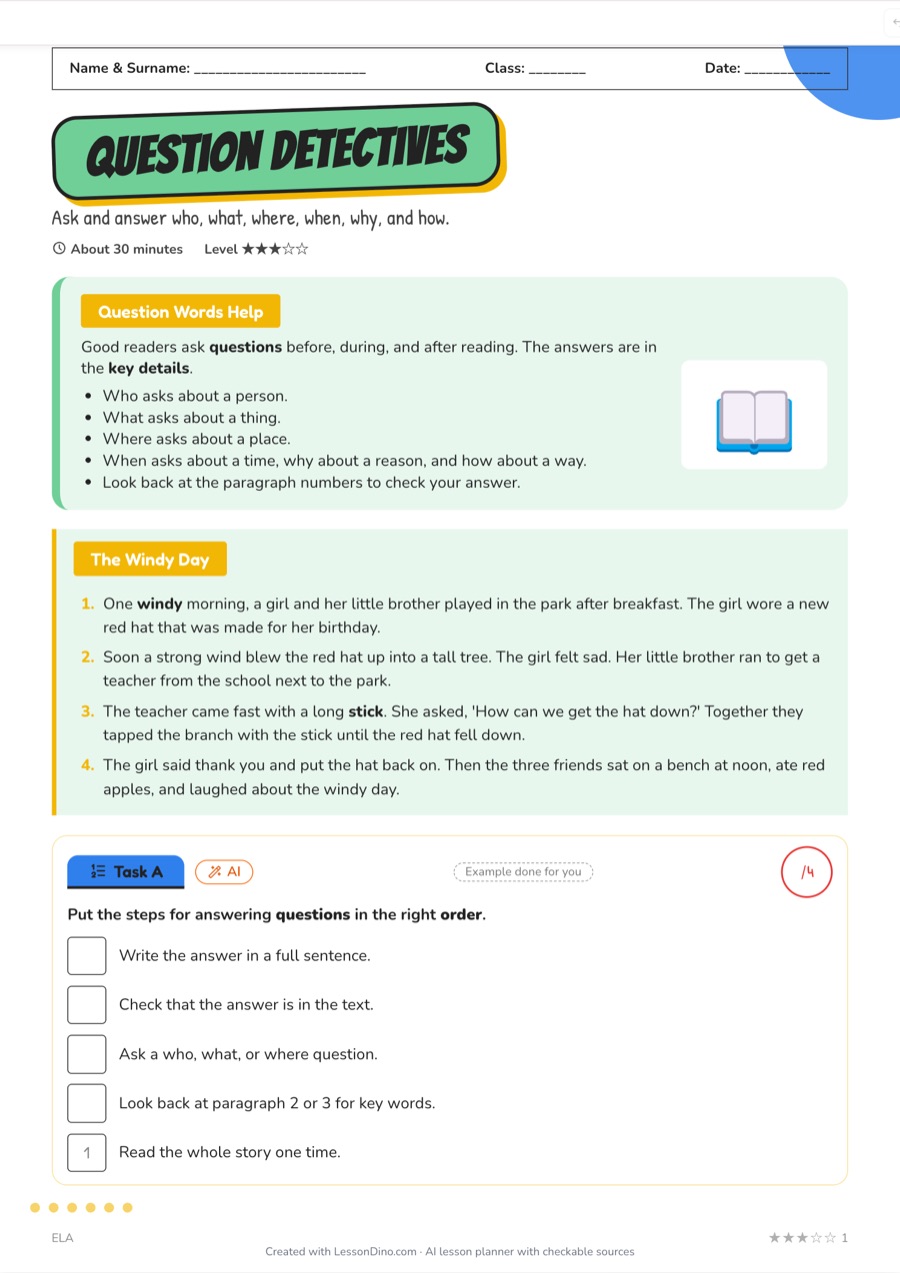
| 12 min | Guided Practice | To practice the steps for finding key details and answering together. Display Slide 8 text: On Saturday a student flew a red kite in the park. It stuck in a tree. A neighbor helped get it down. Show Slide 9 chain: See a who or why question, Look back at the story, Find the key detail, Say the answer fully, and think aloud with a where question. Hand out Worksheet Task A and order the steps for answering questions together, checking that locating information in the text builds confidence. Ask where and why about the kite text and underline the proof sentence with the class. |
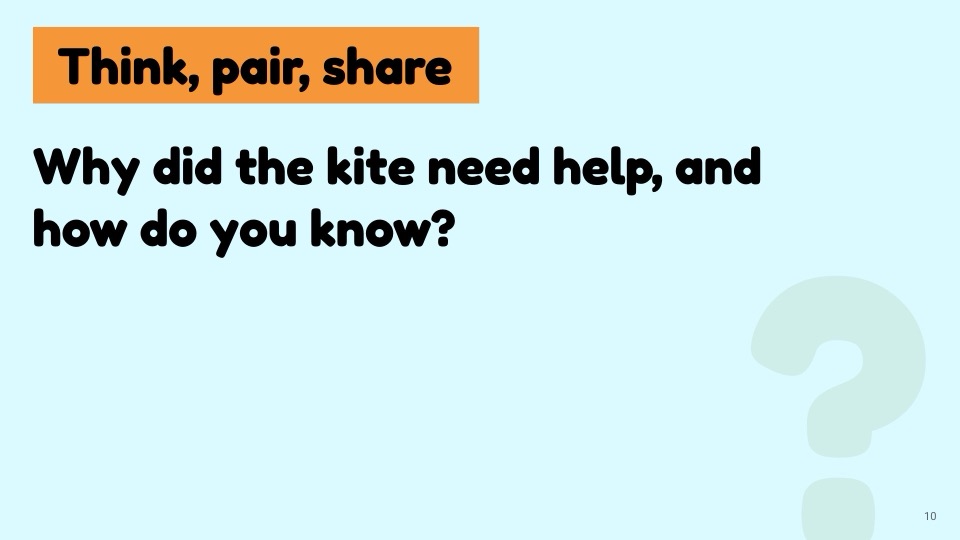
| 20 min | Main Activity | To take turns asking and answering who, where, and why questions with text proof. Give each pair story cards printed with: On Saturday a student flew a red kite in the park. It stuck in a tree. A neighbor helped get it down. plus the question word checklist. Model roles: Student A reads the card, Student B picks a word from the checklist and asks, Student A answers and points to the proof, then they switch, noting that generating questions after reading improves recall. Set a timer for two rounds of 8 minutes and circulate to listen for full answers and pointing to proof. Stop for Slide 10: Why did the kite need help, and how do you know? and have pairs share their proof sentence. |
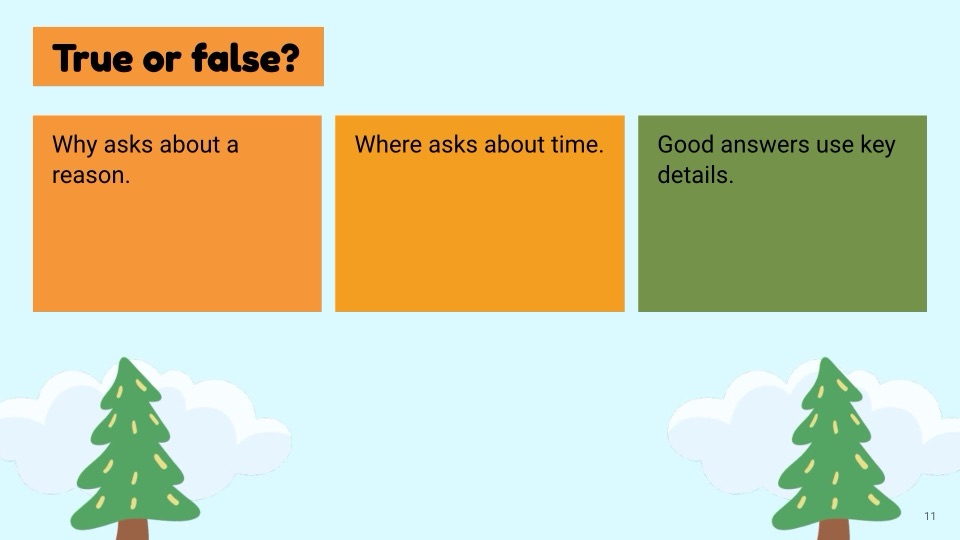
| 8 min | Plenary | To check that students can match question words and use key details in answers. Return to objectives and restate: Good readers ask questions and find answers in the text. Show Slide 11 true or false: Why asks about a reason, Where asks about a place, Good answers use key details, and vote true or false together. Complete Worksheet Task E together: match each word to what it asks about by writing the number in the circle. Collect exit slips with one who or where question and answer from the kite text. |
Common mistakes
- Mixing up where (place) and when (time).
How to spot it: Student answers in the park to a when question or On Saturday to a where question.
Point to Slide 6 and act out: point around for where, tap wrist for when, then find the proof words in the text. - Answering from memory without text proof.
How to spot it: Answer sounds right but student cannot point to the sentence.
Require Look back, find and underline the key detail that answers it. - Asking a statement instead of a who, what, where, when, why, how question.
How to spot it: Student says The kite is red instead of What color is the kite?
Give stems: Who did ___? Where was ___? Why did ___? and have them change one word.
Support
- Give cards with the who and where answers underlined to start.
- Keep kite text and Slide 6 meanings visible and allow drawing plus one-word answers before full sentences.
Stretch
- Have partners ask a why question and answer with because from story clues.
- Have students explain why a detail matters and what needed two sentences to figure out.
Check questions
- Who flew the red kite?
Answer: A student. - Where did the student fly the kite?
Answer: In the park. - Why did the kite need help?
Answer: Because it stuck in a tree.
Curriculum
Ask and answer such questions as who, what, where, when, why, and how to demonstrate understanding of key details in a text.
Video clips
Clips on YouTube, from the start and end times we chose. Check each one before you show it.
-
2nd Grade Q&A During Reading from 0:00 to 2:25
eSpark: Asking and Answering Questions During Reading | 2nd Grade Reading | eSpark Instructional Video
Made exactly for 2nd grade and models asking and answering who, what, where, when, why, and how, with vocabulary and pace perfect for 7-8-year-olds.
-
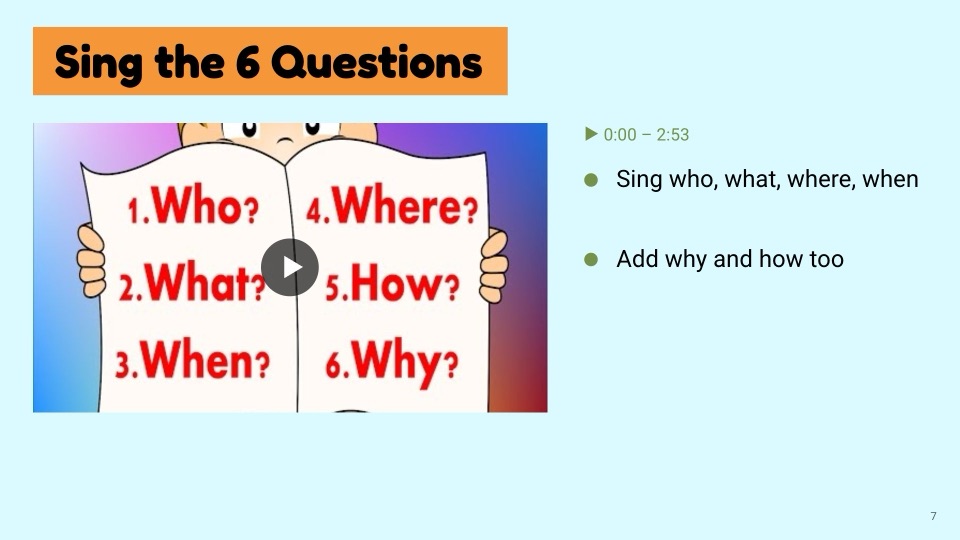
6 Questions Song Strategy from 0:00 to 2:53
Jack Hartmann Kids Music Channel: 6 Questions | Fun Reading & Writing Comprehension Strategy For Kids | Jack Hartmann
Teaches the 6 questions for comprehension in a fun music style made for kids, with pace and language just right for 7-8-year-olds.
Worksheet
Sources
- Question Generation - ed files.eric.ed.gov
- The Line Between The Line Between: Questions, Responses, and americanenglish.state.gov
- Reading - Wikipedia en.m.wikipedia.org
- Reading, Berkshire - Wikipedia en.m.wikipedia.org
- Yusuf al-Asir Wikipedia
Picture credits
- Photo: ParentiPacek · Pixabay
- Microsoft Fluent Emoji (MIT)
Made with Lesson Dino's AI on 16 October 2026. AI can make mistakes, so check facts against the sources before you teach.