The worksheet
About this worksheet
Students learn to list theoretical sample spaces for single and combined fair events. They use the lists to calculate probabilities as fractions. This Year 8 Maths worksheet gives students (ages 12–13) five pages of practice on probability. It goes with our free Probability lesson, which has the slides and a timed lesson plan.
What it covers
By the end, students should be able to:
- Students will generate theoretical sample spaces for single and combined fair events.
- Students will calculate theoretical probabilities using favourable divided by total outcomes.
How to use it
- Independent practice (12 minutes): Hand out Worksheet Task B and Task C and recap the chain: list, count total, count wanted, divide.
- Support: Give a partially completed list with HH and TT filled in, so students only need to find the two mixed outcomes.
- Stretch: Ask students to list the 8 outcomes for three coins and find P(exactly two heads).
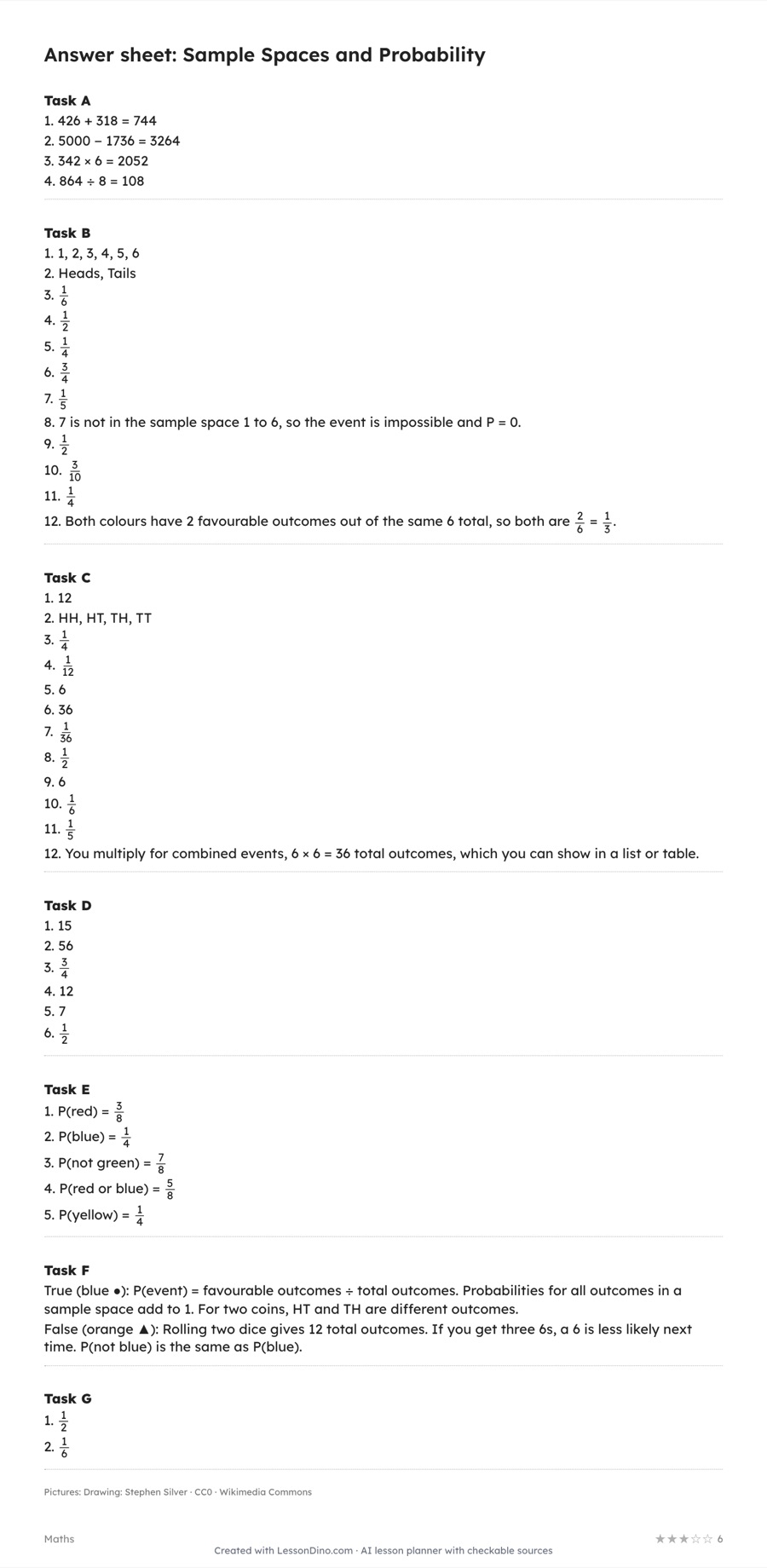
- The answer sheet is the last page, so you can print it on its own or let students check their own work.
Key vocabulary
- sample space: the full list of everything that could happen in a test
- theoretical probability: what you expect, worked out by counting, not by trying it many times
- equally likely: each possible result has the same chance of happening
- mutually exclusive: only one result can happen at a time, not two together
- favourable outcome: a wanted result you count for the event you asked about
Mistakes to watch for
- Listing only HH, HT, TT for two coins, treating HT and TH as the same. Stress order matters for the first and second toss and recount four equally likely outcomes HH, HT, TH, TT.
- Using wanted divided by total when outcomes are not equally likely. Show equal versus unequal sections and explain the rule needs each outcome equally possible.
- Adding instead of multiplying for combined totals, for example coin + die = 7. Draw the 2 by 6 table to show 12 cells and count wanted over total.
What's on the worksheet
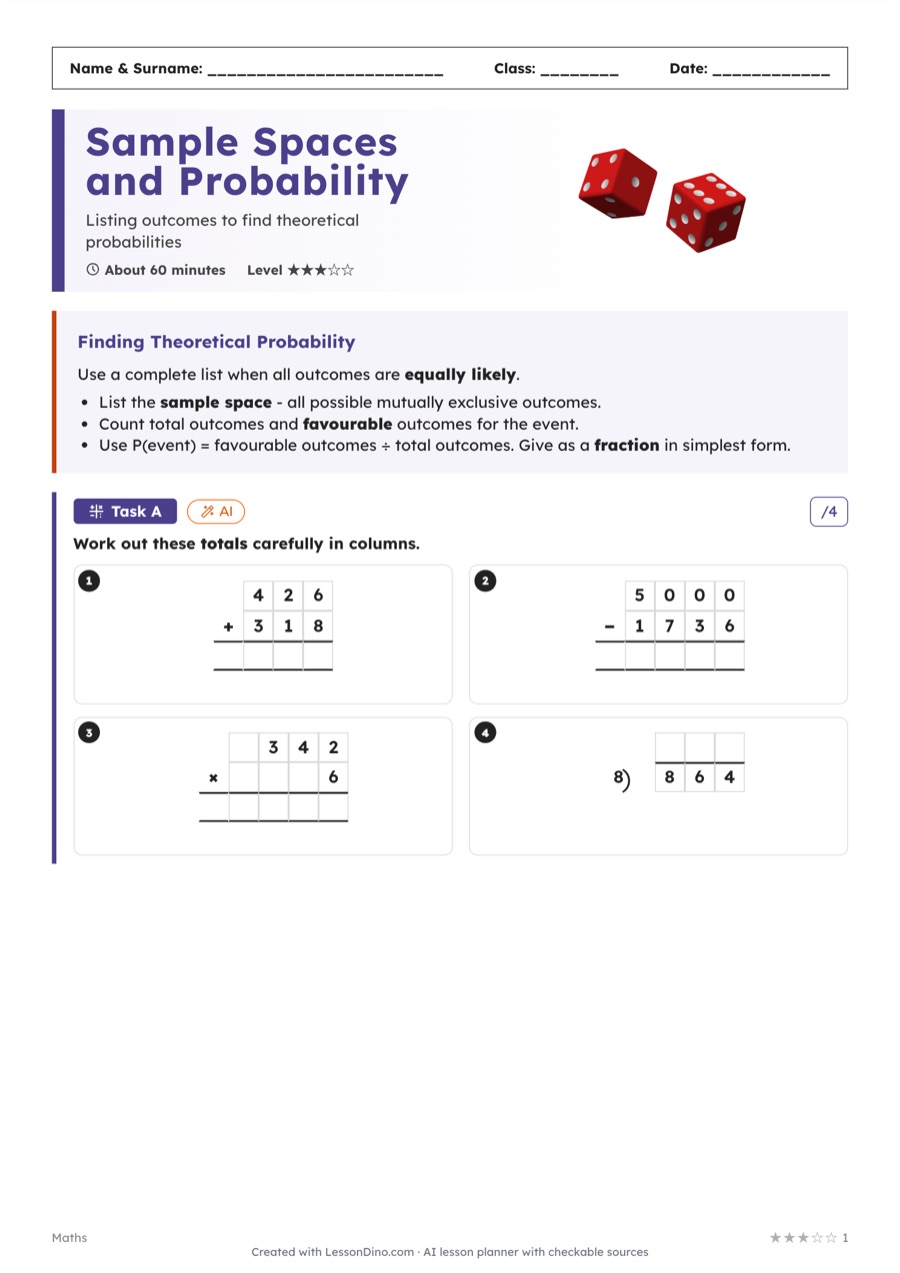
List All Outcomes
Learn how to list sample spaces and work out probabilities.
Finding Theoretical Probability
- Use a complete list when all outcomes are equally likely.
- List the sample space - all possible mutually exclusive outcomes.
- Count total outcomes and favourable outcomes for the event.
- Use P(event) = favourable outcomes ÷ total outcomes. Give as a fraction in simplest form.
Work out these totals carefully in columns.
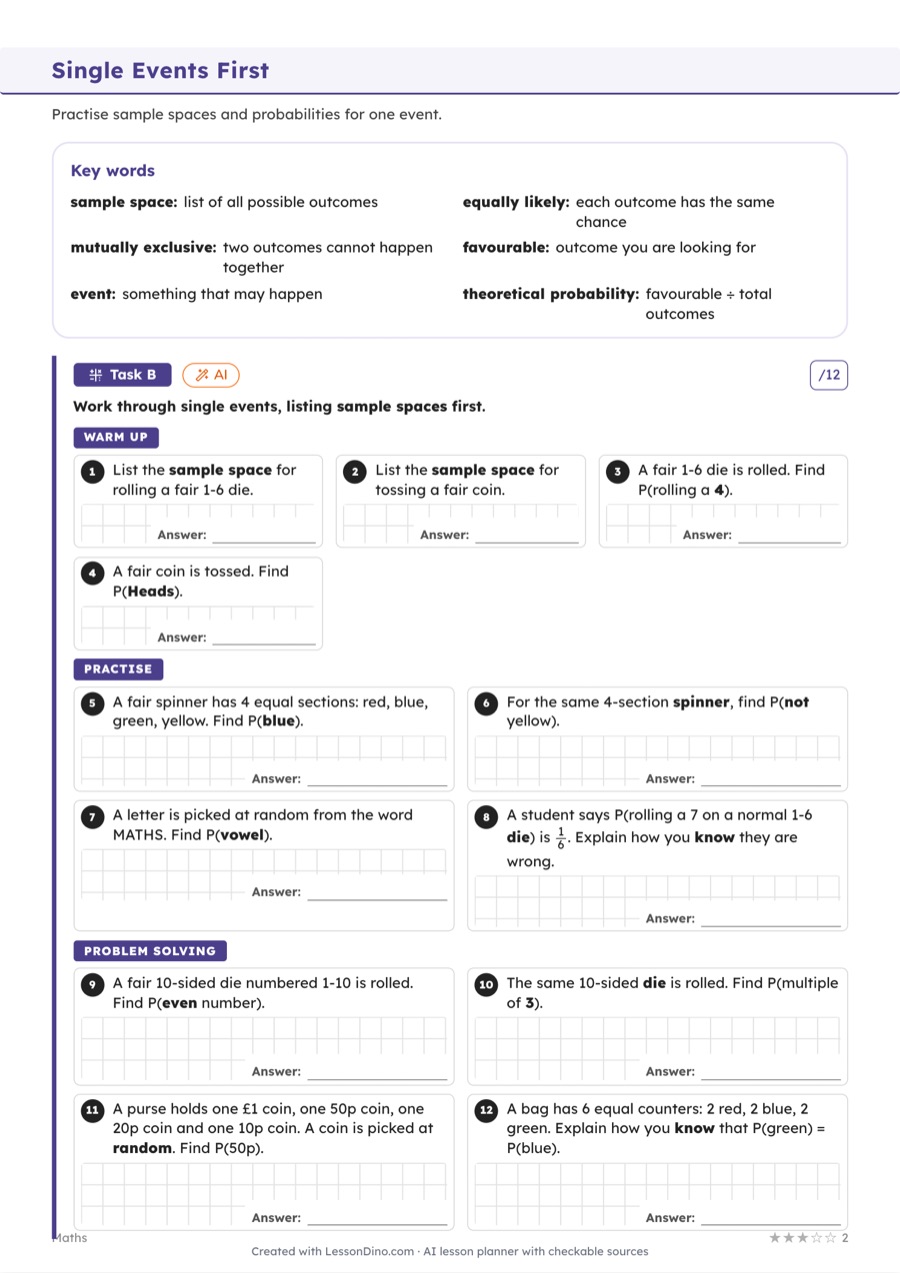
Single Events First
Practise sample spaces and probabilities for one event.
| Word | Meaning |
|---|---|
| sample space | list of all possible outcomes |
| equally likely | each outcome has the same chance |
| mutually exclusive | two outcomes cannot happen together |
| favourable | outcome you are looking for |
| event | something that may happen |
| theoretical probability | favourable ÷ total outcomes |
Work through single events, listing sample spaces first.
Warm up
- List the sample space for rolling a fair 1-6 die.
- List the sample space for tossing a fair coin.
- A fair 1-6 die is rolled. Find P(rolling a 4).
- A fair coin is tossed. Find P(Heads).
Practise
- A fair spinner has 4 equal sections: red, blue, green, yellow. Find P(blue).
- For the same 4-section spinner, find P(not yellow).
- A letter is picked at random from the word MATHS. Find P(vowel).
- A student says P(rolling a 7 on a normal 1-6 die) is 1/6. Explain how you know they are wrong.
Problem solving
- A fair 10-sided die numbered 1-10 is rolled. Find P(even number).
- The same 10-sided die is rolled. Find P(multiple of 3).
- A purse holds one £1 coin, one 50p coin, one 20p coin and one 10p coin. A coin is picked at random. Find P(50p).
- A bag has 6 equal counters: 2 red, 2 blue, 2 green. Explain how you know that P(green) = P(blue).
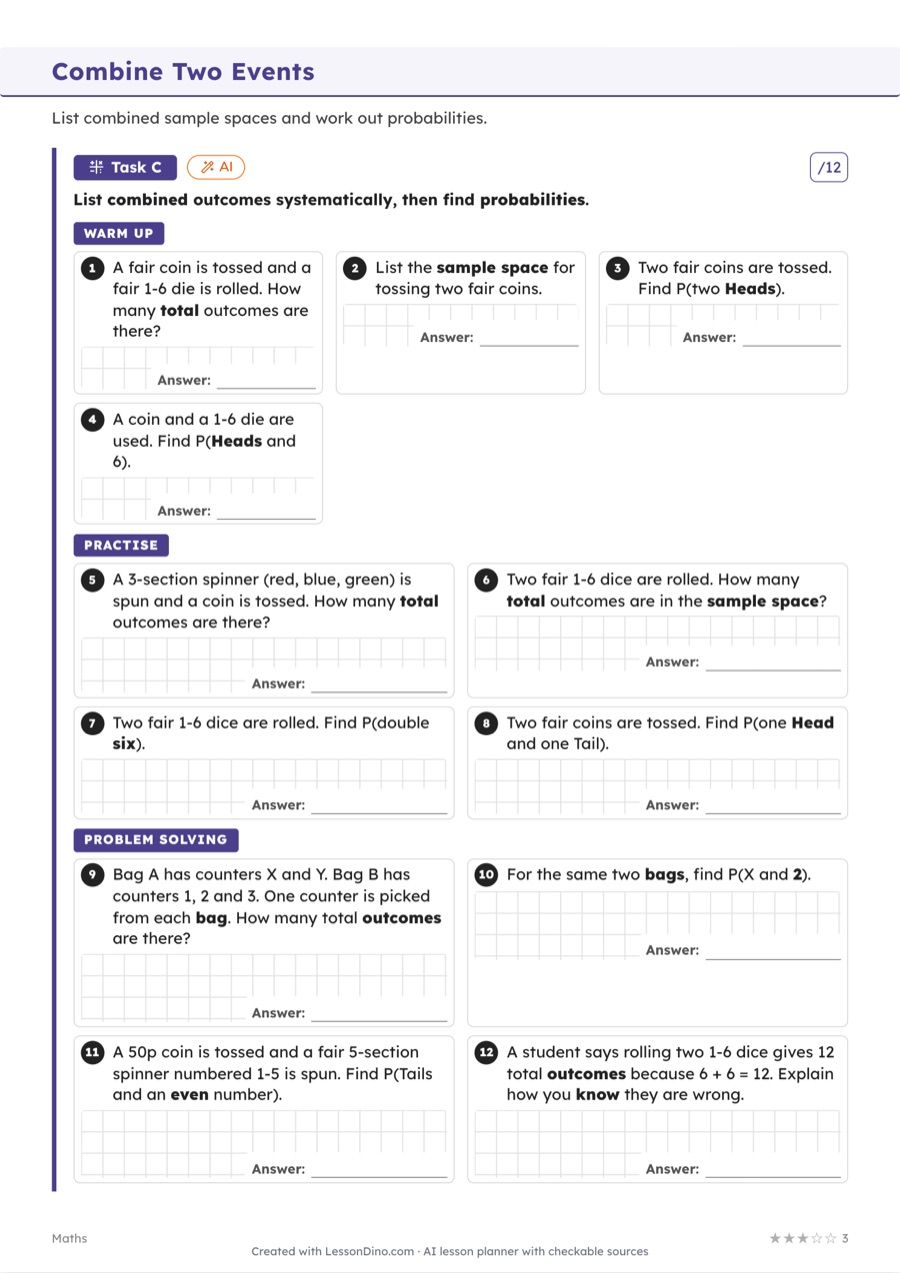
Combine Two Events
List combined sample spaces and work out probabilities.
List combined outcomes systematically, then find probabilities.
Warm up
- A fair coin is tossed and a fair 1-6 die is rolled. How many total outcomes are there?
- List the sample space for tossing two fair coins.
- Two fair coins are tossed. Find P(two Heads).
- A coin and a 1-6 die are used. Find P(Heads and 6).
Practise
- A 3-section spinner (red, blue, green) is spun and a coin is tossed. How many total outcomes are there?
- Two fair 1-6 dice are rolled. How many total outcomes are in the sample space?
- Two fair 1-6 dice are rolled. Find P(double six).
- Two fair coins are tossed. Find P(one Head and one Tail).
Problem solving
- Bag A has counters X and Y. Bag B has counters 1, 2 and 3. One counter is picked from each bag. How many total outcomes are there?
- For the same two bags, find P(X and 2).
- A 50p coin is tossed and a fair 5-section spinner numbered 1-5 is spun. Find P(Tails and an even number).
- A student says rolling two 1-6 dice gives 12 total outcomes because 6 + 6 = 12. Explain how you know they are wrong.
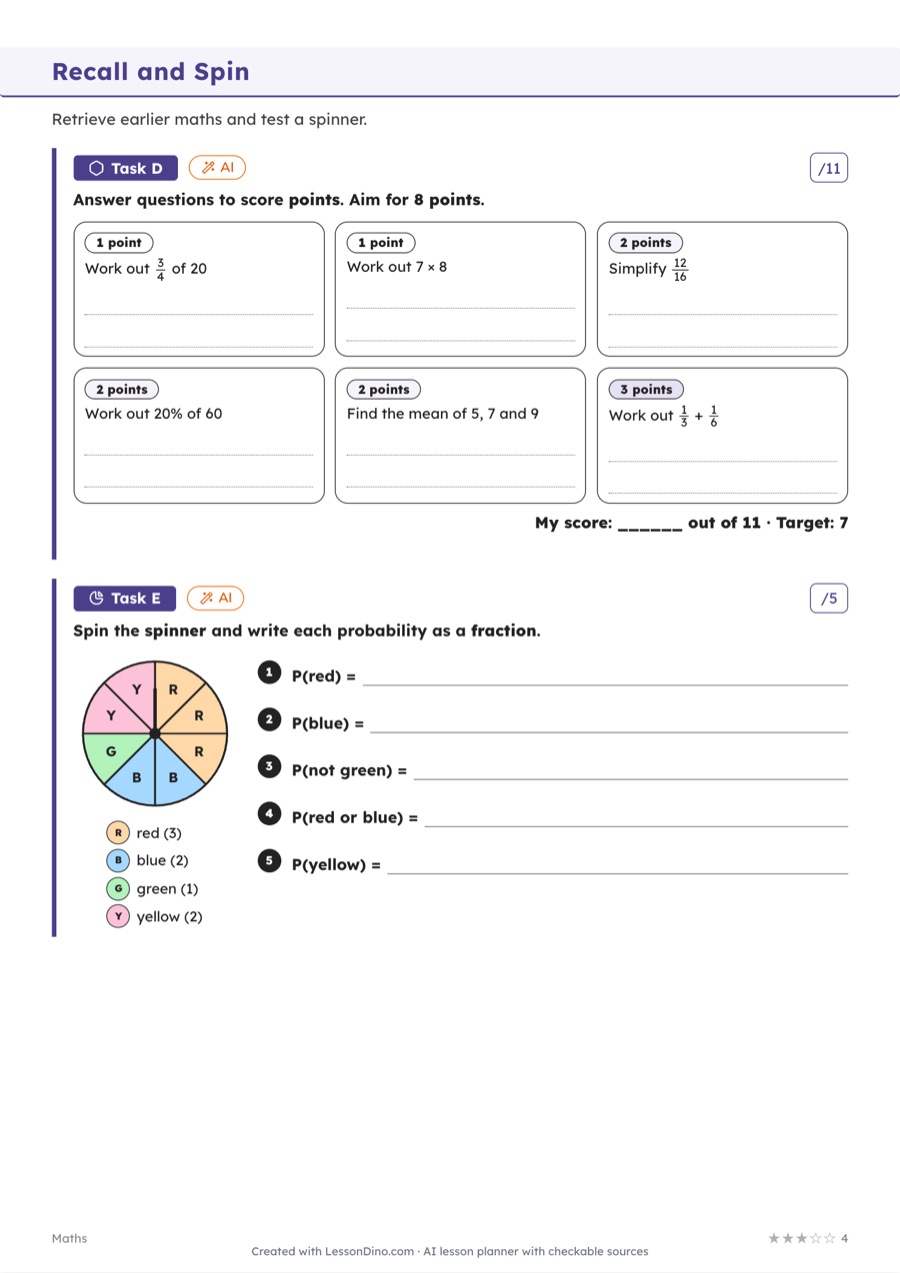
Recall and Spin
Retrieve earlier maths and test a spinner.
Answer questions to score points. Aim for 8 points.
- Work out 3/4 of 20
- Work out 7 × 8
- Simplify 12/16
- Work out 20% of 60
- Find the mean of 5, 7 and 9
- Work out 1/3 + 1/6
Spin the spinner and write each probability as a fraction.
- red
- blue
- not green
- red or blue
- yellow
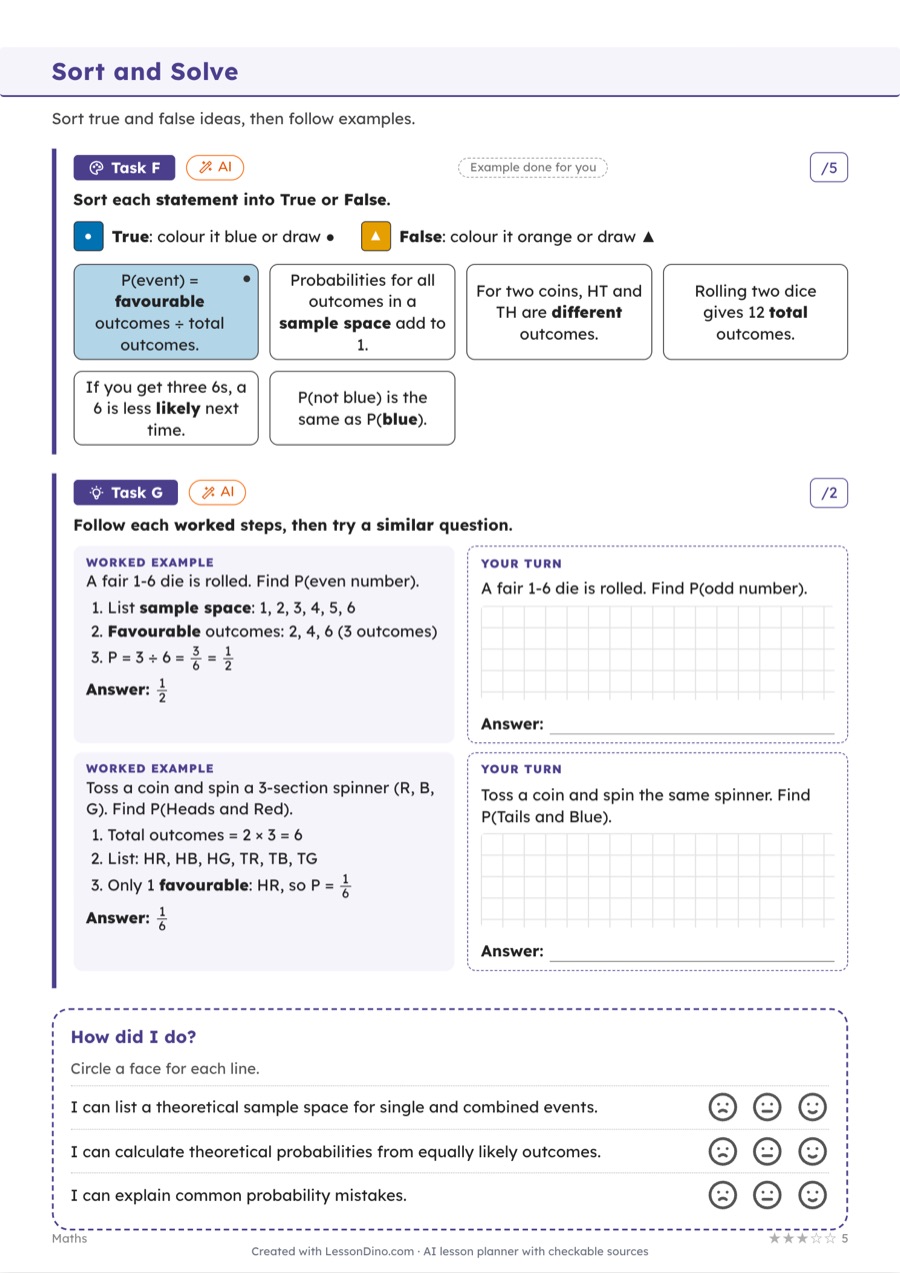
Sort and Solve
Sort true and false ideas, then follow examples.
Sort each statement into True or False.
Follow each worked steps, then try a similar question.
Answers
Show the answers
- List the sample space for rolling a fair 1-6 die. 1, 2, 3, 4, 5, 6
- List the sample space for tossing a fair coin. Heads, Tails
- A fair 1-6 die is rolled. Find P(rolling a 4). 1/6
- A fair coin is tossed. Find P(Heads). 1/2
- A fair spinner has 4 equal sections: red, blue, green, yellow. Find P(blue). 1/4
- For the same 4-section spinner, find P(not yellow). 3/4
- A letter is picked at random from the word MATHS. Find P(vowel). 1/5
- A student says P(rolling a 7 on a normal 1-6 die) is 1/6. Explain how you know they are wrong. 7 is not in the sample space 1 to 6, so the event is impossible and P = 0.
- A fair 10-sided die numbered 1-10 is rolled. Find P(even number). 1/2
- The same 10-sided die is rolled. Find P(multiple of 3). 3/10
- A purse holds one £1 coin, one 50p coin, one 20p coin and one 10p coin. A coin is picked at random. Find P(50p). 1/4
- A bag has 6 equal counters: 2 red, 2 blue, 2 green. Explain how you know that P(green) = P(blue). Both colours have 2 favourable outcomes out of the same 6 total, so both are 2/6 = 1/3.
- A fair coin is tossed and a fair 1-6 die is rolled. How many total outcomes are there? 12
- List the sample space for tossing two fair coins. HH, HT, TH, TT
- Two fair coins are tossed. Find P(two Heads). 1/4
- A coin and a 1-6 die are used. Find P(Heads and 6). 1/12
- A 3-section spinner (red, blue, green) is spun and a coin is tossed. How many total outcomes are there? 6
- Two fair 1-6 dice are rolled. How many total outcomes are in the sample space? 36
- Two fair 1-6 dice are rolled. Find P(double six). 1/36
- Two fair coins are tossed. Find P(one Head and one Tail). 1/2
- Bag A has counters X and Y. Bag B has counters 1, 2 and 3. One counter is picked from each bag. How many total outcomes are there? 6
- For the same two bags, find P(X and 2). 1/6
- A 50p coin is tossed and a fair 5-section spinner numbered 1-5 is spun. Find P(Tails and an even number). 1/5
- A student says rolling two 1-6 dice gives 12 total outcomes because 6 + 6 = 12. Explain how you know they are wrong. You multiply for combined events, 6 × 6 = 36 total outcomes, which you can show in a list or table.
- Work out 3/4 of 20 15
- Work out 7 × 8 56
- Simplify 12/16 3/4
- Work out 20% of 60 12
- Find the mean of 5, 7 and 9 7
- Work out 1/3 + 1/6 1/2
The answer sheet is the last picture above.
Curriculum
generate theoretical sample spaces for single and combined events with equally likely, mutually exclusive outcomes and use these to calculate theoretical probabilities
From National curriculum in England, Key Stage 3 mathematics.
Made with Lesson Dino's AI on 19 October 2026. AI can make mistakes, so check the answers and facts against the sources before you teach.