The worksheet
About this worksheet
Students learn why Britain industrialised first and how towns changed. They make a verdict poster weighing progress against price. This Year 8 History worksheet gives students (ages 12–13) five pages of practice on the Industrial Revolution, part of the industry and empire unit. It goes with our free The Industrial Revolution lesson, which has the slides and a timed lesson plan.
What it covers
By the end, students should be able to:
- Students will explain why factories grew first in Britain after 1760.
- Students will describe how mill work, housing and health changed towns.
- Students will judge if Industrial Revolution fits changes from 1750-1901.
How to use it
- Why Britain first (12 minutes): Hand out Worksheet Task C and model first two dates, then pairs order rest.
- Support: Use three-box frame and word bank home, hand, factory, machine, faster, more.
- Stretch: Rank work, housing, health or vote by most change and justify top choice.
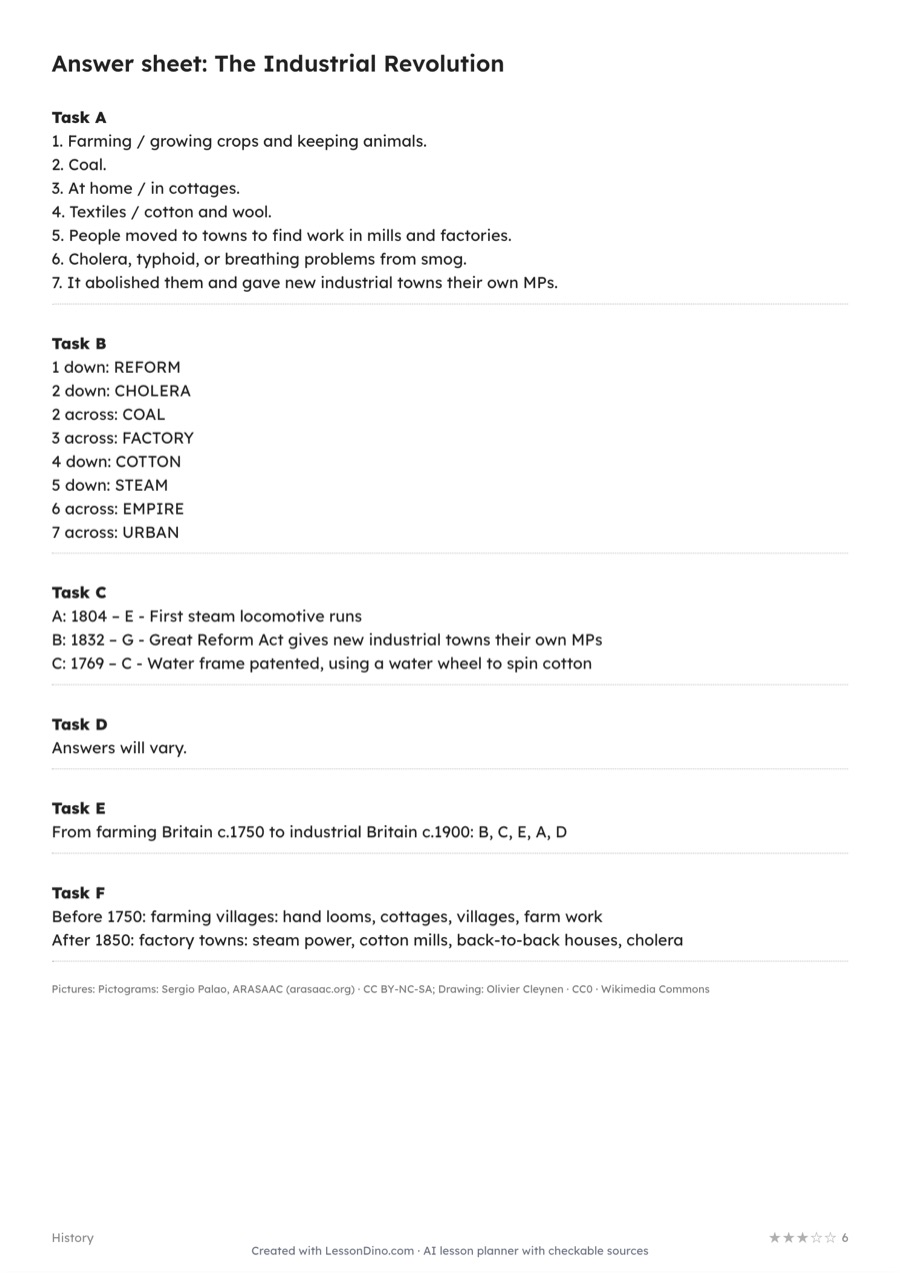
- The answer sheet is the last page, so you can print it on its own or let students check their own work.
Key vocabulary
- Industrial Revolution: time from about 1750-1900 when Britain changed to machine making and towns
- factory: large building where machines make cloth and other goods fast
- empire: lands ruled by one country that trade goods with it
- franchise: group of people allowed to vote in elections
- cholera: serious illness spread by dirty water or food
Mistakes to watch for
- Thinking the Industrial Revolution happened in one year like 1769. Stress period 1750-1900 and long change, so some say term misleading; practise ordering 1764 to 1829.
- Thinking factories made life better for everyone. Contrast profitable owners with incredibly difficult conditions for workers and women and children employed.
- Thinking 1832 gave the vote to all. Recall Act abolished rotten boroughs and extended franchise but politicised middle and lower classes still pushed for more.
What's on the worksheet
Britain Changes Fast
Learn the key changes that made Britain industrial.
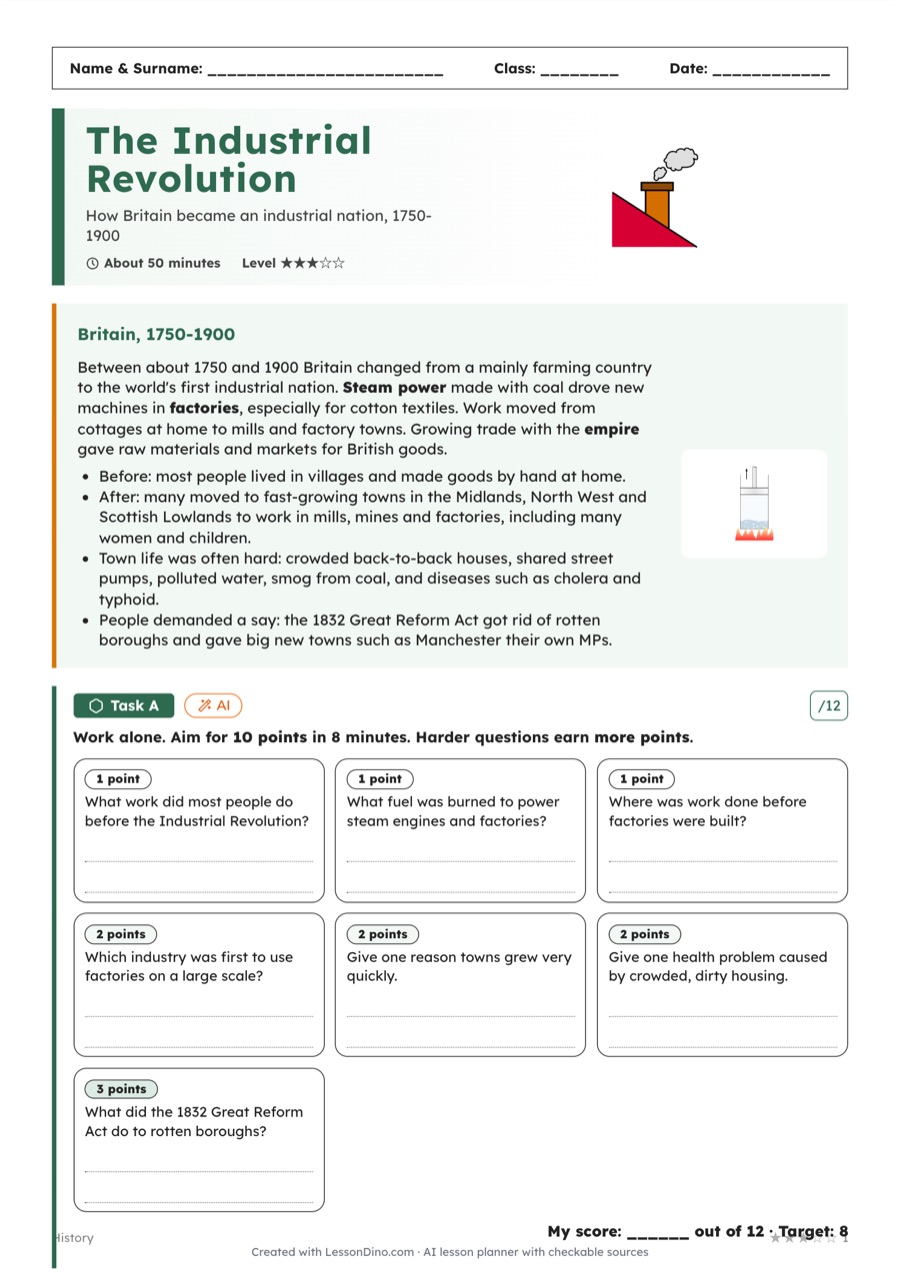
Britain, 1750-1900
- Between about 1750 and 1900 Britain changed from a mainly farming country to the world's first industrial nation. Steam power made with coal drove new machines in factories, especially for cotton textiles. Work moved from cottages at home to mills and factory towns. Growing trade with the empire gave raw materials and markets for British goods.
- Before: most people lived in villages and made goods by hand at home.
- After: many moved to fast-growing towns in the Midlands, North West and Scottish Lowlands to work in mills, mines and factories, including many women and children.
- Town life was often hard: crowded back-to-back houses, shared street pumps, polluted water, smog from coal, and diseases such as cholera and typhoid.
- People demanded a say: the 1832 Great Reform Act got rid of rotten boroughs and gave big new towns such as Manchester their own MPs.
Work alone. Aim for 10 points in 8 minutes. Harder questions earn more points.
- What work did most people do before the Industrial Revolution?
- What fuel was burned to power steam engines and factories?
- Where was work done before factories were built?
- Which industry was first to use factories on a large scale?
- Give one reason towns grew very quickly.
- Give one health problem caused by crowded, dirty housing.
- What did the 1832 Great Reform Act do to rotten boroughs?
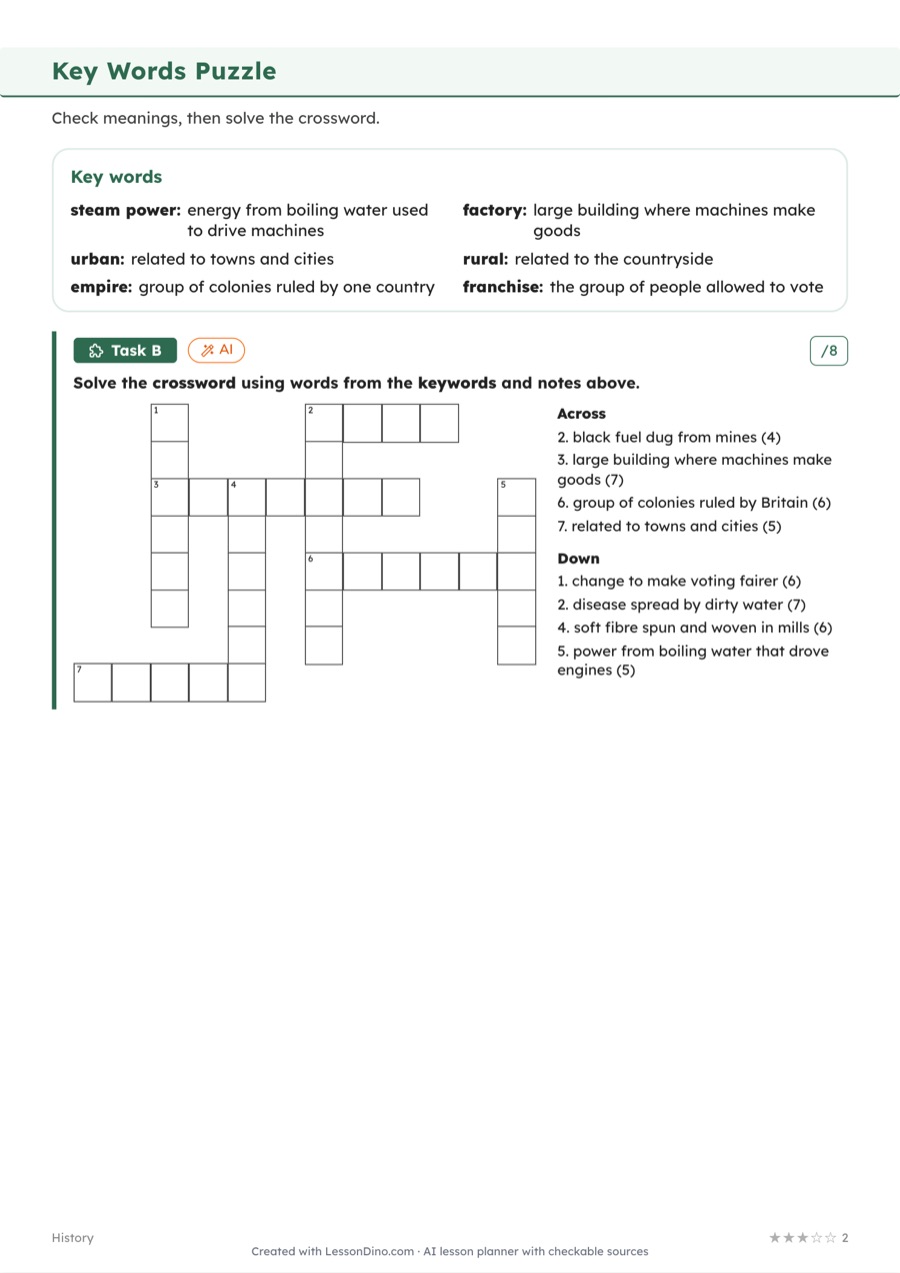
Key Words Puzzle
Check meanings, then solve the crossword.
| Word | Meaning |
|---|---|
| steam power | energy from boiling water used to drive machines |
| factory | large building where machines make goods |
| urban | related to towns and cities |
| rural | related to the countryside |
| empire | group of colonies ruled by one country |
| franchise | the group of people allowed to vote |
Solve the crossword using words from the keywords and notes above.
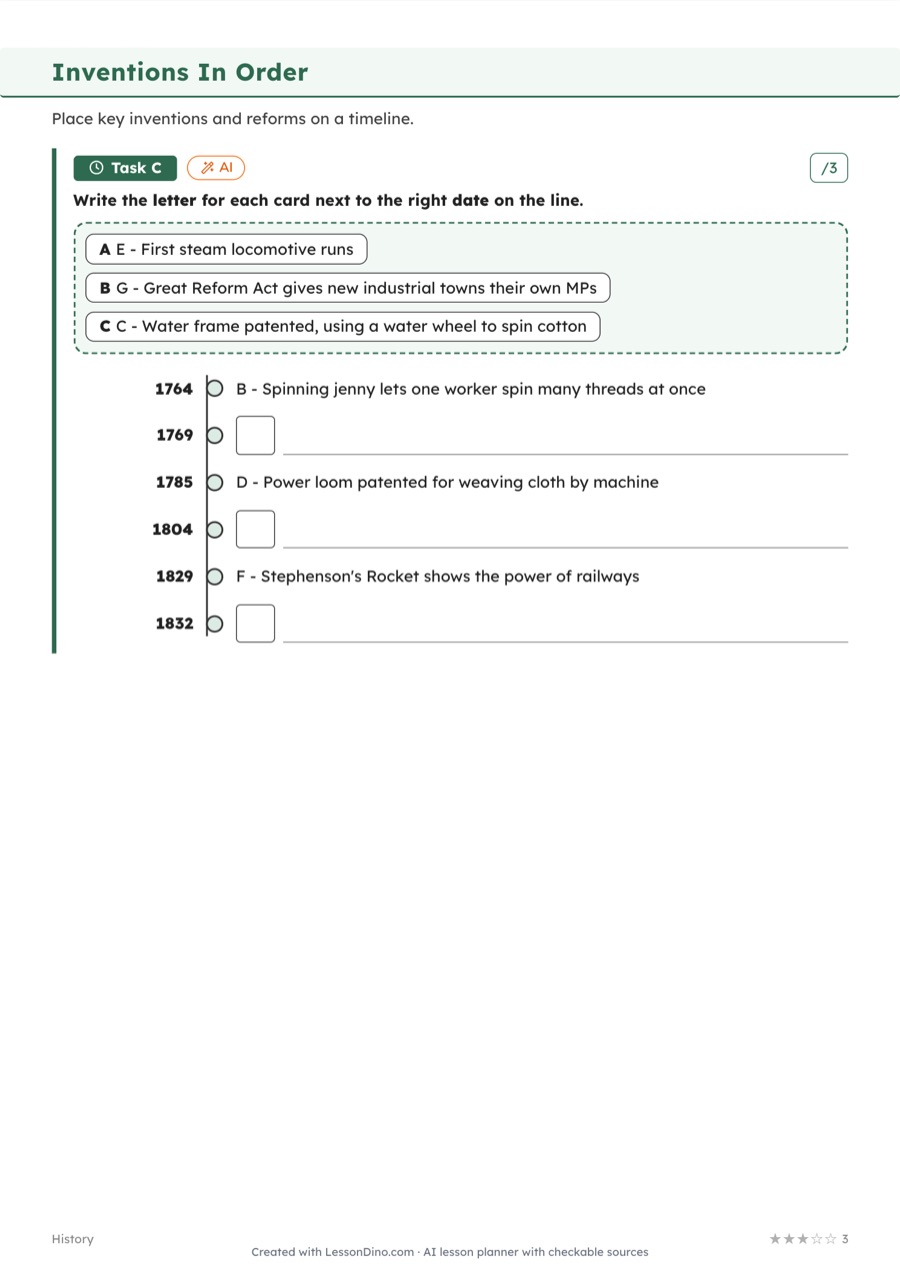
Inventions In Order
Place key inventions and reforms on a timeline.
Write the letter for each card next to the right date on the line.
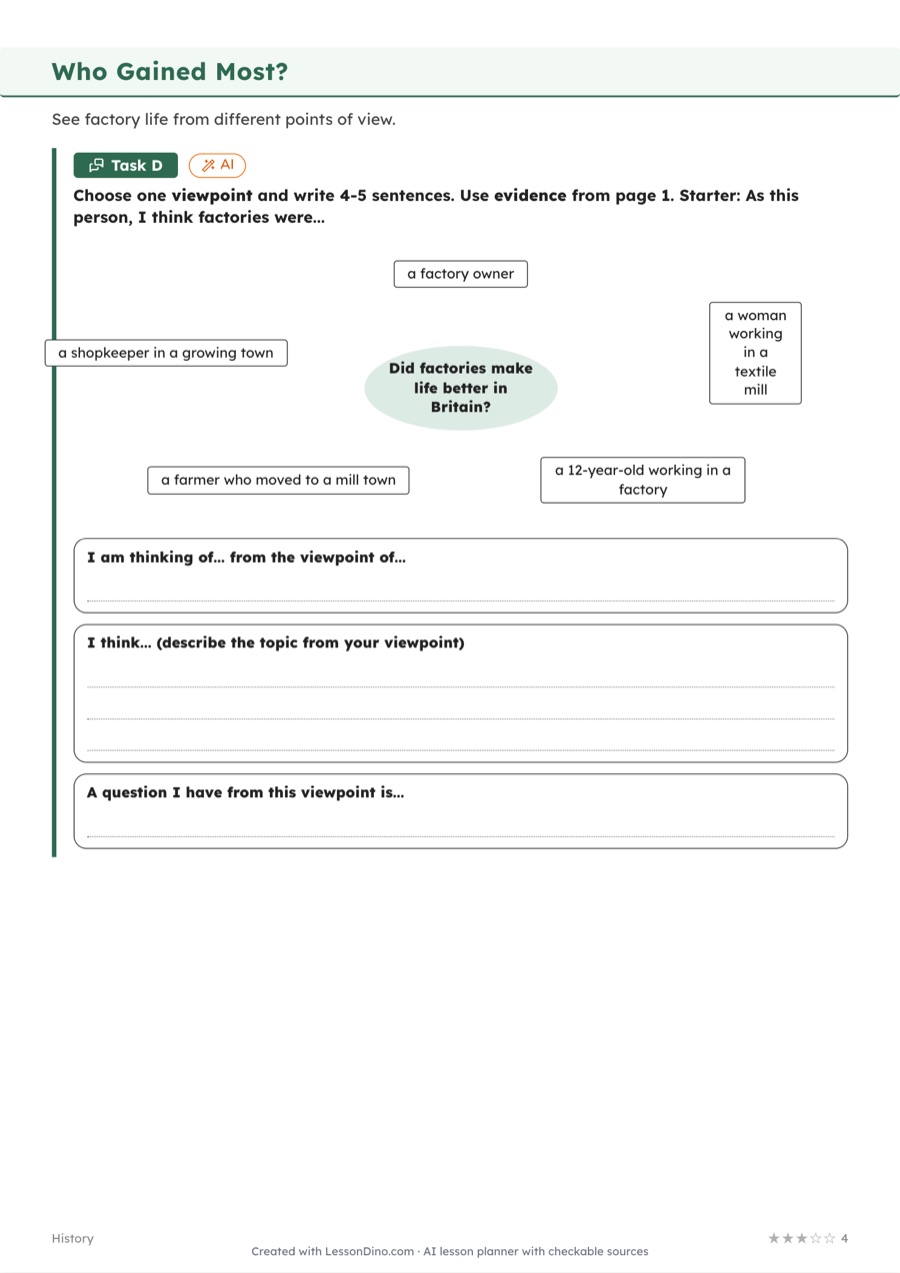
Who Gained Most?
See factory life from different points of view.
Choose one viewpoint and write 4-5 sentences. Use evidence from page 1. Starter: As this person, I think factories were...
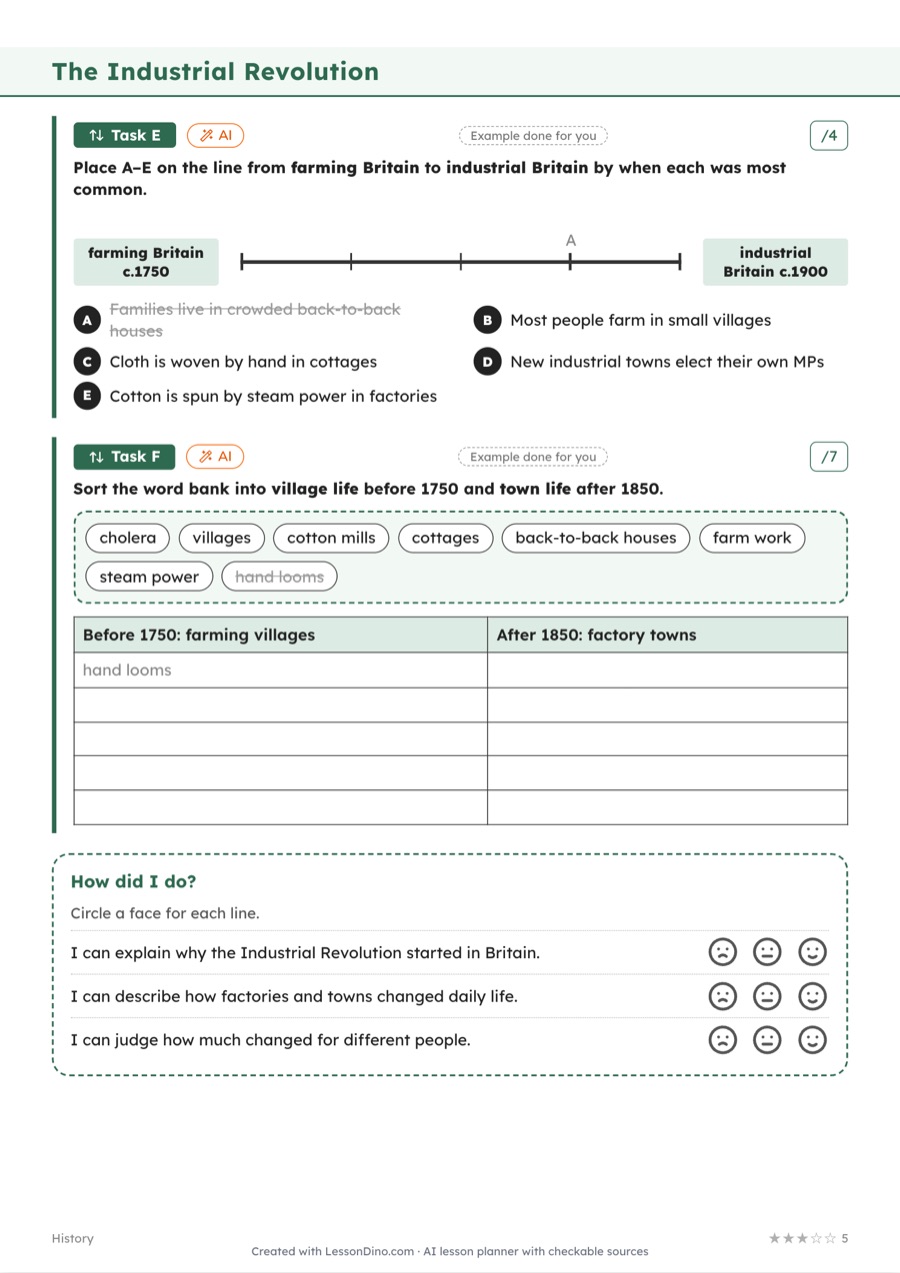
Page 5
Place A–E on the line from farming Britain to industrial Britain by when each was most common.
Sort the word bank into village life before 1750 and town life after 1850.
Answers
Show the answers
- What work did most people do before the Industrial Revolution? Farming / growing crops and keeping animals.
- What fuel was burned to power steam engines and factories? Coal.
- Where was work done before factories were built? At home / in cottages.
- Which industry was first to use factories on a large scale? Textiles / cotton and wool.
- Give one reason towns grew very quickly. People moved to towns to find work in mills and factories.
- Give one health problem caused by crowded, dirty housing. Cholera, typhoid, or breathing problems from smog.
- What did the 1832 Great Reform Act do to rotten boroughs? It abolished them and gave new industrial towns their own MPs.
The answer sheet is the last picture above.
Curriculum
ideas, political power, industry and empire: Britain, 1745-1901
Made with Lesson Dino's AI on 17 October 2026. AI can make mistakes, so check the answers and facts against the sources before you teach.