Slides
Lesson plan
Cotton, Coal and Change 1745-1901
Students learn why Britain industrialised first and how towns changed. They make a verdict poster weighing progress against price.
Objectives
- Students will explain why factories grew first in Britain after 1760.
- Students will describe how mill work, housing and health changed towns.
- Students will judge if Industrial Revolution fits changes from 1750-1901.
Success criteria
- I can compare making cloth at home and in mills.
- I can describe factory work, back-to-back housing and disease.
- I can give a verdict with two pieces of evidence.
Key words
| Word | Meaning |
|---|---|
| Industrial Revolution | time from about 1750-1900 when Britain changed to machine making and towns |
| factory | large building where machines make cloth and other goods fast |
| empire | lands ruled by one country that trade goods with it |
| franchise | group of people allowed to vote in elections |
| cholera | serious illness spread by dirty water or food |
Timed plan (60 minutes)
| Time | Stage | What happens |
|---|---|---|
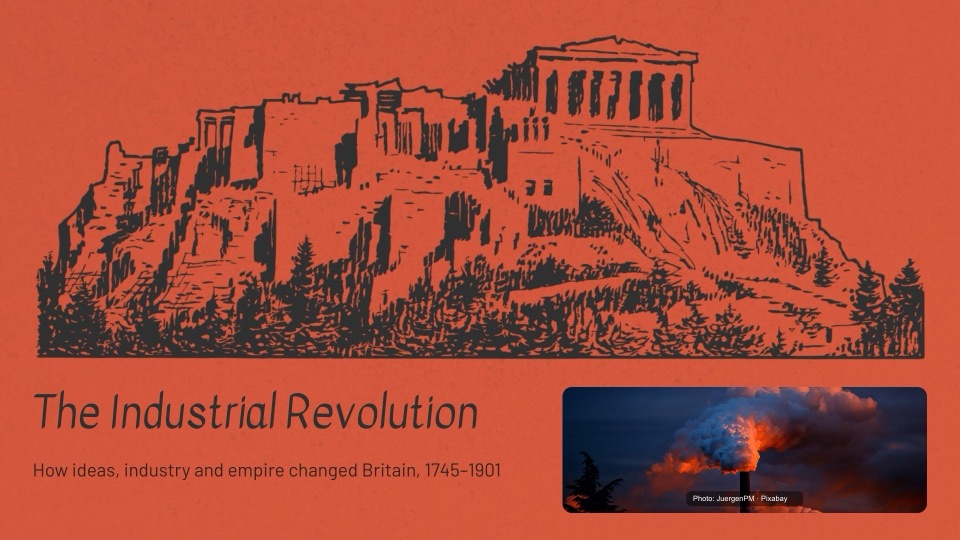
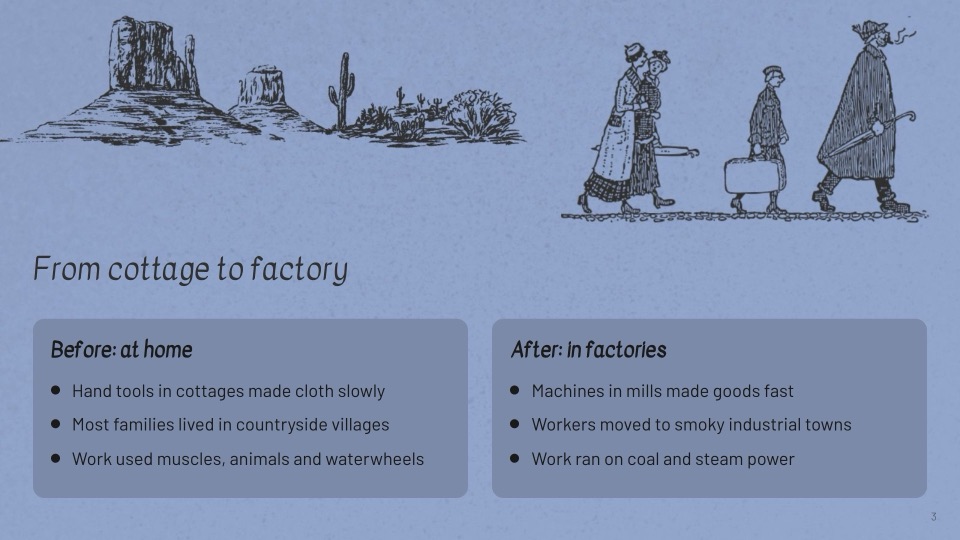
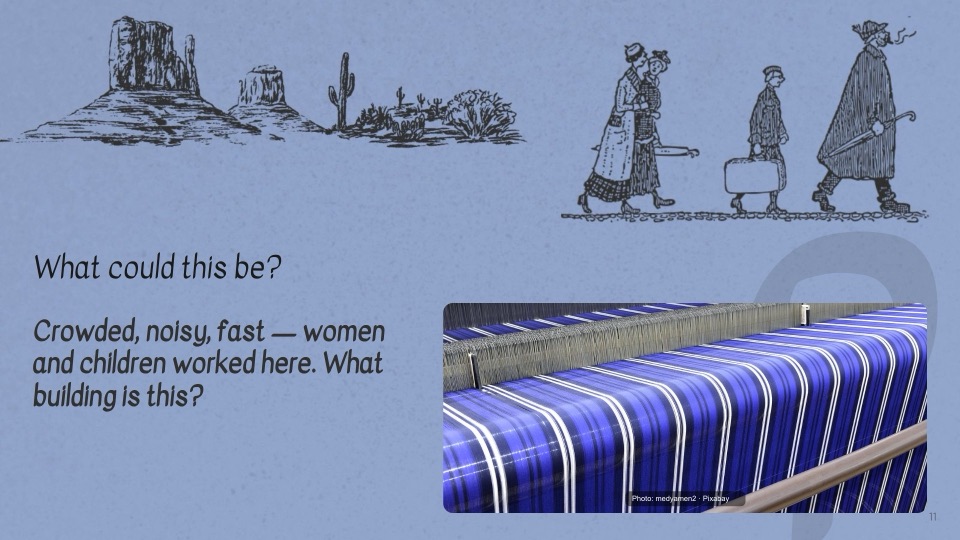
| 5 min | Starter | Hook the class and recall the shift from home work to factory work. Show Slide 1 The Industrial Revolution title and read objectives on Slide 2. Say the hook: Was it really a revolution in a flash, or a slow burn over 150 years? You are the historians. You decide. Show Slide 3 From cottage to factory and explain before work was done in people's homes by hand, sometimes called cottage industries. Ask pairs to guess hands v machine winner and take 3 quick answers. |
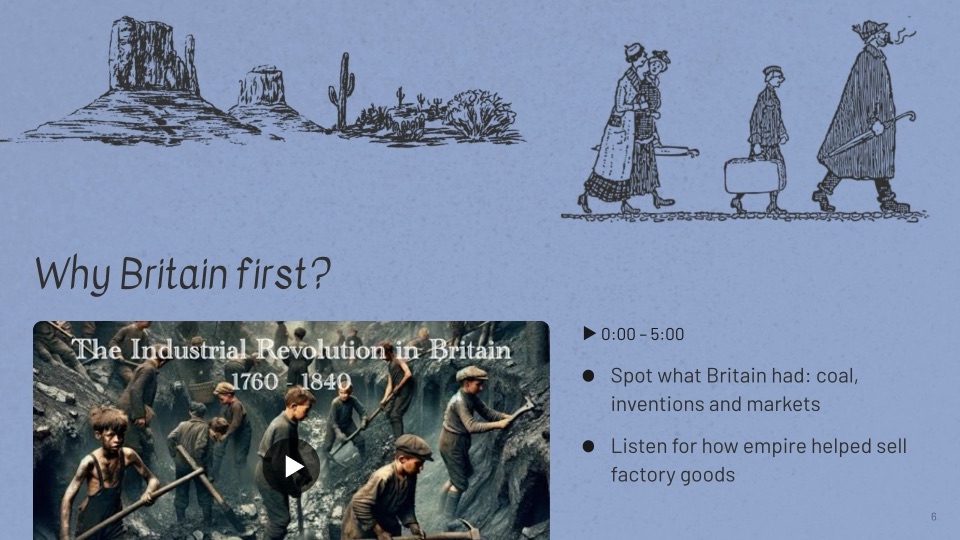
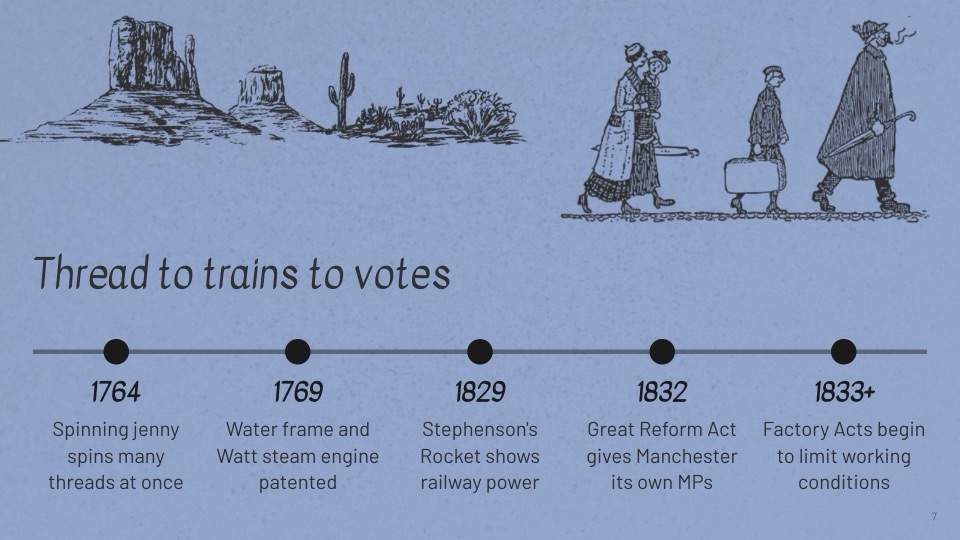
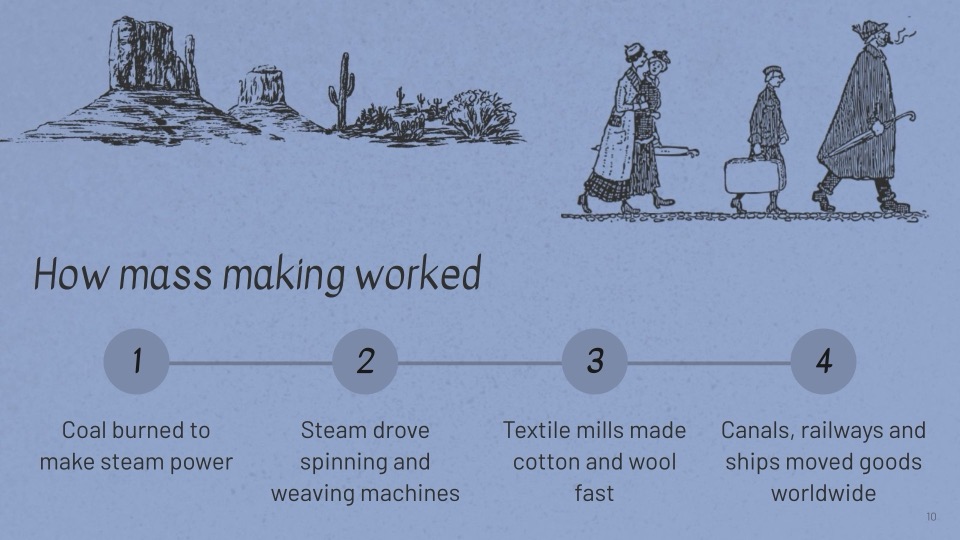
| 12 min | Why Britain first | Explain why inventions, coal and empire markets let factories grow first in Britain. Play Video clip 2 (0:00-5:00) on Slide 6: spot coal, inventions and markets, listen for how empire helped sell factory goods. Explain steam engines burned coal to create immediate power for mills and transport, and by mid-1700s Britain was becoming the world's most powerful empire. Show Slide 7 Thread to trains to votes and Slide 10 steps: coal burned to make steam, steam drove machines, mills made cotton fast, canals and railways moved goods. Hand out Worksheet Task C and model first two dates, then pairs order rest. |
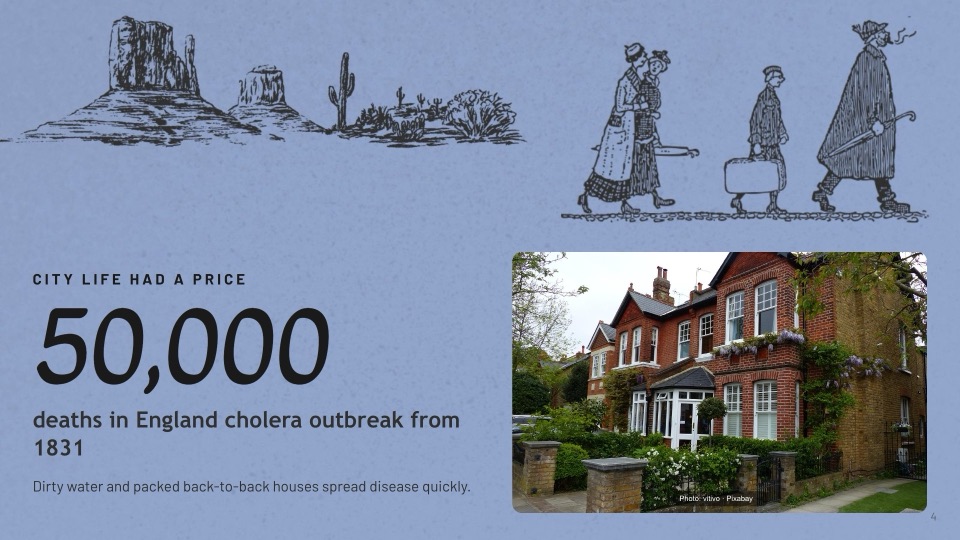
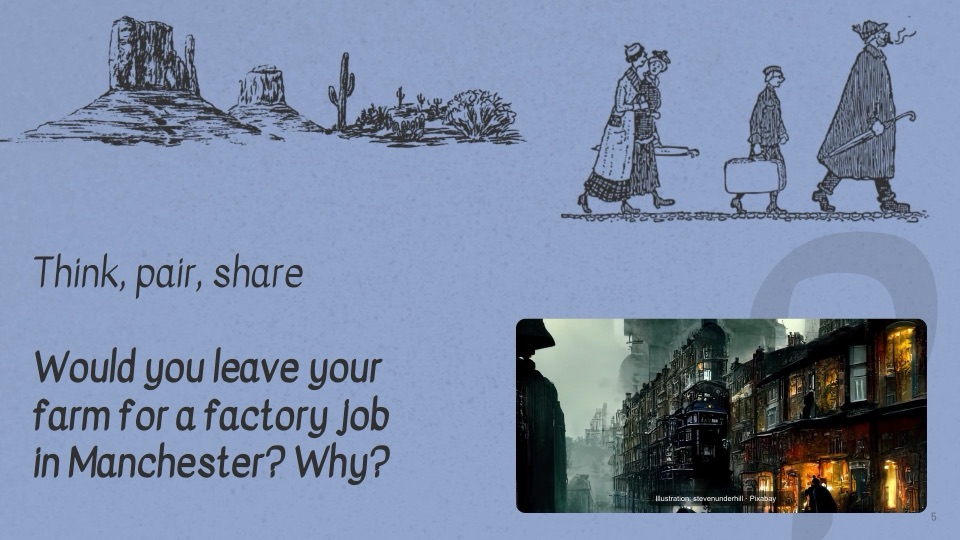
| 13 min | Price of town life | Describe hard work, crowded housing, disease and calls for votes. Show Slide 4 City life had a price: dirty water and packed back-to-back houses spread disease quickly, 50,000 deaths in England cholera outbreak from 1831. Explain owners built cheap back-to-back and terraced houses with families in single room, shared toilets, street pumps fed by polluted river and thick smog from coal. Explain factory side: profitable for owners but incredibly difficult conditions for workers, common to employ women and children in 1800s to supervise equipment. Run Slide 5 Think, pair, share: Would you leave your farm for Manchester? Then link to 1832 Great Reform Act after calls for political change. |
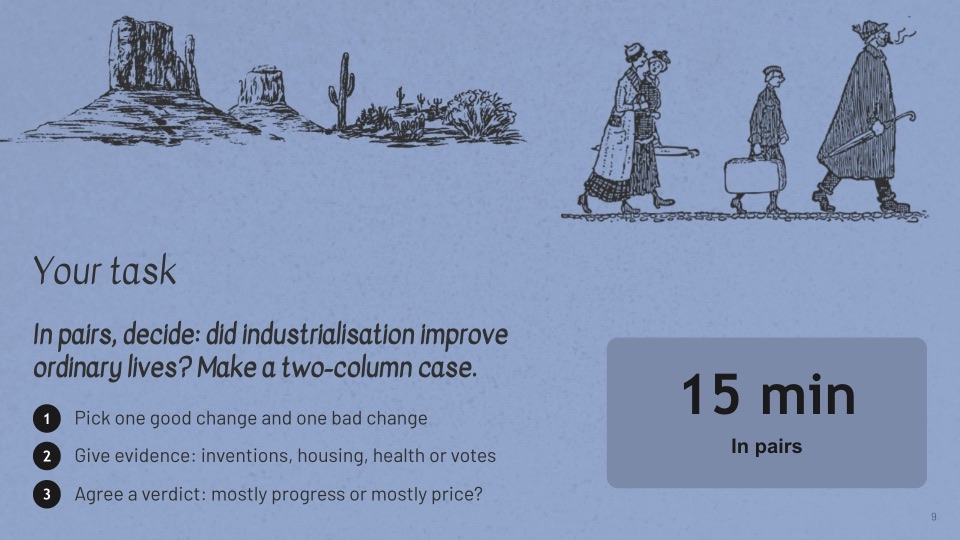
| 20 min | Revolution or Slow Burn? | Judge whether Industrial Revolution is the right name using evidence. Show Slide 9 Your task: pick one good change and one bad change with evidence from inventions, housing, health or votes. Give A3 paper, markers, verdict cards and three-box frame: life before, what changed, life after. Model split at 1750 and 1900: left farming and hand work, right factories, steam and cities, noting period 1750-1900 of great change and shift from agriculture and handicrafts to industry and machines. Circulate, prompt evidence and remind some historians say term is misleading as change took long time. |
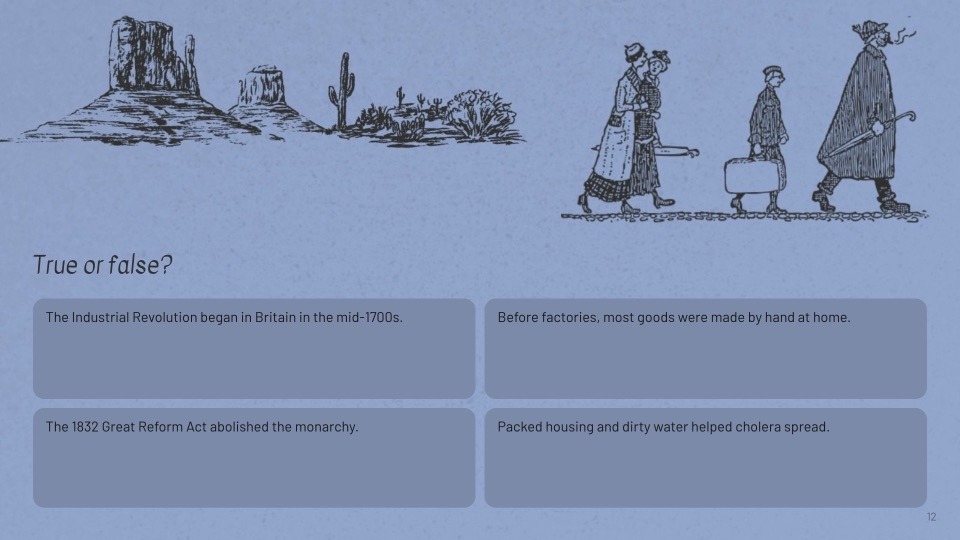
| 10 min | Plenary | Check understanding and agree what changed most by 1901. Show Slide 12 True or false? Read statements: began in Britain mid-1700s, led with textiles coal steam, most goods made by hand before. Take votes for mostly progress or mostly price and ask two groups to give evidence. Set exit ticket on mini-whiteboards with three questions. |
Common mistakes
- Thinking the Industrial Revolution happened in one year like 1769
How to spot it: Timeline puts all inventions on same date
Stress period 1750-1900 and long change, so some say term misleading; practise ordering 1764 to 1829 - Thinking factories made life better for everyone
How to spot it: Poster lists only inventions and forgets housing and health
Contrast profitable owners with incredibly difficult conditions for workers and women and children employed - Thinking 1832 gave the vote to all
How to spot it: Says franchise means everyone can vote now
Recall Act abolished rotten boroughs and extended franchise but politicised middle and lower classes still pushed for more
Support
- Use three-box frame and word bank home, hand, factory, machine, faster, more
- Pre-mark pump and shared toilets on street plan if needed
- Pair readers for Task C timeline
Stretch
- Rank work, housing, health or vote by most change and justify top choice
- Explain water v steam power link from thread supply to weaving demand
- Link mill profit to strict rules and empire markets
Check questions
- Give one reason factories grew first in Britain.
Answer: Coal for steam power plus inventions plus empire market buying British goods. - Give one bad change to town life with cause.
Answer: Cholera from contaminated water due to overcrowding and shared pumps/toilets. - Revolution or slow burn? Give one reason.
Answer: Either with evidence: huge shift to machines or long period 1750-1900 so misleading.
Curriculum
ideas, political power, industry and empire: Britain, 1745-1901
Video clips
Clips on YouTube, from the start and end times we chose. Check each one before you show it.
-
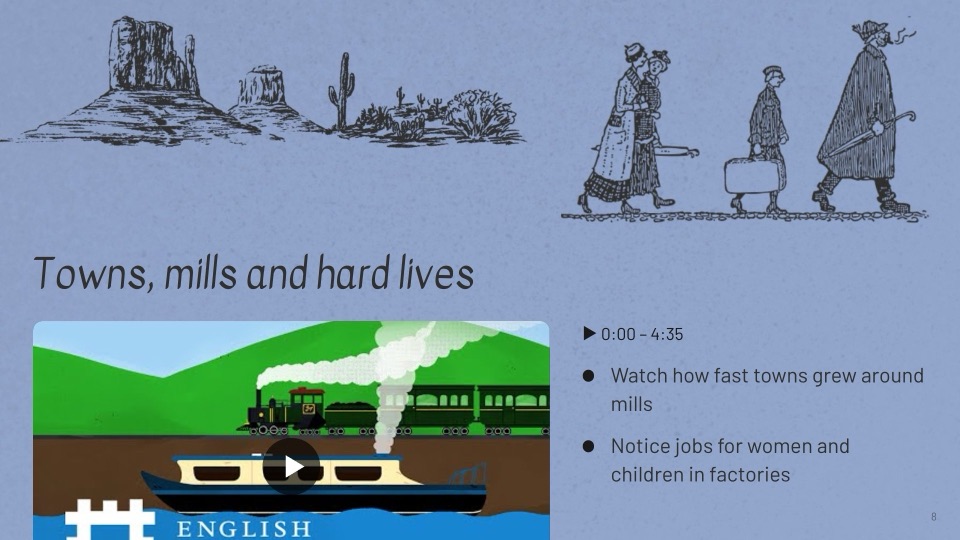
History in a Nutshell overview from 0:00 to 4:35
English Heritage: What was the Industrial Revolution? | History in a Nutshell | Animated History
Trustworthy animated overview from English Heritage with clear vocabulary and steady pace perfect for 12-13-year-olds studying Britain 1745-1901.
-
Industrial Revolution in Britain explained from 0:00 to 5:00
Real-World Learning: The Industrial Revolution in Britain - Simply Explained - History Videos for Students
Made for school students with simple vocabulary and pace ideal for Year 8 and it focuses directly on British industry and empire.
Worksheet
Sources
- Year 8 History - Curriculum Overview and KS3 ... - Hitchin Girls' School hgs.herts.sch.uk
- History Department: Year 8 Curriculum Aim of the curriculum: The Year 8 ... trinity.bexley.sch.uk
- When was the industrial revolution? - BBC Bitesize bbc.co.uk
- Industrial Revolution - Schoolshistory.org.uk schoolshistory.org.uk
- Industrial Revolution Timeline: Key Events in History history-timelines.org.uk
- Factories During The Industrial Revolution industrialrevolution.org.uk
- Impact on Society During the Industrial Revolution - Worldhistory worldhistory.org.uk
- The Industrial Revolution: A profound transformation in human history ourhistory.org.uk
- Health and the Industrial Revolution - Medicine and the ... bbc.co.uk
- The Industrial Revolution and change in Britain thenational.academy
- The Industrial Revolution: did industrialisation ... thenational.academy
- How the Industrial Revolution Changed the World | Britannica britannica.com
- Industrial Revolution en.wikipedia.org
- The Industrial Revolution | History Teaching Institute hti.osu.edu
- Industrial Revolution: Definition and Inventions | HISTORY history.com
- BBC Two - Why the Industrial Revolution Happened Here - Learning… bbc.co.uk
- Industrial Revolution - Students | Britannica Kids | Homework Help kids.britannica.com
- [1911.01708v1] Fourth Industrial Revolution for Development: The… arxiv.org
- Industrialization History and Lesson Plans | OER Project oerproject.com
- Industrial Revolution Unit Plan for World History - Students of History studentsofhistory.com
- Industrial Revolution Educational Materials - Student Handouts studenthandouts.com
- Industrial Revolution | History Today historytoday.com
- Industrial Revolution Lesson Plans & Activities - Storyboard That storyboardthat.com
- TechShop: an industrial revolution for $125 a month engadget.com
- Industrial Revolution Activities Your Students Will Actually Enjoy lessonsinhumanities.com
Picture credits
- Photo: JuergenPM · Pixabay
- Photo: vitivo · Pixabay
- Illustration: stevenunderhill · Pixabay
- Photo: medyamen2 · Pixabay
- Drawing: Olivier Cleynen · CC0 · Wikimedia Commons
- Pictograms: Sergio Palao, ARASAAC (arasaac.org) · CC BY-NC-SA
Made with Lesson Dino's AI on 17 October 2026. AI can make mistakes, so check facts against the sources before you teach.