Slides
Lesson plan
From Stone to Iron in Britain
Pupils learn how tools, food and homes changed from the Stone Age to the Iron Age. They make a 3-part tool timeline to show the order of changes.
Objectives
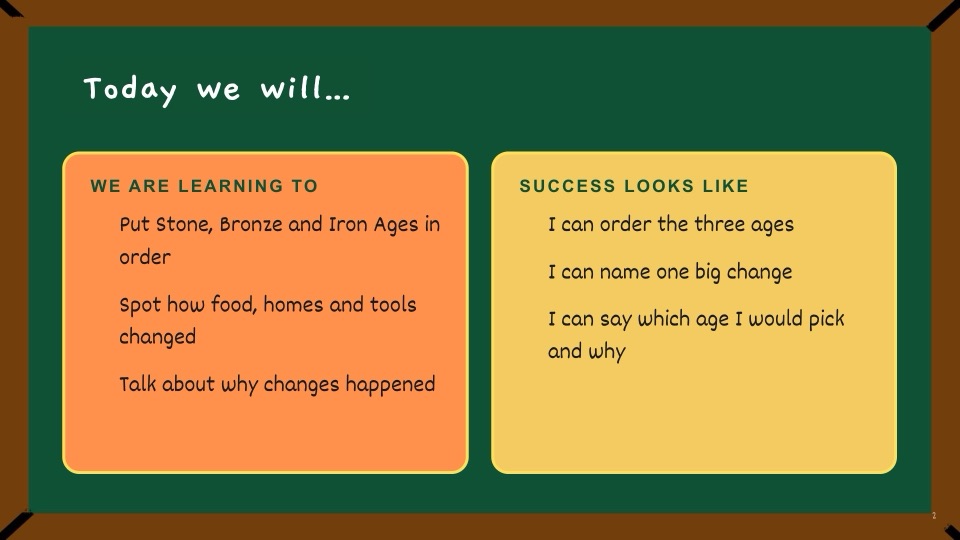
- Students will order the Stone Age, Bronze Age and Iron Age in time.
- Students will describe how tools, food and homes changed over time.
- Students will explain why bronze then iron replaced stone tools.
Success criteria
- I can order the Stone, Bronze and Iron Ages oldest to newest.
- I can name one change in tools, food or homes.
- I can say why a new metal replaced the old material.
Key words
| Word | Meaning |
|---|---|
| chronological | in time order, oldest first |
| prehistory | the time before people could write things down |
| nomadic | moving from place to place to find food |
| smelting | getting metal out of rocks by heating and melting |
| bronze | shiny mixed metal that replaced stone for tools around 2,300 BC |
| iron | strong dark metal that later replaced bronze for tools |
Timed plan (60 minutes)
| Time | Stage | What happens |
|---|---|---|
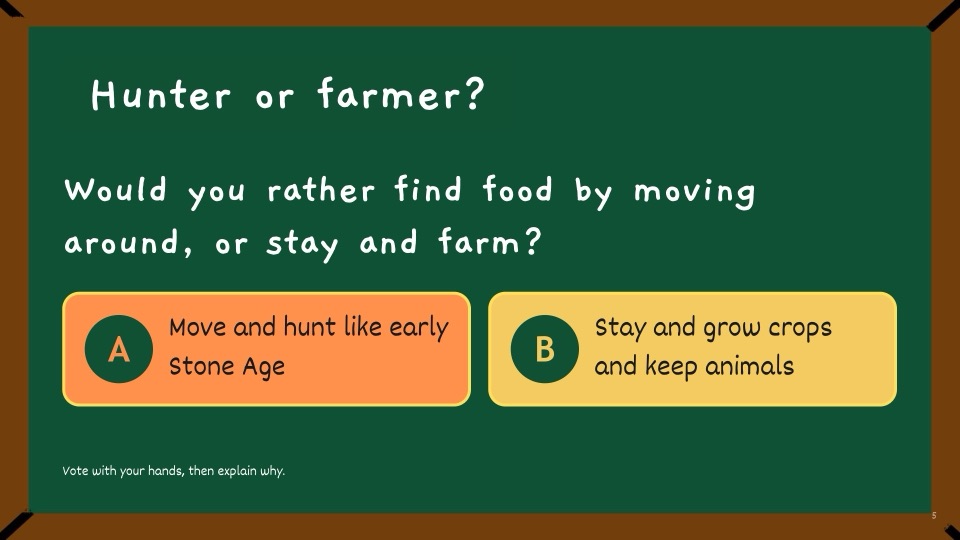
| 5 min | Starter | To hook pupils and set the goal of ordering stone, bronze and iron oldest to newest. Show Slide 1 title and Slide 2 objectives, read the I can lines with the class. Use the hook: If you could only take one tool to chop wood, would you pick rock, shiny metal or strong metal? Take a quick vote with hands for rock, shiny metal or strong metal and ask two pupils why. Link votes to today: we will order which came first and why people changed. |
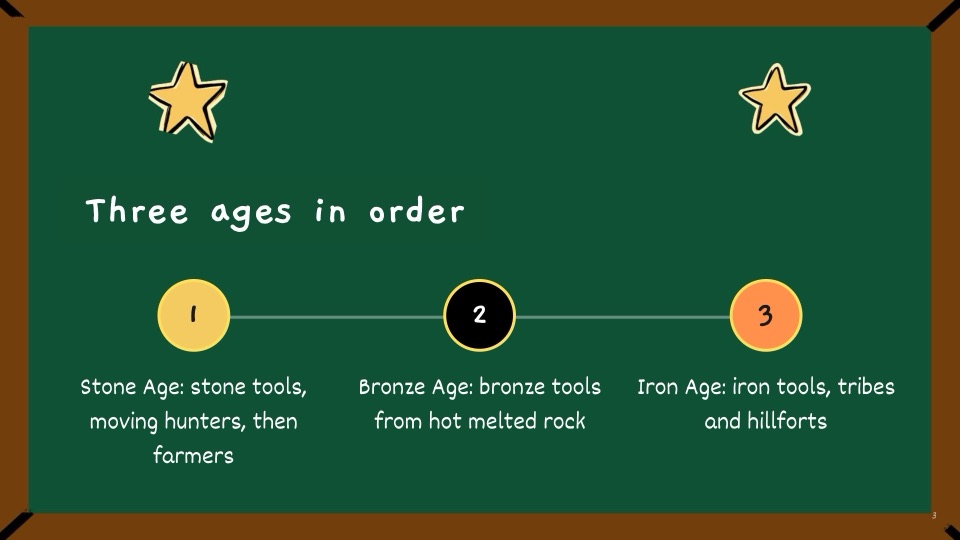
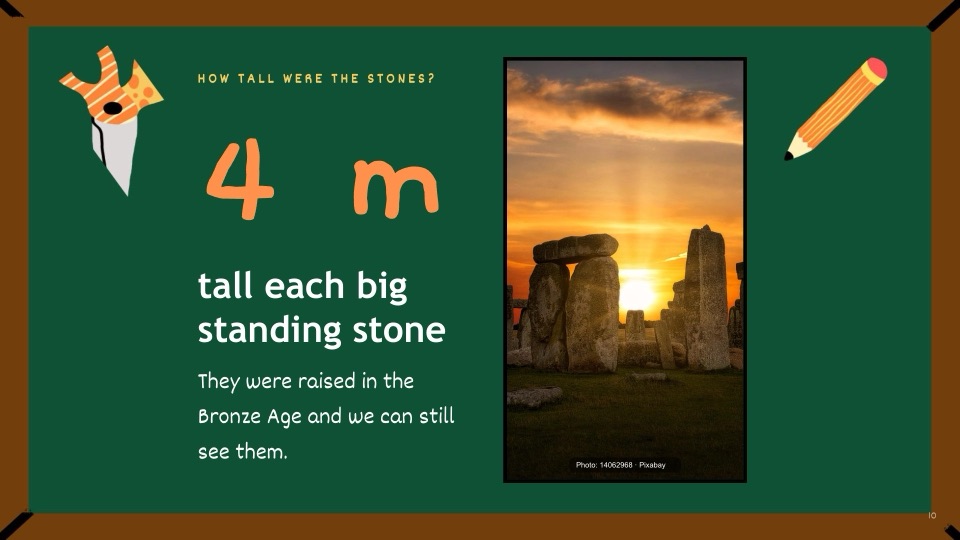
| 10 min | Teaching | To explain how hunting, farming and island life changed before metal tools. Show Slide 3 steps and talk through Stone Age moving hunters, then Bronze Age bronze tools, then Iron Age iron tools and hillforts. Show Slide 5 vote: explain around 12,000 BC people were nomadic hunters who roamed from place to place. Explain that by about 4,000 BC nomads began to settle into farming villages, looking after animals and growing crops. Add that sea levels rose and Britain became an island at about 6,000 BC, before that joined to mainland Europe. |
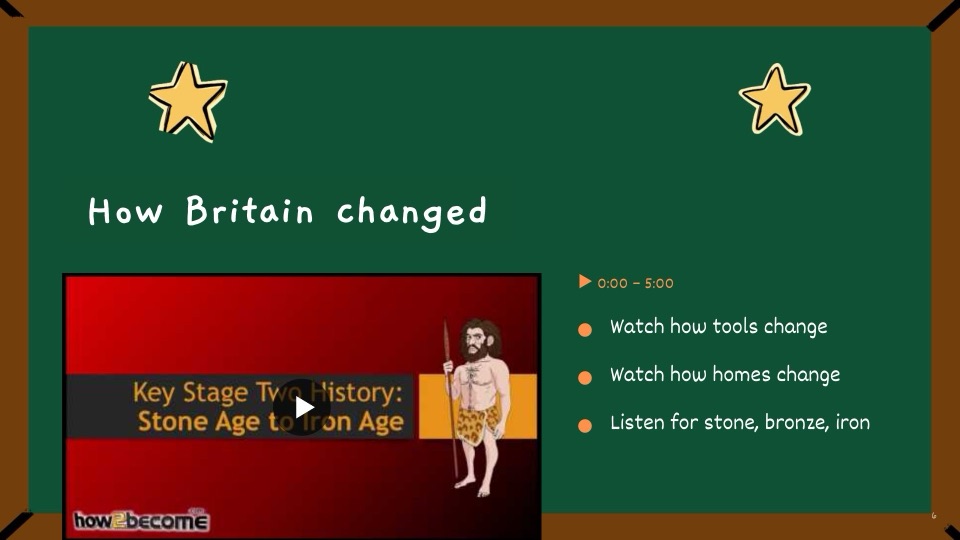
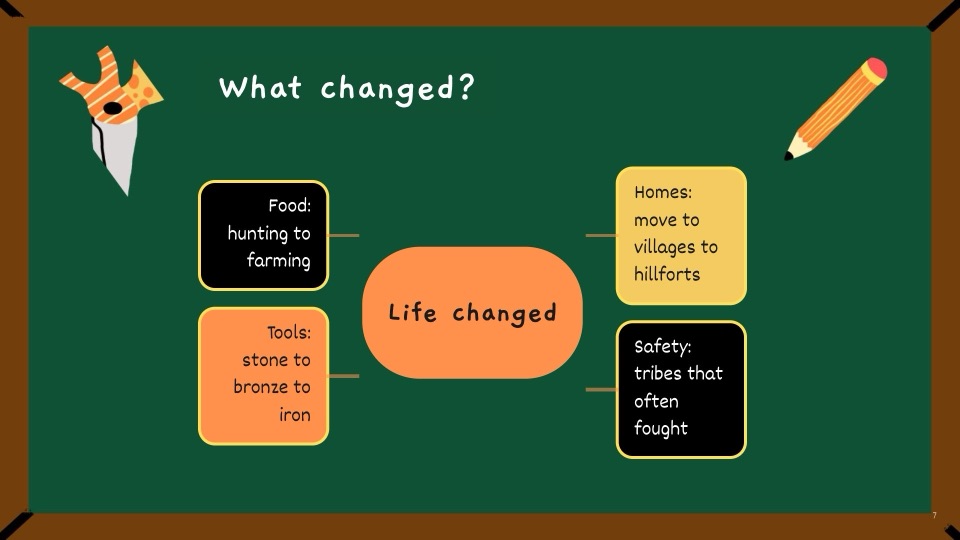
| 10 min | Video and mindmap | To show how tools, homes and safety changed across the three ages. Show Slide 6 and play Video clip 1 (0:00-5:00); ask pupils to listen for stone, bronze, iron and watch homes change. Pause once halfway to name the tool seen: stone, then bronze, then iron. Show Slide 7 mindmap and build it together: food hunting to farming, homes move to villages to hillforts, tools stone to bronze to iron. Explain prehistory means the time before people started writing and being able to record events, so archaeologists learn by digging up artefacts and studying them. |
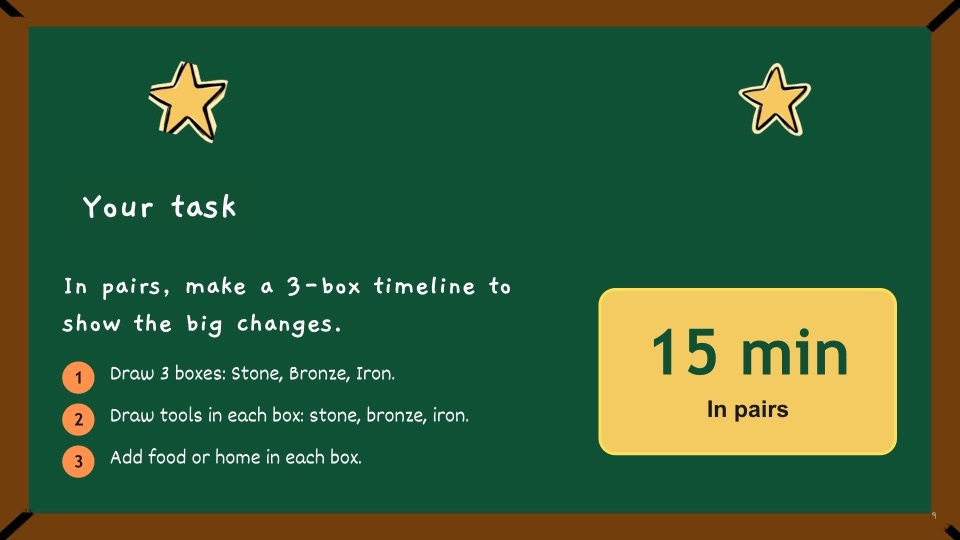
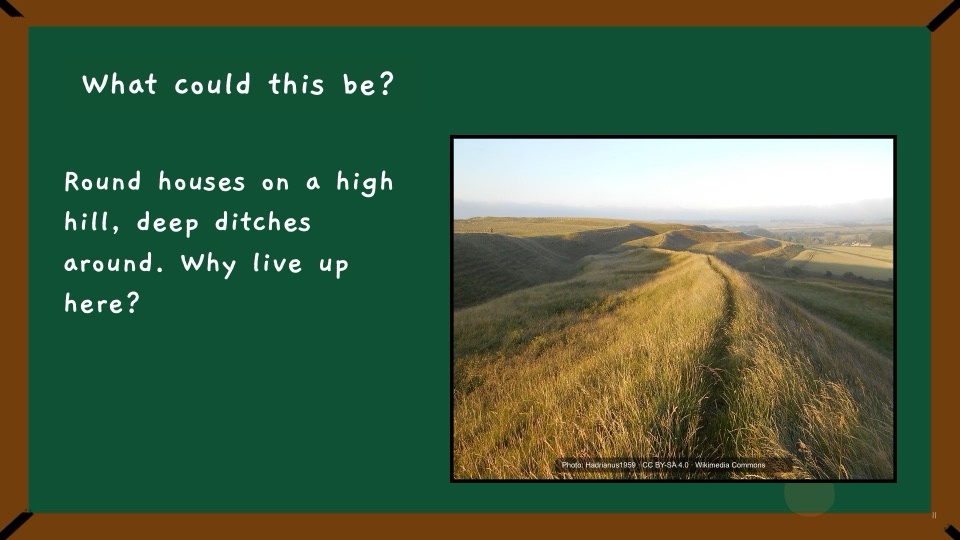
| 25 min | Main activity | To make a 3-part tool timeline that orders stone, bronze and iron and shows food and homes. Show Slide 9 task and give out long paper strips, pebbles, gold-brown and dark-grey card, glue. Model the strip in three boxes: stick pebble for Stone Age, shiny card for Bronze Age from about 2,300 BC, dark card for Iron Age begun from around 800 BC. Model adding labels and one extra: wheat or sheep for farming villages, hillfort circle for tribes often at war. Send pairs to make, label in chronological time order, then hold up strips and name the three ages in order. |
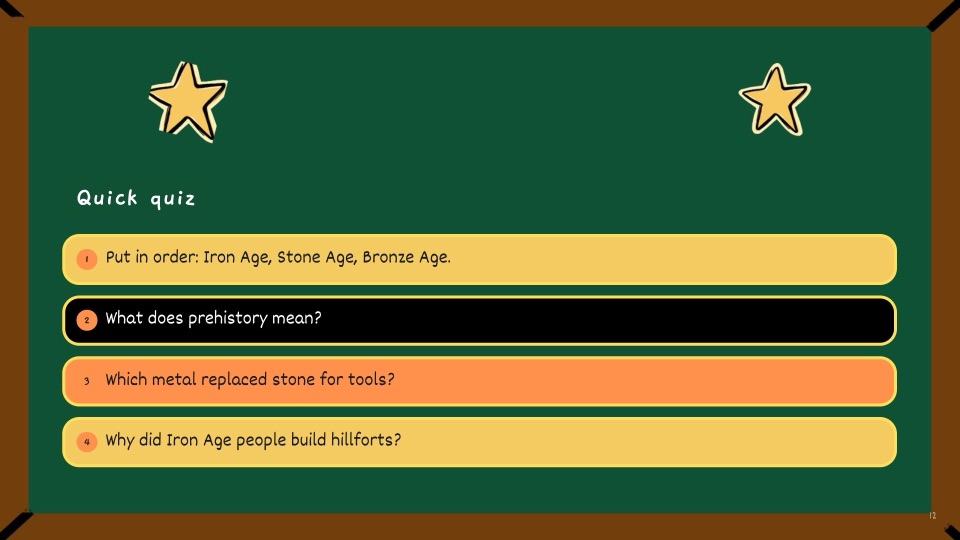
| 10 min | Plenary | To check pupils can order the ages and name changes and reasons. Show Slide 12 quiz and ask pupils to put Iron Age, Stone Age, Bronze Age in order. Ask what prehistory means and how we know about tool changes. Invite three pairs to hold up strips and say one change and one reason for the change. Close by repeating the order and the I can lines from Slide 2. |
Common mistakes
- Thinking a smaller BC number means longer ago
How to spot it: Puts 800 BC before 2,300 BC on the strip
Practise that the bigger the number BC, the longer ago it was, using 12,000 BC, 2,300 BC and 800 BC. - Mixing up bronze and iron order
How to spot it: Says iron came before bronze
Repeat that bronze replaced stone around 2,300 BC, then iron replaced bronze as the main material, with Iron Age from around 800 BC. - Thinking people farmed from the start
How to spot it: Draws villages in the Stone Age hunting box
Retell that around 12,000 BC people were nomadic hunters, then by about 4,000 BC they settled into farming villages with crops and animals.
Support
- Use picture cards with colour borders, pre-cut tools and pre-written labels to narrow choice.
- Keep word mats with stone, bronze, iron, tent, village and hillfort for pointing.
Stretch
- Add a caption explaining why a farmer or hunter might prefer the new material.
- Compare two ideas about change and argue which change mattered most and why.
Check questions
- Put these in order oldest first: Iron Age, Stone Age, Bronze Age.
Answer: Stone Age, Bronze Age, Iron Age. - Name one way food or homes changed from Stone Age to Iron Age.
Answer: From moving hunters to farming villages with crops and animals, then to hillfort homes. - Why did people stop using only stone for tools?
Answer: Because bronze then iron made stronger, sharper tools and weapons.
Curriculum
changes in Britain from the Stone Age to the Iron Age
Video clips
Clips on YouTube, from the start and end times we chose. Check each one before you show it.
-
Stone Age to Iron Age overview from 0:00 to 5:00
CareerVidz: KS2 History: Stone Age to Iron Age
Made for KS2 and covers changes in Britain in simple language ideal for 7-8-year-olds.
-
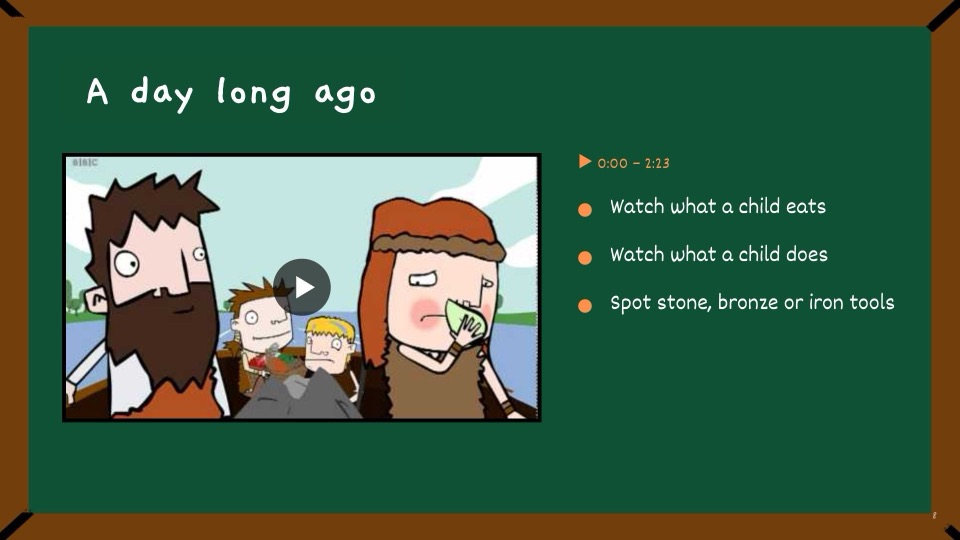
Day in life in Ancient Britain from 0:00 to 2:23
BBC: A Day in the Life Of A 10-Year-Old in Ancient Britain - Hands on History - BBC
BBC film follows a 10-year-old in Ancient Britain in a way 7-8-year-olds can relate to.
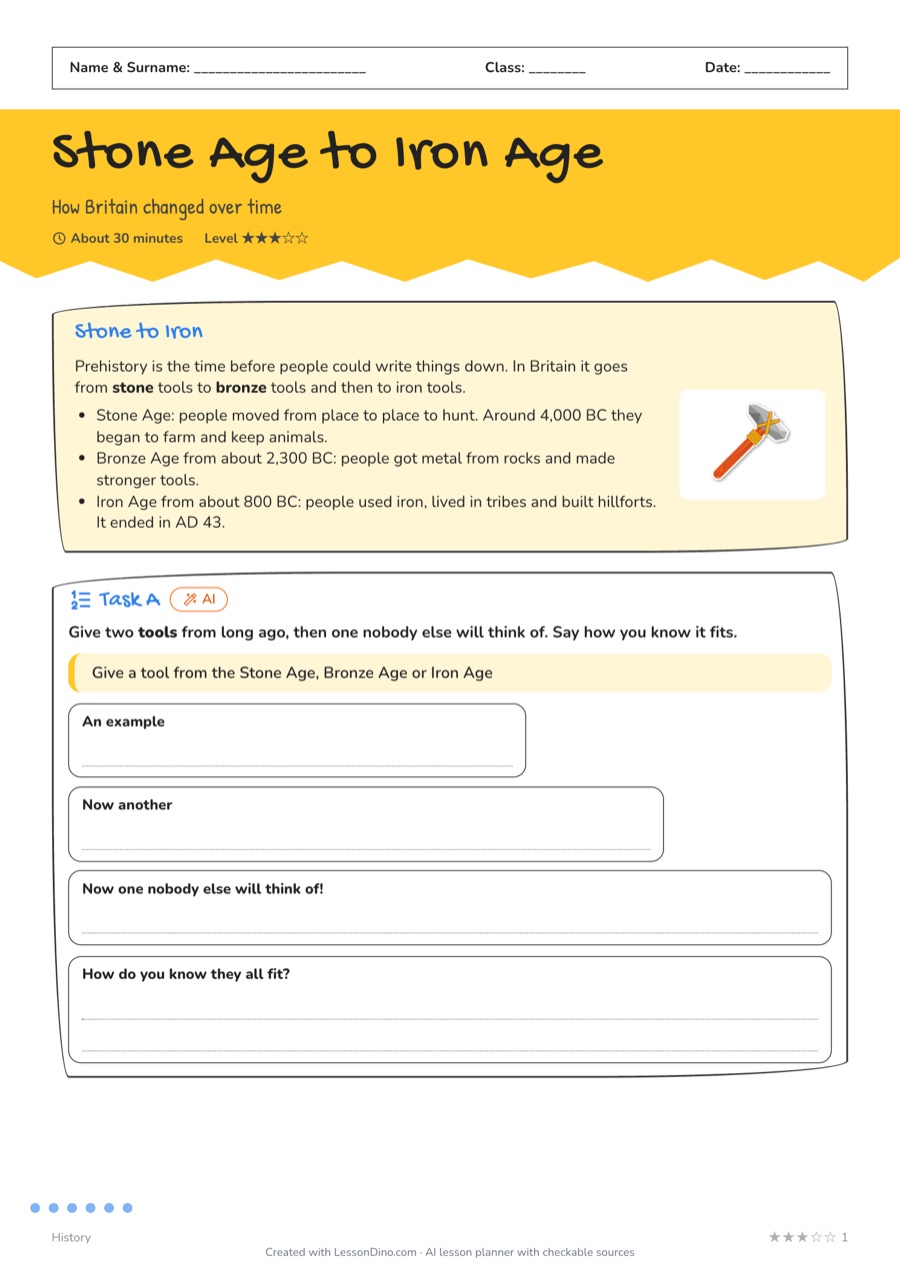
Worksheet
Sources
- 25B26F989F10243DEA01CAC486F267D0 lodgefarm.herts.sch.uk
- Year 3 Yearly Curriculum Overview leadgate.durham.sch.uk
- BJS Knowledge Organiser Iron Bronze Stone Age Year 3 brockwell-jun.derbyshire.sch.uk
- Primary SoW Stone Age to Iron Age 2020 history.org.uk
- British Iron Age - Wikipedia en.wikipedia.org
Picture credits
- Photo: artellliii72 · Pixabay
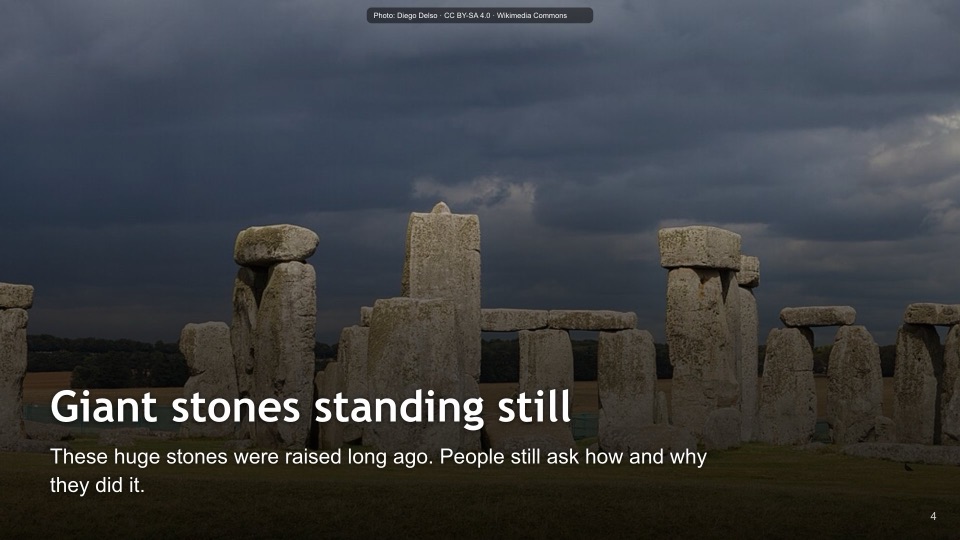
- Photo: Diego Delso · CC BY-SA 4.0 · Wikimedia Commons
- Photo: 14062968 · Pixabay
- Photo: Hadrianus1959 · CC BY-SA 4.0 · Wikimedia Commons
- Illustration: ArtsyBeeKids · Pixabay
- Drawing: Tom dl · CC0 · Wikimedia Commons
- Pictograms: Sergio Palao, ARASAAC (arasaac.org) · CC BY-NC-SA
- Illustration: IMAGEMO · Pixabay
- Picture: unknown · CC0 · rawpixel via Openverse
- Illustration: Picsbix · Pixabay
Made with Lesson Dino's AI on 17 October 2026. AI can make mistakes, so check facts against the sources before you teach.