The worksheet
About this worksheet
Pupils place Ancient Egypt in time and place and explain the Nile flood. They test farming and make a mini Nile poster about achievements. This Year 4 History worksheet gives students (ages 8–9) five pages of practice on ancient Egypt, part of the ancient civilisations unit. It goes with our free Ancient Egypt lesson, which has the slides and a timed lesson plan.
What it covers
By the end, students should be able to:
- Students will place Ancient Egypt in time and place along the Nile.
- Students will explain how the yearly Nile flood helped farmers grow food.
- Students will describe Egyptian achievements in building, writing and belief.
How to use it
- Starter (5 minutes): Give out Worksheet Task B and ask pupils to fill columns 1 and 2 only.
- Teaching (10 minutes): Model Worksheet Task D by ordering two cards first, then let pupils number the rest.
- Teaching (15 minutes): Give out Worksheet Task E bar chart about class votes to complete in pairs.
- Plenary (10 minutes): Give Worksheet Task G to circle the correct word in each sentence.
- Support: Use word banks, picture guides and pre-drawn Nile outlines for posters.
- Stretch: Predict crop results in low-flood years and explain choices for burial goods.
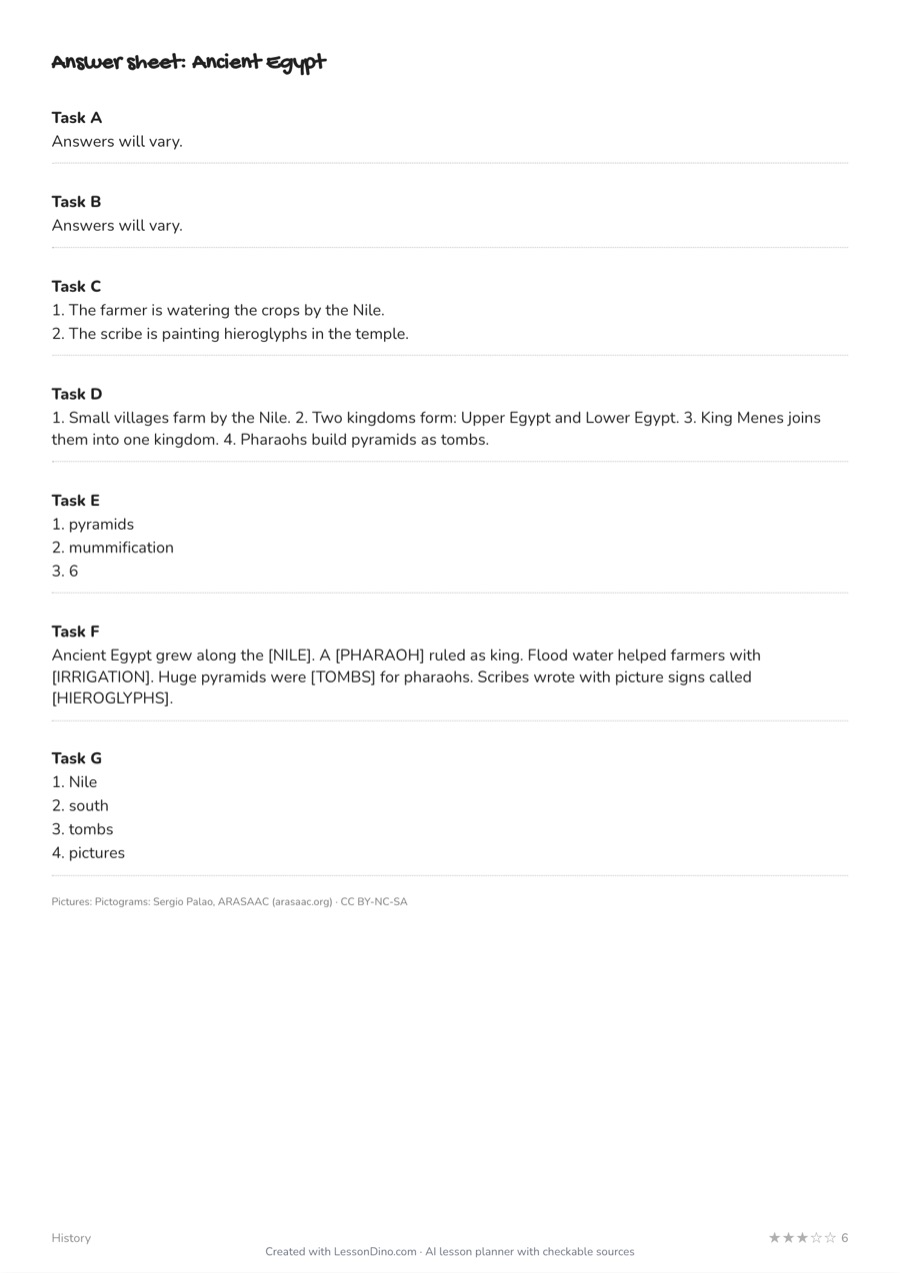
- The answer sheet is the last page, so you can print it on its own or let students check their own work.
Key vocabulary
- civilisation: a large group of people living in towns with rules, jobs and writing
- pharaoh: a king of Ancient Egypt who ruled the land and religion
- flood: when river water rises over the banks and covers the fields
- hieroglyphs: picture writing used in Ancient Egypt with more than 700 signs
- pyramid: a huge stone tomb built for a pharaoh
Mistakes to watch for
- Thinking Upper Egypt is in the north because up on a map is north. Re-trace the Nile flowing from south to north and repeat: Upper is southern valley, Lower is northern delta.
- Thinking the flood ruined farming instead of helping it. Point to dark soil in tray and recall it left thick, dark soil full of nutrients.
- Thinking hieroglyphs are just decoration, not writing with meaning. Recall rulers used hieroglyphic writing to record decrees and grain taxes and the Rosetta Stone holds the same text in three scripts.
What's on the worksheet
Meet Ancient Egypt
Find out when and where the first Egyptians lived.
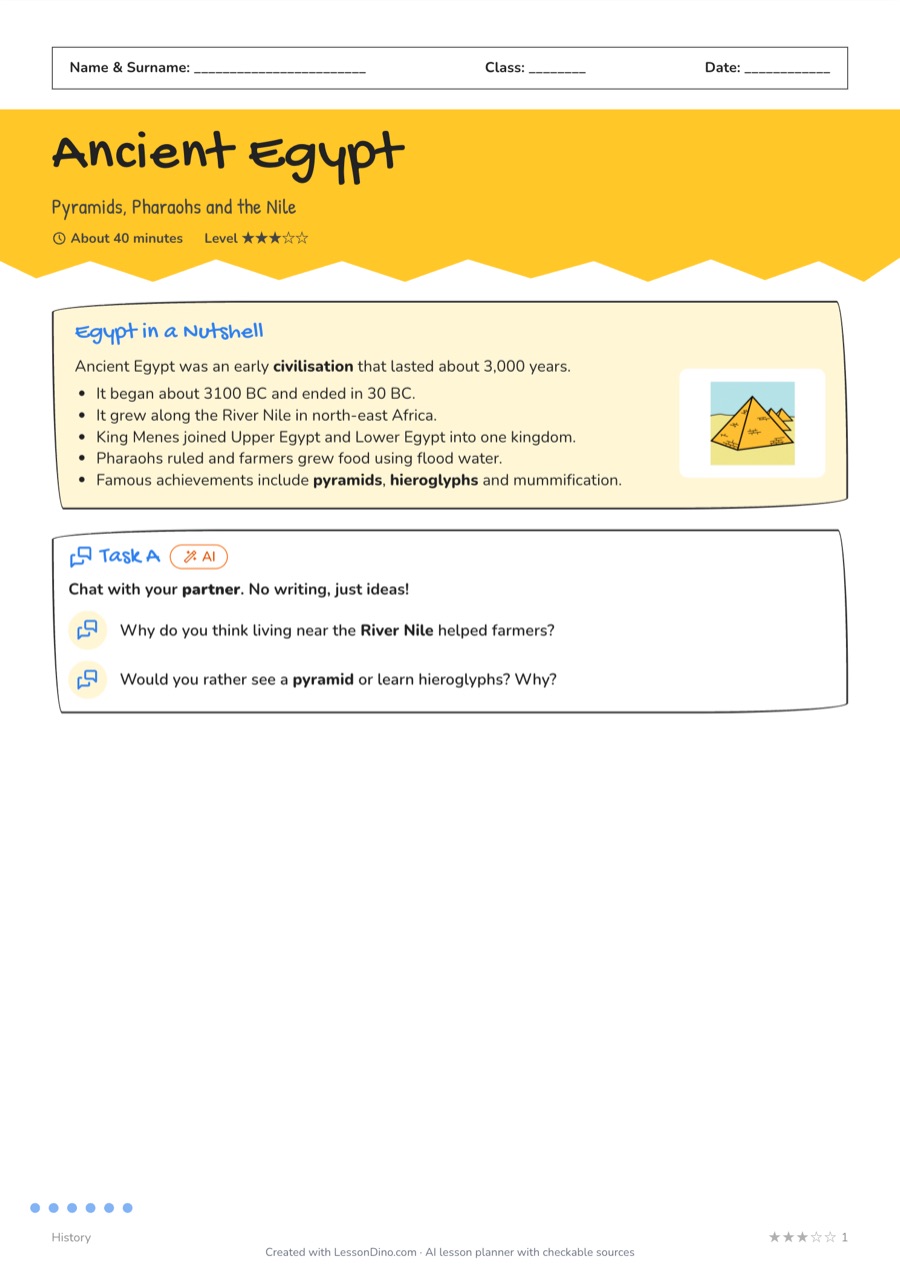
Egypt in a Nutshell
- Ancient Egypt was an early civilisation that lasted about 3,000 years.
- It began about 3100 BC and ended in 30 BC.
- It grew along the River Nile in north-east Africa.
- King Menes joined Upper Egypt and Lower Egypt into one kingdom.
- Pharaohs ruled and farmers grew food using flood water.
- Famous achievements include pyramids, hieroglyphs and mummification.
Chat with your partner. No writing, just ideas!
- Why do you think living near the River Nile helped farmers?
- Would you rather see a pyramid or learn hieroglyphs? Why?
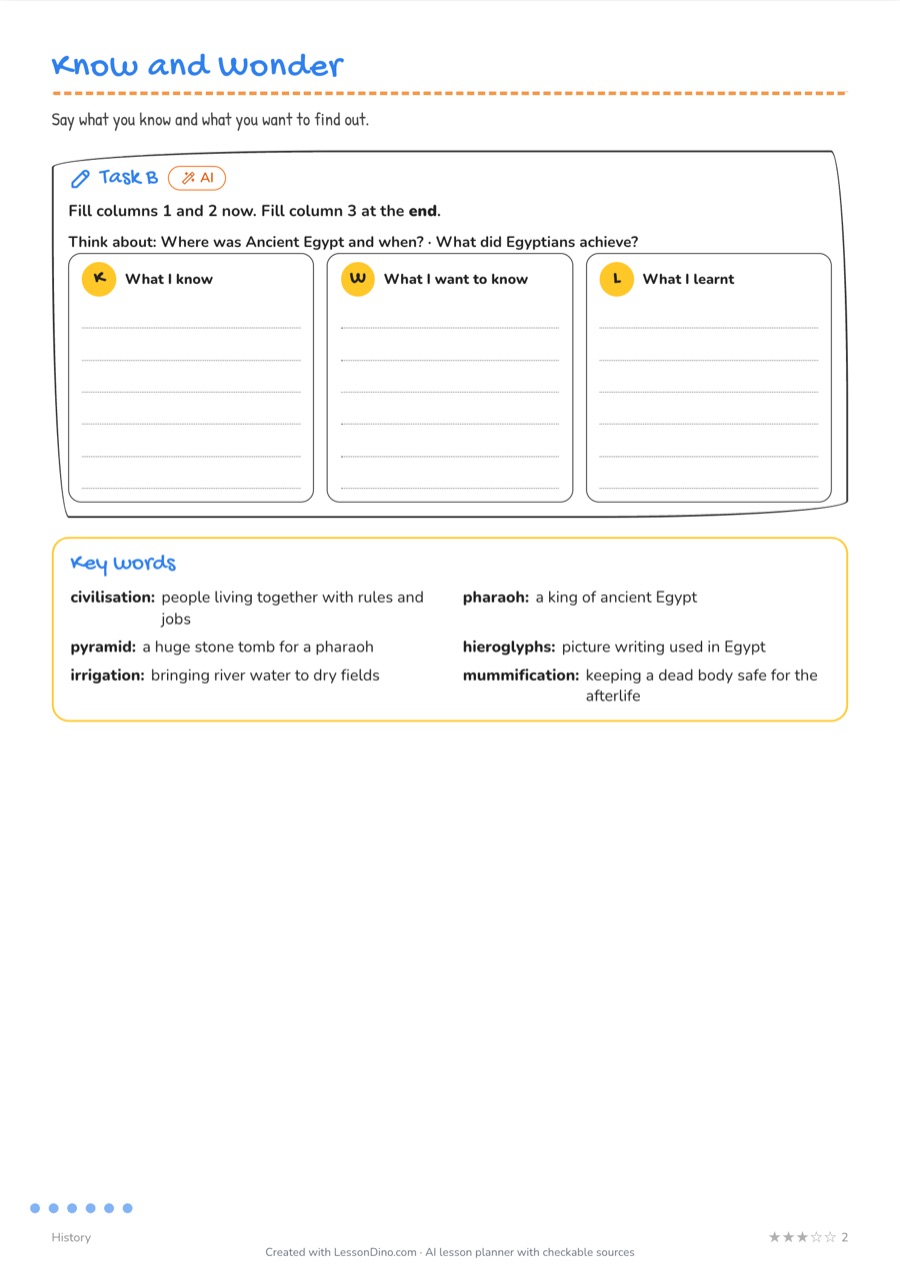
Know and Wonder
Say what you know and what you want to find out.
Fill columns 1 and 2 now. Fill column 3 at the end.
| Word | Meaning |
|---|---|
| civilisation | people living together with rules and jobs |
| pharaoh | a king of ancient Egypt |
| pyramid | a huge stone tomb for a pharaoh |
| hieroglyphs | picture writing used in Egypt |
| irrigation | bringing river water to dry fields |
| mummification | keeping a dead body safe for the afterlife |
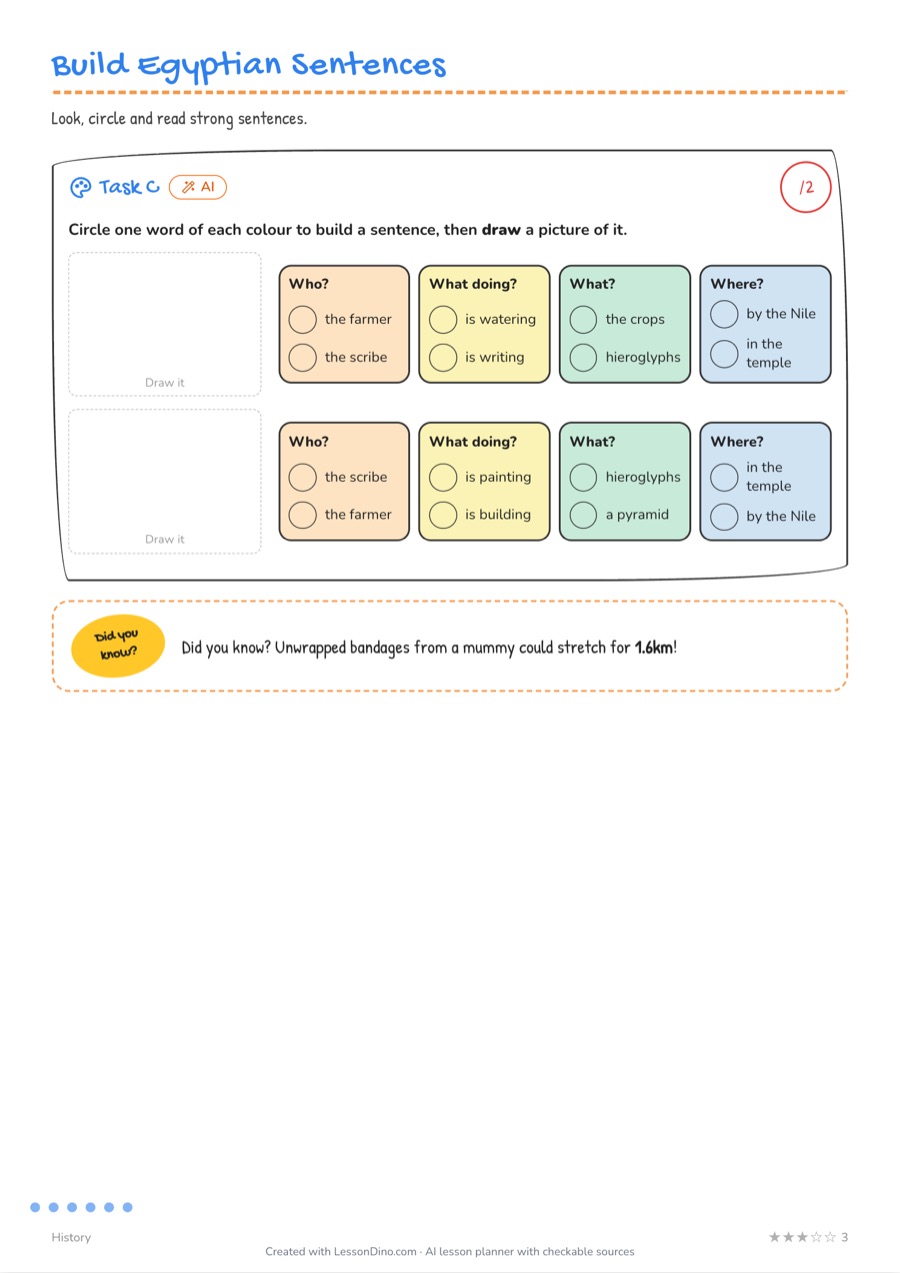
Build Egyptian Sentences
Look, circle and read strong sentences.
Circle one word of each colour to build a sentence, then draw a picture of it.
- Did you know? Unwrapped bandages from a mummy could stretch for 1.6km!
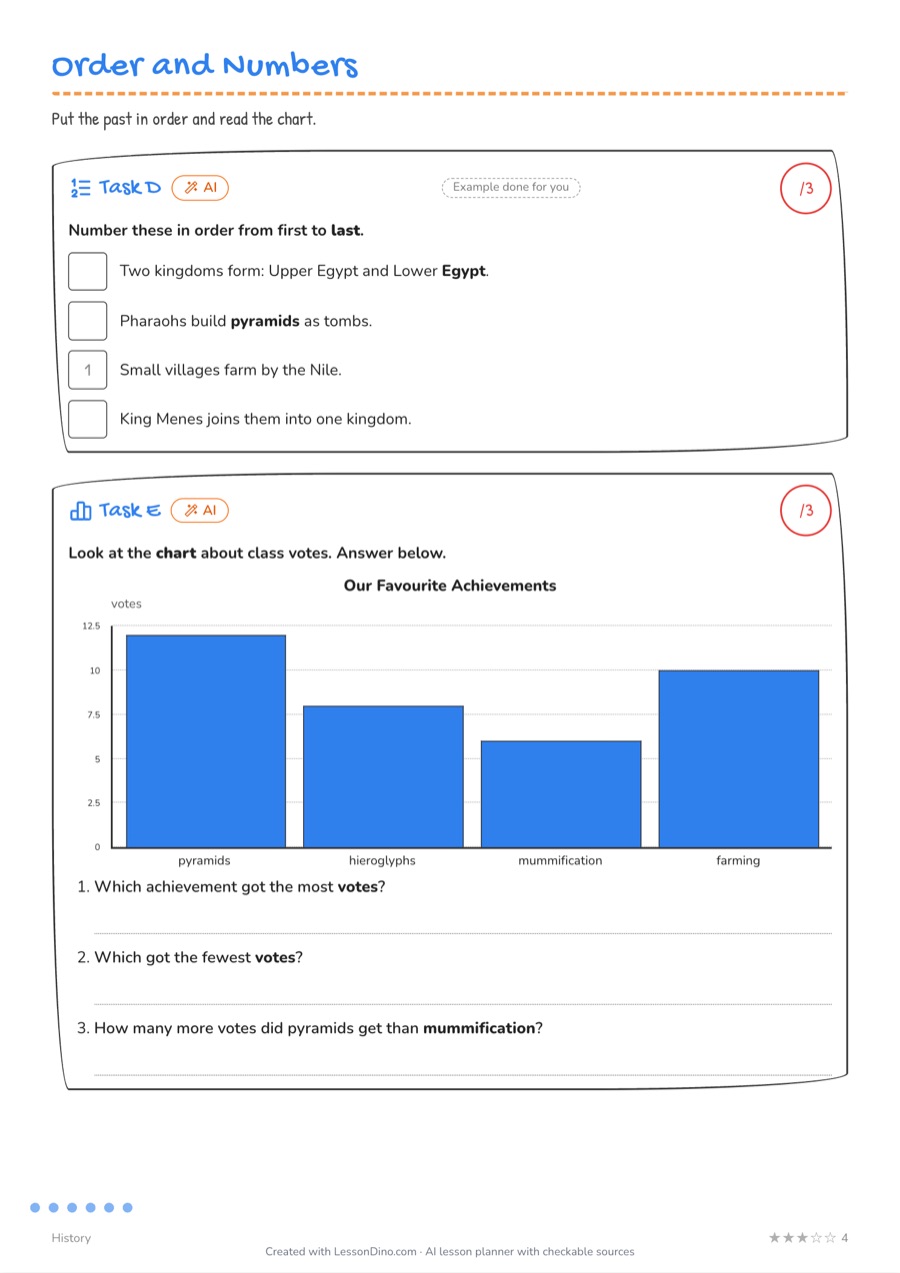
Order and Numbers
Put the past in order and read the chart.
Number these in order from first to last.
Look at the chart about class votes. Answer below.
- Which achievement got the most votes?
- Which got the fewest votes?
- How many more votes did pyramids get than mummification?
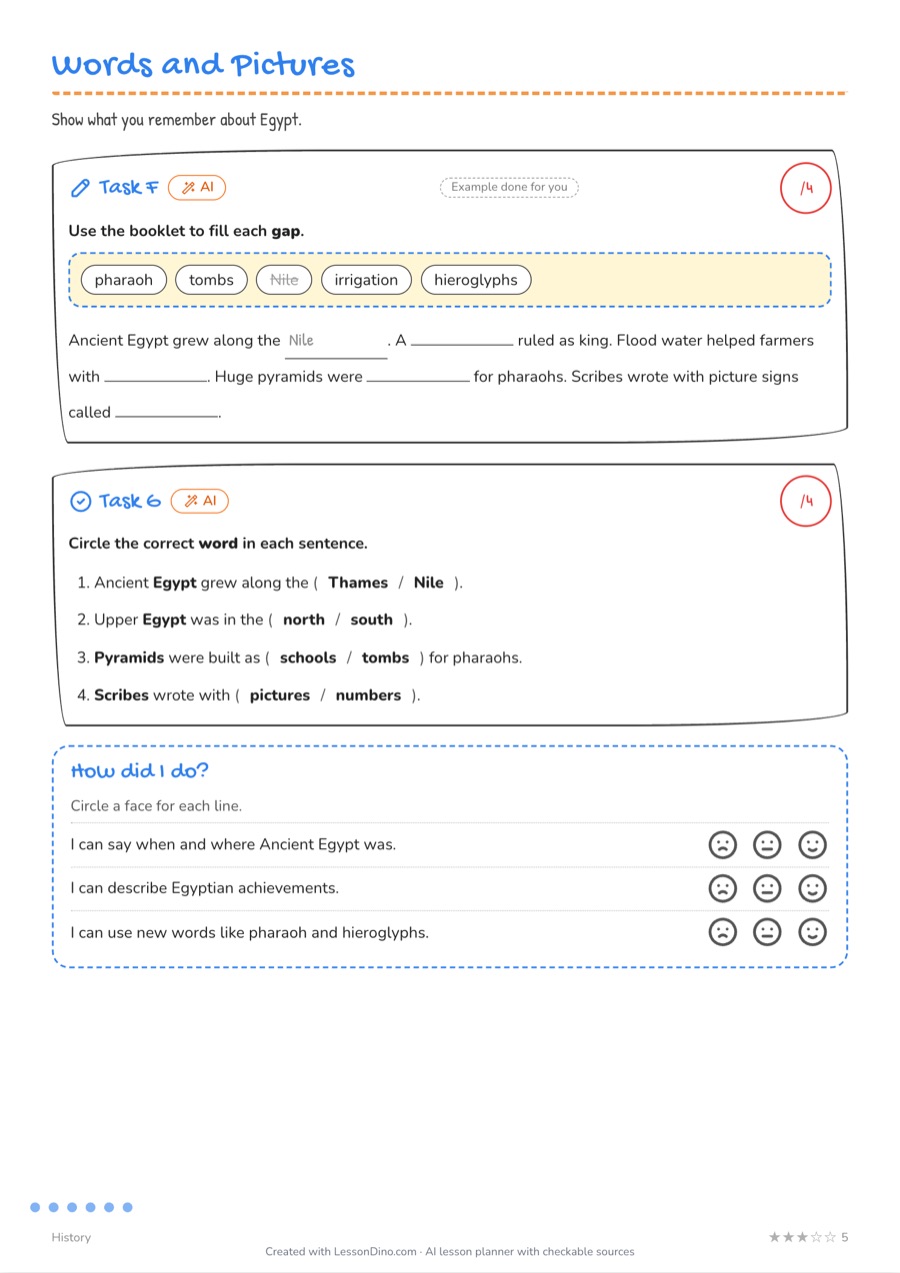
Words and Pictures
Show what you remember about Egypt.
Use the booklet to fill each gap.
- Ancient Egypt grew along the [[Nile]]. A [[pharaoh]] ruled as king. Flood water helped farmers with [[irrigation]]. Huge pyramids were [[tombs]] for pharaohs. Scribes wrote with picture signs called [[hieroglyphs]].
Circle the correct word in each sentence.
Answers
Show the answers
- Which achievement got the most votes? pyramids
- Which got the fewest votes? mummification
- How many more votes did pyramids get than mummification? 6
The answer sheet is the last picture above.
Curriculum
the achievements of the earliest civilizations – an overview of where and when the first civilizations appeared and a depth study of one of the following: Ancient Sumer, The Indus Valley, Ancient Egypt, The Shang Dynasty of Ancient China
Made with Lesson Dino's AI on 17 October 2026. AI can make mistakes, so check the answers and facts against the sources before you teach.