Slides
Lesson plan
Anglo-Saxon Settlements: Place Names and Village Life
Pupils learn why Anglo-Saxons settled and how villages worked. They plan and map their own Saxon village.
Objectives
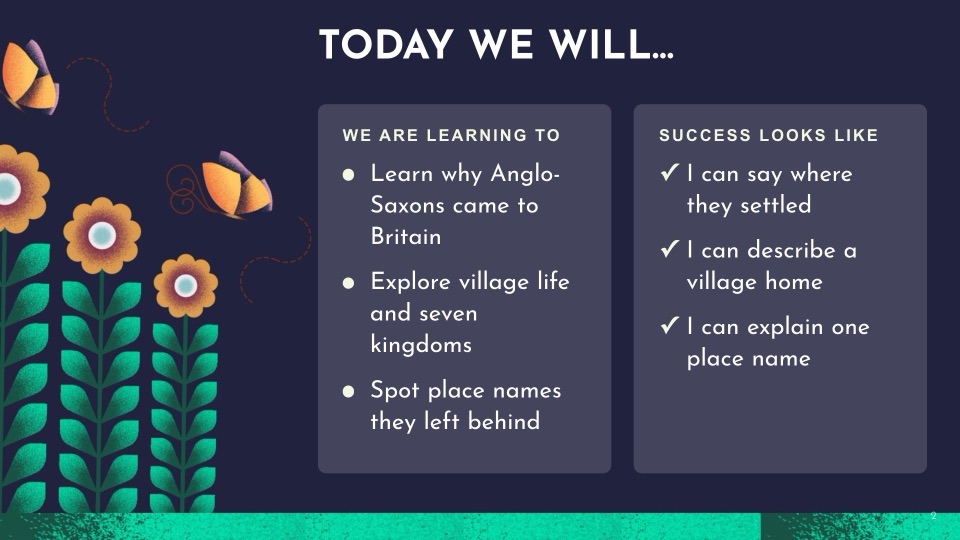
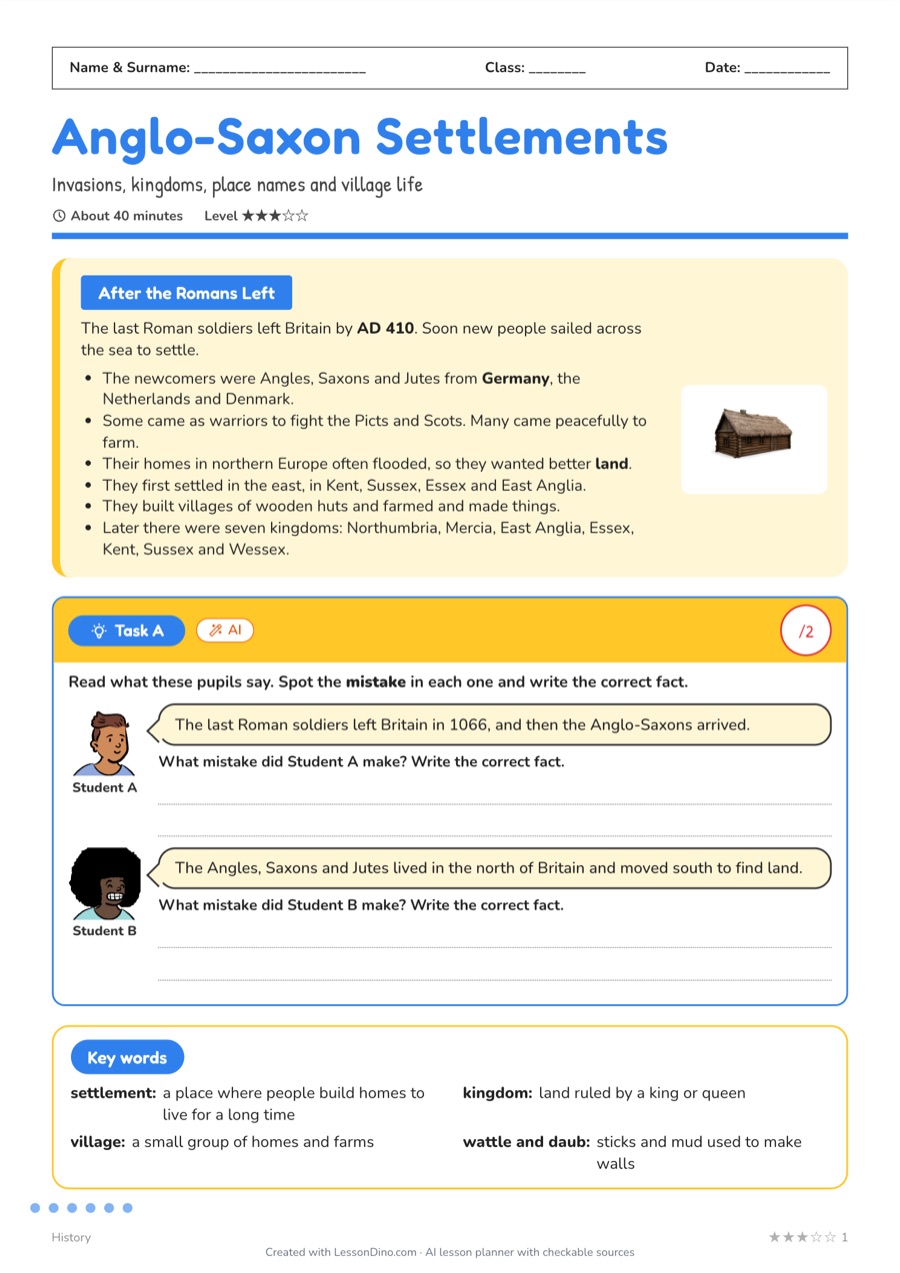
- Students will explain why Anglo-Saxons came and where they settled.
- Students will describe village life and how houses were built.
- Students will link settler groups to place names and kingdoms.
Success criteria
- I can say where Anglo-Saxons settled and why they came.
- I can describe homes and life in a Saxon village.
- I can match Essex and East Anglia and use -ham or -ton.
Key words
| Word | Meaning |
|---|---|
| settlement | a place where people choose to begin a community |
| kingdom | a country or area ruled by a king or queen |
| village | a small group of homes where families farm and work together, giving food, warmth and shelter |
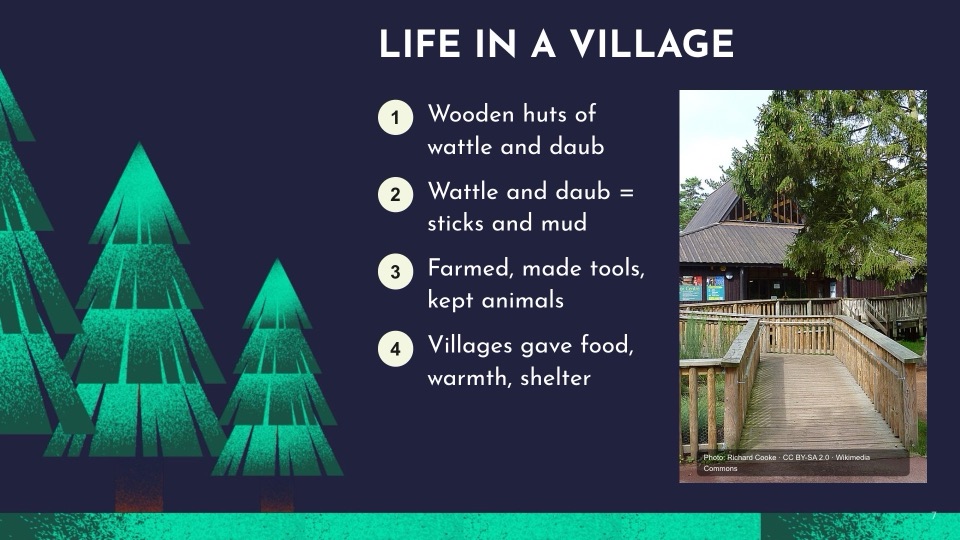
| wattle and daub | sticks covered with mud to make walls of a hut |
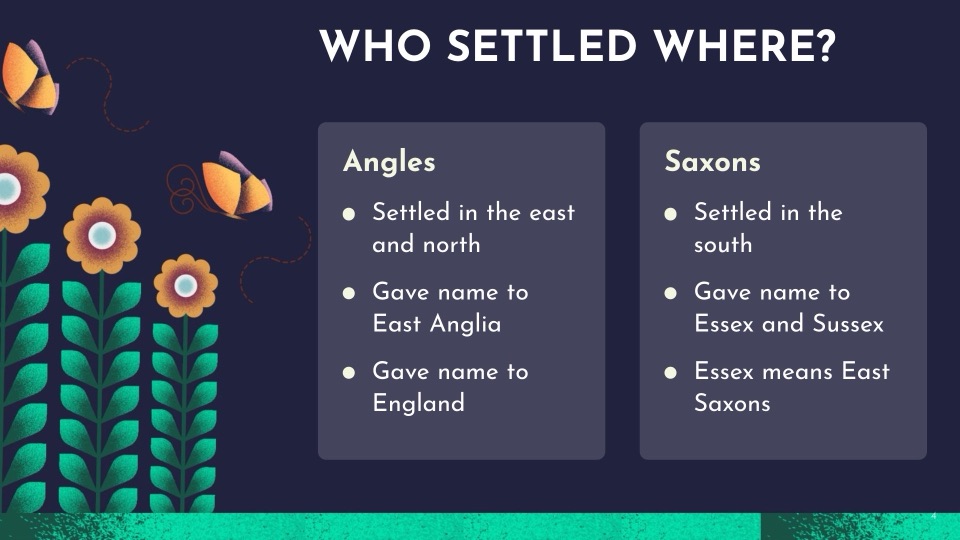
| Angles | one group from Germany, the Netherlands and Denmark who settled in the east |
Timed plan (60 minutes)
| Time | Stage | What happens |
|---|---|---|
| 5 min | Starter | To hook pupils with the settler challenge and recall Roman Britain. Show Slide 1 Anglo-Saxon Settlements and Slide 2 Today we will objectives. Show Slide 3 Big idea and read: When Romans left, Anglo-Saxons made Britain home. Use the hook: point to an empty space and say the settler challenge. Take 3 quick ideas on what a family needs to survive winter. |
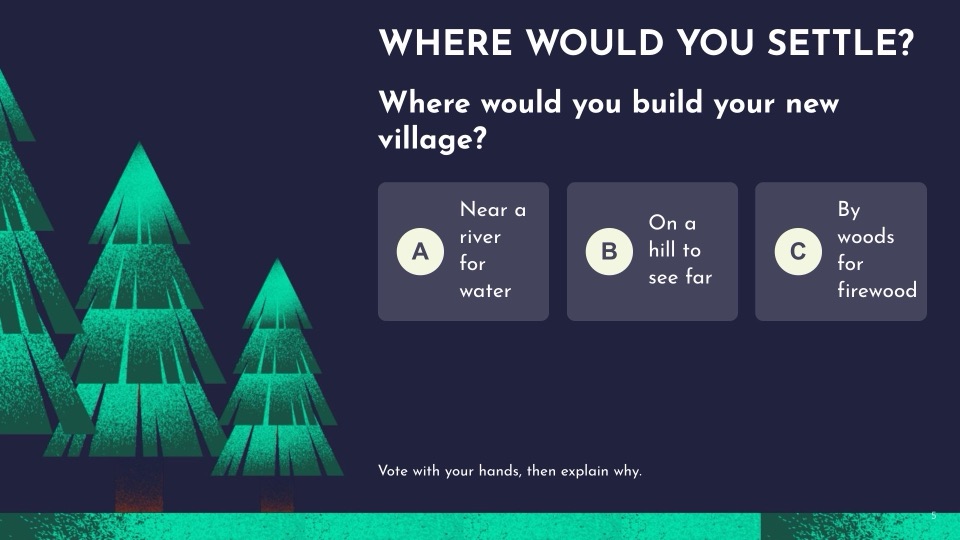
| 10 min | Teaching | To explain why Anglo-Saxons came and who settled where. Show Slide 4 Who settled where and explain the Angles in the east and north and Saxons in the south. Teach that they were a mix of tribes from Germany, Denmark and the Netherlands, the three biggest were the Angles, the Saxons and the Jutes. Teach that they came as warriors to fight the Picts and Scots in the north, and also peacefully to find land to farm and build new homes. Show Slide 5 Where would you settle and take a class vote for river, hill or woods. |
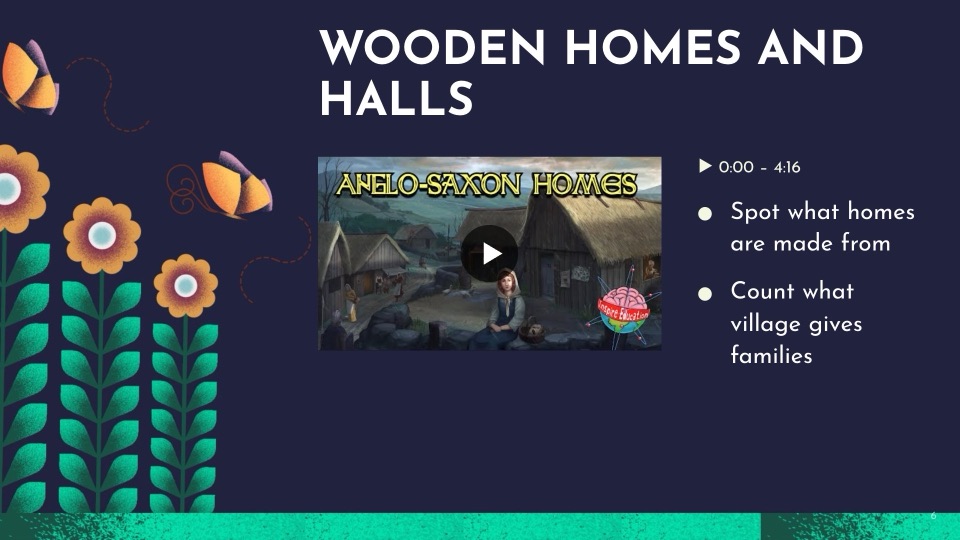
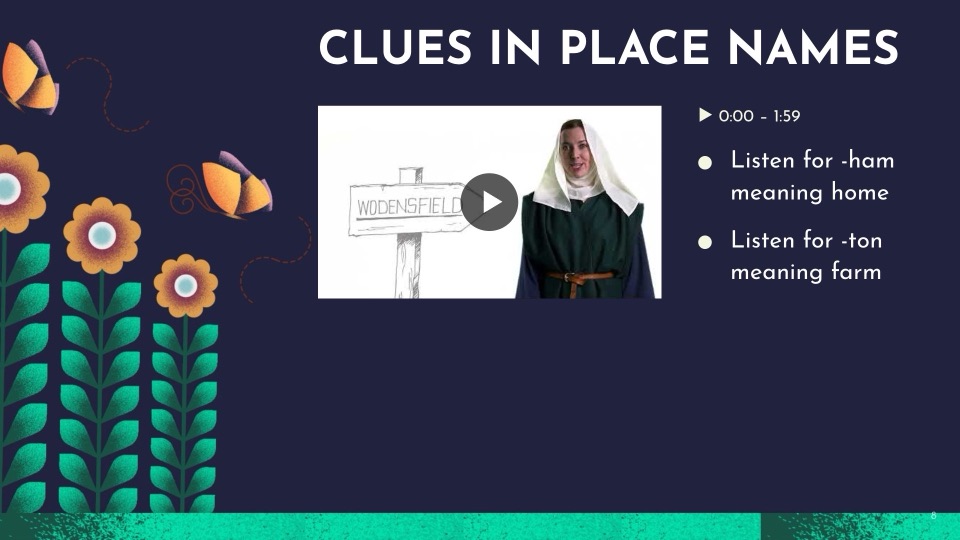
| 10 min | Teaching | To show what Saxon homes were made from and what -ham and -ton mean. Show Slide 6 and play Video clip 1 Houses and Settlements (0:00-4:16). Show Slide 7 Life in a village and explain wattle and daub as sticks and mud. Show Slide 8 and play Video clip 2 Place-Name Clues (0:00-1:59) for -ham meaning home and -ton meaning farm. Summarise what a village gave families and what rotted away. |
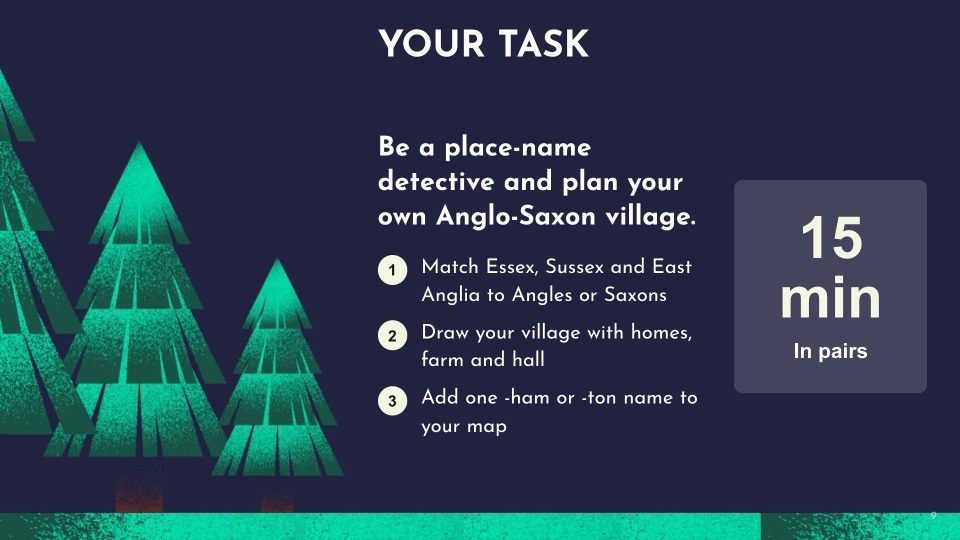
| 25 min | Main activity | To plan a Saxon village that could feed and shelter families. Show Slide 9 Your task and explain: match, draw homes, farm and hall, add one -ham or -ton name. Model a quick plan: river for water, huts together, field, workshop, fence round the edge. Give out large sugar paper, felt tips and small farm-animal counters. Circulate, ask where food, shelter and work happen, and check place-name links. |
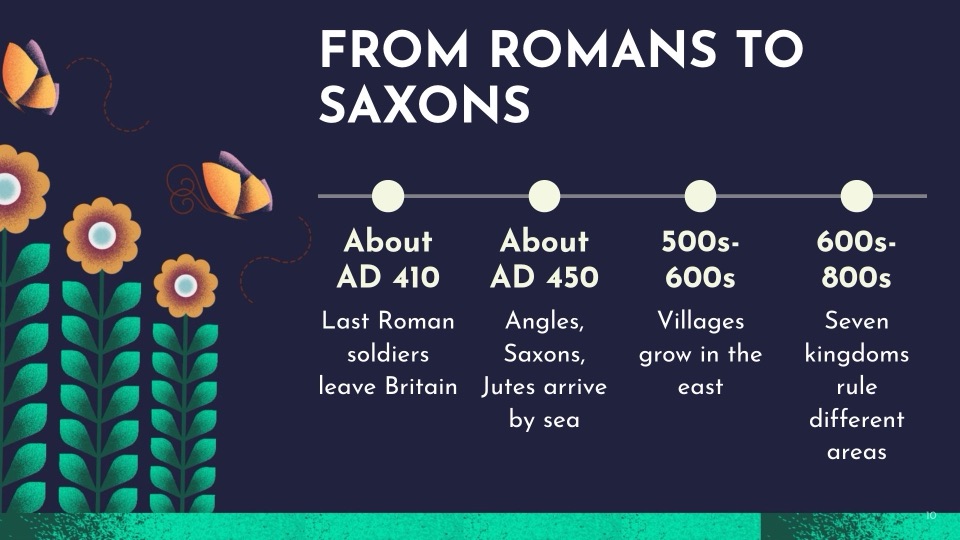
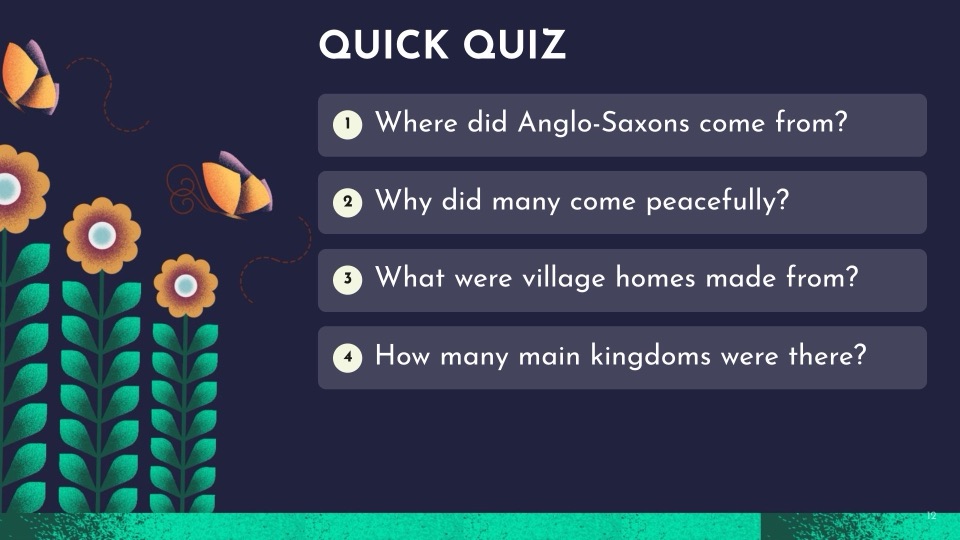
| 10 min | Plenary | To secure the timeline, seven kingdoms and place-name links. Show Slide 10 From Romans to Saxons and peg the order: AD410, AD450, 500s-600s, 600s-800s. Teach that the Anglo-Saxons established seven kingdoms - Northumbria, Mercia, East Anglia, Essex, Kent, Sussex and Wessex. Show Slide 11 Think, pair, share: Why do so many town names still sound Saxon? Show Slide 12 Quick quiz and take answers as exit check. |
Common mistakes
- Pupils think one king ruled all the Anglo-Saxons.
How to spot it: They say king of England ruled from the start.
Stress that no single king ruled over all the Anglo-Saxons and practise all seven kingdoms. - Pupils think Saxon houses were stone and still stand.
How to spot it: They draw castles or stone streets.
Remind them most homes were made from natural materials and rotted, so no original settlements are left, and ordinary houses were short-lived timber. - Pupils call Anglo-Saxons Vikings or one single tribe.
How to spot it: They say Viking village or one boat of same people.
Teach they were a mix of tribes from Germany, Denmark and the Netherlands, the biggest were Angles, Saxons and Jutes, and Saxon is not Viking.
Support
- Use colour-matched word cards and picture labels for Angles, Saxons, wattle and daub.
- Give faint village outlines and sentence starters for explanations.
Stretch
- Explain which village jobs mattered most for winter survival and why.
- Add movement arrows and a -ham or -ton name with a reason.
Check questions
- Where did Anglo-Saxons first settle?
Answer: In the east: Kent, Sussex, Essex and East Anglia. - What were Saxon homes made from and why are none left?
Answer: Natural materials like wood, wattle and daub, which rotted over time. - Which settlers link to Essex and East Anglia?
Answer: East Saxons to Essex and Angles to East Anglia, as peoples gave names to places.
Curriculum
Anglo-Saxon invasions, settlements and kingdoms: place names and village life
Video clips
Clips on YouTube, from the start and end times we chose. Check each one before you show it.
-
Houses and Settlements from 0:00 to 4:16
Inspire Education: Anglo-Saxon Houses and Settlements
Shows wooden halls and settlement layout with clear simple vocabulary ideal for ages 8-9.
-
Place-Name Clues from 0:00 to 1:59
60 Second Histories: Anglo Saxon Place Names | KS2 History
Explains Anglo-Saxon place-name endings for KS2 with short clear examples suited to ages 8-9.
Worksheet
Sources
- National curriculum in England: history programmes of study assets.publishing.service.gov.uk
- Curriculum Map: History Year 4 Below outlines the learning ... camrose.harrow.sch.uk
- KS2 History: An Anglo-Saxon settlement - BBC Teach bbc.co.uk
- Exploring Anglo-Saxon Settlement - Current Archaeology archaeology.co.uk
- 425-792 Britain's Settlement by the Anglo-Saxons and Scots grippinghistory.co.uk
- Who were the Anglo-Saxons? - BBC Bitesize bbc.co.uk
- Anglo-Saxon settlement of Britain Facts for Kids kids.kiddle.co
- Anglo-Saxon kingdoms KS2 | Y5 History | Lesson Resources thenational.academy
- Anglo-Saxon settlement of Britain - Wikipedia en.wikipedia.org
- Anglo Saxons primary resource - National Geographic Kids natgeokids.com
- Middle Ages for Kids: Anglo-Saxons of England - Ducksters ducksters.com
- Why did the Anglo-Saxons come to Britain? - BBC Bitesize bbc.co.uk
- History of Anglo-Saxon England Facts for Kids kids.kiddle.co
- UK Archaeologists Unearth Previously Unknown Anglo-Saxon Settlement | Sci.News sci.news
Picture credits
Made with Lesson Dino's AI on 17 October 2026. AI can make mistakes, so check facts against the sources before you teach.