
Slides
Lesson plan
Gift of the Nile: Why Ancient Egypt Thrived
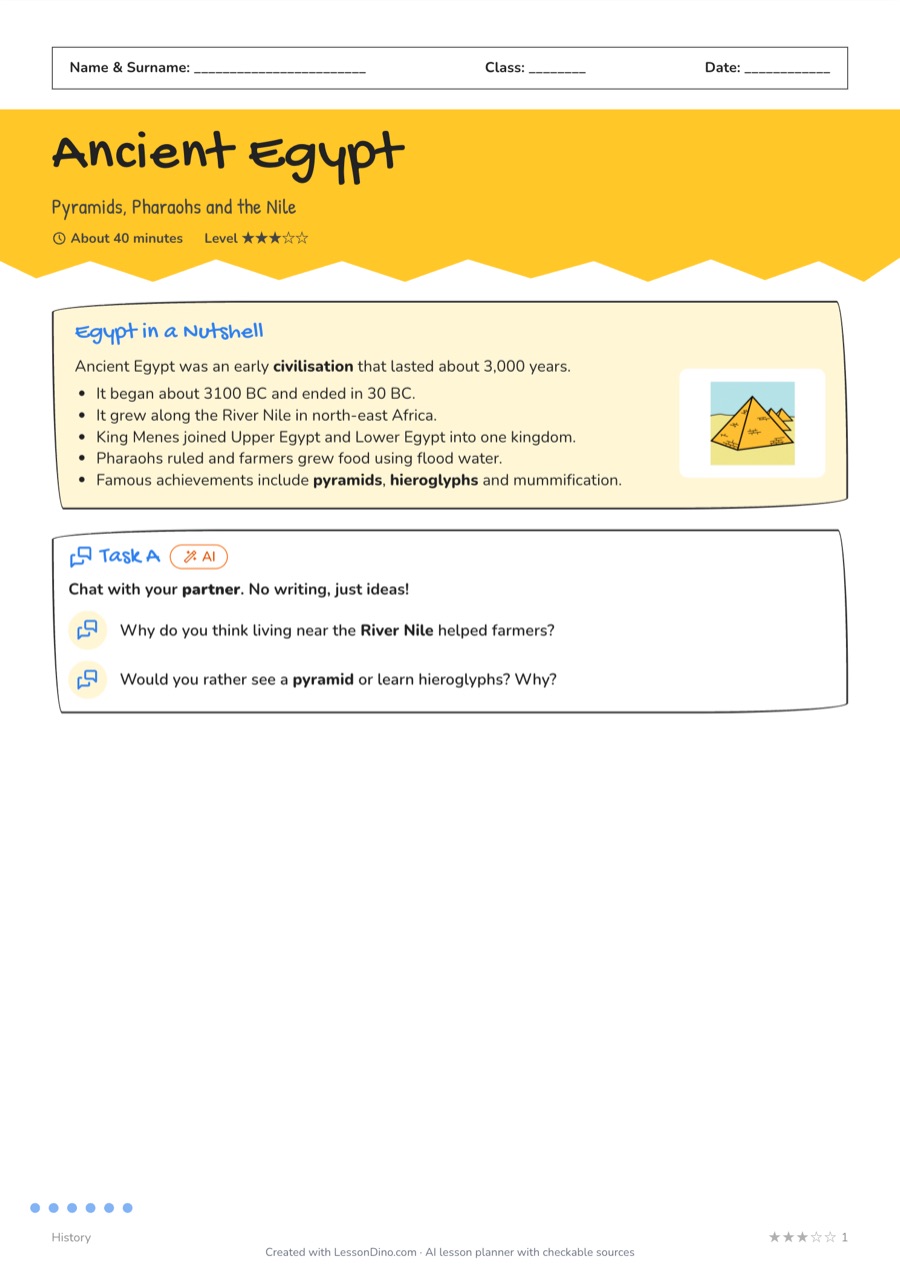
Pupils place Ancient Egypt in time and place and explain the Nile flood. They test farming and make a mini Nile poster about achievements.
Objectives
- Students will place Ancient Egypt in time and place along the Nile.
- Students will explain how the yearly Nile flood helped farmers grow food.
- Students will describe Egyptian achievements in building, writing and belief.
Success criteria
- I can show where and when Ancient Egypt was on maps.
- I can explain why the Nile flood helped farming happen.
- I can name three Egyptian achievements and what they were for.
Key words
| Word | Meaning |
|---|---|
| civilisation | a large group of people living in towns with rules, jobs and writing |
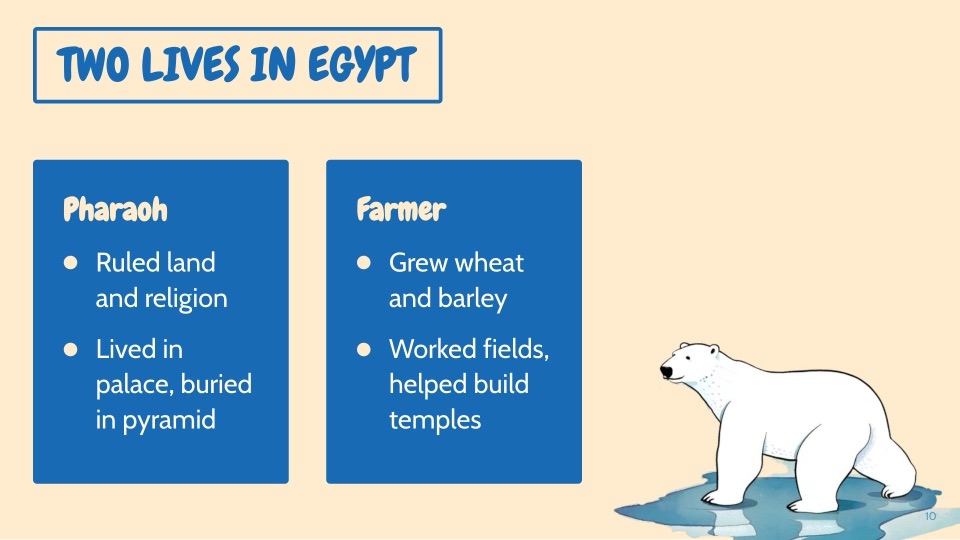
| pharaoh | a king of Ancient Egypt who ruled the land and religion |
| flood | when river water rises over the banks and covers the fields |
| hieroglyphs | picture writing used in Ancient Egypt with more than 700 signs |
| pyramid | a huge stone tomb built for a pharaoh |
Timed plan (60 minutes)
| Time | Stage | What happens |
|---|---|---|
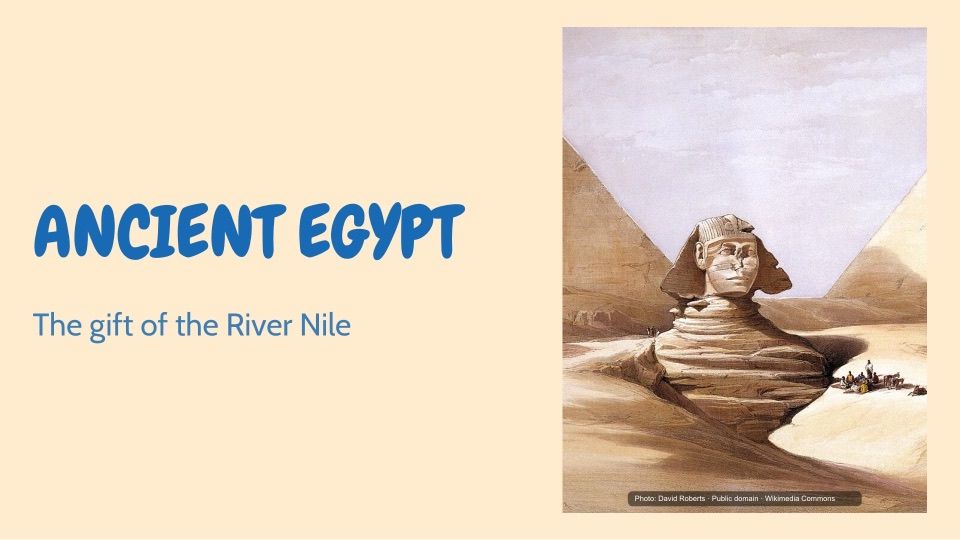
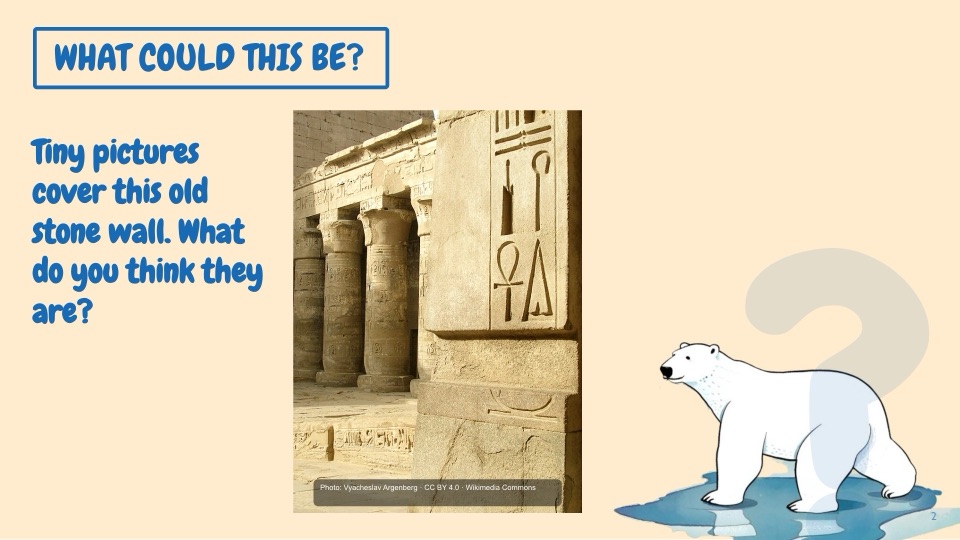
| 5 min | Starter | To hook pupils with the farming problem and recall what a civilisation needs. Show Slide 1 Ancient Egypt [title]: The gift of the River Nile and read the title together. Say the hook and ask pupils to turn and whisper an idea to a partner. Show Slide 2 mystery wall of tiny pictures and ask what they could be. Give out Worksheet Task B and ask pupils to fill columns 1 and 2 only. |
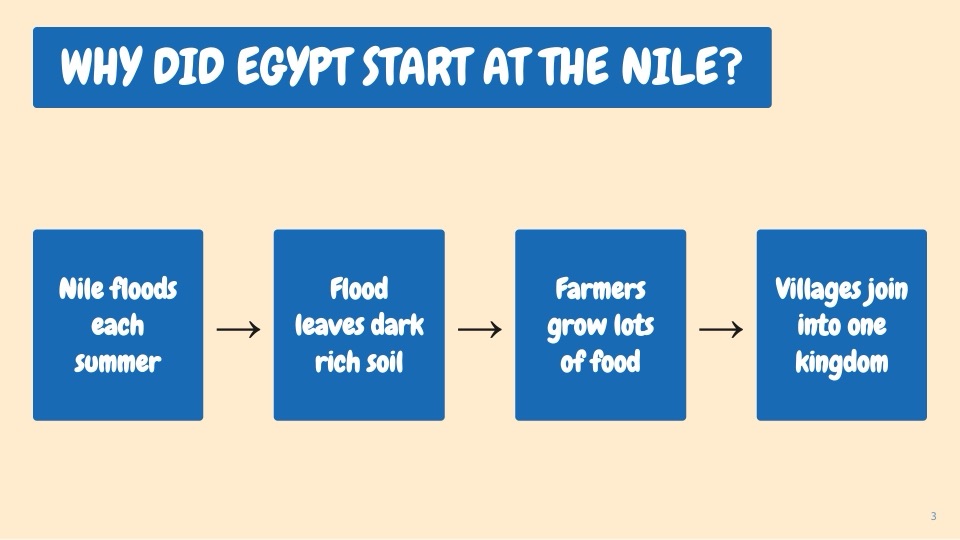
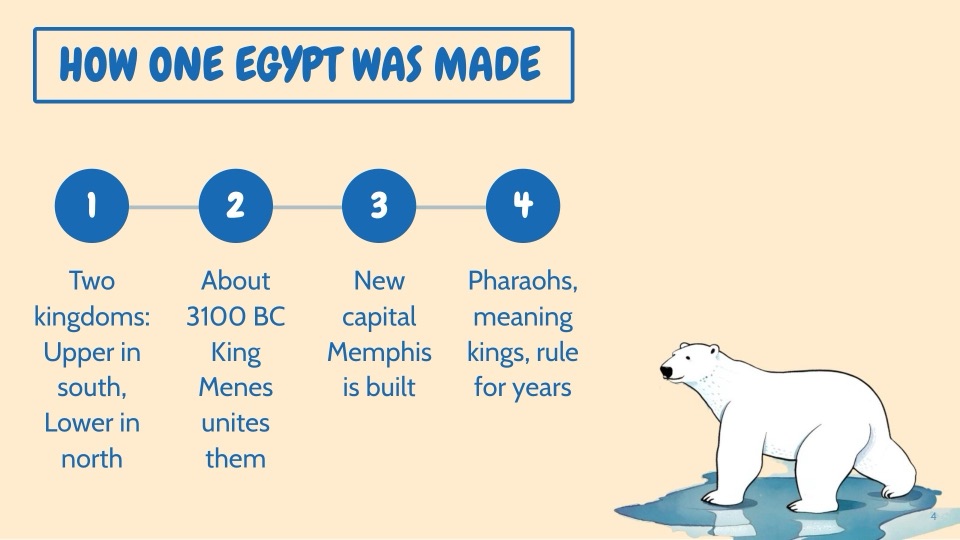
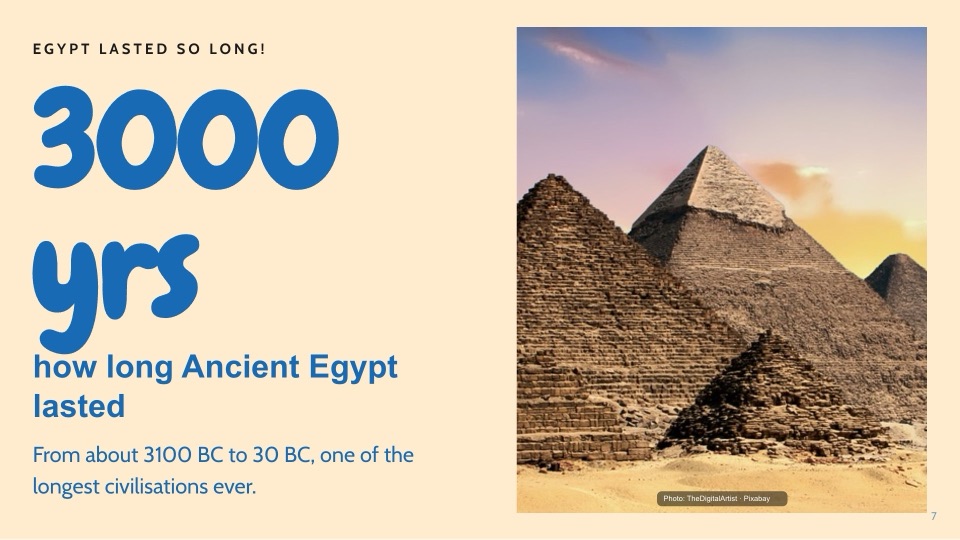
| 10 min | Teaching | To place Ancient Egypt in time and place on a map and timeline. Show Slide 3 chain and talk through flood, soil, food and one kingdom. Show a large world map, point to the Nile Valley in north-east Africa and trace flow from south to north. Show Slide 4 steps and Slide 7 bignumber to place about 3100 BC to 30 BC. Model Worksheet Task D by ordering two cards first, then let pupils number the rest. |
| 20 min | Main activity | To explain why the Nile flood made farming possible. Demonstrate with one tray: pour a small cup, let water soak, point to dark damp soil left behind. Explain Egyptians called the land Kemet meaning the Black Land because of dark rich soil. Show paper canals and a shaduf, a tool used to lift water from the river onto the land. Ask groups to test, observe and draw before and after the flood. |
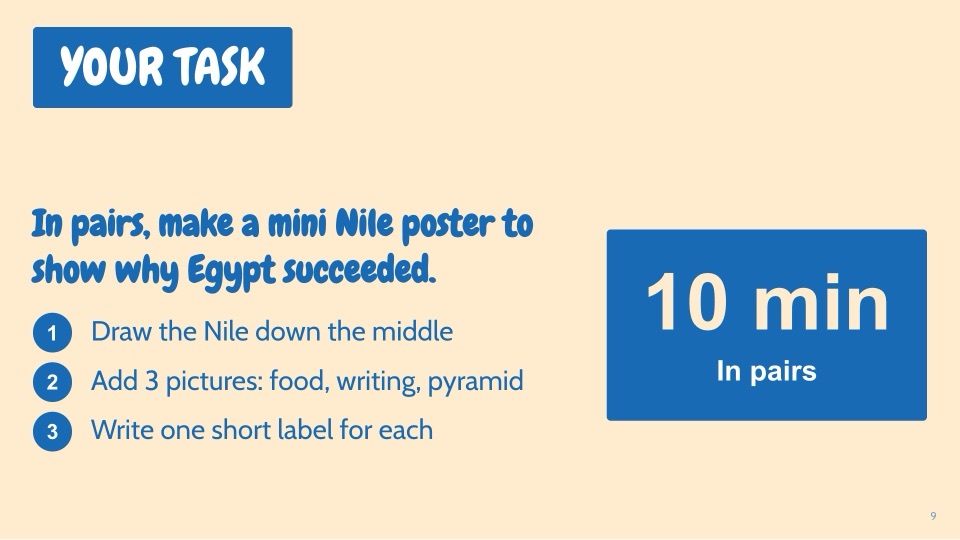
| 15 min | Teaching | To describe three achievements: pyramids, writing and organised farming and belief. Show Slide 5 vote and take a quick class vote on most amazing achievement. Show Slide 10 Two lives and compare pharaoh and farmer jobs. Model a mini Nile poster with river down the middle and three quick sketches. Give out Worksheet Task E bar chart about class votes to complete in pairs. |
| 10 min | Plenary | To check what pupils learnt and answer why Egypt is called the gift of the Nile. Show Slide 11 question and let pairs share one reason using their poster. Show Slide 12 exit lines and ask pupils to finish column 3 of Task B. Give Worksheet Task G to circle the correct word in each sentence. Collect posters and praise clear links between Nile, food and achievements. |
Common mistakes
- Thinking Upper Egypt is in the north because up on a map is north.
How to spot it: Pupil points north when asked to show Upper Egypt.
Re-trace the Nile flowing from south to north and repeat: Upper is southern valley, Lower is northern delta. - Thinking the flood ruined farming instead of helping it.
How to spot it: Drawing shows crops washed away with no good result.
Point to dark soil in tray and recall it left thick, dark soil full of nutrients. - Thinking hieroglyphs are just decoration, not writing with meaning.
How to spot it: Pupil says the pictures do not say anything.
Recall rulers used hieroglyphic writing to record decrees and grain taxes and the Rosetta Stone holds the same text in three scripts.
Support
- Use word banks, picture guides and pre-drawn Nile outlines for posters.
- Pair less confident pupils with a buddy and give role cards with one sentence to read.
- Check trays and worksheets often and model each step before pupils start.
Stretch
- Predict crop results in low-flood years and explain choices for burial goods.
- Compare pharaoh and farmer lives and decide which artefact tells more about farmers.
- Write a two-word hieroglyph message for another pair to decode.
Check questions
- Where was Ancient Egypt and how long did it last?
Answer: Along the River Nile in north-east Africa for about 3,000 years, about 3100 BC to 30 BC. - Why did the yearly Nile flood help farmers?
Answer: It left dark rich soil and water for irrigation so crops like wheat and barley grew. - Name one Egyptian achievement and what it was used for.
Answer: Pyramids as pharaoh tombs, hieroglyphs for recording, or irrigation for farming.
Curriculum
the achievements of the earliest civilizations – an overview of where and when the first civilizations appeared and a depth study of one of the following: Ancient Sumer, The Indus Valley, Ancient Egypt, The Shang Dynasty of Ancient China
Video clips
Clips on YouTube, from the start and end times we chose. Check each one before you show it.
-
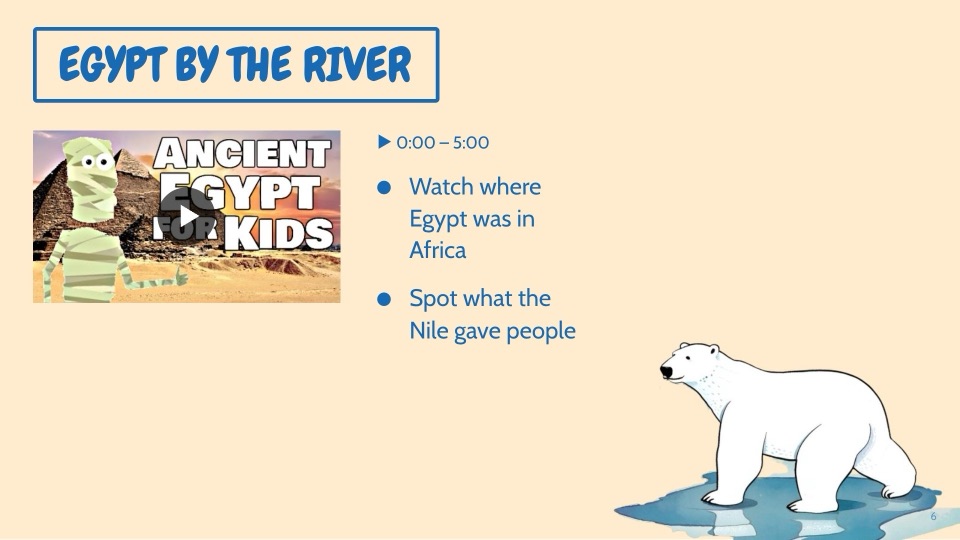
Ancient Egypt overview from 0:00 to 5:00
Homeschool Pop: Ancient Egypt for Kids
Clear, slow narration and cartoon visuals made for ages 8-9 give an ideal Year 4 overview of the Nile, pharaohs and pyramids.
-
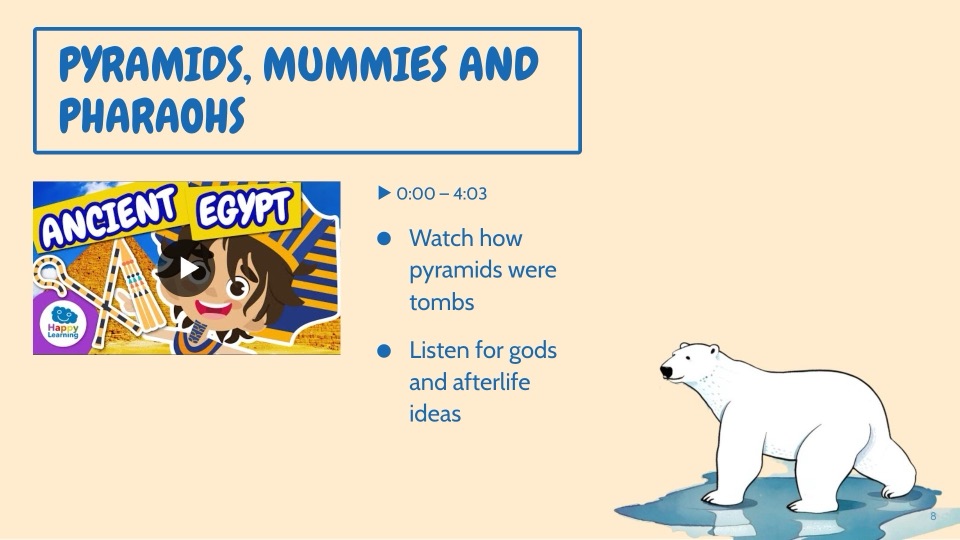
Pyramids, mummies and pharaohs from 0:00 to 4:03
Happy Learning English: ANCIENT EGYPT: Pyramids, Mummies and Pharaohs | Educational Videos for Children @HappyLearningENG
Child-friendly explanation made for ages 8-9 focuses on the most memorable achievements for Year 4.
Worksheet
Sources
- YEAR 4 HISTORY CURRICULUM Ancient Egypt Ancient Greece Roman Invasion st-marys-deane.bolton.sch.uk
- National curriculum in England: history programmes of study assets.publishing.service.gov.uk
- Ancient Egypt: An Introduction - Oxford Lifelong Learning lifelong-learning.ox.ac.uk
- Ancient Egypt | Department of Archaeology, Classics and Egyptology ... liverpool.ac.uk
- An introduction to Ancient Egypt - BBC Bitesize bbc.co.uk
- Ancient Egypt - KS2 History - BBC Bitesize bbc.co.uk
- A Bitesize History of Ancient Egypt | Sky HISTORY TV Channel history.co.uk
- Ancient Egypt / Historical Association history.org.uk
- Ancient Egypt - Wikipedia en.m.wikipedia.org
- Ancient history - Wikipedia en.m.wikipedia.org
- Incest in ancient Egypt en.wikipedia.org
- Ancient Egypt Facts for Kids kids.kiddle.co
- Ancient Egypt facts and history | National Geographic Kids kids.nationalgeographic.com
- World History: Ancient Egypt for Kids - Ducksters ducksters.com
- ancient Egypt - Kids | Britannica Kids | Homework Help kids.britannica.com
- Egyptian History Books for Children - Ancient Egypt britishmuseumshoponline.org
- Ancient Egypt | History, Government, Culture, Map, Gods, Religion, Rulers, Art, Writing, & Facts | Britannica britannica.com
- Ancient Egypt History for Kids - Children in Ancient Egypt - Ancient Egypt for Kids egypt.mrdonn.org
- Daily Life in Ancient Egypt for Kids - Homes, Food, Clothing, and ... academickids.com
- Ancient Egypt for kids - History Primary Homework Help superbrainybeans.com
- Ancient Egypt - History for kids historyforkids.net
- Ancient Egypt for Kids ancient-egypt-online.com
- 10 Facts About Ancient Egypt | National Geographic Kids natgeokids.com
- Ancient Egypt Facts for Kids - coolaboo.com coolaboo.com
- Ancient Egypt | Ancient History For Kids - AncientCivilizations ancienthistoryforkids.com
Picture credits
- Photo: David Roberts · Public domain · Wikimedia Commons
- Photo: Vyacheslav Argenberg · CC BY 4.0 · Wikimedia Commons
- Photo: TheDigitalArtist · Pixabay
- Pictograms: Sergio Palao, ARASAAC (arasaac.org) · CC BY-NC-SA
Made with Lesson Dino's AI on 17 October 2026. AI can make mistakes, so check facts against the sources before you teach.
_by_David_Roberts,_RA.jpg)
