The worksheet
About this worksheet
Pupils learn what square numbers and cube numbers mean and how ² and ³ work. They match notation to multiplications in a paper domino chain. This Year 5 Maths worksheet gives students (ages 9–10) five pages of practice on square and cube numbers, part of the multiplication and division unit. It goes with our free Square and cube numbers lesson, which has the slides and a timed lesson plan.
What it covers
By the end, students should be able to:
- Students will recognise square numbers to 10² and write them using ².
- Students will recognise cube numbers to 5³ and write them using ³.
- Students will match ² and ³ notation to multiplications and explain answers.
How to use it
- Consolidation (7 minutes): Hand out Worksheet Task B and read the instruction together.
- Support: Give a starter domino chain already joined, including 5 x 5 (or 5²) = 25, then ask pupils to continue it.
- Stretch: Pupils make three extra dominoes of their own for another pair to solve.
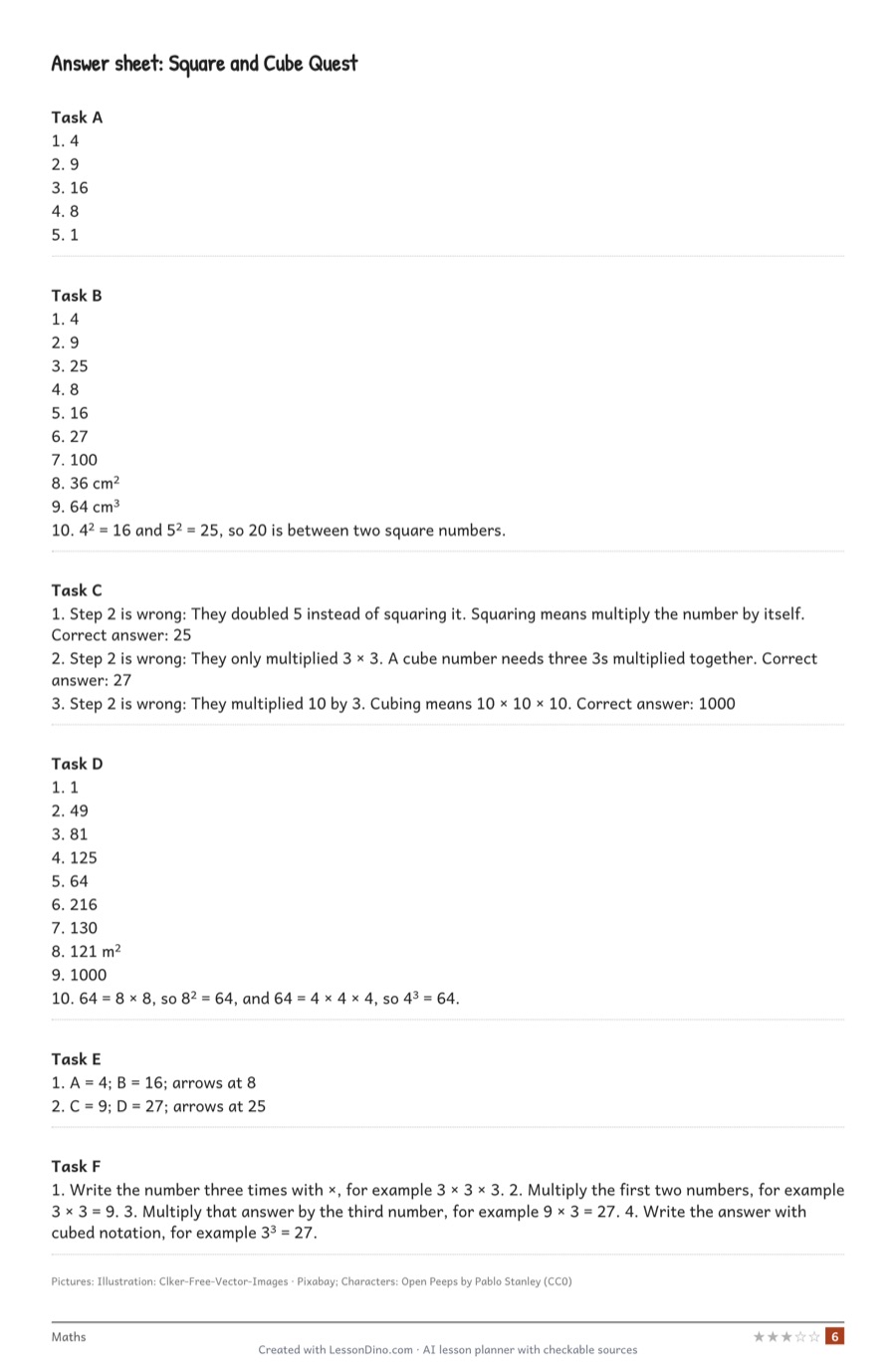
- The answer sheet is the last page, so you can print it on its own or let students check their own work.
Key vocabulary
- squared: little 2 that tells you to multiply a value by itself
- cubed: little 3 that tells you to multiply a value by itself and then again
- square number: result when a whole value is multiplied by itself
- cube number: result when a whole value is multiplied by itself twice
- product: answer you get when you multiply two or more values together
Mistakes to watch for
- Thinking squaring means doubling, e.g. 5² = 10. Rebuild with dots: 5 rows of 5 is 25, not 10. Stress that 5² = 25, not 10 and to calculate a square number, you times a number by itself.
- Thinking cubing means adding or multiplying by 3, e.g. 2³ = 6. Build with blocks and do steps: 2 multiplied by 2 is 4 and this multiplied by 2 is 8. Emphasise to calculate a cube number, you multiply a number by itself and then by itself again.
- Mixing up ² and ³, e.g. 3³ = 9. Count the factors: square is the product of two repeated integers and cube is the product of three repeated integers. Check 3 x 3 = 9 but 3 x 3 x 3 = 27.
What's on the worksheet
Squares and Cubes
See how square and cube numbers are made.
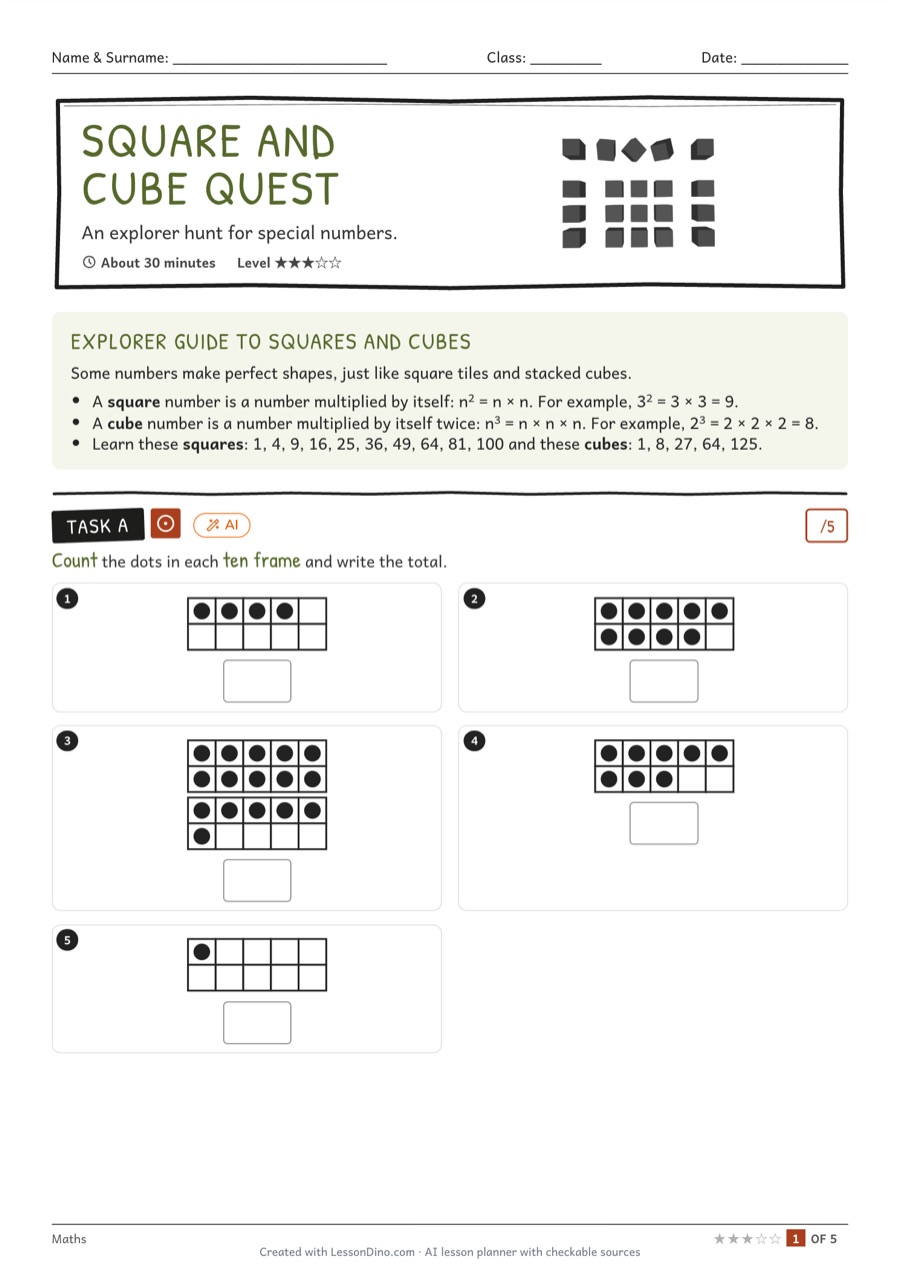
Explorer guide to squares and cubes
- Some numbers make perfect shapes, just like square tiles and stacked cubes.
- A square number is a number multiplied by itself: n² = n × n. For example, 3² = 3 × 3 = 9.
- A cube number is a number multiplied by itself twice: n³ = n × n × n. For example, 2³ = 2 × 2 × 2 = 8.
- Learn these squares: 1, 4, 9, 16, 25, 36, 49, 64, 81, 100 and these cubes: 1, 8, 27, 64, 125.
Count the dots in each ten frame and write the total.
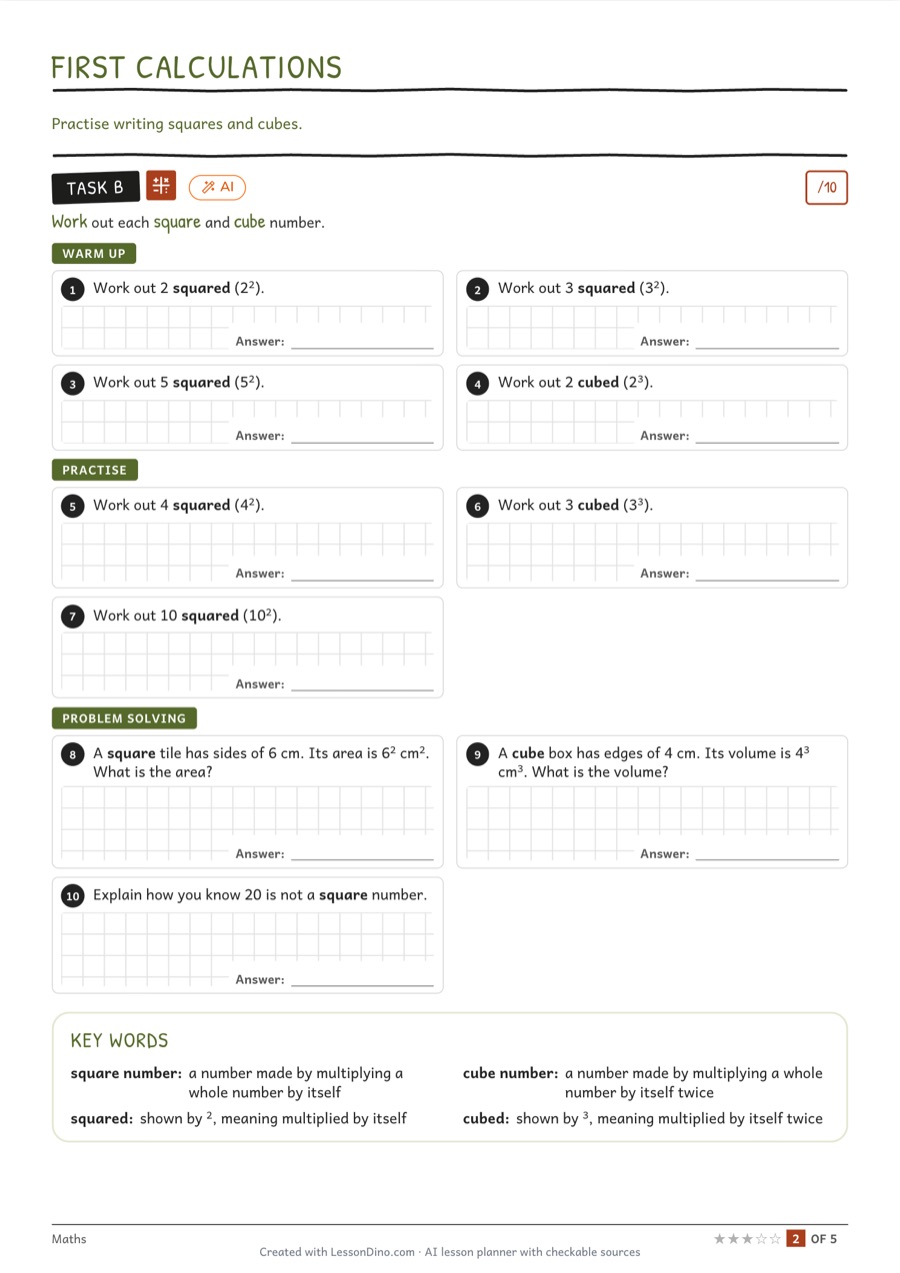
First Calculations
Practise writing squares and cubes.
Work out each square and cube number.
Warm up
- Work out 2 squared (2²).
- Work out 3 squared (3²).
- Work out 5 squared (5²).
- Work out 2 cubed (2³).
Practise
- Work out 4 squared (4²).
- Work out 3 cubed (3³).
- Work out 10 squared (10²).
Problem solving
- A square tile has sides of 6 cm. Its area is 6² cm². What is the area?
- A cube box has edges of 4 cm. Its volume is 4³ cm³. What is the volume?
- Explain how you know 20 is not a square number.
| Word | Meaning |
|---|---|
| square number | a number made by multiplying a whole number by itself |
| cube number | a number made by multiplying a whole number by itself twice |
| squared | shown by ², meaning multiplied by itself |
| cubed | shown by ³, meaning multiplied by itself twice |
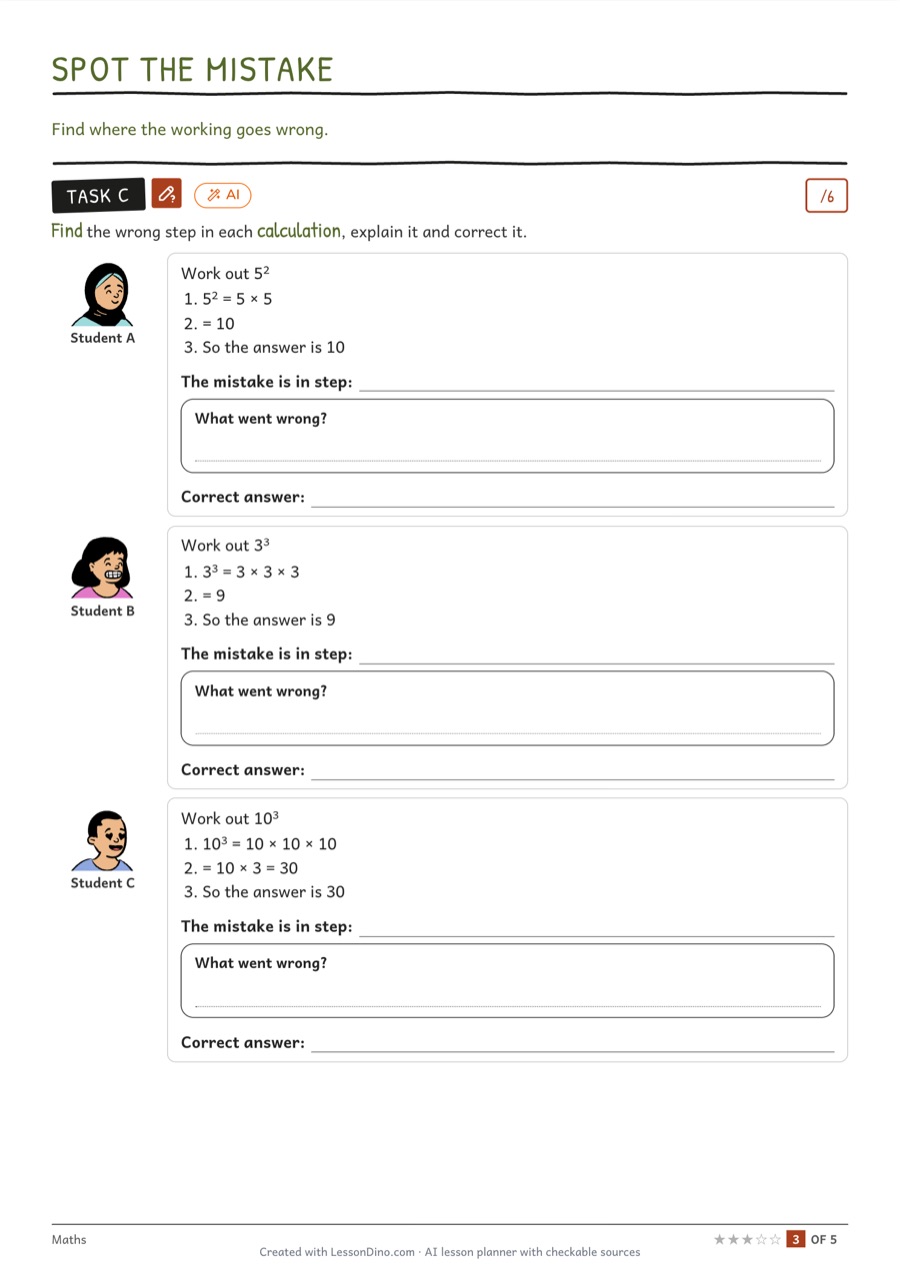
Spot the Mistake
Find where the working goes wrong.
Find the wrong step in each calculation, explain it and correct it.
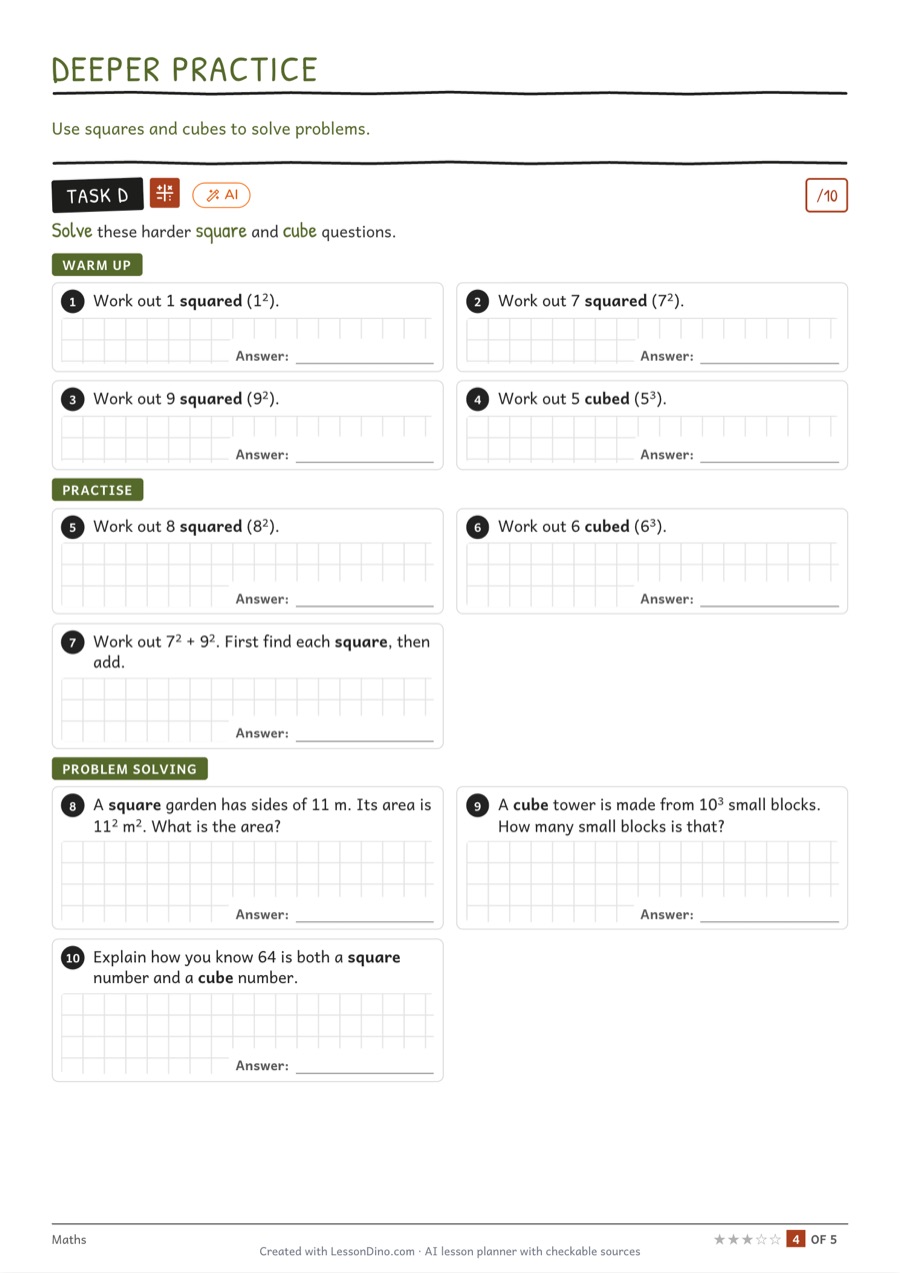
Deeper Practice
Use squares and cubes to solve problems.
Solve these harder square and cube questions.
Warm up
- Work out 1 squared (1²).
- Work out 7 squared (7²).
- Work out 9 squared (9²).
- Work out 5 cubed (5³).
Practise
- Work out 8 squared (8²).
- Work out 6 cubed (6³).
- Work out 7² + 9². First find each square, then add.
Problem solving
- A square garden has sides of 11 m. Its area is 11² m². What is the area?
- A cube tower is made from 10³ small blocks. How many small blocks is that?
- Explain how you know 64 is both a square number and a cube number.
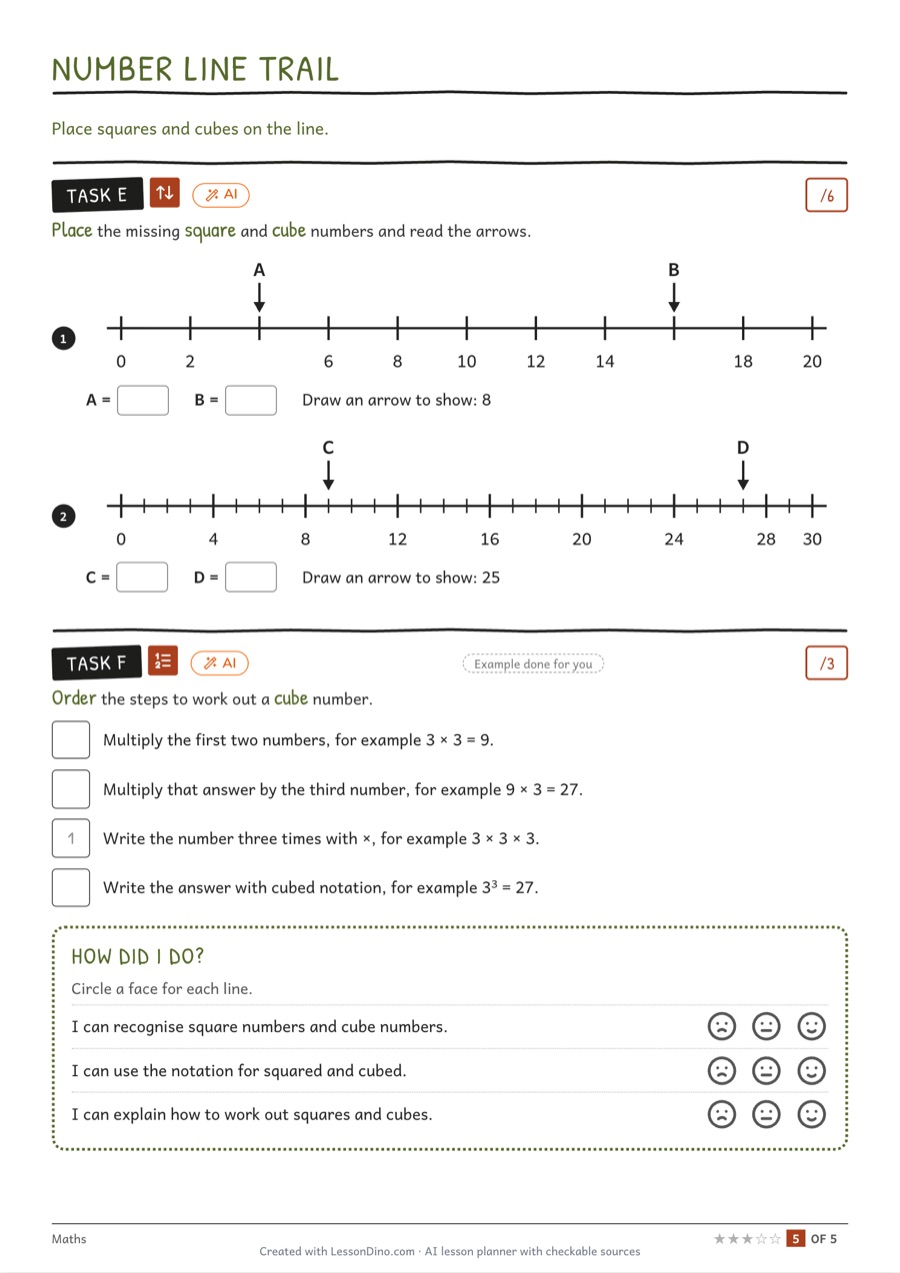
Number Line Trail
Place squares and cubes on the line.
Place the missing square and cube numbers and read the arrows.
Order the steps to work out a cube number.
Answers
Show the answers
- Work out 2 squared (2²). 4
- Work out 3 squared (3²). 9
- Work out 5 squared (5²). 25
- Work out 2 cubed (2³). 8
- Work out 4 squared (4²). 16
- Work out 3 cubed (3³). 27
- Work out 10 squared (10²). 100
- A square tile has sides of 6 cm. Its area is 6² cm². What is the area? 36 cm²
- A cube box has edges of 4 cm. Its volume is 4³ cm³. What is the volume? 64 cm³
- Explain how you know 20 is not a square number. 4² = 16 and 5² = 25, so 20 is between two square numbers.
- Work out 1 squared (1²). 1
- Work out 7 squared (7²). 49
- Work out 9 squared (9²). 81
- Work out 5 cubed (5³). 125
- Work out 8 squared (8²). 64
- Work out 6 cubed (6³). 216
- Work out 7² + 9². First find each square, then add. 130
- A square garden has sides of 11 m. Its area is 11² m². What is the area? 121 m²
- A cube tower is made from 10³ small blocks. How many small blocks is that? 1000
- Explain how you know 64 is both a square number and a cube number. 64 = 8 × 8, so 8² = 64, and 64 = 4 × 4 × 4, so 4³ = 64.
The answer sheet is the last picture above.
Curriculum
recognise and use square numbers and cube numbers, and the notation for squared (²) and cubed (³)
Made with Lesson Dino's AI on 19 October 2026. AI can make mistakes, so check the answers and facts against the sources before you teach.