The worksheet
About this worksheet
Pupils learn to read, write, order and compare decimals to thousandths. They sort race-time cards and explain the order using place value. This Year 5 Maths worksheet gives students (ages 9–10) five pages of practice on decimals up to three places, part of the number - fractions (including decimals and percentages) unit. It goes with our free Decimals up to three places lesson, which has the slides and a timed lesson plan.
What it covers
By the end, students should be able to:
- Students will read and write numbers with up to three decimal places accurately.
- Students will order decimals to three places from smallest to largest correctly.
- Students will compare decimals to three places using < and > signs.
How to use it
- Guided practice (15 minutes): Hand out Worksheet Task B: Practice questions to practise reading, writing and comparing thousandths.
- Support: Add a zero in any gaps so 7.01 becomes 7.010 for direct column comparison.
- Stretch: Put < or > signs between each neighbouring pair and add one more number that keeps the order correct.
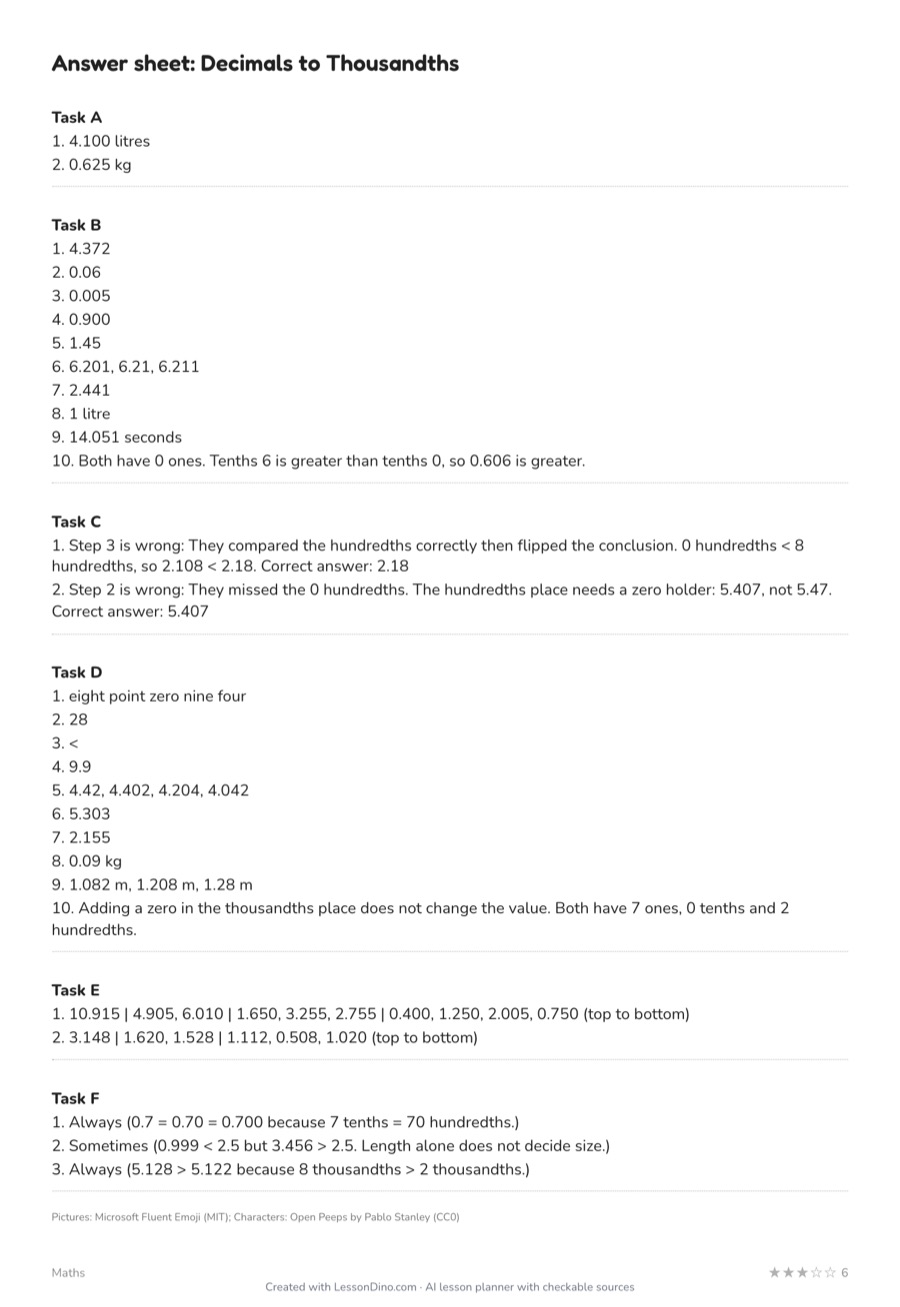
- The answer sheet is the last page, so you can print it on its own or let students check their own work.
Key vocabulary
- tenths: the first spot after the point, worth one share when a whole is split in ten
- hundredths: the second spot after the point, worth one share when a whole is split in a hundred
- thousandths: the third spot after the point, very tiny shares of a whole split in a thousand
- decimal point: the dot that splits whole amounts from small pieces of a whole
- ascending order: putting amounts in a line from least value to greatest value
- compare: saying which amount is larger, smaller, or if both are equal
Mistakes to watch for
- Thinking a longer decimal is always larger, so 7.808 > 7.81. Write both in a place-value table, fill gaps with zero to make 7.810 and 7.808, then compare digits from the left.
- Missing zeros when reading, for example reading 7.008 as seven point eight. Practise saying each digit after the point and relating thousandths to tenths and hundredths.
- Comparing from the right instead of the left, starting with thousandths. Insist on lining up decimal points and comparing starting at the left with the greatest place value.
What's on the worksheet
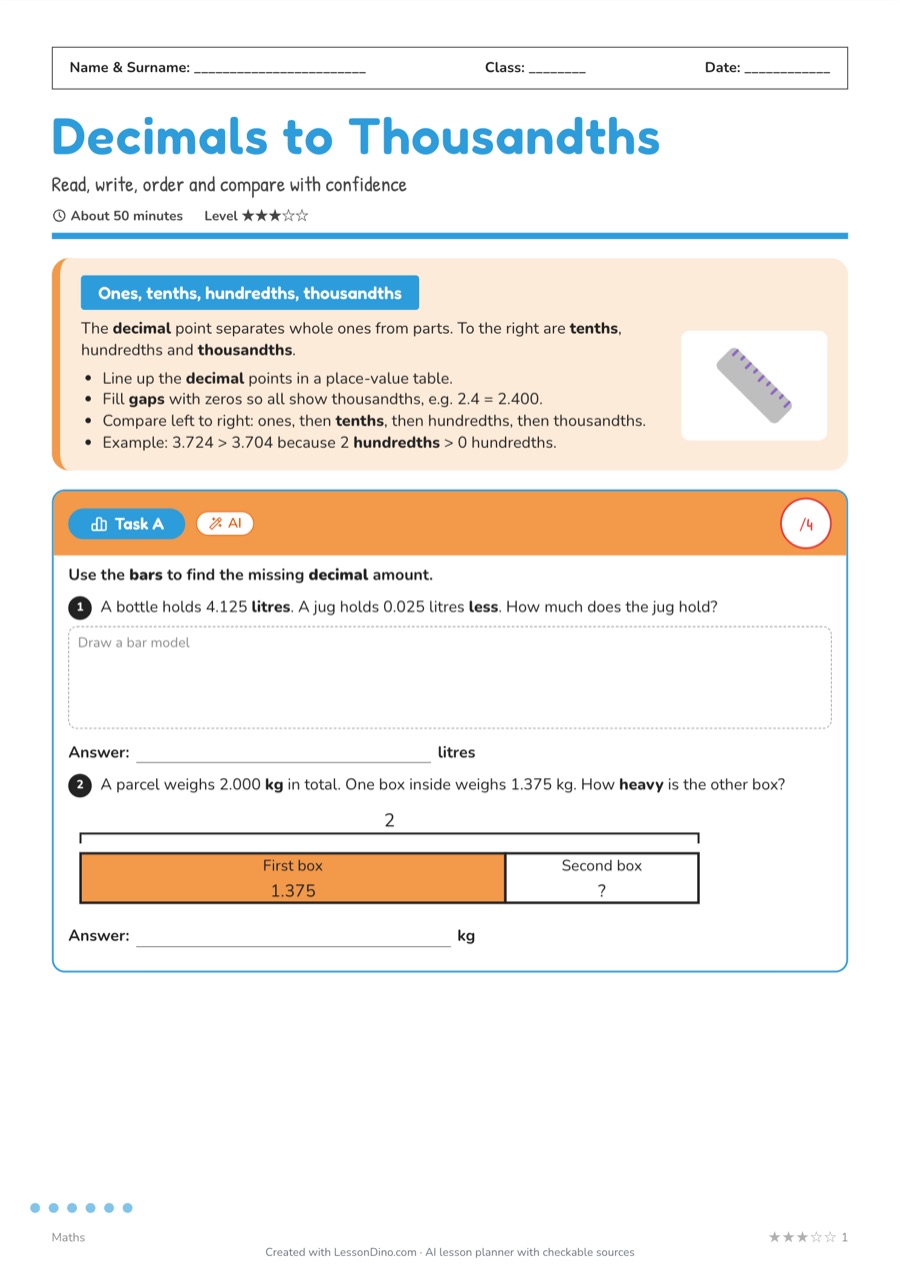
Thousandths Place Value
Read thousandths and use bar models to compare decimals.
Ones, tenths, hundredths, thousandths
- The decimal point separates whole ones from parts. To the right are tenths, hundredths and thousandths.
- Line up the decimal points in a place-value table.
- Fill gaps with zeros so all show thousandths, e.g. 2.4 = 2.400.
- Compare left to right: ones, then tenths, then hundredths, then thousandths.
- Example: 3.724 > 3.704 because 2 hundredths > 0 hundredths.
Use the bars to find the missing decimal amount.
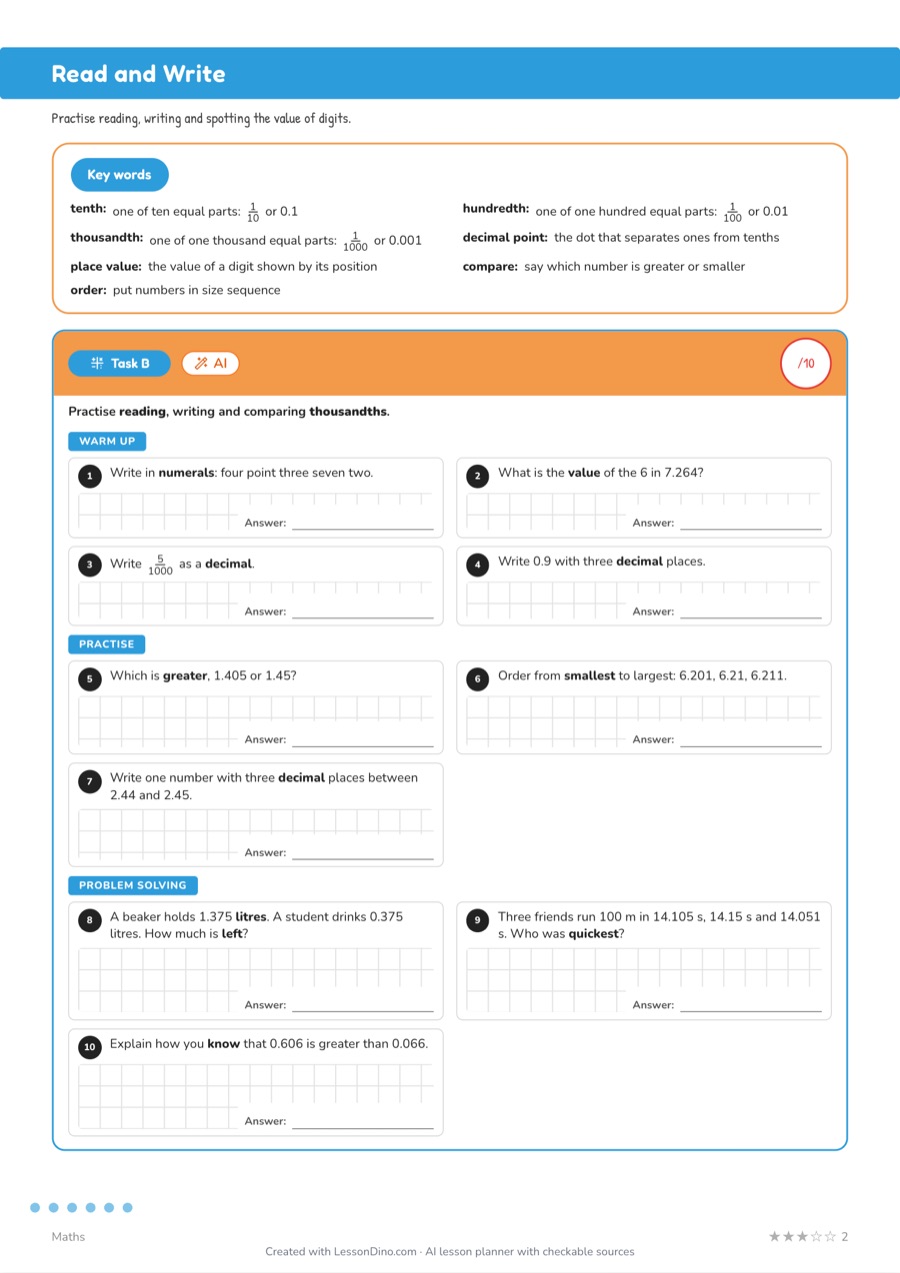
Read and Write
Practise reading, writing and spotting the value of digits.
| Word | Meaning |
|---|---|
| tenth | one of ten equal parts: 1/10 or 0.1 |
| hundredth | one of one hundred equal parts: 1/100 or 0.01 |
| thousandth | one of one thousand equal parts: 1/1000 or 0.001 |
| decimal point | the dot that separates ones from tenths |
| place value | the value of a digit shown by its position |
| compare | say which number is greater or smaller |
| order | put numbers in size sequence |
Practise reading, writing and comparing thousandths.
Warm up
- Write in numerals: four point three seven two.
- What is the value of the 6 in 7.264?
- Write 5/1000 as a decimal.
- Write 0.9 with three decimal places.
Practise
- Which is greater, 1.405 or 1.45?
- Order from smallest to largest: 6.201, 6.21, 6.211.
- Write one number with three decimal places between 2.44 and 2.45.
Problem solving
- A beaker holds 1.375 litres. A student drinks 0.375 litres. How much is left?
- Three friends run 100 m in 14.105 s, 14.15 s and 14.051 s. Who was quickest?
- Explain how you know that 0.606 is greater than 0.066.
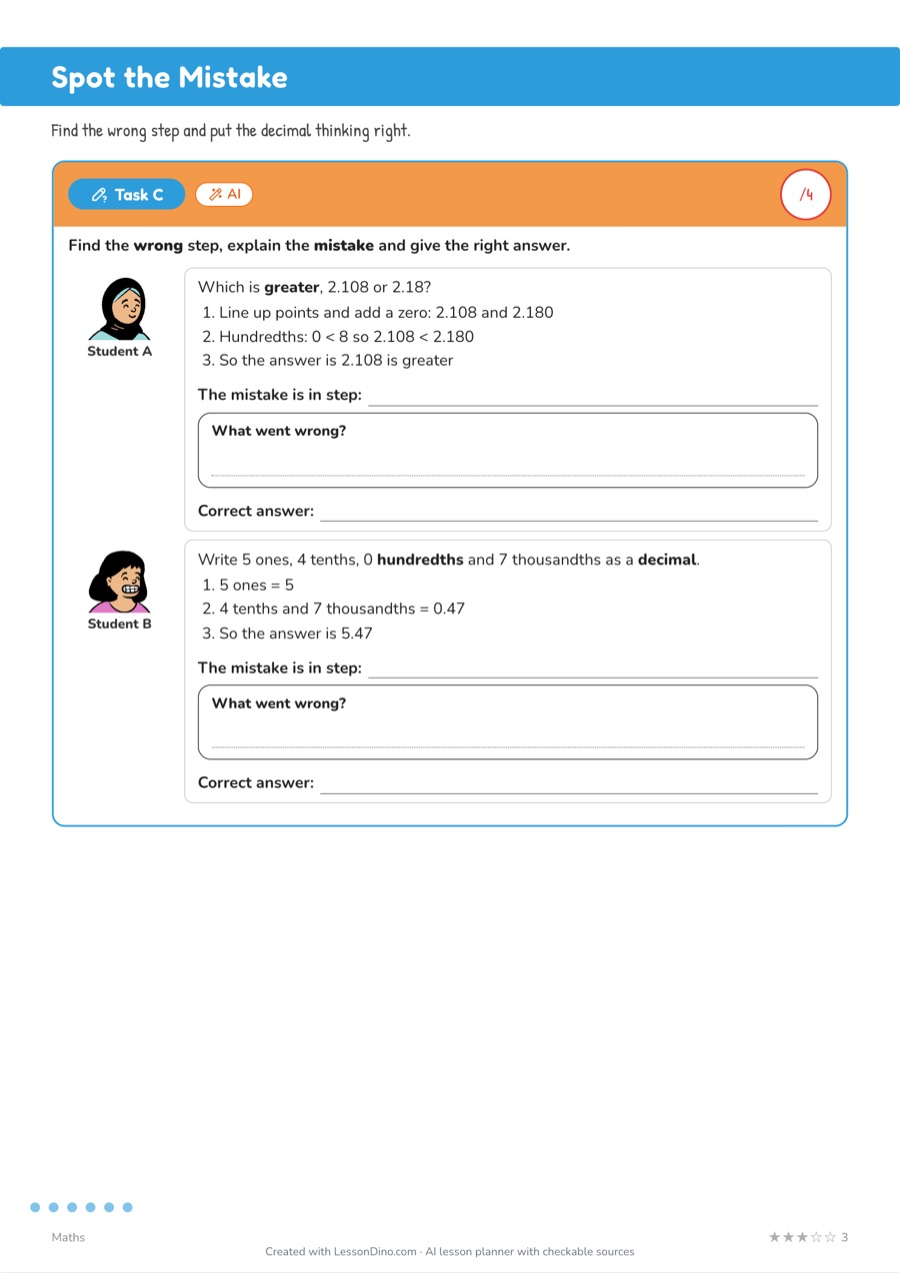
Spot the Mistake
Find the wrong step and put the decimal thinking right.
Find the wrong step, explain the mistake and give the right answer.
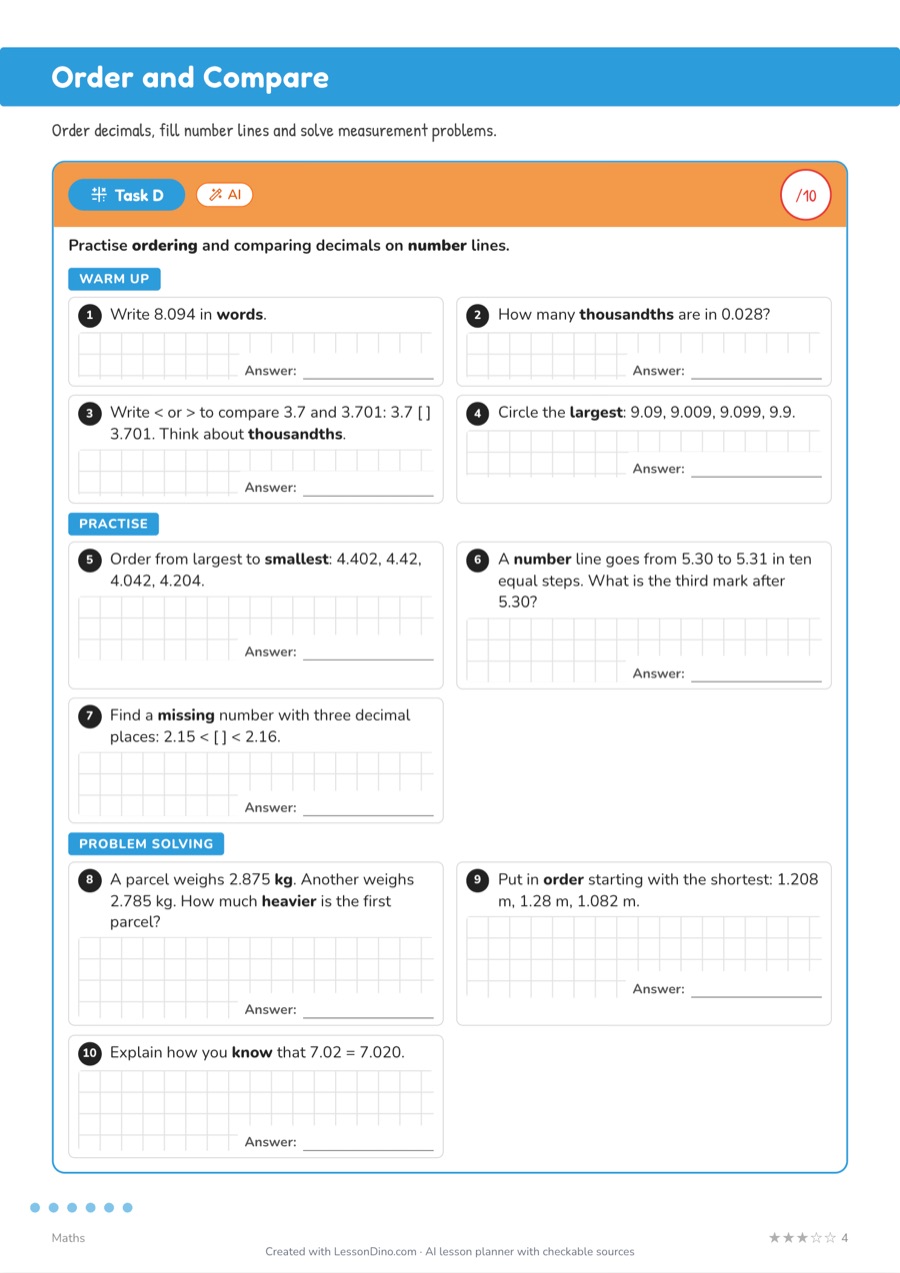
Order and Compare
Order decimals, fill number lines and solve measurement problems.
Practise ordering and comparing decimals on number lines.
Warm up
- Write 8.094 in words.
- How many thousandths are in 0.028?
- Write < or > to compare 3.7 and 3.701: 3.7 [ ] 3.701. Think about thousandths.
- Circle the largest: 9.09, 9.009, 9.099, 9.9.
Practise
- Order from largest to smallest: 4.402, 4.42, 4.042, 4.204.
- A number line goes from 5.30 to 5.31 in ten equal steps. What is the third mark after 5.30?
- Find a missing number with three decimal places: 2.15 < [ ] < 2.16.
Problem solving
- A parcel weighs 2.875 kg. Another weighs 2.785 kg. How much heavier is the first parcel?
- Put in order starting with the shortest: 1.208 m, 1.28 m, 1.082 m.
- Explain how you know that 7.02 = 7.020.
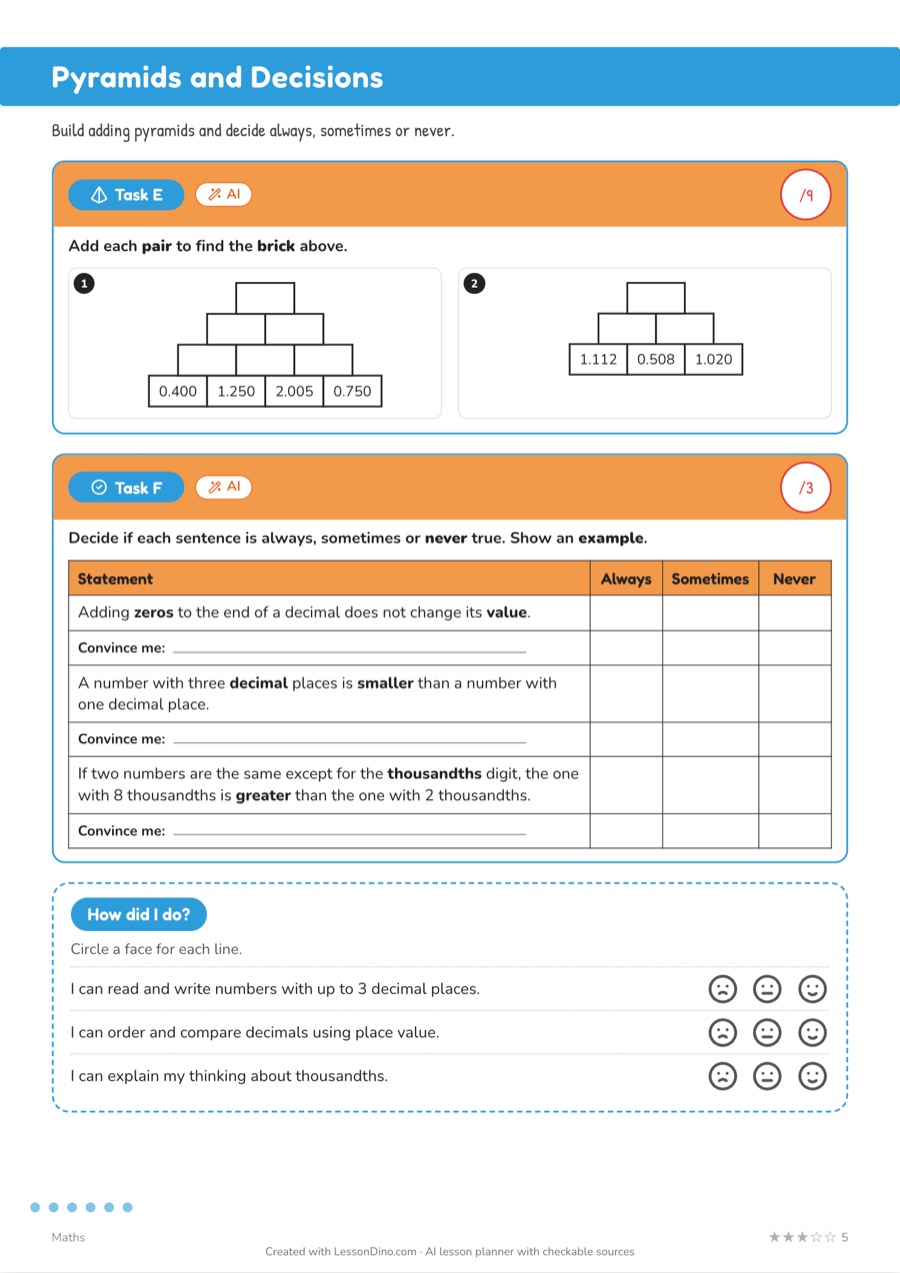
Pyramids and Decisions
Build adding pyramids and decide always, sometimes or never.
Add each pair to find the brick above.
Decide if each sentence is always, sometimes or never true. Show an example.
Answers
Show the answers
- Write in numerals: four point three seven two. 4.372
- What is the value of the 6 in 7.264? 0.06
- Write 5/1000 as a decimal. 0.005
- Write 0.9 with three decimal places. 0.900
- Which is greater, 1.405 or 1.45? 1.45
- Order from smallest to largest: 6.201, 6.21, 6.211. 6.201, 6.21, 6.211
- Write one number with three decimal places between 2.44 and 2.45. 2.441
- A beaker holds 1.375 litres. A student drinks 0.375 litres. How much is left? 1 litre
- Three friends run 100 m in 14.105 s, 14.15 s and 14.051 s. Who was quickest? 14.051 seconds
- Explain how you know that 0.606 is greater than 0.066. Both have 0 ones. Tenths 6 is greater than tenths 0, so 0.606 is greater.
- Write 8.094 in words. eight point zero nine four
- How many thousandths are in 0.028? 28
- Write < or > to compare 3.7 and 3.701: 3.7 [ ] 3.701. Think about thousandths. <
- Circle the largest: 9.09, 9.009, 9.099, 9.9. 9.9
- Order from largest to smallest: 4.402, 4.42, 4.042, 4.204. 4.42, 4.402, 4.204, 4.042
- A number line goes from 5.30 to 5.31 in ten equal steps. What is the third mark after 5.30? 5.303
- Find a missing number with three decimal places: 2.15 < [ ] < 2.16. 2.155
- A parcel weighs 2.875 kg. Another weighs 2.785 kg. How much heavier is the first parcel? 0.09 kg
- Put in order starting with the shortest: 1.208 m, 1.28 m, 1.082 m. 1.082 m, 1.208 m, 1.28 m
- Explain how you know that 7.02 = 7.020. Adding a zero in the thousandths place does not change the value. Both have 7 ones, 0 tenths and 2 hundredths.
The answer sheet is the last picture above.
Curriculum
read, write, order and compare numbers with up to 3 decimal places
Made with Lesson Dino's AI on 17 October 2026. AI can make mistakes, so check the answers and facts against the sources before you teach.