The worksheet
About this worksheet
Pupils learn short and long multiplication for large numbers. They solve a sticker order and write a shop receipt. This Year 5 Maths worksheet gives students (ages 9–10) six pages of practice on long multiplication, part of the multiplication and division unit. It goes with our free Long multiplication lesson, which has the slides and a timed lesson plan.
What it covers
By the end, students should be able to:
- Students will multiply 4-digit numbers by 1-digit numbers using short multiplication.
- Students will multiply up to 4-digit numbers by 2-digit numbers using long multiplication.
How to use it
- Main activity (20 minutes): Give out Worksheet Task B, receipt slips and squared paper; remind pairs to show both rows, zero holder and total.
- Support: Provide the first partial product (1,236 x 4 = 4,944) and let pupils complete the tens row and the addition.
- Stretch: Add a second order of 1,236 x 34 and ask which total is larger and by how much, without a calculator at first.
- The answer sheet is the last page, so you can print it on its own or let students check their own work.
Key vocabulary
- long multiplication: a written column method that finds the total for a two-digit number in two rows then adds them
- short multiplication: a written column method that finds the total for a one-digit number in one row
- partial product: a small answer made along the way that is added with others for the final total
- placeholder: a 0 put at the start of the second row to keep place value correct
Mistakes to watch for
- Leaving out the zero placeholder on the tens row. Write 0 first and say times 20 not times 2; the row is ten times too small without it.
- Not lining up columns by place value. Use squared paper and place-value grid, one digit per square, check ones under ones.
- Forgetting to add both partial products or losing exchanges. Circle each step used, write small carries above, then add 4,944 + 24,720.
What's on the worksheet
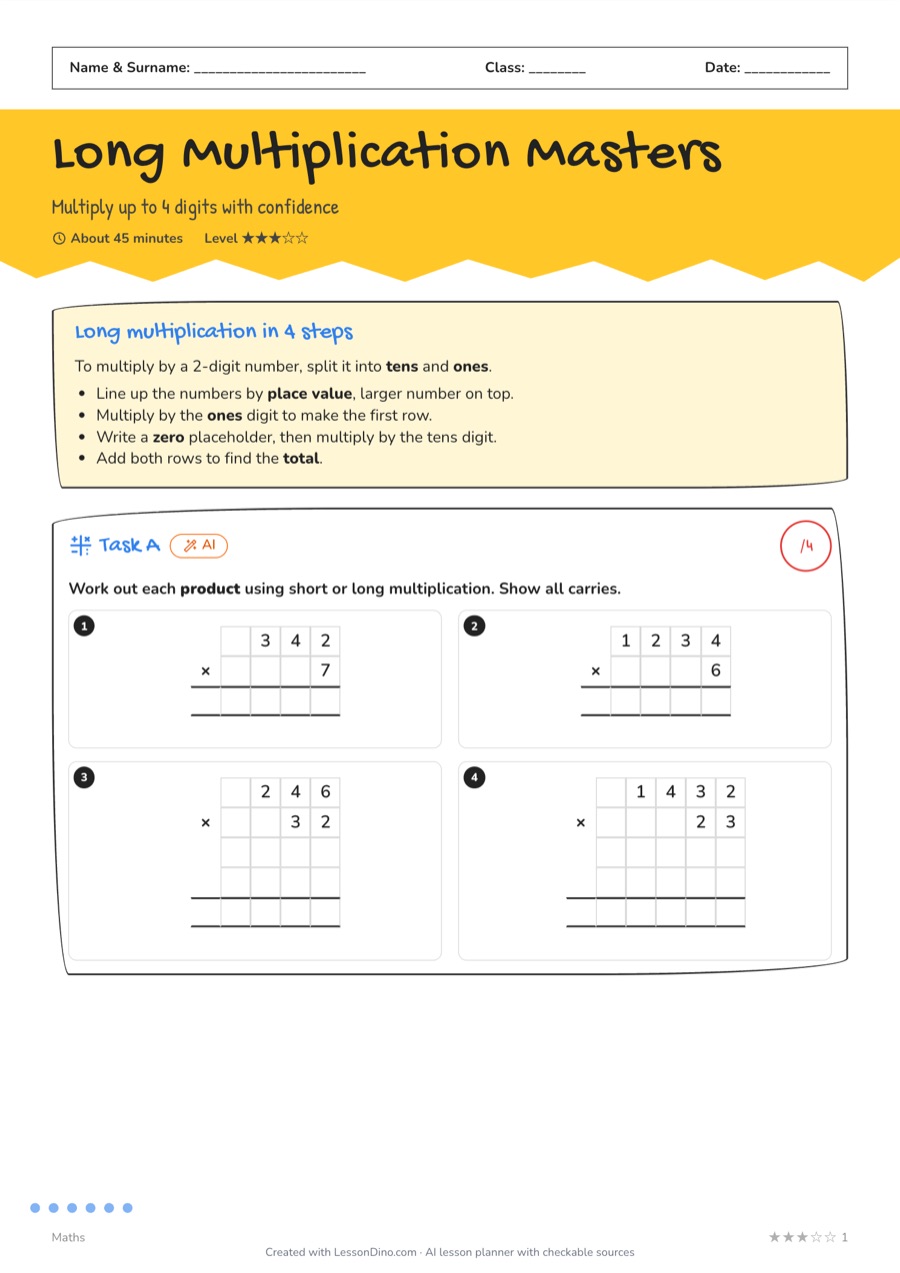
Multiply in Steps!
Learn the column method, then try it yourself.
Long multiplication in 4 steps
- To multiply by a 2-digit number, split it into tens and ones.
- Line up the numbers by place value, larger number on top.
- Multiply by the ones digit to make the first row.
- Write a zero placeholder, then multiply by the tens digit.
- Add both rows to find the total.
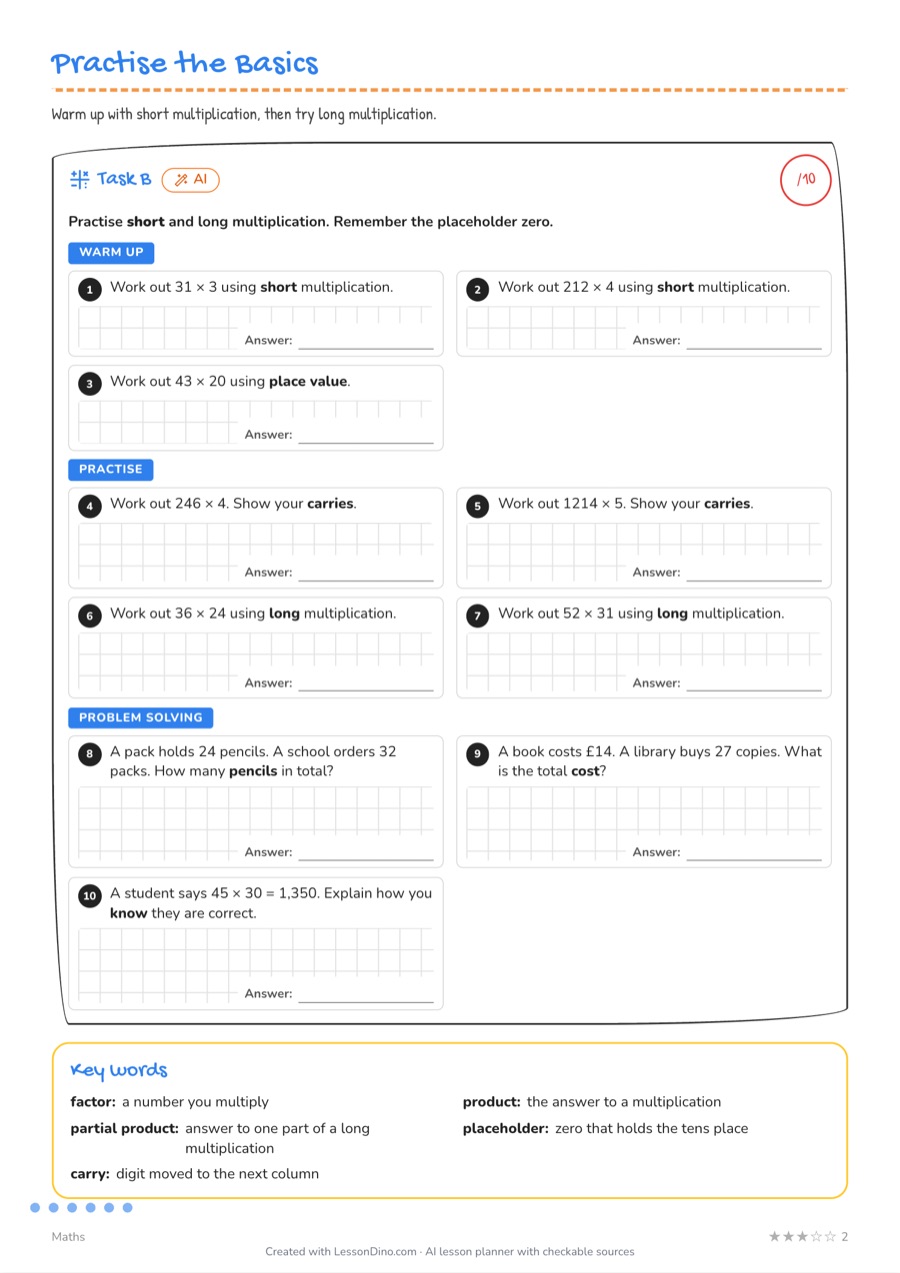
Work out each product using short or long multiplication. Show all carries.
Practise the Basics
Warm up with short multiplication, then try long multiplication.
Practise short and long multiplication. Remember the placeholder zero.
Warm up
- Work out 31 × 3 using short multiplication.
- Work out 212 × 4 using short multiplication.
- Work out 43 × 20 using place value.
Practise
- Work out 246 × 4. Show your carries.
- Work out 1214 × 5. Show your carries.
- Work out 36 × 24 using long multiplication.
- Work out 52 × 31 using long multiplication.
Problem solving
- A pack holds 24 pencils. A school orders 32 packs. How many pencils in total?
- A book costs £14. A library buys 27 copies. What is the total cost?
- A student says 45 × 30 = 1,350. Explain how you know they are correct.
| Word | Meaning |
|---|---|
| factor | a number you multiply |
| product | the answer to a multiplication |
| partial product | answer to one part of a long multiplication |
| placeholder | zero that holds the tens place |
| carry | digit moved to the next column |
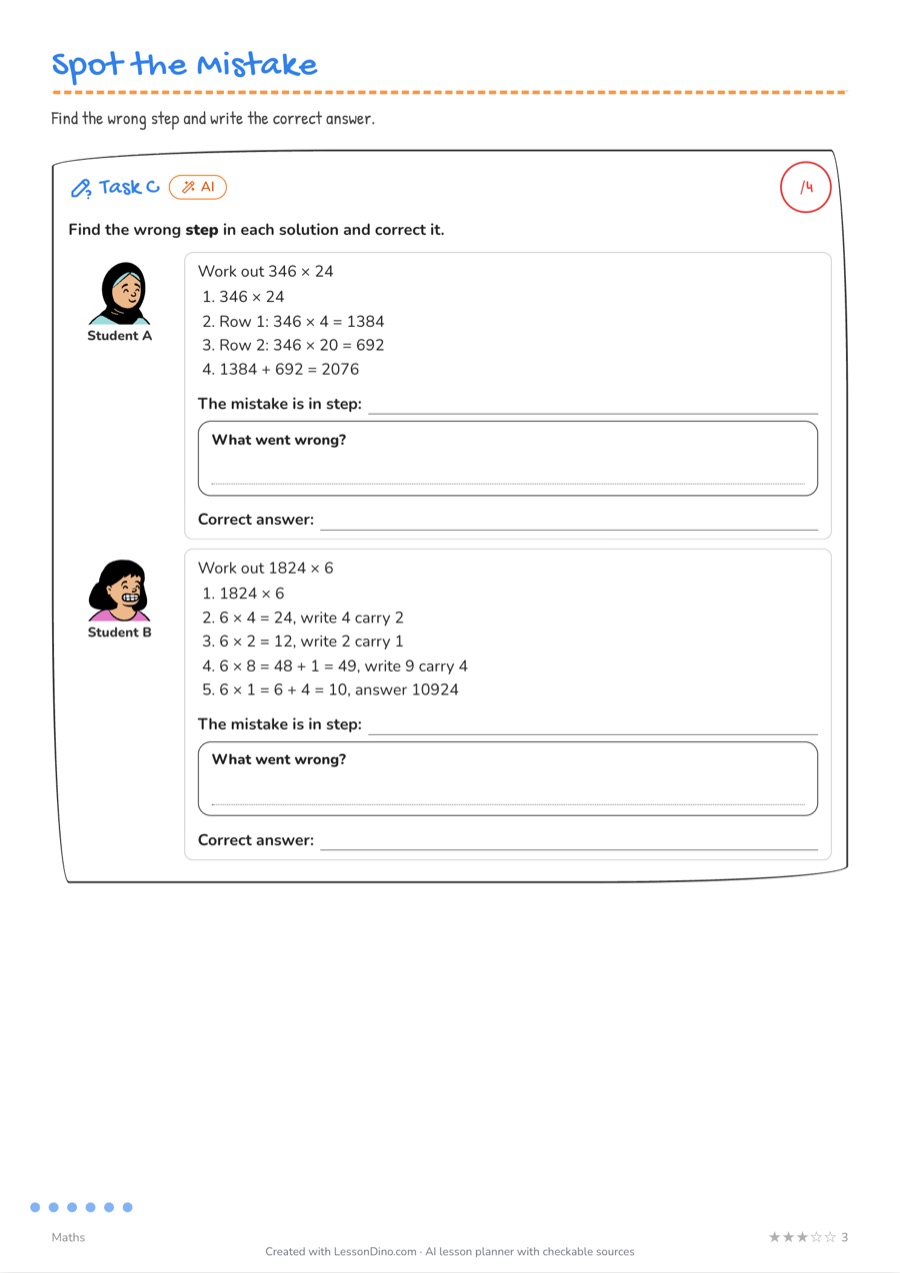
Spot the Mistake
Find the wrong step and write the correct answer.
Find the wrong step in each solution and correct it.
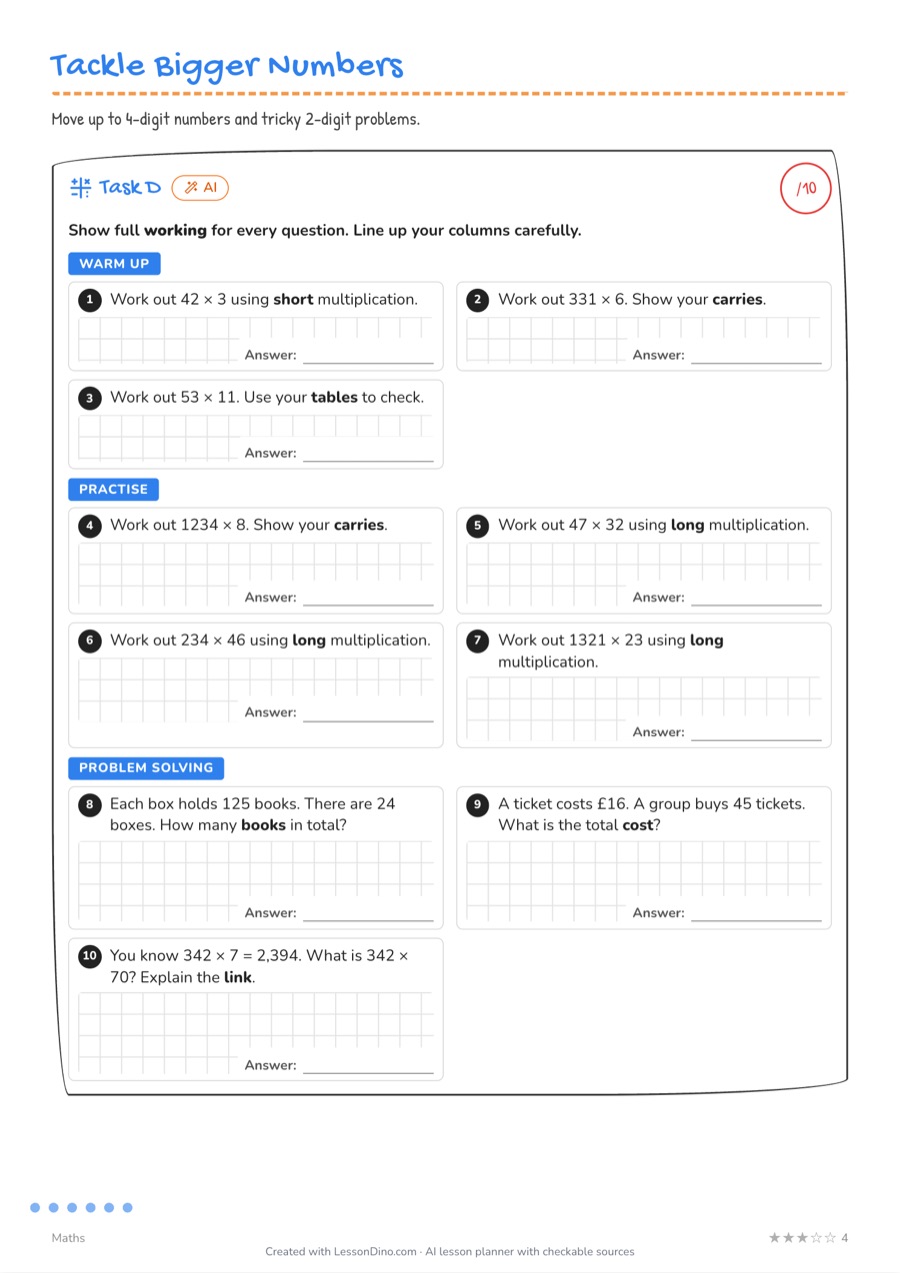
Tackle Bigger Numbers
Move up to 4-digit numbers and tricky 2-digit problems.
Show full working for every question. Line up your columns carefully.
Warm up
- Work out 42 × 3 using short multiplication.
- Work out 331 × 6. Show your carries.
- Work out 53 × 11. Use your tables to check.
Practise
- Work out 1234 × 8. Show your carries.
- Work out 47 × 32 using long multiplication.
- Work out 234 × 46 using long multiplication.
- Work out 1321 × 23 using long multiplication.
Problem solving
- Each box holds 125 books. There are 24 boxes. How many books in total?
- A ticket costs £16. A group buys 45 tickets. What is the total cost?
- You know 342 × 7 = 2,394. What is 342 × 70? Explain the link.
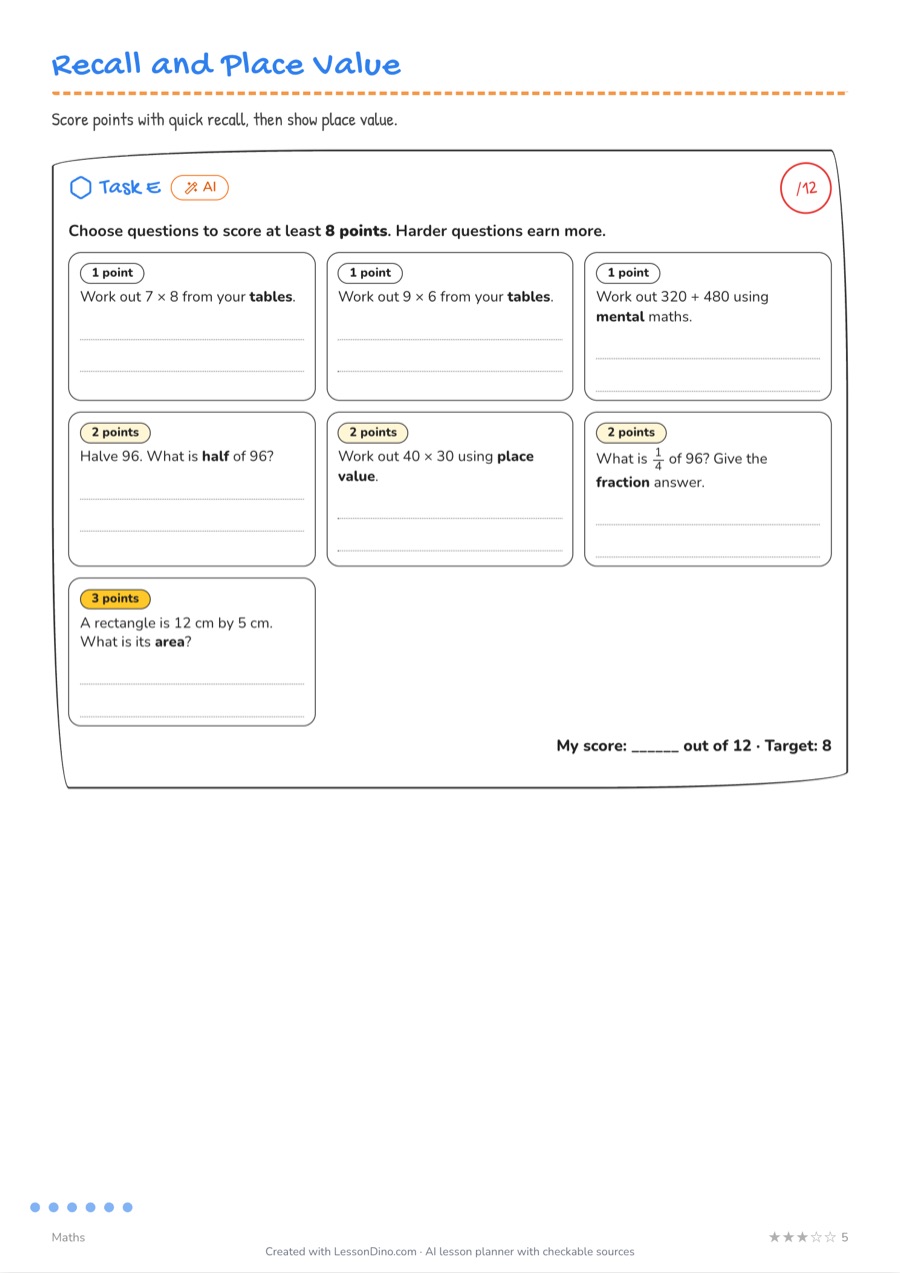
Recall and Place Value
Score points with quick recall, then show place value.
Choose questions to score at least 8 points. Harder questions earn more.
- Work out 7 × 8 from your tables.
- Work out 9 × 6 from your tables.
- Work out 320 + 480 using mental maths.
- Halve 96. What is half of 96?
- Work out 40 × 30 using place value.
- What is 1/4 of 96? Give the fraction answer.
- A rectangle is 12 cm by 5 cm. What is its area?
Page 6
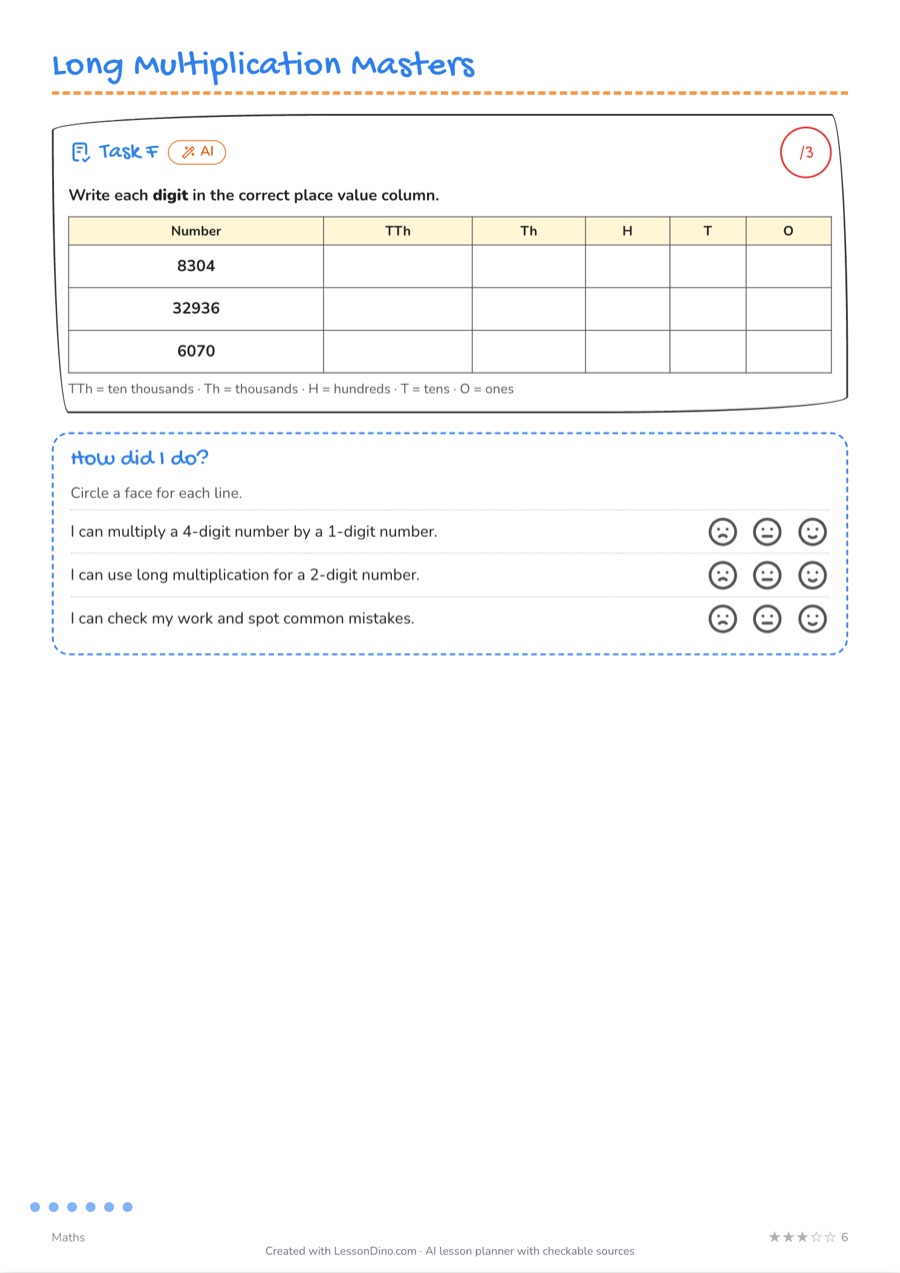
Write each digit in the correct place value column.
Answers
Show the answers
- Work out 31 × 3 using short multiplication. 93
- Work out 212 × 4 using short multiplication. 848
- Work out 43 × 20 using place value. 860
- Work out 246 × 4. Show your carries. 984
- Work out 1214 × 5. Show your carries. 6070
- Work out 36 × 24 using long multiplication. 864
- Work out 52 × 31 using long multiplication. 1612
- A pack holds 24 pencils. A school orders 32 packs. How many pencils in total? 768 pencils
- A book costs £14. A library buys 27 copies. What is the total cost? £378
- A student says 45 × 30 = 1,350. Explain how you know they are correct. They are correct because 45×3=135, so 45×30 is 10 times larger, which is 1,350.
- Work out 42 × 3 using short multiplication. 126
- Work out 331 × 6. Show your carries. 1986
- Work out 53 × 11. Use your tables to check. 583
- Work out 1234 × 8. Show your carries. 9872
- Work out 47 × 32 using long multiplication. 1504
- Work out 234 × 46 using long multiplication. 10764
- Work out 1321 × 23 using long multiplication. 30383
- Each box holds 125 books. There are 24 boxes. How many books in total? 3000 books
- A ticket costs £16. A group buys 45 tickets. What is the total cost? £720
- You know 342 × 7 = 2,394. What is 342 × 70? Explain the link. 23,940 because 70 is 10 times 7, so the product is 10 times larger.
- Work out 7 × 8 from your tables. 56
- Work out 9 × 6 from your tables. 54
- Work out 320 + 480 using mental maths. 800
- Halve 96. What is half of 96? 48
- Work out 40 × 30 using place value. 1200
- What is 1/4 of 96? Give the fraction answer. 24
- A rectangle is 12 cm by 5 cm. What is its area? 60 cm²
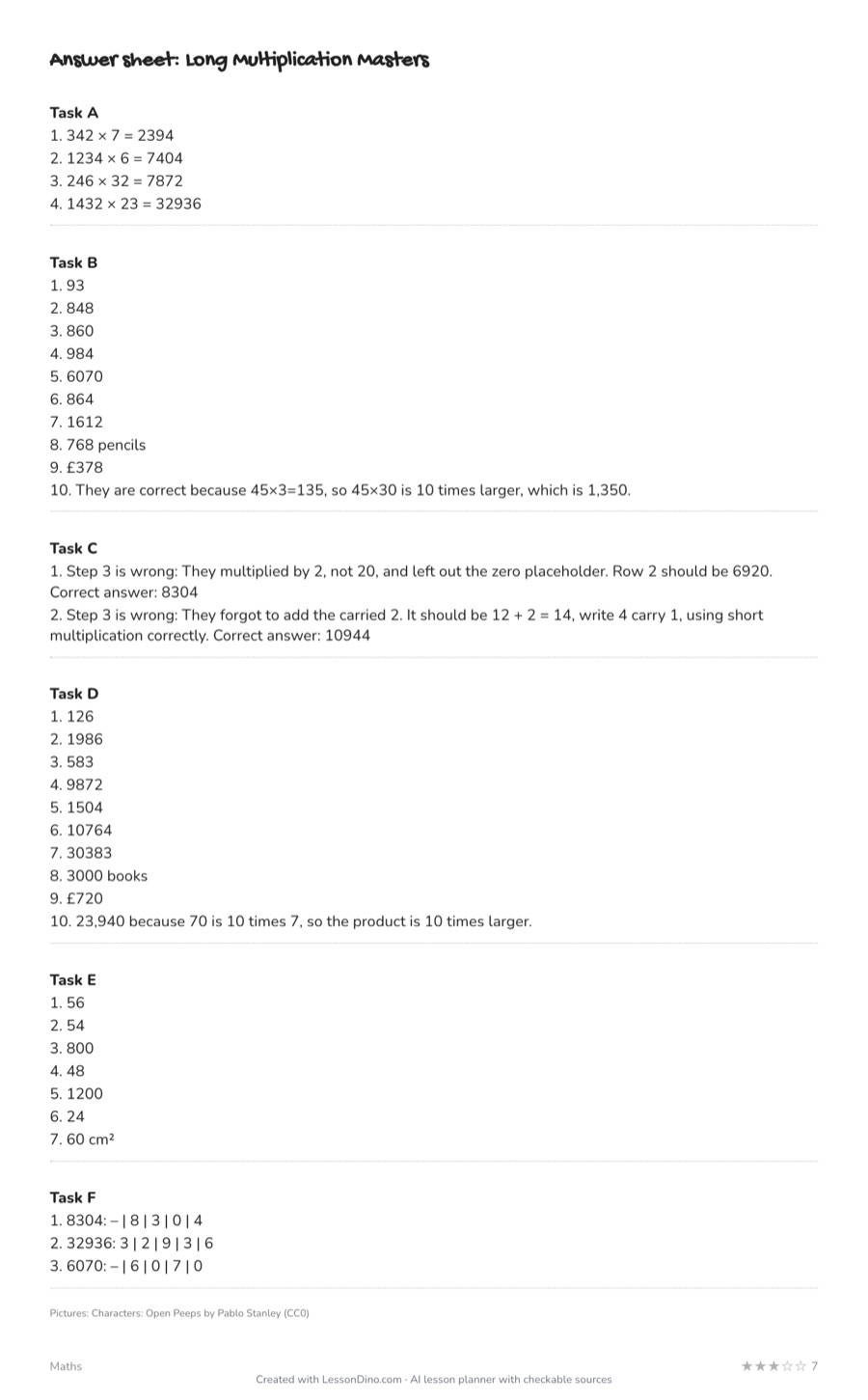
The answer sheet is the last picture above.
Curriculum
multiply numbers up to 4 digits by a one- or two-digit number using a formal written method, including long multiplication for two-digit numbers
Made with Lesson Dino's AI on 17 October 2026. AI can make mistakes, so check the answers and facts against the sources before you teach.