Slides
Lesson plan
Ordering thousandths to three places
Pupils learn to read, write, order and compare decimals to thousandths. They sort race-time cards and explain the order using place value.
Objectives
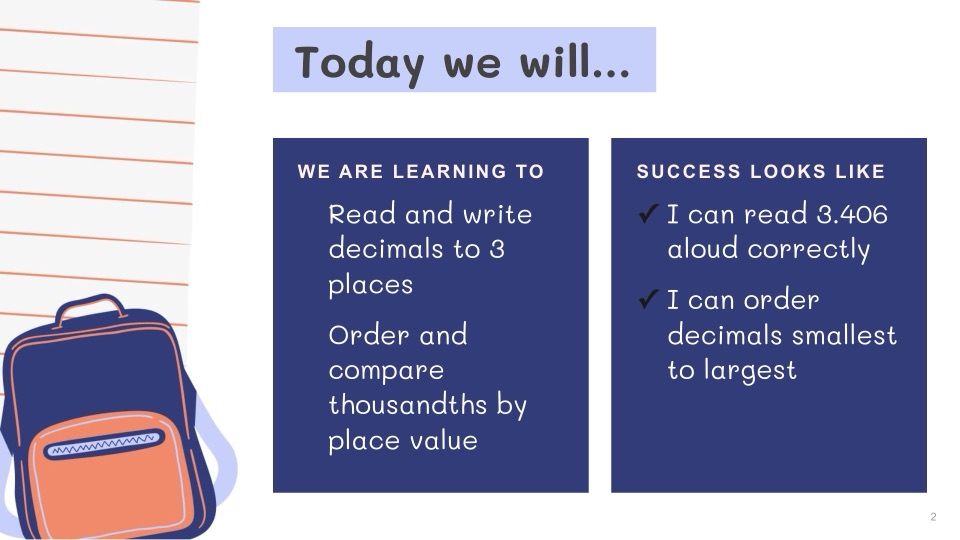
- Students will read and write numbers with up to three decimal places accurately.
- Students will order decimals to three places from smallest to largest correctly.
- Students will compare decimals to three places using < and > signs.
Success criteria
- I can read 3.406 aloud correctly and write decimals in words.
- I can order decimals with thousandths from smallest to largest.
- I can compare two decimals with < or > and explain why.
Key words
| Word | Meaning |
|---|---|
| tenths | the first spot after the point, worth one share when a whole is split in ten |
| hundredths | the second spot after the point, worth one share when a whole is split in a hundred |
| thousandths | the third spot after the point, very tiny shares of a whole split in a thousand |
| decimal point | the dot that splits whole amounts from small pieces of a whole |
| ascending order | putting amounts in a line from least value to greatest value |
| compare | saying which amount is larger, smaller, or if both are equal |
Timed plan (60 minutes)
| Time | Stage | What happens |
|---|---|---|
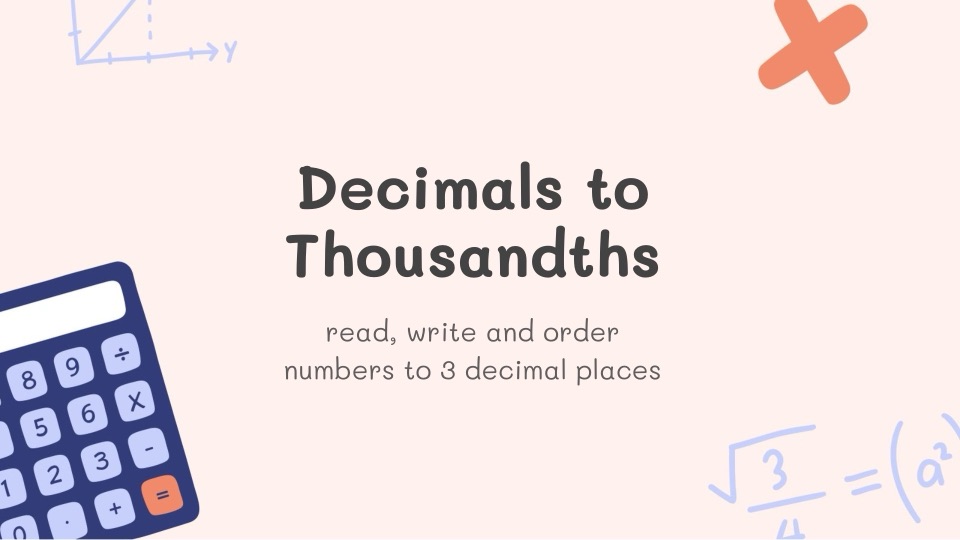
| 8 min | Starter | To recall comparing decimals to two places and hook pupils into silent ordering. Show Slide 1 title and Slide 2 objectives and read them aloud with the class. Ask the prior-check pair 0.45 and 0.54 and take quick whiteboard answers. Give the hook in the exact words: No tablets, no talking — can you and your partner sort these numbers using only pointing? Show the five slips will be 7.01, 7.008, 7.018, 7.808 and 7.81 and explain that smallest time wins. |
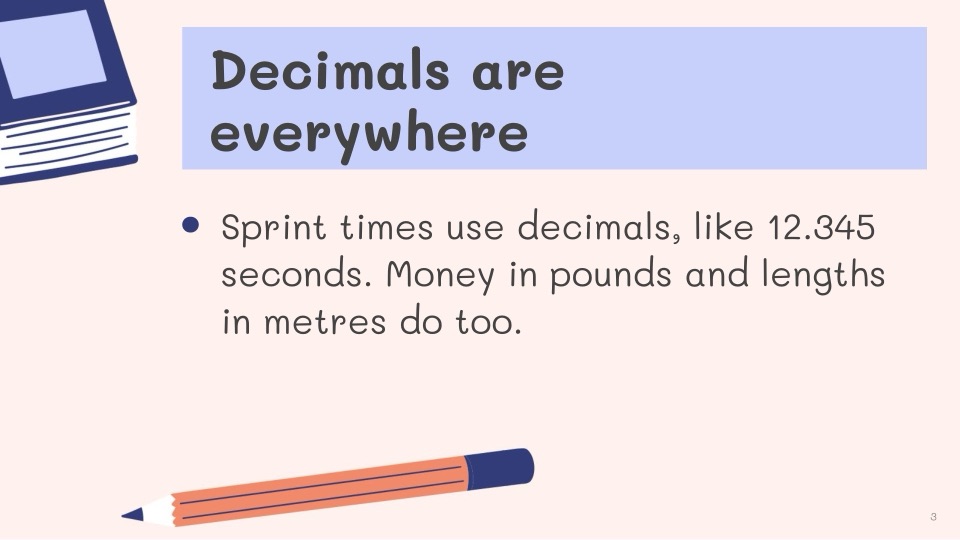
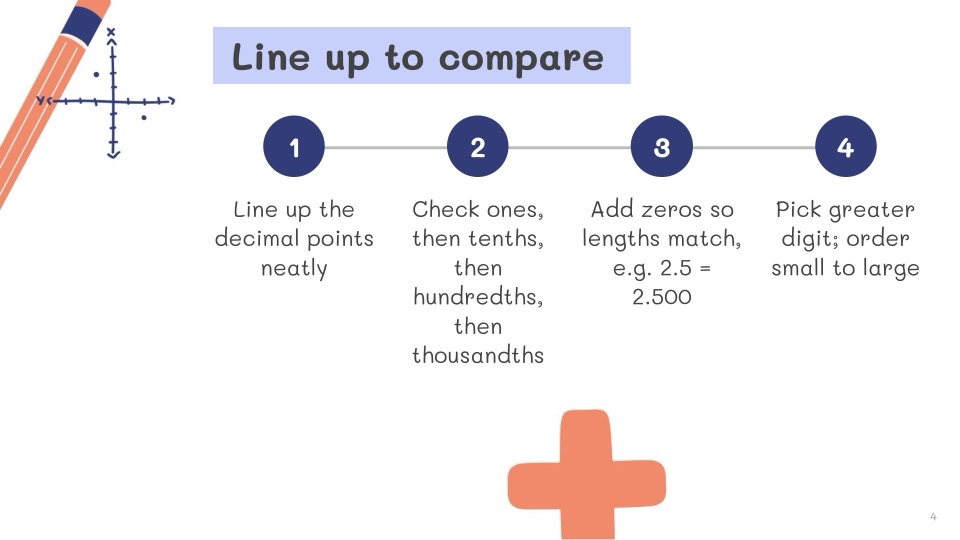
| 12 min | Teaching | To model reading, writing and comparing decimals to three places by place value. Show Slides 3-4 and model lining up decimal points neatly in a place-value table. Think aloud reading 7.808 as seven point eight zero eight and writing digits under ones, tenths, hundredths, thousandths. Model filling gaps with zero, so 7.81 becomes 7.810, then compare digits from the left. Model the rule that a greater digit in a column means that the number is greater. |
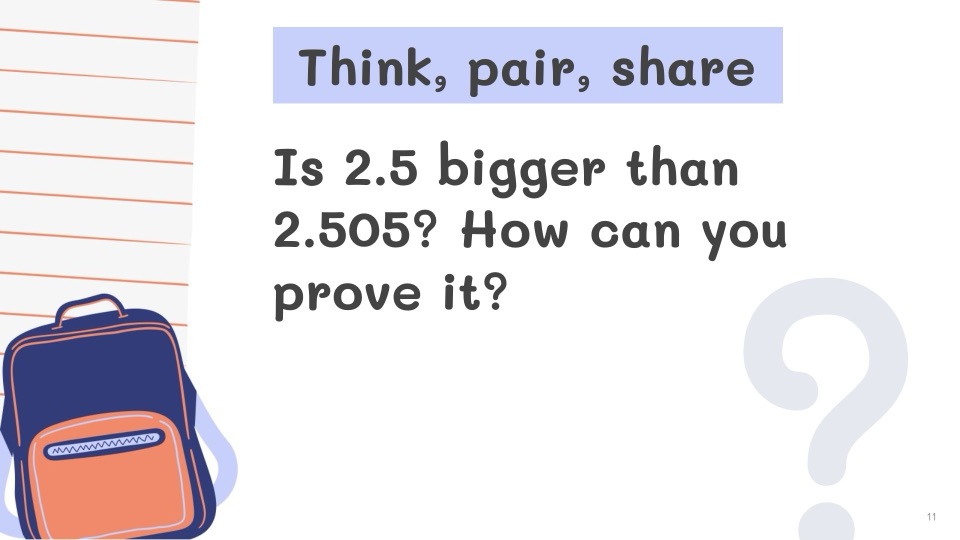
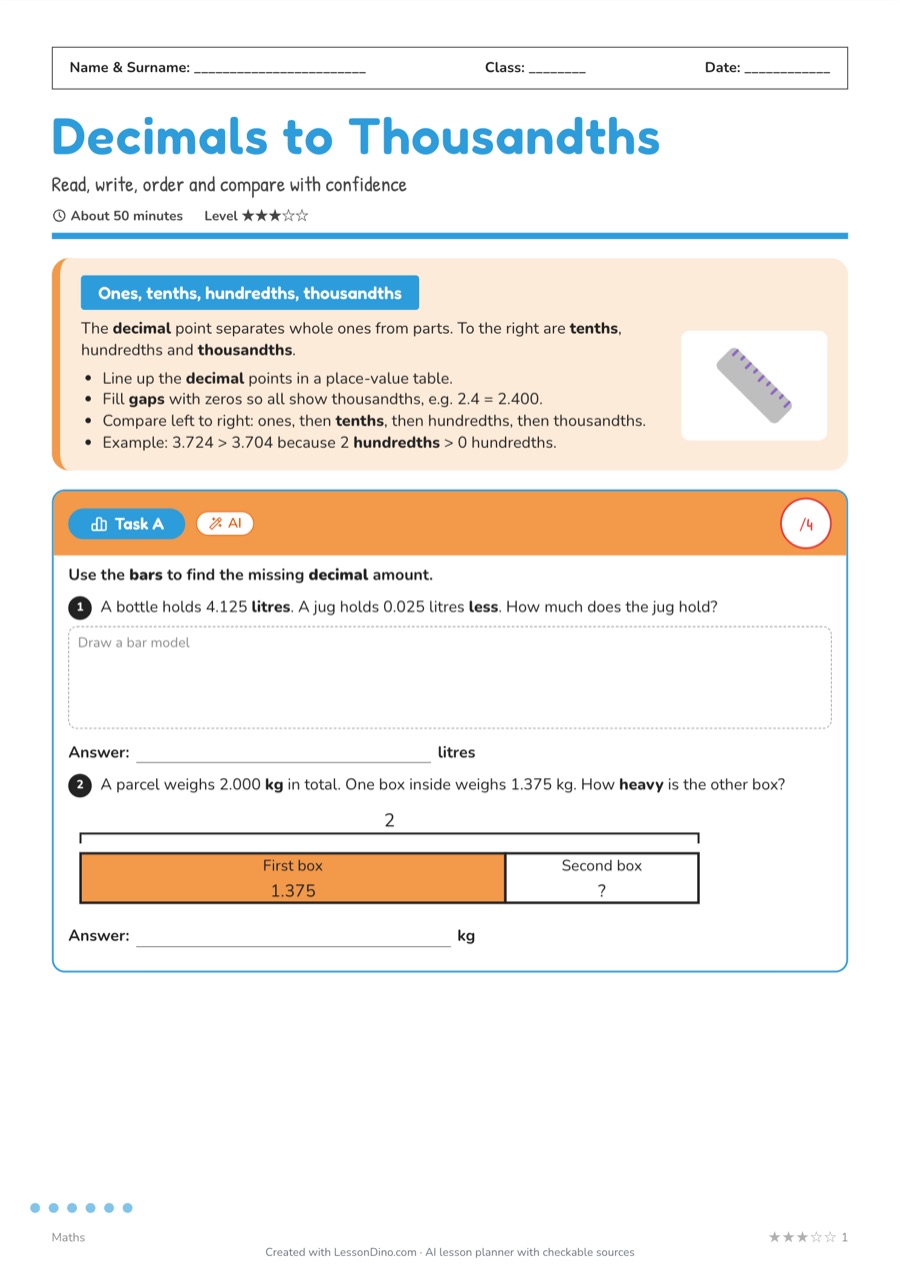
| 15 min | Guided practice | To practise reading, writing and comparing thousandths together before sorting alone. Show Slide 11 question and ask pairs to discuss without writing first. Hand out Worksheet Task B: Practice questions to practise reading, writing and comparing thousandths. Circulate as pairs line up points, add zeros to make 2.500 and 2.505, and write < or >. Take feedback and record the agreed comparison sentence on the board. |
| 17 min | Main activity | To order five decimals to three places and read, write and compare them. Show Slide 9 task and hand out envelopes of number slips for Silent Card Sort. Remind pairs of the silent rule: sort by pointing only, then write the final order. Monitor ordering of 7.01, 7.008, 7.018, 7.808 and 7.81 into order starting with the smallest. Stop silence after sorting and ask pairs to read aloud, write in words and insert < signs. |
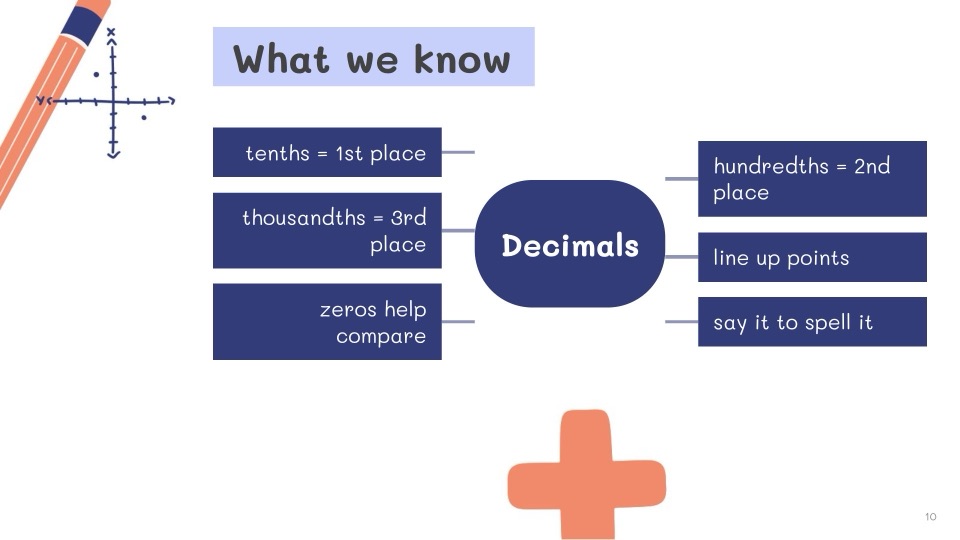
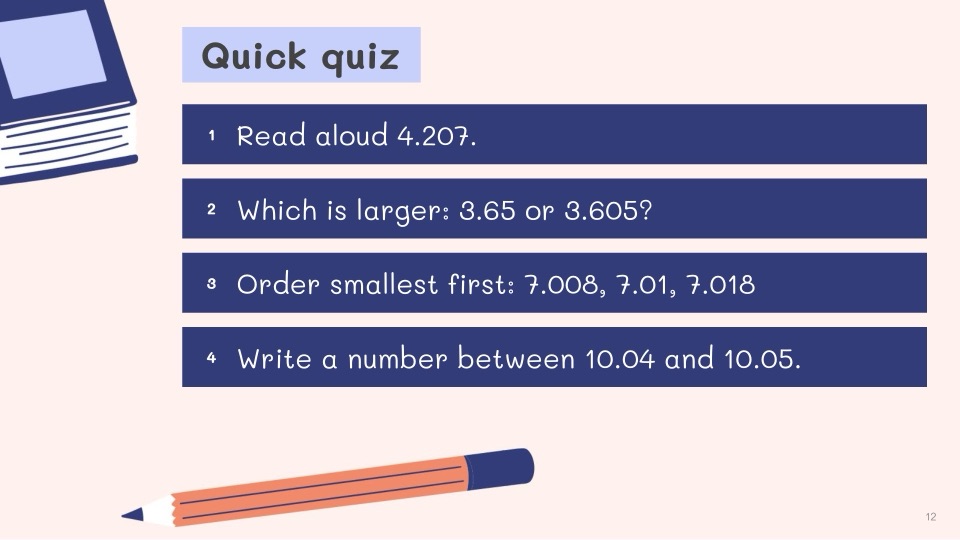
| 8 min | Plenary | To check pupils can read, order and compare decimals to three places. Show Slide 10 mindmap and ask pupils to say what they remember for each branch. Show Slide 12 quiz and run the three questions as exit tickets on whiteboards. Confirm answers: four point two zero seven; 3.65 because 3.650 is more than 3.605; order smallest first. Link back to objectives and praise use of lining up points and adding zeros. |
Common mistakes
- Thinking a longer decimal is always larger, so 7.808 > 7.81.
How to spot it: Pupil orders 7.81 before 7.808 or says thousandths make it bigger.
Write both in a place-value table, fill gaps with zero to make 7.810 and 7.808, then compare digits from the left. - Missing zeros when reading, for example reading 7.008 as seven point eight.
How to spot it: Pupil reads aloud without saying zeros or writes wrong word form.
Practise saying each digit after the point and relating thousandths to tenths and hundredths. - Comparing from the right instead of the left, starting with thousandths.
How to spot it: Pupil points to last digits first and misorders 7.018 and 7.81.
Insist on lining up decimal points and comparing starting at the left with the greatest place value.
Support
- Add a zero in any gaps so 7.01 becomes 7.010 for direct column comparison.
- Use partly filled place-value grids with decimal points kept in line.
Stretch
- Put < or > signs between each neighbouring pair and add one more number that keeps the order correct.
- Compare tricky numbers that use the same digits in different positions, such as 7.765 and 7.756.
Check questions
- Read aloud 4.207.
Answer: four point two zero seven - Which is larger: 3.65 or 3.605?
Answer: 3.65, because 3.650 is more than 3.605 - Order smallest first: 7.018, 7.01, 7.008.
Answer: 7.008, 7.01, 7.018
Curriculum
read, write, order and compare numbers with up to 3 decimal places
Video clips
Clips on YouTube, from the start and end times we chose. Check each one before you show it.
-
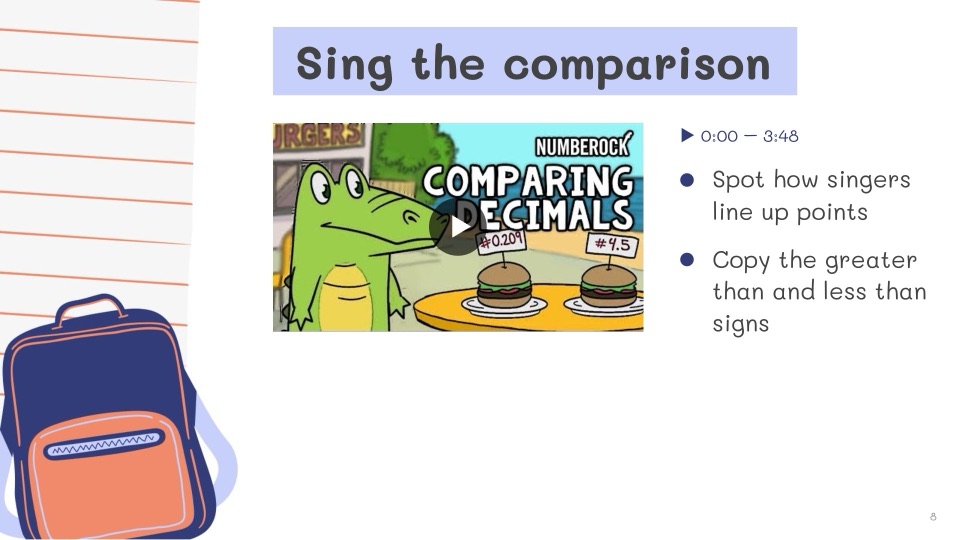
Comparing decimals song from 0:00 to 3:48
Numberock: Comparing Decimals | Less Than and Greater Than Decimals | Grades 4-6
Directly teaches ordering and comparing decimals with clear visuals ideal for ages 9-10.
-
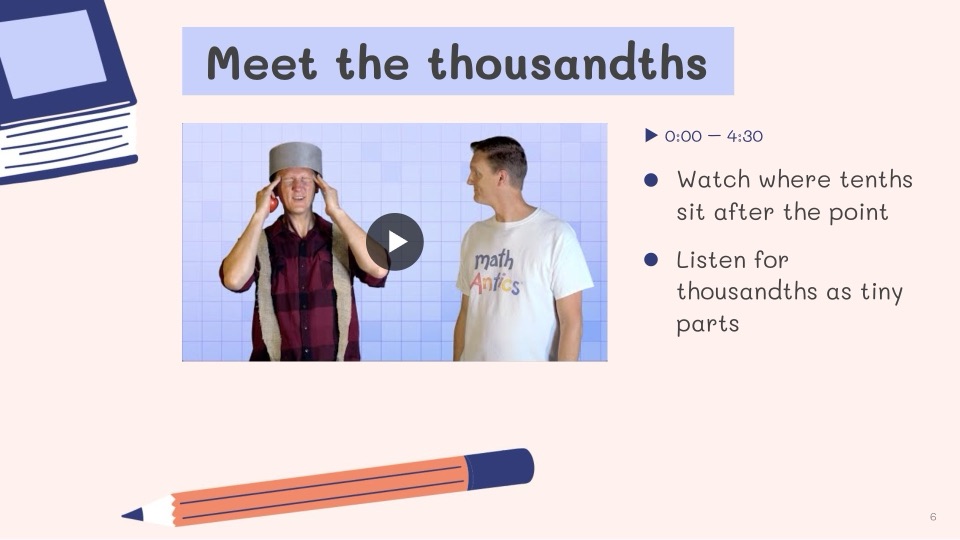
Decimal place value explained from 0:00 to 4:30
mathantics: Math Antics - Decimal Place Value
Clearly explains tenths, hundredths and thousandths place value at the right pace for ages 9-10.
Worksheet
Sources
- National curriculum in England: mathematics programmes of ... assets.publishing.service.gov.uk
- National curriculum in England: mathematics programmes of study gov.uk
- Rounding to 3 decimal places (3 d.p) - Round to three decimal ... - BBC bbc.co.uk
- Read, write, order and compare numbers with up to three decimal places ... mathsframe.co.uk
- to three decimal places - Mathsframe mathsframe.co.uk
- Rounding numbers (decimals) - BBC Bitesize bbc.co.uk
- Place value and ordering decimals - BBC Bitesize bbc.co.uk
- Year 6 Unit 2 - decimal numbers with up to three places ... famlearn.co.uk
- Decimals – Mathematics for Elementary Teachers open.maricopa.edu
Picture credits
- Photo: sweetlouise · Pixabay
- Photo: lubhz · Pixabay
- Microsoft Fluent Emoji (MIT)
Made with Lesson Dino's AI on 17 October 2026. AI can make mistakes, so check facts against the sources before you teach.