Slides


Lesson plan
Receipt Roll: Long Multiplication Masters
Pupils learn short and long multiplication for large numbers. They solve a sticker order and write a shop receipt.
Objectives
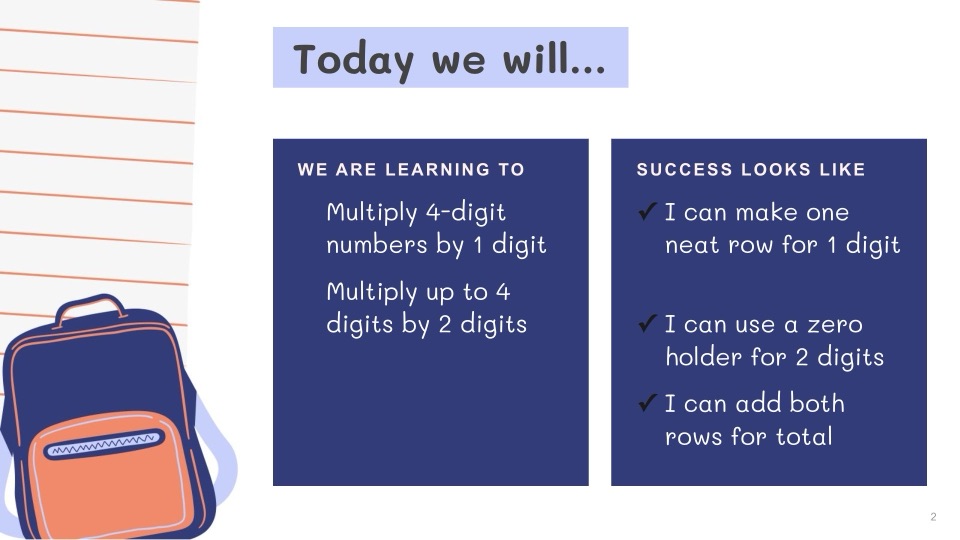
- Students will multiply 4-digit numbers by 1-digit numbers using short multiplication.
- Students will multiply up to 4-digit numbers by 2-digit numbers using long multiplication.
Success criteria
- I can make one neat row for a 1-digit multiplier.
- I can use a zero holder for the tens row.
- I can add both rows to get the correct total.
Key words
| Word | Meaning |
|---|---|
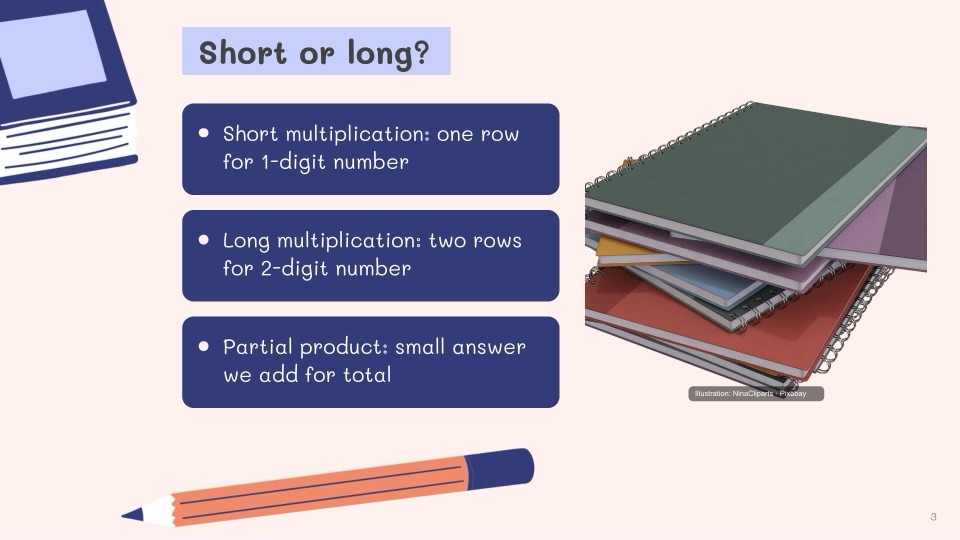
| long multiplication | a written column method that finds the total for a two-digit number in two rows then adds them |
| short multiplication | a written column method that finds the total for a one-digit number in one row |
| partial product | a small answer made along the way that is added with others for the final total |
| placeholder | a 0 put at the start of the second row to keep place value correct |
Timed plan (60 minutes)
| Time | Stage | What happens |
|---|---|---|
| 8 min | Starter | Hook pupils with the sticker order and recall short multiplication. Show Slide 2 and read the goals: one neat row for 1 digit, zero holder for 2 digits. Show Slide 5 mystery: 24 packs, 1,236 stickers in each pack. How many in all? Ask pairs to estimate first using 1,200 x 25, then recall 23 x 4 on whiteboards. Link estimate to check: exact work must be close to the estimate. |
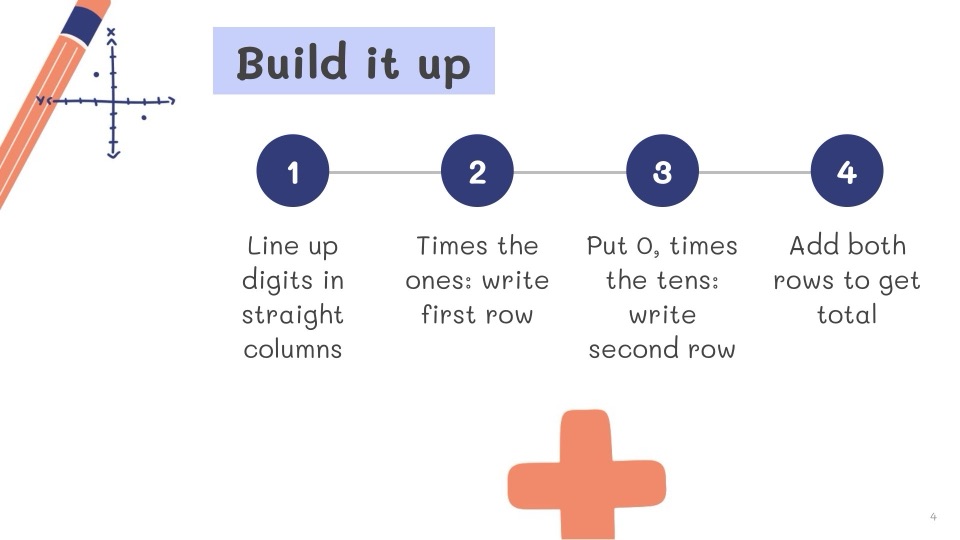
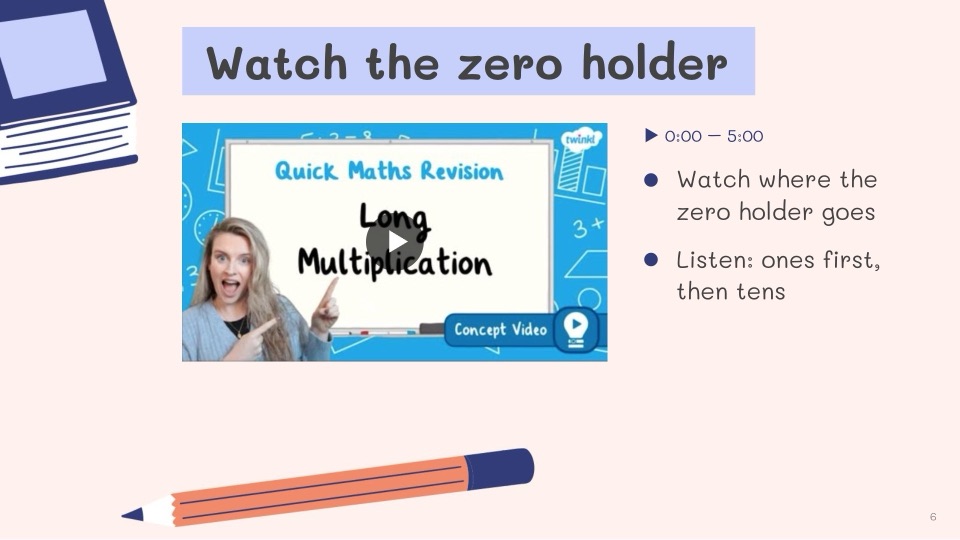
| 12 min | Teach | Model how partitioning links to the two rows of long multiplication. Show Slide 4 steps: line up columns, times the ones, put 0 then times the tens, add both rows. Model 23 x 14 in columns, thinking aloud about place value and exchanges. Play Slide 6 Video clip 1 (0:00-5:00) to show where the zero holder goes. Match each part to Slide 3: first row is ones, second row is tens, both are partial products. |
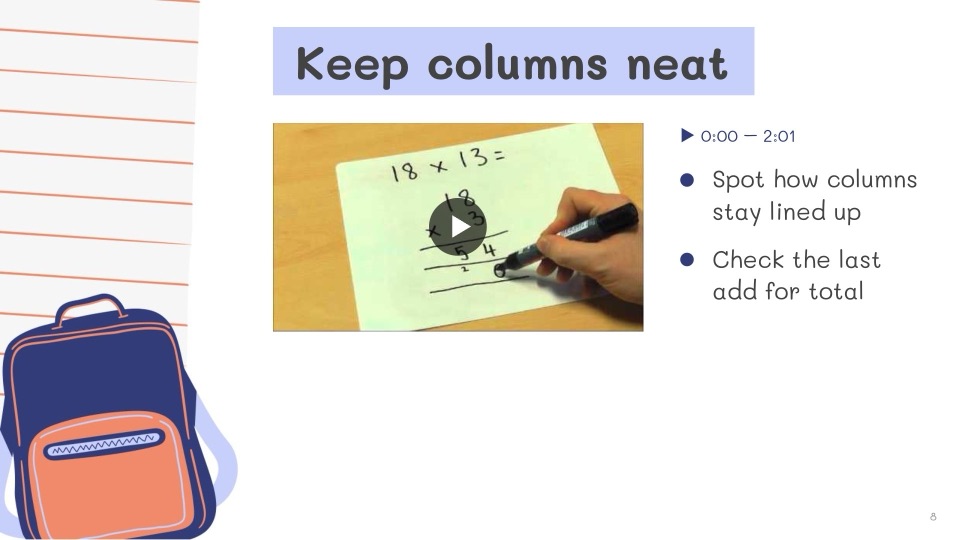
| 12 min | Guided practice | Practise the full 4-digit by 2-digit method together with neat columns. Show Slide 7 big order: 1,236 x 24 = 29,664, close to 1,200 x 25. Model 1,236 x 24 step by step: 1,236 x 4, then 0 holder, then 1,236 x 20, then add. Play Slide 8 Video clip 3 (0:00-2:01) to spot how columns stay lined up. Check the final add and compare to the 30,000 estimate for sense. |
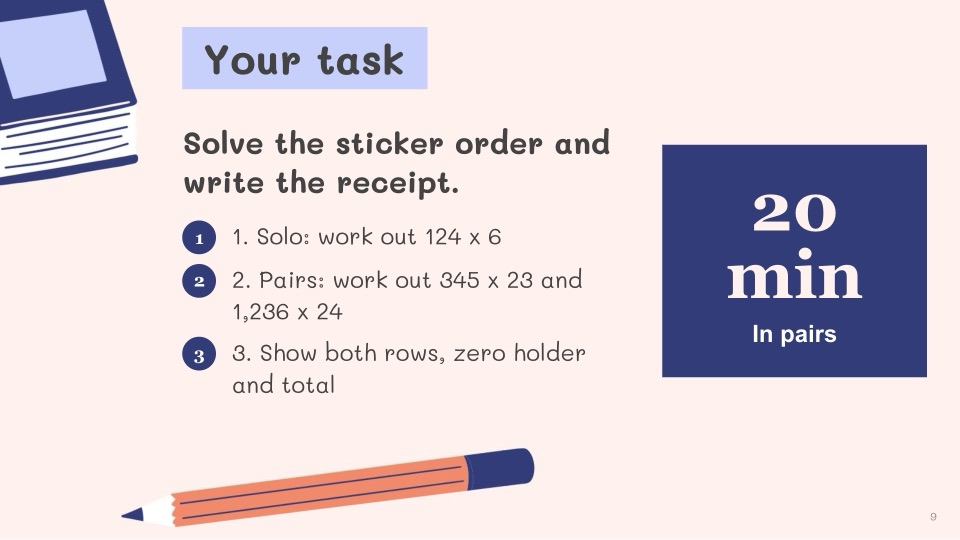
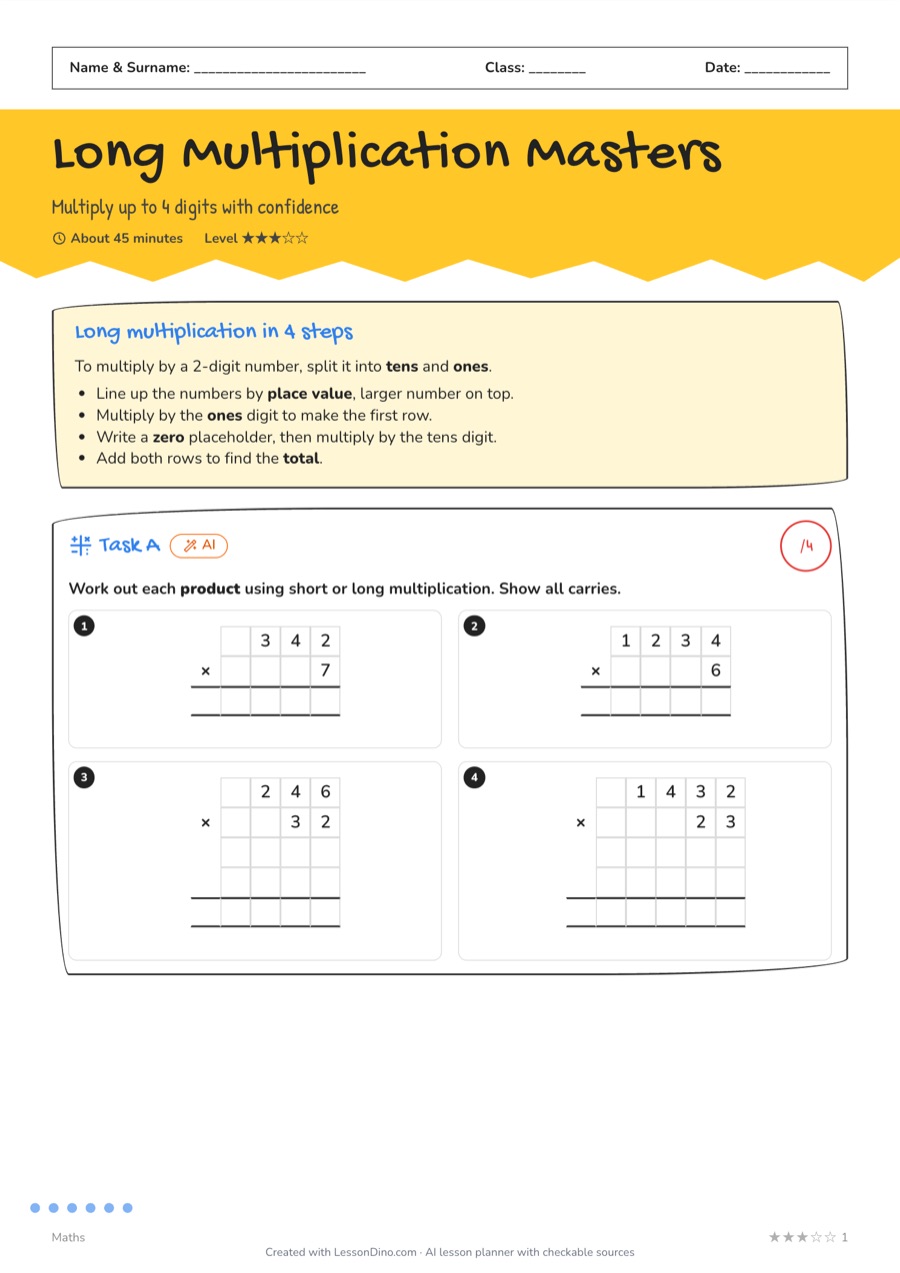
| 20 min | Main activity | Multiply a 4-digit number by a 2-digit number to solve the price problem. Show Slide 9 task: solo 124 x 6, then pairs 345 x 23 and 1,236 x 24 with receipt. Give out Worksheet Task B, receipt slips and squared paper; remind pairs to show both rows, zero holder and total. Circulate, check exchanges and column alignment, and prompt estimation before calculating. Select two pairs to show receipts with both rows of working and final total. |
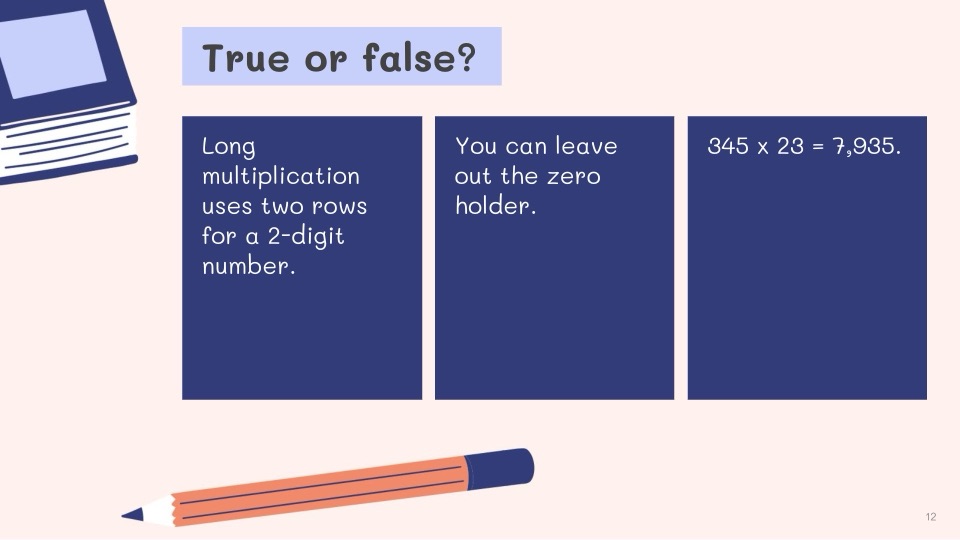
| 8 min | Plenary | Secure why the zero holder matters and revisit the success criteria. Show Slide 10: multiply by the ones, then by the tens, then add. Use Slide 11 think, pair, share: why do we put a zero at the start of the second row? Use Slide 12 true or false to test two rows, ones plus tens, and missing zero. Return to Slide 2 goals and ask pupils to rate I can statements. |
Common mistakes
- Leaving out the zero placeholder on the tens row
How to spot it: Second row starts directly under ones, e.g. 2,472 instead of 24,720
Write 0 first and say times 20 not times 2; the row is ten times too small without it - Not lining up columns by place value
How to spot it: Digits drift left or right and addition is wrong even when tables are right
Use squared paper and place-value grid, one digit per square, check ones under ones - Forgetting to add both partial products or losing exchanges
How to spot it: Only one row given as answer, or final add does not match rows
Circle each step used, write small carries above, then add 4,944 + 24,720
Support
- Provide the first partial product (1,236 x 4 = 4,944) and let pupils complete the tens row and the addition.
Stretch
- Add a second order of 1,236 x 34 and ask which total is larger and by how much, without a calculator at first.
Check questions
- Work out 132 x 5 using short multiplication.
Answer: 660 in one row. - Work out 23 x 14 using long multiplication. Show both rows.
Answer: 92 + 230 = 322. - True or false: you can leave out the zero holder and still get the right total?
Answer: False, missing zero makes the tens row ten times too small.
Curriculum
multiply numbers up to 4 digits by a one- or two-digit number using a formal written method, including long multiplication for two-digit numbers
Video clips
Clips on YouTube, from the start and end times we chose. Check each one before you show it.
-
What is long multiplication from 0:00 to 5:00
Twinkl Educational Publishing: What Is Long Multiplication? | KS2 Maths Concept for Kids
Made for KS2 pupils aged 9-10 and explains the long multiplication layout clearly.
-
Year 5 long method from 0:00 to 2:01
Armitage Primary: Year 5 Multiplication using the long method for 2, 2 digit numbers
Made for Year 5 aged 9-10 and matches the two-digit long method you are teaching.
Worksheet
Sources
- National curriculum in England: mathematics programmes of ... gov.uk
- Year 5 Maths Curriculum map 2023-2024 westend.lancs.sch.uk
- Long multiplication - yorksj.ac.uk yorksj.ac.uk
- Long multiplication - York St John University yorksj.ac.uk
- Long multiplication - KS2 Maths - Learning with BBC Bitesize bbc.co.uk
- Long Multiplication Practice | Free Daily Questions | MathsDaily mathsdaily.co.uk
- Long Multiplication | Grid Method | Maths Made Easy - MME Revise mmerevise.co.uk
- How to do long multiplication using Napier's method – KS3 ... bbc.co.uk
- Kids Math: Long Multiplication - Ducksters ducksters.com
- Kids Math: Multiplication Tips and Tricks - Ducksters ducksters.com
- Multiplication Facts for Kids kids.kiddle.co
- Multiplication strategies for larger numbers and long ... - NCETM ncetm.org.uk
- How to do long multiplication | Method and practice questions ... doodlelearning.com
- How to Do Long Multiplication: 2 Step-by-Step Methods - wikiHow wikihow.com
- Teach Long Multiplication - Math Kids Club games.math-kids.club
- Long Multiplication - Definition, Facts, Example, Quiz | Math ... workybooks.com
- How to Do Long Multiplication | DreamBox - DoodleLearning dreambox.com
- Long Multiplication - Math is Fun mathsisfun.com
- How To Do Long Multiplication I Wiki I Twinkl ZA - Twinkl twinkl.co.za
Picture credits
Made with Lesson Dino's AI on 17 October 2026. AI can make mistakes, so check facts against the sources before you teach.